Blog Archives
Dr. Kohl’s Ag Update
This week, I’m sharing an article that my colleague, Brandy VanDeWalle wrote on December 5, 2025 about “Ag Update and the Road Ahead” by Dr. David Kohl’s presentation at the recent Farmers and Rancher’s College Program. Brandy writes,
“Recently at a Farmers & Ranchers College program, Dr. David Kohl shared his global perspective on current events and how they influence U.S. agriculture—insights that are always incredibly valuable. One of the highlights of his presentation was a “SWOT analysis” of the United States. While many businesses routinely use SWOT analyses to evaluate strengths, weaknesses, opportunities, and threats, it was fascinating to consider how this framework applies to an entire country.
Kohl noted that one of the United States’ greatest strengths is its abundant natural resources. Together, the U.S. and Canada hold 20% of the world’s water supply. The nation’s extensive river system also provides an efficient means of transporting goods. Additional strengths include a solid capital structure, legal system, and property rights; the global role of the U.S. dollar in trade; a strong educational system; an entrepreneurial economy; and the country’s historic position as a global influencer since World War II.
Weaknesses cited include political polarization, inconsistent policies, and declining trust in institutions. The U.S. also faces an aging population combined with a reactive healthcare system, a growing federal deficit, substantial budget obligations, a service-dependent economy, a widening concentration of wealth and income, and aging infrastructure paired with supply chain challenges.
Kohl highlighted that North America has tremendous potential when the U.S., Canada, and Mexico work together—representing 5% of the world’s population but 29% of the global economy. Additional opportunities include improving proactive healthcare to enhance quality of life, cultivating next-generation leadership at all levels, advancing as a global leader in applied technologies, and strengthening natural resource and environmental management.
Among the threats, Kohl warned of the likelihood of a catastrophic technology event that could disrupt major industries or even the country itself. He also identified the risk of a “brain drain,” as scientists and researchers leave the U.S. due to issues such as funding uncertainty, instability, perceived anti-science sentiment, and heavy recruitment from other global powers including the EU and China.
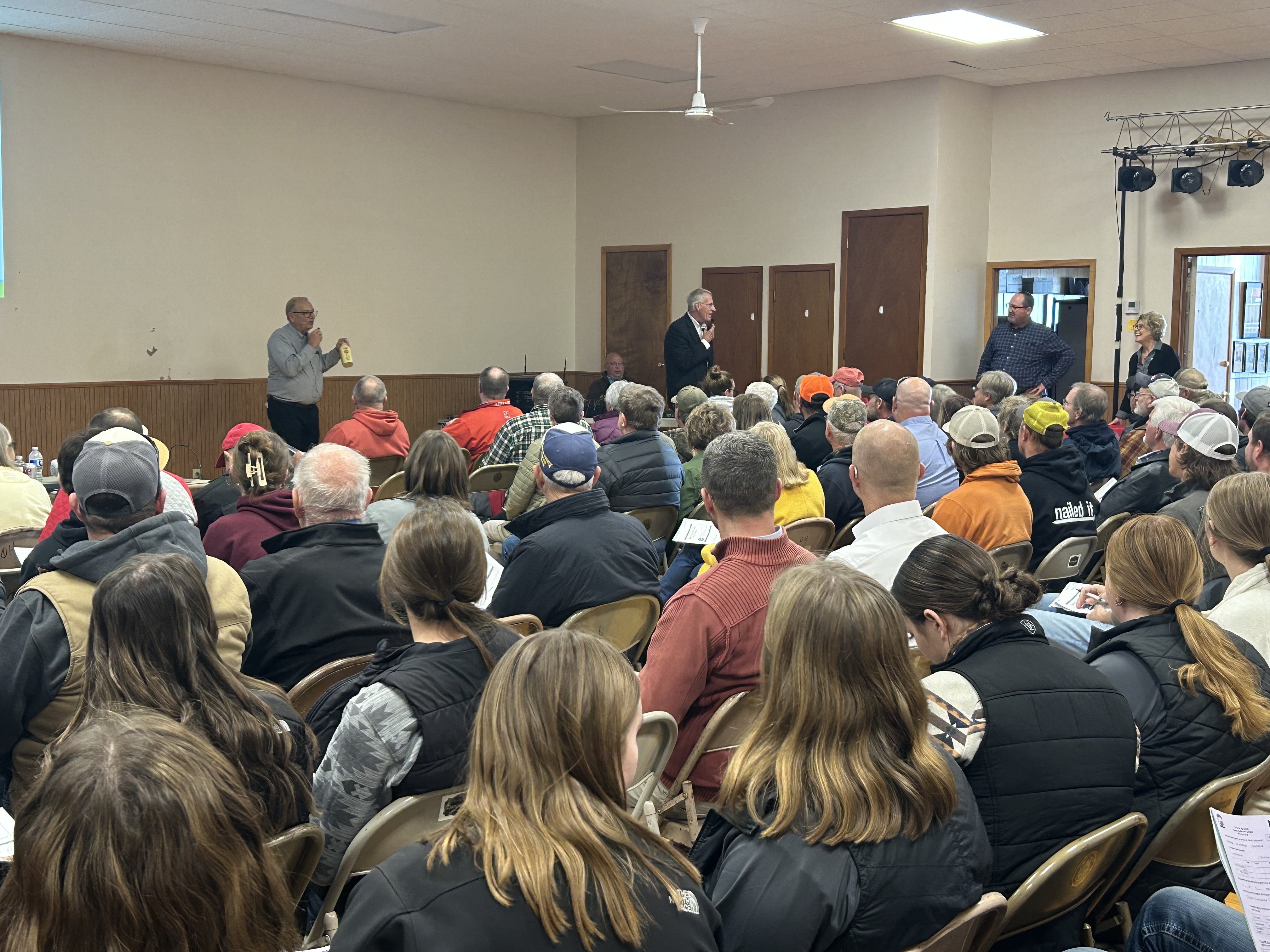
Dr. Kohl emphasized the critical importance of human interaction and communication. While artificial intelligence and other technological tools can help reduce workloads, they can never replace genuine human relationships. He reminded attendees that people need connection and purpose. Quoting a favorite saying, he noted, “It is better to have a good neighbor than their farm,” reinforcing the idea that being kind and building strong relationships matter far more than acquiring more land or expanding a business.
In conclusion, he provided leadership principles that stand the test of time:
- Change occurs bottom up, not top down.
- Manage the controllables, manage around the uncontrollable.
- Quick money builds ego – disciplined principle-based strategy/activity results in resiliency, nimbleness, agility and character.
- If you are going to lead, you must read!
- Success is often measured in dollar signs. Significance is giving back and making a difference in people’s lives.
- A successful culture and society must have success in agriculture.
It was great to see over 30 FFA members and community college students in attendance which Dr. Kohl praised and asked them each to share what they learned. He praised the 4-H and FFA programs for providing youth a purpose and developing life skills.”

JenREES 2/5/23
Sharing more February events this week. Will share more on-farm research results in future weeks.
Looking forward to hearing farmers and livestock producers share at two opportunities this week. Reminder of the Eastern NE Soil Health Conference at Eastern NE R&E Center near Mead on Feb. 9th beginning at 9 a.m. (Reg. at 8:30 a.m.). Also a reminder of our Conversations around Rethinking Grazing-Strategies for nutrient distribution on Feb. 10th from 10-noon at the 4-H Building in York. I’ve asked a few producers to kick off the conversation on how they’re grazing cornstalks, cover crops, pastures for the purpose of better nutrient distribution. If you’re interested in this topic, please plan to attend to share your perspectives, what you’re doing, and questions!
For those reading this planning on attending pesticide recertification trainings in Hastings in Feb. and Mar., the location is at the Extension Office (2975 S. Baltimore Ave.) in Hastings and NOT at the fairgrounds as listed in the winter program brochure.
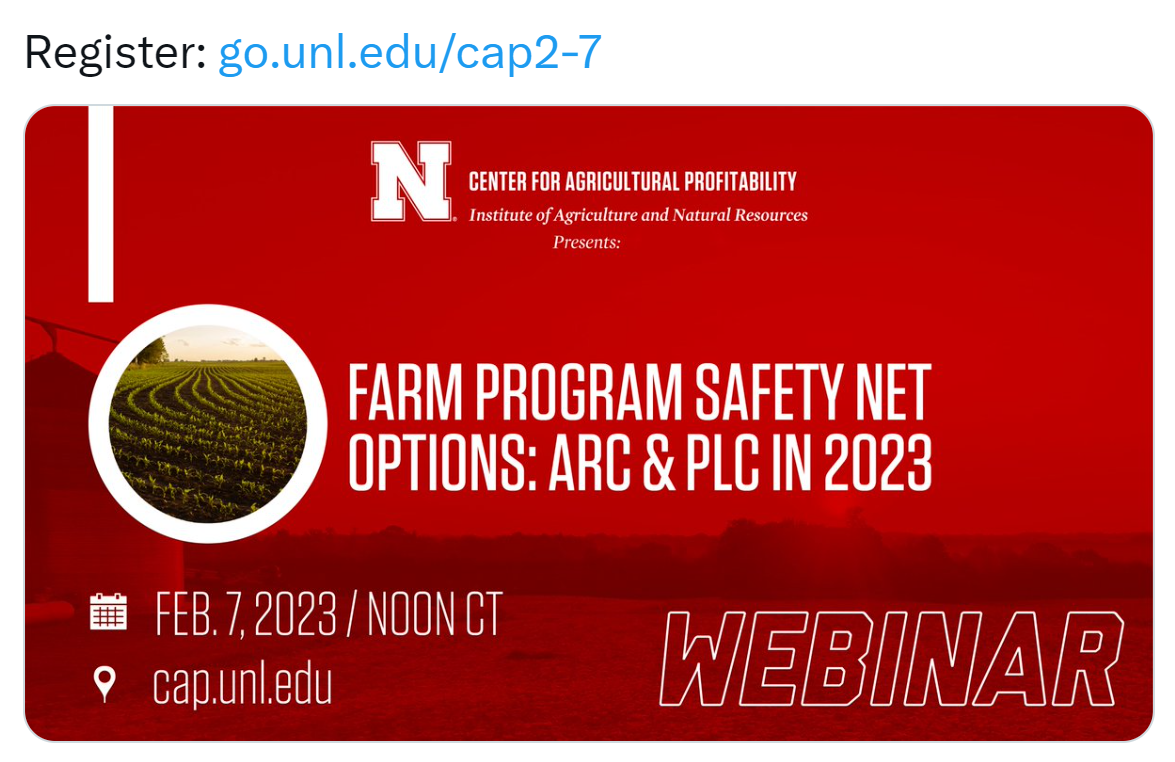
Farm Bill Webinar: Nebraska USDA Farm Service Agency (FSA) is reminding producers now is the time to make elections and enroll in the Agriculture Risk Coverage (ARC) and Price Loss Coverage (PLC) programs for the 2023 crop year. The signup period is open through March 15, 2023.
Producers can learn about the ARC and PLC options during a UNL Center for Agricultural Profitability webinar scheduled for 12 p.m. CT on Tuesday, Feb. 7. Cathy Anderson, production and compliance programs chief for the Nebraska Farm Service Agency, and Brad Lubben, extension policy specialist in the University of Nebraska-Lincoln’s Department of Agricultural Economics, will present and share information relevant for producers, ag professionals and ag stakeholders. Registration for the webinar is free and can be found at: https://go.unl.edu/cap2-7.
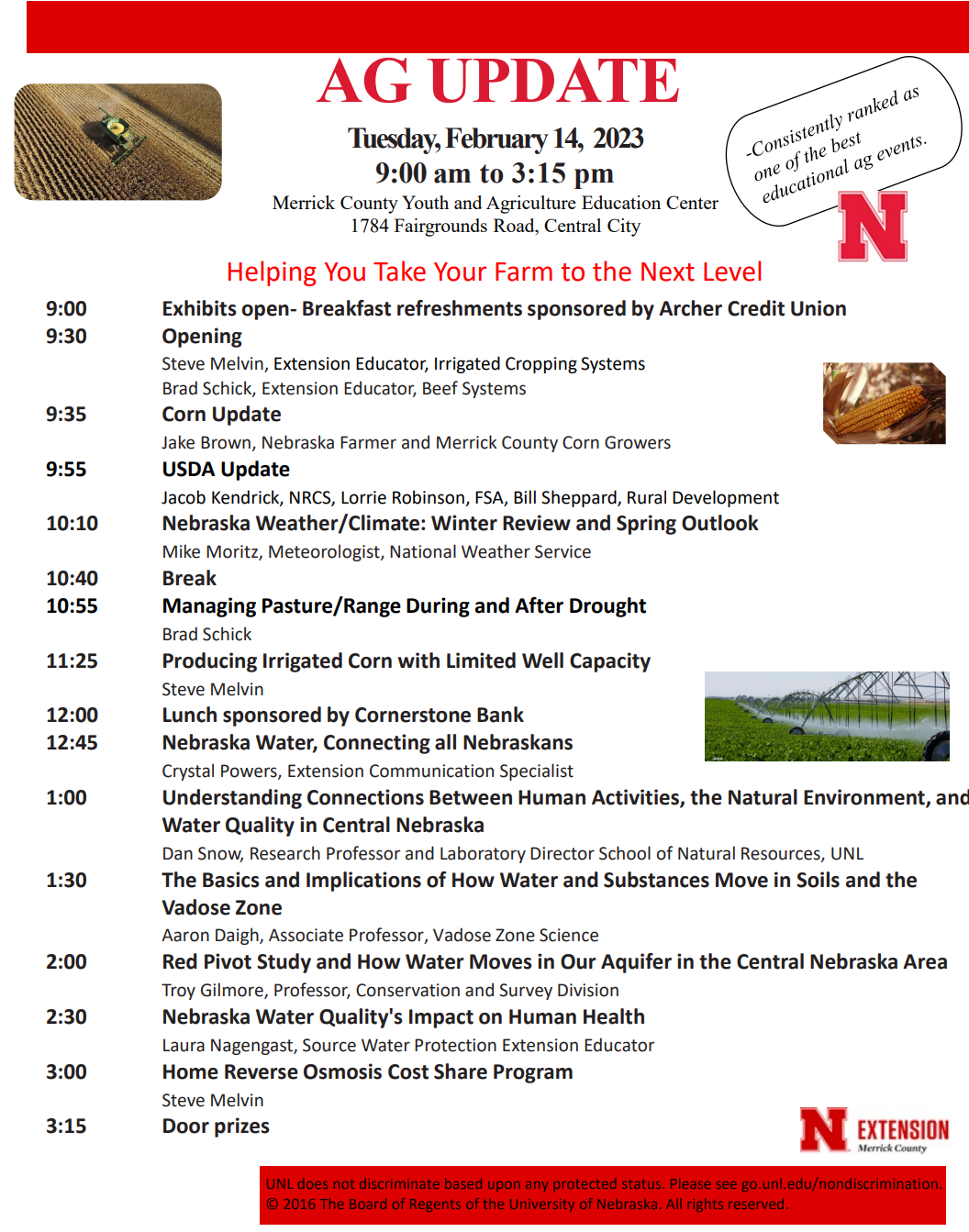
Feb. 14 Ag Update Merrick Co.: Nebraska water quality’s impact on human health and more, Ag Update 2023 will be held Tuesday, Feb. 14 at the Merrick County Youth and Agriculture Education Center, 1784 Fairgrounds Rd, Central City. It will start with breakfast refreshments provided by Archer Credit Union and exhibits opening at 9 am. The event has a great lineup of speakers and exhibits, including “Nebraska Water, Connecting all Nebraskans” with Crystal Powers, “How Water and Substances Move in Soils and the Vadose Zone” with Aaron Daigh, and “Home Reverse Osmosis Cost Share Program” with Steve Melvin. Lunch will be provided and sponsored by Cornerstone Bank. The day will wrap-up about 3:15 p.m. with door prizes. RSVP to Steve Melvin at (308) 946-3843 or at the Merrick County Extension site.
Feb. 28-Mar. 1 Central Plains Irrigation Conference: The event will take place at the Kearney Holiday Inn Convention Center. This is an educational event and opportunity for networking among producers, university officials, industry leaders and other stakeholders. Irrigation in the Central Plains region will be the focus of the conference with topics such as, but not limited to: Getting the most out of your technology and irrigation support tools; Cover crops and residue management; Remote sensing and drone technology; Pivot performance; “Ogallala Aquifer’s Story: Human, Environment and Production”; Insect and nutrient management via chemigation; “TAPS: Effects of Participant Decisions on Profitability & Efficiency”. The conference will be from 9 a.m. to 5 p.m. on Tuesday, Feb. 28 and then 9 a.m. to 12 p.m. on Wednesday, March 1. The cost to attend the event is $55 in advance or $65 at the door. Registration cost does include the lunch meal on Tuesday. Registration is available online, and payment ahead of the conference is appreciated via check or credit card. CCA credits are pending. A vendor show will be available and if your business or organization is interested in having a booth, please contact Donna Lamm at 785-462-7574.




 JenResources