Blog Archives
Crop Update 8/1/14

Southern rust of corn confirmed in Clay County July 31. Very small, tan-brown lesions on upper surface of the leaf, usually in clusters. Spores inside the pustules are typically orange. This was found on one leaf in a field near Trumbull. Just because southern rust has been found in the area, we don’t recommend automatically spraying. Scout your fields and consider disease pressure, growth stage, and economics. Long season corn and late-planted fields have the potential for most damage. Secondary common rust sporulation has also been confused as southern rust as the secondary pustules tend to look like this. It’s important to obtain microscopic confirmation to know for sure if you have southern rust in your fields.
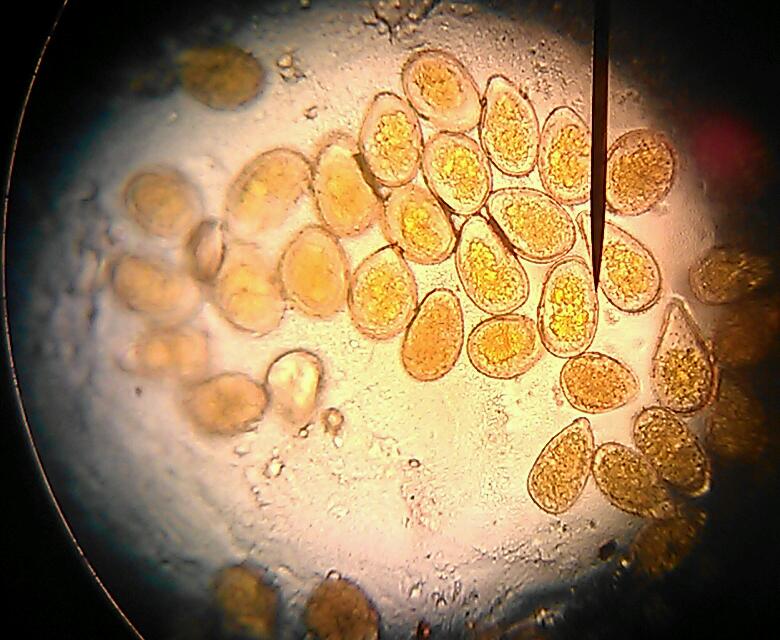
Microscopic Observation: Spores of southern rust appear elongated vs. common rust appear as near perfect circles.

Another common problem is old common rust lesions being confused as gray leaf spot. The color of this lesion is a tan-gray, typical of gray leaf spot. Using backlighting or a handlens, you can see the pustules within this lesion confirming it is common rust and not gray leaf spot. I’ve had many calls that gray leaf spot was up the entire plant in their fields and after looking at fields, have found it to be common rust in most situations. It’s important to know what disease you truly have to make the best decision on fungicide application.
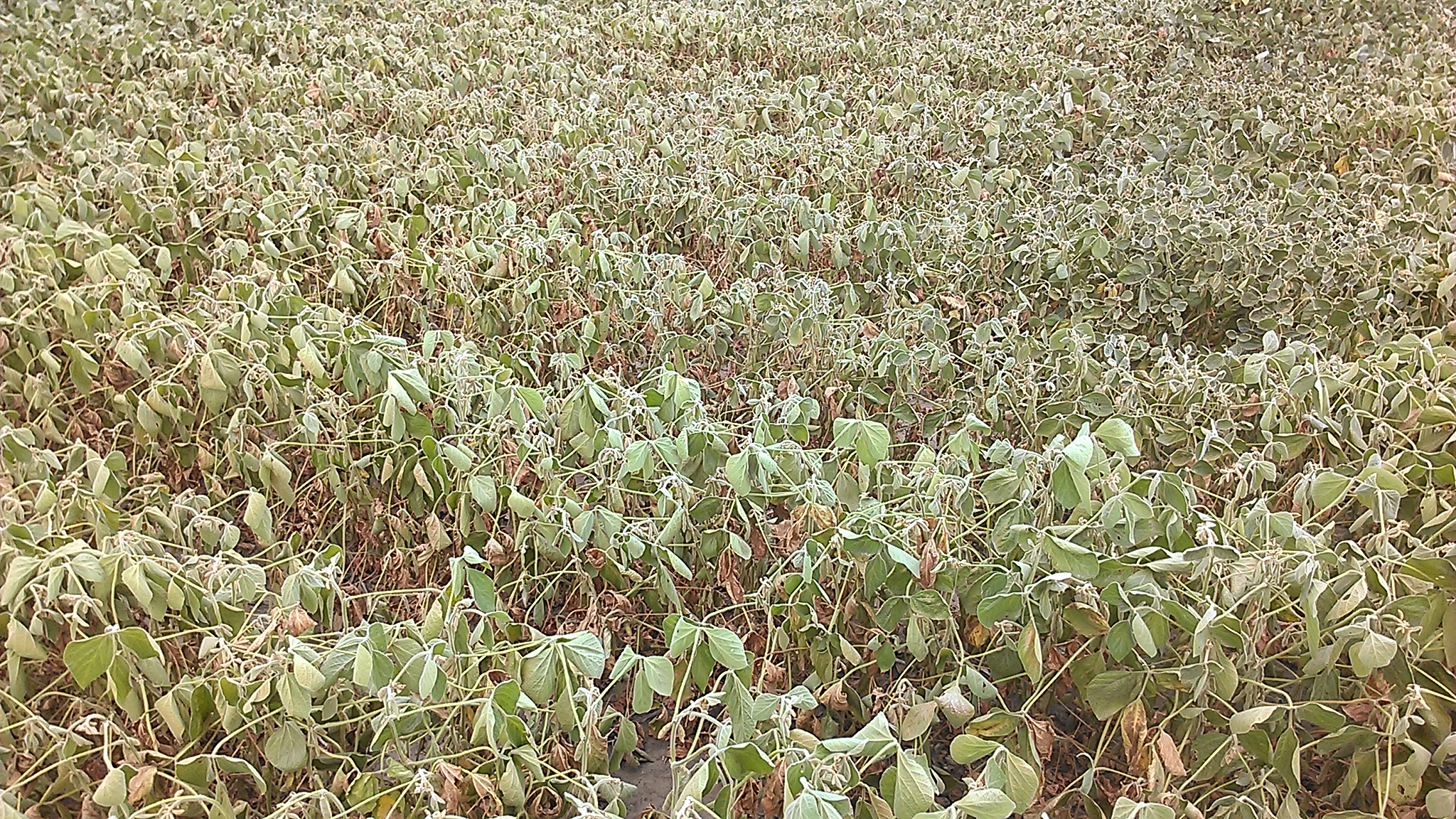
Have also received questions on soybeans, particularly in dryland. This photo is showing drought stressed soybeans-often occurring in pockets within dryland fields right now. Closer observation shows plants aborting pods and losing lowest leaves. Spidermites can also be viewed on leaves in some of these patches.

Dryland corn showing stress as well. June rains were making for dryland crops with potential, but also led to shallow rooting. Crops could use a drink right now….but would prefer no more hail and tornadoes. The storm that hit Clay County so hard occurred one year ago today.
Alabama Agriculture-What I learned

At our first stop, this farming operation had fields where peanuts were strip cropped between rows of pecan trees (shown in background). The farming operation went from around 1500 to 900 pecan trees after the hurricanes in the 1980s. The pecan trees were around 80 years old.
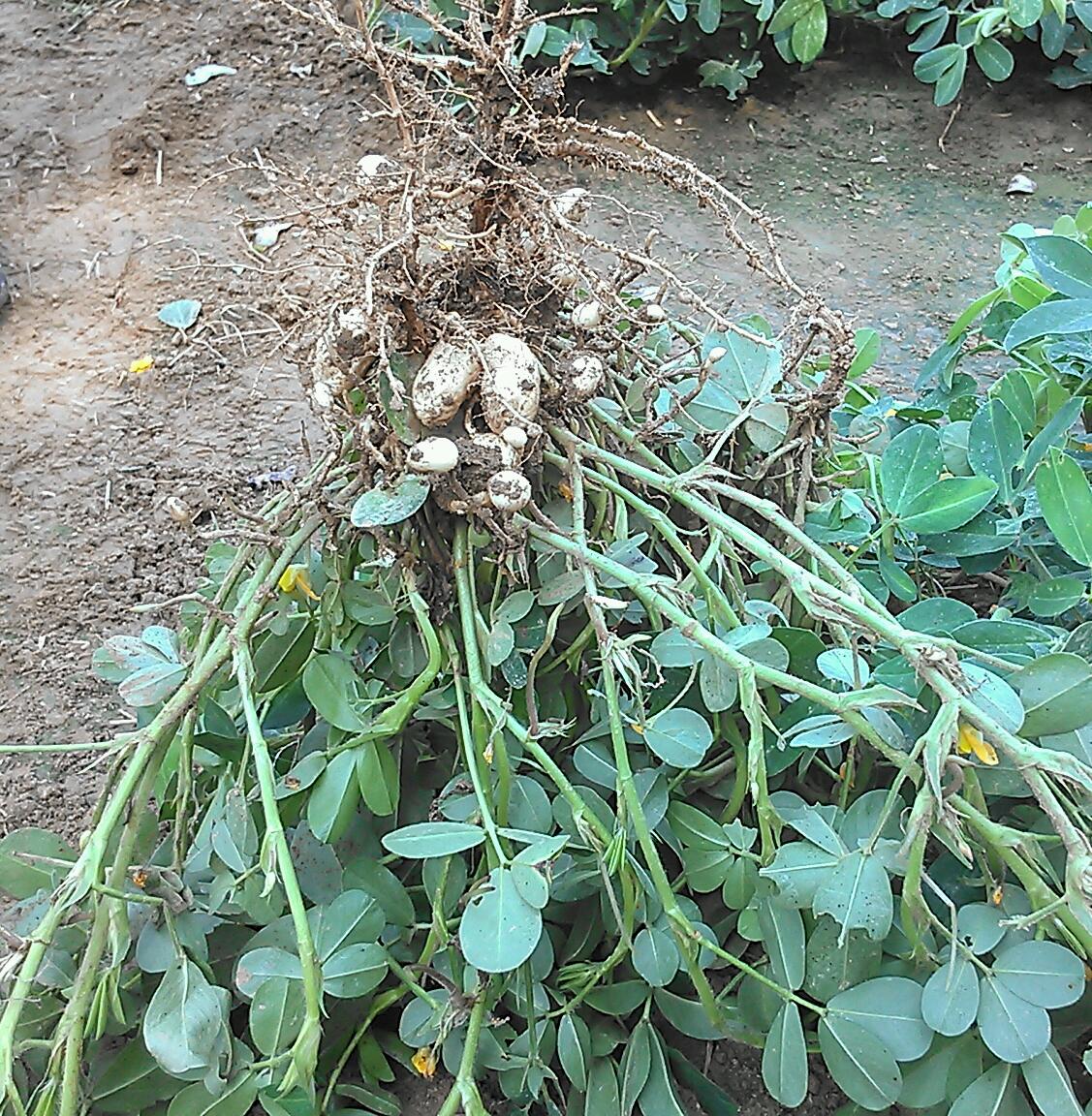
Peanut plant up close. The soils in this part of Alabama are highly acidic and peanuts like a pH between 5.8-6.8 and well-drained soil, so the producers add quite a bit of lime. Different maturities of peanuts are grown so they’re harvested anywhere from September to October.
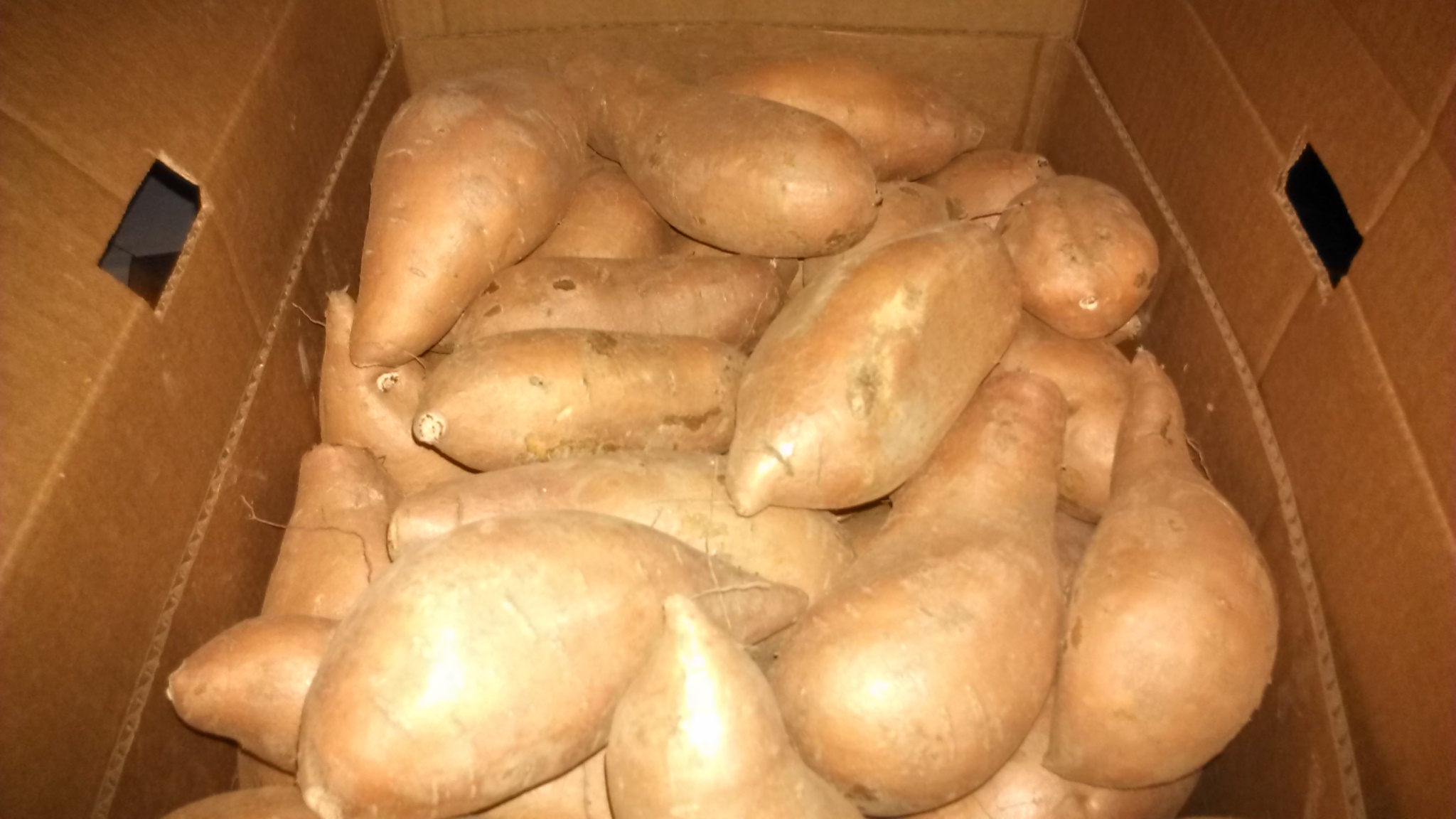
Sweet potatoes! I absolutely love to eat them 🙂 This farm had tried a variety of crops in the past and continues to grow cotton and peanuts as well for a rotation with the sweet potatoes. With low commodity prices for the other crops, sweet potatoes provided another source of income. They are planted mid-April and will be harvested early August this year. The smaller sweet potatoes will go to a canning facility. Potatoes have to be at least 2″ in diameter to be processed for sweet potato fries.

The nephew of the sweet potato farmer was interested in value-added herbs and greens. He put up this greenhouse 11 months ago and has been growing hydroponic greens and herbs for high end restaurants and supermarkets.

A cotton plant. Cotton is actually in the hibiscus family and can get 5-7 feet tall. Growth regulators are used to keep the cotton short so more energy goes into producing cotton instead of vegetative material like leaves and branches. While not easily seen on this picture, the “squares” are where each cotton blossom and seed will be produced.

Auburn Extension Specialist explaining how a cotton plant puts on a new node (where flowers and seed are produced) about every 3 days. He was also showing the shortened internode length due to adding growth regulators to the cotton. Cotton was often no-tilled into wheat. They have similar findings as we do here regarding the improved yields of crops following wheat in dryland. Although, interestingly, they receive on average 66″ of rain a year and Mobile, AL has surpassed Seattle as the rainiest city in the U.S.
Corn Disease Look-Alikes
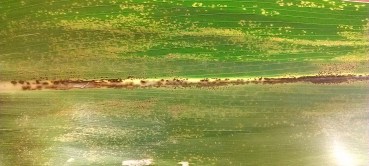
Physoderma brown spot on corn. While the small, speckled lesions may look like southern rust, under hand lens or microscopic observation, there are no raised pustules as would be the case with southern rust. Also notice the brown/purple discoloration on the midrib which is also noticed on the stalk as well where the leaf color meets the stalk.
Fair week tends to be time for tasseling in corn and considerations for watering and fungicide application are being made. Regarding diseases in corn, there has been confusion about a few diseases, particularly about a disease called physoderma brown spot which some have confused for southern rust. The fungus causing physoderma brown spot feeds on pollen and debris on leaves and does not cause harm to the corn plants themselves. Because the spores of this fungus move via water (it’s closely related to oomycetes), numerous lesions can appear on leaves in bands or areas where water collects. While the lesions may look like early southern rust, there will be no pustules present and often purple colored lesions will also be observed in the midrib, leaf sheath, stalk, and outer husks.
Differentiating Rusts:
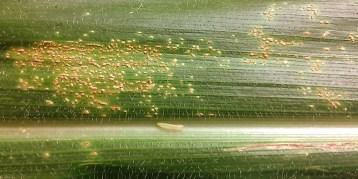
Southern rust in corn. We currently have not seen southern rust in Nebraska in 2014. Notice how you can see raised pustules in this picture compared to the photo of physoderma brown spot above.
When differentiating between southern rust vs. common rust, there are several criteria to consider and this NebGuide is a great resource. Typically common rust will have brick-red pustules randomly scattered on the upper and lower leaf surfaces that are larger in size. It is common rust that we are currently seeing in our fields.
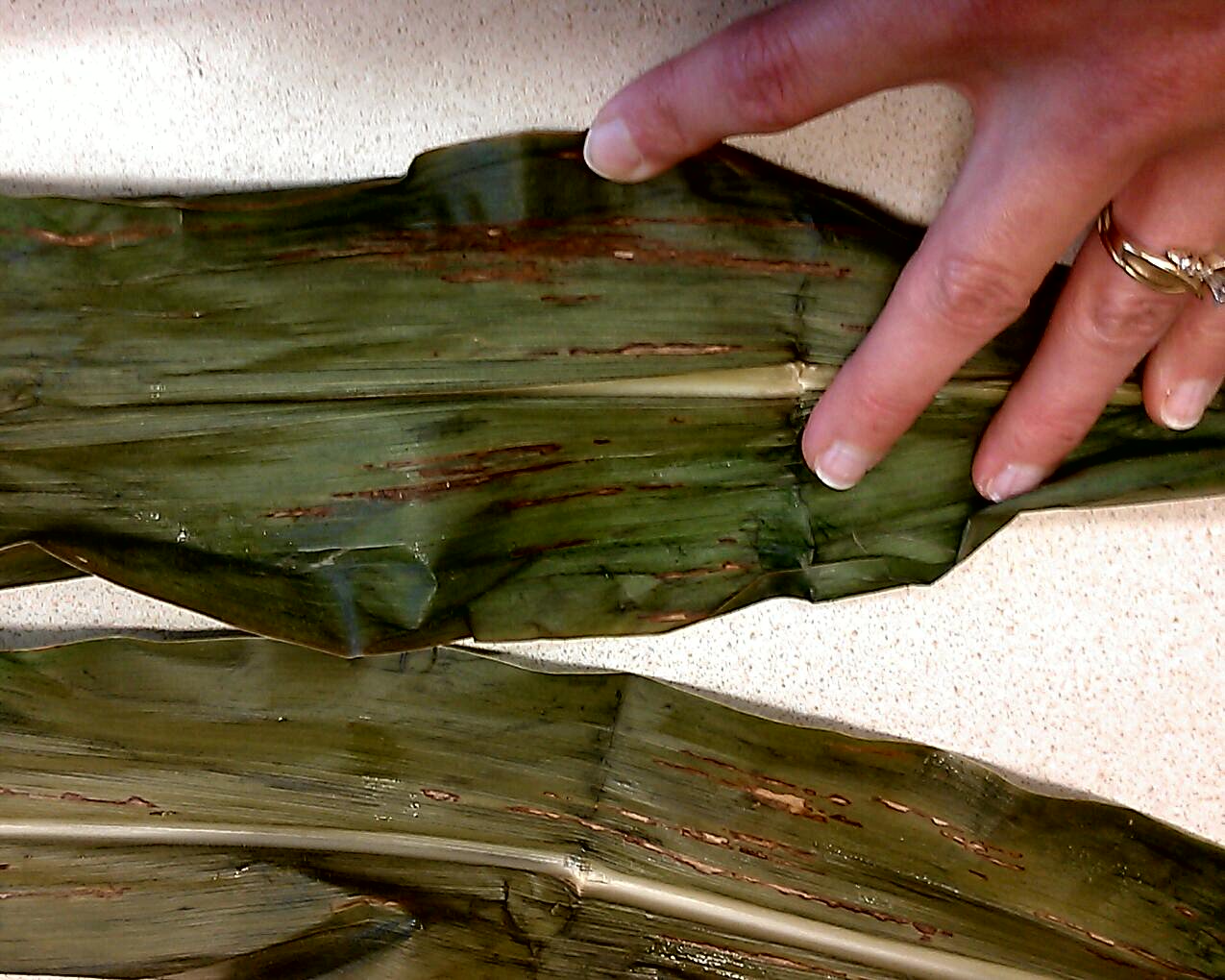
Bacterial leaf blight showing up heavily in some hybrids. The lesions are red-brown in color, long and skinny and mostly vein-limited. Older lesions spread outside the veins and are buff in color-sometimes they are being confused as gray leaf spot. The UNL Plant and Pest Diagnostic Lab is determining species and we will share more information in the future. There is no control for this disease at this time of the season.
Southern rust in our area tends to have very small, raised, tan-orange pustules on the upper leaf surface of leaves in localized areas on mid-upper leaves. These pustules are tightly clustered on the leaves. However, color and size are relative as sometimes the two diseases can look alike. Microscopic observation is the best way to differentiate the two diseases. Fungal spores from Puccinia sorghi causing common rust will be near perfect round circles whereas fungal spores fromPuccinia polysora will be oblong in shape.
We do have some gray leaf spot in the lower canopies and I haven’t seen much northern corn leaf blight in the fields. But we do
have a bacterial leaf blight that is affecting quite a bit of leaf tissue on some hybrids. These lesions are long and skinny appearing at first to be limited to the veins. There’s been concern about these lesions being severe gray leaf spot but it’s not and there’s nothing you can do about the bacterial disease. Please don’t mistake this bacterial disease as a fungal one and trigger a fungicide application too early.
Fungicide Application Timing
We tend to see southern rust in our part of the State each year; it’s a matter of time. Triggering a fungicide application too early may result in no residual for when you need it if/when southern rust occurs. Every year some producers make more than one fungicide application due to blanket applications at tassel or shortly after followed by another fungicide application when southern rust occurs later in the year. Consider good fungal resistance management and apply fungicides when disease pressure warrants them in your fields and also consider economics for your situation for proper fungicide application timing.
Edible Landscaping

There’s been increased interest in growing vegetables, flowers, and herbs together. Learn more about this in our Edible Landscaping workshop on May 8th at the Clay County Fairgrounds in Clay Center! Please RSVP by May 5th and hope to see you there!!!
Still Time for On-Farm Research!
With the recent rains and cooler weather in the State, producers still have an opportunity to consider conducting an on-farm research experiment that may be of interest to you! So far this year we have producers conducting nutrient management, irrigation timing, cover crop, seeding rates and dates, fungicide timing, and studies of various products on the market including sugar products. You can learn more about conducting on-farm research at our Nebraska On-Farm Research Network Website, our On-Farm Research Grower’s Guide, by Contacting a UNL Extension Educator or Specialist, the Nebraska Corn Board at 402-471-2676 or Nebraska Corn Growers Association at 402-438-6459. You can also learn more from our producers themselves in the video below. We hope you will consider conducting on-farm research this year to answer the questions you may have in your operation!
On-Farm Research Update
Hope to see you next week at our Nebraska On-Farm Research Updates to be held March 10 at ARDC near Mead and March 11 in York!!!

Precision Ag Workshops
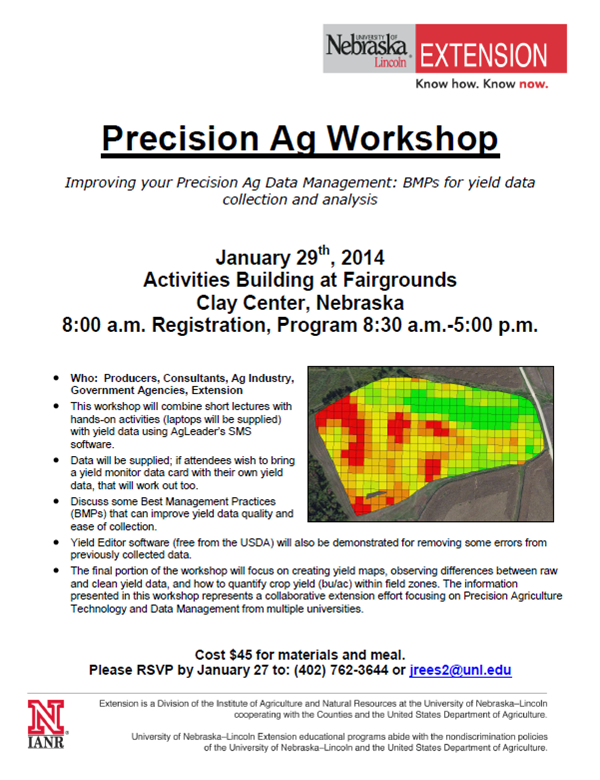
Agricultural machinery is equipped with numerous tools these days! When it comes to precision agriculture, do you know how to use these tools to the best of their ability for your operation? We’re hosting Precision Ag Workshops in Clay Center and York on January 29th and 30th respectively to help anyone interested learn how to utilize these tools more effectively. Computers, software, and data will be provided, but you are welcome to bring your own yield monitor data card to work on if you wish. Please register for Jan 29th session to Clay County Extension at 402-762-3644 or jrees2@unl.edu or for the January 30th session to York Extension at 402-362-5508 or gary.zoubek@unl.edu.
Soil and Water Conference
Hope you can join us for our Soil and Water Conference tomorrow in Clay Center!

#Ag Tour Day 1
UNL Extension Ag Educators from throughout Nebraska gathered together in late October for an excellent professional development tour to Iowa and Minnesota!
Before the bus started moving we were working on plant identification for a client. Then we learned about the status of Emerald Ash Borer among other pests at the Douglas-Sarpy County Extension Office. By the end of the presentation we were considering getting a meat thermometer and recordable Hallmark card! (will explain later).
Along the way, John Wilson provided an update regarding the flood recovery efforts from the 2011 flood. He mentioned at Gavins Point Dam, the lake would have drained every 25 hrs. when releases were occurring for the flood. He was involved with an effort in putting together a webinar that involved 25-30 agencies and 14 speakers from 5 states. During the recovery there were 2″ to 25′ drifts of sand in fields. One piece of ground that was reclaimed cost $125-150K and needed 7 excavators for a month. One 300 acre piece of ground that wasn’t reclaimed was going to cost $10,000/ac. to reclaim it.
John Hay provided an update regarding wind energy. He pointed out the different types of towers along the way as we passed several wind farms. Facts included: a 1.5Megawatt wind turbine can run 1000 homes each and the gear box is turning 2000:1 compared to the blades. Iowa is #1 in percent of electricity produced from wind power (20%) and it costs $3-6 million each to install a wind turbine (essentially double the cost of how many megawatts). The life span of a turbine is 20 years with a maintenance cost about $0.05/kwh. When considering efficiency, wind turbines are 40-50% efficient vs. coal power (35%), nuclear (35%), cars (25%); so they’re more efficient at converting free energy into electricity but they are less cost  efficient than those other energy sources. Windfarms also typically pay for themselves in 5-10 years.
Our first stop was at Hawkeye Breeders where we saw their semen storage facility that essentially had enough semen to fertilize every cow in the U.S. They ship all over the world and their primary customer is the dairy industry. We also toured their semen collection facility and got the coolest pen from there.
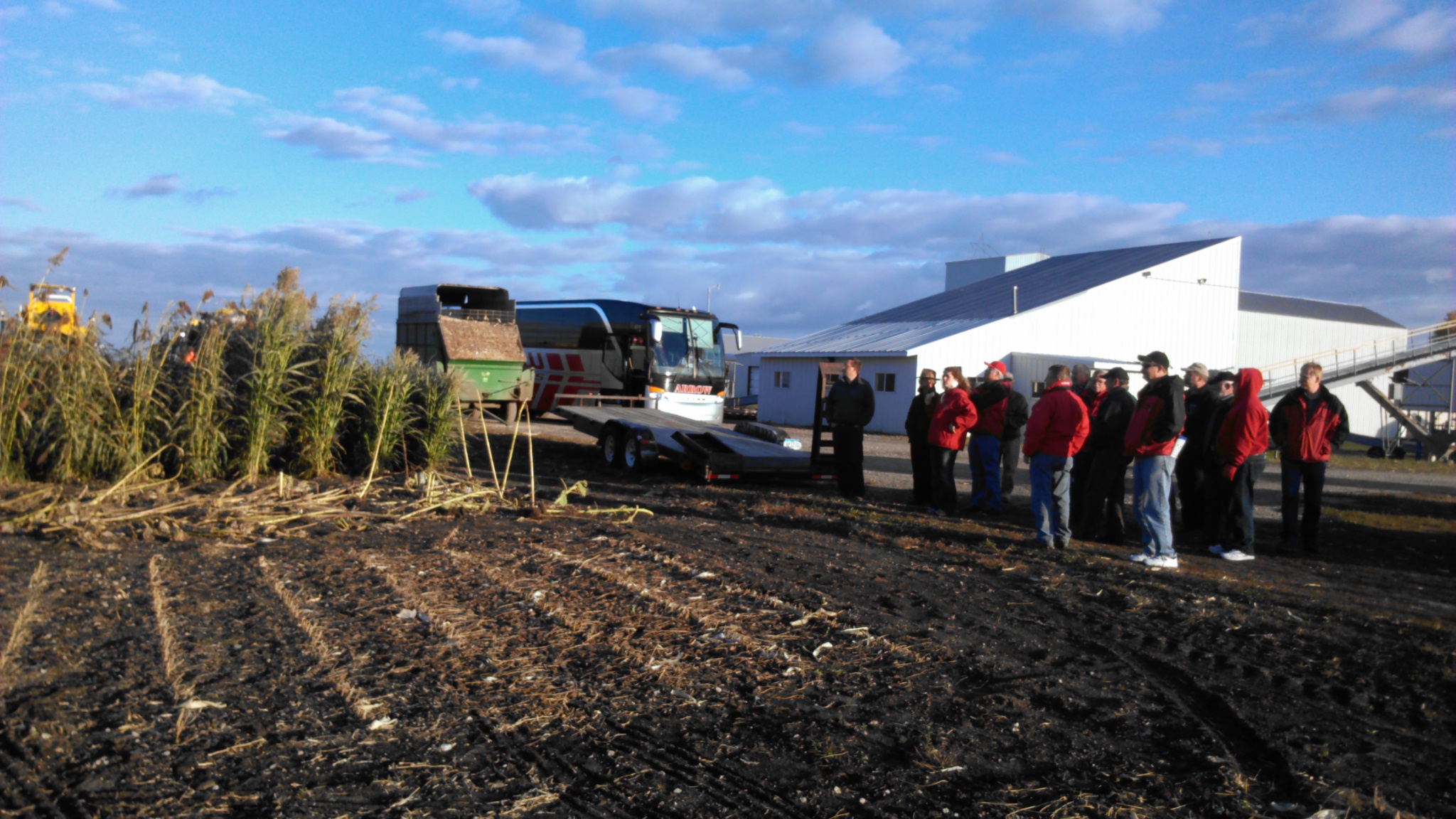
From there we stopped at Blue River Organic Seeds and were surprised to learn that all their organic seed research is done conventionally. They provide organic seed for corn, alfalfa, soybean, and various forages and are looking for more growers. We also learned about PuraMaize which was developed by Dr. Tom Hoegemeyer to essentially block pollen from outside sources to maintain purity.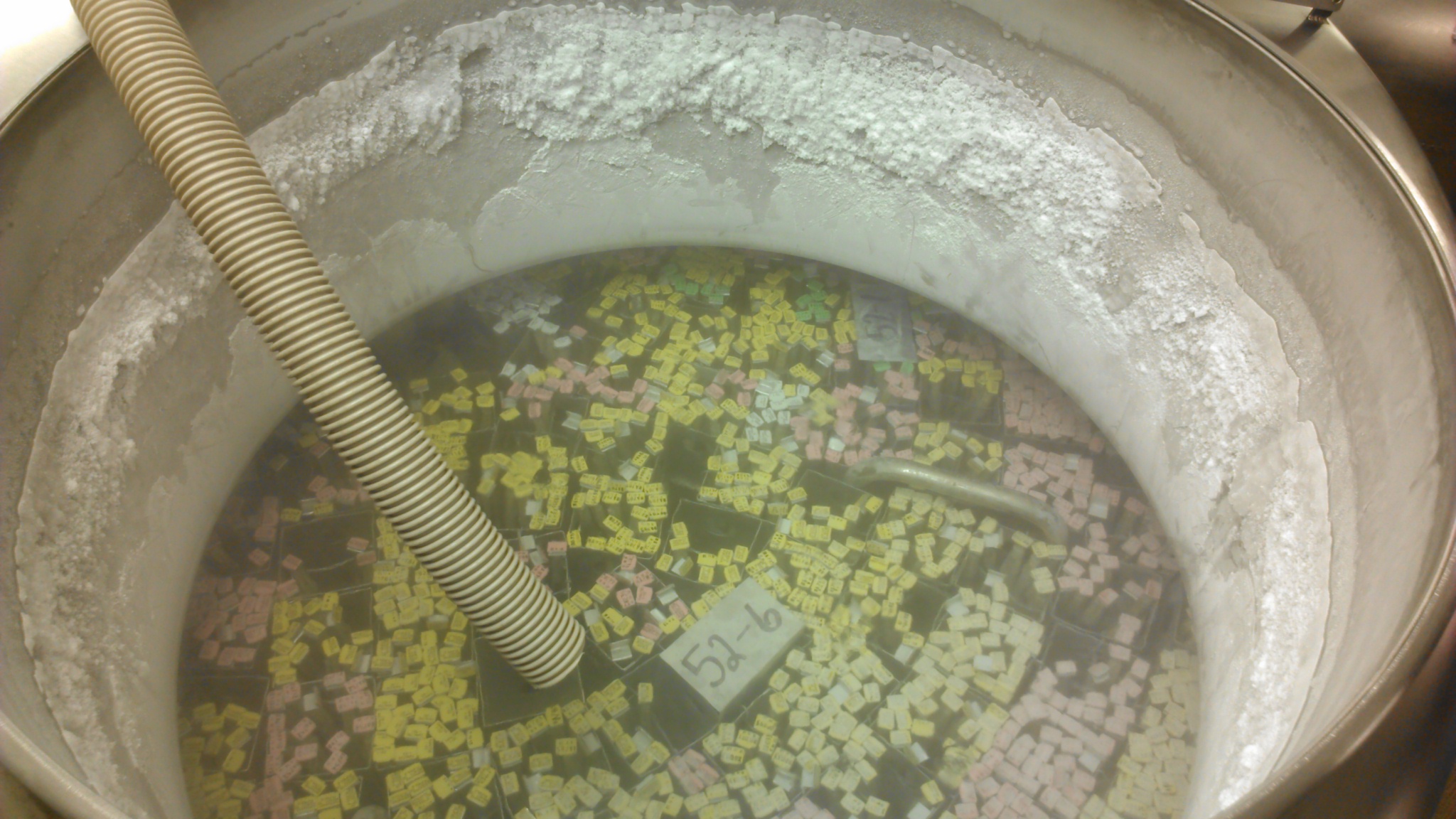
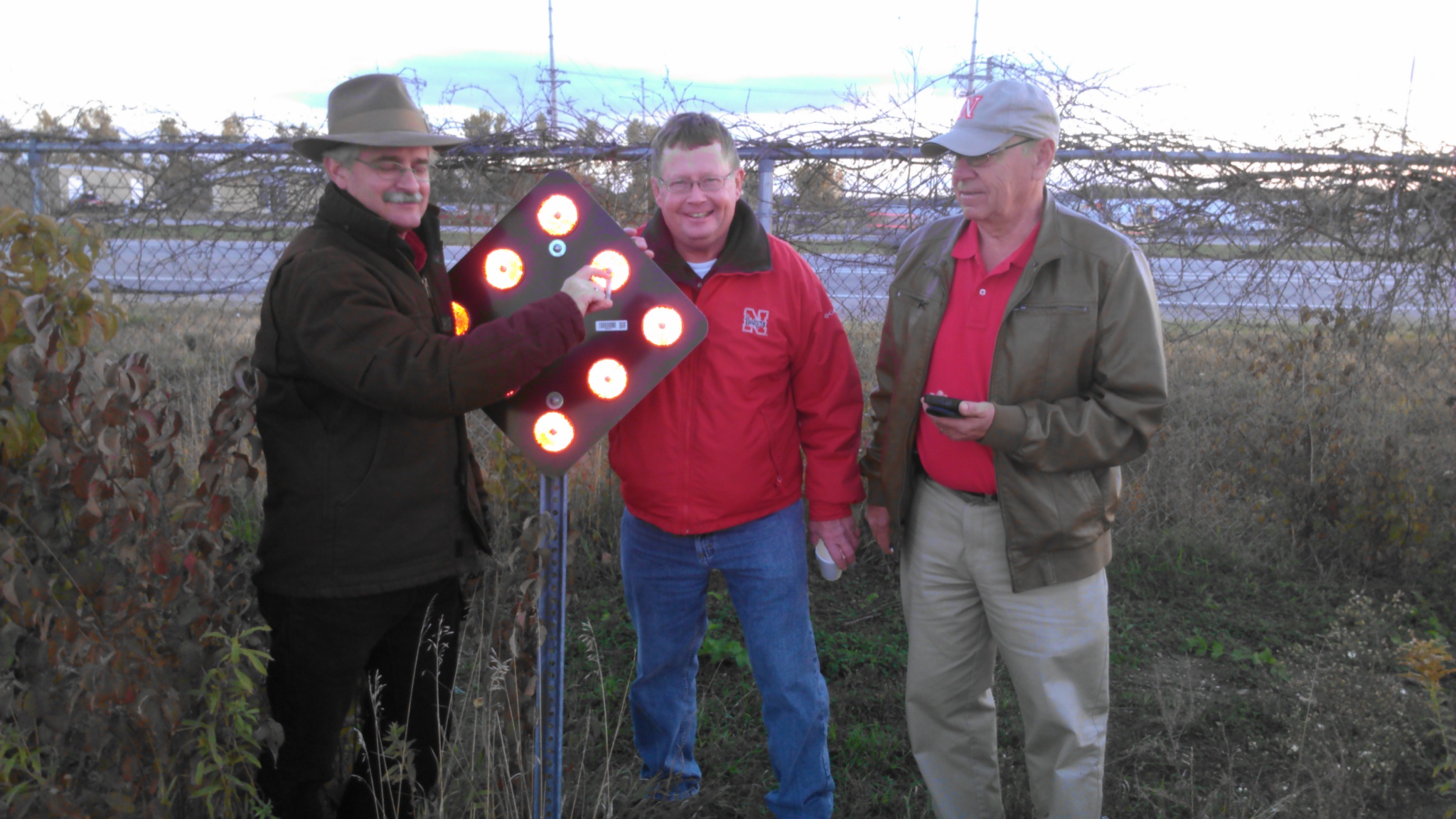
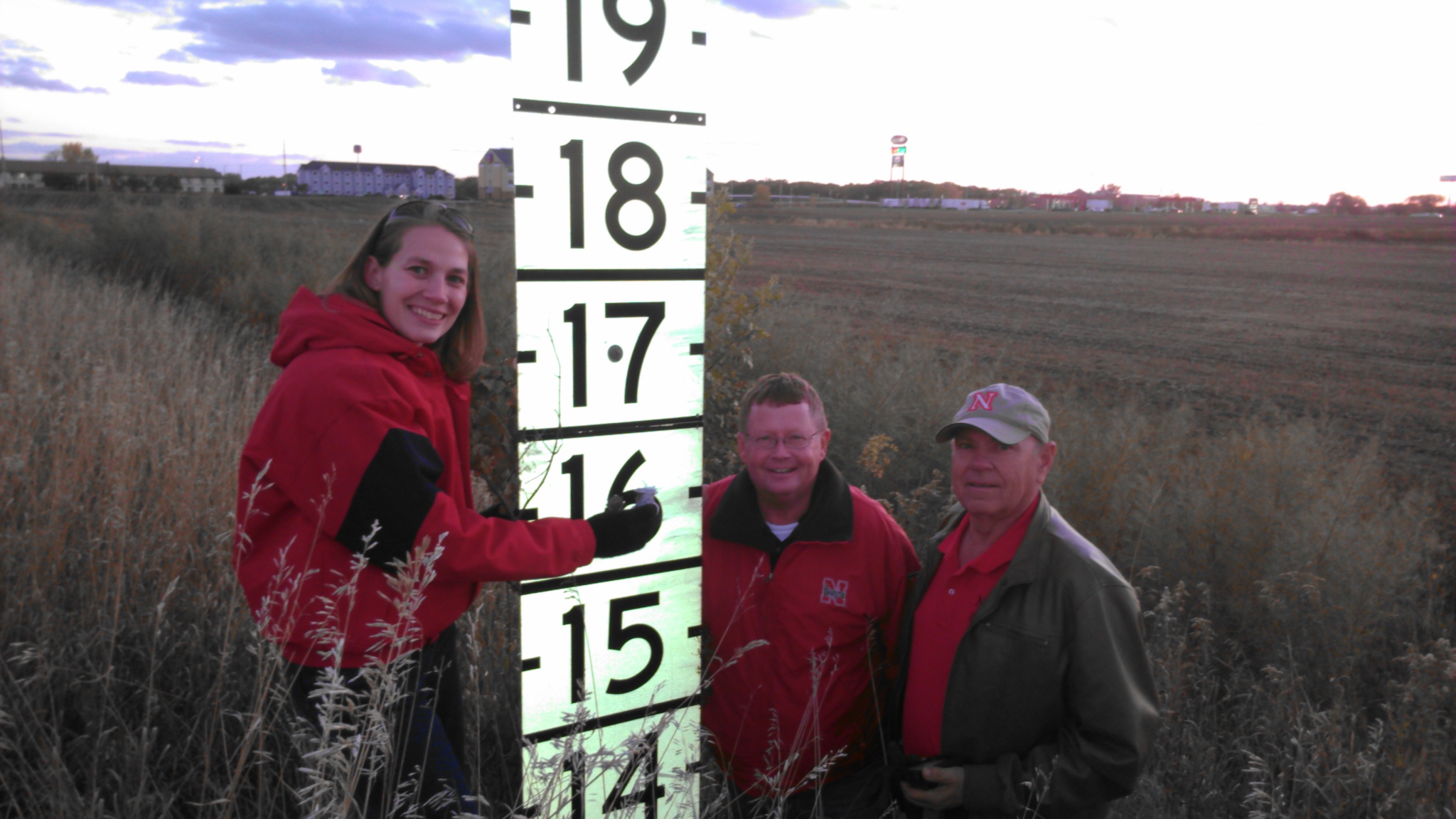
That night we had supper with faculty from Iowa State University talking about programming efforts there, including their manure programming, ag economics, and Roger Elmore spoke of the corn programming there. But before that, a few of us took advantage of the 45 min. of time to get a few geocaches in the area 🙂
Toothless grins…Fun Fact Friday
Welcome Dr. Lindsay Chichester, UNL Extension Educator, to the blogging world! Here is her first post regarding a “fun fact Friday” on how cattle eat!

Did you know…
Ruminant animals (animals that have one stomach with four compartments and chew their cud; includes cattle, sheep, goats, lamas, etc. – will explain more later) do NOT have teeth on their upper jaw?
Well, technically they have premolars and molars in the very back of their mouths on the upper and lower jaws, but no teeth upper front teeth. Instead they have a dental pad, which would be hard, slick surface.
 (Photo: Virginia cooperative Extension)
So how do they eat? Glad you asked! The part of their mouth where the upper teeth would normally be is called a dental pad. When they take a bite of grass they wrap their tongue around it and use the dental pad and their bottom teeth to bite it off.
So how do the young animals nurse you ask… They wrap their tongues around the mother’s teat and use pressure from…
View original post 31 more words


 JenResources