Blog Archives
JenResources 4/27/25
The weather and soil temperatures have been incredible for planting progress in this part of the State! The main agronomic question I’ve received the past few weeks has been from those with small grain cover crops around termination timing. We share more details in this article, although decisions are based on individual producers’ goals and the situation in each individual field: https://cropwatch.unl.edu/2021/cover-crop-termination-tradeoffs/.
It’s been a very different spring with small grain and pasture growth. In some ways, it reminds me of 2023, but in others, it seems worse. There was a period of time I was watching small grains, especially in non-irrigated fields, just “set” and not grow. Pastures were doing the same thing. Now in non-irrigated fields, I’m seeing rye that’s fairly short and in boot to heading stage, far earlier than it should be. My biggest concern for non-irrigated fields is soil moisture. It’s a field by field assessment and I recommend that growers be digging in fields to have a better idea of soil moisture and depth of moisture. Even for some growers that typically plant green, we’ve made the call to terminate prior to planting or at planting to conserve what moisture we can.
For the irrigated fields, the rye is also maturing quicker than expected, and for some, has gotten taller than they had desired before planting. For those who were planning on planting soybeans green into the rye, I’m not concerned about the rye “getting too tall”. You will observe the soybeans “stretching” for sunlight once they emerge. They will be longer between the soil surface and the cotyledons and also first unifoliates compared to if they were planted without a small grain. My concerns would be:
- Ensuring the soybean is planted into even moisture or able to be irrigated after planting. If you’re concerned about soil moisture and won’t get beans planted this week, you can always terminate before planting.
- The seed vee is closed if a PRE herbicide is applied. Sometimes I’ve seen difficulty in getting the seed vee closed and if that’s the case, avoid a PRE herbicide to avoid injury to the seed/germinating seedlings. Often I don’t recommend a PRE herbicide when planting green due to the tradeoff in cost between the PRE and the cost of cover crop seed and seeding. But for those who still want to use one, it’s important to ensure that seed vee is closed.
- For both corn and soybean, be aware that the taller the rye gets, the greater the Carbon:Nitrogen ratio becomes. This ratio impacts nutrient tie-up and results in longer break-down time of the small grain. For corn, it’s important to add nitrogen some way during planting to help off-set the nutrient tie-up early on in that seedling’s life. For both corn and beans, sulfur is also tied up. Purdue University found adding 20 lbs of sulfur anytime from pre-plant to V3 resulted in a yield increase. Oh, and when planting green with taller rye, we’ve found it helpful to not use residue removers.
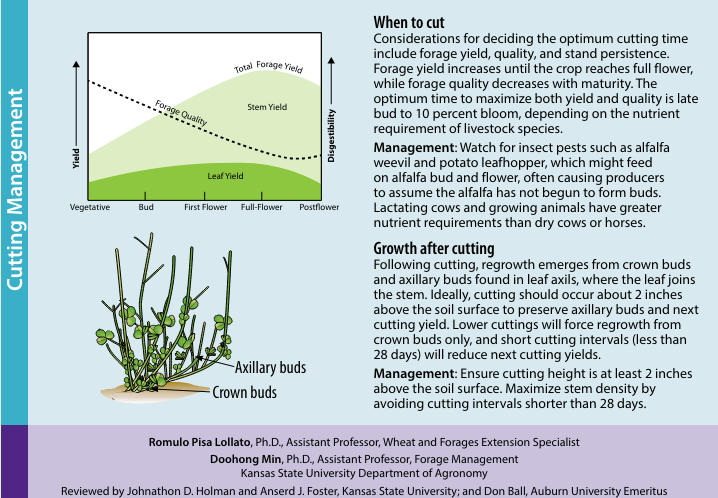
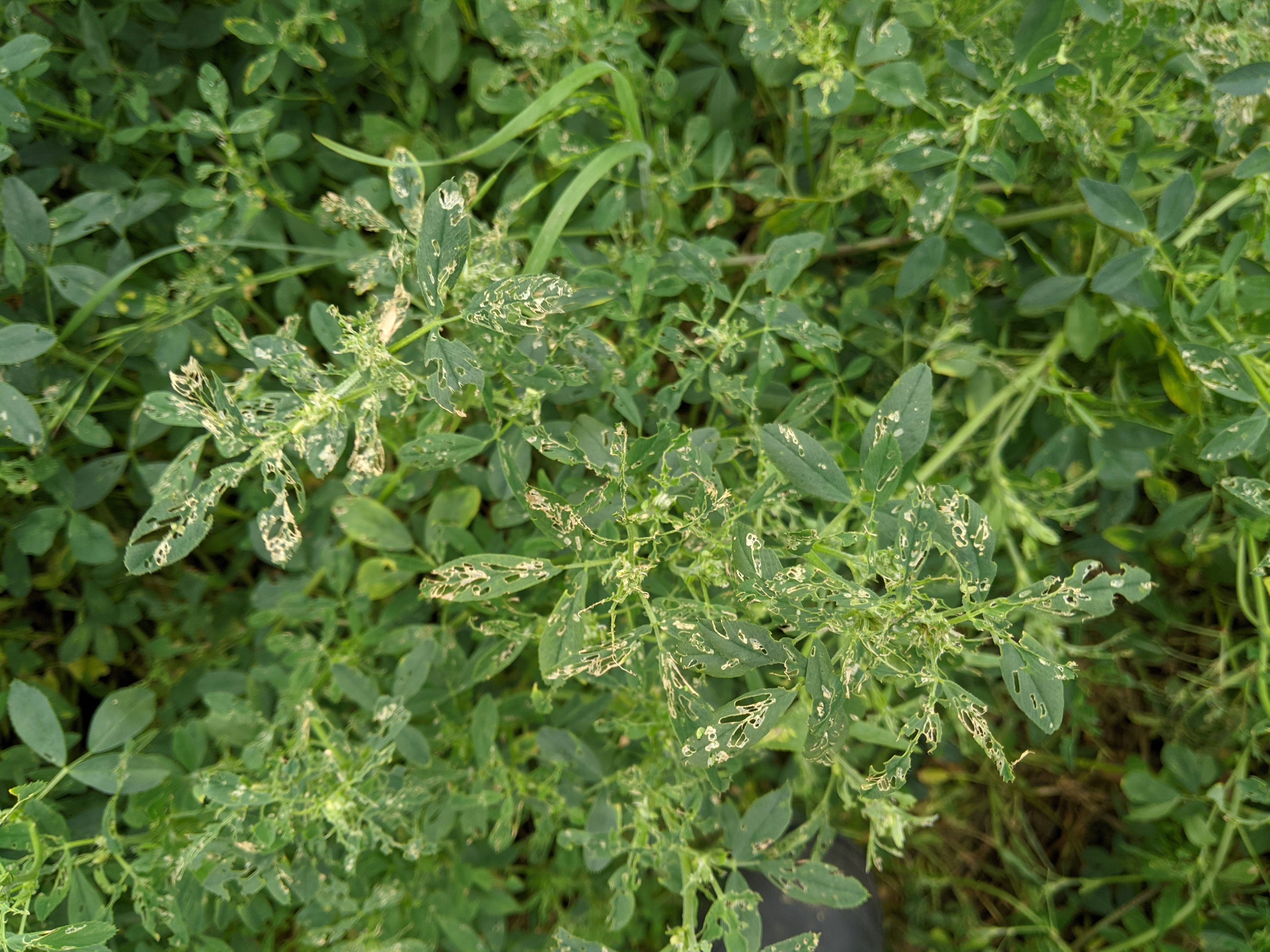
Alfalfa Weevils: I’ve also been noticing alfalfa weevils at low incidence in alfalfa fields thus far and recommend scouting your fields. Cut 10 stems at ground level at 5 different sites in the field. Then, beat the stems in a 5 gallon bucket and count the total number of larvae with a black head. Determine the average number of larvae per stem. There’s a couple of charts with economic thresholds at: https://crops.extension.iastate.edu/encyclopedia/alfalfa-weevil. There’s also a tradeoff of harvesting early vs. spraying depending upon when economic thresholds are reached.

JenREES 5/6/24
I’m so grateful for the rain and the green is so beautiful!!! The rain has led to some questions.
Corn Yields: it’s still early! I’ve mentioned this often to people the past week. We now set at May 5. In 2023, Dr. Jim Specht led a CropWatch article looking at NASS yields and 50% planting progress over 43 years (https://go.unl.edu/dge7). A summary of the data showed, delays in the Nebraska corn 50% progress date that occur within the May 2-12 planting period do not seem to have an appreciable impact on resultant corn yield. You have heard me and others talk about planting windows for several years based on data that Dr. Roger Elmore had previously shared and that information has been consistent with data from Iowa, Indiana and the U.S that corn yield doesn’t appear impacted till after mid-May. For perspective, think about the 2022 replant corn yields.
Regarding soybeans, Dr. Specht shared (in 2023), “one other notable feature is that Nebraska producers have advanced the 50% soybean progress date from a 43-year mean of May 22 by eight days to a projected date of May 14 for the year 2023. That eight-day shift to earlier soybean planting in Nebraska would have generated 0.99 x 8 = ~ 8 bu/ac greater yield for irrigated soybean producers and 0.54 x 8 = ~ 4 bu/ac greater yield for rainfed soybean producers.” The soybean planting date is more critical than corn. A number of producers have either finished soybeans before corn or have been planting at the same time to take advantage of increased soybean yields.
Pre-Plant Nitrogen movement with rains: In short, “it depends” is the best answer based on soil type, nitrogen source, soil moisture, amount of nitrate in the soil, and soil temp. Additional sampling such as soil, tissue, or using tools like Sentinel Fertigation can help in season to better understand plant nitrogen needs. University of Minnesota shares, “As a rule of thumb, with each inch of water moving down through the soil, nitrates will move down with that water five to six inches in silt loam and clayey soils, and up to 12 inches in sandy soils.” Ammonia binds to soil particles and is more stable in the soil. Urea will move with water if applied shortly before a heavy rain and can leach; however, it also quickly converts to ammonium in the soil, which is a stable source of nitrogen not easily leachable. A CropWatch article written in 2013 helps in a year like this without a full soil moisture profile, “If nitrogen was applied as a surface broadcast application immediately before rainfall (to a silt loam soil), it would move down with the rainfall. Its distribution in the soil would not be uniform, but 3 inches of infiltrated rain would distribute the nitrogen in the top 18 inches of soil. There would still be some nitrogen in the top 6 inches, but the “bulge” of the nitrate concentration would be at about 12 inches. Corn roots will grow into that nitrogen and there should not be an N deficiency as early plant needs would be met.” (https://go.unl.edu/76yw)
University of Minnesota shares that microbes will convert various nitrogen sources to nitrate twice as fast with each 10F temperature rise. Their example was, “urea that takes 24 days to fully convert to nitrate at 50°F will fully convert to nitrate in six days at 70°F.” For perspective, we’ve been holding around 58F for the past week. So the short answer is for most situations, we most likely haven’t lost much if any pre-plant nitrogen beyond the root zone due to the soil conditions thus far. Use in season tools and sampling to understand specific field situations.
Alfalfa Weevil Control Tradeoffs: With current hay prices and alfalfa in the late vegetative to early bud stage, we’re looking at alfalfa weevil thresholds of 1.5-2 weevil larvae per stem (threshold charts here: https://go.unl.edu/p6ym). The challenging decision right now is if you wish to cut alfalfa early or treat with a shorter pre-harvest interval product. Reports in the Holdrege area have shared weevil resistance to products with lambda-cyhalothrin (Warrior, etc.). Steward is a product that contains a different active ingredient (indoxacarb) and is safer for beneficial insects, but costs more. It could be an option for those of you further out from first cutting. For those of you getting towards early bud, perhaps the option is to take an early first cutting and watch regrowth of second cutting if you’re at the economic threshold?

JenREES 5/30/21
Driving to look at some on-farm research fields in Seward county last week, I came over the hill to see the flags lining Highway 34 at the cemetery. This time of year, when flags are set out lining streets in towns and at cemeteries, never ceases to get me. In that moment, with chills and tears, I said a prayer of gratitude for our Country, for our beautiful flag, for our freedoms and those who gave all for my freedom, and for living in this great Country. In spite of everything going on in the world, and in spite of how differently people view freedom and what’s happening, we still are so blessed to live in this Country! Many service members recall their battle buddies who never came home with them. Many military families throughout history have walked alongside the families left behind. Freedom truly is not free! So this Memorial Day, may we remember and be grateful for those who paid the ultimate sacrifice for our freedom, may we remember and be grateful to those families left behind, and may we keep praying for our Country and leaders, military members and their families.
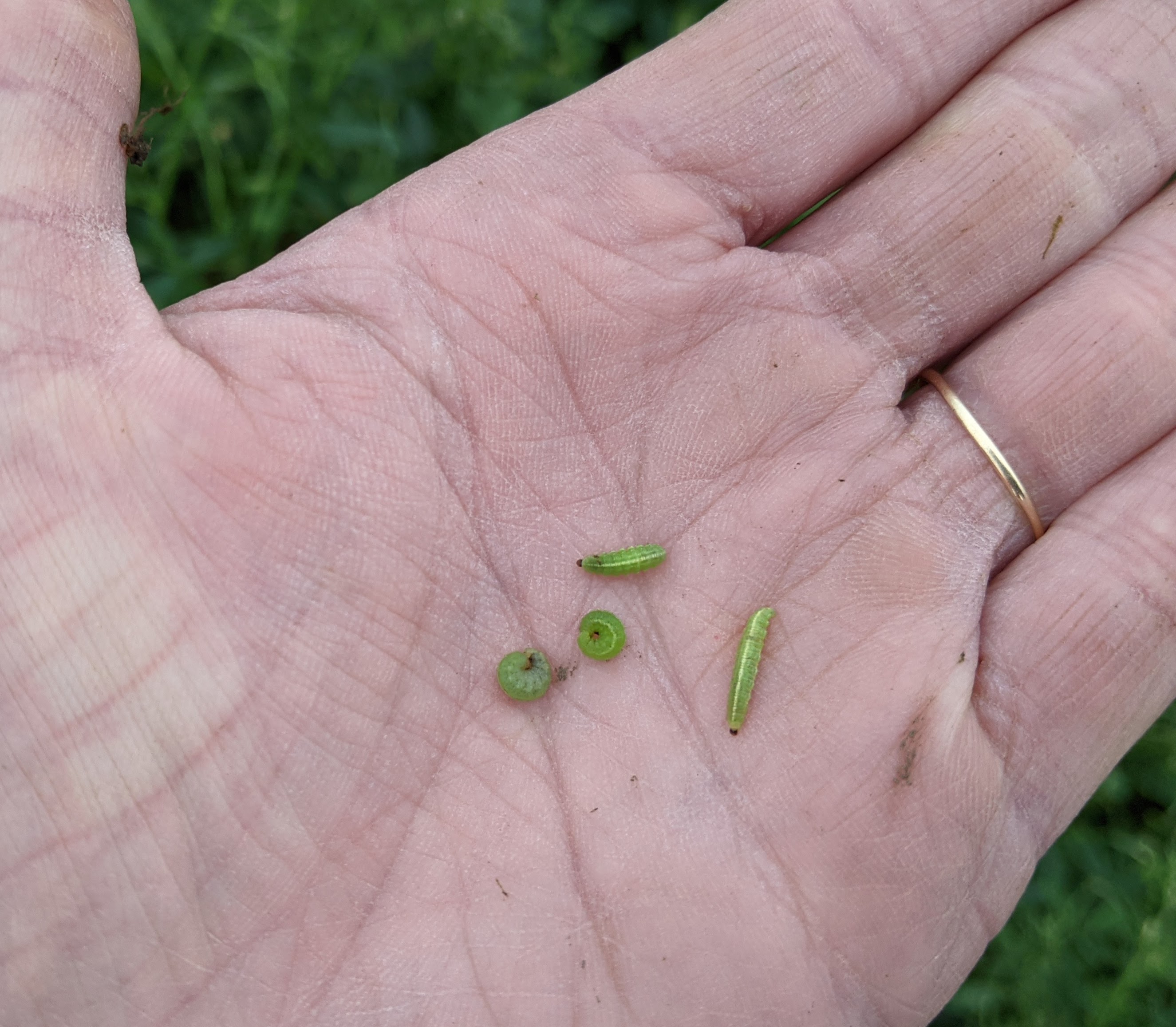
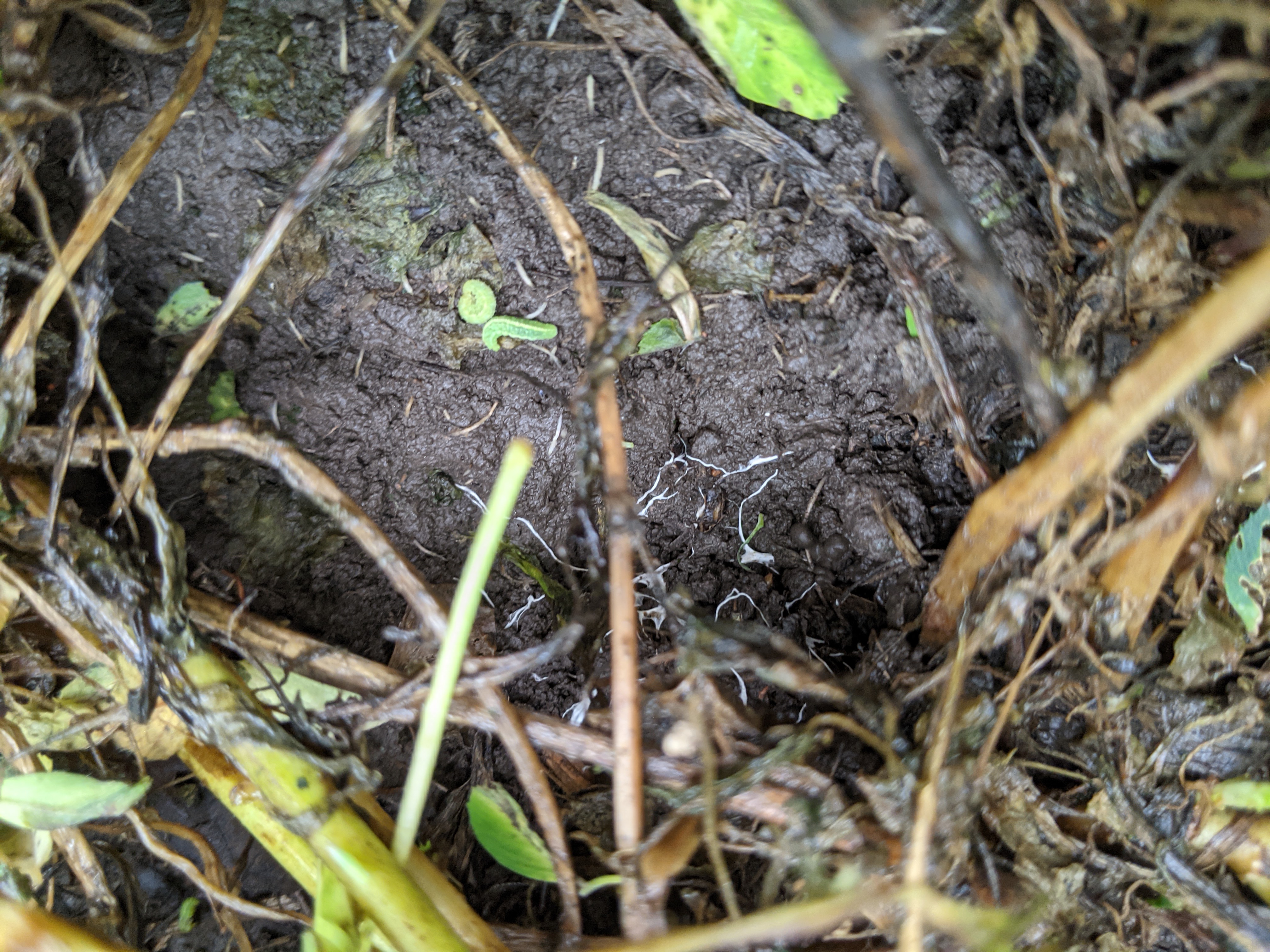
Alfalfa weevils have been heavy this year. For those with alfalfa, you may have noticed the tops of your plants turning a grayish/brown color. The culprit is most likely alfalfa weevil larvae. They are green caterpillars with a white stripe down the back and dark head. They are often hard to find as they will go down to the crowns of plants in heat of day. By the time you read this, the alfalfa will most likely be put down. What you may observe: once the alfalfa is put down, the weevil larvae will continue to feed. The area under the windrows will turn brown as they feed on the regrowth. As soon as the alfalfa is baled, we’d recommend using an insecticide to kill the larvae and allow the alfalfa to regrow. I’m still seeing all stages of larvae in the field. Highly effective insecticides for alfalfa weevil control include those that are pyrethroids (active ingredient ends in “thrin”, such as Permethrin) and products containing indoxacarb (e.g., Steward). Each field situation may be different, though, so watch the regrowth. If it’s greening up and you’re not finding weevil larvae, they may have pupated and treatment may not be necessary.
Nebraska Land Link provides opportunities to connect land seekers with retiring landowners. Land access is one of the biggest challenges facing aspiring and beginning farmers. For some landowners, they simply do not have the next generation available to take over their operation. Nebraska Land Link is a project of Nebraska Extension’s Farm and Ranch Succession and Transition program and Nebraska Women in Agriculture. When you apply to Nebraska Land Link, either as a land seeker or a landowner, Nebraska Extension personnel will work to match your application with the most compatible counterpart. Using the answers you submit and offer in a potential interview, Nebraska Land Link matches are based on the shared values, interests and skills of both parties, so that a mutually beneficial and satisfying partnership can be forged over the course of the transition plan. You can learn more about the program at: https://farm.unl.edu/landlink and watch a short 3 minute introductory video at: https://go.unl.edu/8sv6.
Ash Trees Losing Leaves: The past few weeks I’ve received questions about ash trees losing leaves. Because of the weather conditions, anthracnose on shade trees, including ash, is fairly prevalent. It’s crazy how I didn’t take any pictures when looking at any of these trees…but what you will see are small dark spots on the leaves. The leaves may curl and turn yellow-green in color before dropping. There’s nothing you should do and a new flush of leaves will appear in time.
York Co. Progressive Ag Safety Day has been postponed to June 14, 2022.
Dealing with Conflict Dynamics for Farm and Ranch Families Course: Conflict and tension often arise in family farms and ranches. This new course strives to provide Nebraskans with tools to build a better culture. Participants will gain the skills and resources necessary to overcome the conflict that may be hampering their family and business relationships. The course will be taught by renowned farm family coach Elaine Froese and hosted by Nebraska Extension’s Women in Agriculture Program. The Conflict Dynamics Training is a three-part course that will be held virtually from 3:30 to 5 p.m. Central time on June 15, 22 and 29, via Zoom. An internet connection is required, and participants should plan on attending all three sessions. Participants in this course will take a Conflict Dynamics Profile assessment to measure their personal conflict behaviors. The profile will help participants understand how they respond to conflict, what triggers can escalate conflict and how to manage conflict more effectively. Froese will then guide participants through a discussion on how to deal with conflict and tension on the family farm or ranch. The course fee is $35 per participant and the class size is limited to 20 people. Registration closes June 11. Because of the sensitive nature of the course, it will not be recorded. Registration is open at https://wia.unl.edu/conflict-dynamics.



Crop Update May 5, 2017

Received numerous alfalfa questions about browning and wilting of leaves/stems. This photo shows those symptoms of frost/freeze damage.

Check the upper-most cluster of buds on alfalfa to determine any affects on regrowth. This is where the growing point is located. Most of the alfalfa plants I’ve observed have healthy buds. With the cool temperatures, regrowth has been delayed. You may need to wait 7-14 days after the frost/freeze event to determine if regrowth is occurring from upper buds or from crown buds-and also to determine if an early harvest is warranted if there’s no regrowth from upper buds. More information on alfalfa frost damage and management considerations.

I’m also observing alfalfa weevils in low numbers in alfalfa fields. It will be important to scout your fields and monitor regrowth for second cutting. More information on alfalfa weevil thresholds.

Soybean planted April 21 at 2″ depth with good growth (I should have removed the soil from the root for this picture-did so after taking it and the root is healthy). Corn planted April 24th, 48 hours prior to cold rains in Clay County, showing beginning germination and a healthy seed. More information on potential chilling injury to corn and soybean seeds.

Cooler temps last week slowed stripe rust of wheat which I found in low incidence April 26. Powdery mildew (gray/white spots in this photo) is still moderate-heavy in lower canopy. April 6th was a beautiful day when I was in the area looking at crops, but with so many wheat fields with herbicide apps in that time-frame, I didn’t walk into fields to know how close wheat was to jointing. Since then I’ve noticed a more sprawling growth to wheat instead of erect. This week I’m noticing thicker than normal nodes where wheat is trying to erect itself-and you can see that in this photo with the bent stems. I’m not observing noticeable damage from frost/freeze at this time thankfully. It will be important to watch as heads emerge for any difficulty emerging from the boot, damage to awns, or white colored florets/heads.

Germination of corn in York County Corn Grower plot planted April 22. Soil temperature in the field that morning was 46F with a weekend of warm air temperatures.


 JenResources