Blog Archives
Tree Problems
I’ve received several questions on trees. If you have silver maples or pin oaks that are looking a little yellow, most likely the yellowing
is due to iron chlorosis. Symptoms of iron chlorosis include leaves with green leaf veins while the leaf tissue is yellow-green. Iron chlorosis is common in several of the towns in Clay County due to higher pH soils (more basic soils) which makes the iron unavailable to the plants. Trees can be injected with iron sulfate in the base of the trunk with the amount injected dependent on the diameter of the tree. There’s also another method of soil injection with micronutrients that can also be used. I also have a list of tree care providers for the area for trunk injections; please contact the Extension Office if you’re interested in obtaining this list.
On evergreen trees, spruces losing their new growth or inside needles may be doing so due to two different fungal diseases or spidermites. If you are noticing this problem on your spruces, the time to prevent fungal diseases will be May next year with products such as Bravo, Daconil, or copper-sulfate based products. Spidermites can be managed with insecticidal soap. Ponderosa, Austrian, and Scotch pine trees with brown fungal bands on needles causing the needles to turn brown can be sprayed with a copper-sulfate based product now to help prevent further browning. If large branches of your trees have needles dying, the culprit may actually be the pine wood nematode which causes pine wilt disease in Scotch pines. There is no cure for that disease. To determine if pine wilt is the problem, cut a piece of dead/dying branch that is at least 1 inch in diameter and 4 inches long and send it to the UNL Plant and Pest Diagnostic Lab for diagnosis. Cedar trees are also showing Cercospora blight right now with needles turning brown. We used to think nothing would kill a cedar tree, yet many cedar windbreaks have needles turning brown and this fungal disease is killing needles due to restricted air flow and high humidity within our windbreaks. Restricted air flow is something you’d like with windbreaks but many of the trees in windbreaks were planted too close together many years ago and we’re starting to see more of a problem with various fungal diseases. Another option to spraying fungicides is to consider removing every other tree from the windbreaks to allow for more air circulation to cut back on fungal diseases.
If you’re unsure how to tell what kind of evergreen tree you have, cedar trees have needles like ropes. Spruce needles are single and when you roll them in your fingers, they have edges to them. Fir needles are also single and when you roll them in your fingers, they don’t roll easily like spruce needles because they are flat (flat fir). Pine needles are always in groups-of 2, 3, or 5. Austrian and Ponderosa pines have the very long needles; Austrians will always have long needles in groups of 2 but Ponderosa’s will have long needles in groups of 2 or 3 (If you ever see 3 needles, it’s a Ponderosa pine!). Scotch pines always have short needles in groups of 2. White pines have needles in groups of 5.
White Heads in Wheat
The last week I have received questions about white heads in wheat. An excellent resource from UNL to determine various wheat head disorders can be found here. If the heads are completely bright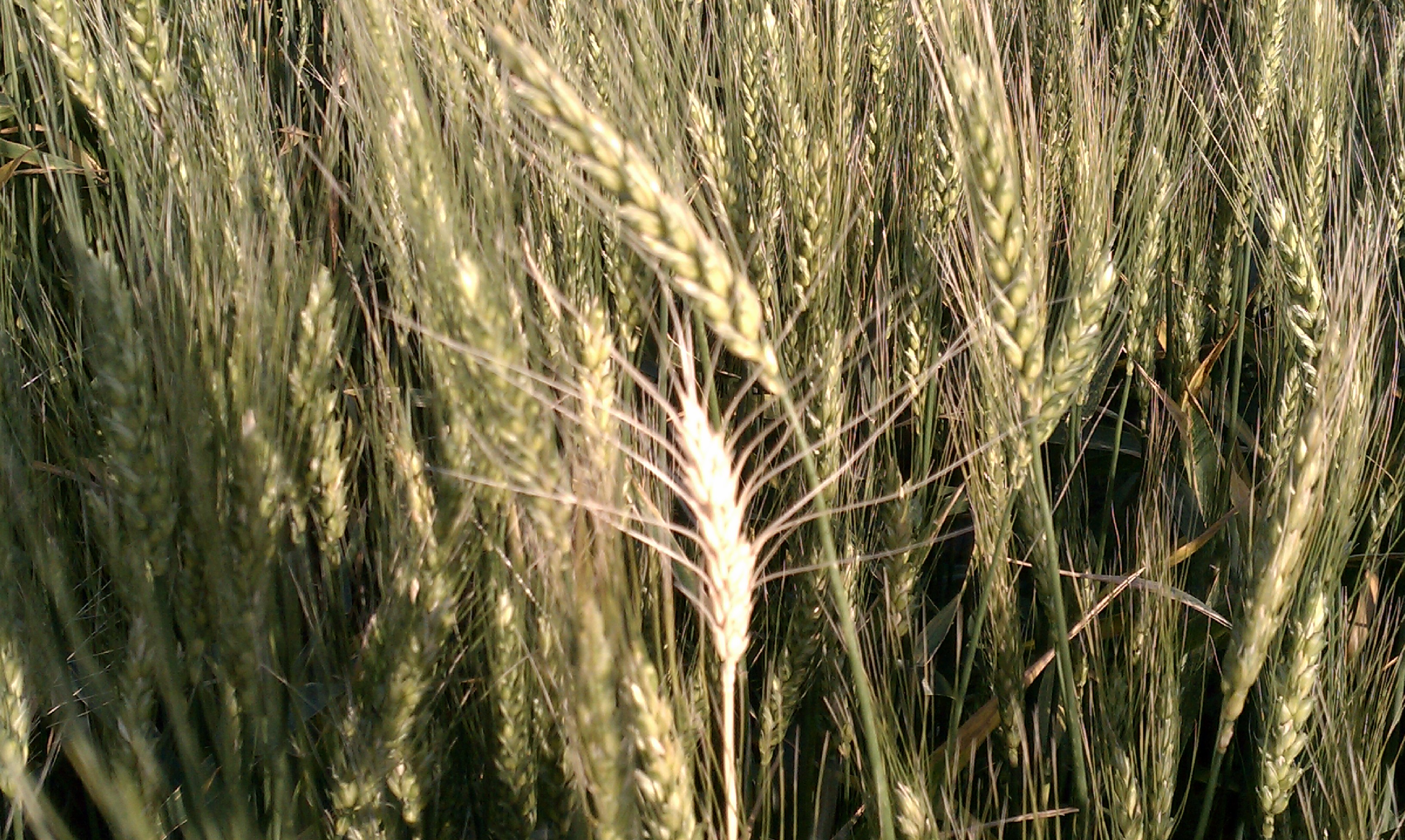 white and you can easily pull those heads out of the stem, the culprit is the wheat stem maggot. This insect will sever the stem above the top node so that the stem upward to the head are white while the rest of the plant remains green. I usually only see a few of these types of heads scattered around in fields and there’s no recommendations for managing it
 because damage isn’t considered economical.
If your heads have white or pink colored kernels in them in addition to regular looking kernels, chances are the discolored kernels have Fusarium Head Blight also known as head scab. The kernels eventually may have a brown discoloration to them and the stem just below the head may also turn a brown-purple color. The Fusarium fungus that causes head scab is the same that causes stalk rot in corn. Wheat on corn rotations in no-till systems have a greater potential of scab in wheat, but these situations don’t mean that scab will always occur. Ultimately, rainy, humid conditions for a 2 week period around flowering is the primary factor for allowing scab to occur.
If you are finding scab in your fields, there’s nothing to spray or do now. Set your combine to blow out the lighter, shrunken, scabby kernels to help avoid dockage at the elevator. I would also recommend to avoid saving back scab-infested seed. Plan to purchase certified seed instead for next year and be sure to have a fungicide seed treatment applied to it to avoid problems with smut.
Wheat Scab Prevention
Wheat is nearing heading in much of the area and is flowering farther south. Because the flag leaf and one below contribute over 80% of the yield for wheat, producers have been asking if a fungicide is needed this year. We haven’t had disease pressure regarding rust or powdery mildew so far, so I’ve been recommending to wait till closer to heading and see what weather conditions are like. If you are considering foliar fungicide products such as Headline, Quilt and Stratego for example, these cannot be applied once the head begins to flower according to the labels.
The Fusarium fungus causing Fusarium Head Blight (or Scab) is
favored by humid, moist conditions for about a 2 week period around and during flowering. If scab is a concern for you, you will want to continue monitoring the situation and apply products like Caramba and Prosaro when the plants are early in their flowering stage. We used to say aim for fungicide application between 15-50% flowering. Instead, I would say aim for that application shortly after your heads fully emerge or as early flowering as possible. My reasoning for this is that so often wheat begins to pollinate shortly after full head emergence and by the time airplanes get to your fields, your wheat may be too far along for the fungicide to work as effectively as it should. Remember, the wheat head will begin to flower in the center of the head first.
The fungicide product also needs to be on at least 4 hours before a rain event. This is very tricky to time fungicide applications for scab as you’re typically applying them because it’s raining or rain is in the forecast. These products are curative products that are locally systemic, so they will also provide at least a 2 week residual and kill fungi causing leaf and stripe rust, tan spot, septoria leaf blotch, and powdery mildew. That’s why I was suggesting to consider waiting on foliar fungicide applications this year to potentially save money by making one application during heading with as little disease pressure as we have seen. Both Caramba and Prosaro have a 30 day pre-harvest interval, so that’s another thing to keep in mind. Products, rates, and further information can be found starting on page 219 of the 2011 UNL Guide for Weed, Disease, and Insect Management.
Dr. Stephen Wegulo, UNL Extension Wheat Pathologist, writes articles for Crop Watch at http://cropwatch.unl.edu nearly every week, so you can keep up with wheat diseases and fungicide information by checking that out. You can also sign up to receive scab alerts at the following Web address: http://scabusa.org/fhb_alert.php.
Ascochyta Leaf Blight
The strange weather has allowed for an uncommon turf disease to begin appearing in this area of the State. Ascochyta leaf blight typically is found in places like Colorado, but this year, it’s showing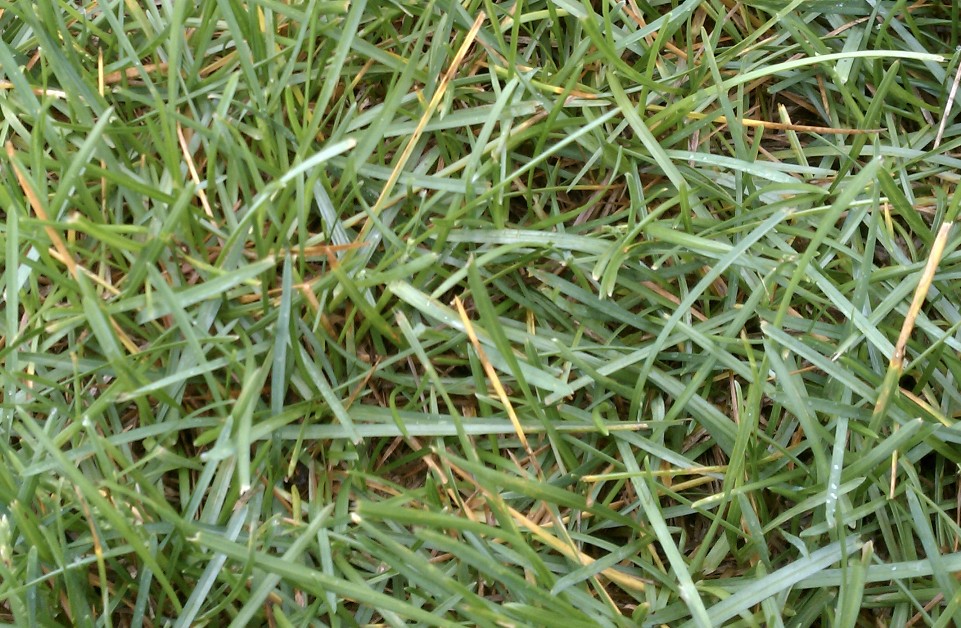 up in Clay and other areas of Nebraska. Typically the fungal pathogen is favored by hot, dry weather preceded by cool, wet weather-exactly what we’ve had up till this recent wet spell-which also favors the pathogen. Symptoms include the leaf blades turning straw colored or bleached and dying back from the tips. Eventually patches of turf may appear straw colored.
There’s nothing recommended for this disease except to manage your turf properly-mowing at proper height (we recommend 3″), fertilize at proper times, etc. For more information, check out this source: http://turf.unl.edu/pdfctarticles/AschochytaMay2011.pdf
Wheat Update
It’s been a quiet year so far regarding wheat, so it didn’t surprise me when the calls started rolling in this week regarding wheat looking yellow. Most wanted to know if we had disease issues out there. Looking at fields throughout Nuckolls and Clay counties, I saw very little disease overall. That’s most likely due to the dry conditions we’ve had and the fact that many fields I looked at were wheat on corn or soybean stubble. Wheat on wheat fields had disease such as tan spot or septoria leaf blotch on the leaves. I did not see any powdery mildew or rust in any of the fields I looked at.
So why are some fields yellow? Well, most likely it’s due to a combination of factors. We had a dry fall and winter. Some wheat had winter injury and some just never developed a good root structure due to lack of moisture. Dr. Drew Lyon, UNL Extension Dryland Cropping Systems Specialist, also shared with me that poor root structure could also be a result of not having a firm seed bed during planting. Without a firm seed bed, roots aren’t allowed to develop like they should, can’t explore the soil for nutrients, and are more exposed to the potential for crown and root rots. Fall-applied fields often had sprayer wheel
tracks showing green wheat in the wheel tracks and yellow wheat elsewhere-most likely the compaction from wheels allowed for better establishment, created a depression where moisture held, and allowed for less nitrogen loss.
Fall applied nitrogen may have been lost due to the dry fall and winter. It appears that fields with spring applied nitrogen look better due to moisture this spring after application. There’s also environmental reasons for yellow wheat. The cold soil temperatures may not have allowed for nitrogen release to the plants yet-we may see a change by next week. Many places in south central Nebraska have experienced dry conditions creating yellow-brown lower leaves and a blue cast to the wheat. I have pictures of wheat with ice crystals on it from some of the cold snaps we experienced. Cell rupture of that plant tissue could also have caused the yellowing of those lower leaves.
Bottom line, right now there’s nothing you can really do for the yellow wheat and warmer temperatures may allow for nitrogen uptake in the future if the nitrogen wasn’t already lost. Right now there’s nothing to be worried about regarding fungal disease concerns. I’d recommend you continue scouting your fields for powdery mildew and rust and consider a fungicide application if needed (need to protect the flag leaf). I’ll keep you updated on what I’m finding in the fields!


 JenResources