Blog Archives
Dr. Kohl’s Ag Update
This week, I’m sharing an article that my colleague, Brandy VanDeWalle wrote on December 5, 2025 about “Ag Update and the Road Ahead” by Dr. David Kohl’s presentation at the recent Farmers and Rancher’s College Program. Brandy writes,
“Recently at a Farmers & Ranchers College program, Dr. David Kohl shared his global perspective on current events and how they influence U.S. agriculture—insights that are always incredibly valuable. One of the highlights of his presentation was a “SWOT analysis” of the United States. While many businesses routinely use SWOT analyses to evaluate strengths, weaknesses, opportunities, and threats, it was fascinating to consider how this framework applies to an entire country.
Kohl noted that one of the United States’ greatest strengths is its abundant natural resources. Together, the U.S. and Canada hold 20% of the world’s water supply. The nation’s extensive river system also provides an efficient means of transporting goods. Additional strengths include a solid capital structure, legal system, and property rights; the global role of the U.S. dollar in trade; a strong educational system; an entrepreneurial economy; and the country’s historic position as a global influencer since World War II.
Weaknesses cited include political polarization, inconsistent policies, and declining trust in institutions. The U.S. also faces an aging population combined with a reactive healthcare system, a growing federal deficit, substantial budget obligations, a service-dependent economy, a widening concentration of wealth and income, and aging infrastructure paired with supply chain challenges.
Kohl highlighted that North America has tremendous potential when the U.S., Canada, and Mexico work together—representing 5% of the world’s population but 29% of the global economy. Additional opportunities include improving proactive healthcare to enhance quality of life, cultivating next-generation leadership at all levels, advancing as a global leader in applied technologies, and strengthening natural resource and environmental management.
Among the threats, Kohl warned of the likelihood of a catastrophic technology event that could disrupt major industries or even the country itself. He also identified the risk of a “brain drain,” as scientists and researchers leave the U.S. due to issues such as funding uncertainty, instability, perceived anti-science sentiment, and heavy recruitment from other global powers including the EU and China.
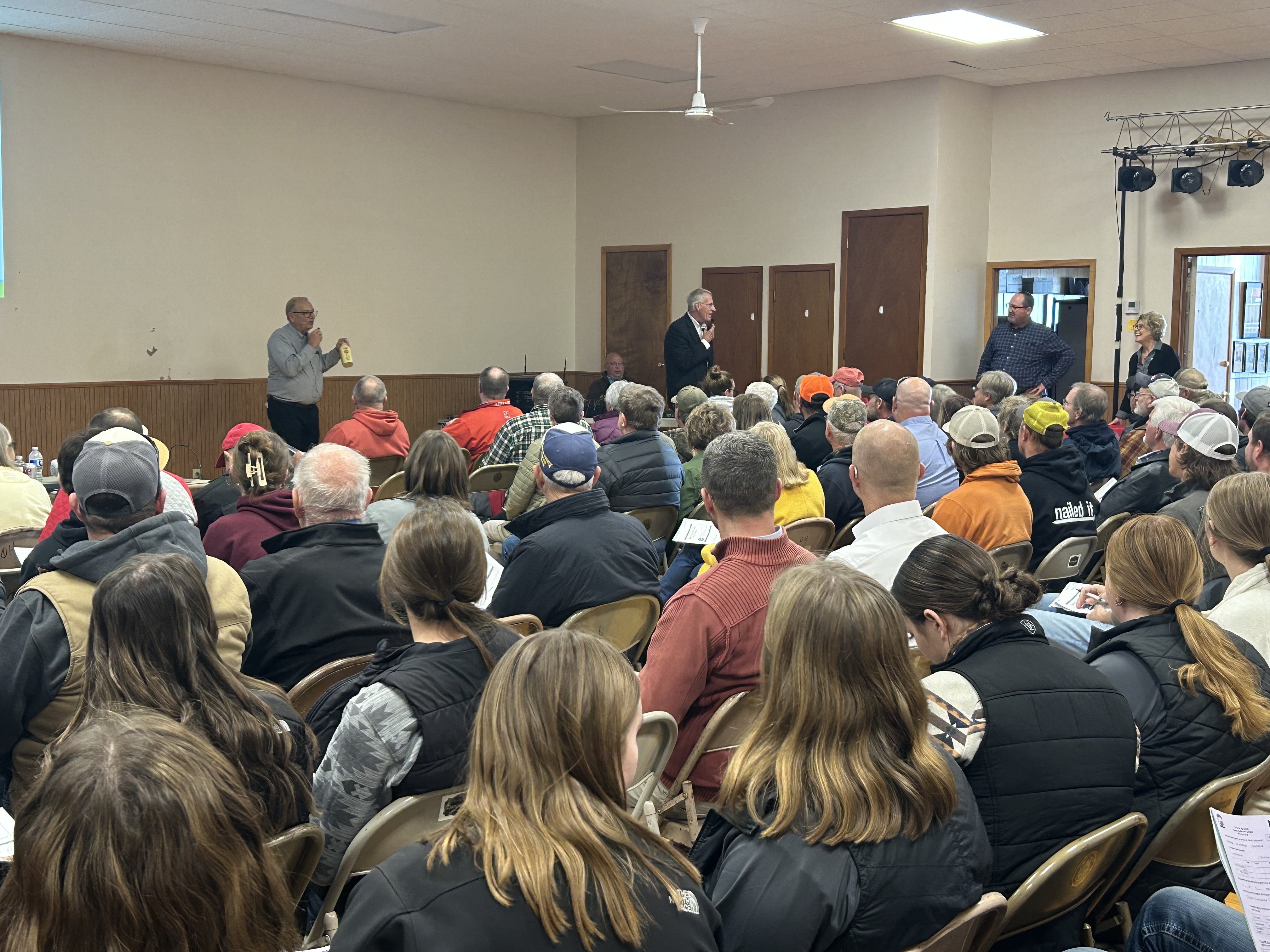
Dr. Kohl emphasized the critical importance of human interaction and communication. While artificial intelligence and other technological tools can help reduce workloads, they can never replace genuine human relationships. He reminded attendees that people need connection and purpose. Quoting a favorite saying, he noted, “It is better to have a good neighbor than their farm,” reinforcing the idea that being kind and building strong relationships matter far more than acquiring more land or expanding a business.
In conclusion, he provided leadership principles that stand the test of time:
- Change occurs bottom up, not top down.
- Manage the controllables, manage around the uncontrollable.
- Quick money builds ego – disciplined principle-based strategy/activity results in resiliency, nimbleness, agility and character.
- If you are going to lead, you must read!
- Success is often measured in dollar signs. Significance is giving back and making a difference in people’s lives.
- A successful culture and society must have success in agriculture.
It was great to see over 30 FFA members and community college students in attendance which Dr. Kohl praised and asked them each to share what they learned. He praised the 4-H and FFA programs for providing youth a purpose and developing life skills.”

Dr. Kohl Recap
Walking in the misty rain Thursday, it just felt wonderful to get some moisture, even though it became ice! Sharing some things learned from Dr. David Kohl that day. His overall theme was to “Be in the black (profitable) without the government”. Many illustrations he likened to sports in needing to stick to fundamentals such as knowing cost of production, our marketing plan, staying the course with what we can control vs. getting derailed by what we can’t. Media headlines can rapidly change things thus the extra importance to stay the course. Ag is such a global market. With all the politics, he emphasized the need to have a fuel and fertilizer input cost strategy as China will more directly trade with Brazil/Argentina first. And, because of the world dynamics, he emphasized several times to “Never bet your farm or ranch on an authoritarian government”. Another thing that’s kept me thinking was “People who are successful are 5% better in a lot of little areas”.
My colleague, Brandy VanDeWalle, wrote the following in her column, “Recently at a Farmers & Ranchers College program, Dr. David Kohl emphasized the importance of maintaining working capital or cash for businesses and families, among other important business principles. As always, his global knowledge of events and how they impact U.S. agriculture is fascinating.
One of the mega-trends for producers to pay attention to is the increased focus on healthy soil and water. Healthy soil and water quality creates healthy plants, animals, humans, and environment. Likely there will be paid incentives for producers who excel in these areas. Continuing to reassure consumers where and how food is produced, processed, and distributed remains important. It is also crucial to know your cost of production to plan best, average, and worst-case scenarios. Kohl also recommends overestimating capital expenditures by 25%.
His “Rule of 78” caught the attention of a lot of participants. When most people reach 78 years of age, usually health starts to decline unless you practice 8 habits. Those eight habits to have a quality of life included taking care one oneself physically by drinking water, exercising regularly, eating healthy and getting enough sleep. Mentally, people should have a support network, life purpose, engage in mental activities such as reading or meditating and practice your faith/spiritual life. He emphasized the importance of allowing oneself 2 hours per day with no technology.
Farmers and ranchers should also manage things that can be controlled and manage around those that cannot be controlled. He reinforced the idea that for a successful operation, you must plan, strategize, execute, and monitor. Examine monthly or at least quarterly financials to ensure you are on track. Those with a written business plan are four times more profitable than those without a plan. Also, the mental health of those with a business plan have two times the mental health as those without a written plan.
Kohl reminded participants of his business IQ exercise that ANY business should undertake. The areas in the business IQ included cost of production knowledge, cost of production by enterprise, goals (business, family, personal), record keeping system, projected cash flow, financial sensitivity analysis, financial ratio/break evens, those who work with an advisory team/lender, those whom have a marketing plan and execute, those whom have a risk management plan and execute, modest lifestyle habits, strong people management plan, transition plan, those whom attend educational seminars, and their attitude.
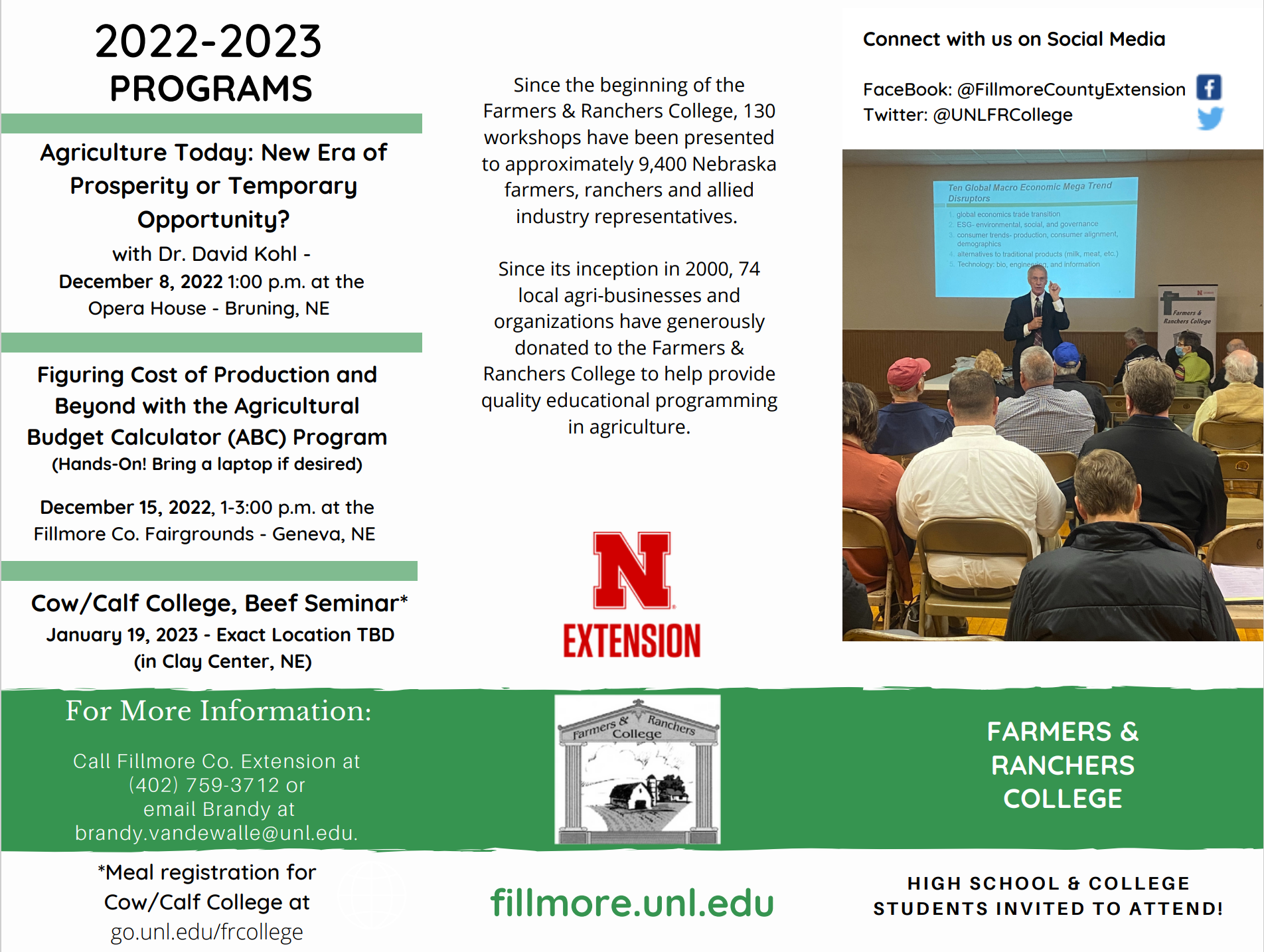
To determine what your cost of production is, a hands-on training will be held at the Fillmore County Fairgrounds on Thursday, December 15th from 1-3:00 p.m. This program is free, but registration is preferred for planning. Register at cap.unl.edu/abc/training. Attendees are encouraged to bring their own laptop or tablet to the workshop.”
Nebraska Mesonet are the weather stations located throughout our State with the data shared in our UNL CropWatch site for ET, soil temperature, precipitation, etc. But beyond farmers/ranchers and Extension using it, the data’s also used by National Weather Service, NOAA, Drought Monitor, etc. Please consider reading this article to become more familiar with what the Mesonet is and its importance regarding what shutting down locations means for Nebraska: https://go.unl.edu/a64h.


 JenResources