Blog Archives
Estate and Succession Planning
Transition/Estate Planning: This topic is perhaps one of the most important topics for all families to discuss, especially in agriculture. Many have shared stories of heartbreak with me. I’ve also heard an increasing number of farmers share with me they weren’t sure who the farm will transition to as there’s not an interested heir returning. The following are a few workshops to aid in beginning conversations and in the transition process. Perhaps this may be a goal for your farm the coming year? The first workshop allows for farm women (and in York I’m also encouraging couples) to gather to form connections and learn together. The second workshop is one my family participated in. It was special to connect with the other families who attended and talk through the questions/situations each family was facing and the advice/tools lawyers provided for varying situations. I’d highly encourage your family to consider attending one of these opportunities this winter if you haven’t started the farm transition discussion/process.
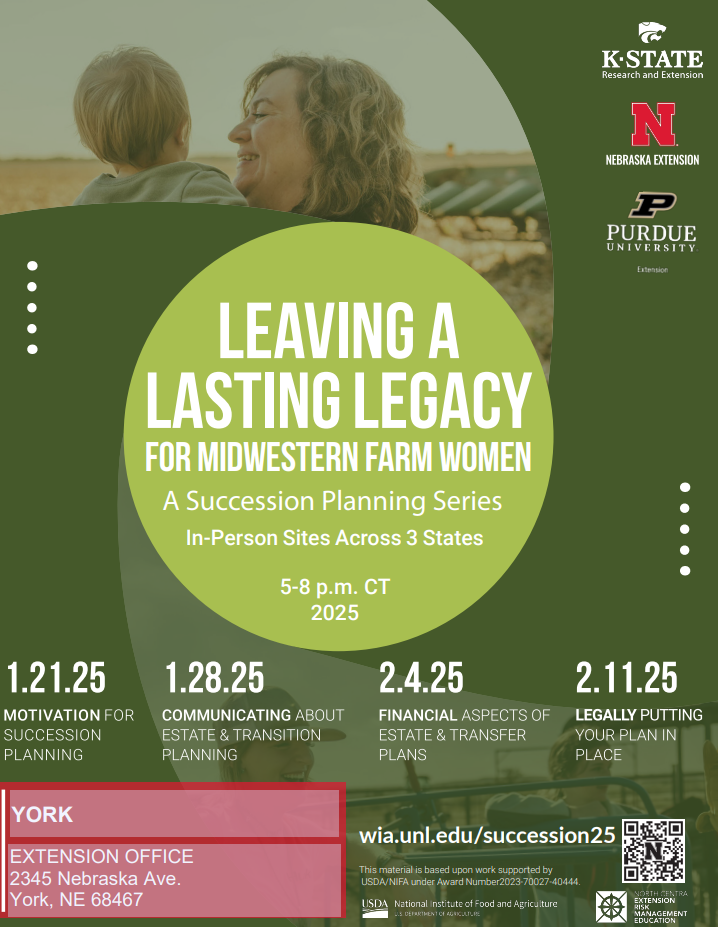
Succession Planning Workshop for Farm Women: This workshop is a 4-part series from 5-8 p.m. on Tuesday nights (Jan. 21, Jan. 28, Feb. 4 and Feb. 11). I will be hosting this workshop at the Extension Office in York and there are other area locations in Geneva, Lincoln, Central City, Columbus, Blue Hill, and Auburn. The workshop is geared towards women but men are also welcome, and I’d encourage couples to attend if it works. Topics covered will include motivation for succession planning, communicating with family, the financial aspects of estate and transition plans, and the legal aspects of putting a plan in place. A keynote speaker will be simulcast to every workshop location during each meeting, with time for questions and a hands-on activity for participants. A meal will be provided on each date.
The registration fee for in-person attendance is $60 before Jan. 13 and increases to $75 on or after Jan. 13. A virtual option is available for $75. Participants are encouraged to attend all four sessions. More information and registration is available on the Nebraska Women in Agriculture website, https://wia.unl.edu/succession25.
Returning to the Farm 2025 is a workshop series for families who are in the transition process of bringing members back to the farm or ranch. It will begin with a two-day workshop for multi-generational families on March 7 and 8, at Central Community College in Hastings, 550 S. Technical Blvd. The series also includes two follow-up workshops, to be held virtually after the in-person meetings.
The series assists families and agricultural operations with developing financial plans and successful working arrangements to meet their unique needs. It will guide families in developing estate and transition plans, setting personal and professional goals and improving the communication process between family members. Presenters will include extension experts as well as agribusiness and legal professionals.
The workshop fee is $75 per person on or before Feb. 28. March 1, the fee increases to $85 per person. Registration includes dinner on March 7 and lunch on March 8. It also includes two follow-up workshops, to be held virtually (dates/times TBD). Hotel accommodations are not included. https://cap.unl.edu/rtf25.
The In-Season Nitrogen Publication I had mentioned in the previous columns has now been published and can be found: https://go.unl.edu/tp7c.
JenREES 6/12/22
The storms this past week have resulted in a lot of damage at a difficult and critical time for crop decision making. I’m sorry for all affected and grateful for safety for those who had windows, vehicles, homes and other structures damaged. Last week I wrote a blog post on assessing hail damage at: https://jenreesources.com/2022/06/10/hail-damage-assessment/. It shares photos of things to look for in crops. I will continue to share recovery photos as time progresses on my jenreesources.com blog.
The challenge in sharing blanket information is each field and farm situation will have details to consider that don’t apply to others. Herbicides used and timing, crop insurance, amount of grain marketed, percent of acres impacted, amongst other factors all come into play. I’ve had individual conversations where I’ve shared experiences, especially regarding herbicides and replant considerations, but they’re not things I can write about. There’s a lot of experience and wisdom within the people in this area of the State who helped with and were impacted by the June 2014 storms. If you have stories/experiences you’re willing to share, please share your comments at the end of my blog post. Also, I’d just recommend talking to a variety of people (other farmers, agronomists, seed and chem reps, crop insurance) so you can get different perspectives and determine the wisest plan for your specific situation.
It seems like farming has continued to become more challenging, especially with weather events. It’s just another reminder to me how we’re not in control and how we’re ultimately stewards of everything we’ve been given to do the best we can. We have a long growing season left and storms like this take emotional tolls on everyone involved from farmers to families to those serving farmers with decision making and sales/application. So, I would encourage everyone to stay safe with the upcoming heat, find ways each day to look for positives and keep perspective, take small breaks whenever you can, and keep talking to others. And, for those who keep me accountable to what I write, I’m doing these things too!
After the storm webinar: Thursday, June 16th from Noon-1, a team of us will be presenting a webinar on crop decision making after the hailstorm. If interested, please register here: https://cap.unl.edu/webinars.
Hail damage to landscapes: The biggest thing to remember for trees, lawns, plants in general is to not apply fertilizer or any products to stressed plants. Plants will shoot new growth as long as the growing point wasn’t injured. Damaged vegetation will turn brown and eventually slough off. If you do choose to cut away dead growth, it may be wise to dip your scissors/pruning shears in a 10% bleach solution (1 part bleach to 9 parts water) after each cut to reduce the opportunity for bacterial transmission. For those with rhubarb that was ready to be harvested, you can still cut and use stems that aren’t mushy from rotting at this point (can cut out the most damaged areas of stems with stone damage). The following tips are from UNL’s Backyard Farmer: https://www.youtube.com/watch?v=vIeA731LQg8&t=1s.
Estate Planning Workshop Central City June 23: We had a packed house at Seward last winter for this meeting. Sharing this opportunity as several mentioned they’d be willing to drive to listen again to Al Vyhnalek and Tom Fehringer as there’s so much to glean. The info. they present is wise, practical, thought-provoking. So, please share with others this opportunity at the Fairgrounds in Central City from 10 a.m.-3 p.m. It includes a free lunch and please RSVP at: 308-946-3843.
Irrigation scheduling equipment: It’s crazy that this week is mid-June! Here’s a reminder if you haven’t already set out ET gages and/or your irrigation scheduling equipment. And, I realize that some of this has to be delayed depending on replant decisions and/or obtaining new pivots.


 JenResources