Blog Archives
Inputting Data into Texas A&M Farm Bill Decision Tool
Last week was enjoyable working with farmers on Farm Bill decisions. I’ve decided to work with producers on an individual basis. If you are interested in help looking at your potential options using the Texas A&M model or would like another set of eyes to make sure the data was inputted correctly, please call (402) 762-3644 and Deanna or Holli will get you scheduled for a time.
One caveat is that this model is only as good as the data you input into it and your decisions

Example of FSA “eraser sheet” courtesy of Randy Pryor, Nebraska Extension in Saline County.
are based on where you feel potential prices the next five years will be. You need your CC yields and base acres from FSA as well as production history since at least 2008 (2003 if you wish to run crop insurance tool). Requesting a copy of the FSA “eraser sheet” is a great tool to check on planted and crop production planted acres and to see if reallocated base jives with the computer program. The Texas A&M simulation at https://usda.afpc.tamu.edu/ isn’t difficult to run, but it can be confusing as to what number to input where. Begin by registering at the site by providing an email address and password. Then login and you will see the following screen.
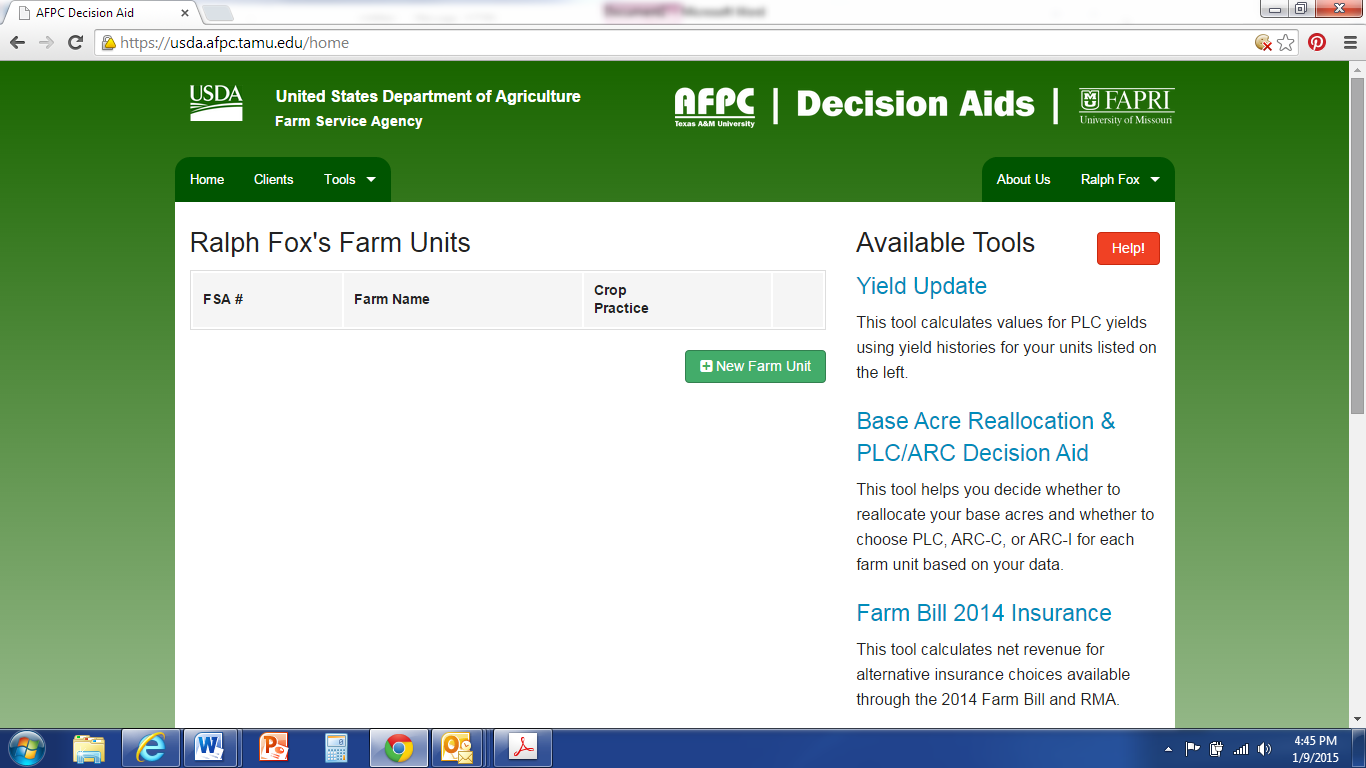
It is important for you to decide what you want the tool to analyze for you. It can analyze: yield update, base reallocation, ARC vs. PLC, and crop insurance (shown in right-hand column in screen-shot, or can also be selected from “Tools” in top drop-down menu). If you want to analyze crop insurance decisions, EACH crop insurance tract needs to be entered as a “new farm unit” under each FSA farm number. It takes a lot of time and it can be done, but that’s the only way to use this tool to also look at crop insurance including supplemental coverage option (SCO).
If you do not want to look at crop insurance decision but wish to consider the first three decisions, then for counties such as Clay County with COMBINED irrigated and dryland county yields, completing the Price Loss Coverage (PLC) Yield Worksheet (CCC-859) from FSA with your combined irrigated and dryland yields for each FSA number will greatly aid you in inputting the data. For counties with any splits in irrigated and dryland yields, I recommend placing irrigated and dryland production separately on the top of the PLC Yield worksheet, and then combining production by crop towards the bottom of the worksheet. Regardless of if your county has the opportunity for a split irrigated/non-irrigated payment, all CC yields in Nebraska are combined by crop (regardless of irrigation or not), so FSA will want a combined yield by crop on their form.
EACH crop needs to be entered as a separate farm unit. I have created a fake account to walk you through a simulation.
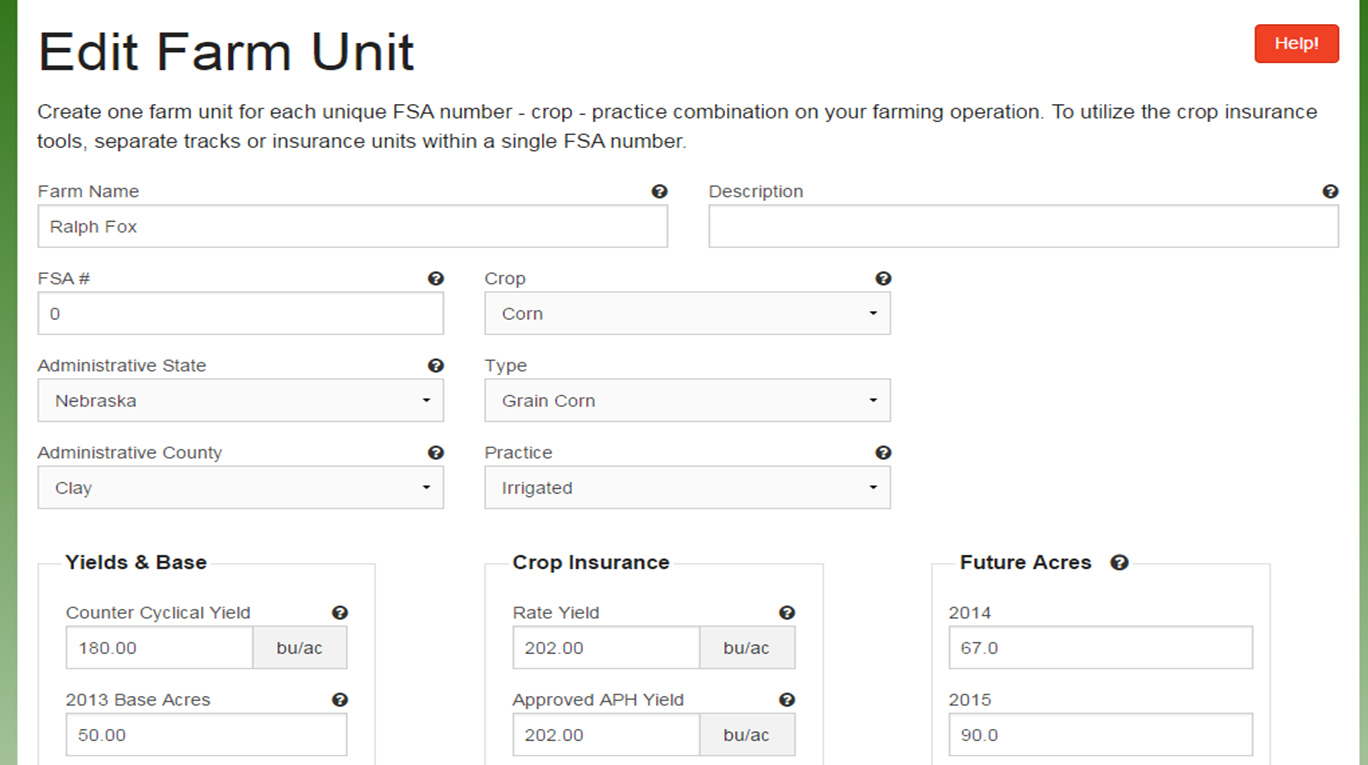
Some are having a difficult time finding “rate yield” on their crop insurance forms. It is not critical if you are not using the crop insurance tool and the same Approved APH yield can be inputted for the rate yield as well. If using the crop insurance tool, the correct rate yield from crop insurance must be used. UPDATE: If you ARE NOT interested in analyzing crop insurance information, “0” can be inserted for basis price, rate and APH yields, and select “none” for crop insurance. If you are also not interested in analyzing ARC-IC, then “future acres” can also be entered as “0”.
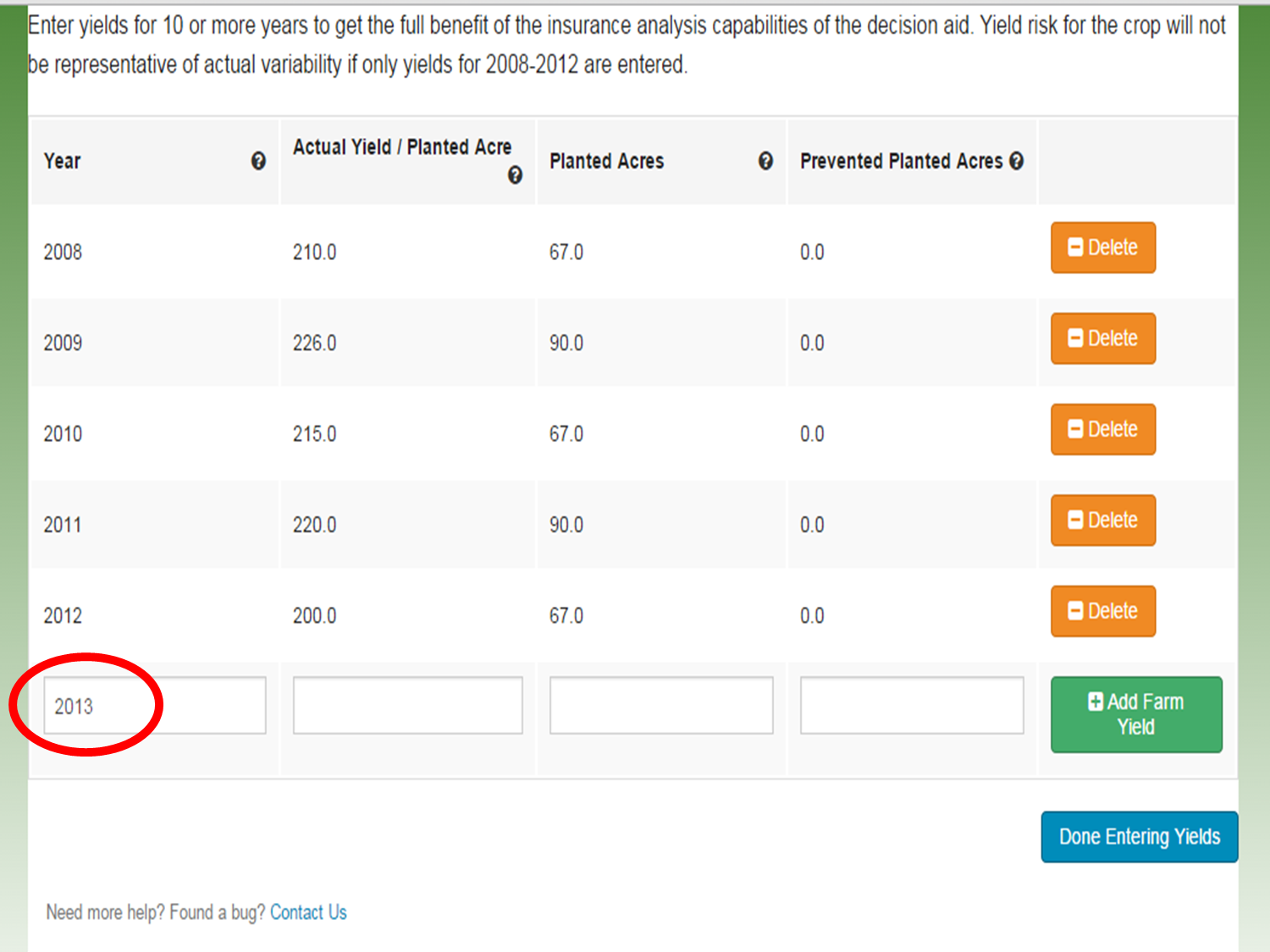
When entering yields, you need to enter one more date after all your yield data has been entered for the data to save properly. In this example, I have inputted yield data for 2008-2012. I then added “2013” and pressed “save yield data”. If you input 2013 yields, be sure to add a “2014” instead. Not doing this step will delete your last row of yield information.

Notice that each crop needs to be added as a separate farm unit. If using the crop insurance tool, each crop insurance tract under each FSA farm number needs to be added as a separate farm unit. Be sure to split out base acres among the tracts and be sure that the total base acres add up to the total base acres from FSA.
For entering separate crop insurance tracts, the CC yield should remain the same for all dryland tracts under one FSA farm number (same for irrigated). However, you will have to split out base acres amongst the tracts and you need to make sure the acres inputted add up; please double check this!
For your yield update and base reallocation information: For some of you, the base reallocation acres in the tool have been slightly different than what you received from FSA office. That may be because risk management agency (RMA) acres were used and were different than the production acres FSA had on file. You need to use the FSA acres for planted acres when using this model if they differ from the RMA ones.
When running this model, on many farms PLC + SCO looks favorable for some crops. A word of caution, you can consider PLC but should not consider SCO in your decision if you have not broken everything out into crop insurance tracts and included 10 years of production history into the tool. So in the decision of reallocating base acres or not, in the final summary section that gives you total numbers, anytime PLC+SCO is shown for a particular crop and you have not included the proper crop insurance info, you need to re-calculate the final total by hand using PLC ONLY from the table above that area. It normally doesn’t change the outcome that the decision tool provides, but it can. I’m not saying that SCO shouldn’t be considered, what I’m saying is that the numbers provided in the tool are not accurate if you have not inputted the data in the way needed to look at crop insurance decisions.

In this example, you notice three tabs: Base reallocation, risk chart, and per crop analysis. The green tab shows what you are looking at-in this case base reallocation. Notice there are two charts: The top one shows ARC-Co, PLC, and PLC+SCO. Blue circles indicate best option with reallocating base acres while orange circles indicate best option without reallocating base acres. The second table gives you your totals. Notice in this table and the one above that PLC+SCO are shown as the best options for corn. However, in the total, because we did not separate the crop insurance tracts in this FSA farm number and because I didn’t include 10 years of yield data, I need to recalculate the totals by looking at the top table for the next highest prices under ARC and PLC. So for this example, to refigure best reallocation of base payment total, I would take the $8093 listed in PLC, reallocation for corn since it is higher than ARC and add it to the $4612 for soybean payment to get: $12,705 for base reallocation. For no base reallocation, I would add $10,791 from PLC since higher than ARC in this example and add it to $3075 to get a total of $13,866 for no base reallocation. Most of the time, the outcome stays the same, but there are a couple instances it has changed, so wanted to make you aware of the importance of this.
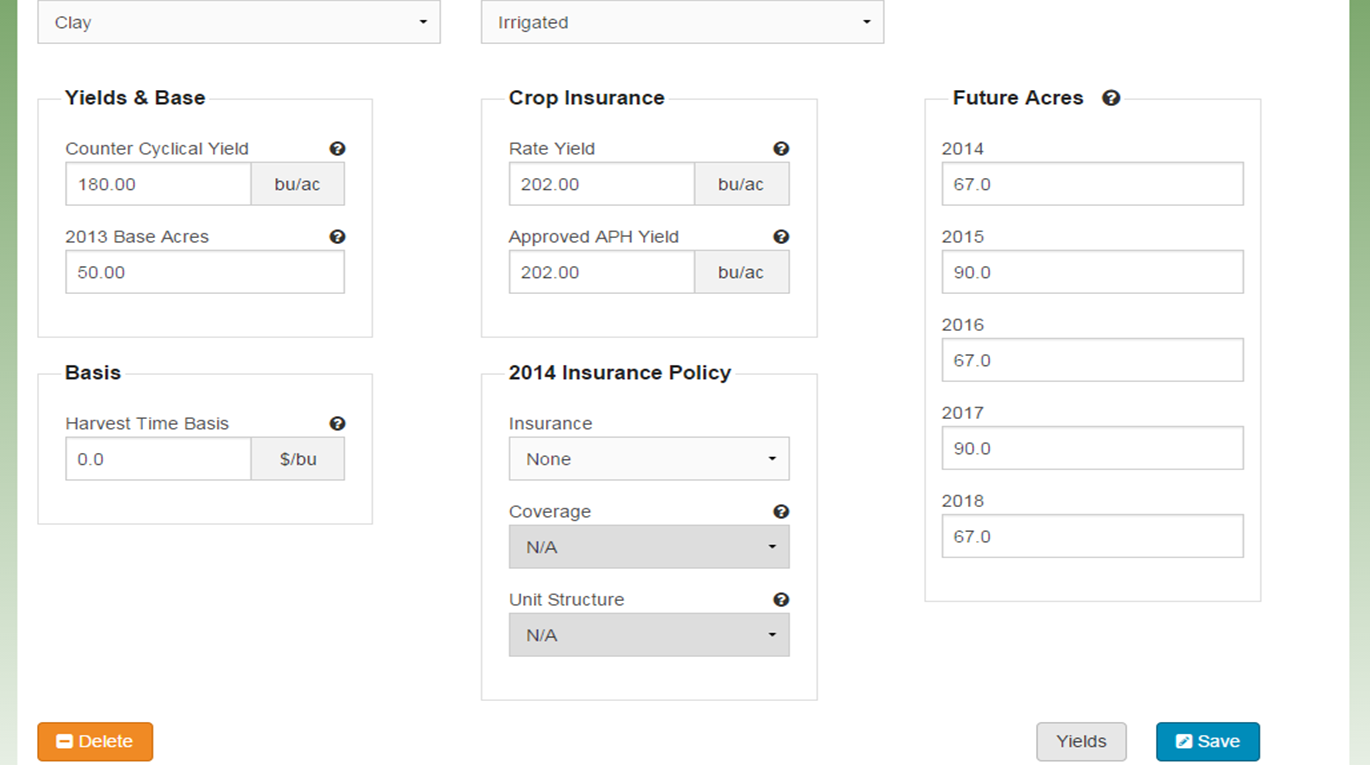
Or to get around having to hand-calculate removing SCO from the total decisions, Randy Pryor and Paul Hay, Nebraska Extension in Saline and Gage Counties respectively, discovered that if you select “no crop insurance policy” on the edit screen for each farm unit, that it automatically takes out adding SCO into your final calculated options as you can see from the next screenshot!
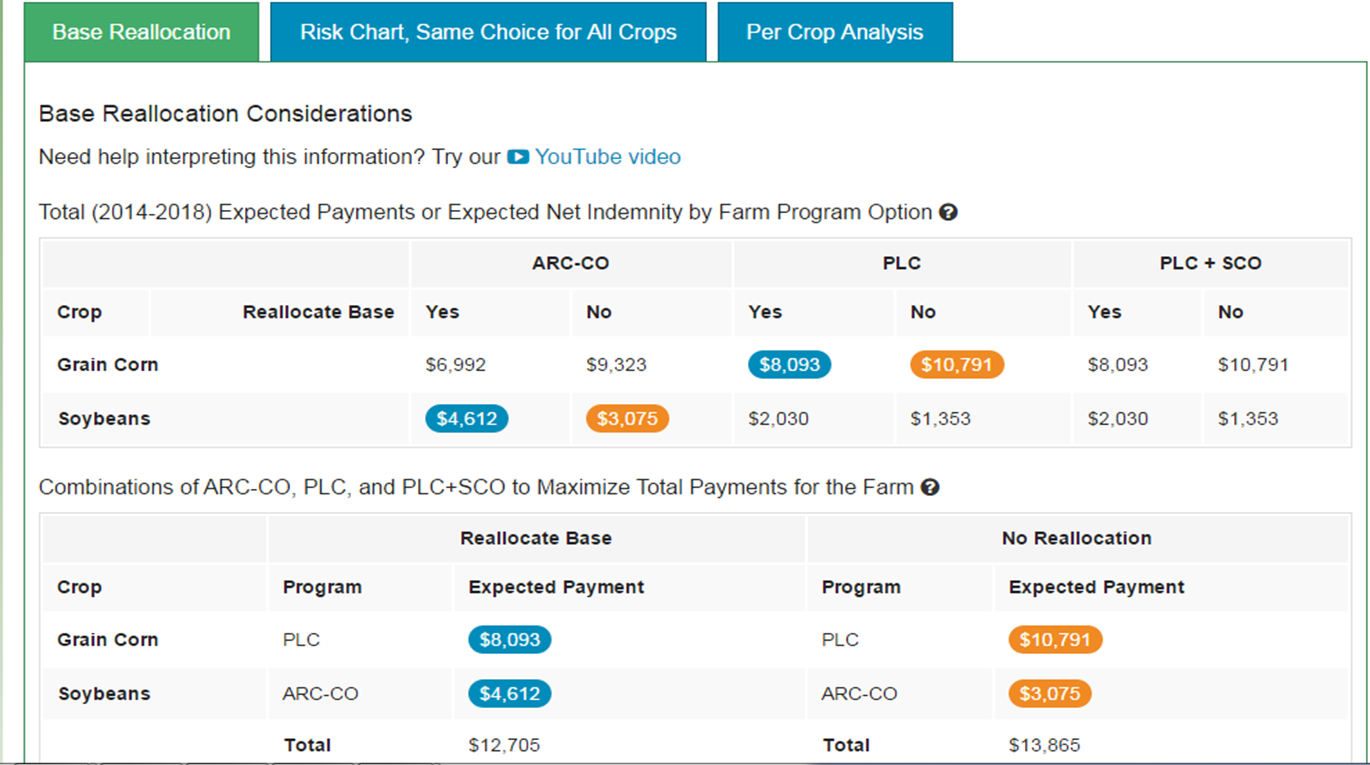
When not adding crop insurance tract info and 10 year yield history information to be able to analyze Supplemental Coverage Option (SCO), removing crop insurance from the beginning edit screens allows you to analyze base reallocation and ARC-Co vs. PLC program options without having to recalculate and remove SCO. It won’t give you a higher SCO payment number when adding information in this way.
Some of you have questioned why PLC even lists a payment when prices are inputted higher than the benchmark price of $3.70 for corn, etc. The Texas A&M tool is giving you essentially a bell curve of 500 random outputs with the distribution of that curve around the particular price you input for each crop. So with every given price you input, there’s a certain probability that the price will be at, above, or below that particular price. That’s essentially what the red, green, yellow bars are showing you on the analysis. So you’re assessing where you feel prices will be, what decision will allow you to best sleep at night, the potential of spreading out risk with several farm numbers by choosing different options, etc. You can also view the YouTube videos from Texas A&M with more information!

Connecting with Extension to Enhance the Land Grant Mission
My thoughts on the importance of connecting with Teaching and Research to ensure Extension’s and the Land Grant Institution’s future success, relevancy, and existence.

I had the opportunity to provide a seminar to the UNL Agronomy and Horticulture  Department last week which was truly an honor. As I thought about what to present, I kept thinking about the future of Extension and two major challenges I see Extension facing in the next 100 years…actually now.
Challenge of losing our research base.
Challenge of sharing our unbiased, research-based information in the places where customers are receiving information.
I continue to think about Extension’s Mission: We provide unbiased, research-based information to the people to ultimately improve their lives.
My thoughts kept centering around the fact that in order for me to achieve Extension’s Mission, I need to be more connected with the people on campus and research stations. I need to know about their research to share with our customers. For us to be the best Land Grant University System we can be in…
View original post 336 more words
Public Issues Leadership Development Experience
As President-elect of the Nebraska Agricultural Agents Association, I had the opportunity to participate in the Public Issues Leadership Development (PILD) Conference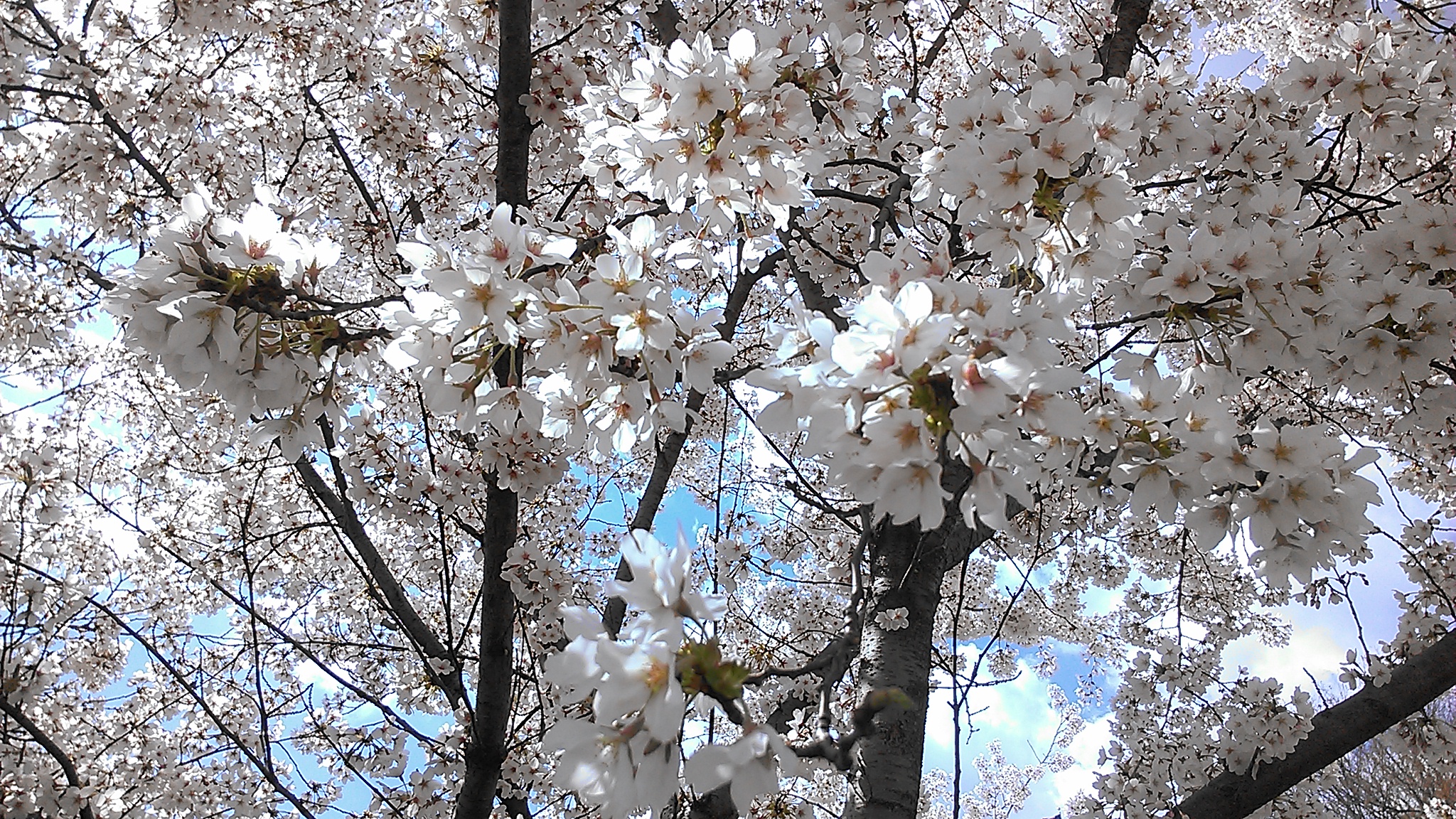 in April of 2014. The goal of PILD is professional development and public issues education. I never had the opportunity to visit D.C. that time of year before and the cherry blossoms were just opening when the group of us from Nebraska arrived. By the time we left they were in full bloom-just beautiful with an amazing fragrance! Our delegation was Monte Stauffer (representing 4-H), Patricia Jones (representing Food/Nutrition), Diane Vigna (representing community development), and myself along with our Dean and Director Dr. Chuck Hibberd.
For me, these conferences are about networking and people and I truly enjoyed seeing my Ag Extension colleagues from across the U.S. The conference was very much focused on celebrating 100 years of Cooperative Extension and the challenges/opportunities Extension faces in the next 100 years.
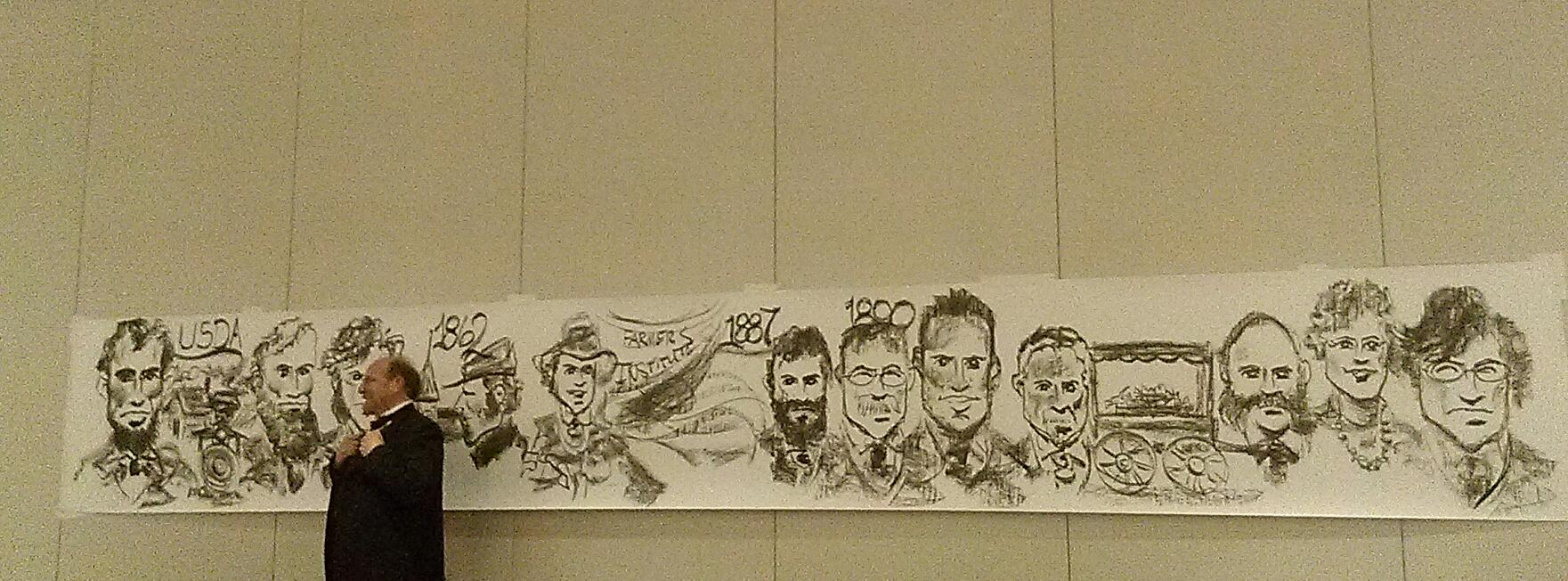
Presentation on the History of Cooperative Extension by a North Dakota State University alum where he does charcoal drawings as he speaks. I had seen this at an NACAA conference in the past; he is so talented!
Sessions included discussing how to determine public value of what we do and the debate continues to be how do we extrapolate information and who gets the credit. I think Nebraska is on track with much of what we do in this area as we’ve had many similar discussions here. There were also discussions about the relevance of Extension and the need to share information several ways; again, I think we have people in Nebraska leading the way in this effort. But it is critically important for ALL of Extension to be repackaging our information several ways to reach our customers where they view information.
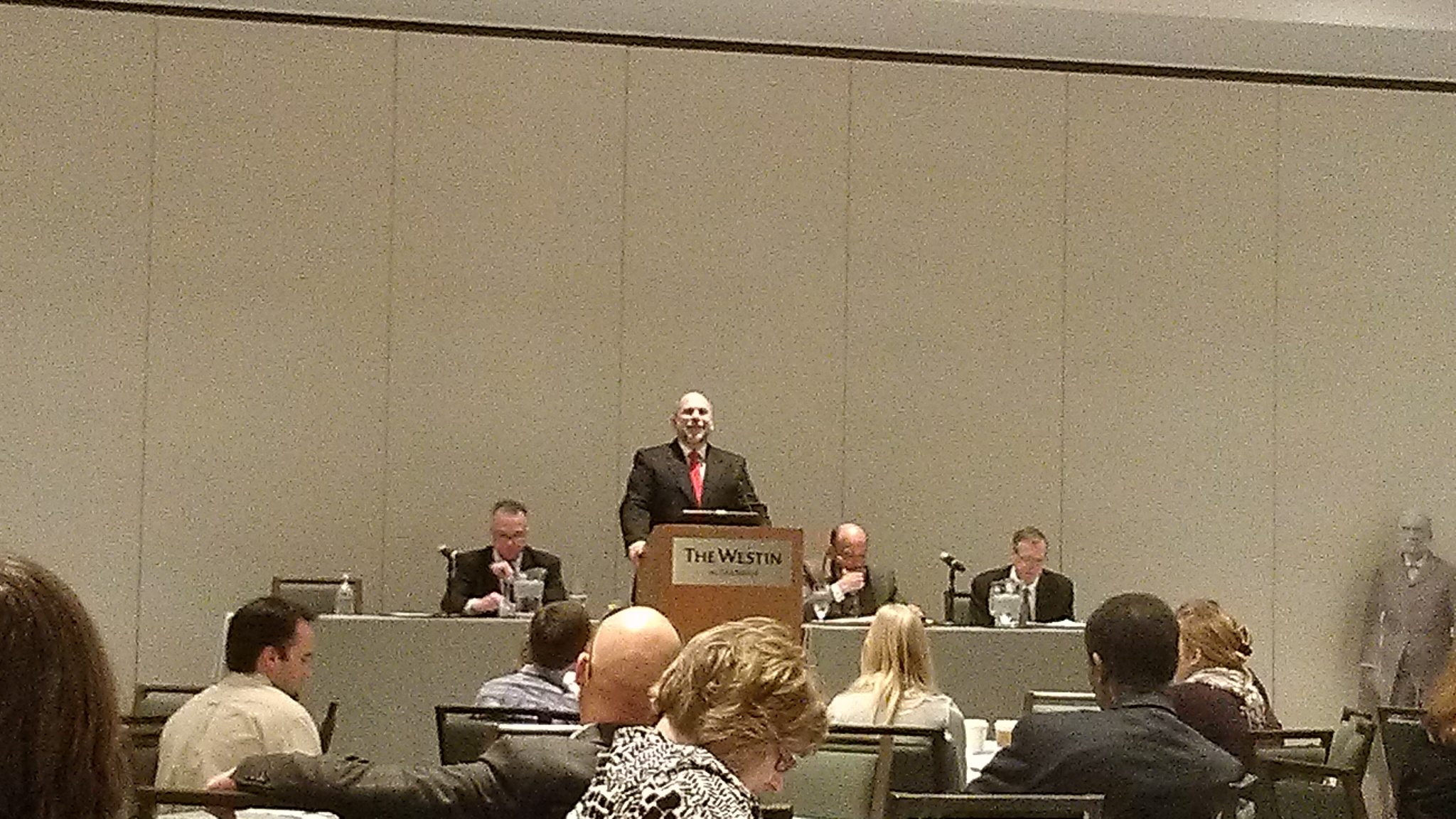
John Wilson presented on the Missouri River Flood in a panel discussion regarding controversial issues in Cooperative Extension. He did a great job as always! Additional controversial issues included fracking and the oil boom in other states.
We had the opportunity to interact with National Institute of Food and Agriculture program leaders to express the critical needs for the people we serve in hopes of influencing where research and extension initiatives should be focused in future grant releases. We also spent a large portion of time discussing different bills of importance to all of our States and determining the key messages we wished to share on the Hill with our Congressmen and Senators.

Wednesday was the highlight for me. On Wednesday, each State visits their Congressmen and Senators on the Hill. The Ag Section rep typically sets up the visits, so I was thankful for my experiences in organizing CWF trips! We began the morning at the Nebraska Breakfast and had the opportunity to visit with Senator Fischer immediately afterward. We had the amazing opportunity to meet with all of our representatives and/or their staffers that day: Congressman Smith, Senator Johanns, and then Monte and I split up so he visited Congressman Terry’s Office while I visited Congressman Fortenberry’s Office. In between we also had a Capitol tour and visited the Senate Gallery as Monte and Pat had never experienced that before. It was a wonderful day with great visits sharing the great things Extension has done and continues to do for the people of Nebraska! Our Senators and Congressmen also supported the Smith-Lever bill for recognizing 100 years of Cooperative Extension, so we were happy about that!

Lincoln Memorial during night tour of memorials and monuments the first evening-always neat to see.

We had an amazing seafood supper during one of the evenings with Dr. Hibberd who graciously paid for our meals.

It was an honor to represent the Nebraska Ag Agents at the 2014 PILD Conference and I thank our Ag Section and Dr. Hibberd for paying my expenses for this trip! This photo is of cherry blossoms with the Washington Monument in the background.
Crop Update 8/1/14

Southern rust of corn confirmed in Clay County July 31. Very small, tan-brown lesions on upper surface of the leaf, usually in clusters. Spores inside the pustules are typically orange. This was found on one leaf in a field near Trumbull. Just because southern rust has been found in the area, we don’t recommend automatically spraying. Scout your fields and consider disease pressure, growth stage, and economics. Long season corn and late-planted fields have the potential for most damage. Secondary common rust sporulation has also been confused as southern rust as the secondary pustules tend to look like this. It’s important to obtain microscopic confirmation to know for sure if you have southern rust in your fields.
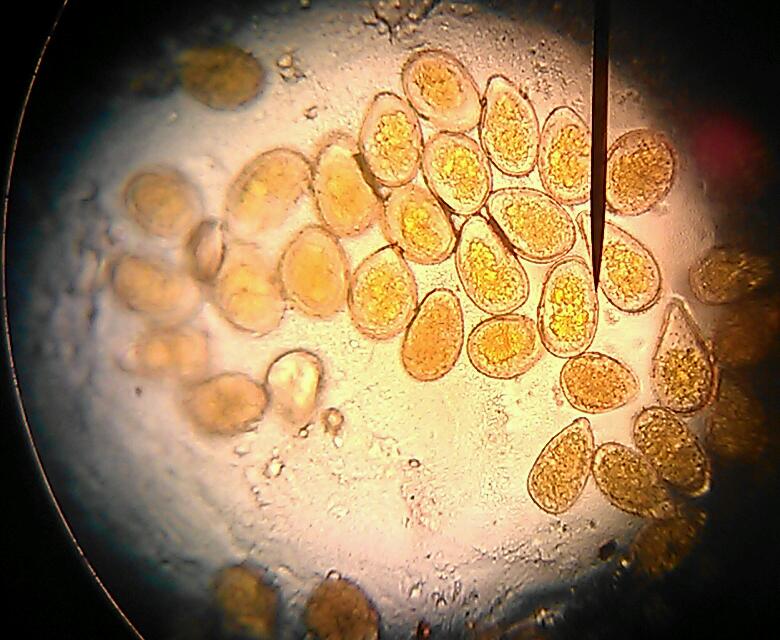
Microscopic Observation: Spores of southern rust appear elongated vs. common rust appear as near perfect circles.

Another common problem is old common rust lesions being confused as gray leaf spot. The color of this lesion is a tan-gray, typical of gray leaf spot. Using backlighting or a handlens, you can see the pustules within this lesion confirming it is common rust and not gray leaf spot. I’ve had many calls that gray leaf spot was up the entire plant in their fields and after looking at fields, have found it to be common rust in most situations. It’s important to know what disease you truly have to make the best decision on fungicide application.
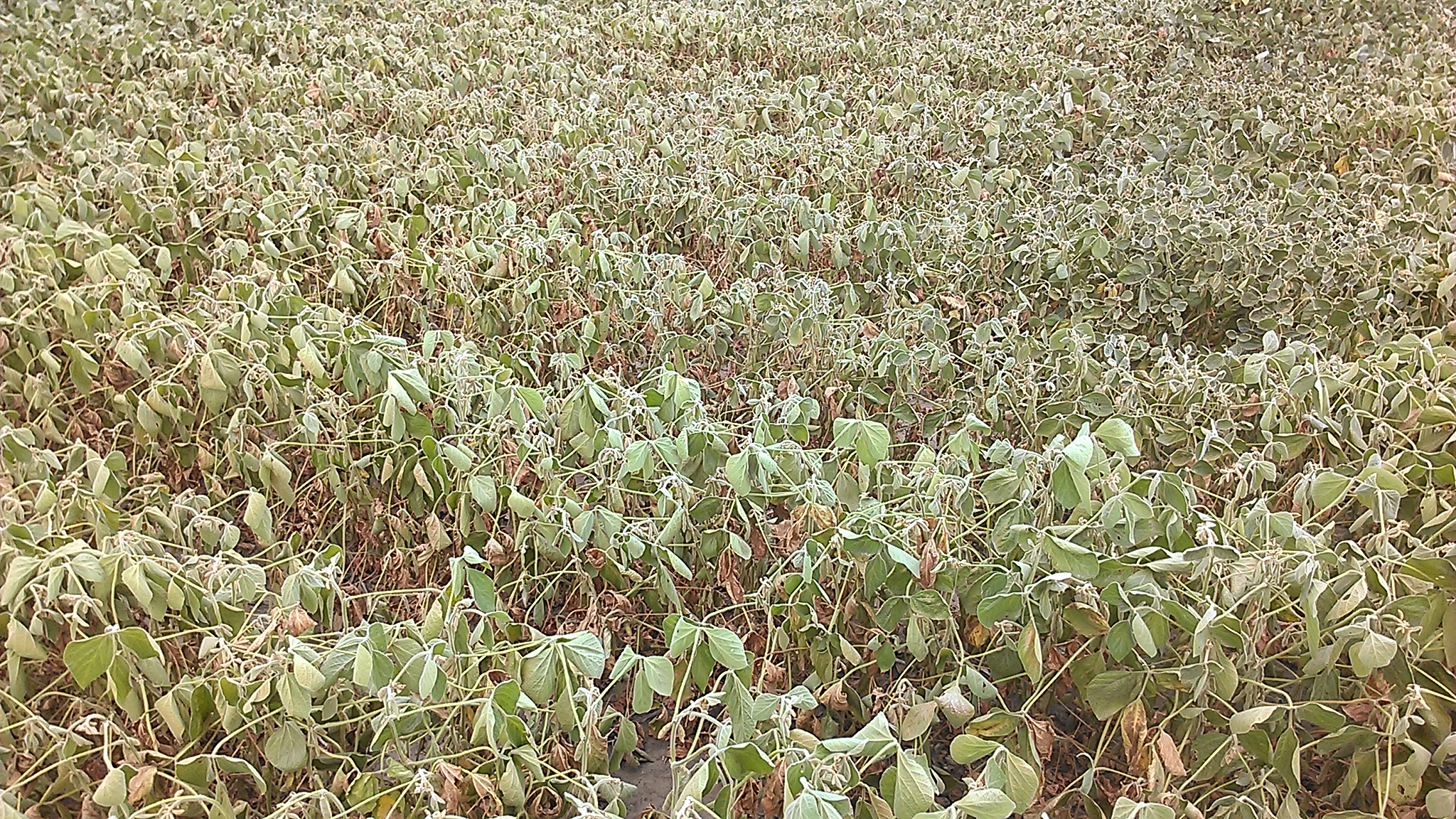
Have also received questions on soybeans, particularly in dryland. This photo is showing drought stressed soybeans-often occurring in pockets within dryland fields right now. Closer observation shows plants aborting pods and losing lowest leaves. Spidermites can also be viewed on leaves in some of these patches.

Dryland corn showing stress as well. June rains were making for dryland crops with potential, but also led to shallow rooting. Crops could use a drink right now….but would prefer no more hail and tornadoes. The storm that hit Clay County so hard occurred one year ago today.
Alabama Agriculture-What I learned

At our first stop, this farming operation had fields where peanuts were strip cropped between rows of pecan trees (shown in background). The farming operation went from around 1500 to 900 pecan trees after the hurricanes in the 1980s. The pecan trees were around 80 years old.
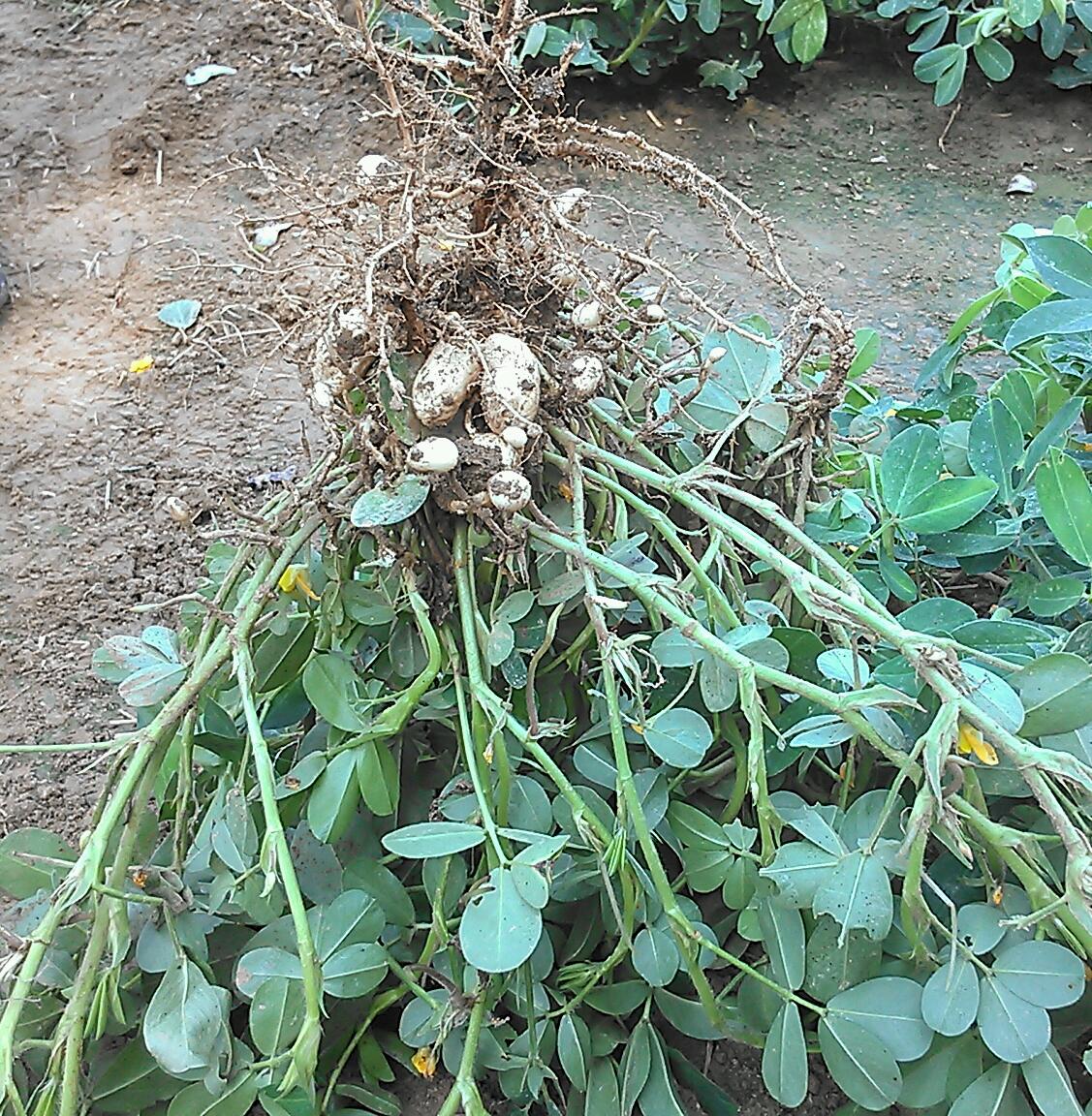
Peanut plant up close. The soils in this part of Alabama are highly acidic and peanuts like a pH between 5.8-6.8 and well-drained soil, so the producers add quite a bit of lime. Different maturities of peanuts are grown so they’re harvested anywhere from September to October.
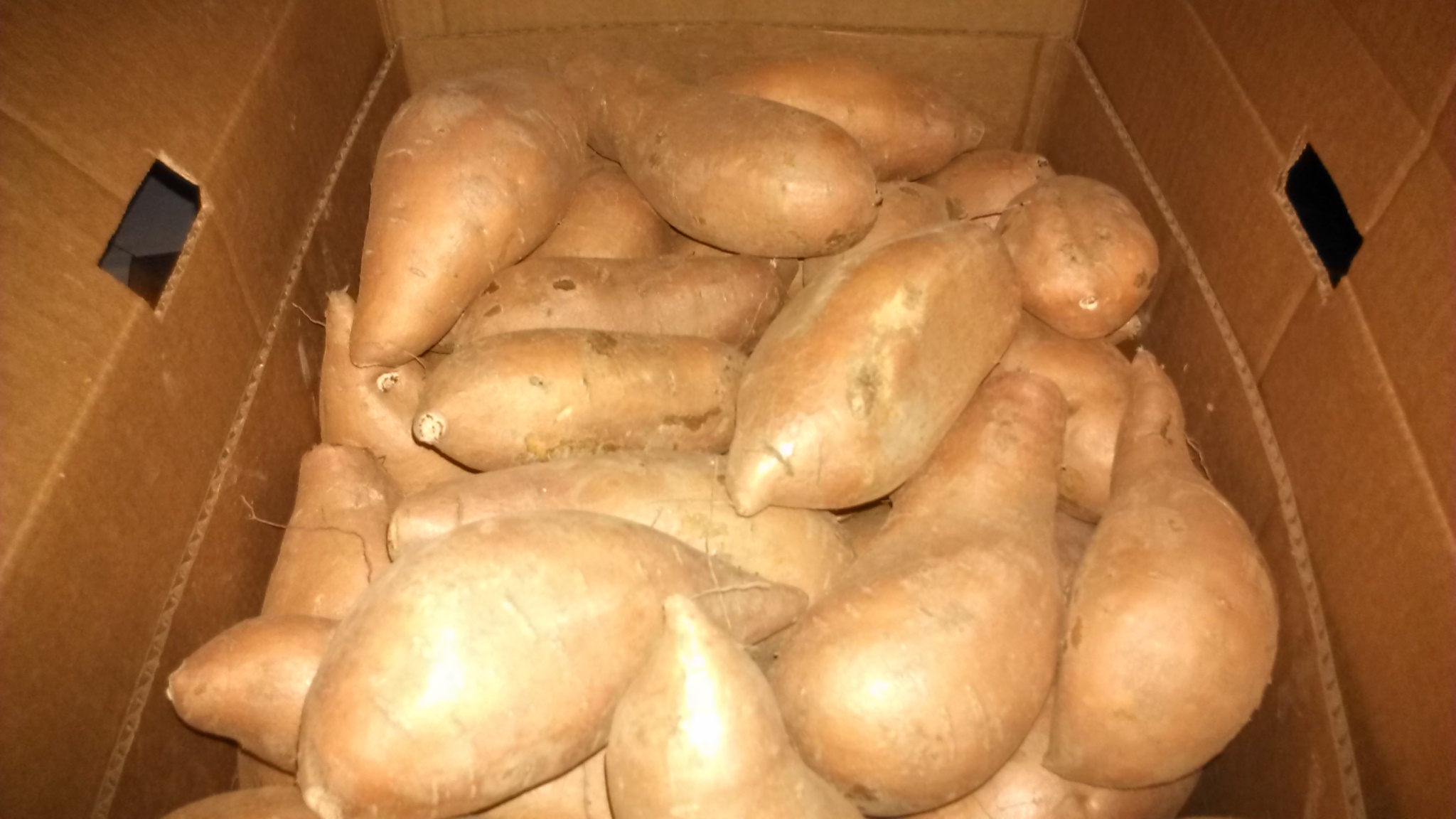
Sweet potatoes! I absolutely love to eat them 🙂 This farm had tried a variety of crops in the past and continues to grow cotton and peanuts as well for a rotation with the sweet potatoes. With low commodity prices for the other crops, sweet potatoes provided another source of income. They are planted mid-April and will be harvested early August this year. The smaller sweet potatoes will go to a canning facility. Potatoes have to be at least 2″ in diameter to be processed for sweet potato fries.

The nephew of the sweet potato farmer was interested in value-added herbs and greens. He put up this greenhouse 11 months ago and has been growing hydroponic greens and herbs for high end restaurants and supermarkets.

A cotton plant. Cotton is actually in the hibiscus family and can get 5-7 feet tall. Growth regulators are used to keep the cotton short so more energy goes into producing cotton instead of vegetative material like leaves and branches. While not easily seen on this picture, the “squares” are where each cotton blossom and seed will be produced.

Auburn Extension Specialist explaining how a cotton plant puts on a new node (where flowers and seed are produced) about every 3 days. He was also showing the shortened internode length due to adding growth regulators to the cotton. Cotton was often no-tilled into wheat. They have similar findings as we do here regarding the improved yields of crops following wheat in dryland. Although, interestingly, they receive on average 66″ of rain a year and Mobile, AL has surpassed Seattle as the rainiest city in the U.S.
Hail Damage Meetings
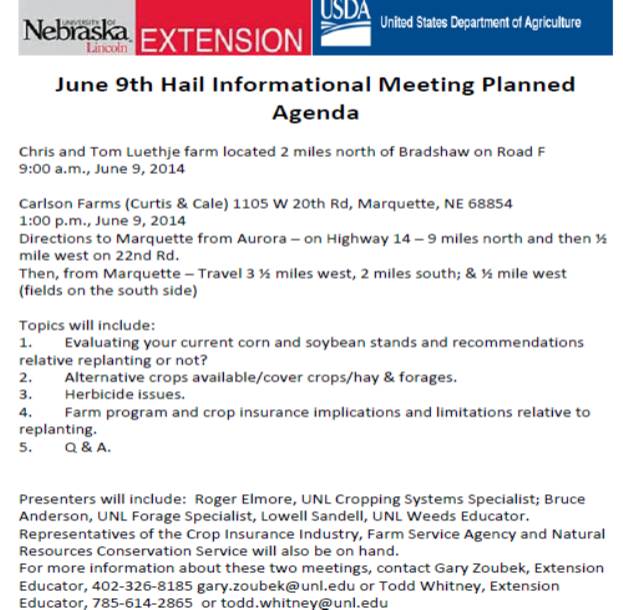
Hail Damage Meetings in York and Hamilton Counties. Please click on image to enlarge.
Edible Landscaping

There’s been increased interest in growing vegetables, flowers, and herbs together. Learn more about this in our Edible Landscaping workshop on May 8th at the Clay County Fairgrounds in Clay Center! Please RSVP by May 5th and hope to see you there!!!
Still Time for On-Farm Research!
With the recent rains and cooler weather in the State, producers still have an opportunity to consider conducting an on-farm research experiment that may be of interest to you! So far this year we have producers conducting nutrient management, irrigation timing, cover crop, seeding rates and dates, fungicide timing, and studies of various products on the market including sugar products. You can learn more about conducting on-farm research at our Nebraska On-Farm Research Network Website, our On-Farm Research Grower’s Guide, by Contacting a UNL Extension Educator or Specialist, the Nebraska Corn Board at 402-471-2676 or Nebraska Corn Growers Association at 402-438-6459. You can also learn more from our producers themselves in the video below. We hope you will consider conducting on-farm research this year to answer the questions you may have in your operation!
Proper Tree Pruning
Special thanks to Dr. Scott Dewald for the wonderful evening of information he provided at our tree care workshop last week!

Scott Dewald explaining what to look for when considering pruning a tree. Scott shared that one should never prune more than 1/3 the height of a tree in one season. Pruning should also be done to obtain a main leader and overall structure. It’s also best not to prune limbs more than 2″ in diameter. If the limb needs to be pruned but it encompasses more than 1/3 of the limit of what should be removed in a season, one could “head” the limb by removing a portion of it one year and then complete the cut the following year. This will slow the growth of that limb.
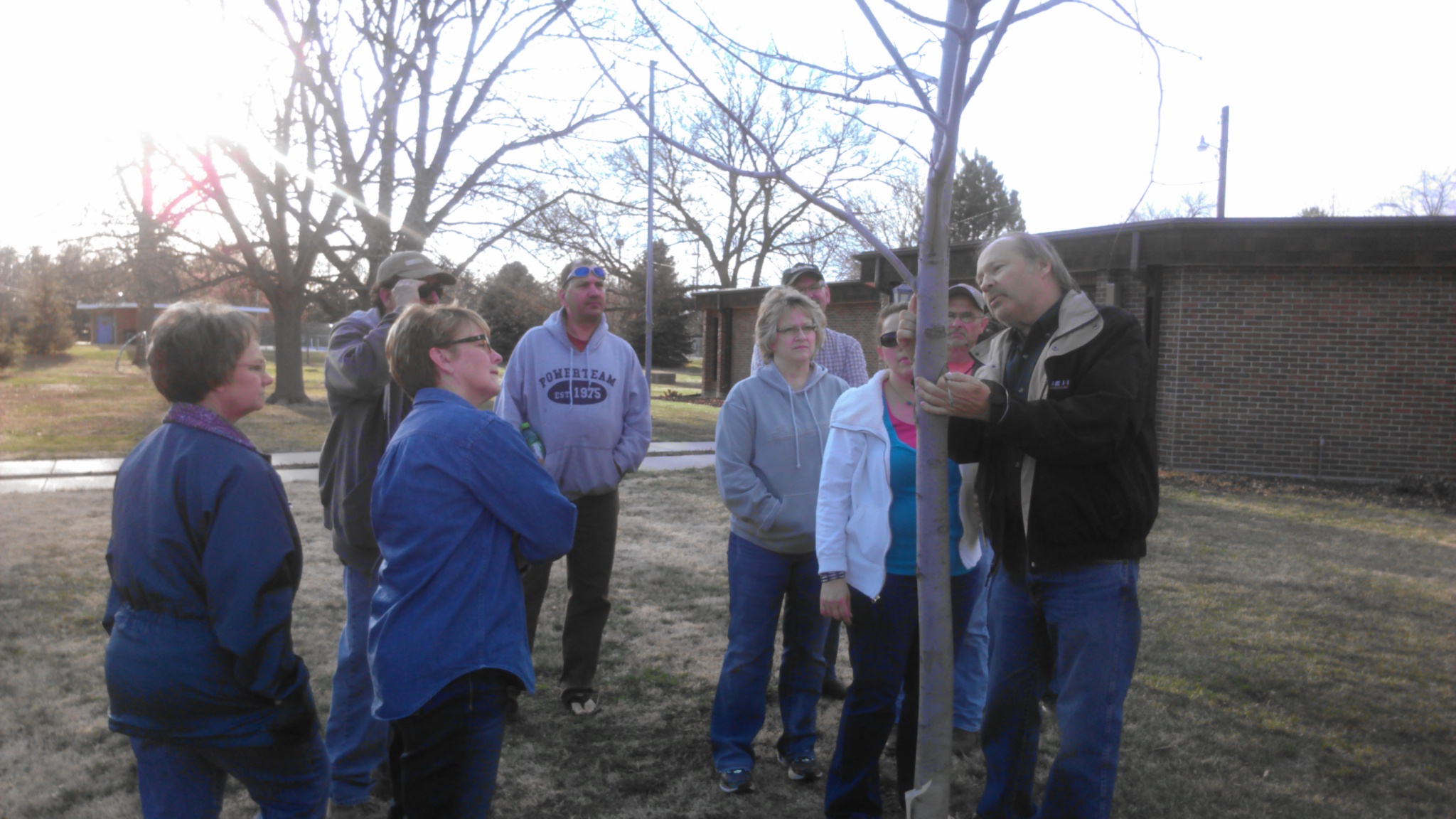
Pruning cuts should always be made at the “bark collar ridge” which produces a round cut and allows the tree to naturally heal. Scott shows attendees where the bark collar ridge is on this branch.
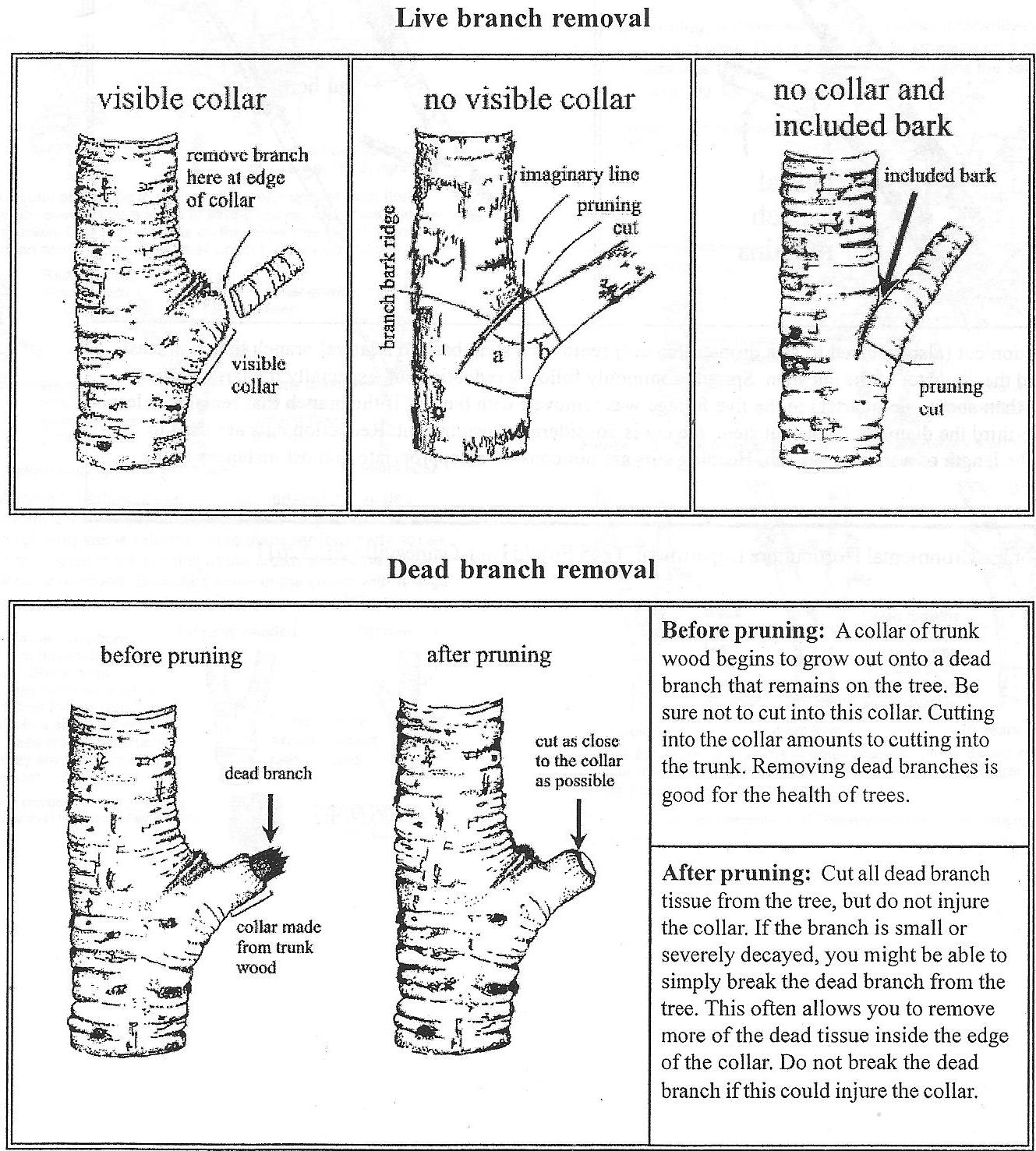
Pruning Fact Sheet ENH847 from University of Florida Extension written by Edward Gilman with good visuals of where proper pruning cuts should occur.
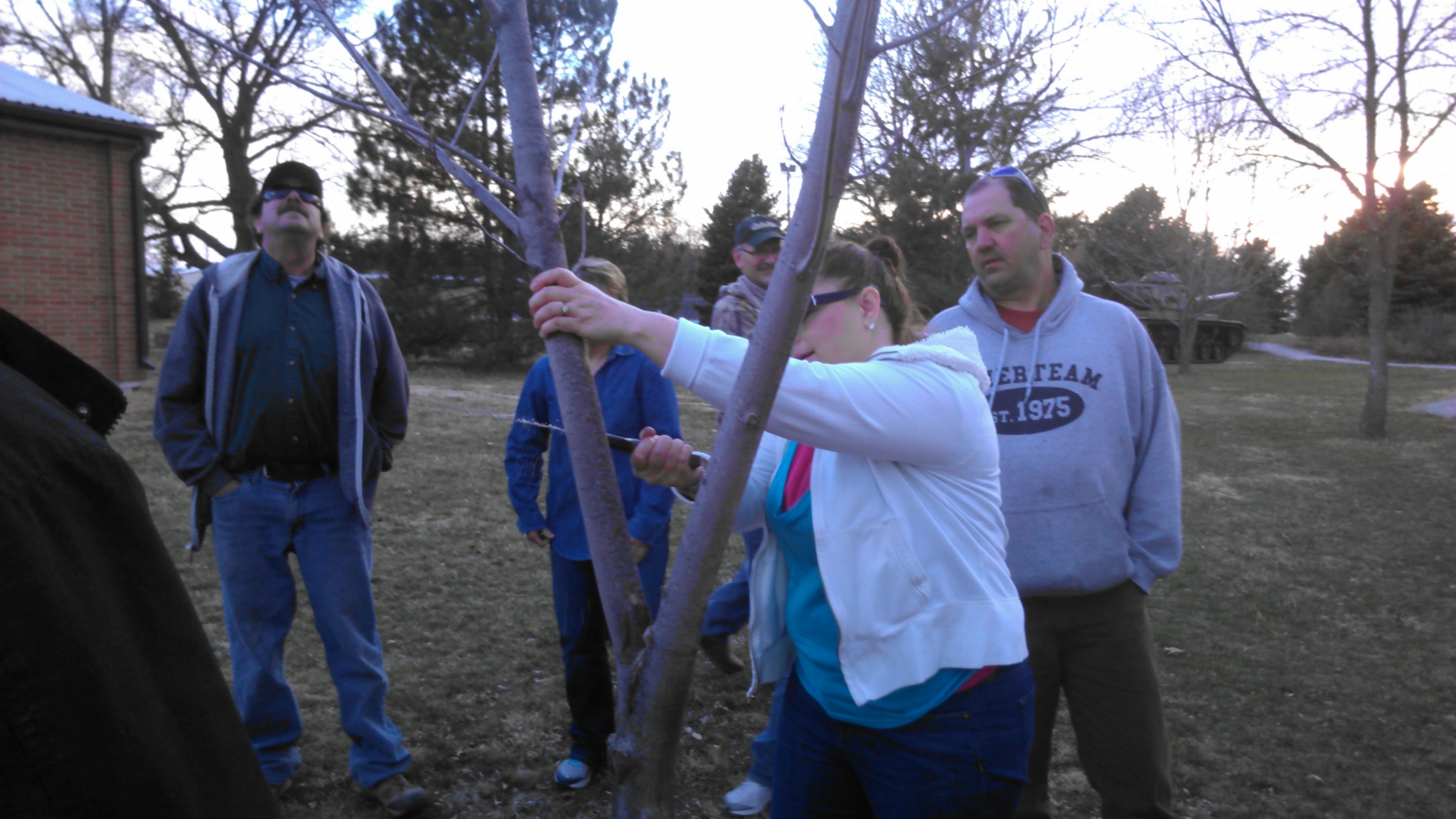
We learned that on large branches, it’s good to make a cut farther out to remove the weight first, and then go back and make the proper cut at the bark collar ridge. Improper pruning can result in further damage to the tree. Here we were trying to correct this tree for not having a main leader. Typically one would leave the southern-most branch according to Scott, but in this case, the northern-most branch was stronger. Scott said there was no need to stake the tree or try to get the northern-most branch to straighten out as it would naturally do this in time on its own.

After a large part of the branch weight has been removed, this attendee is now making the proper cut at the bark collar ridge.
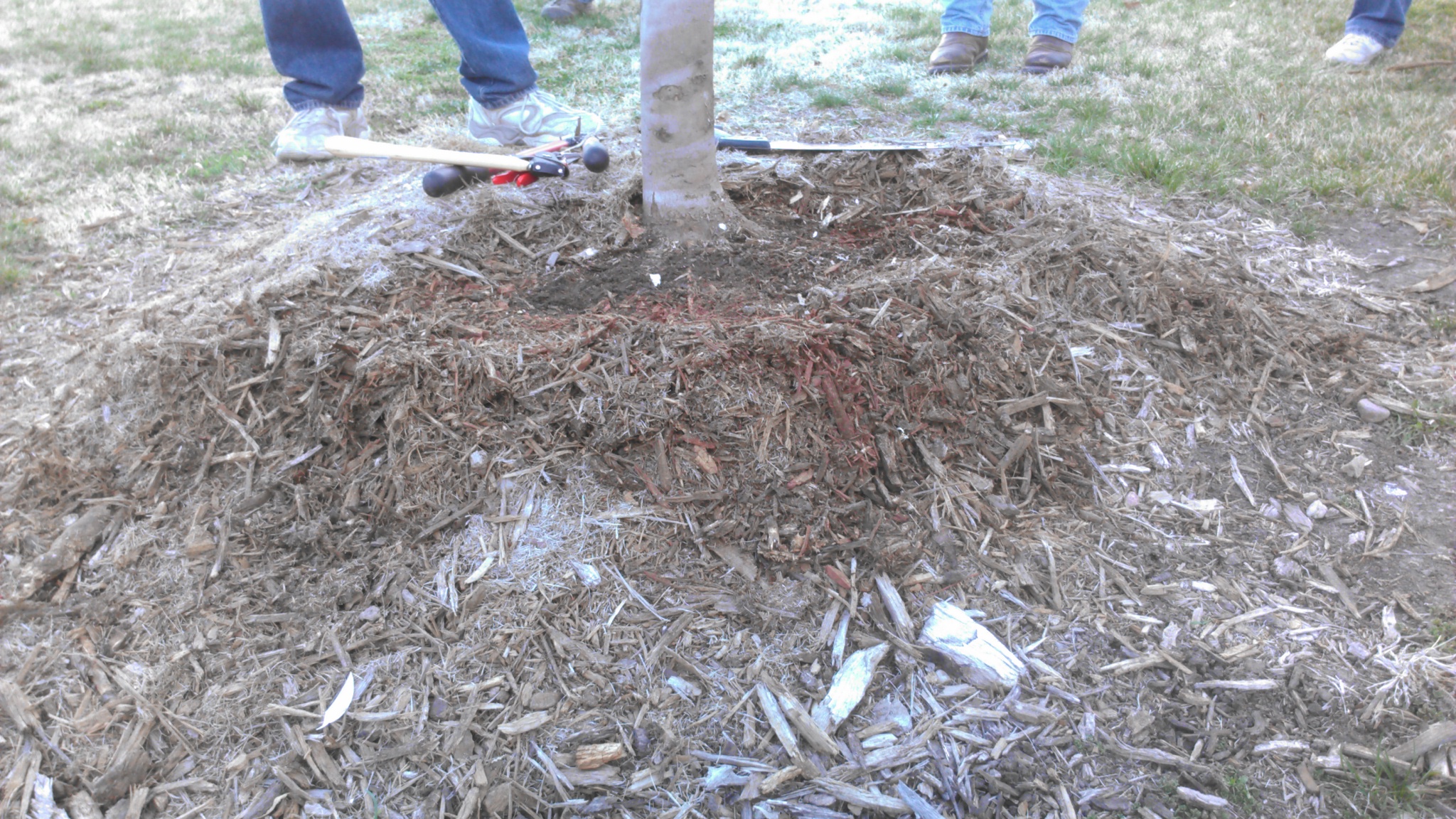
We also walked from tree to tree in the park looking at additional problems. I noticed how high the mulch was piled on some of the trees. Mulch should never be placed against the base of the tree as it can cause rot. But in this case, it was observed that the person who planted the tree did not dig a deep enough hole. What appeared to be a pile of mulch was the actual root ball and soil mounded up above ground.

This situation also most likely was a result of improper planting. In this case, the tree roots began wrapping around the base of the tree girdling it (like choking it).

This is the most common problem I see with tree calls. A huge enemy to trees are weed whackers! In this case, you can see extensive damage to the bark and the base of this tree. Depending on the damage and how well the tree can seal the wound will depend on if the tree will survive or not. Often, as in the case of this tree, the tree will be weakened with few leaves appearing on branches. It’s best to place mulch around trees in order to avoid having to use weed whackers on them-but again, don’t place the mulch up against the base of the tree!
This was a fun workshop for me with the right size of group and great hands-on demonstration where we also learned from pruning mistakes and how best to correct them. Thanks again Scott!
Tree Care Workshop

The Memorial Day and August 1st storms of 2013 did significant damage to our trees in Clay County. This workshop is designed to provide demonstrations on pruning techniques, what to look for, and learning how care for your storm damaged trees in future years. There is no charge and all are invited to attend. Please spread the word as many trees were damaged last year!


 JenResources