Blog Archives
JenREES 8/6/23

Thank you to everyone who made the 150th York County Fair a success! It was a fun fair celebrating the 150th with displays of previous exhibitors and fairs through the years, special events like alumni showmanship, ice cream, and the special awards. These milestones are quite a legacy and perhaps the current 4-H/FFA youth will be able to celebrate 200 years one day? Wishing everyone the best with the Seward County Fair this week as well! This week sharing on some upcoming events in August.
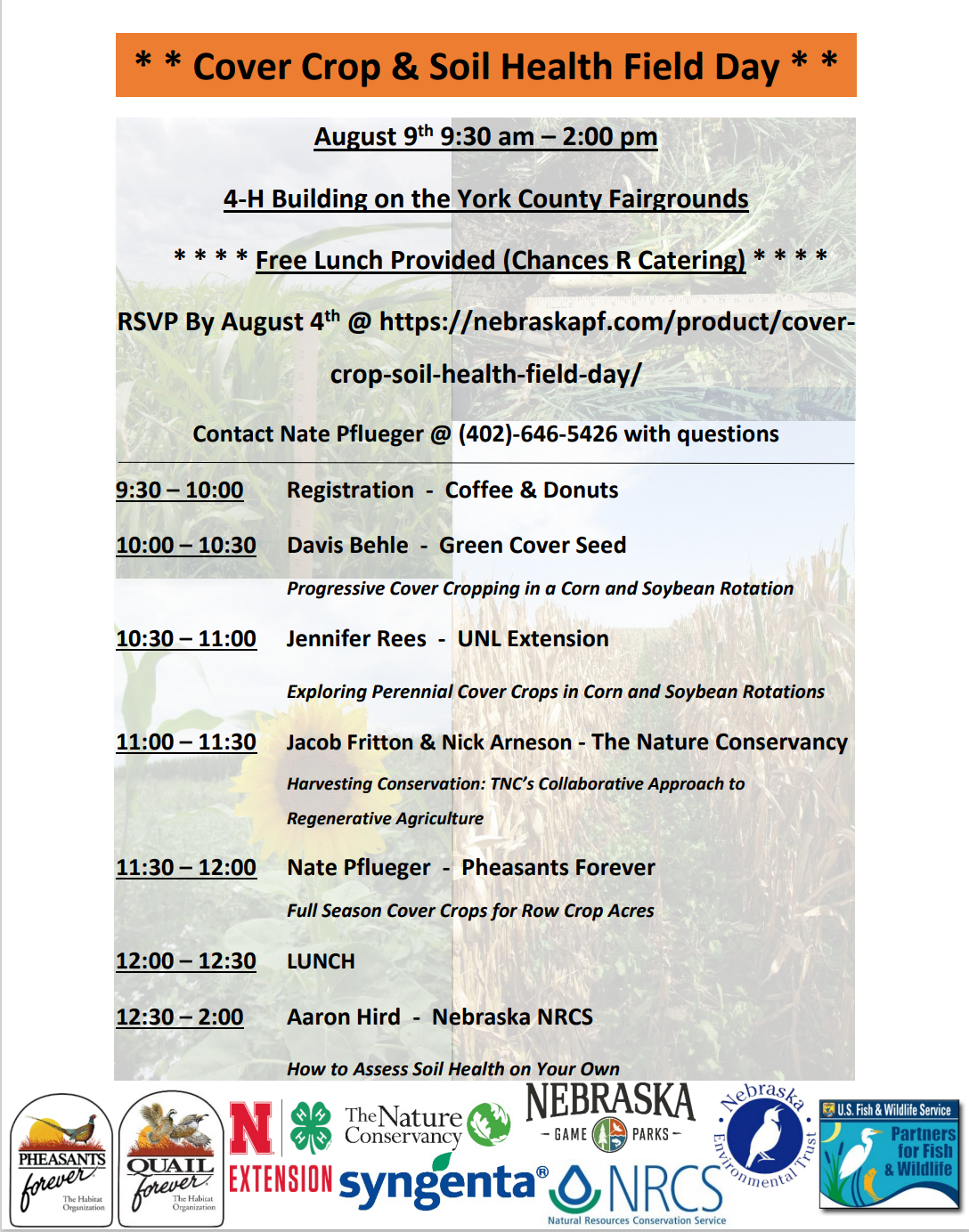
Cover Crop & Soil Health Field Day will be held Aug. 9th from 9:30 a.m.-2 p.m at the 4-H Building in York followed by field tours at Bob Bettger’s farm. Topics include: Progressive cover cropping in a corn an soybean rotation; exploring perennial cover crops in a corn and soybean rotation; presentation from The Nature Conservancy; full season cover crops for row crop acres; and assessing soil health on your own (which is part of the field tour). The event is free, but please RSVP for the meal to Nate Pflueger with Pheasants Forever at 402-646-5426.
Soybean Management Field Days will be held this week: Aug. 8 near Rockville, Aug. 9 near Concord, Aug. 10 near Mead, and Aug. 11 near DeWitt. This year is 25 years of SMFD with topics including sprayer cleanout and setup; disease and insect management; cover crops and soil health; irrigation & technology; and grain markets. The event is free thanks to the Nebraska Soybean Board but please RSVP for meal count to https://enreec.unl.edu/soydays or to 402-441-3240.
Soil Health and Cover Crop Field Day will be held Aug 22 at Eastern NE R&E Center near Mead from 9 a.m.-2:50 p.m. (Reg. 8:30). The field day is co-sponsored by UNL and Cargill with topics on assessing soil health and summer cover crops. Equipment demonstrations will include a Highboy interseeder and roller crimper in the field followed by a tour of the UNL biochar study. No charge. More info. and RSVP for meal at: https://go.unl.edu/bosp.
Southeast NE Alfalfa & Wheat Expo will be held Aug. 24 from 8:45 a.m.-3:30 p.m. (Reg. 8 a.m.) in Crete. The morning topics are focused on wheat while the afternoon ones are focused on alfalfa. Wheat topics include: UNL breeding program, seed treatments, wheat production, round table discussion. Alfalfa topics include: variety selection and planting dates, insect management, alfalfa as protein supplement in fall. More info. at: https://croptechcafe.org/alfalfawheatexpo/.
Corn and Soybean Clinics will be held Aug. 29 in North Platte and Aug. 31 at ENREEC near Mead from 9:30-3:20 p.m. (Reg. 9 a.m.). The clinics are designed to walk through the growing season addressing critical agronomic developmental events in corn and soybeans in addition to diseases, weeds, insects, nutrients, and irrigation management while being out in the field. 4.5 CCA credits are available. More info. and RSVP: https://extension.unl.edu/statewide/enreec/nebraska-corn-soybean-clinic/
Hamilton Co. Corn Growers will have their plot tour on Aug. 28th at 5 p.m. near Giltner (1/4 North of Rd 6 and J). A meal sponsored by Bayer Crop Sciences will follow at 6 p.m. at the Giltner Community Center. Featured speakers are Chuck Woodside, CEO KAAPA Ethanol with updates from Nebraska Corn and Hamilton Co. FSA.
York Co. Corn Grower plot tour and annual banquet will be held on Tuesday, August 29th beginning at 6 p.m. at Stone Creek Event Center in McCool Junction. Please save the date and plan to attend as we combine our plot tour with the annual banquet! Everything will be held at Stone Creek. At 6 p.m., seed reps will share on the hybrid entries they submitted in the plot followed by a social time at 6:30 p.m. and prime rib meal and program at 7 p.m. Cost is $15 for the meal. Please RSVP to York Co. Extension (402) 362-5508 or any York Co. Corn Grower director.
JenREES 7/23/23
Grateful for the rains we had earlier in July for green-up of plants and allowing some to take a little break from irrigating and for beautiful cooler weather during pollination!
Crop Update: There’s no southern rust yet. Minimal common rust, minimal GLS lowest leaves, minor northern corn leaf blight in some canopies. Mostly bacterial leaf streak from wind/hail and also physoderma brown spot which is common once pollination occurs.
Hail Damage Follow-Up: I would describe this week as a roller coaster for all dealing with hail damage again. Each passing day makes decisions more difficult because we’re running out of growing season. First, the fact that you’re going back and forth on decisions is normal-none of us knows the best decisions right now or how this season will end. I’m also grateful to hear how many are seeking input from others! The fact that all our farmers are weary from the stress of drought, irrigating since planting, and now some having to replant is real. The fact that some of you are at the point of being ‘done with trying to do something with damaged fields’ is also a common theme. Conversations I’ve had if it helps:
Beans: I can’t guarantee the beans you planted or are planting this week will make it, but a Group 2.0 or less will be close at this point. They are an easier option for some to get something covering the ground. You may feel better seeing something growing in a week.
Annual Forages: Lot’s of back/forth here. You should get enough growth for haying something like pearl millet or sorghum-sudangrass yet, but in the event you don’t, there’s always the option of grazing. I’ve mostly recommended this option for people who have livestock, have someone who wants to graze, or are more familiar with annual forage from an equipment, etc. perspective. I don’t foresee a problem with ‘getting rid’ of forage. If this seems too risky as we approach August or you’re too exhausted to consider this, go with the next options instead.
Ready to be Done but Want Ground Cover: I’m more concerned about palmer control than yields on these fields. We know how sickening harvest was last year. The ‘easier button’ at this point is to have someone fly or spread on something for you. There may be opportunities to use ground rigs from seed corn fields. You wouldn’t have to do anything with stalks right now.
- No livestock: If you want something to winterkill, options are a small grain like oats, brassicas like turnips/radishes, or if you don’t want the ‘divots’ from the bulbs, consider forage collards (more expensive). Rape is also an option. If you want something to survive winter, use rye or wheat.
- Livestock: The above are also options for those with livestock or those who may have someone to graze stalks. The stalks, regardless of height, can still be grazed at some point.
Hail Damage Recovery: Seeing new leaves on soybean plants. The problem is how many of these plants were close to R5 (beginning seed) at the time of hail. Fields that were R3 have more flowers coming, but fields that were in R4 or later are mostly just showing leaves with very few flowers. So, the pods that are currently out there are mostly it for what can be produced. For corn, in these fields with 25% or less tassels, pollination is spotty and poor. Some fields, there’s quite a bit of hailstone damage with mold already developing…I’m not trying to be a downer, just honest on what can be observed. Please take care of yourselves! Rural Response Hotline: 1-800-464-0258.
Field Days: July 31st at 7 p.m. is the Precision Fertigation Sunset Seminar at Jason Richter’s field on Road 8 between the York/Seward County line road and Road W in York County. This is an on-farm research study using the Sentinel Fertigation technology I’ve shared about…to apply fertilizer based on when the plant says it needs it using satellite imagery. Thank you to Jason for hosting! More info. and RSVP here: https://www.sentinelfertigation.com/sunset-seminars.
August 1 is the South Central Ag Lab Field Day near Clay Center from 8:45 a.m.-3:05 p.m. (Reg. at 8:30 a.m.). You choose the tours you attend from topics such as nutrient, disease, weed, irrigation, insect management. Noon speaker is Jackson Stansell with Sentinel Fertigation on “Reducing Nitrogen Use With Sentinel Fertigation.” RSVP at: go.unl.edu/scalfieldday.
August 3 is the Drones in Ag field day at the ENREC near Mead from 8 a.m.-2:30 p.m. (Reg. at 7 a.m.). This conference serves as a platform to exchange knowledge and experiences among participants. Topics include how to fly drones legally in the national airspace, including requirements to fly sprayer drones, practical uses of drones in agriculture, and tips and tricks to successfully use drones in a business. CCA credits pending. Details and RSVP at https://neata.org/.


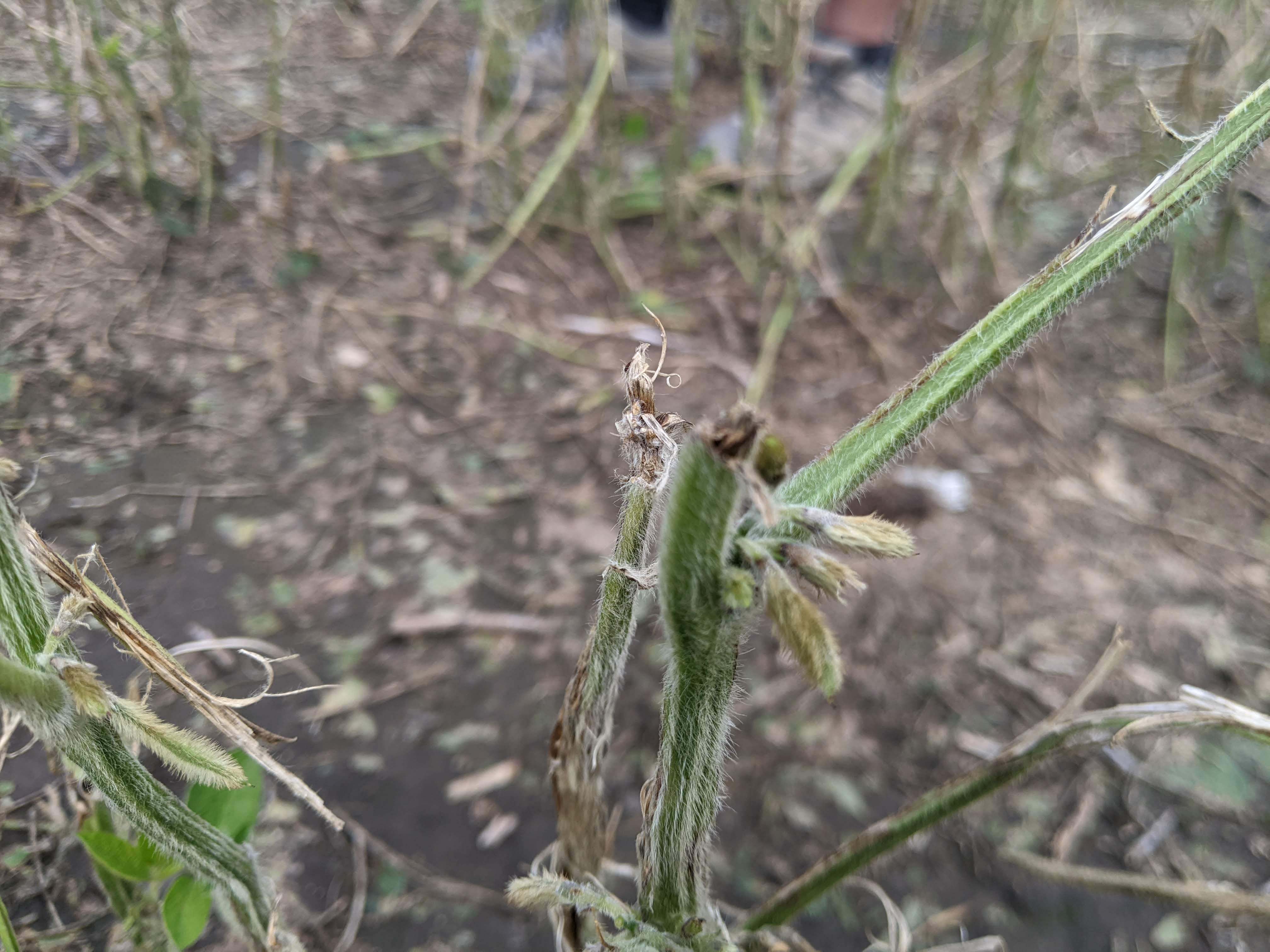
Anyone else seeing this? Hard to tell in the pic but tried to draw lines. I’m seeing the old check strips left from last year showing up as greener than the rest of the fields in these fields hailed again this year. Unsure why…more N perhaps there? Also showing soybeans with pods that survived the hail in different fields where I’m not seeing new flowers.
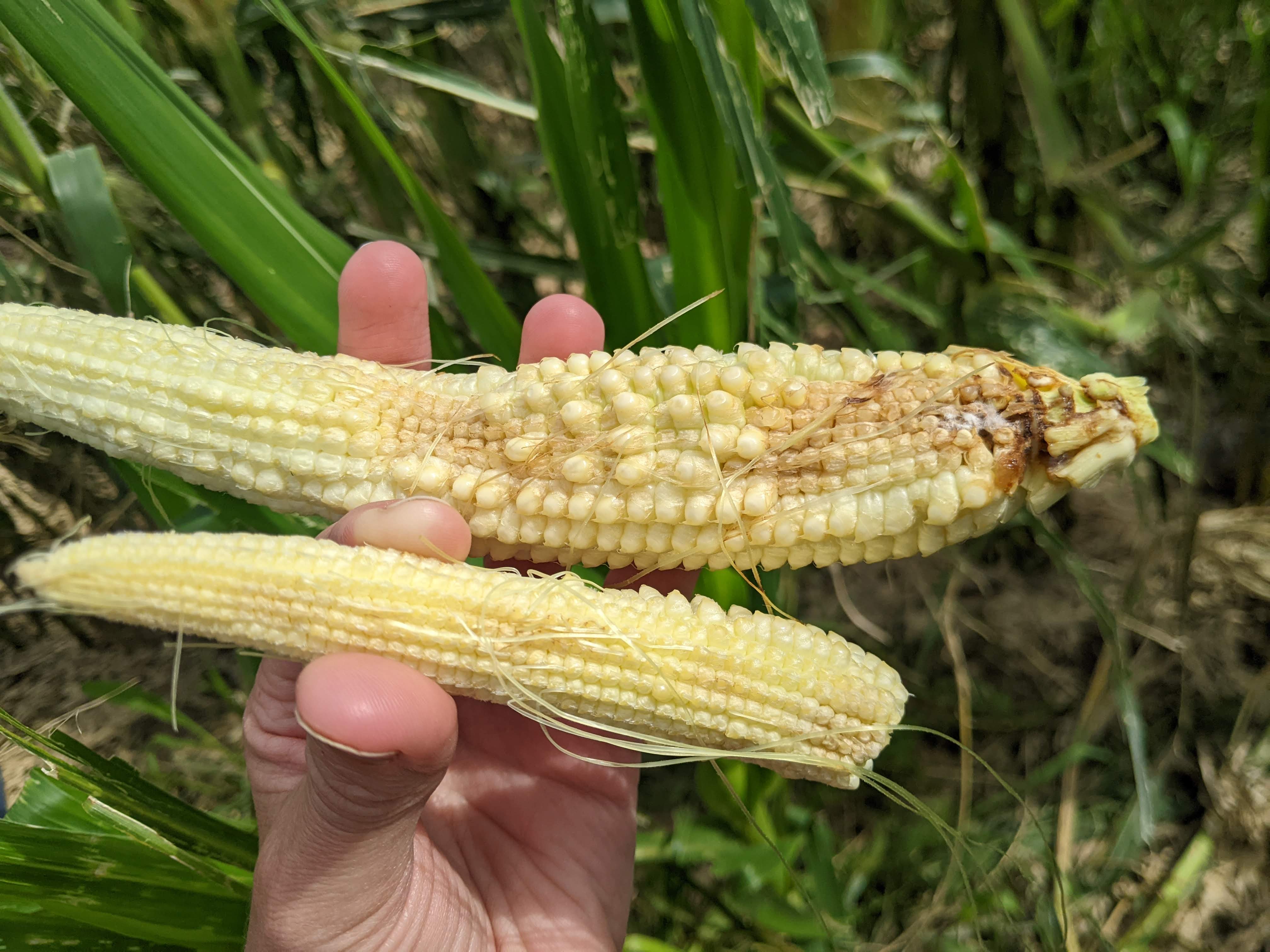
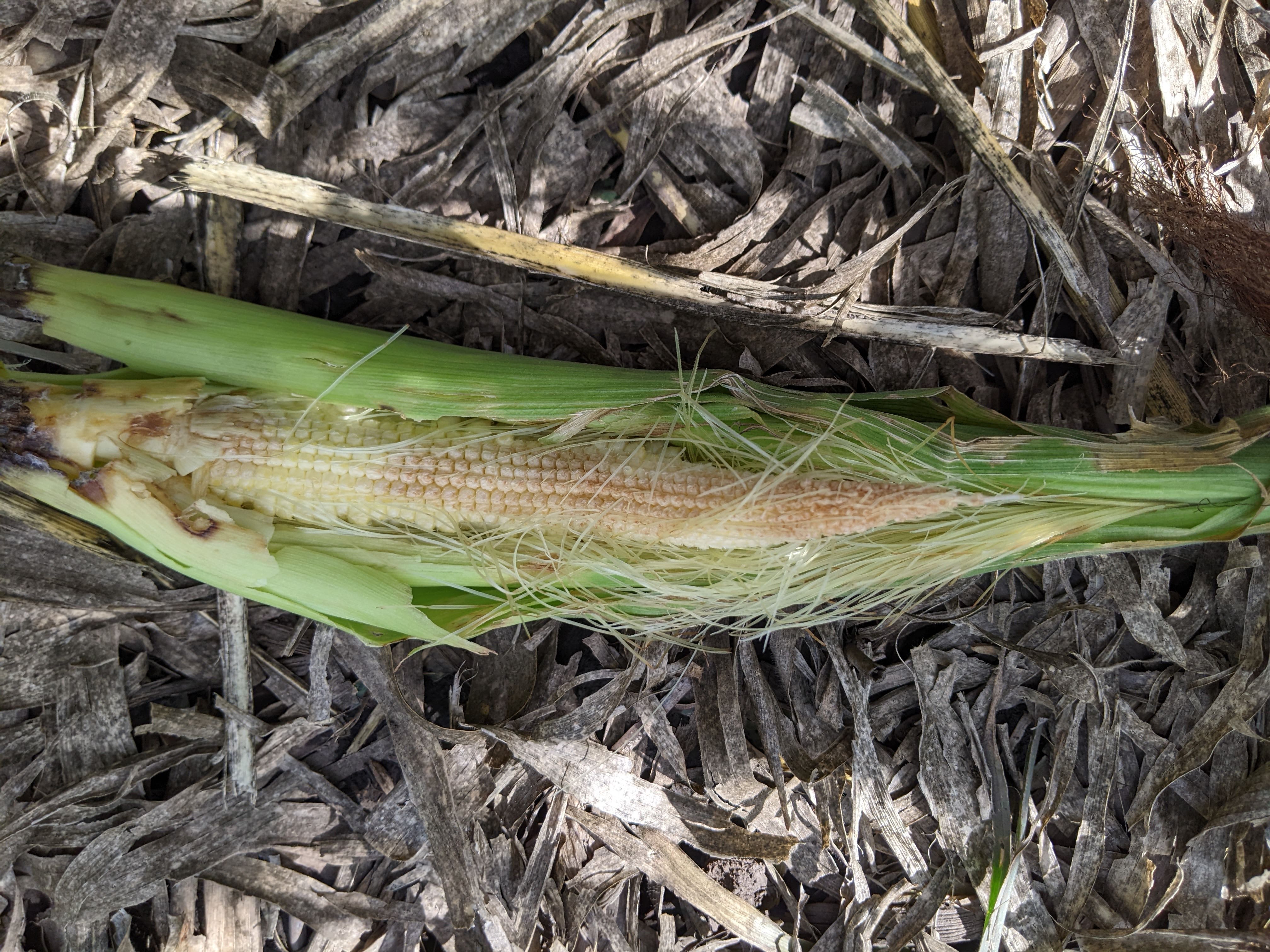
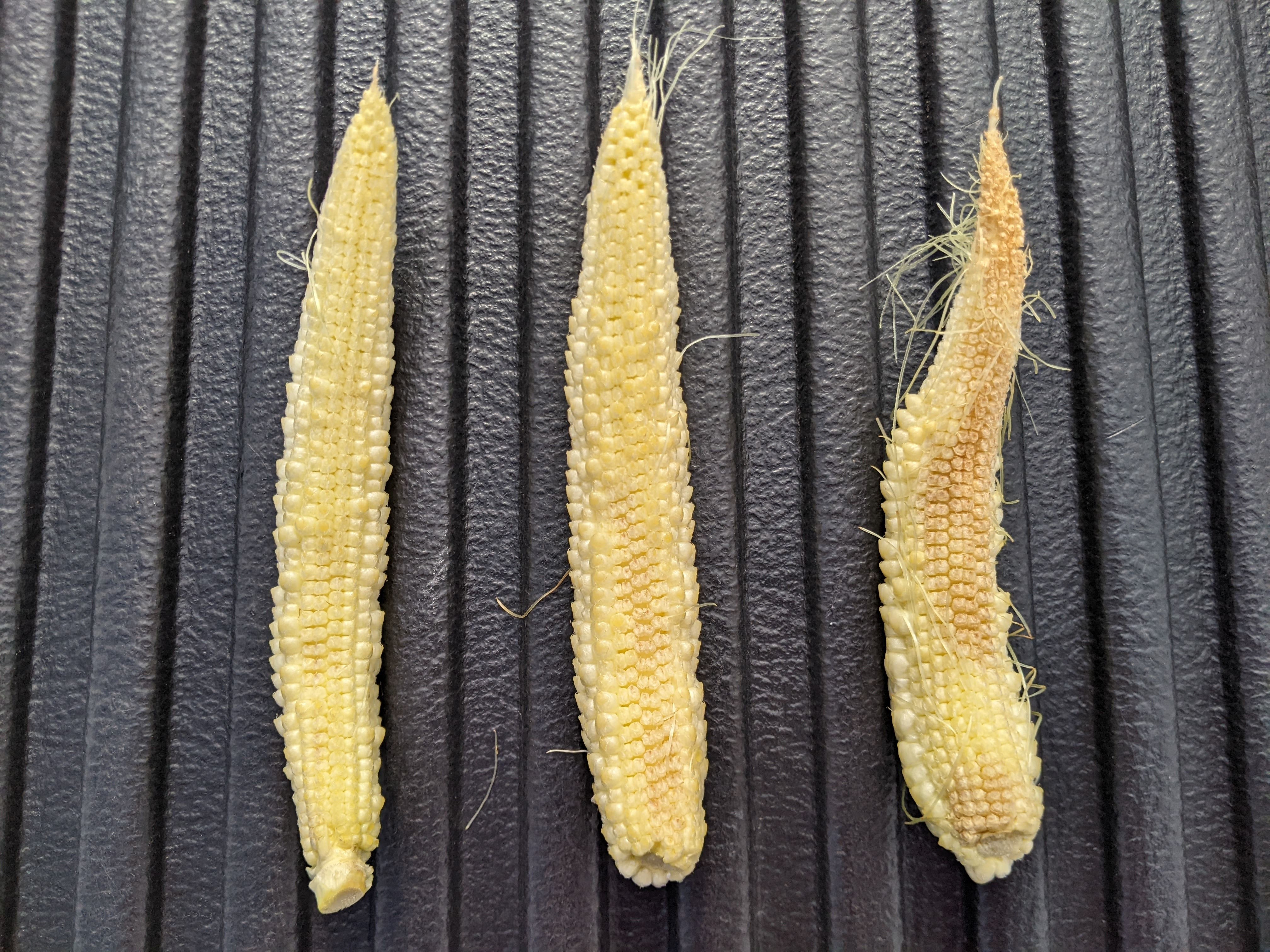
Can see pollination had occurred on some kernels showing blister development and a lot of ugly looking ears between lack of pollination and from hailstone bruising. The top ear already shows mold growth from Fusarium towards the ear base.

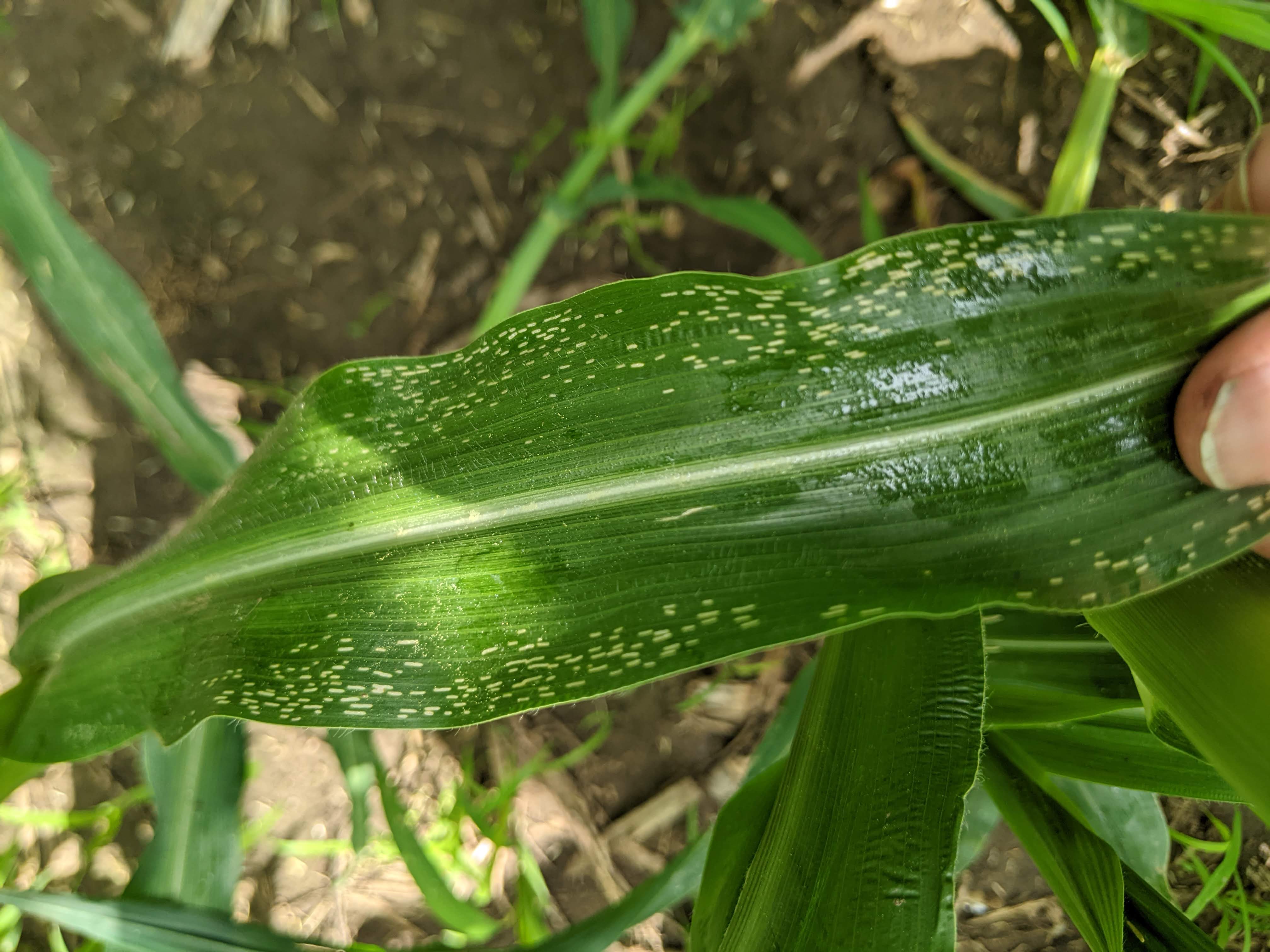
So far nothing to be concerned about regarding corn diseases in fields I’ve looked at. Bacterial leaf streak (above) fairly common in fields right now from wind/hail damage. When backlit, you will see yellow halos around lesions and it looks worse from the back-side of leaves-nothing to do or worry about. Below: Upper left is northern corn leaf blight (cigar-shaped lesions in mid-canopy of some fields); Gray leaf spot (typical rectangular lesion that I found 3 leaves above the soil and not above that); Below that is damage from corn blotch leaf miner adults when the female is making ovipositioning sites; larger lower picture is physoderma brown spot lesions (dark purple/brown spots along midribs, leaf axils and leaf sheaths and also orangish colored ‘bands’ of circular lesions on leaves since this pathogen moves with water. Notice on the top part of this leaf is a white streak that appears transparent; that is from corn blotch leaf miner larvae feeding.




JenREES 6-21-20
Crop Update: The National Weather Service in Omaha shared that it’s been the 2nd hottest June on record (150 years) and the 2nd windiest June (72 years). It’s truly taken its toll on people, plants, and animals. It’s also resulted in increased stress levels with much to be done (spraying, hilling/cultivating, fertigating, changing herbicide plans, etc.) as crops rapidly grow.
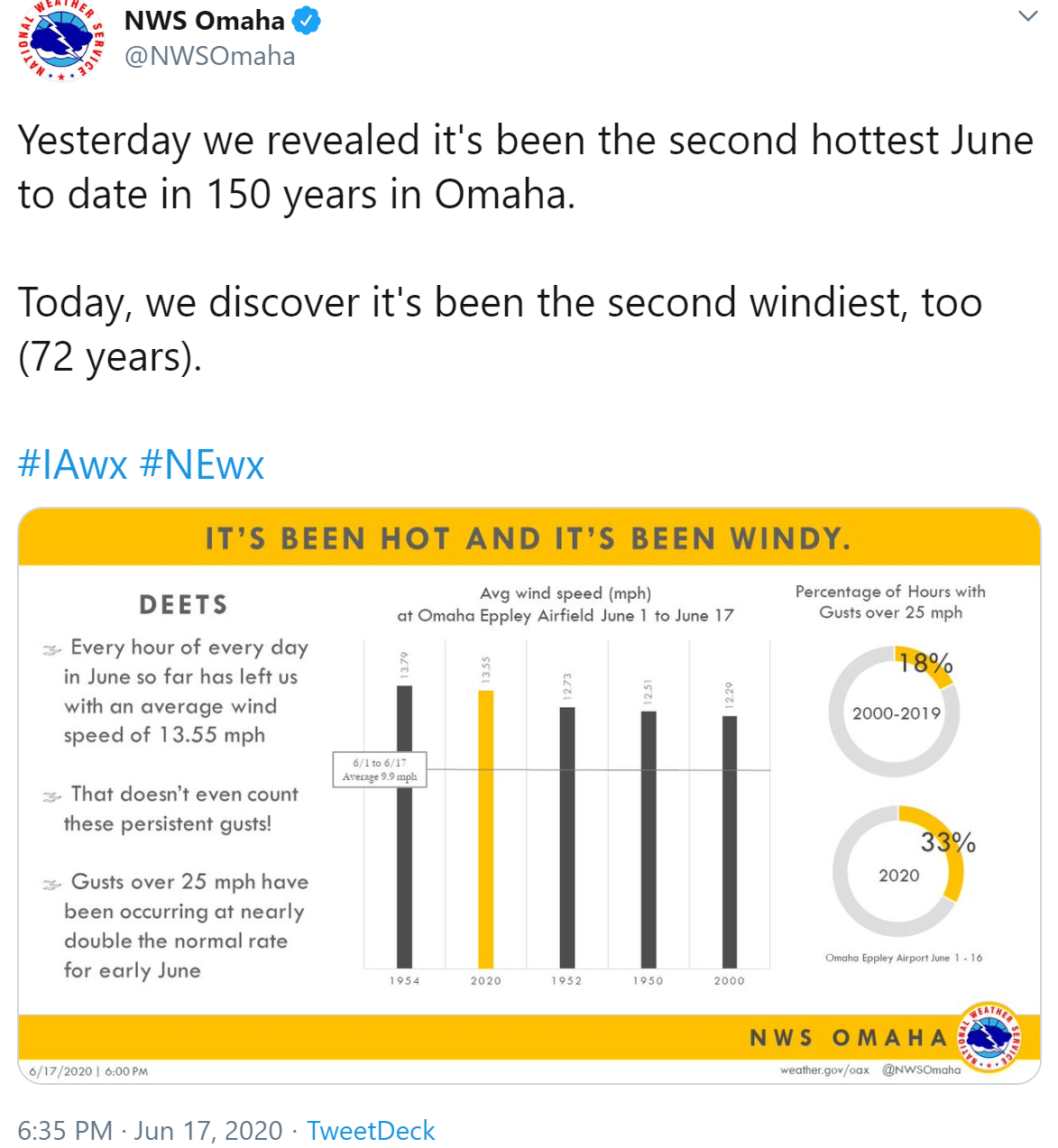
Tweet from NWS Omaha on June 17, 2020.
Since the Memorial Day rains, I’ve observed bacterial leaf streak (BLS) on corn in fields.
Bacterial leaf streak on susceptible hybrid this past week.
BLS has long, narrow, red/brown colored lesions that follow leaf veins. The lesions also have a yellow halo when backlit. Upon close examination, the lesion edges are wavy, which differentiate it from gray leaf spot. It started fairly minor, but some more susceptible hybrids are showing higher levels of lesions right now. There’s also been a number of whitish colored lesions on leaves from wind damage/sand blasting (if they

Been receiving a number of questions on white-colored lesions on leaves. Some are just due to wind damage. Some situations are herbicide related. A number of people are starting to notice BLS developing from these damaged areas on the leaves, particularly on more BLS susceptible hybrids.
weren’t due to herbicide situations). It’s from some of these wind damaged areas that BLS is also occurring. The bacterium causing BLS can infect directly through stomata; however, it can also infect through wounding. So the wind-driven rains and also high winds with sand blasting have also increased the incidence and severity of BLS in fields. Fungicides aren’t effective on it and it’s not known to result in yield loss.
Received a number of field calls/questions regarding herbicide application problems. Also recognize the challenge in figuring out a plan B, C, or D with some fields. Some practical things for those still needing to spray: know what traits are in what fields and double/triple check with whoever is spraying that the right product is going to the correct field. Double check the crop growth stage and the label as to what can be in the tank mix to avoid crop damage. Don’t go by plant height as there’s short beans that are flowering now and shorter corn in no-till and/or cover crop situations that is further along than one may realize. Proper tank/boom/nozzle cleanout is also always important to avoid crop damage to the next field being sprayed. And, spraying in high winds doesn’t help any of us.
For irrigation, UNL research shows we can wait till 35% depletion in the top 2 feet prior to tassel or top 3 feet once tasseling occurs. There’s a number of reasons why farmers have been irrigating: applying fertilizer, activating herbicide, small/replant crops with shallow roots, softening the topsoil for brace root establishment, and some may not be needing to water. There’s an article in this week’s CropWatch by Steve Melvin regarding irrigating considerations during the vegetative stages. We have a CropWatch poll to learn where people obtain their evapotranspiration (ET info.). Please help us by filling it out at: https://go.unl.edu/wxqv. There’s also ET and GDD info. available from CropWatch at: https://cropwatch.unl.edu/gdd-etdata and the NAWMN ETgage site (ET info. only) at: https://nawmn.unl.edu/ETdata/DataMap. The recent weather has helped with moving roots down. From digging plants and watching moisture sensors, many area fields from V7-10 have roots at least at 12” and below now.
Light Trap Reports: Light trap data can aid in scouting for various moth/butterfly pests. The closest light trap reports for the area are at UNL’s South Central Ag Lab near Clay Center and the Eastern NE Research and Extension Center near Mead. You can find all the reports online for the State at: https://entomology.unl.edu/fldcrops/lightrap.
Field Days: Weed Science (Clay Center) and Palmer Amaranth (Carleton) Field Days are cancelled for this year. Dr. Amit Jhala and his team are working on ways to present the data and information virtually. Nathan Mueller shared a self-guided tour is setup at the 2020 Jefferson County Winter Wheat Variety Trials in cooperation with Brian Maust (Variety Trial Technician) and Mark Knobel (hosting farmer). It’s located north of Fairbury on Hwy 15, then east 1 mile on 716th Rd, then 3/4 of a mile north on 569th Ave, east side of the road marked with a UNL sign. You can take a self-guided tour by grabbing a handout in the realtor box at the plots. It’s asked that you not walk/damage the wheat (i.e. pulling heads) and stay in the wide walking alleys. Please bring your own hand sanitizer so you can use it after touching the realtor box. Will keep you updated on additional information regarding these and other field days as details are released.

Also seeing low levels of woolly bear caterpillars in soybeans. This guy was moving with the wind/heat trying to get in lower canopy. Thresholds for soybean defoliation: 30% defoliation for anything defoliating soybean in vegetative stages and 20% with insects present in the soybean reproductive stages.
JenREES 8-4-19
Thank you to everyone who “pulled together” to make the 2019 York County Fair a success! Reminder of the Seward County Fair in Seward August 8-11 and you can find details at: http://sewardcountyfair.com/.
Cash-Rent Workshops: Nebraska Extension land specialists will address common agricultural landlord and tenant questions such as: What does an equitable rental rate look like for my land? How do I manage a farmland lease? How could the lease be adjusted for recent flood damage? What should I expect for communications between the landlord and tenant? What are key pasture leasing considerations including stocking rates? Who is responsible for cedar tree removal from grazing land? What does it cost to raise crops on my ground? The closest locations to our area are listed below. Registration is 15 minutes prior to start time. The cost is $15 per person or $25 per couple. Registration will include refreshments and handouts.
- Aug. 8, 10 a.m. – 2 p.m.: Eastern Nebraska Research and Extension Center near Mead (includes lunch). RSVP: 402-624-8030 or kglewen1@unl.edu
- Aug. 19, 10 a.m. – 2 p.m.: St. Paul Community Library, 1301 Howard Ave., St. Paul (includes lunch). RSVP: 308-754-5422 or troy.ingram@unl.edu
- Aug. 20, 9 a.m. to noon: Saline County Extension Office, 306 W 3rdSt. Wilber. RSVP: 402-821-2101 or randy.pryor@unl.edu
- Aug. 21, 1 – 4 p.m.: Lancaster County Extension Office, 444 Cherrycreek Rd., Lincoln. RSVP: 402-441-7180 or tyler.williams@unl.edu
Nebraska Soybean Management Field Days will be held August 13-16 and will offer farmers research-based information to improve their soybean profitability. Locations are Sargent on Aug. 13; Pilger on Aug. 14th; Plymouth on Aug. 15; or Waverly on Aug. 16. The field days begin with registration at 9:00 a.m. and conclude at 2:30 p.m. More details at: https://go.unl.edu/2019smfd. Topics include: Making Sense of Production Costs and Policy Changes; Soybean Insects & Cover Crops; Hail Damage Impact on Growth & Development of Soybeans; Management of Cover Crops & Soybean Insects and Pathogens; Soybean Weed Control & Cover Crops; Cover Crop – Pros & Cons Associated with Soybean Production; Soybean Production & Agronomic Topics Associated with Cover Crops – Planting Rates, Row Spacing, Planting Dates, Maturity Groups, Irrigation Management. CEUs available for Certified Crop Advisors.
Soil Health Workshop will be held on August 22 at the Eastern Nebraska Research & Extension Center near Mead. This hands-on workshop is geared for anyone interested in learning more about soil health including home and acreage owners, farm operators, and industry consultants. Topics include: management considerations to improve soil health; measuring bulk density, porosity and infiltration and the impact on soil health; physical soil properties – the foundation for soil health; cover crops for improving soil health; what is soil biology – active carbon test; soil characteristics, productivity and landscape position; and chemical soil properties. CCA credits have been applied for (6.5 Soil & Water Mgt.). Details at: https://enrec.unl.edu/2019MidwestSoilsClinic.pdf or call (800) 529-8030.
West Central Crops and Water Field Day will be held on Aug. 22 at the West Central Research & Extension Center in North Platte. Registration begins at 8 a.m. with program from 8:45 a.m.-5 p.m. This Field Day offers a unique opportunity for anyone interested in water to learn and see irrigation practices and cropping systems on a farm scale that maintain or increase crop production while conserving water. Approximately 25 commercial vendors will be on hand to provide live demonstrations of how their products can help farmers manage their fields. UNL-TAPS updates and field tours will be included. Details at: https://extension.unl.edu/statewide/westcentral/water-crops-field-day/.
Field Days
Well, August has begun and so has the season for field days. Here are a few I hope you mark on your calendars and plan on 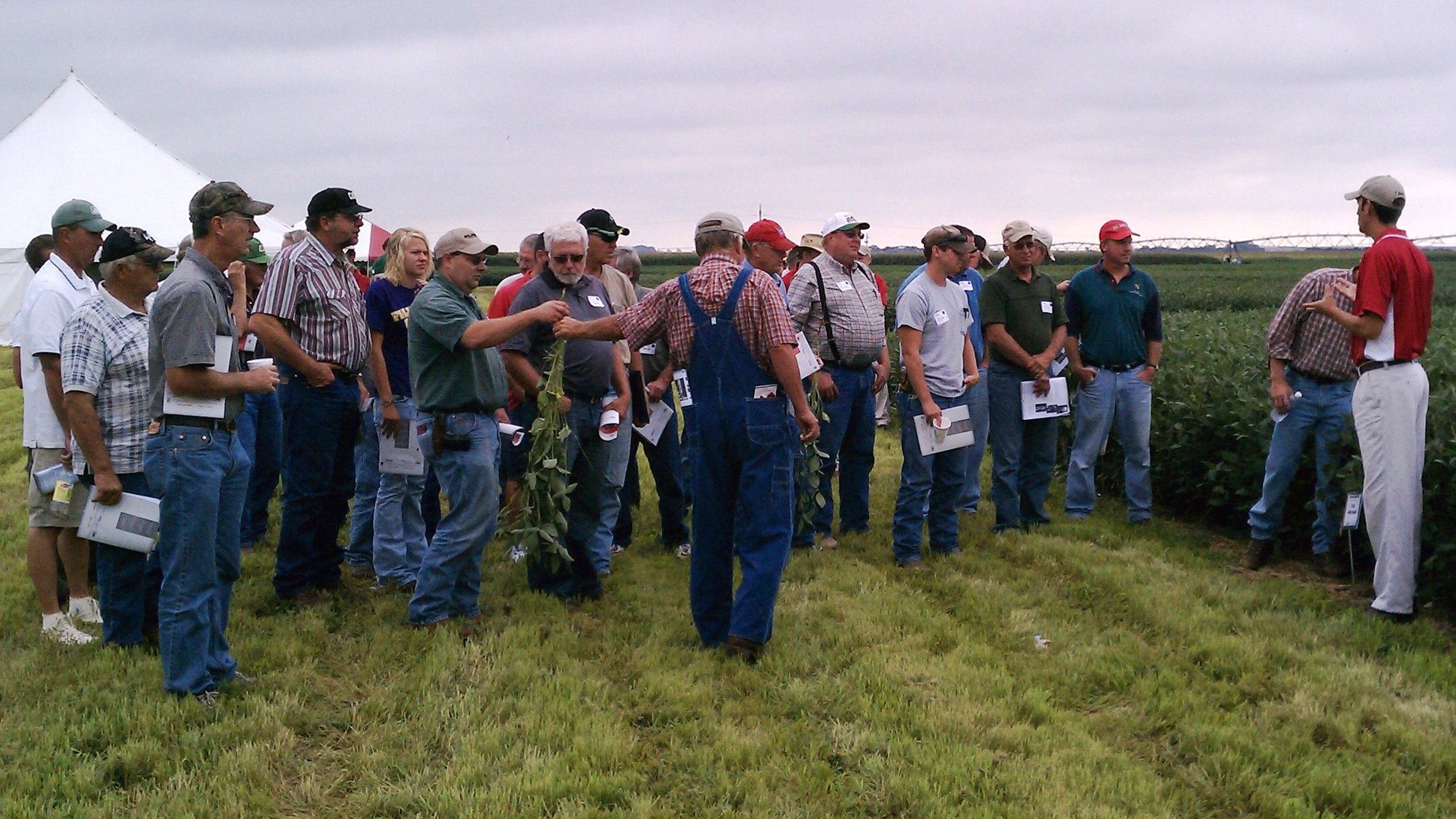 attending. Also a reminder, for all drought information from UNL Extension including crop, livestock, water, lawn, and garden, please check out http://droughtresources.unl.edu.
With the drought and a shortage of forages, if you are considering harvesting or grazing crops for forage, it is important to consider the herbicide restrictions applied to these fields. Check the labels of these herbicides to confirm that grazing restrictions or forage harvesting restrictions have been met before you turn livestock into the fields or cut the crop for hay or silage. Check out this link for more information.
Soybean Management Field Days Planned: Please mark the dates of the upcoming Soybean Management Field Days on your calendar. They are planned for August 14-17 with sessions planned for Lexington, O’Neill, Platte Center and David City. Registration for each of the Field Days starts at 9:00 a.m. with four one hour programs from 9:30 a.m. to 2:30 p.m. Topics include: Soybean Seed Treatments and Foliar Fungicides Growth Enhancement Interaction with Herbicides, Managing Land Leases and Soybean Marketing, Herbicide Carrier Rate Study and Quest for the Holy Grail in Soybean Production! Check out the sessions by going to http://ardc.unl.edu/soydays. The David City date and location is August 17th and it’s located from the Jct of 92 & Hwy 15, 1 mile east on 92 and ¾ mile north on county road.
South Central Ag Lab Field Day: Some of you have been asking about the next field day at South Central Ag Lab near Clay Center. Please mark your calendars for August 22 from 9:00 a.m.-2:00 p.m. with registration beginning at 8:30 a.m. Topics include: Weed control, timing, resistant weeds; Emerging diseases of corn and corn rootworm management options; Impacts of corn stover harvest on soil quality and greenhouse gas emissions; Variable rate nitrogen and irrigation management according to landscape variation; and Use of Soy-Water for managing soybean irrigation. There is no charge but please RSVP for a meal count by Friday, August 17 to (402) 762-4403. Hope to see you there!
York County Corn Grower Plot Tour: The York County Corn Growers Annual Plot tour will be held Thursday, August 23, 2012 from 5:30 – 7:30 p.m. This year’s cooperators are Ray and Ron Makovicka and the plot is located west of York on the Dwight Johnson farm. The plot is located ¾ miles north of Hwy 34 on Road I. Those attending will be able to check out the various corn varieties and visit with the seed company representatives. Supper will be served after the tour. Then there will be a report on 2012 practices, products used and irrigation update.
Also this year they have several different types of irrigation equipment in the field to monitor soil moisture and estimate crop ET. Systems in the field include: AquaCheck USA provided an AquaCheck soil moisture sensor system; Servitech provided the Profiler Watermark soil moisture sensor system; McCrometer provided an EnviroPro soil moisture sensor system; and AquaSpy provided AquaSpy soil moisture sensor system. Several of you have asked about wireless irrigation scheduling systems-here’s your chance to compare them all in one place!


 JenResources