Blog Archives
Fridays in February 2024
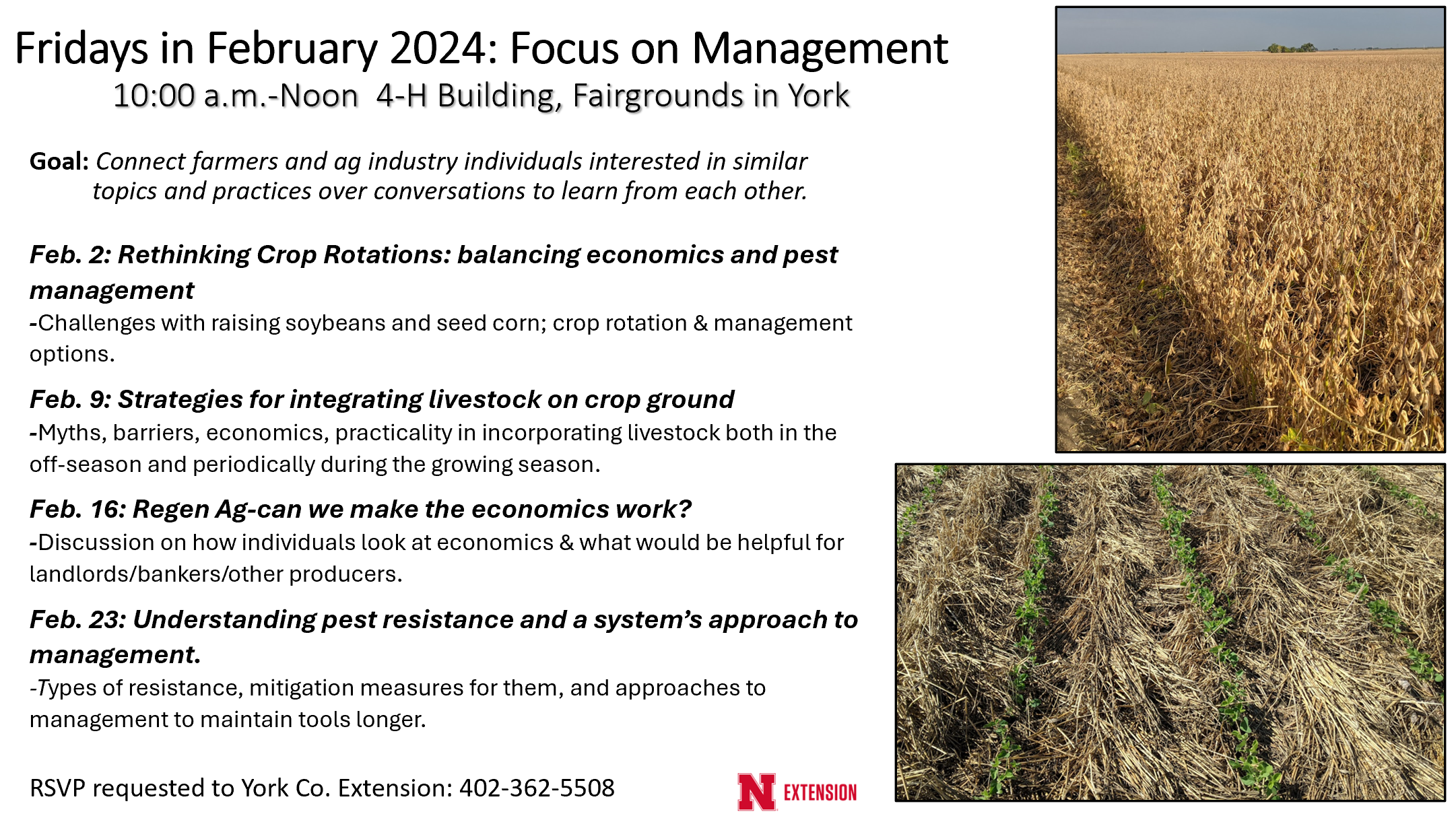
Fridays in February Conversations-Focus on Management: As an Extension educator, I prefer discussion, interaction, and co-learning vs. lecturing. This program started a couple years ago as an opportunity for producers and ag industry to gather and have informal, practical conversations, and share experiences/solutions around topics ag is facing. As I thought about last year and conversations people shared, the following topics surfaced. Each conversation is on Fridays in February from 10 a.m.-Noon at the 4-H Building in York. Please join us for coffee, cookies, and conversation around any/all these topics if you’re interested! Please RSVP to me or 402-362-5508.
Feb. 2: Rethinking Crop Rotations: balancing economics and pest management. A number of producers are frustrated with soybean yields, the problems with raising soybeans, and a handful have given up seed corn with others considering this. Both are important crops to this area so we’ll discuss crop rotation/management options to do things differently.
Feb. 9: Strategies for integrating livestock on crop ground. There’s many benefits of having livestock on crop ground. We’ll discuss some myths, barriers, economics, and what could be practical in incorporating livestock both in the off-season and periodically during the growing season.
Feb. 16: Regen Ag-can we make the economics work? There’s quite a bit of interest in Regen Ag and trying things differently. This is good yet the economics still need to work. As I’ve worked with producers in this space, I feel we need to have a discussion on how individuals look at economics and what we need better numbers around for landlords, bankers, and other producers.
Feb. 23: Understanding pest resistance and a system’s approach to management. Pest resistance is a topic we are currently and will continue to face in the future. We’ll discuss types of resistance, mitigation measures for them, and approaches to management to maintain tools longer.
Eastern NE Corn and Soybean Expo will be held on Jan. 25th at the Eastern NE R&E Center near Mead with viewing of vendor booths at 8:30 a.m. and program beginning at 9:10 a.m. This event combined the former Fremont Corn Expo and the Soybean Days in Wahoo. Mike Zuzolo, president of Global Commodity Analytics and Consulting LLC, is the keynote speaker. He will speak on “Navigating 2024 Commodity Markets — Funds vs. Fundamentals”. His presentation will include: Assessing 2024 Prices For Grains and Cattle — Look at Top 3-5 Drivers; Factors To Focus Upon — U.S. and Global S/D Fundamentals (Micro-Conditions) vs. Funds and Investment Flow Drivers (Macro-Conditions); Project 2024 “Overvalue” and “Undervalue” Levels For Corn/Soybeans/Cattle Through March 31. Many additional topics are included. More info. at: https://go.unl.edu/jmh7.
Chemigation Training In York Jan. 26: For anyone interested in applying chemicals (fertilizer or pesticides via irrigation systems, a chemigation certification is required. Steve Melvin is doing this training Jan. 26th at 1 p.m. at the 4-H Building in York if you need initial or recertification training. RSVP to 402-362-5508.
Nitrogen Challenge Meeting Jan. 29th: Reminder of my nitrogen challenge meeting at the Holthus Convention Center in York from 9 a.m.-Noon on January 29th. This training does qualify for nitrogen certification training requirements from the NRD. You can walk in that day but RSVP is helpful for planning purposes to me or 402-362-5508.

February 2023 Events
January just flew by! Sharing upcoming February events.
Friday Conversations-Focus on Nutrients: These meetings will all be held 10 a.m.-Noon on Feb. 3, 10, and 24 in the 4-H Bldg in York. I started Friday in February conversations last year, and attendees shared to continue them. My goal is to connect farmers and ag industry to share practical info. on what is working and hasn’t worked around specific topics in their operations. These are informal meetings where I’ve asked some farmers to start the conversation and it builds from there. Last year the focus was on cover crops. This year, it’s around nutrient management. Please join us if interested for a time of connection, conversation, and learning! RSVP isn’t required but helps me with preparing (402-362-5508 or jrees2@unl.edu). Topics include:
- Feb. 3: Understanding the soil microbiome (featuring Dr. Rhae Drijber, UNL soil microbiologist). Discussion around soil microbes and our expectations of what they can/can’t do.
- Feb. 10: Rethinking Grazing-Strategies for nutrient distribution. Producers share how they graze cornstalks, cover crops, pastures for the purpose of better nutrient distribution & value of this.
- Feb. 24: Nutrient balancing in conventional, regen, and organic systems. What does the term ‘nutrient balance’ mean to you, what does that look like, and how does one achieve it?
Feb. 9 Eastern NE Soil Health Conference is back at the Eastern NE R&E Center near Mead from 9 a.m.-3 p.m. (Registration at 8:30 a.m.). Topics include: Rediversifying crop rotations via Marshall McDaniel, ISU; Chad Dane (Clay Co. Farmer) and Jay Goertzen (York Co. Farmer) will share their experiences after 3 and 4 years interseeding cover crops into early season corn/soybeans on a farmer panel with me; Mary Drewnoski will share practical tips for selecting and grazing forage cover crops; A farmer panel will share on diversifying and intensifying crop rotations (Angela Knuth (Saunders County), Garret Ruskamp (Cuming County), Kyle Riesen (Jefferson County), and Haldon Fugate (Gage County) moderated by Nathan Mueller, NE Extension; and emerging topics will include biochar, kernza, and what’s new in the cover crop industry. There’s no charge, RSVP to: https://go.unl.edu/z7rx.
On-Farm Research Updates: They’re my favorite because the farmers share about research conducted on their own farms. If you haven’t attended in awhile, the York meeting has been designed around conversation with the goals of connection and learning from each other. Come hear farmers share their experiences on production practices such as soybean rates and maturities, nutrient management studies, cover crops, and products such as Pivot Bio PROVEN, Source N, and Xyway. There’s no charge, but RSVP is required for meal planning: https://go.unl.edu/2023ofr. All locations begin at 9 a.m. (Reg. at 8:30 a.m.). Locations: York (Feb. 15, Holthus Convention Center); Beatrice (Feb. 16, Holiday Inn); Fremont (Feb. 17, Extension Office); North Platte (Mar. 1 West Central REEC); Kearney (Mar. 2, Extension Office).
Certification Trainings Dates for programs listed below are listed at: https://jenreesources.com/upcoming-events/
- Pesticide Trainings: For those who have missed pesticide trainings, I still have some left in Geneva, Deshler, York, David City, Seward.
- Chemigation: I failed to remind people we were doing chemigation trainings last week in our area. If you still need this, you can do this online or attend in-person in Aurora, Central City, Grand Island, Columbus, Lincoln, or Beatrice.
- RUP Dicamba training is no longer provided by Extension. You need to take the trainings provided by the companies. Direct links at: https://jenreesources.com/upcoming-events/
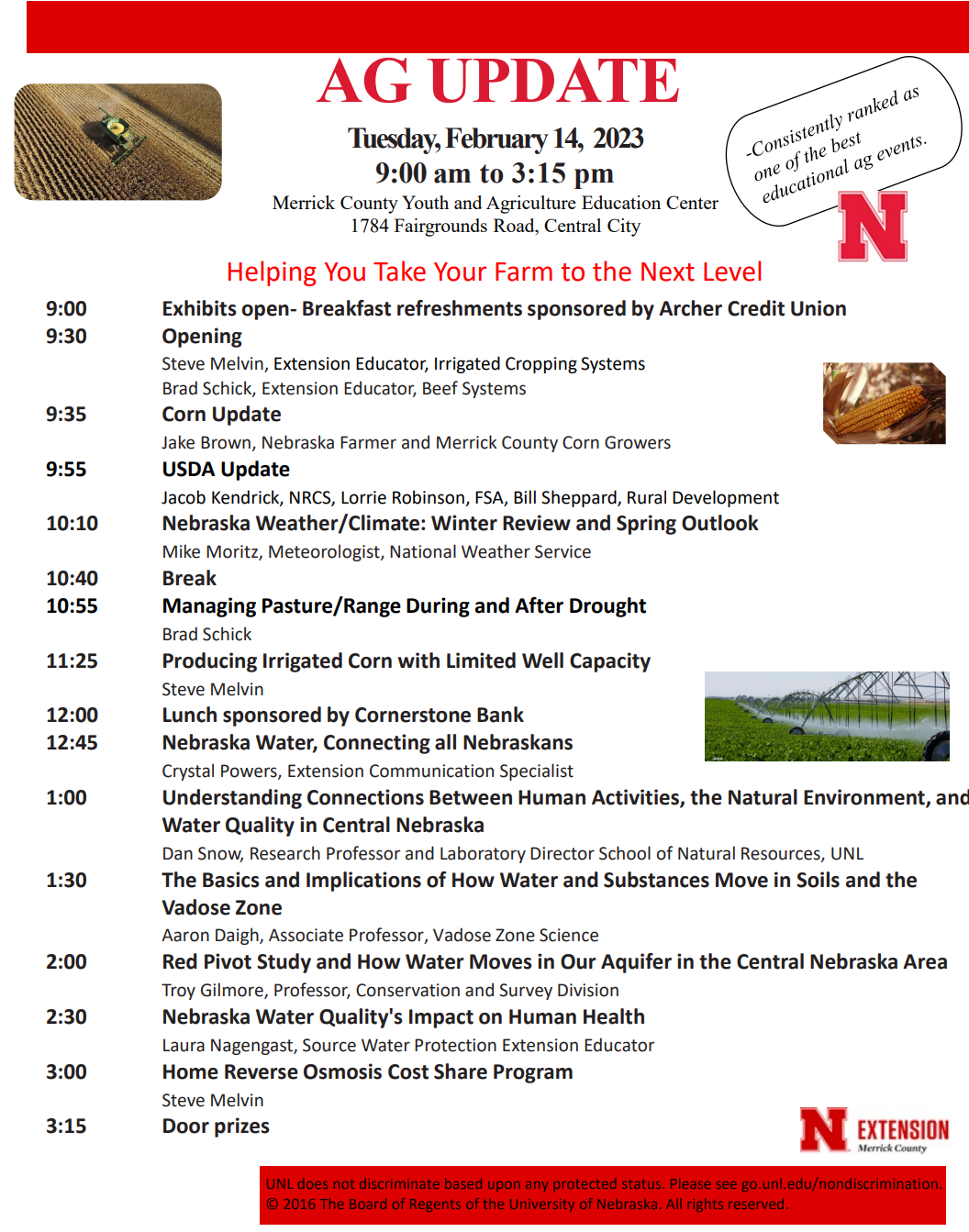
Additional Meetings: Feb. 14 is the Ag Update in Central City with a focus on drought and water; Feb. 23-24 is Women in Ag in Kearney; and the Central Plains Irrigation Conference is in Kearney on Feb. 28-Mar. 1.
Balancing Species Protection and Soybean Production workshop on Feb 9th and 10th in Lincoln, NE. For individuals (soybean growers, crop consultants, and ag professionals) across Nebraska and Iowa interested in participating. This is an important opportunity to communicate the impact of the Endangered Species Act on ag production and to find solutions that work for farmers and the species in our communities. Goal is to bring together a diverse group of stakeholders to discuss the impacts of national pesticide decisions on a local level and identify the potential consequences and co-benefits of conservation practices for pesticide mitigation measures, endangered species protections, and soil and water conservation. Discuss current ag productivity stressors and listed species needs to work towards developing local adaptive management solutions that can ultimately feed into national pesticide decisions. Having these conversations at a local level can potentially provide greater flexibility in managing new or emerging production issues. Please email Dr. Justin McMechan by Feb. 2 if you’re interested in attending or have comments to share: justin.mcmechan@unl.edu.




 JenResources