Blog Archives
February 2026 Events
Fridays in February are conversations held each Friday in February from 10 a.m.-Noon at the 4-H Building in York. Farmers and ag industry professionals share their experiences around various topics. I ask a few people to lead the conversation and the discussion ensues from there. These are very informal and they’ve spurred increasing changes to producer operations. Topics this year are focused on economics. Walk-ins are welcome, but RSVP is preferred to 402-362-5508 to ensure enough handouts for the discussions.
Fri. Feb. 6: Beginning Steps using Regen Ag Practices for Soil Health. With the $700M designated for soil health practices, this conversation will focus on practical steps to begin one’s soil health journey. Hear from farmers about the challenges, successes, and their recommendations regarding beginning one’s soil health journey.
Fri. Feb. 13: Understanding Nutrient Balance. For years, the focus has been on Nitrogen, Phosphorus and Potassium in ag, but too much of these nutrients create imbalances with other nutrients in the soil and plants. There’s an increasing number of ag professionals sharing how too much N contributes to increased disease and insects in the system due to plants lacking in availability of other critical nutrients. Hear from a few farmers and ag industry professionals about what nutrient balance looks like to them and how they go about it in fields.
Fri. Feb. 20: Producer Updates: Crops, Cows, Compost. This session is an update of last year’s conversations. Hear from the producers who made changes in their operations as a result of the conversations and the economics of these changes in their system. Some changes include: adding alternative crops in rotation, converting crop ground to annual forages for grazing, and using compost extracts on fields.
Fri. Feb. 27: Strengthening Nebraska’s Ag Economy. These conversations will share research-proven ways to reduce input costs without impacting yields. Information will be shared by producers and Extension educators who studied these topics via on-farm research. Come learn ways to reduce input costs on your farm this year and try some of these ideas for yourself!

Chemigation Training for the York area will be held on Thursday, Feb. 5th at 1 p.m. in the 4-H Building at the Fairgrounds in York. There are also chemigation trainings on Feb. 19th at 1 p.m. in Davenport at the Community Center, Feb. 19th at 1:30 p.m. at the Extension Office in Grand Island.
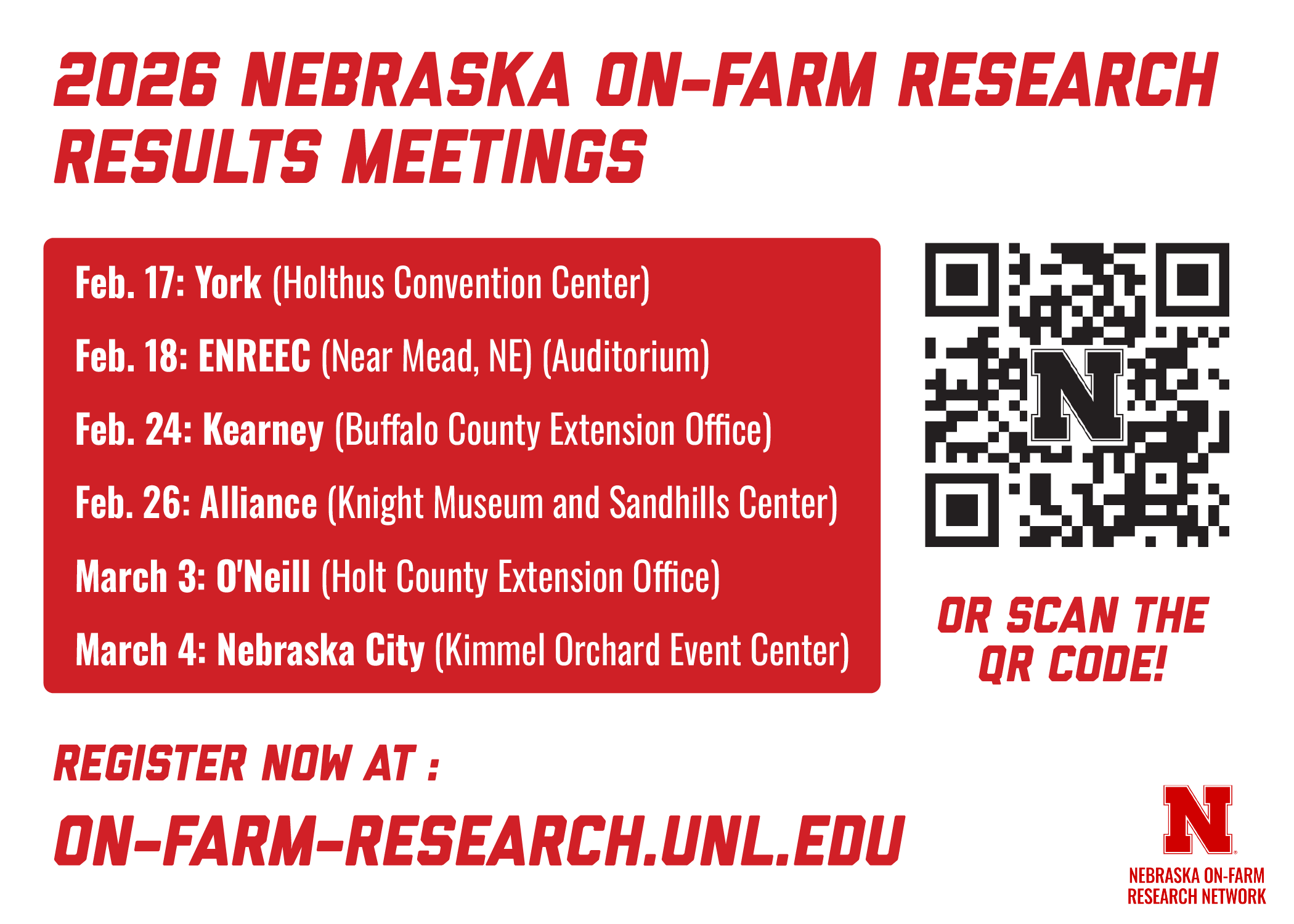
On-Farm Research Updates will be held Feb. 17th in York at the Holthus Convention Center, Feb. 18th at ENREEC near Mead, and Feb. 24 at the Extension Office in Kearney. The program at each location begins at 9 a.m. with registration at 8:30 a.m. Hear from the producers who conducted the research to learn what they tried and the results they found. No charge, but please RSVP at: https://on-farm-research.unl.edu/.
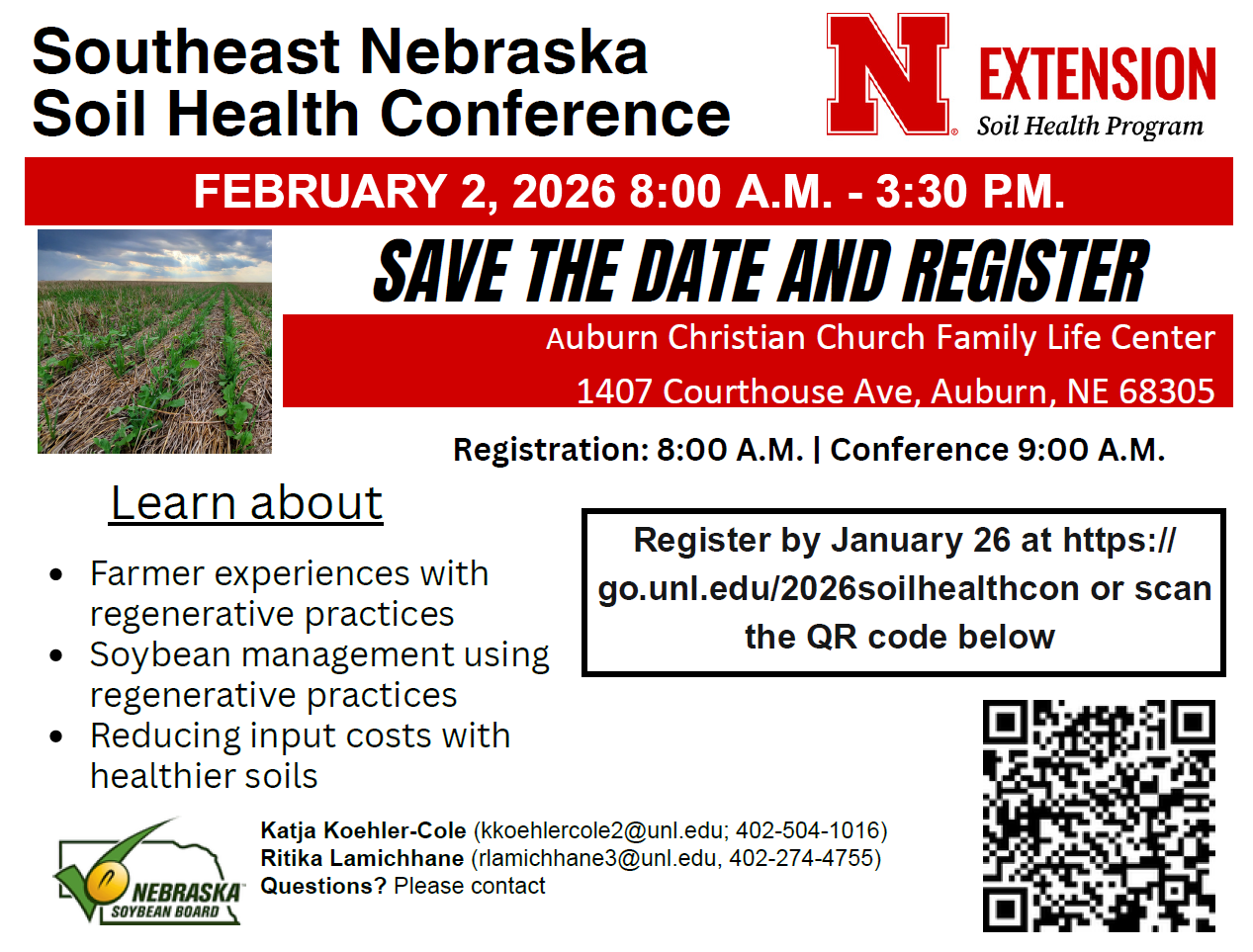
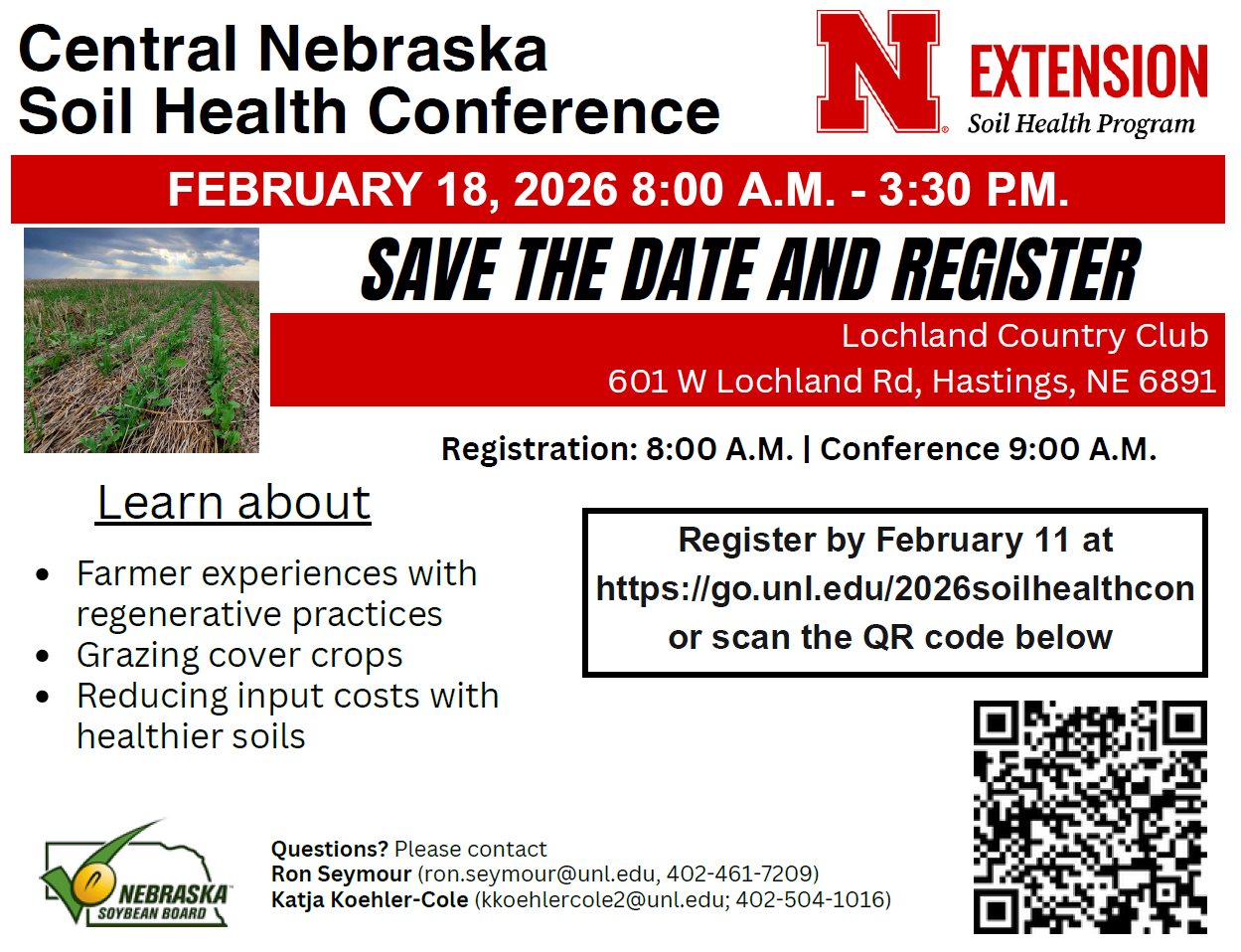
Central Nebraska Soil Health Conference will be held on Feb. 18th at the Lochland Country Club in Hastings. The conference will run from 9 a.m. to 3:30 p.m., with registration beginning at 8 a.m. Local growers will share information on converting crop ground for grazing, regenerative ag practices in raising soybean, and a producer panel. The keynote will share on biochar in ag. No fee, registration is requested for lunch count: https://go.unl.edu/kx80.
Fridays in February 2025
2025 Fridays in February Conversations: For the past few years I’ve hosted “Fridays in February” conversations with the goals for producers and ag industry to gather and have informal, practical conversations, and share experiences/solutions around topics ag is facing. With the downturn in commodity prices and tight economics, I’ve been thinking about alternative strategies. I’ve also received increased questions and interest around some common topics. So, they will be the topics of conversation this year. With every conversation, I will invite a few producers and/or ag industry to share their experiences. Then all engage in informal conversation. Please consider joining us for coffee, cookies, and conversation around any/all these topics if you’re interested! Conversations are held each Friday from 10 a.m.-Noon at the 4-H Building in York. Please RSVP to me or to 402-362-5508 so I can have enough materials prepared for each conversation.
February 7 – Relay Cropping and Double Cropping: There’s been increasing interest of how to improve the economics of small grains with either relay cropping or double cropping soybeans with either rye or wheat. Hear from growers who are trying this in a variety of ways and what they have learned.
February 14 – Roller Crimping Strategies: Small grains have huge benefits in our crops regarding reducing soil erosion, weed control, and breaking pest cycles. There’s also been an increase of growers planting corn or soybeans green into small grains. Hear from growers on the equipment they’re using, different strategies on roller crimping small grains and what they’ve learned.
February 21 – Using Compost Extracts: There’s an increased interest in using biology to help release soil nutrients to the plants while reducing the amount of synthetic nutrients applied. Instead of purchasing biological products, the growers using compost extracts are “growing their own biology” from composts using various methods, then adding water to the compost to extract the microbes and applying them to fields. Hear about the different methods growers are using for creating compost, extracting microbes, and what they’ve learned. On-Farm Research results will also be presented.
February 28 – Annual Forage Systems: With low commodity prices and high cattle markets, there could be opportunity for more producers to consider annual forage systems instead of traditional commodity crops. There’s also increasing interest in trying “regen” years on a piece of ground that includes cover crops and grazing to build diversity. Hear from growers who are incorporating annual forage systems into their crop rotations and what they’ve learned.
Reporting Survey: It’s reporting season for Extension. If you’d kindly like to share how my Extension work impacted you in 2024, please go to slido.com and use the code 4EXT. It’s anonymous and only 5 questions. Thanks!


Fridays in February 2024
Fridays in February Conversations-Focus on Management: As an Extension educator, I prefer discussion, interaction, and co-learning vs. lecturing. This program started a couple years ago as an opportunity for producers and ag industry to gather and have informal, practical conversations, and share experiences/solutions around topics ag is facing. As I thought about last year and conversations people shared, the following topics surfaced. Each conversation is on Fridays in February from 10 a.m.-Noon at the 4-H Building in York. Please join us for coffee, cookies, and conversation around any/all these topics if you’re interested! Please RSVP to me or 402-362-5508.
Feb. 2: Rethinking Crop Rotations: balancing economics and pest management. A number of producers are frustrated with soybean yields, the problems with raising soybeans, and a handful have given up seed corn with others considering this. Both are important crops to this area so we’ll discuss crop rotation/management options to do things differently.
Feb. 9: Strategies for integrating livestock on crop ground. There’s many benefits of having livestock on crop ground. We’ll discuss some myths, barriers, economics, and what could be practical in incorporating livestock both in the off-season and periodically during the growing season.
Feb. 16: Regen Ag-can we make the economics work? There’s quite a bit of interest in Regen Ag and trying things differently. This is good yet the economics still need to work. As I’ve worked with producers in this space, I feel we need to have a discussion on how individuals look at economics and what we need better numbers around for landlords, bankers, and other producers.
Feb. 23: Understanding pest resistance and a system’s approach to management. Pest resistance is a topic we are currently and will continue to face in the future. We’ll discuss types of resistance, mitigation measures for them, and approaches to management to maintain tools longer.
Eastern NE Corn and Soybean Expo will be held on Jan. 25th at the Eastern NE R&E Center near Mead with viewing of vendor booths at 8:30 a.m. and program beginning at 9:10 a.m. This event combined the former Fremont Corn Expo and the Soybean Days in Wahoo. Mike Zuzolo, president of Global Commodity Analytics and Consulting LLC, is the keynote speaker. He will speak on “Navigating 2024 Commodity Markets — Funds vs. Fundamentals”. His presentation will include: Assessing 2024 Prices For Grains and Cattle — Look at Top 3-5 Drivers; Factors To Focus Upon — U.S. and Global S/D Fundamentals (Micro-Conditions) vs. Funds and Investment Flow Drivers (Macro-Conditions); Project 2024 “Overvalue” and “Undervalue” Levels For Corn/Soybeans/Cattle Through March 31. Many additional topics are included. More info. at: https://go.unl.edu/jmh7.
Chemigation Training In York Jan. 26: For anyone interested in applying chemicals (fertilizer or pesticides via irrigation systems, a chemigation certification is required. Steve Melvin is doing this training Jan. 26th at 1 p.m. at the 4-H Building in York if you need initial or recertification training. RSVP to 402-362-5508.
Nitrogen Challenge Meeting Jan. 29th: Reminder of my nitrogen challenge meeting at the Holthus Convention Center in York from 9 a.m.-Noon on January 29th. This training does qualify for nitrogen certification training requirements from the NRD. You can walk in that day but RSVP is helpful for planning purposes to me or 402-362-5508.



 JenResources