Blog Archives
JenResources 4/6/25
Storm Damaged Trees have been an increasing concern for homeowners. The cedar windbreaks seem to be the greatest affected and it’s hard to know how much damage has been done until you start the cleanup process. This is a resource from the Nebraska Forest Service on storm damaged trees: https://nfs.unl.edu/snow-and-ice-damage-trees/ and https://nfs.unl.edu/immediate-care-storm-damaged-trees/. Additional resources: https://nfs.unl.edu/pruning-large-trees/ and all Forest Service Resources at: https://nfs.unl.edu/nfs-publications/.
When I look at each tree situation, I look at the overall structure of the tree, if there’s any shelf fungi (look like dinner plates) on the trunk or main branches (indicator of heart rot), any other major signs of decay/disease, and seek to visualize how the tree will look upon being properly pruned. I’m not a forester, but these are quick things I’m looking for. Most of the trees I’ve recommended to keep unless they had obvious heart rot or other issues. Of key importance is to trim the trees back to the bark branch collar to allow for sealing over the pruning cut. There are places in trees with large gaping wounds from the sheer weight of branches tearing and falling. I don’t know how they will all heal and seal, but trees are pretty amazing at what they can withstand. Some of these trees have an odd-shape after pruning, but you can always make the decision to remove them later.

There have been some fungus gnat outbreaks after removing trees, especially entire windbreaks. The decaying organic matter in the soil in addition to exposed moist soil can allow for fungus gnats to thrive. They typically only live 7-10 days, but in that time-frame, the female can unfortunately lay hundreds of eggs multiple times. Thus, why a few are reporting “millions” of gnats in their farm yards. I don’t have a good answer for you on managing this. Numbers will be reduced once the soil dries out in the top two inches or so. Unfortunately, this situation will most likely take three to four weeks to potentially resolve until the gnats find a new home and/or die. If they get into your home, you can use yellow sticky traps to catch them and also shallow pans of dishwater.
Vegetable Planting Guide that was compiled by emeritus Extension Educator Gary Zoubek can be found at: https://go.unl.edu/vegetableguide.
Ground covers: The following is information from April’s ProHort Update at:https://hles.unl.edu/update042025/. Ground covers can be a great alternative to mulching the landscape bed while providing habitat for pollinators and season-long interest. They will spread and cover the ground via rhizomes or stolons while also reducing soil erosion. That makes them a great option instead of grass on a steep slope where it is hard to maintain turf. There are many native or well adapted groundcovers to choose from. Here are a few groundcover options for spring color:
- Prairie smoke (Geum triflorum), grows great in sunny, dry locations, blooms from May to July
- Sweet woodruff (Galium odoratum), grows great in dry shade, blooms April-May
- Carpet bugleweed (Ajuga reptans), grows in moist shade with blue blooms from May to June
- Creeping phlox (Phlox stolonifera), good bloomer in shade with purple blossoms in spring
- Pasque flower (Pulsatilla patens), very early spring bloomer with purple blossoms in full sun
- Candytuft (Iberis sempervirens), showy April-May bloomer in full sun
- Lungwort (Pulmonaria officinalis), small pink-blue blooms in April-May in part to full shade

Fruit Flies and Fungus Gnats
Hope you had a blessed Thanksgiving! For whatever reason, I’ve received a number of questions about “tiny flies” in homes “flying around their faces” in the past 10 days. All had different situations but each situation led to the culprit being either fruit flies or fungus gnats. So, sharing on the differences between the two insects and some strategies for management should you or someone you know also end up dealing with them. The first key is identification with the second being locating where the pest is breeding and eliminating that source before seeking to trap and eliminate them.
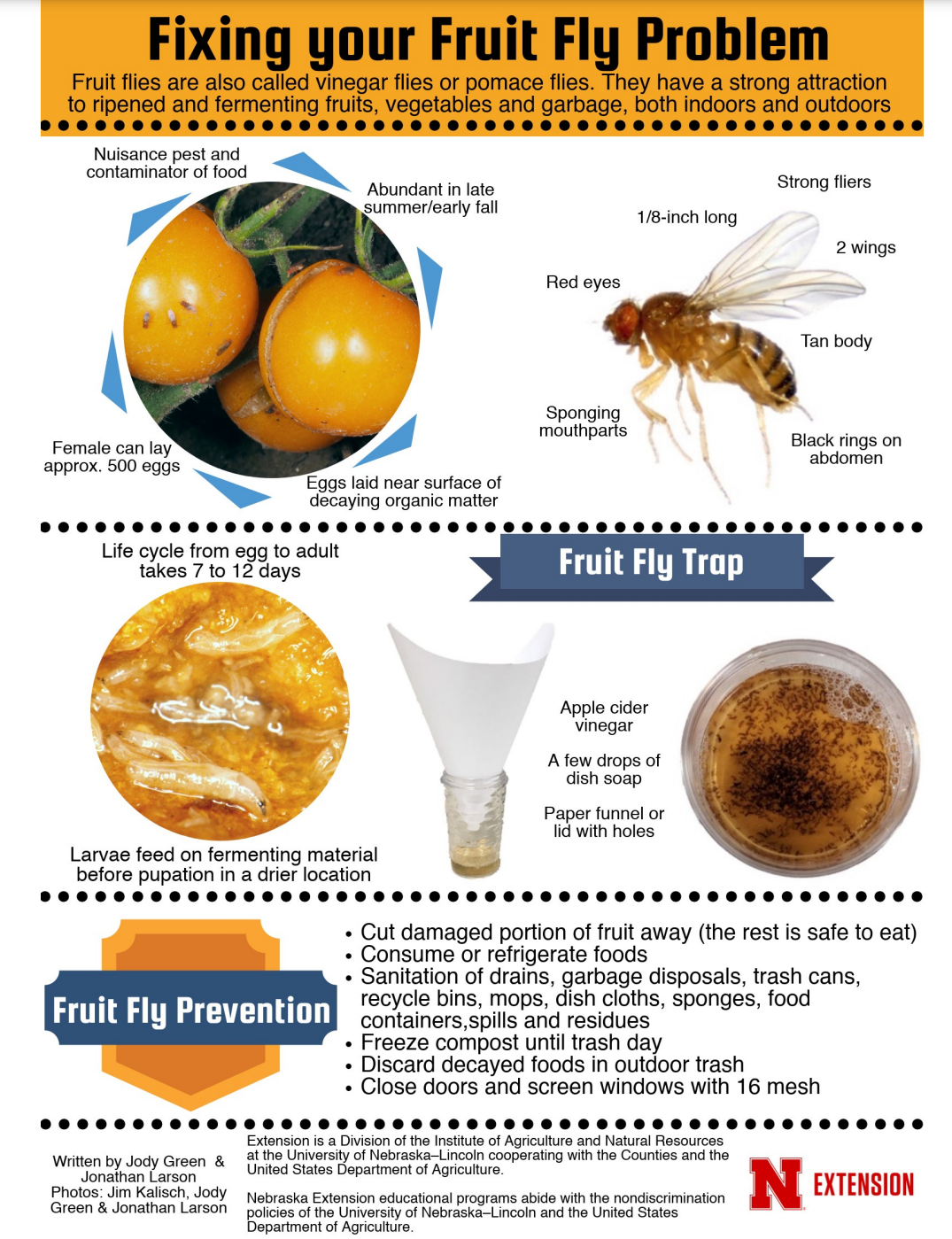
Fruit Flies: Jody Green, Extension entomologist, shares, “Fruit flies are 1/8-inch long and typically have red eyes. They are one of the smallest and most common flies in homes or anywhere food ripens, rots and ferments. Fruit flies begin as eggs before they hatch into legless larvae or maggots. The maggots enter a pupal stage to develop into mature, winged adult flies. They are active year round indoors, but their life cycle will slow in cooler temperatures. Under optimal conditions in the summer, they can complete their life cycle in 7–10 days. Prior to pupation, the maggots will migrate to a drier location nearby. Adults are good fliers, attracted to lights and therefore found flying around people’s faces away from the source of the infestation.”
We commonly see fruit flies in the summer as garden produce gets picked or bought, ripens on counters, and especially as bananas and tomatoes get overripe. However, fruit flies can be attracted to other places beyond the kitchen counter in our homes. These places can include: anywhere where non-refrigerated produce is stored like pantry and cupboards (ex. potatoes); trash, compost, recycled collection areas (ex. pop cans, discarded food containers); lunch boxes and forgotten storage containers; drains and garbage disposal (these can be called fruit or drain flies but need drain sanitation or there’s natural products on the market for purchase); any type of pet food bowl/terrarium; and anywhere a moist film of fermenting material remains such as on mops and dishcloths. Determining the breeding site in your particular situation is key to helping eliminate the fruit flies.
Once the breeding site is eliminated, homemade traps can then be used to trap and remove any additional fruit flies from the home. I was recommending vinegar water in a bowl or cup and discarding each day so no larvae were able to hatch and crawl out. In following up, most said that did the trick. Extension entomologists shared two other trap options using home-made items that you can keep for up to one week on the kitchen counter.
1-Using a salt shaker, fill ¼ full with apple cider vinegar, add 2 drops of dish soap, and replace cap or use a paper funnel. Discard within 7 days.
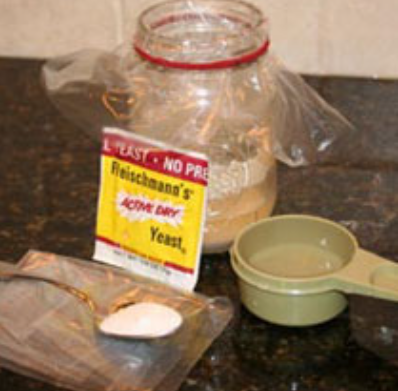
2-“Use a one-pint glass jar. Add 1/4 – 1/3 cup of warm (not boiling) water. Sprinkle a package of activated dry yeast over the water. Add one teaspoon of sugar to activate the yeast. Swirl the yeast liquid. In a few minutes, the sugar will cause the yeast to foam and expand and start producing CO2. Take a small plastic bag (like a sandwich Baggie®) and place over the mouth of the jar with one corner reaching into the jar. . Poke a small hole (no more than 1/8-inch diameter) in the corner of the bag with a pencil. Secure the bag around the rim with a rubber band or canning ring. Fruit flies will immediately be attracted”-Barb Ogg. Be sure to discard the trap in seven days.

Fungus Gnats: These can be confused with fruit flies but they complete their life cycle in the top layers of soil of house plants, especially when they are overwatered. Jodi Green shares, “Adults are grayish-black, about 1/8-inch long and have one pair of wings. Females lay 100–150 eggs in moist potting soil and the larvae feed and develop on the fungi and organic matter. Fungus gnat larvae are white, slender, legless maggots with translucent bodies and dark heads. Larval feeding sometimes includes gnawing on the roots and stems of plants. In warm conditions, overlapping generations may occur, producing large populations which can cause spotting, curling, yellowing or plant death. After pupating in the soil, they emerge as winged adults, bothering people by flying around faces, lights, windows and food items. In order to eliminate a fungus gnat infestation, the life cycle must be broken. This can be done by removing the fungus in which they breed, while simultaneously reducing the number of breeding and egg-laying adults. A non-chemical approach is to reduce the topsoil moisture by less frequent watering, drying out the soil and changing the plant medium to provide better drainage. To catch flying adults, yellow sticky card traps are available at garden stores and placed at the soil surface. In addition, there are biological control products such as the microorganism, Bacillus thuringiensis (Bt), which is applied to the soil to kill larvae after ingestion. Bt is selective to insect larvae, non-toxic to humans, pets and contains no harmful residues.”
JenREES 1-24-21
Farm Bill: In my desire to share what I’ve learned with you all, I realized I threw too much information into the decision tool blog post, and what I was seeking to share didn’t come across clearly. So, I revised it and you will need to refresh your web browser to view the most updated version.
Ultimately, PLC offers price protection. If your MYA price is less than the reference price ($3.70 for corn; $8.40 for soy; $3.95 for sorghum; $5.50 for wheat), a PLC payment is triggered. ARC-CO is a revenue safety net with price and yield protection, and it takes into account a 5-year Olympic average of prices and yields (for this 2021 decision it looks at 2015-2019).
So as things set today, it’s possible there won’t be either an ARC-CO nor PLC payment for corn or soybean for 2021. Corn tends to favor a PLC election. Wheat favors PLC. Sorghum traditionally has favored PLC. Soybean could be selected either way, particularly depending on if the county has irrigated/non-irrigated split or not. What can impact this is if we see major yield or price losses from current expectations.
What I don’t know yet is if ARC-IC is an option as a result of the significant windstorm in several counties. Once we get the 2020 county yields (most likely in February), I will start looking at that.
Sometimes looking at the probabilities in the decision tools can be confusing, but they can also provide direction if you’re unsure. Thus, why I provide the blog post on how to use the decision tools.
The calculation I shared with you last week may be the easiest thing you can do. So, I put that into a separate blog post and placed screen shots of county by crop in Nebraska so you can see which way things are favored by county. The best way to find all this info. is go to the “Farm Bill” category on my blog: https://jenreesources.com/category/farm-bill-2/ (but only look at the 2021 info.).

Fungus Gnats: Kelly Feehan shares, “If you have small gnats flying around your home or windows, these may be fungusgnats. These nuisance pests are small fly-like insects mainly noticed around houseplants. They cause no harm to people, pets and rarely to plants. Fungus gnats develop in overwatered houseplant soil or poorly drained potting mixes. The larvae, which is a tiny maggot, lives and matures in the potting medium, mainly feeding on fungal or algal growth in overwatered soil. If the potting mix is harboring fungus gnats, cut back on watering frequency so the mix dries out briefly between watering. If needed, repot plants using a well-drained potting mix and containers with drainage holes. Pour excess water out of catch basins after watering. Reduced moisture limits fungal growth, hence fungus gnat larvae food. The upper two inches of the potting mix can also be treated with a labeled houseplant insecticide or insecticidal soap.”
York-Hamilton Cattlemen January Meeting is scheduled for Tuesday, January 26, 2021 at Chances ‘R’ in York. The meeting will open the doors at 6:30 p.m. with meal at 7:00 p.m. Gerald Peterson, Secretary, said this meeting is scheduled in place of the Cattlemen’s Banquet that is usually held this time of year but has been canceled for 2021 on recommendations of area health departments. Kim Siebert, Cattlemen’s President said the evening will feature a presentation from Max McLean of McLean Beef who are in the process of opening a new animal processing and retail meat business in south York. McLean Beef is a longtime cattle feeder farmer in the Benedict area of northern York County. Bill Rhea, President of the Nebraska Cattlemen has been invited to attend the meeting along with Nebraska Cattlemen staff to update the Cattlemen on bills in the Nebraska Legislature. Please RSVP to Gerald Peterson by email at gpeterson808@gmail.com or by phone at 308-991-0817 if you plan to attend.


 JenResources