Blog Archives
Yield & Soil Impacts from Grazing Corn Residue
With pastures short on grass due to drought, it’s a blessing for producers to get cattle out on cornstalks. Sharing an update on long-term research showing no negative impacts to the subsequent yield or soil from cattle grazing corn residue.
Mary Drewnoski, et. al share on yield impacts, “Two studies were conducted to evaluate the effects of corn residue harvest on subsequent crop yields. In a long-term study (16 years), cattle grazing corn residue in the spring (February to the middle of April) or the fall (November through January) slightly improved subsequent soybean yields and had no effect on corn yields in an irrigated field maintained in an annual corn-soybean rotation at Mead, Neb. In a five-year study, fall grazing (December through January) or baling of corn residue had no effect on subsequent corn grain yields in a field maintained in continuous corn production at Brule, Neb. These data suggest that the grazing of corn residue in the fall or spring at or below UNL recommended stocking rates will have slightly positive or no impacts on subsequent soybean or corn yields.
The stocking rates utilized were consistent with UNL grazing recommendations, which result in removal of half the husks and leaves produced (8 lb of leaf and husk per bushel of corn grain produced). The corn yields ranged from a low of 186 bu/ac in 2004 to a high of 253 bu/ac in 2009, with a median over the 16 years of 203 bu/ac. Recommended stocking rates would have ranged from 2.1 to 2.9 AUM/ac with a median of 2.3 AUM/ ac.”
Dr. Mary Drewnoski wrote an updated Beefwatch article about soil compaction and grazing. “One of the most common concerns about grazing corn residue is that cattle will cause soil compaction. A long term grazing data (16 years) conducted at the UNL has shown no compaction when grazing in the fall or the early spring. In this long-term study, grazing did not impact soil nutrient content. This fits well with expected impacts given that cows in mid-pregnancy retain very little nitrogen, phosphorus or potassium. Thus, they excrete in manure and urine most of what they consume resulting in very little nutrients being removed from the land. With long term grazing there was an improvement in subsequent soybean and corn yields. This could have been due to the nutrient cycling being sped up as there is an increase in microbial biomass in the soil in the grazed areas.
More recently, a study was designed to test an extreme scenario for spring grazing. The thought was that if grazing was to cause compaction, it was most likely to happen when the soil is wet and thawed and when a high stocking density was used. The field was grazed at the recommended rate by starting in mid-February with 3 hd/ac for 45 days (normal stocking) or starting in early March with 9 hd/ac for 15 days (high stocking). Turn out of the higher stocking density groups was delayed until it rained to have the worst-case scenario. All groups were removed mid-March. There were some minor increases in bulk density (measure of compaction). The penetration resistance was also higher, and thus more down pressure had to be applied to get the soybeans planted. Down pressure applied at planting was 265 lbs in the non-grazed and 290 lbs in the grazed treatments. Much of the increase in penetration resistance is due to the soil having less cover and thus less surface soil moisture. The planting speed was also reduced due to the surface roughness. However, the subsequent soybean yields were still improved by grazing. While it is not recommended to graze late into the spring as this does have some downsides when it comes to planting, if cattle happen to be left out when a warm-wet spell occurs, there is no long-term damage to the land.
Overall, when managed correctly, grazing corn residue can be a win-win for both the crop and cattle producer. Want to see the data for yourself? Check out these Nebraska Beef Reports:”
Effect of Corn Residue Removal on Subsequent Crop Yields
Effect of long-Term Corn Residue Grazing on Soil Properties
Effect of Corn residue grazing or Baling on Subsequent Crop Yield and Nutrient Removal
Impact of Spring Corn Residue Grazing on Soil Physical Properties and Crop Yield

JenREES 10-25-20

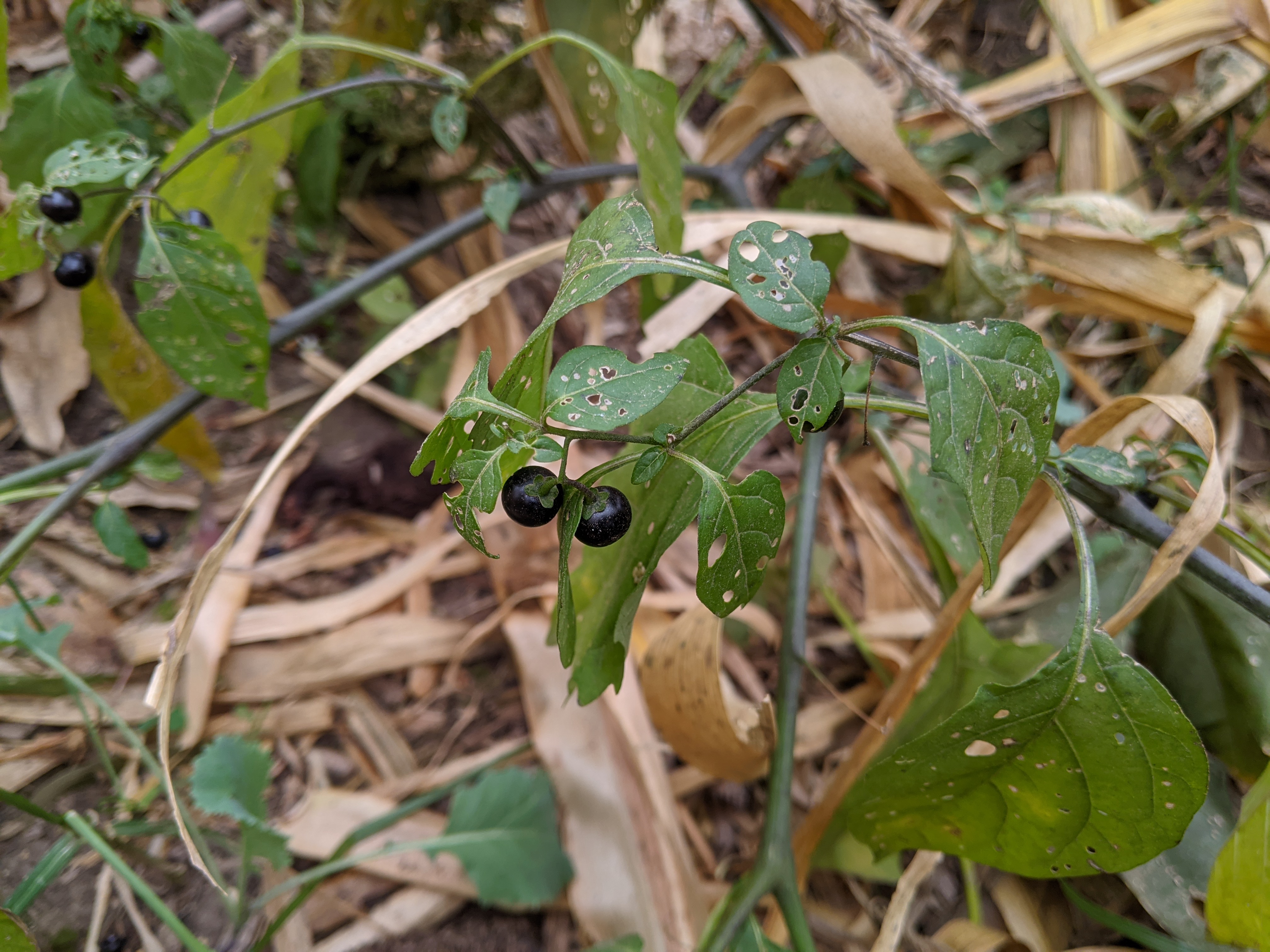
Grazing Corn Residue: Have received some questions on corn residue management. Cattle grazing can be a beneficial way of residue management if one has access to cattle. Note: I’ve been seeing quite a bit of black nightshade and some horsenettle, particularly in corn fields that had wind damage. Both species have poisonous leaves (increase concentration as plants age) and berries (decrease concentration as berries ripen). Frost doesn’t change toxin levels. UNL forage specialists say when cattle graze corn fields containing nightshade species, there’s enough dilution with the grain, leaf, and husk that poisoning shouldn’t be an issue. We’d recommend watching the cattle as some may prefer grazing the nightshade. I’ve also seen cattle prefer weeds after herbicide applications, so also watch that if fall herbicides are applied. Ultimately, would just recommend don’t turn cattle empty into stalks with significant amounts of nightshade, watch cattle, and don’t graze past the point of 50% of leaf/husk removal. Dr. Jerry Volesky shares more here: https://twitter.com/jenreesources/status/1320513145941692418?s=20.
So, how does one calculate 50% leaf/husk removal and the grazing days for cattle on corn residue? The following is information from my beef Extension colleague, Brad Schick.
- “There are 8 lbs of grazable dry matter per bushel of corn.
- Leaf and husk make up 39.6% of the dry matter in corn residue.
- Intake on corn residue fields will be close to 2% of bodyweight.

Having corn stalks to graze is a great resource for livestock producers. For dry cows, it is a relatively inexpensive feed that can typically meet or come very close to meeting nutritional needs. Grazing can also help get rid of corn remaining in the field and potentially reduce volunteer corn the following year. But are cattle really grazing stalks?
Yes and no. In everyday conversation, grazing corn stalks is said, but the stalk is the last thing cattle eat. Cattle do eat stalks, particularly if they are left on a field too long, but they are primarily consuming leaf, husk, and leftover corn. The stem or stalk makes up about 48.5% of the residue, while the leaf blade and husk make up 39.6%. Cattle will consume leaf and husk if available. That diet will consist of 52 to 55% TDN (total digestible nutrients) and 5 to 5.5% crude protein.
When thinking about how long to graze corn residue, the calculation to follow is that for every bushel of corn produced, there is 16 lbs of dry leaf and husk. The recommended grazing plan should be to remove 50% of the leaf and husk. This assumes that portions of the forage will also be lost to trampling, defecation, and other considerations such as wind. That leaves 8 lbs (16 lbs X 50%) of good forage on a dry matter basis that is available for consumption for every bushel of corn.
For example, say the field produced 200 bu/ac corn. By the calculations, there is 1600 lbs of dry matter per acre available (8 lbs X 200 bu = 1600 lbs). A 1000 lb animal will consume about 26 lbs of dried forage per day which means a 1300 lb animal will consume about 34 lbs per day. However, with lower quality forage such as corn residue, intake will be closer to 2% of bodyweight. In this example, that means closer to 26 lbs for the 1300 lb animal. So, how many days of grazing is that? By the calculations, there are 61 days of grazing for one cow grazing one acre (1600 lbs DM ÷ 26 lbs = 61 days). A general rule is about 30 cow days per 100 bushels/acre of corn produced.
Calves and replacement heifers can be also be a great option but will need a protein source in order to meet their growing requirements. Not only is grazing corn residue good for the cattle producer, but it is also good for the crop producer. Studies from the University of Nebraska-Lincoln have shown that grazing corn residue increases or at least maintains crop yields. (Grazing Corn Residue: A Win-Win for Crop and Cattle Producers).” More info. can be found at: https://go.unl.edu/fsa9.


 JenResources