Blog Archives
Crop-Livestock Integration Case Study
Happy March! We had a great Friday February conversation again. I think the power in that conversation was watching how ideas from previous years of conversations came to fruition with actual data including stocking rates and economics from several growers. The following is a case study where a grower who enjoys cattle wanted to find a way to raise his herd in the Utica, NE area where corn/soy/seed corn is plenty and pasture is limited. He thought outside the box, challenged the status quo and split a pivot into four quarters in 2024.
On one quarter he planted corn, the next quarter was a year of annual forages for strip grazing, the next was cereal rye for seed followed by winter stockpiled annual forages, and the final was soybeans. The pivot corners consist of pasture and one farmstead. The crops on each quarter are rotated clockwise each year. For example, the quarter that was strip-grazed annual forages in 2024 was planted to corn in 2025. Volunteer rye and vetch were grazed before corn was planted in that area and the cows were moved onto oats/peas he planted into the annual forage quarter. As they were dying out, he followed the cows with planting an annual forage summer mix that contained multi-species but was heavier on millets so he didn’t have to worry about removing cows during light frosts (he was avoiding the potential of prussic acid poisoning by using the millets instead of sorghum species). Now the cows are on the winter stockpiled forage that was also a muti-species mix but heavier on the sorghum species side. For a stocking rate, he figures 1 pair per acre (around 33 pairs if he stayed on this quarter system). This would also be a great system for stockers.
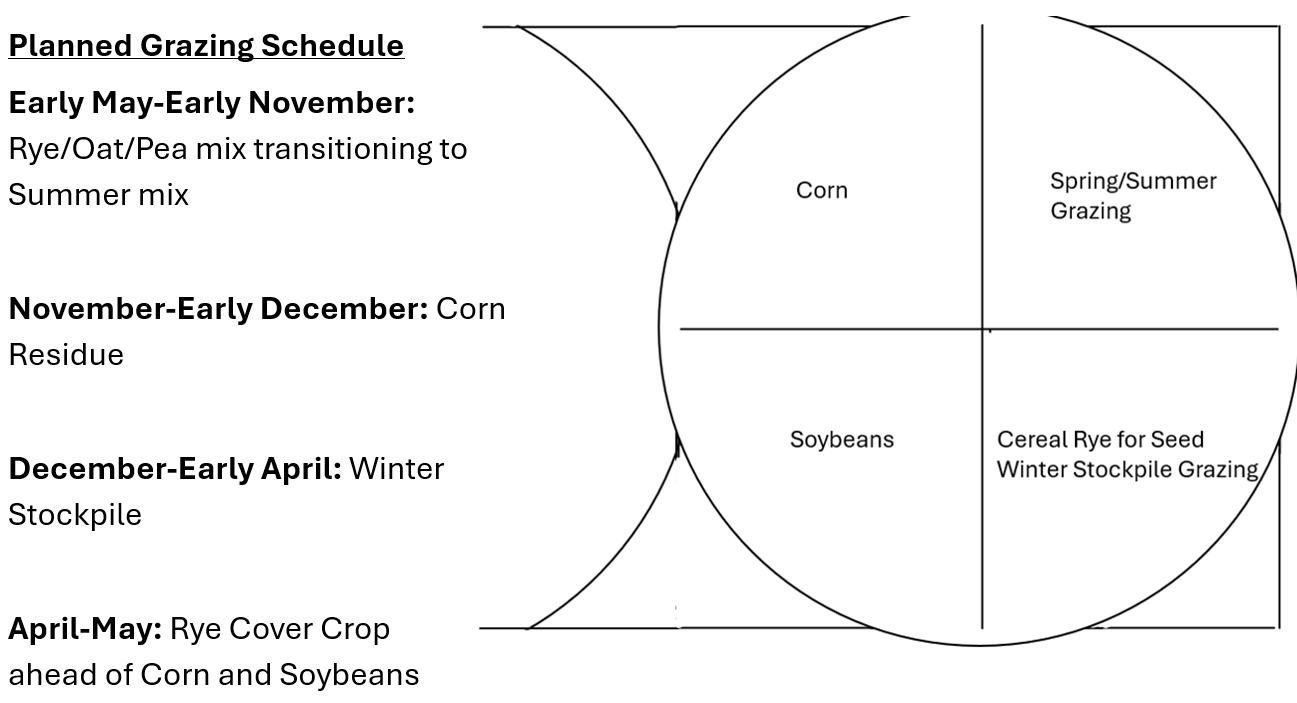
Splitting a pivot into quarters wouldn’t perhaps be the easiest set-up for most. His goals were to keep his cows on this one pivot for the entire year and to see what his stocking rate could be as he grew his herd. He also wanted to determine the economics and soil health of this system by the end of four years to see if he could scale it to other pivots on his farm. The beauty of this is that the system could be adapted to each producers’ goals and needs. Pivots could be split in half or converted entirely to suit the individual’s goals.
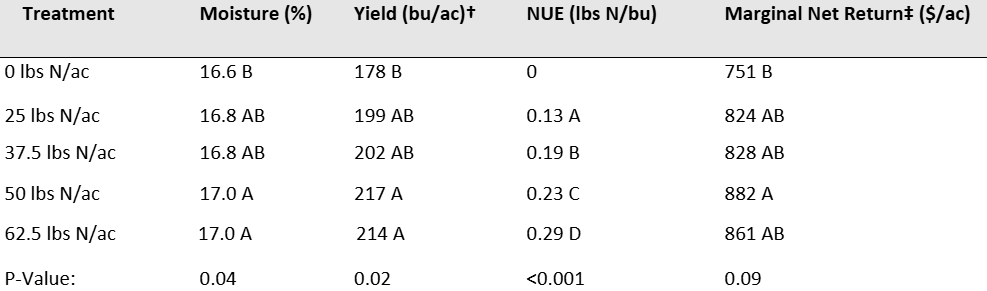
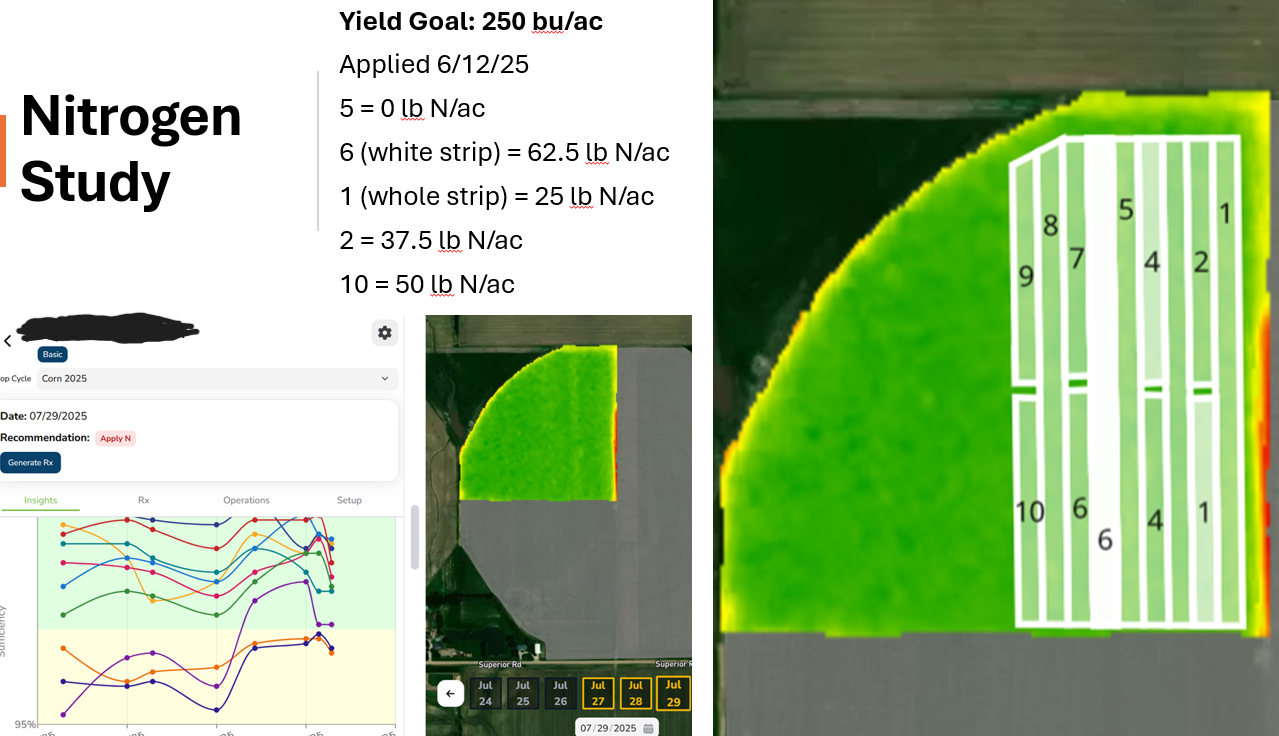
This grower also wanted to see how much nitrogen…and other nutrients over time…the annual forage grazing contributed to the succeeding corn crop. We’ve heard a potential of 100 lb/ac of nitrogen could be credited, so that was considered in addition to the residual soil nitrate and nitrate in irrigation water. He set up a side-dress on-farm research study where he applied starter fertilizer but no other nitrogen until V2-V3 corn. He had 4 reps including rates of 0, 25, 37.5, 50, and 62.5 lb N/ac applied. The goal was to apply these same rates to the same strips the next time he side-dressed. He then used Sentinel Ag to sense the timing of when he would need additional nitrogen. However at side-dress time, the Sentinel Ag imagery said he only needed nitrogen on the 0 lb and two of the 25 lb/ac strips. So, the grower decided to let it go and see what happened. His yields? While they were down like many in the area, he raised 217 bu/ac on 50 lb N/ac and 178 bu/ac on 0 lb N/ac! For the annual grazing with cow-calf pairs, his economics came to a profit of $683/ac (that was using $300/ac rent cost). Think about his corn and grazing economics for your own system. It’s exciting to me to see a case study like this where crops and livestock are integrated so well to show the benefits of diversity not only for the land and reduced inputs but economically!
And, it’s another example of how Sentinel Ag’s satellite imagery can be used to help with nitrogen management. With March pre-plant nitrogen applications, consider the nitrogen challenge: only apply 50-100 lb N/ac pre-plant and use Sentinel Ag to determine the remaining needs this growing season. Please contact me if you’re interested in more information.


Crop Ground to Annual Forage Grazing
Converting Crop Ground to Annual Forage Grazing: A handful of producers have been doing this in the area with more considering it for 2026. Why? With the high input costs and low commodity prices, producers are searching for alternatives. The economics of grazing covers is good compared to planting corn and soybeans. Pencil it out for your operation. Input costs for grazing annual forages include cover crop seed and seeding, land costs, potentially one herbicide application between rye and planting a summer cover crop, water and fence infrastructure, and irrigation for establishing covers on irrigated ground. Here’s a potential rotation to make this work: rye planted in the fall or oats planted in March. Strip graze the rye or oats in April-May. Plant a summer annual cover crop mix in June/early July. Strip-graze the summer mix in late July-October. Some people will move livestock off the crop ground between light frosts until a hard freeze if sorghum species are in the summer mix (to avoid any prussic acid poisoning). Then livestock can continue grazing any remaining forage after frost with minimal loss in quality. If cool season cereals like rye/wheat/oats were added to the summer mix, they will come on in the fall and add additional quality to the forage into the winter. Or, a cool season cereal can be planted in the fall after the summer annual forages are grazed off. There’s multiple options for doing this!
Those cash renting ground were often able to pay for the cash rent of irrigated or non-irrigated crop ground in 1 to 2 grazings. How to figure costs? UNL farm real estate reports share an average cost of $68/cow-calf pair/month to graze on pasture in Eastern and Central NE. Annual forages would have a higher quality, so that should be taken into consideration for the value received. If you would graze cattle for someone else, such as grazing custom cattle, you can expect to receive anywhere between $1.50-$2.50/1000 lbs of cow (standard animal unit)/day depending on one’s location. This is also the value you’re creating if you’re using your own cattle to graze the covers. If you own cattle and want to retain your calves and add weight after weaning, consider putting the calves on the forages for the highest value return and gains. Pencil it out for your operation. We converted half our crop acres this year to forages for custom grazing cows. And, the benefits are beyond a single year of economics. I’ve seen how strip-grazing plants with animals can improve ground through improving pH, improving water infiltration through better soil aggregation, increased soil microbial communities, and nutrient release. A risk for consideration is lack of rainfall on non-irrigated ground to establish covers and maintain growth. Producers will also share specific examples with their economics on this Friday’s Feb. 27th conversation from 10-noon at the 4-H Building in York.
Farmers Bridge Assistance (FBA) Program: This program provides $11 billion in one-time bridge payments to row crop producers in response to temporary trade market disruptions and increased production costs. The FBA enrollment period opens Feb. 23 and closes April 17, 2026. There will not be mailed prefilled applications anymore. Producers are encouraged to use/create a login.gov on farmers.gov to apply or they can still apply in person in the office. More info: https://www.fsa.usda.gov/news-events/news/02-20-2026/usda-announces-enrollment-period-farmer-bridge-payments?utm_campaign=022026fbaenrollment&utm_medium=email&utm_source=govdelivery.
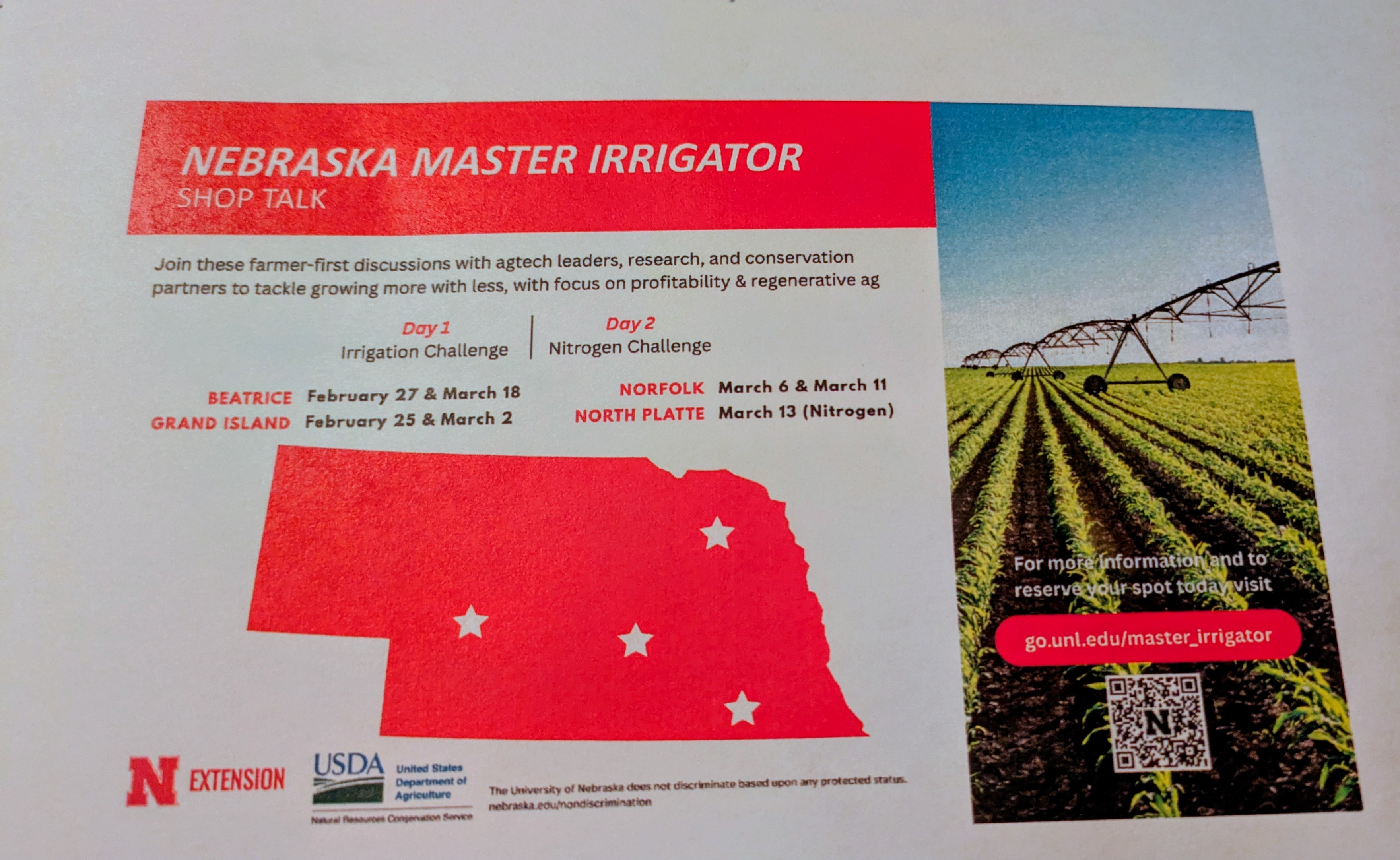
Master Irrigator Program: Nebraska Extension invites farmers, agricultural professionals and conservation partners to participate in a local 2026 Nebraska Master Irrigator “Shop Talk” discussion. These will be two‑day, discussion‑based programs focused on tackling today’s most pressing irrigation and nitrogen management challenges. The first day of each location will focus on irrigation and the second day will focus on nitrogen. Registration and info at: https://go.unl.edu/master_irrigator. Walk-ins are welcome. Closest sessions include: Grand Island Extension Office on Feb. 25 & Mar. 2; Extension Office in Beatrice on Feb. 27 & Mar. 18.


 JenResources