Blog Archives
Pesticide Safety
Pesticide Safety: I remember first getting my pesticide license in college. Since then I’ve taught safety training each year for the past 21 years as an Extension Educator. It’s not my favorite thing to teach, but it is important. After teaching 8 trainings this past week, I got to thinking that beyond those trainings, I never have shared that information broadly. So, sharing, what I feel is, impactful safety information.
During training, I share that we’re there as private pesticide applicators receiving safety training so that we can keep ourselves, our families, and everyone in our operations safe.
An Agricultural Health Study was conducted where carpet dust from various places in the home was collected. The researchers were looking for pesticide residues in the dust. They collected residues from non-farm homes, farm homes without recent pesticide use, and farm homes with recent pesticide use. In all cases, they found: metolachlor and chlorpyrifos at very low levels and 2,4-D and glyphosate (Roundup) at medium to high levels. I then ask each group of applicators where they think the most residue would be found in the home. Logically, most of us would say the laundry room or the entryway of our homes. The answer? The Father’s Changing Area…the bedroom. I think that’s a sobering thought for a lot of us. Even more sobering is an update to this information. Pesticide residues, specifically atrazine, was also found in the child’s bedroom, only in farm homes.
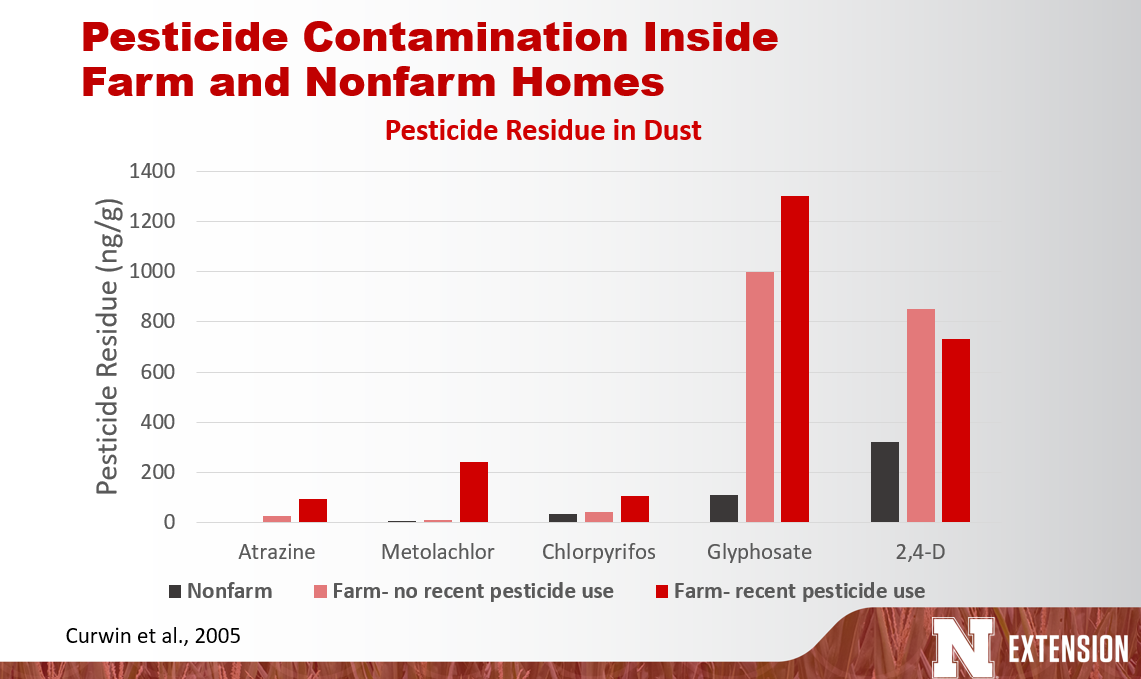

This information is important as we think about how any of us can be tracking pesticides through our homes. Pesticides are applied to fields but also to our lawns and sometimes even to driveways. Think about our shoes walking through all these areas.
- Do we always remove our shoes at the entranceway before walking through homes?
- Do we always remove pesticide contaminated clothing in an area where we’re not walking through the home first?
- Are we then leaving that clothing separated from the family laundry in a plastic trash bag?
Laundering pesticide contaminated clothing correctly is also super important. We talk about this during pesticide training. But I wonder how many homeowners using general use pesticides are aware of how to properly launder clothes after they’ve applied products like roundup, 2-4D, or things like weed and feed to lawns?
The following are basic steps for laundering pesticide contaminated clothing. I also have magnets that you can put by the washer machine and you can contact me if you’re interested in having one.
- Separate clothing with heavy plastic bag (trash bag)
- If the clothing is heavily contaminated, hose it off or pre-soak outdoors…or consider tossing heavily soiled clothing and shoes.
- Wash contaminated clothing daily.
- Use Hot water, liquid detergent, and the biggest wash load size possible.
- NEW: Add 1 cup of salt to the washer if washing clothing where paraquat was used.
- If possible, line dry clothing. Otherwise, use the regular drying setting.
- Run an empty cycle through the washing machine before washing family/regular laundry.



 JenResources