Blog Archives
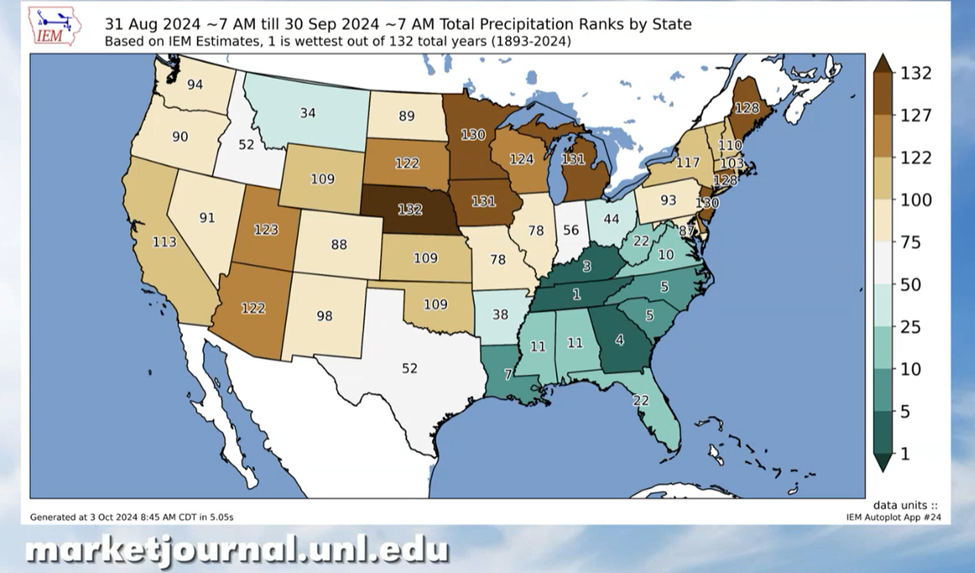
Dry September 2024
Dry Conditions: With the dry conditions, harvest has been rapidly progressing. Two weeks ago, soybeans had green stems with seeds that were drier than people thought. Last week, many were harvesting soybeans in the 7-8% range. For corn I’ve been hearing a lot of 13-15% moisture and a couple reports down to 11%, but still with good kernel depth and quality. There’s unfortunately nothing we can do about this other than prioritize which fields to harvest. We’re in a race against time and the low moisture is due to weather conditions and hybrid specificity.
I’ve never seen it so dry in September. Eric Hunt, Extension Meteorologist, showed that September 2024 was the driest September in Nebraska on record (132 years). He also shared there’s no relief in site moisture-wise with above-average temps till at least the latter half of the month.
The lack of relative humidity and precipitation, intense sunshine, higher temperatures, and wind have all led to the grain moisture loss we’re seeing (which can be as much as 0.8-1.0 percentage points/day). Dr. Bob Nielsen, Extension Emeritus Corn Specialist from Perdue shared, “It is not uncommon for grain moisture to decline more than one percentage point per day over a period of days when conditions are warm, sunny, windy and dry.” Research that he and others conducted back in the 90’s showed that when corn matures also impacts drydown rate. Corn that matured in late August had a daily average drydown rate of 0.8 percentage points per day while corn that matured in late September averaged 0.4 percentage points per day. The corn borer pressure on non-gmo hybrids and late season disease pressure on all hybrids also led to plants dying/maturing early.
Corn hybrid characteristics can also impact kernel moisture. Hybrids that have thinner or permeable pericarp layers (outermost layer of the corn kernel), are more subject to moisture loss and faster drying rates in the field. I’m unsure how one knows this characteristic though.
You can look for these other characteristics resulting in quicker drydown: lower husk leaf number and thinner husk leaf, how soon the husk leaf tissue turns brown, how well the husk covers the ear (less coverage allows for faster drying), how tight the husk is (as looser husks will increase moisture loss), and how fast the ear turns down vs. remaining upright.

Fire Conditions: With the dry conditions and low humidity, we have a high risk of fire potential. I’m grateful to Nebraska DOT for posting the fire danger on signs throughout the state as a reminder to those traveling. Hopefully that will help reduce cigarette fires. Please keep thinking safety including fire safety with harvest. Days like Saturday are days to take a break from the field. Have fire extinguishers with you and charged, disks at fields, blow out combines regularly. Roads are so dangerous with the dust; turn lights on when traveling in the daylight. Please be safe! Safety resources: Educational Resources | College of Public Health | University of Nebraska Medical Center (unmc.edu)
Cover Crops and Small Grains: With the dry conditions, I’ve heard of several semi loads of wheat returned and not planted in the southern counties I serve. It’s hard to know what to do, but if a small grain is part of one’s rotation (which I feel there’s many benefits of), I’d recommend to stay the course with planting the current rotation and evaluate the situation next spring. It’s something to also discuss with crop insurance. Regarding irrigated ground, I have been recommending to put on 0.5”, potentially with two shots if needed, for cover crops. This may seem like a waste of water, so my explanation. The covers are an investment for soil erosion loss, uptaking excess nitrogen, aiding with weed control next year, and/or for grazing. With no soil moisture, the low amounts of irrigation are to get seeds growing or keep seedlings alive for the time being.
Trees and Lawns: We also need to be deeply watering trees in landscapes. Push a screwdriver in the ground to determine wetting depth. Kentucky bluegrass is shallower-rooted and doesn’t take heat as well as fescue. However, bluegrass will go dormant without dying, whereas fescue, even though it’s deeper rooted and more drought-tolerant, doesn’t go dormant from drought-stress, so it can die. After bluegrass has reached three weeks of dormancy and fescue has changed color, it’s recommended to water 0.5”/week to keep both grass species from dying.


 JenResources