Blog Archives
Tree Problems
I’ve received several questions on trees. If you have silver maples or pin oaks that are looking a little yellow, most likely the yellowing
is due to iron chlorosis. Symptoms of iron chlorosis include leaves with green leaf veins while the leaf tissue is yellow-green. Iron chlorosis is common in several of the towns in Clay County due to higher pH soils (more basic soils) which makes the iron unavailable to the plants. Trees can be injected with iron sulfate in the base of the trunk with the amount injected dependent on the diameter of the tree. There’s also another method of soil injection with micronutrients that can also be used. I also have a list of tree care providers for the area for trunk injections; please contact the Extension Office if you’re interested in obtaining this list.
On evergreen trees, spruces losing their new growth or inside needles may be doing so due to two different fungal diseases or spidermites. If you are noticing this problem on your spruces, the time to prevent fungal diseases will be May next year with products such as Bravo, Daconil, or copper-sulfate based products. Spidermites can be managed with insecticidal soap. Ponderosa, Austrian, and Scotch pine trees with brown fungal bands on needles causing the needles to turn brown can be sprayed with a copper-sulfate based product now to help prevent further browning. If large branches of your trees have needles dying, the culprit may actually be the pine wood nematode which causes pine wilt disease in Scotch pines. There is no cure for that disease. To determine if pine wilt is the problem, cut a piece of dead/dying branch that is at least 1 inch in diameter and 4 inches long and send it to the UNL Plant and Pest Diagnostic Lab for diagnosis. Cedar trees are also showing Cercospora blight right now with needles turning brown. We used to think nothing would kill a cedar tree, yet many cedar windbreaks have needles turning brown and this fungal disease is killing needles due to restricted air flow and high humidity within our windbreaks. Restricted air flow is something you’d like with windbreaks but many of the trees in windbreaks were planted too close together many years ago and we’re starting to see more of a problem with various fungal diseases. Another option to spraying fungicides is to consider removing every other tree from the windbreaks to allow for more air circulation to cut back on fungal diseases.
If you’re unsure how to tell what kind of evergreen tree you have, cedar trees have needles like ropes. Spruce needles are single and when you roll them in your fingers, they have edges to them. Fir needles are also single and when you roll them in your fingers, they don’t roll easily like spruce needles because they are flat (flat fir). Pine needles are always in groups-of 2, 3, or 5. Austrian and Ponderosa pines have the very long needles; Austrians will always have long needles in groups of 2 but Ponderosa’s will have long needles in groups of 2 or 3 (If you ever see 3 needles, it’s a Ponderosa pine!). Scotch pines always have short needles in groups of 2. White pines have needles in groups of 5.
White Heads in Wheat
The last week I have received questions about white heads in wheat. An excellent resource from UNL to determine various wheat head disorders can be found here. If the heads are completely bright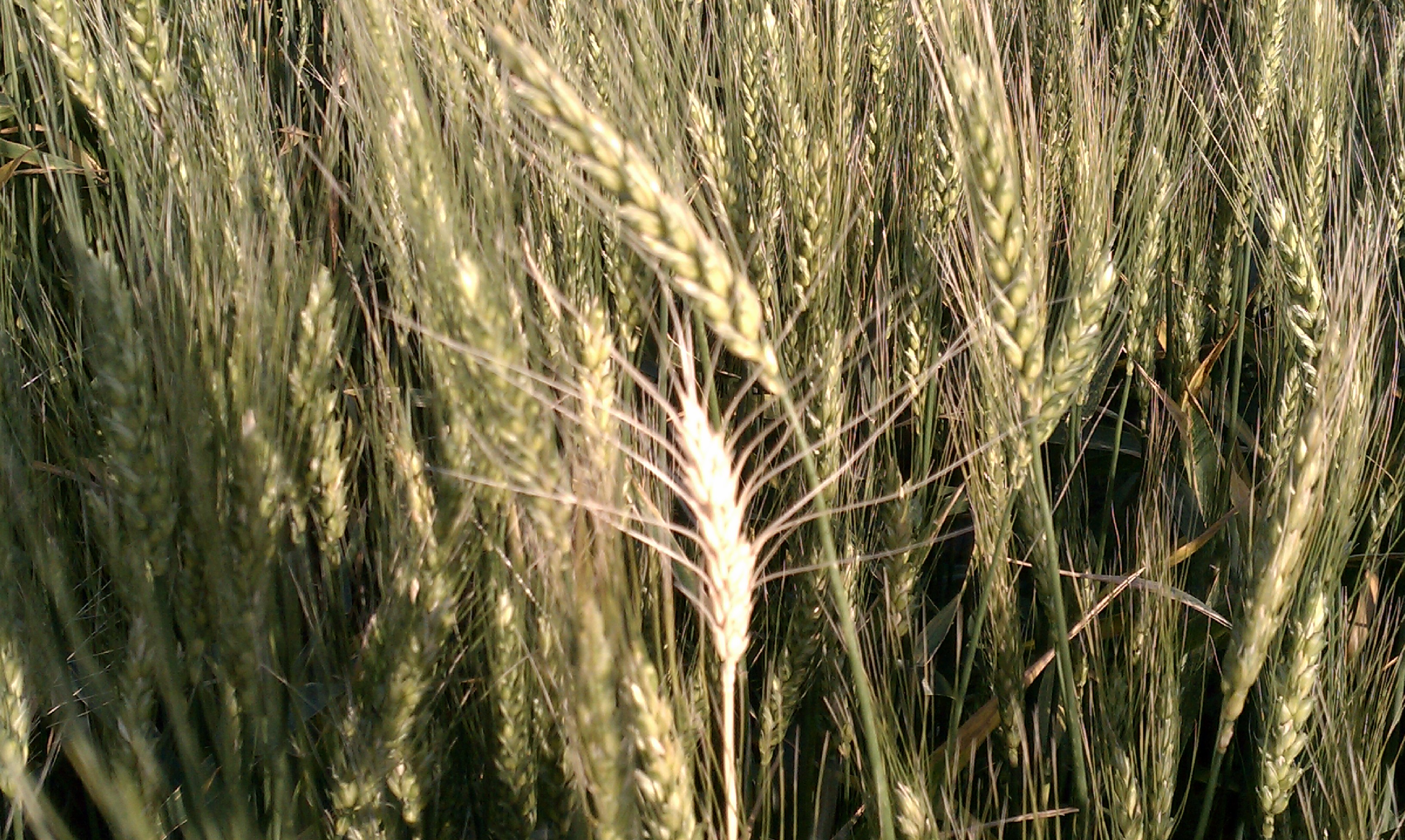 white and you can easily pull those heads out of the stem, the culprit is the wheat stem maggot. This insect will sever the stem above the top node so that the stem upward to the head are white while the rest of the plant remains green. I usually only see a few of these types of heads scattered around in fields and there’s no recommendations for managing it
 because damage isn’t considered economical.
If your heads have white or pink colored kernels in them in addition to regular looking kernels, chances are the discolored kernels have Fusarium Head Blight also known as head scab. The kernels eventually may have a brown discoloration to them and the stem just below the head may also turn a brown-purple color. The Fusarium fungus that causes head scab is the same that causes stalk rot in corn. Wheat on corn rotations in no-till systems have a greater potential of scab in wheat, but these situations don’t mean that scab will always occur. Ultimately, rainy, humid conditions for a 2 week period around flowering is the primary factor for allowing scab to occur.
If you are finding scab in your fields, there’s nothing to spray or do now. Set your combine to blow out the lighter, shrunken, scabby kernels to help avoid dockage at the elevator. I would also recommend to avoid saving back scab-infested seed. Plan to purchase certified seed instead for next year and be sure to have a fungicide seed treatment applied to it to avoid problems with smut.
Rootless Corn Syndrome
Heavy rains in previous weeks have washed soil away from developing roots in some fields. Plants now up to 4-5 leaf stages in affected areas are hanging on by the main radical root. Some plants haven’t been able to survive while others have. Looking closely, brace roots are developing at the crowns of affected plants and eventually, they will begin to kink themselves to pull the plants upright again. There’s not much to do in this situation, but if you have the ability to get soil built up around the root base by cultivating, that can help. If not, an irrigation or rainfall may also help.
Often I see rootless corn syndrome as a problem with smaller plants-3 leaves or less-in which the seed was planted shallow to allow for planting in wet soils. Windy conditions and lack of soil moisture near the surface can allow for poor root development leading to rootless corn syndrome. Thus, I recommend planting corn 2″ deep and not planting shallow to avoid this problem later on.
Discussion: Irrigation Scheduling
I’m adding this post as a discussion topic as we get into the growing season for producers to post their irrigation scheduling questions or to share what their sensors and ET gages are reading. With the Nebraska Ag Management Network, we’ve learned that producers often need other producers to check their readings with-kind of like a support group for producers involved with this effort. That’s because it’s hard to not irrigate when neighbors are irrigating and your irrigation scheduling tools are telling you that you don’t need to irrigate! We’ve had some good discussions in the past so I look forward to the discussions this coming year!
Irrigation Scheduling Equipment
It’s nearing mid-May and crops should hopefully be emerging soon! For those of you utilizing watermark sensors for irrigation scheduling, it’s important to install those shortly after emergence so you can monitor soil moisture fluctuations long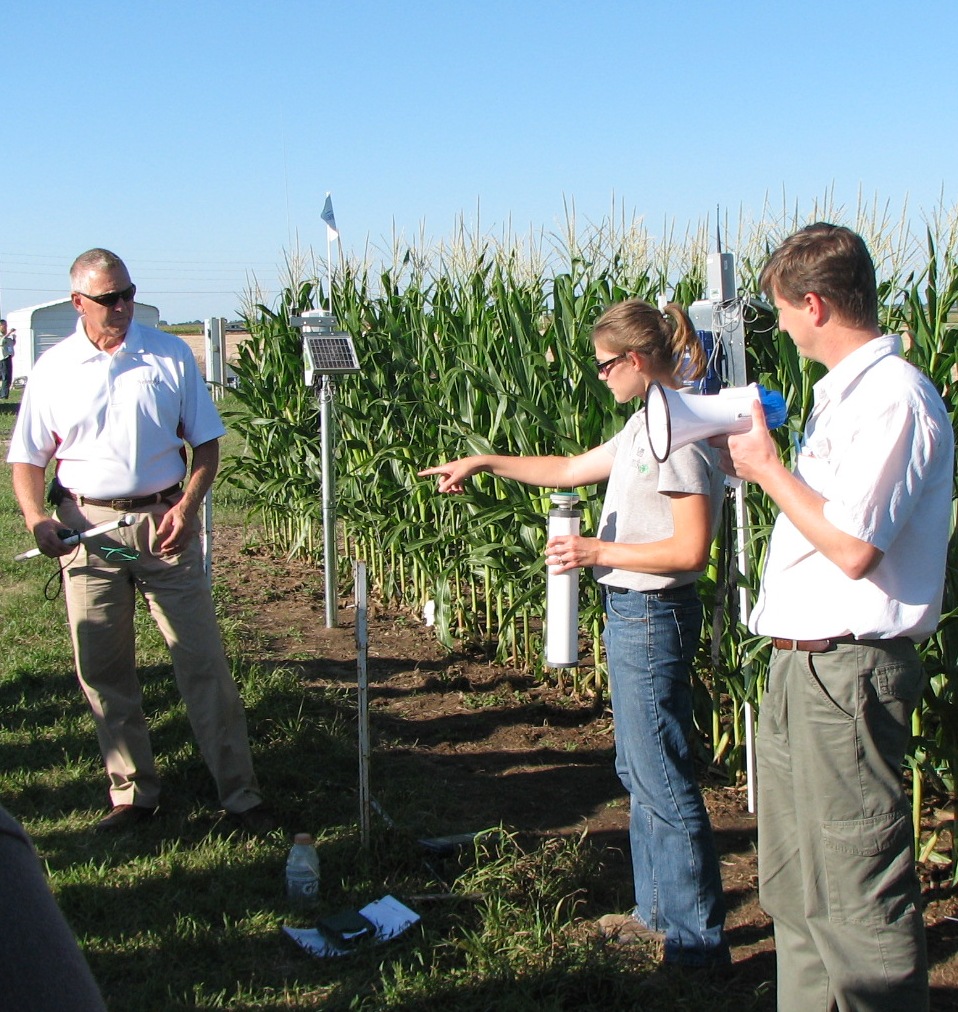 before you ever need to think about irrigating. I’ve found that our cooperators who install these early after emergence are far more confident in the readings than those who install them closer to irrigation time. That’s why we no longer install these for anyone past June 15.
In case you’re wondering what is a watermark sensor, it’s a 3″ sensor filled with fine sand with a fiber glass mesh around it that measures how much energy it takes for the plant roots to extract moisture from the soil. The sensor measures this in a unit of energy called kilopascals or centabars…units that don’t mean much to you or I. That’s why we’ve created charts that convert these units to inches of depletion/foot-terms with which we are more familiar! We recommend farmers install one set at 1′, 2′, and 3′ depths in their fields to monitor when their soil reaches at least 35% depletion. The basic rule of thumb based on research by Dr. Suat Irmak at UNL is to take the average of the top two sensors prior to the reproductive stages of the crop and the average of all three sensors once the crop has reached the reproductive stages (tasseling or flowering). When the average of these sensors reaches 35%, we suggest you consider scheduling an irrigation.
The other tool we use are Evapotranspiration (ET) Gages. The green canvas cover mimics the leaf surface and essentially as the cover is exposed to different environmental conditions such as wind and low humidity, water is moved out of the tube through the canvas cover and the depletion is noted on a site gage on the front. This tool has helped farmers visually better understand why their crop did or didn’t use water for any given week as they can look at the ET gage and consider the weather conditions and the influence they had on what the crop used.
On average, our farmers have saved 2.0-2.5″ of water in corn and soybeans since participating in this program. This program called the Nebraska Ag Water Management Network began in 2005 and now has over 500 cooperators State-wide in Nebraska. More information about the Network, the tools and charts I described above, and videos demonstrating the equipment can be found at: http://water.unl.edu/nawmdn.


 JenResources