Blog Archives
Nebraska On-Farm Research Updates

Another one of my favorite winter meetings, and honestly, one of the most powerful farmer learning experiences I have the opportunity to take part in, is the Nebraska On-Farm Research Network and the winter Updates! Why is this such a powerful experience? Because the farmers who conduct the research are the ones presenting what they did, why they did it, and their results! The discussion amongst farmers, ag industry, and Extension is highly engaging and thought provoking. Great questions are asked. But even more powerful is the understanding that occurs on what valid research is and how to question what one sees and hears presented at meetings, in magazines, and online. The Nebraska On-Farm Research Network is sponsored by the Nebraska Corn Board and Nebraska Soybean Board via your checkoff dollars and this year we are having meetings at three locations in the State. February 13th will be at College Park in Grand Island; February 16th at the Lifelong Learning Center in Norfolk; February 17th at the ARDC near Mead and all meetings will begin at 9:00 a.m. and last till 3:00 p.m. There is no charge for these meetings but pre-registration is needed for meal count and ensuring we have enough materials and space. Please pre-register for all meeting locations by calling (402) 624-8000 or email christina.franklin@unl.edu. There are five CCA credits pending approval. Hope to see you at one or more of the meetings!
Inputting Data into Texas A&M Farm Bill Decision Tool
Last week was enjoyable working with farmers on Farm Bill decisions. I’ve decided to work with producers on an individual basis. If you are interested in help looking at your potential options using the Texas A&M model or would like another set of eyes to make sure the data was inputted correctly, please call (402) 762-3644 and Deanna or Holli will get you scheduled for a time.
One caveat is that this model is only as good as the data you input into it and your decisions

Example of FSA “eraser sheet” courtesy of Randy Pryor, Nebraska Extension in Saline County.
are based on where you feel potential prices the next five years will be. You need your CC yields and base acres from FSA as well as production history since at least 2008 (2003 if you wish to run crop insurance tool). Requesting a copy of the FSA “eraser sheet” is a great tool to check on planted and crop production planted acres and to see if reallocated base jives with the computer program. The Texas A&M simulation at https://usda.afpc.tamu.edu/ isn’t difficult to run, but it can be confusing as to what number to input where. Begin by registering at the site by providing an email address and password. Then login and you will see the following screen.
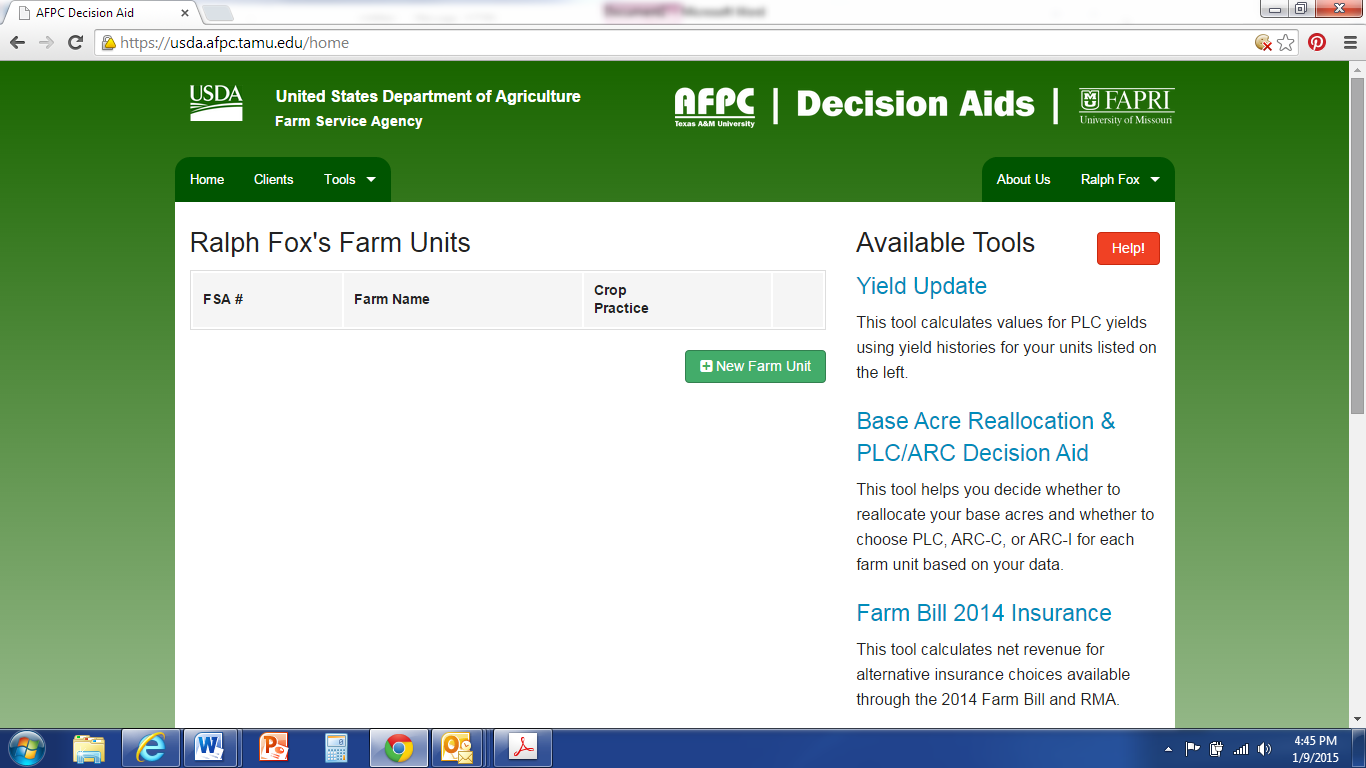
It is important for you to decide what you want the tool to analyze for you. It can analyze: yield update, base reallocation, ARC vs. PLC, and crop insurance (shown in right-hand column in screen-shot, or can also be selected from “Tools” in top drop-down menu). If you want to analyze crop insurance decisions, EACH crop insurance tract needs to be entered as a “new farm unit” under each FSA farm number. It takes a lot of time and it can be done, but that’s the only way to use this tool to also look at crop insurance including supplemental coverage option (SCO).
If you do not want to look at crop insurance decision but wish to consider the first three decisions, then for counties such as Clay County with COMBINED irrigated and dryland county yields, completing the Price Loss Coverage (PLC) Yield Worksheet (CCC-859) from FSA with your combined irrigated and dryland yields for each FSA number will greatly aid you in inputting the data. For counties with any splits in irrigated and dryland yields, I recommend placing irrigated and dryland production separately on the top of the PLC Yield worksheet, and then combining production by crop towards the bottom of the worksheet. Regardless of if your county has the opportunity for a split irrigated/non-irrigated payment, all CC yields in Nebraska are combined by crop (regardless of irrigation or not), so FSA will want a combined yield by crop on their form.
EACH crop needs to be entered as a separate farm unit. I have created a fake account to walk you through a simulation.
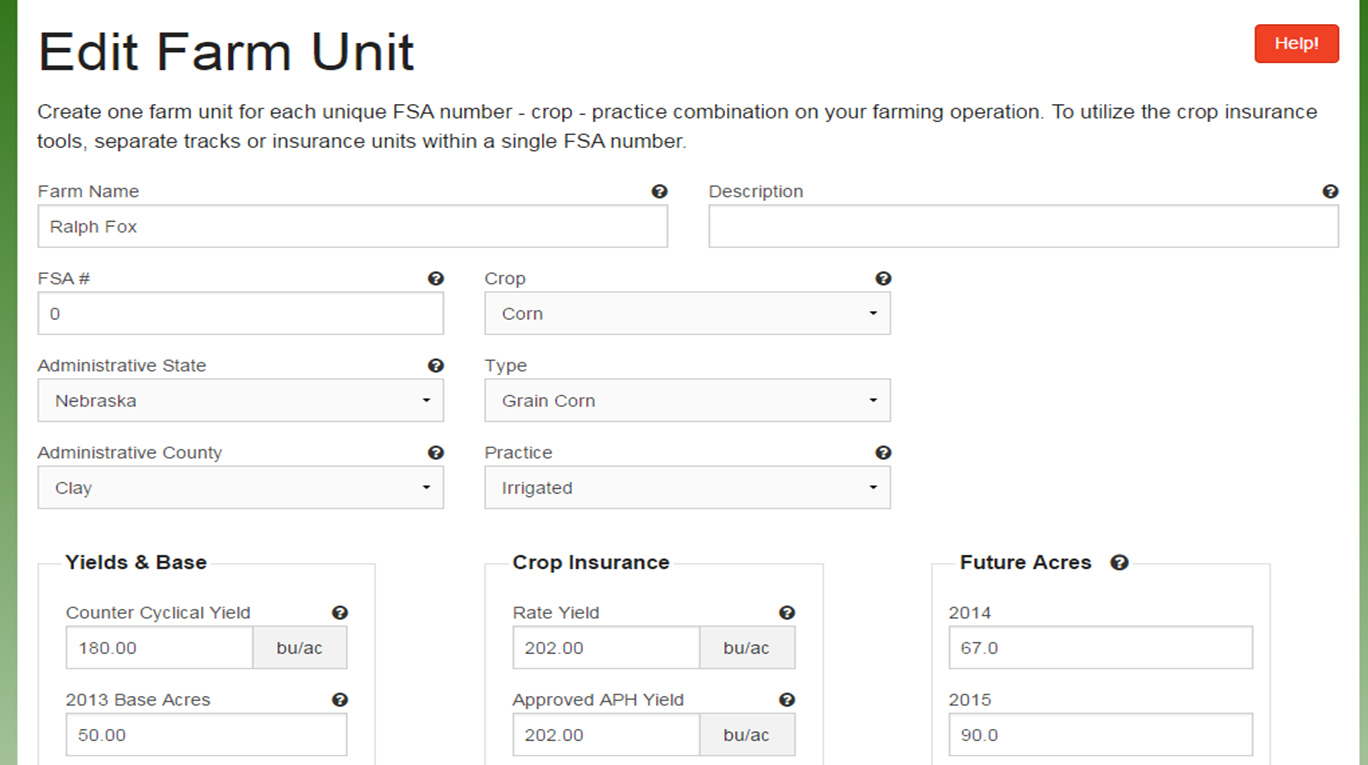
Some are having a difficult time finding “rate yield” on their crop insurance forms. It is not critical if you are not using the crop insurance tool and the same Approved APH yield can be inputted for the rate yield as well. If using the crop insurance tool, the correct rate yield from crop insurance must be used. UPDATE: If you ARE NOT interested in analyzing crop insurance information, “0” can be inserted for basis price, rate and APH yields, and select “none” for crop insurance. If you are also not interested in analyzing ARC-IC, then “future acres” can also be entered as “0”.
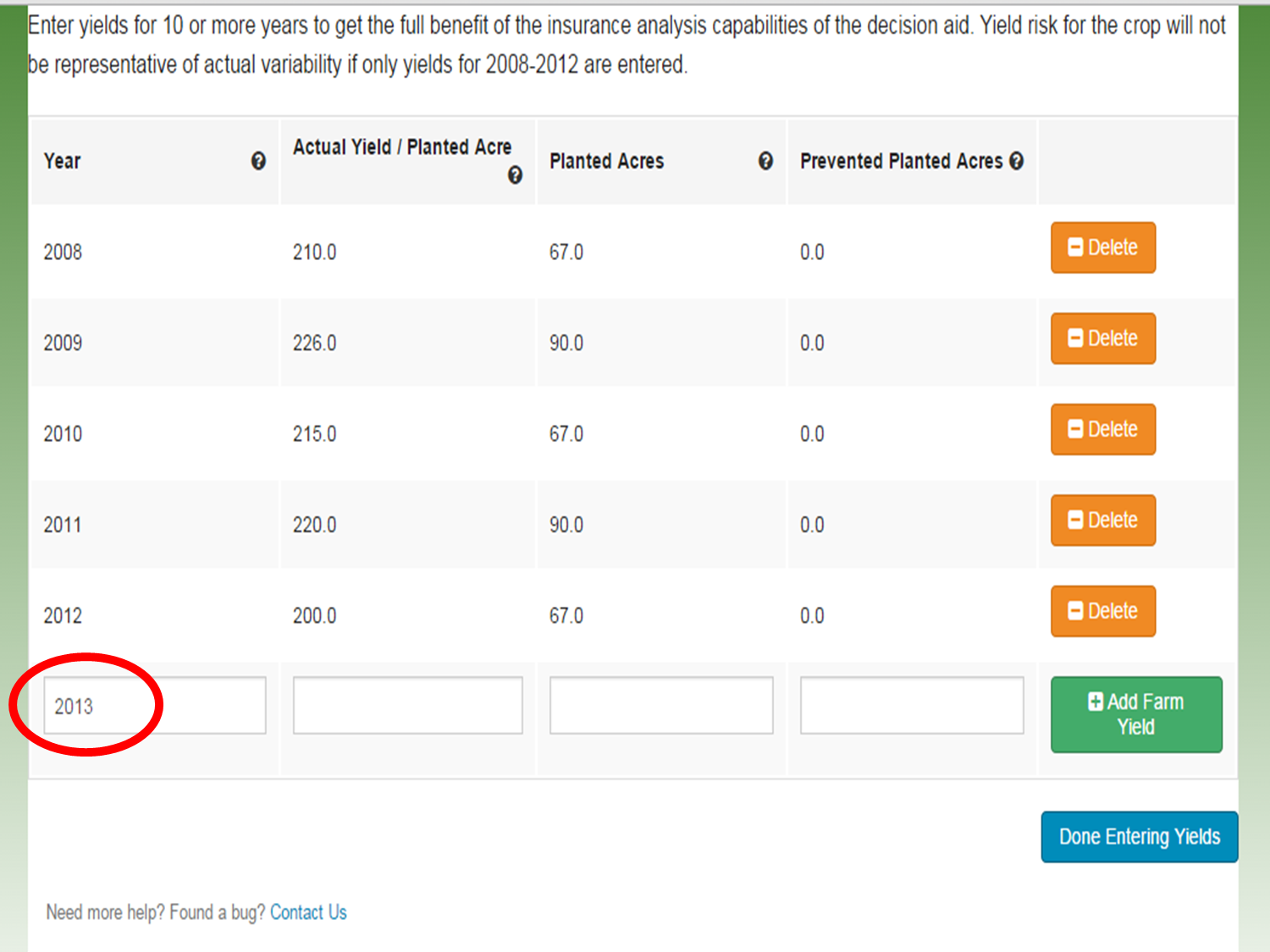
When entering yields, you need to enter one more date after all your yield data has been entered for the data to save properly. In this example, I have inputted yield data for 2008-2012. I then added “2013” and pressed “save yield data”. If you input 2013 yields, be sure to add a “2014” instead. Not doing this step will delete your last row of yield information.

Notice that each crop needs to be added as a separate farm unit. If using the crop insurance tool, each crop insurance tract under each FSA farm number needs to be added as a separate farm unit. Be sure to split out base acres among the tracts and be sure that the total base acres add up to the total base acres from FSA.
For entering separate crop insurance tracts, the CC yield should remain the same for all dryland tracts under one FSA farm number (same for irrigated). However, you will have to split out base acres amongst the tracts and you need to make sure the acres inputted add up; please double check this!
For your yield update and base reallocation information: For some of you, the base reallocation acres in the tool have been slightly different than what you received from FSA office. That may be because risk management agency (RMA) acres were used and were different than the production acres FSA had on file. You need to use the FSA acres for planted acres when using this model if they differ from the RMA ones.
When running this model, on many farms PLC + SCO looks favorable for some crops. A word of caution, you can consider PLC but should not consider SCO in your decision if you have not broken everything out into crop insurance tracts and included 10 years of production history into the tool. So in the decision of reallocating base acres or not, in the final summary section that gives you total numbers, anytime PLC+SCO is shown for a particular crop and you have not included the proper crop insurance info, you need to re-calculate the final total by hand using PLC ONLY from the table above that area. It normally doesn’t change the outcome that the decision tool provides, but it can. I’m not saying that SCO shouldn’t be considered, what I’m saying is that the numbers provided in the tool are not accurate if you have not inputted the data in the way needed to look at crop insurance decisions.

In this example, you notice three tabs: Base reallocation, risk chart, and per crop analysis. The green tab shows what you are looking at-in this case base reallocation. Notice there are two charts: The top one shows ARC-Co, PLC, and PLC+SCO. Blue circles indicate best option with reallocating base acres while orange circles indicate best option without reallocating base acres. The second table gives you your totals. Notice in this table and the one above that PLC+SCO are shown as the best options for corn. However, in the total, because we did not separate the crop insurance tracts in this FSA farm number and because I didn’t include 10 years of yield data, I need to recalculate the totals by looking at the top table for the next highest prices under ARC and PLC. So for this example, to refigure best reallocation of base payment total, I would take the $8093 listed in PLC, reallocation for corn since it is higher than ARC and add it to the $4612 for soybean payment to get: $12,705 for base reallocation. For no base reallocation, I would add $10,791 from PLC since higher than ARC in this example and add it to $3075 to get a total of $13,866 for no base reallocation. Most of the time, the outcome stays the same, but there are a couple instances it has changed, so wanted to make you aware of the importance of this.
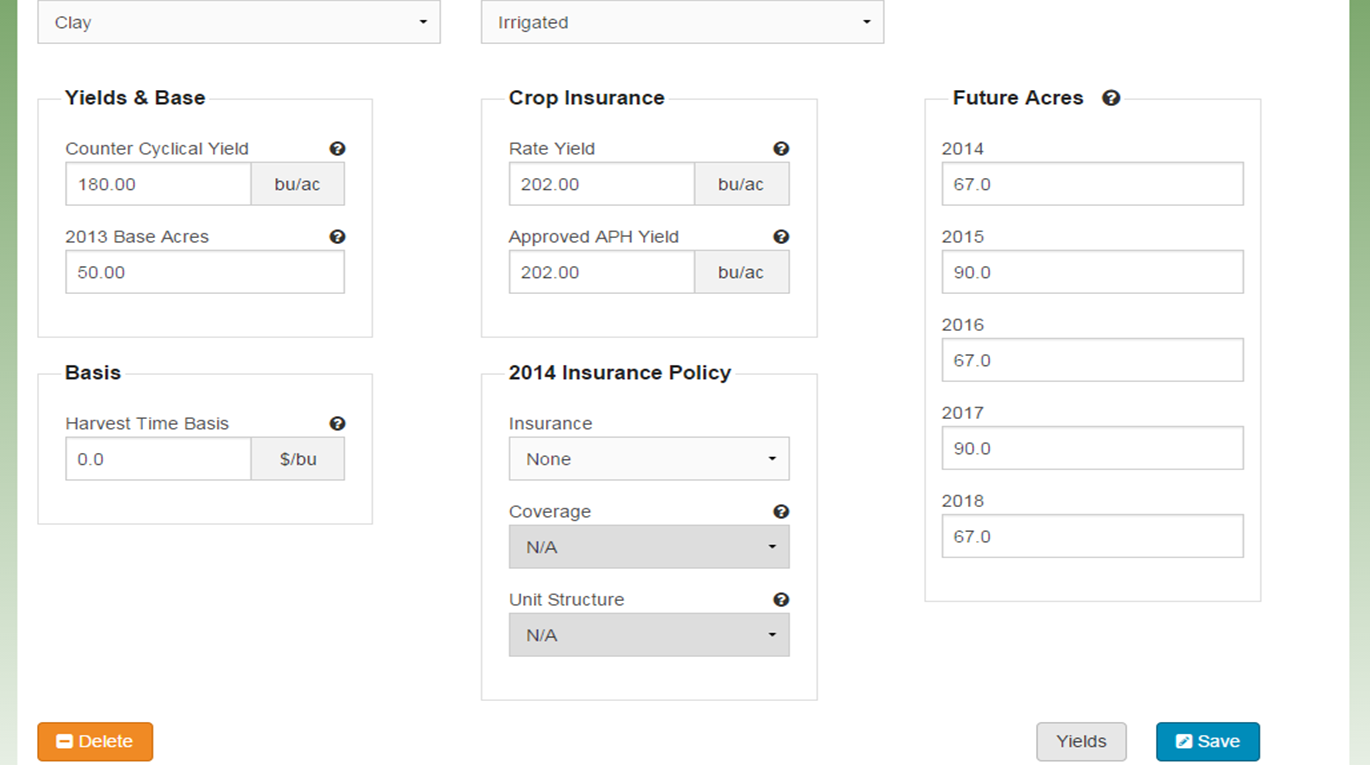
Or to get around having to hand-calculate removing SCO from the total decisions, Randy Pryor and Paul Hay, Nebraska Extension in Saline and Gage Counties respectively, discovered that if you select “no crop insurance policy” on the edit screen for each farm unit, that it automatically takes out adding SCO into your final calculated options as you can see from the next screenshot!
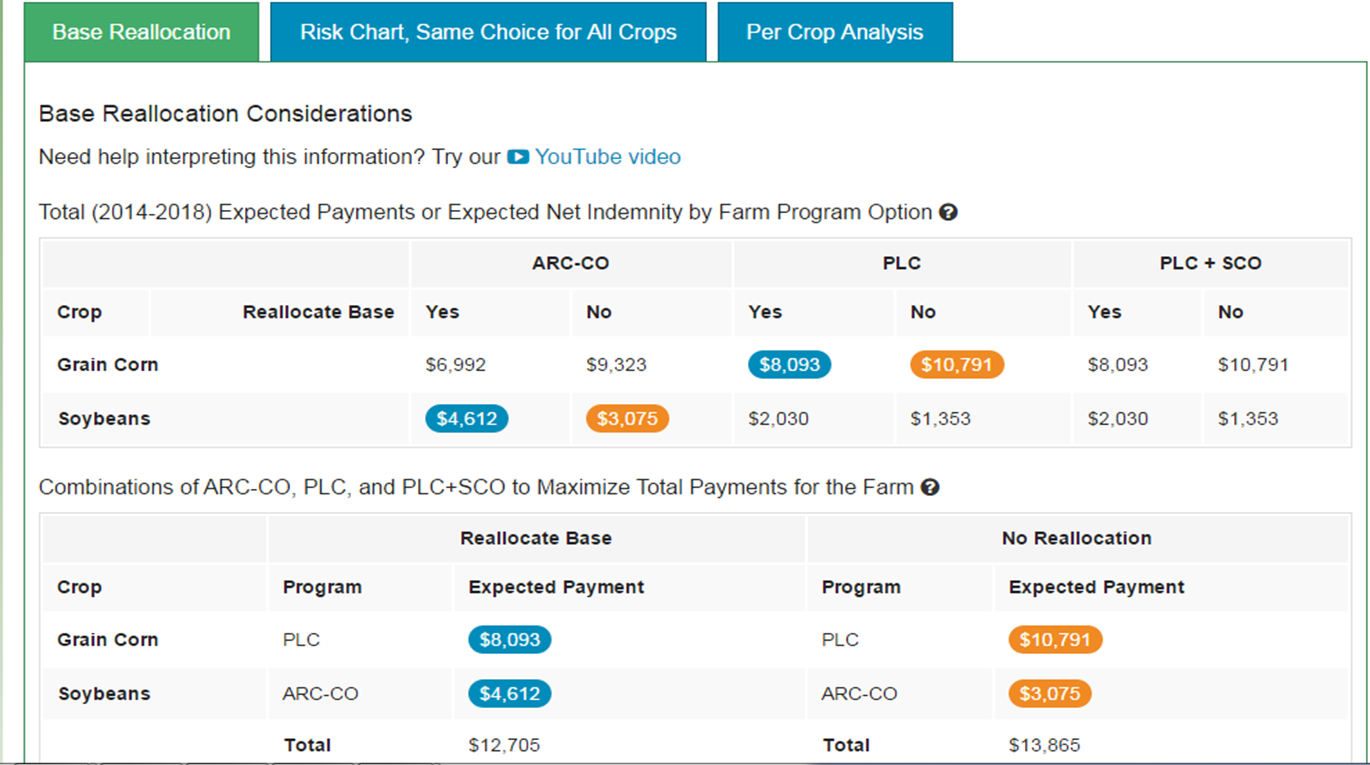
When not adding crop insurance tract info and 10 year yield history information to be able to analyze Supplemental Coverage Option (SCO), removing crop insurance from the beginning edit screens allows you to analyze base reallocation and ARC-Co vs. PLC program options without having to recalculate and remove SCO. It won’t give you a higher SCO payment number when adding information in this way.
Some of you have questioned why PLC even lists a payment when prices are inputted higher than the benchmark price of $3.70 for corn, etc. The Texas A&M tool is giving you essentially a bell curve of 500 random outputs with the distribution of that curve around the particular price you input for each crop. So with every given price you input, there’s a certain probability that the price will be at, above, or below that particular price. That’s essentially what the red, green, yellow bars are showing you on the analysis. So you’re assessing where you feel prices will be, what decision will allow you to best sleep at night, the potential of spreading out risk with several farm numbers by choosing different options, etc. You can also view the YouTube videos from Texas A&M with more information!

Soybean Stem Borer

Are you noticing holes in your soybean stems? Holes where the petiole meets the main stem are the entry point where soybean stem borer (also known as Dectes stem borer) larvae tunnel into the main soybean stem. Originally eggs are laid in soybean leaf petioles in the upper canopy. The eggs hatch into larvae which burrow down the petiole then into the main soybean stem. Notice the soybean stem borer infected stem in the middle while the soybean stem to the right has a a non-infested area where the petiole dropped (it is naturally sealed over by the plant). Count how many plants out of 20 have this symptom to get an idea of percent infestation and repeat in several areas of the field. Fields with 50% or more infestation need to be harvested first and perhaps earlier to avoid lodging and yield loss associated with lodging.

Lodged soybeans can be another key for checking for stem borer around harvest time. Notice the stem in the middle of the photo that is lodged (fallen over instead of standing in the row).

Following the stem to the base, the stem easily breaks away from the plant. The stem itself will appear solid. The base of the plant where it breaks is also often sealed off. The stem borer will seal itself inside the base of the stem. In this case, there’s a small portion that hasn’t been sealed off yet.

Gently pulling apart the base of the stem reveals the soybean stem borer larva. The larva will spend the winter and eventually pupate here. Adult beetles will emerge in late June and there’s only one generation per year. For more information specific to life cycle and management, please see the following NebGuide.
Storm Damage Resources

Field flooding occurred in newly planted and newly emerged fields throughout the area after recent rains.
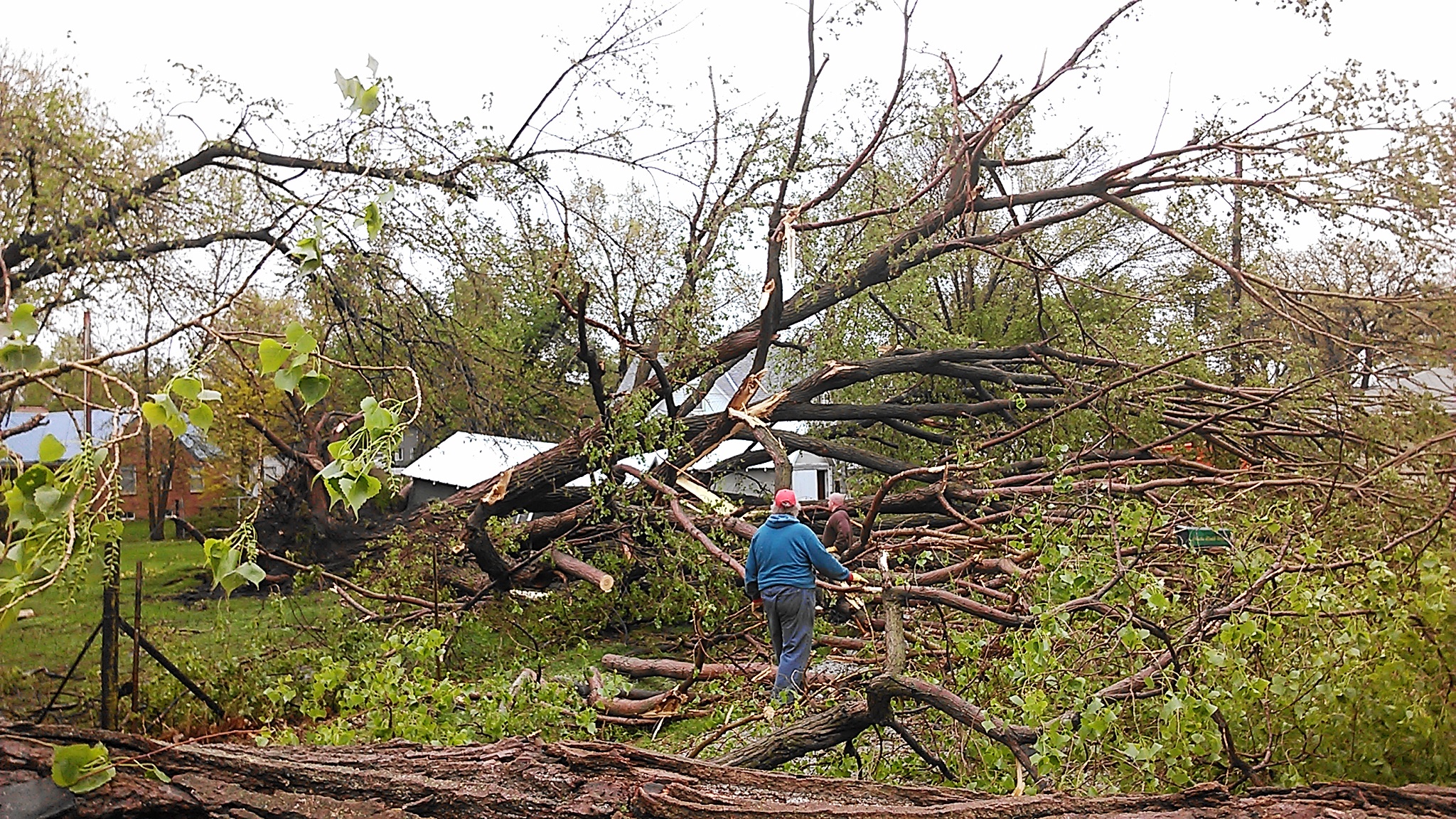
Large trees were uprooted falling on buildings, homes, and cars in Sutton after the May 11, 2014 tornadoes.
The Mother’s Day 2014 storms caused significant damage in Clay County and other areas of the State. It never ceases to amaze me how people throughout the area respond to storm damage! Clay County has had its share, and yet the attitude of those affected has been one of thankfulness-thankfulness that no one was injured and that so many still have their homes in spite of damage. It’s also wonderful to see people from all over the County and area pull together with each storm-helping each other out bringing themselves and equipment to pick up debris or help however possible. It’s a blessing to work with and serve the people of this County!
Resources
As clean-up continues, the following are a list of resources that may be helpful to those affected by the storms. Thoughts and prayers go out to all who were affected!
- Numerous Tornado Damage, Recovery, Cleaning, Decision Making resources (scroll to Recovery portion in middle of page)
- Tips for Early Tornado Damage Recovery
- When to Save and Throw out Frozen Food after Power Outages
- When to Save and Throw out Refrigerated Foods after Power Outages
- Flooding and Corn Survival
- Flooding and Soybean Survival
- Evaluating the Need to Replant
Still Time for On-Farm Research!
With the recent rains and cooler weather in the State, producers still have an opportunity to consider conducting an on-farm research experiment that may be of interest to you! So far this year we have producers conducting nutrient management, irrigation timing, cover crop, seeding rates and dates, fungicide timing, and studies of various products on the market including sugar products. You can learn more about conducting on-farm research at our Nebraska On-Farm Research Network Website, our On-Farm Research Grower’s Guide, by Contacting a UNL Extension Educator or Specialist, the Nebraska Corn Board at 402-471-2676 or Nebraska Corn Growers Association at 402-438-6459. You can also learn more from our producers themselves in the video below. We hope you will consider conducting on-farm research this year to answer the questions you may have in your operation!
Tree Care Workshop

The Memorial Day and August 1st storms of 2013 did significant damage to our trees in Clay County. This workshop is designed to provide demonstrations on pruning techniques, what to look for, and learning how care for your storm damaged trees in future years. There is no charge and all are invited to attend. Please spread the word as many trees were damaged last year!
On-Farm Research Update
Hope to see you next week at our Nebraska On-Farm Research Updates to be held March 10 at ARDC near Mead and March 11 in York!!!

Natural Resource District Updates
Rod DeBuhr with the Upper Big Blue NRD spoke at a few meetings recently. He shared there’s a lot of rumors floating around, but if you have questions, please just ask the NRD. There will be no well drilling moratorium and no restriction on adding new acres in the District. The only exception to this is if the allocation trigger is reached, there will be no new transfers. The UBBNRD encompasses 1.2 million irrigated acres and 57% of the water is used on only 29% of the acres; thus there’s still some inefficiencies within some producers’ operations. These are producers using, on average, more than 8” since 2007. The average water use since 2007 is just under 8” for the District.
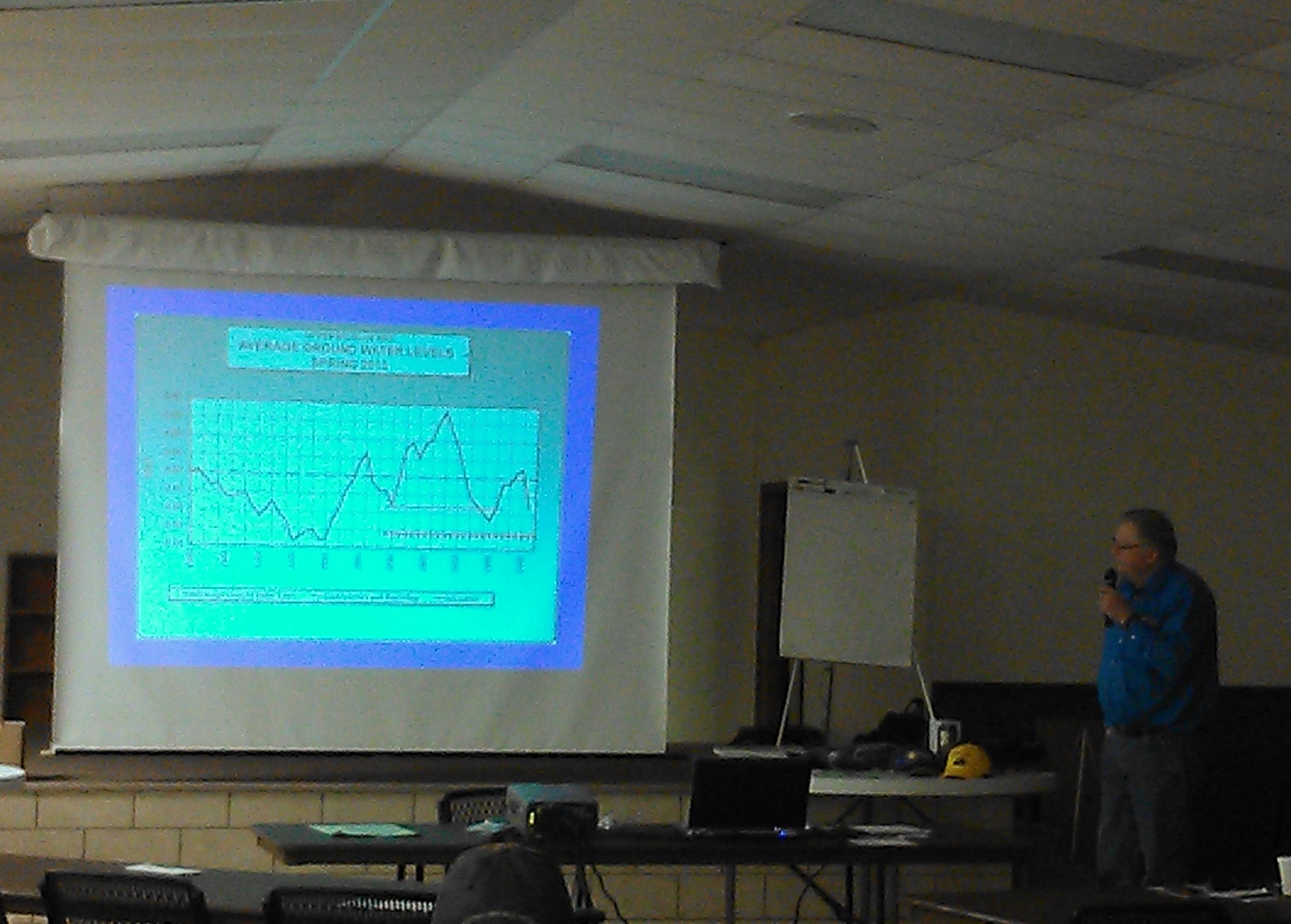
Rod DeBuhr from Upper Big Blue NRD speaks at the Hamilton Co. Ag Day in Aurora.
Flow meters are required on all wells by January 1, 2016 or by when an allocation is triggered-whichever comes first. The first allocation period is 30” of water for 3 years. They will then evaluate where the water levels are. If recovery doesn’t happen after the three years, then there will be a second allocation of 45” for 5 years.
For flow meter specifications: all new meters must record in acre-inches. They must also have an anti-reverse feature on them. They must be installed based on the manufacturer recommendations-no exceptions. Existing meters are grandfathered if they are determined to be accurate. There is no cost share on new meters, but there is some cost share for repairing old meters. Please contact the UBBNRD at (402) 362-6601 for questions or more information.
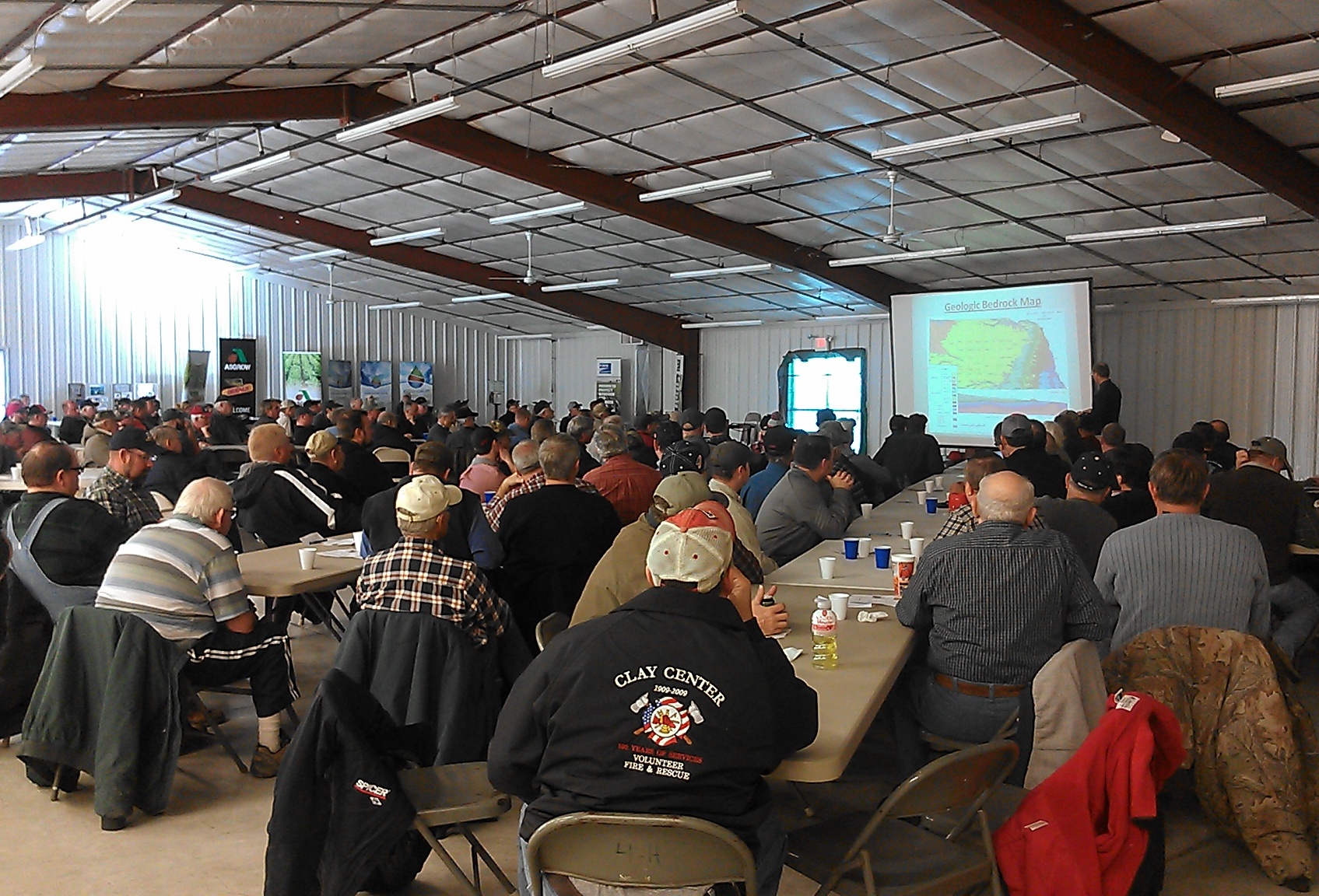
Little Blue NRD updates during the Soil and Water Conference in Clay Center.
Daryl Andersen with the Little Blue NRD also shared some information with me. These rules are effective as of January 17, 2014, which were put in place in 2006 or sooner. For well constructions and flow meter requirements as of Mar. 2006, new or replacement water wells to be used for domestic, stock, or other such purposes shall be constructed to such a depth that they are less likely to be affected by seasonal water level declines caused by other water wells in the same area.
Any new irrigation well or water wells for all other uses except municipal, domestic, public water supply, or livestock are required to have a minimum of 10 times the pipe diameter of clear space in the discharge pipe to allow for potential installation of a flow meter at a future date. There are some exceptions if a new meter is installed during the time of well completion; please contact the LBNRD at (402) 364-2145 for further info. Spacing between all new irrigation wells should be set at 1000 feet.
Nitrogen fertilizer restrictions include: Pre-plant anhydrous ammonia may not be applied prior to November 1. Pre-plant nitrogen fertilizers in liquid or dry forms may not be applied prior to March 1 except under the following conditions: a “Fertilizer Permit” will be required by the LBNRD prior to fertilizer applications, a nitrogen inhibitor will be required if applying over 20 lbs of active nitrogen/acre and an annual report will be required by March 15 of each year if receiving the “Fertilizer Permit.”
For the Clay/Nuckolls Water Quality Sub-Area: Two new rules were enacted March 1st, 2013 along with all of the prior rules. First, water samples need to be collected from all high capacity wells by the producer, delivered to LBNRD and NRD will analyze it for nitrates for 2013 and 2014 growing season. Second, water pumpage report is required from all wells for all producers in 2013 and 2014. Report can be hour meters, flow meters or other devices. Please contact the LBNRD for additional questions.
Soil and Water Conference
Hope you can join us for our Soil and Water Conference tomorrow in Clay Center!

Celebrating 100 years – Cooperative Extension
Cooperative Extension is celebrating 100 years in 2014! We will be celebrating throughout Nebraska in 2014, but in the meantime, check out our YouTube video!


 JenResources