Blog Archives
Nitrogen Management in 2026
With the increasing nitrogen prices, there’s a great opportunity to take the Nitrogen Challenge by trying sensing-based technology on your farm this growing season to help with nitrogen management. How does it work?
- Apply a pre-plant base rate to your field between 50-100 lb N/ac.
- Apply any additional nitrogen the plant needs in season using a sensing based technology like Sentinel Ag.
For the pre-plant base rate, I know only 50-100 lb N/ac is a hard adjustment for many, but in order to use the sensing technology, you really need to have a base rate no more than 120 lb N/ac.
Then somewhere on half of your field, apply a strip of 30 lb N/ac less than your base rate and a strip right next to it of 60 lb N/ac greater than your base rate. Repeat these two strips on the other half of the field. For example, if your base rate is 100 lb N/ac, the low base rate would be 70 lb N/ac and right next to it would be a high strip of 160 lb N/ac. Make sure there’s a high/low paired strip on each side of your field.
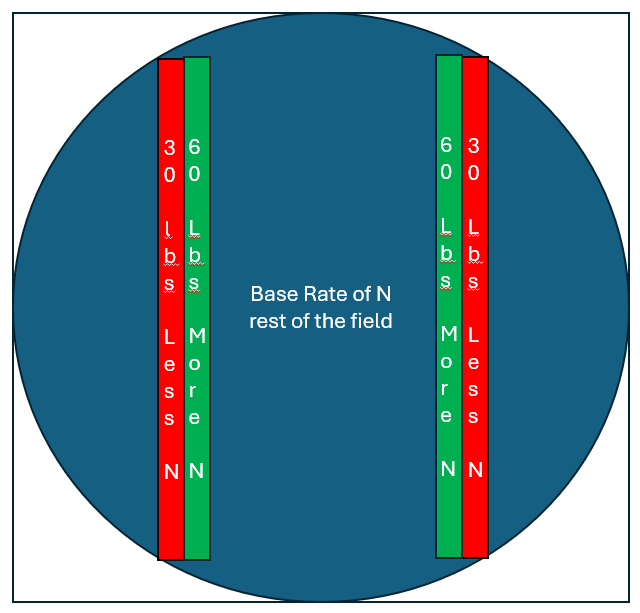
The next step is using a sensing technology like Sentinel Ag to monitor when your plants need any additional nitrogen in season. How do you get started? You can go to: https://www.sentinelag.tech/contact to contact Sentinel Ag and connect with a customer service provider.
From there it’s a matter of getting your field(s) into the system and imagery will be received each day during the growing season when cloud cover isn’t a hindrance. Our on-farm research growers since 2022 have saved on average 52 lb N/ac. We’ve had growers locally use Sentinel Ag who never applied additional nitrogen in the growing season. That usually only happens when there’s already high residual nitrate in the soil. However, it’s a great way to utilize that already existing nitrate and to avoid it leaching to the groundwater.
I also stress this as a nitrogen management tool beyond just reducing the amount of nitrogen applied. The satellite imagery has shown when terminated cover crops released their nutrients to the growing crop. We’ve also seen situations where growers added a 60 lb N/ac in-season rate at the correct timing during rapid growth phase and increase yields by 20 bu/ac. Those are things that we as agronomists can’t predict as we can’t predict mineralization for each field nor can we see the light spectrums that the sensors on the satellites can see that detect stress. It’s a beautiful thing how technology is allowing decades of research to become very practical and usable for growers!
So, for those frustrated by nitrogen prices, this is a great year to try in-season nitrogen management for yourself! And, for anyone using Sentinel Ag this year, we’re beginning peer mentoring groups. What does this mean? It can be scary and hard to try new technologies. Growers who have been using Sentinel Ag have volunteered to serve as peer mentors to other interested growers. We plan to help with understanding the imagery, fertigation, and just walk alongside each other to help with confidence in decisions and what we’re seeing. There’s much power in peer learning! If you’re interested in being a part of the Sentinel Ag Peer Mentoring Groups, please contact me at jrees2@unl.edu. We hope to get started by the end of March/beginning of April.
Richard Ferguson has retired after 40 years of service as a UNL Extension Soils Specialist and he will be greatly missed! His retirement celebration will be this Friday, March 20th from 2-4 p.m. at the Goodding Learning Center at UNL’s East campus. There’s also an online book for well-wishes at: https://go.unl.edu/ferguson-retire.
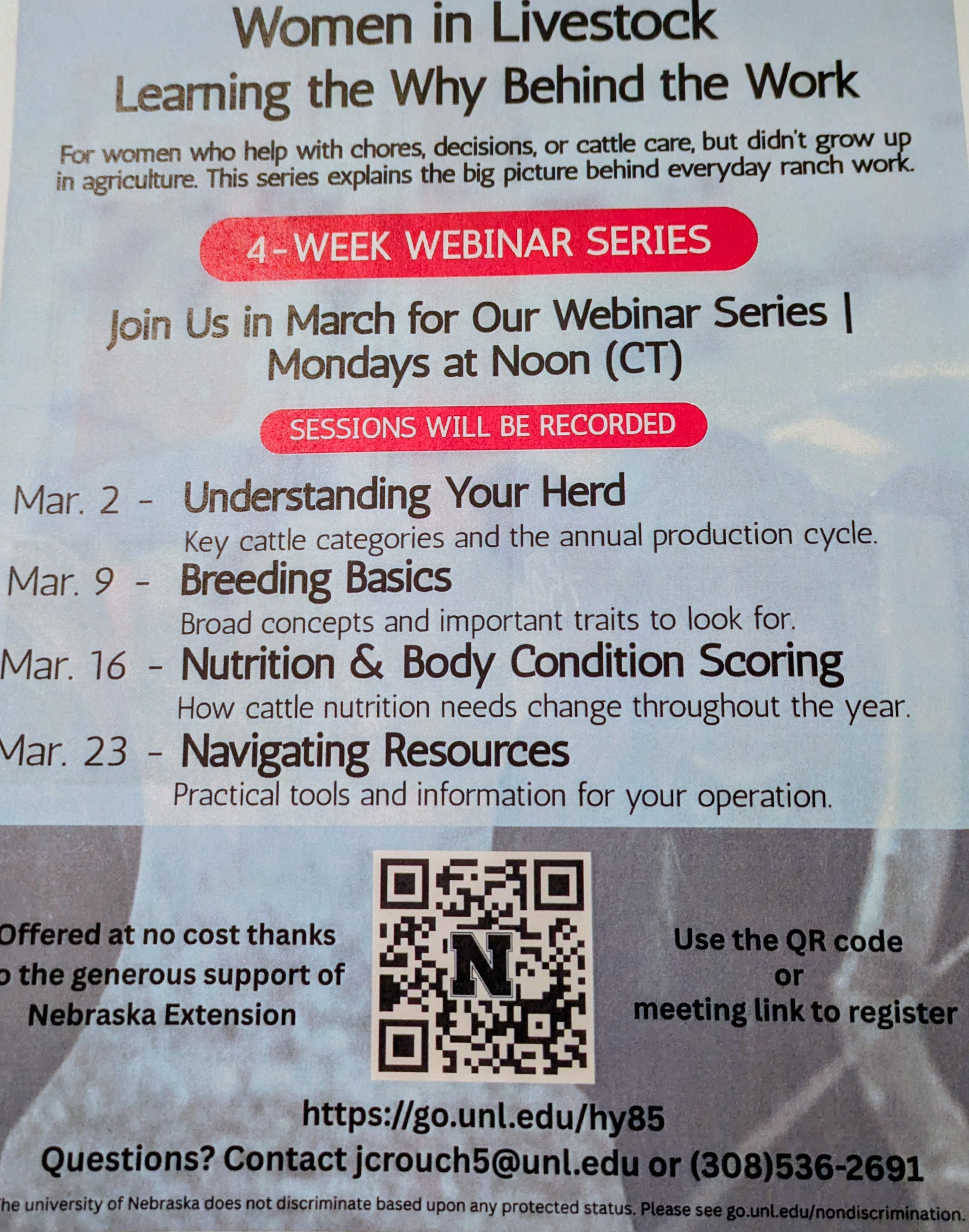
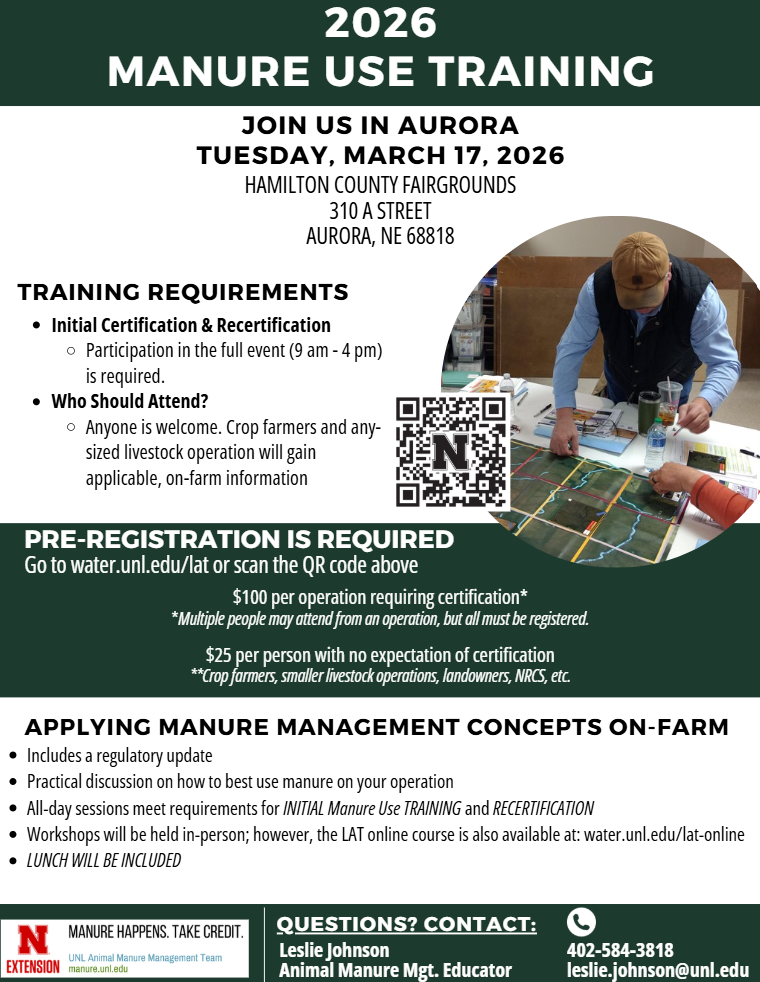
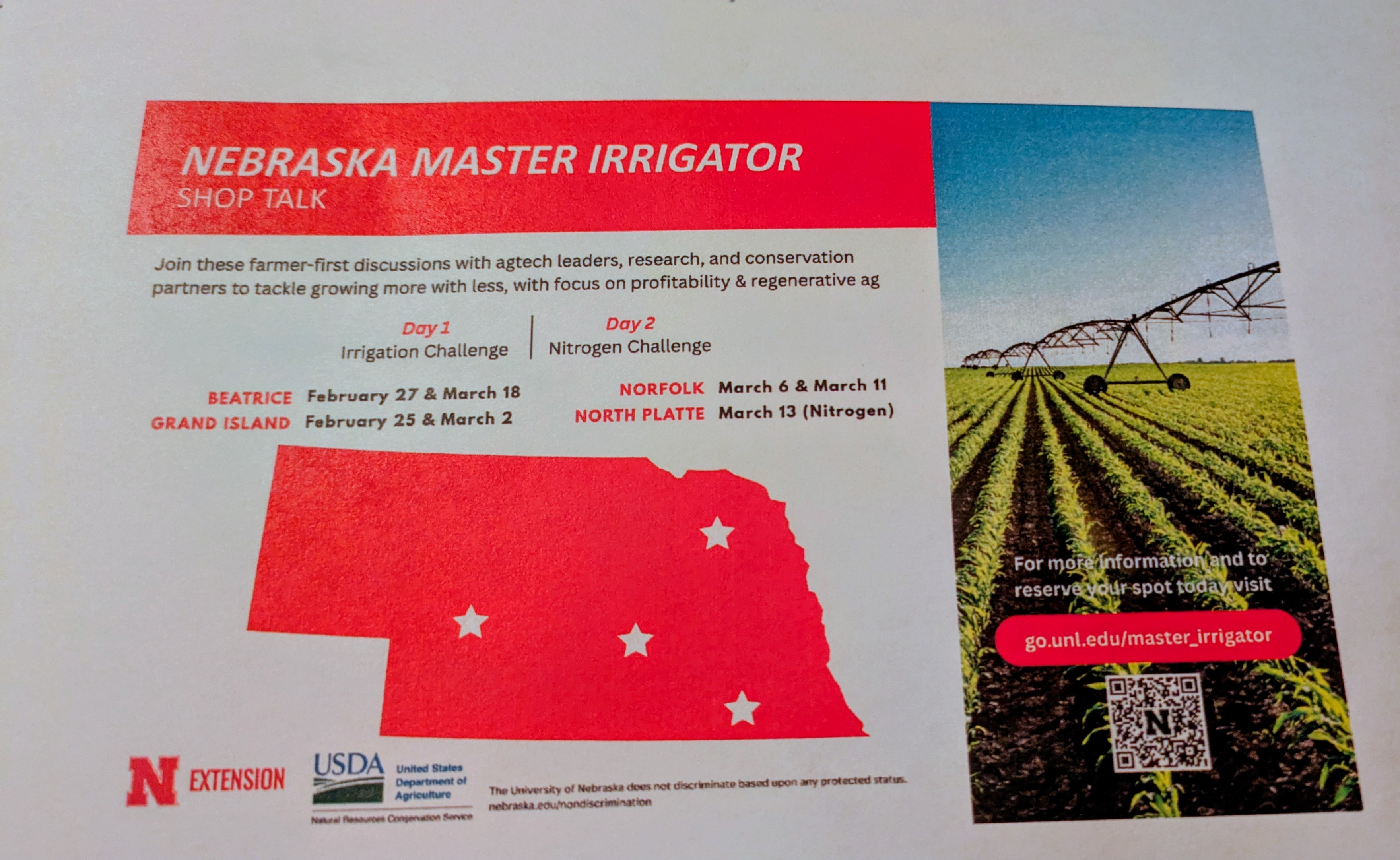
Crop-Livestock Integration Case Study
Happy March! We had a great Friday February conversation again. I think the power in that conversation was watching how ideas from previous years of conversations came to fruition with actual data including stocking rates and economics from several growers. The following is a case study where a grower who enjoys cattle wanted to find a way to raise his herd in the Utica, NE area where corn/soy/seed corn is plenty and pasture is limited. He thought outside the box, challenged the status quo and split a pivot into four quarters in 2024.
On one quarter he planted corn, the next quarter was a year of annual forages for strip grazing, the next was cereal rye for seed followed by winter stockpiled annual forages, and the final was soybeans. The pivot corners consist of pasture and one farmstead. The crops on each quarter are rotated clockwise each year. For example, the quarter that was strip-grazed annual forages in 2024 was planted to corn in 2025. Volunteer rye and vetch were grazed before corn was planted in that area and the cows were moved onto oats/peas he planted into the annual forage quarter. As they were dying out, he followed the cows with planting an annual forage summer mix that contained multi-species but was heavier on millets so he didn’t have to worry about removing cows during light frosts (he was avoiding the potential of prussic acid poisoning by using the millets instead of sorghum species). Now the cows are on the winter stockpiled forage that was also a muti-species mix but heavier on the sorghum species side. For a stocking rate, he figures 1 pair per acre (around 33 pairs if he stayed on this quarter system). This would also be a great system for stockers.
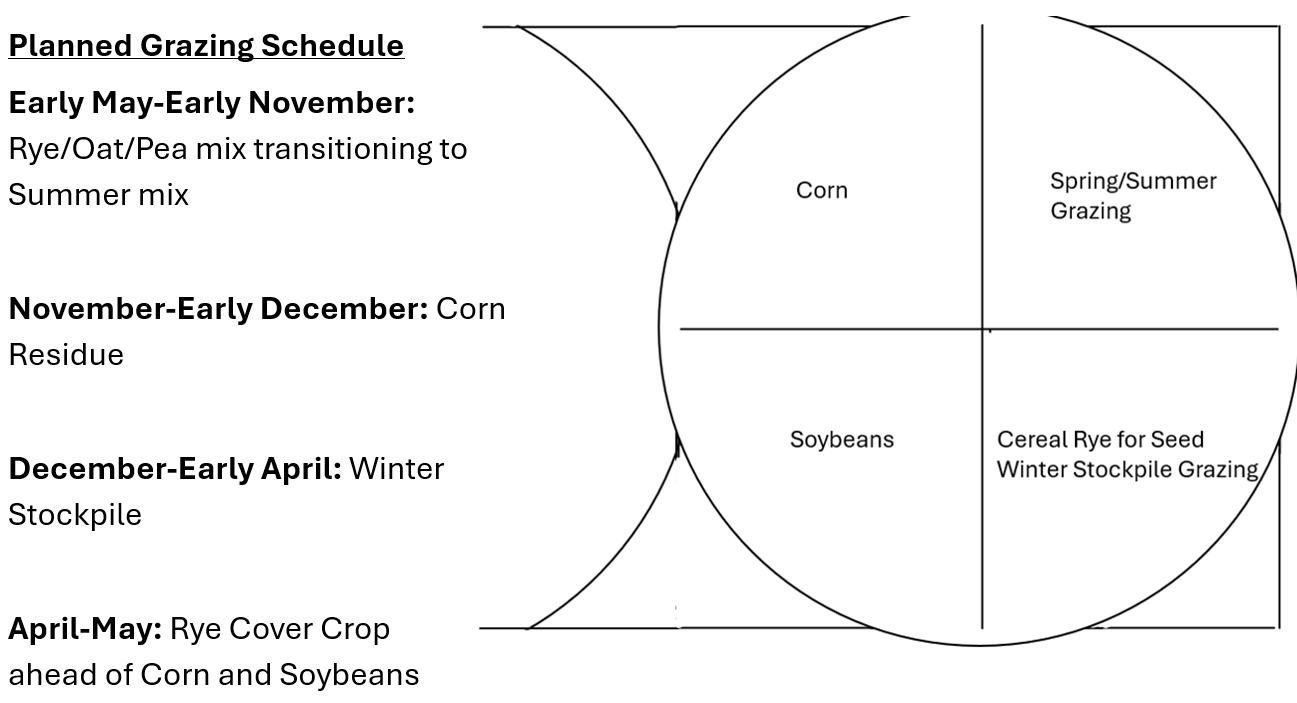
Splitting a pivot into quarters wouldn’t perhaps be the easiest set-up for most. His goals were to keep his cows on this one pivot for the entire year and to see what his stocking rate could be as he grew his herd. He also wanted to determine the economics and soil health of this system by the end of four years to see if he could scale it to other pivots on his farm. The beauty of this is that the system could be adapted to each producers’ goals and needs. Pivots could be split in half or converted entirely to suit the individual’s goals.
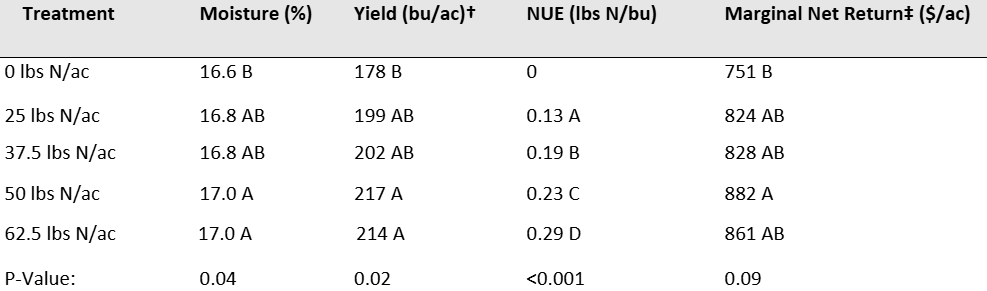
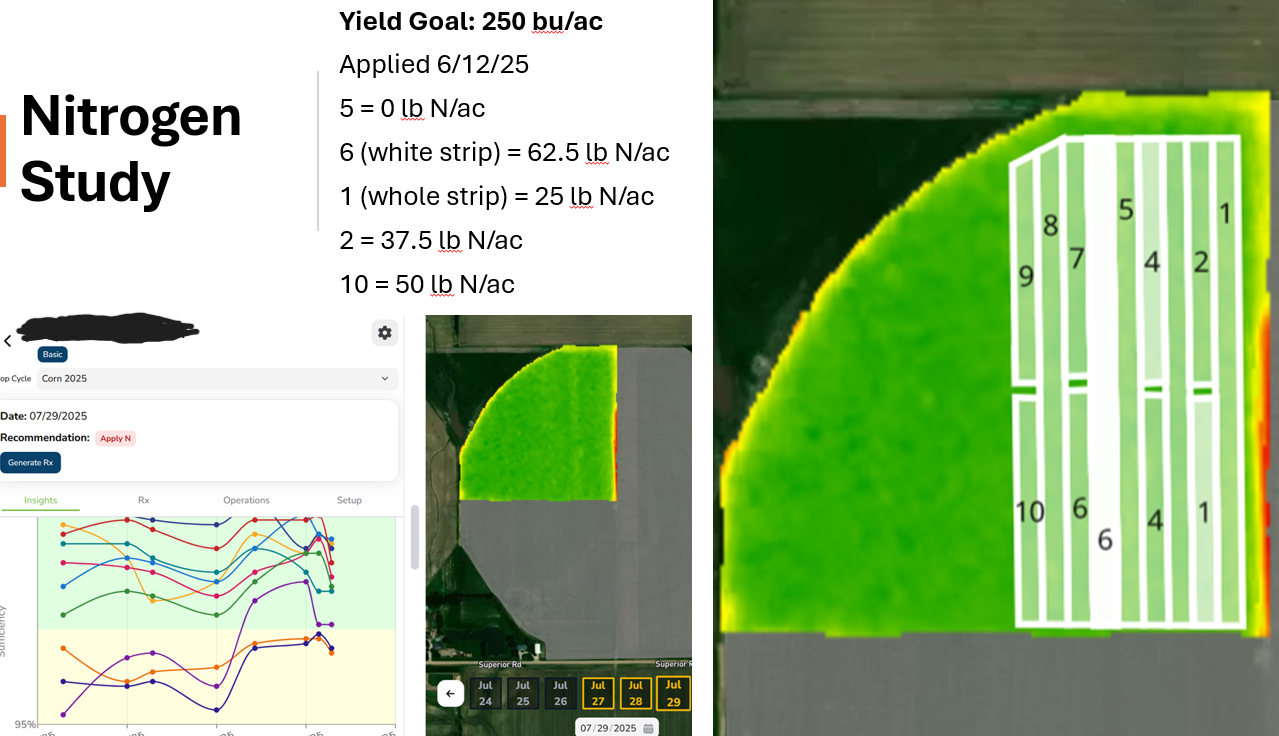
This grower also wanted to see how much nitrogen…and other nutrients over time…the annual forage grazing contributed to the succeeding corn crop. We’ve heard a potential of 100 lb/ac of nitrogen could be credited, so that was considered in addition to the residual soil nitrate and nitrate in irrigation water. He set up a side-dress on-farm research study where he applied starter fertilizer but no other nitrogen until V2-V3 corn. He had 4 reps including rates of 0, 25, 37.5, 50, and 62.5 lb N/ac applied. The goal was to apply these same rates to the same strips the next time he side-dressed. He then used Sentinel Ag to sense the timing of when he would need additional nitrogen. However at side-dress time, the Sentinel Ag imagery said he only needed nitrogen on the 0 lb and two of the 25 lb/ac strips. So, the grower decided to let it go and see what happened. His yields? While they were down like many in the area, he raised 217 bu/ac on 50 lb N/ac and 178 bu/ac on 0 lb N/ac! For the annual grazing with cow-calf pairs, his economics came to a profit of $683/ac (that was using $300/ac rent cost). Think about his corn and grazing economics for your own system. It’s exciting to me to see a case study like this where crops and livestock are integrated so well to show the benefits of diversity not only for the land and reduced inputs but economically!
And, it’s another example of how Sentinel Ag’s satellite imagery can be used to help with nitrogen management. With March pre-plant nitrogen applications, consider the nitrogen challenge: only apply 50-100 lb N/ac pre-plant and use Sentinel Ag to determine the remaining needs this growing season. Please contact me if you’re interested in more information.
Reducing Nitrogen Inputs
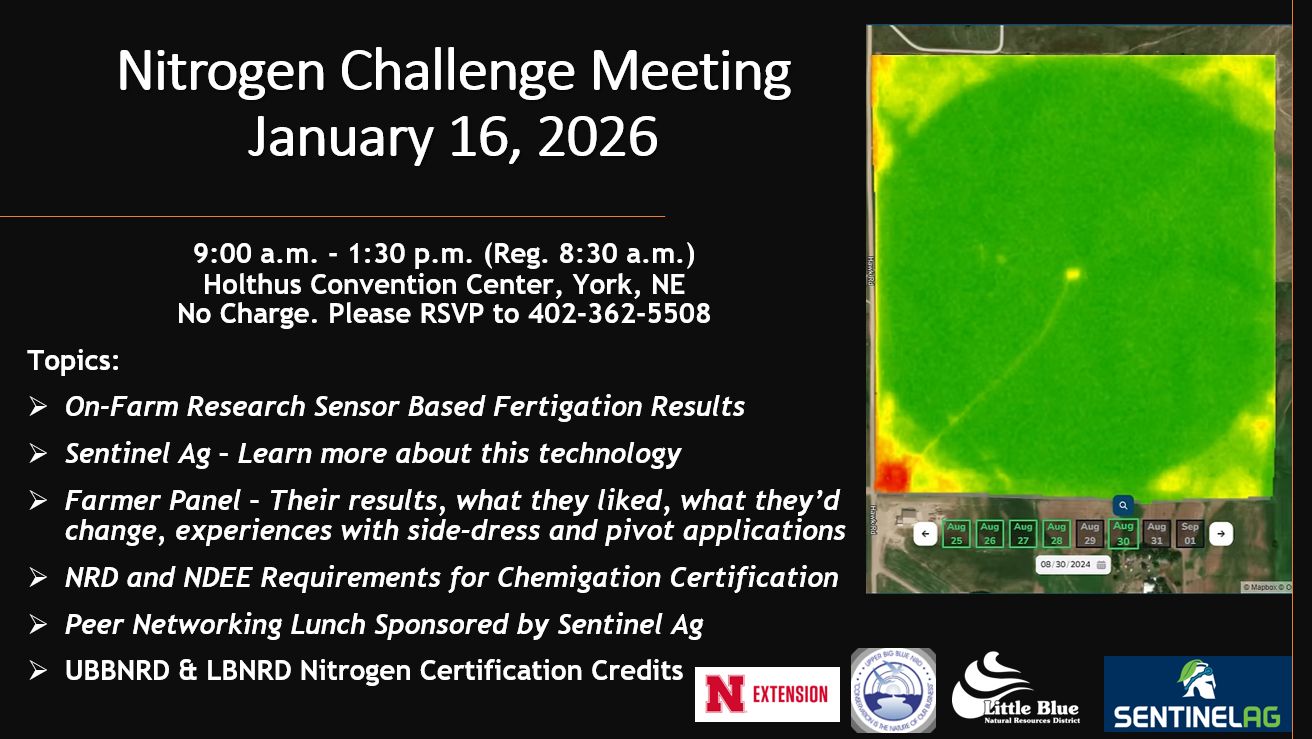
With higher input costs and low commodity prices, I’ve been thinking how to be of help to the farm community I serve during these times. A small group of farmers and I met before Christmas. We talked about the difficulties the farm economy is facing yet also talked about realistic things that can be done to save money right now. One of those is around nitrogen and thus, we planned a Nitrogen Challenge Meeting on Jan. 16th at the Holthus Convention Center in York beginning at 9 a.m. The goals of this meeting are to share the research-based results from using in-season nitrogen management via Sentinel Ag, understand how to use this technology, and share testimonies from growers utilizing this technology. They wanted to create a peer network of famers supporting farmers during the growing season with this technology-so the first step will be a peer networking lunch sponsored by Sentinel Ag. The NRD is providing nitrogen certification credits. There is no charge but please RSVP for the meal count to 402-362-5508 or jrees2@unl.edu.
Why have I stressed nitrogen so much? In the Upper Big Blue NRD newsletter, Terry Julesguard wrote an article about nitrogen in the NRD based on the information provided by the Phase 2 and 3 reports. You can read the full article at: https://www.upperbigblue.org/increased-nitrogen-efficiency-brings-new-questions. In this excerpt Terry shares, “The numbers that stand out are the residual nitrate nitrogen in the soil:
- Corn-on-corn field increases from 33 lbs/A average to 86 lbs/A, an increase of 202%.
- Corn/bean rotation field increases from 32 lbs/A average to 86 lbs/A, a 212% increase.”
I know most farmers are seeking to do their best. The data is showing we’ve increased soil nitrate post-season by over 200%, meaning we’re overapplying N. We talk about the nitrate legacy from past generations, but this is the legacy we’re leaving right now in the soil for our kids and grandkids.
Soil tests in this area of the state from the 2025 season are showing residual soil nitrate is available to reduce the amount of nitrogen applied next growing season. This provides an opportunity to save on nitrogen input costs. No agronomist, including myself, can tell you exactly how much nitrogen you will need because we don’t know the weather/soil conditions for each piece of ground each year. This is why sensing what the plant needs is so powerful using technology like Sentinel Ag.
We have an opportunity to change the nitrogen story now-with us! On-Farm research with Sentinel Ag (2022-2024) in our part of the State showed an average 56 lb N/ac savings without impacting yields, while leaving an average of 5 ppm Nitrate in the top two feet. No other product or practice has proven that in our area of the State via on-farm research. It’s about using technology to manage the nitrogen the plant needs to the best of our ability. Thus, the Nitrogen Challenge in which I’ve asked growers to consider only applying a base rate pre-plant of 50-100 lb N/ac and apply the rest of the nitrogen in-season using a sensor-based technology like Sentinel Ag. Sentinel Ag uses satellite imagery to sense when a corn plant is becoming nitrogen stressed before our eyes can see it. The research was originally developed at UNL and the grad student (Jackson Stansell) then developed a company (Sentinel Ag) around it. Please consider learning more by joining us for the Nitrogen Challenge meeting on Jan. 16th. Farmer testimonials at: https://go.unl.edu/f3si.
Precision Ag and Sensor Tech
For the past few weeks, I’ve shared nitrogen management research and producer testimonials. The producer testimonials, I felt, were especially insightful considering current input costs, commodity prices, and the focus on groundwater quality for future generations. With November 1st a few weeks away and growers thinking about pre-plant nitrogen applications, I’d encourage you to consider the Nitrogen Challenge that I’ve shared the past few years. It is, for Pre-Plant Nitrogen applications:
- Consider applying a base rate of 50-100 lb N/ac on one field.
- Use a sensing technology like Sentinel Ag to apply the remaining nitrogen when needed based on plant needs. The technology can be used with in-season fertigation and/or side-dress applications.
- Only asking you to consider one field. Will you join us in this?
Our Extension Soil Fertility and Precision Ag Specialists wrote a series of Nitrogen management articles for CropWatch, the latest is using precision ag and sensor technology for nitrogen management, which I will share excerpts of below. Their takeaway based on research? “Applying nitrogen closer to when the crop needs it — guided by precision agriculture tools — reduces waste, increases profits and protects Nebraska’s water resources.”
“Why Precision Ag for Nitrogen? Crop sensors measure crop canopy reflectance during the season, detecting developing N stress before it is visible to the human eye. This enables farmers to adjust fertilizer applications in real time, aligning supply more closely with crop demand. Precision ag tools move nitrogen management from a “predict and apply” approach to a “monitor and respond” approach.”
Active Canopy Sensors are mounted on high-clearance applicators and emit light and measure reflectance to determine crop N status. Applications typically occur once between V8-V12 stages.
- UNL’s Project SENSE (2015–2021, >80 site-years) showed that sensor-based sidedress reduced N rates by an average of 33 lb N/acre compared to grower practices, while maintaining yields and improving profits.
Satellite-Based Sensors are passive systems that use the sun’s energy and satellite reflectance data. It’s practical today due to daily revisit times and ~30 foot resolution.
- Partnering with Sentinel Ag, Nebraska On-Farm Research (2021–2023, 24 sites) found average N savings of 56 lb N/acre with yields nearly identical to grower practice, while partial profits increased by about $24/acre.
Steps for Farmers
- Apply a base rate: Around 50-100 lb N/ac (25% of total) at planting.
- Set calibration: Include N reference strips or use virtual references to benchmark sensor readings.
- Monitor the canopy: Between V8-R2 growth stages, track crop reflectance with active or passive sensors.
- Apply as needed: Fertigate or sidedress 30-60 lb N/ac when the sensors detect developing stress. Multiple applications may be required, typically one to three per year.
- Take advantage of irrigation systems: Center pivots with injection pumps allow timely fertigation. Ensure proper chemigation certification and backflow protection.”


Farmer Testimonials: Sentinel Ag
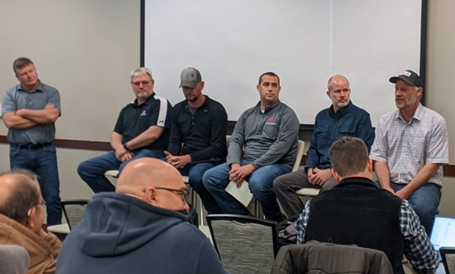

Photos (Left): 2024 Nitrogen Challenge Farmer Panel: Jason Richters, Scott Richert, Mike Spray, Tyler Smith, Phil Christenson, Jesse Williams (photo by Jenny Brhel). (Right): 2025 Nitrogen Challenge Farmer Panel: Jason Richters, Todd Schmieding, Erik Friesen, Tyler Smith (photo by Abigayle Warm).
***Newspaper Editors: Please note this week’s column is longer; because it’s unique, I would appreciate you printing it all if possible-even if it needs to be over a few editions. Thank you!***
Farmers appreciate hearing from other farmers’ experiences. So, I asked farmers who tried Sentinel Ag in the Upper Big Blue and Little Blue NRDs if they’d be willing to share: their why, their experiences, and advice to farmers considering trying it. The following were willing and have used Sentinel Ag for more than one year. I appreciate the vulnerability from these farmers in sharing!
Jason Richters: I had a desire to improve my nitrogen use efficiency, so I decided to try the Sentinel Ag nitrogen management system three years ago. The ability to know if the crop needs a nitrogen application based on satellite imagery is a game changer, and we have learned that we can better manage and reduce our nitrogen application rates while maintaining yields. This is good for our bottom line and may eventually reduce nitrate levels in our groundwater.
Using a nitrogen management system is a management change, but more importantly it’s been a management improvement. I encourage other farmers to try this technology, especially if they are already split applying their nitrogen.
Tyler Smith: My experience is a little different than most producers because I was able to be a part of the development of the concept that grew into Sentinel Ag with my role at UNL. As far as my personal farm operation, I had started fertigating about 15 years ago and had seen the benefits of spreading out my nitrogen applications but there were years where I wondered if I needed that last fertigation. After Sentinel became commercially available, I could see the promise of the method and I enrolled a couple of fields in 2022 and 2023. I was realizing nitrogen savings without losing yield. In 2024 and 2025, I’ve had all of my irrigated corn acres enrolled and I’ve been able to lower my nitrogen use by 10-40% while achieving several new field best yields.
What I’ve observed is that nitrogen availability is so variable in both total growing season need and the timing of that need that I don’t know how I can ever hope to accurately predict it. It’s much easier to let the corn tell me when it needs it and, at the end of the season, I’ll know what the total need was, not at the beginning. We don’t decide how much irrigation we will need for the next growing season in November or March, it’s a real-time decision that we make as we go through growing season that accounts for changes in weather, yield potential, ROI, etc. We have the ability to manage nitrogen the same way that accounts for all of the unknowns in real-time with a sensor-based approach.
Scott Richert: I started my in season nitrogen a while ago with the Nsense program using sensors on a Hagie sprayer. I had been sidedressing for years but wanted to see if I could get better. What I found was I was close. I was putting on enough to have a good yield but the sensors had better ROI. From there we kept adjusting and when the Sentinel program came out I put 2 fields in. I found the same thing that I was getting a good yield but the sensors were having a better ROI. So ROI is great but the other thing that means is that I was over applying nitrogen. In the Upper Big Blue NRD I live in one of the areas that has not moved up on the list for testing and reporting. Looking at how the numbers have been moving though it’s just a matter of time. For my soil it takes 30 years for the nitrate to make it to the water table. It basically takes most of a farming career for the nitrogen you apply to make it to the aquifer.
If we want to make things better for the people that come behind us we need to make changes now. With in season application I have nitrogen in the system only when my crop is there and using it. I have the nitrogen that the crop needs now not for the whole season. If we have adverse weather I can adjust to that. If it is hailed out I save the balance of my fertilizer and don’t let it leach away. If the plant is telling me it needs more I can put it on. If the mineralization is really good the plant will tell me it is happy and I can save an application.
There are some issues to work through. You don’t really know how much nitrogen you are going to use on each farm each year. You may need to purchase more later in the season or you may need to store some until next year. Sometimes it has been hard to apply when you want. It can rain at an inopportune time but I’ve never not got the application done. The sensors have a seven day window of time to make an application.
Todd Schmieding: Sentinel has allowed me to manage nitrogen as it is needed on the field. It accounts for release from cover crops in a way that gives me the full credit when it is available. It does add challenges in timing and changing when my work occurs, as it is not predictable. I have also seen changes in status before I applied the nitrogen, creating additional questions as to what is happening in the field. If you’re considering adding this to your program start on one field at first, and then expand from there.
Jesse Williams: Using in season nitrogen application through the pivot allows you to spread the applications out and “spoon Feed” the crop. Adding a sensor system such as Sentinel provides an additional tool to monitor crop needs. The big benefit to this in my mind is the ability to apply nitrogen based on crop needs and potential throughout the season. Applying a full rate upfront of 1-1.2lb per expected bushel can prove to be extremely wasteful if you encounter weather related issues such as hail, heavy rainfall or wind damage. Using the spoon feed approach with fertigation for the last three years I have typically been able to keep my Nitrogen use under .8lb per bushel.
Challenges for me have been gaps in imagery due to cloud cover/smoke. This year I probably shot from the hip more on applications due to the fact that I was going a week or more between imagery updates and trying to time applications between rainfalls. I think sentinel has some solutions to help with this including capturing drone imagery and modeling expected uptake based on planting date, maturity and GDU’s. We had thought linking my Field View account would bring some of this information in but Field View seems to be struggling to link with any partners this year. Another challenge is working with applicators on variable rate Nitrogen applications since there seems to be very few farmers in the area doing variable rate Nitrogen so their experience in applying it is not where it should be; I have also struggled to get as applied maps back from applicators after the application is done.
Brad Morner: This has been my third season using Sentinel and my experience with in-season nitrogen has been good. I am glad I’ve tried it. It’s made me aware of how much less nitrogen I can use and still have good yields. Working with sentinel has been a very good experience. They are so easy to work with and always get back to me quickly when I have questions. I like it because Sentinel tells me when the corn needs more nitrogen based on the satellite sensing technology, so I’m not just guessing when to apply more. I realized that I could get by with less nitrogen and still get the same yields. The biggest challenge is that it takes a little more time during the season. I used to fertigate once during the season. With Sentinel, I do 2 or 3 smaller applications instead of one large application but I also realize that it is worth the extra time because I am applying the nitrogen more efficiently as needed.
Erik Friesen: Yesterday we took out 2 NCGA (National Corn Grower Association) contest plots. Both were about 140#’s N, two different hybrids and both did 295. These were also non gmo white corn. This year every acre we have has less than 150#’s N. If people can update equipment, adapt to different tillage practices, use of autosteer and technology, why do people still use the same idea that they did 40 years ago when it comes to fertilizer recommendations? The struggle I see is the time it takes, big farmers will just keep doing the same thing. But I guess this is what makes me more competitive with them, raising high value crops, using less inputs.
Grateful to these farmers for sharing their experiences! Please reach out to them with questions if you’re interested in trying Sentinel Ag this coming year.
Nitrogen Challenge Meeting 2025
Nitrogen Challenge Meeting Feb. 10: In November of 2023, I issued a nitrogen challenge. As a reminder, my challenge was to everyone with irrigated ground who applies fall anhydrous or spring pre-plant fertilizer:
- Leave 1 piece of ground with a base rate of 70-100 lb N/ac
- Goal is to apply the rest of N in season using a tool like Sentinel Fertigation that senses what the plant needs.
- Only asking to consider for 1 field. Are you willing to join me in this?
Sixteen area producers took the challenge on 4718 acres in 2024. I haven’t heard the combined nitrogen savings yet, but if each reduced nitrogen by 40 lb/ac, that’s a savings of 188,720 pounds of nitrogen. And the greatest impact is that nitrogen use efficiency continues to be improved to on average around 0.6 lb N/bu produced with minimal residual soil nitrate remaining post-season in soil samples. The comments I’ve heard from the growers so far are that they’re so surprised how the technology can see when the crop needs nitrogen before they can and how much nitrogen they saved using the technology while obtaining similar yields.
I don’t have the 2024 on-farm research results yet. The 2023 on-farm research data showed that on average, 57 lb/ac less nitrogen was applied in the Sentinel Fertigation sectors than the grower sectors with similar average yields of 253 bu/ac for the Sentinel sectors and 255 bu/ac for the grower sectors. Average nitrogen use efficiency was 0.57 for Sentinel and 0.77 for the growers (which was actually really good for these growers to begin with!)
My goal for nitrogen management is to see an increasing number of producers use sensing technologies such as this that have been research-proven to help with nitrogen management. The updated Extension Circular published by UNL Nutrient Management Specialists also recommends using sensing technologies and in-season nitrogen applications vs. recommending a rate or even recommending using nitrogen equations. There’s just too much uncertainty with weather conditions to know what a crop will need in any given year.
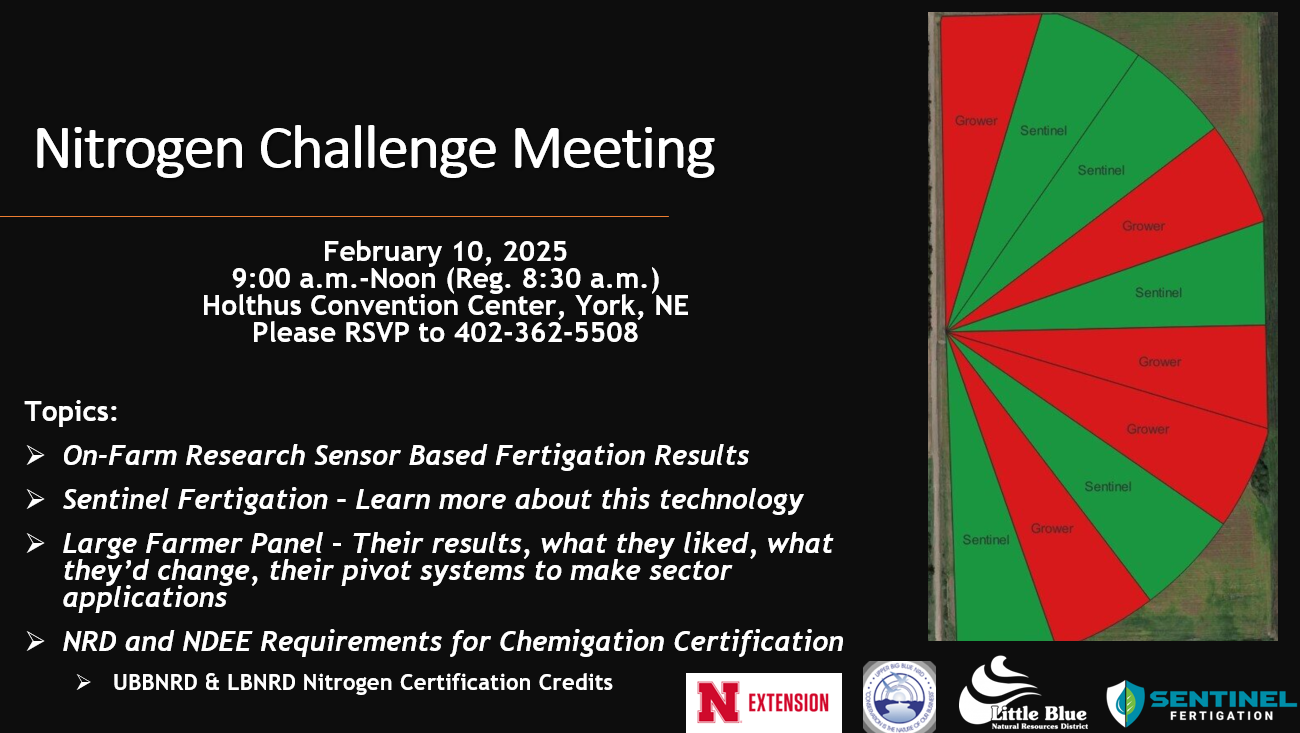
So, I’m hosting another Nitrogen Challenge Meeting this year. It will be February 10, 2025 from 9 a.m.-Noon at the Holthus Convention Center in York. It will be a similar format to last year where on-farm research results will be presented in addition to an explanation of how the sensing technology works from Sentinel Fertigation. We will hear from NRD staff regarding chemigation requirements and this training qualifies for nitrogen recertification credits for both the UBBNRD and LBNRD. I think the most impactful part of last year’s program was the larger farmer panel, which I will have again. There’s so much we can learn from the growers using the technology and from the differences each of them have in their pivot and chemigation systems. You’ll hear from them about the successes and challenges they had.
For non-irrigated acres, there’s increasing interest to use the satellite imagery to also make applications in season. You’ll learn more about this as well. There is no charge for this meeting but please RSVP to me or to 402-362-5508 so we can plan for refreshments and materials. I hope to see more growers trying the Nitrogen Challenge in 2025!
Farm Succession Meetings: As a reminder, our farm succession meetings begin on Tuesday nights for four weeks beginning Jan. 21. It’s a great opportunity and men are welcome in addition to women. More info: https://wia.unl.edu/succession25/

Fall Nitrogen Challenge
It’s such a blessing to receive some moisture! With November here, sharing this week on nitrogen applications.
While the November 1 date that allows for fall fertilizer application to fields has arrived, we also recommend waiting to apply fall nitrogen till soil temperatures are below 50F. At that temperature, soil microbes are less active and less likely to convert ammonium to nitrate. Soil temperatures can be viewed at: https://cropwatch.unl.edu/soiltemperature. As I write this, the daily average 4” soil temperature is currently 55F with the weekly average at 53F.
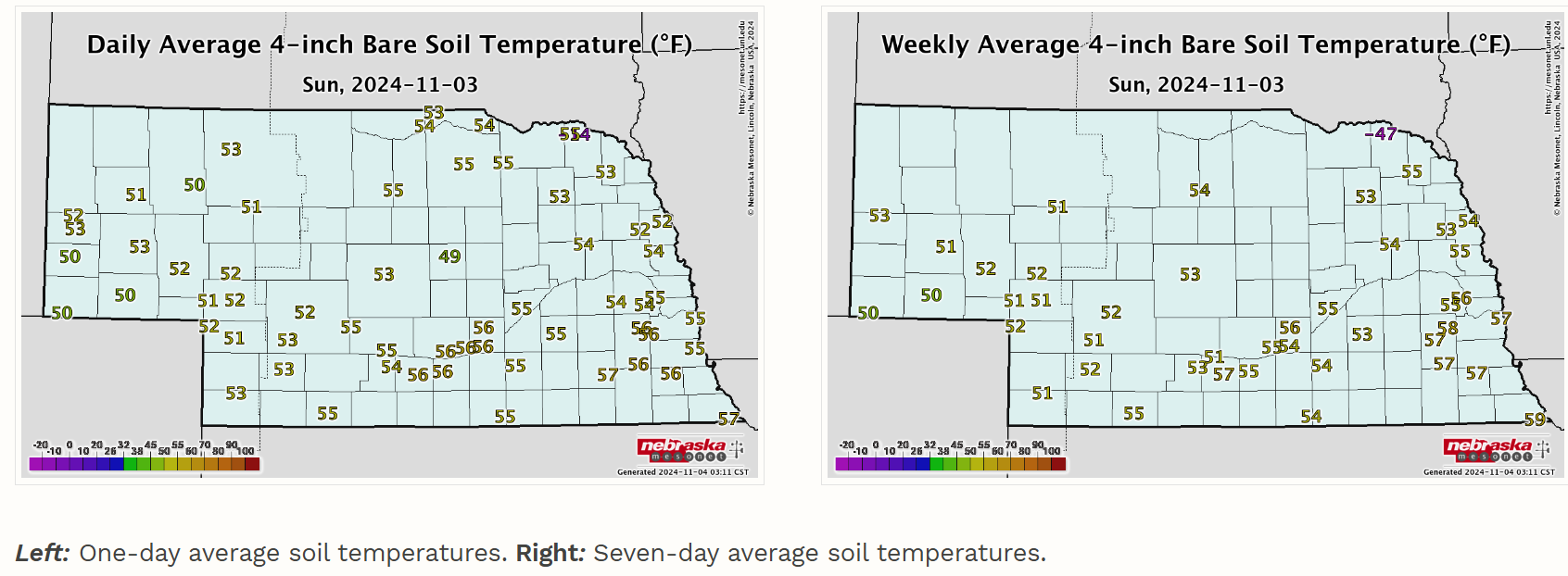
Nearly a year ago, I shared my Nitrogen Challenge with you. I’m grateful for all the producers who gave that a try! Some who wanted to try it had applied too large a base rate before I had released the article, so sharing a reminder now.
My Challenge: The challenge is to everyone with irrigated ground who applies fall anhydrous or spring pre-plant fertilizer:
- Leave 1 piece of ground with a base rate of 70-100 lb N/ac.
- Apply the rest of the N in season as needed using a tool like Sentinel Fertigation that senses plant needs.
- Asking each grower to consider this for 1 field. Are you willing to join me in this?
I genuinely believe this is the primary way to change the nitrogen story both now and for future generations. Why? We can’t impact the legacy nitrate from previous generations that is impacting groundwater nitrate levels now, but we can impact the nitrate that remains in the soil after current nitrogen practices now.
Nitrogen rate is the most consistent thing I keep seeing in nutrient recommendations and on-farm research studies that we can adjust. I’ve shared On-Farm Research results from farmers’ fields in this part of the State on heavier textured soils showing there’s no one solution with nitrification inhibitors, nitrogen application timing, biological products. The most consistent thing I see is an opportunity around reducing nitrogen rates. I’m not saying there’s one solution. My challenge is around what I feel holds the most promise right now for irrigated ag in this area.
We can’t precisely know an amount of nitrogen to recommend for application to land using pre-plant soil tests and/or any nitrogen equation. They’re good tools. But, we don’t know how much irrigation will be applied in season nor how much mineralization will occur due to weather conditions. 2022-2023 were high mineralization years and 2024 was a low one. Soil agronomy needs biology in addition to chemistry and physics. That’s why I’ve been so supportive of the in-season sensing technologies where the plant tells us what it needs based on what is occurring in the soil. Project Sense was a UNL/NRD/Corn Board/USDA research effort using ground rig applications. I think it never took off because I’m unsure any Co-op or company took the idea on as a business. Would still be applicable.
The UNL pivot-based sensing research resulted in the graduate student forming the company Sentinel Fertigation. If there’s other companies doing this, please consider them too. There’s so much in ag we have to react to. Applying N in-season is also reactive. However, we can also be proactive in showing that farmers and agronomists locally want to keep looking for solutions to the nitrate problem by trying newer tools/technologies to see any impacts. Please contact me if you are willing to join me in this challenge.



Rethinking Crop Rotations
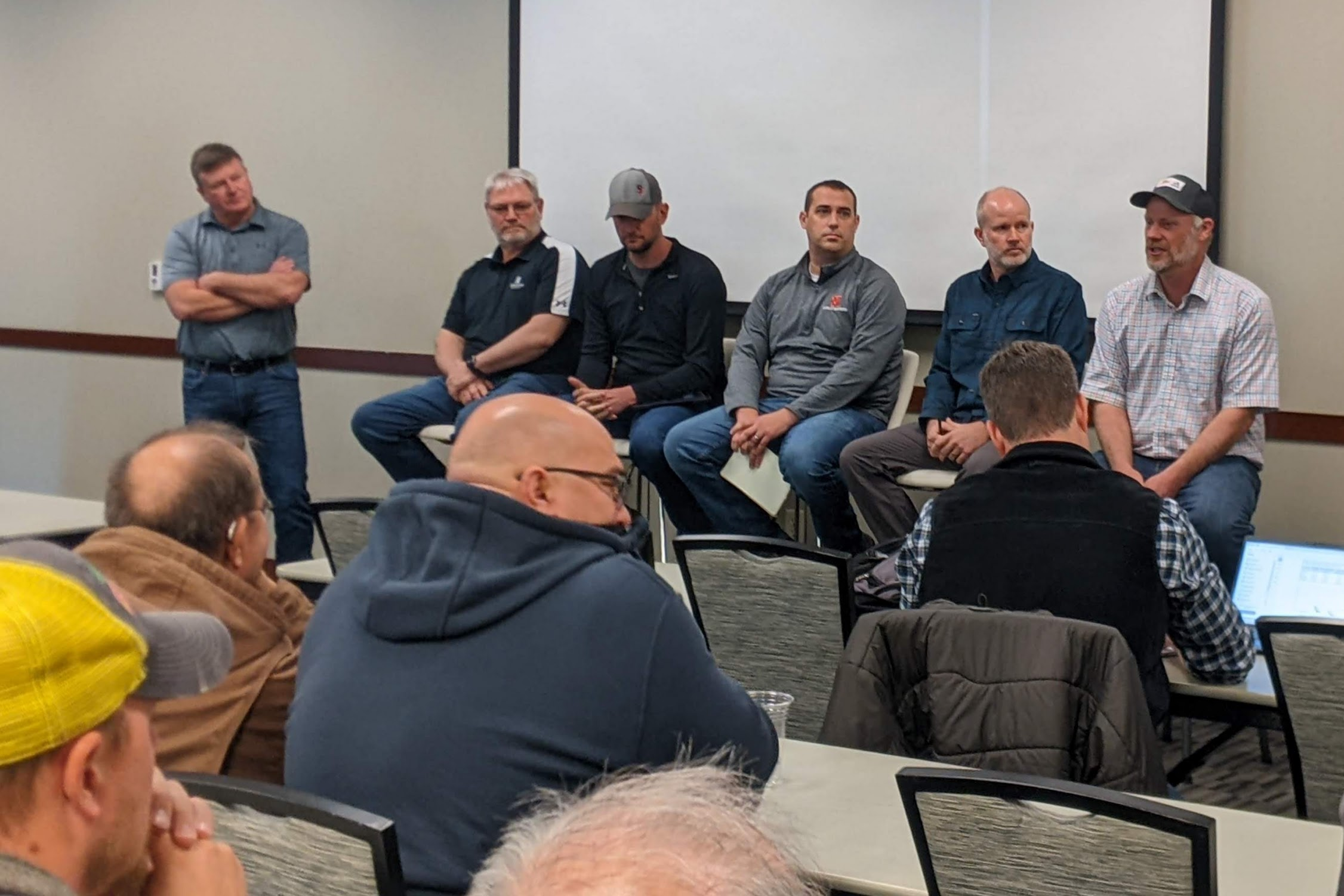
Thank you to all who attended the nitrogen challenge meeting last Monday, to all the presenters and farmers who shared their experiences, and to those who are choosing to join me in the challenge! A lot of great information was presented that day. The following is a snapshot of the combined on-farm research data using sensor-based fertigation via Sentinel Fertigation across 13 locations:
- Grower: 255 bu/ac yield with 195 lb N/ac applied, NUE of 0.77 lb N/bu, $1152.54 profit
- Sentinel: 253 bu/ac yield with 138 lb N/ac applied, NUE of 0.56 lb N/bu, $1177.89 profit
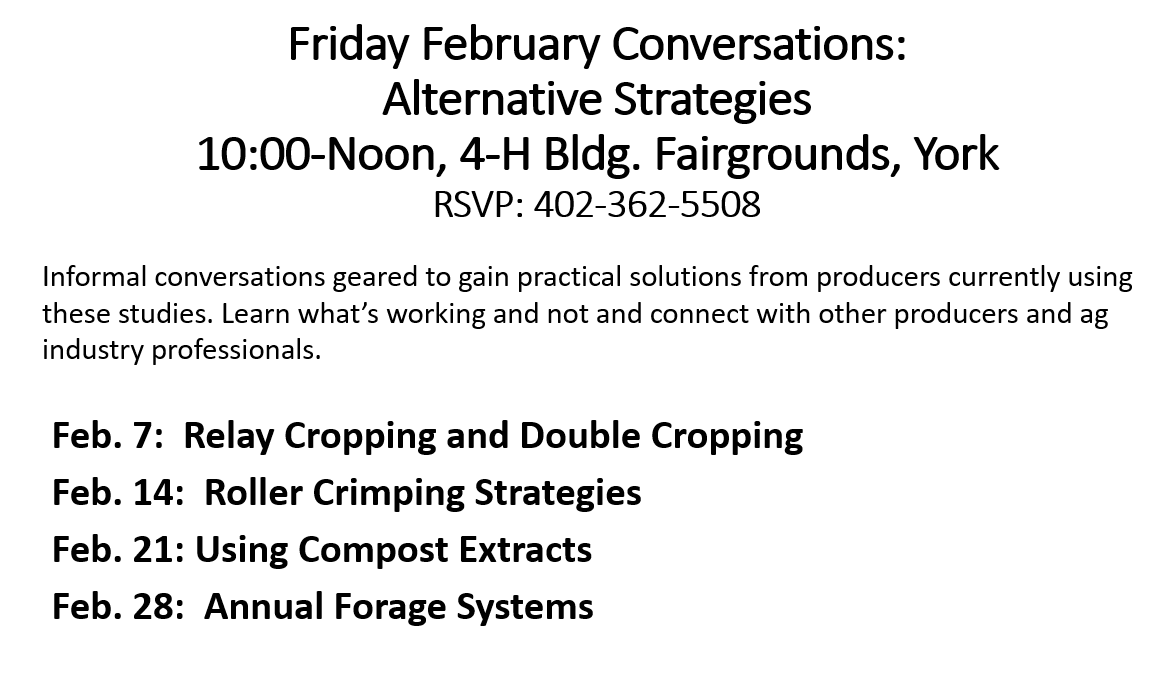
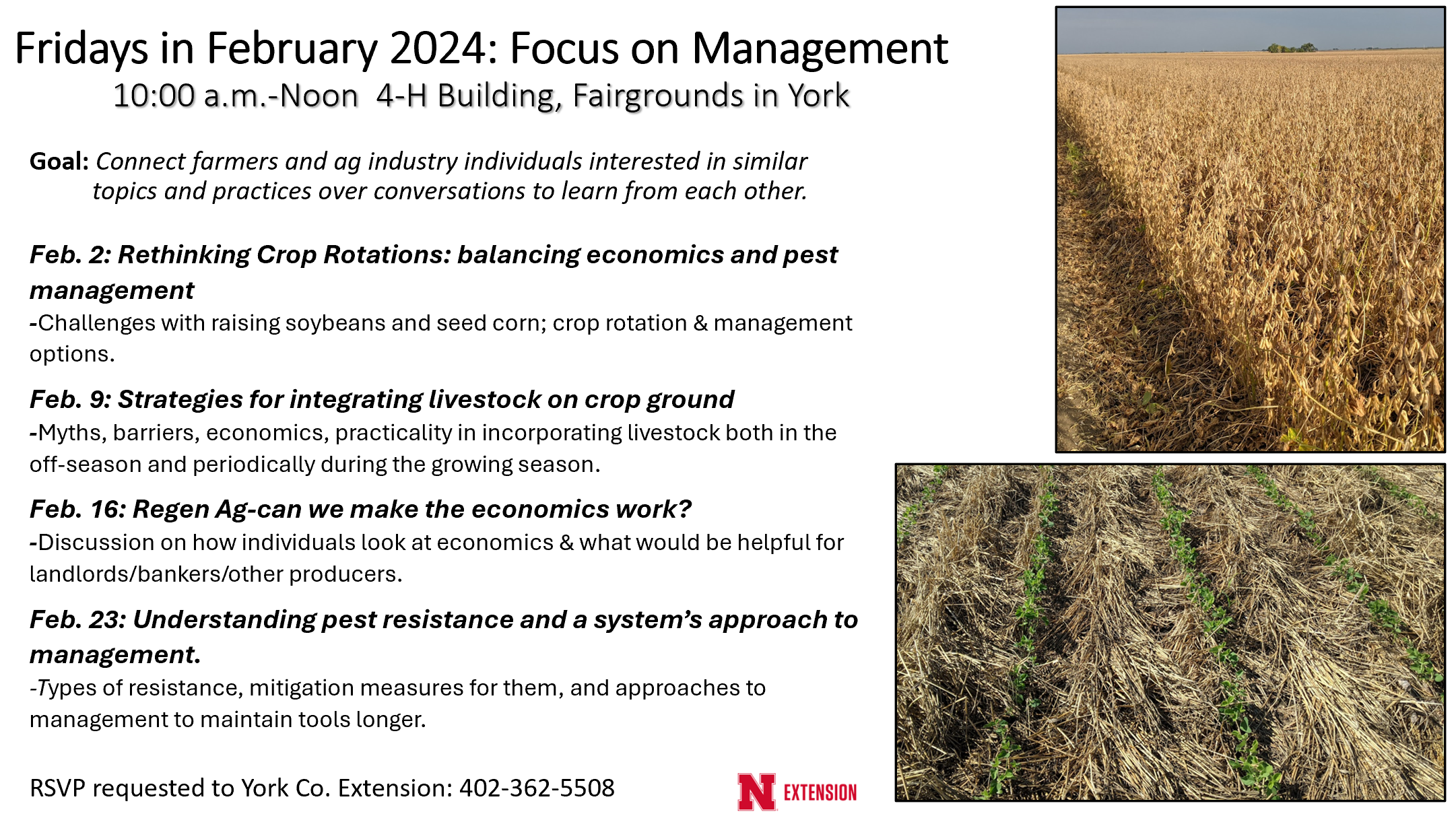
Crop Rotations: Appreciate those who attend the Fridays in February Conversations! We had a rich discussion on the topic of crop rotations and I appreciate the ideas brought forward by growers. We unfortunately didn’t have industry representation. I’ve heard frustration from some farmers raising seed corn with palmer, tracking up fields, low soybean yields and soybean disease issues. A handful of farmers have told me they recently gave up seed corn because of these challenges. Both seed corn and soybeans are important crops to our area of the state, so my hope was to discuss potential solutions. Small grains are also mentioned often below to help with pests, which can take looking at economics over years.
- Requiring extra communication and planning for isolation is to consider a 3-year rotation of seed corn/corn/soybean to allow for more carbon in the system and a longer rotation from soybean.
- I suggest a small grain before and/or after soy to help with erosion control, palmer control, and reduction in soil-borne pathogens impacting soybeans. Research from K-State showed significant reduction in palmer biomass when using either oats or wheat without the use of a residual herbicide (and with residual too). Rye wasn’t in that study; it helps significantly too.
- Red light on bare soil stimulates palmer/waterhemp germination. Keeping the soil covered with residue, cover crops and/or residual herbicide helps. Planting soybean green to allow for more cover crop biomass before termination is helpful (have to consider soil moisture).
- Oats is the best way to reduce soybean cyst nematode and sudden death syndrome in soybean. All small grains help but oats is proven to be the best for reducing those soil-borne pathogens. Planting either spring or fall helps and is an option for those who don’t want an overwintering small grain.
- Cover crop hosts for Sclerotinia sclerotiorum that causes white mold in soybeans include brassicas (turnips/radishes/collards). So, if the field has a history of white mold, consider adding a small grain (oats/rye/wheat) in combination with brassicas or only using small grains. This adds cost/more loads to spread, but a small grain in seed corn fields are critical to help with pests/erosion in my opinion.
- It was suggested to allow cover crops including small grains to be broadcast seeded at detasseling instead of at male destruct to allow more time for establishment and growth once canopy is opened at male destruct. The thought is the small grains can help hold the soil better when it’s wet with equipment. Small grains also help hold the soil from erosion after grazing as not much is left after grazing turnips/radishes. Some are choosing to drill a small grain after harvest.
- Some growers are allowed to plant seed corn green while others aren’t. Growers doing this are plugging drill units where seed is going to be planted. Whether growers terminated early or not, they all shared the small grain roots before seed corn held the soil during winds and held equipment better in wet fields.
- Group of growers in Archer/Central City area are relay cropping wheat/beans in year after seed corn. Something to consider for making small grains work better economically. Several growers doing this allowed for market to develop for taking small grains in that area.
- Much discussion on relay cropping beans using hybrid rye, grain sorghum, rye, wheat for economics. Also discussed the need for bankers to allow a 2-3 year balance sheet to show economics of small grain outside of one year. Will share thoughts mentioned on economics in another column.
If interested, our next topic on February 9th (10-noon at the 4-H Bldg in York) is Strategies for integrating livestock on crop ground both in the off-season and during the growing season.


Nitrogen Challenge Meeting
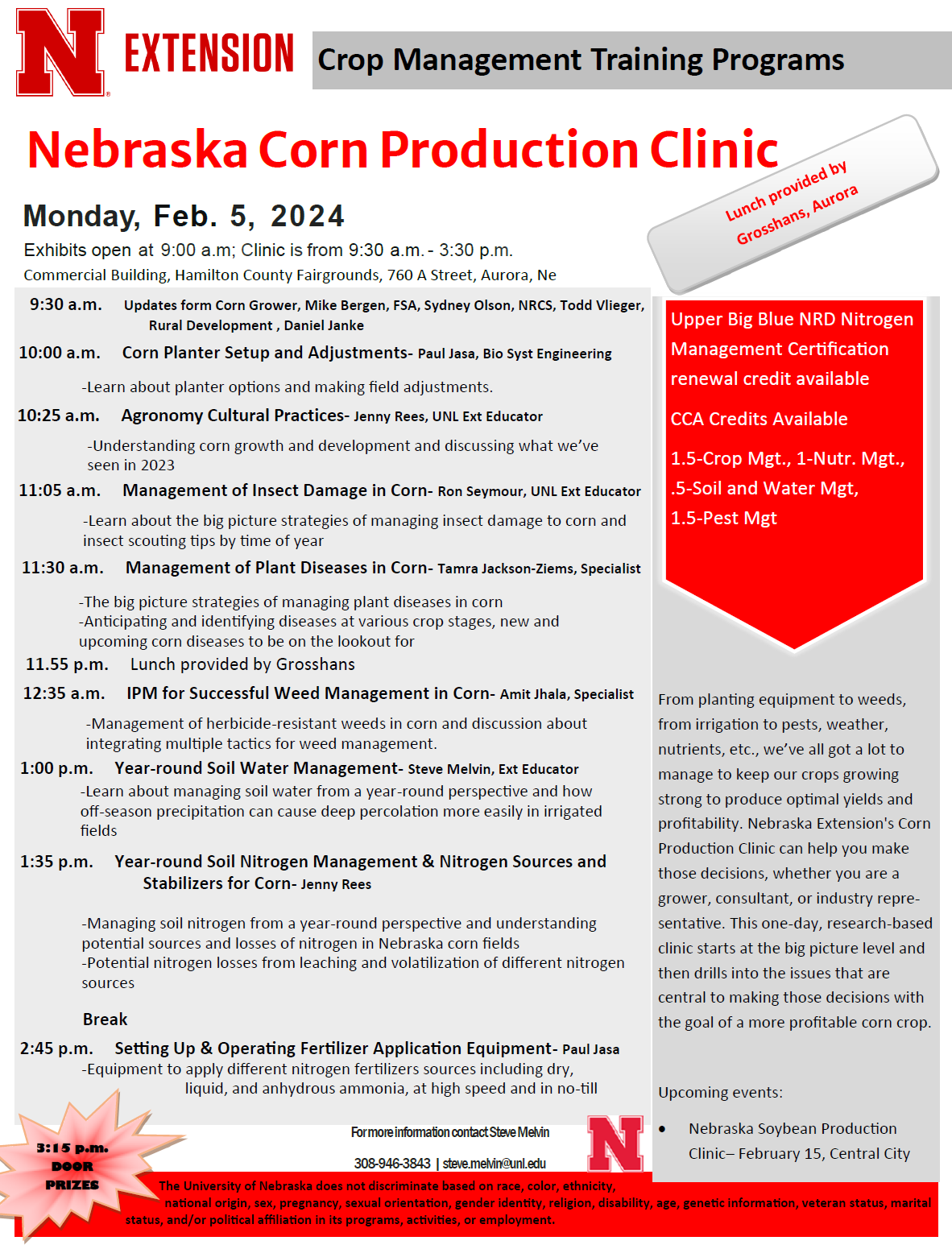
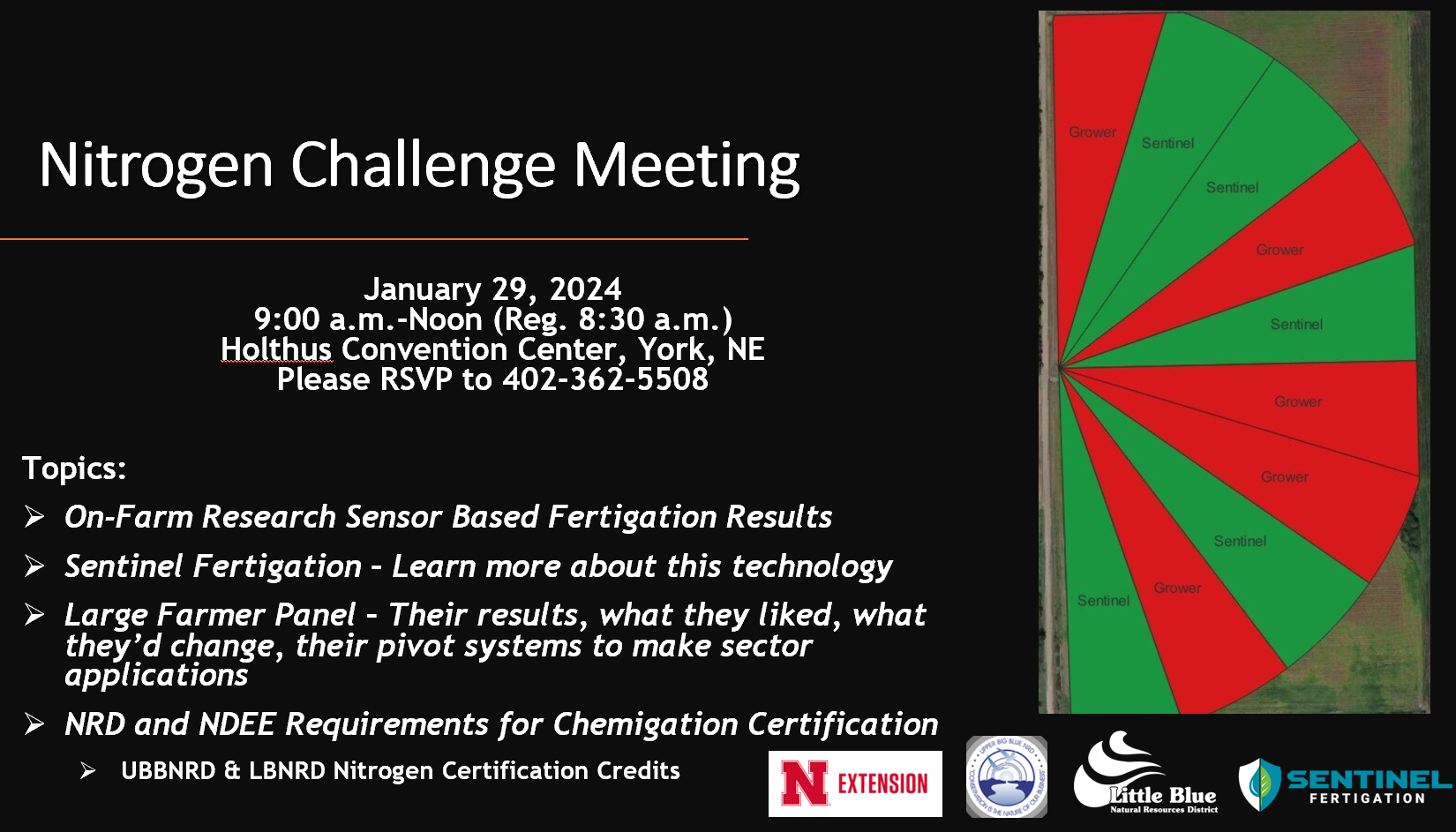
Nitrogen Challenge Meeting Jan. 29: In November I issued a nitrogen challenge. The full article can be found here: https://jenreesources.com/2023/11/12/my-nitrogen-challenge/. My goal is to have an increasing number of producers use sensing technologies such as this that have been research-proven to help with nitrogen management.
Ultimately my challenge was to everyone with irrigated ground who applies fall anhydrous or spring pre-plant fertilizer:
- Leave 1 piece of ground with a base rate of 70-100 lb N/ac
- Goal is to apply the rest of N in season using a tool like Sentinel Fertigation that senses what the plant needs. I will share 2023 research results from area producers this winter. If you decide you don’t wish to try a tool like Sentinel Fertigation, you can apply the rest of N the way you’d like.
- Only asking to consider for 1 field. Are you willing to join me in this?
On January 29th, I’ll be having a Nitrogen Challenge Meeting. It will be from 9 a.m.-Noon at the Holthus Convention Center in York. As promised, on-farm research results from sensor-based fertigation will be shared in addition to learning more about Sentinel Fertigation as a tool for nitrogen management. I also wanted you to hear directly from the area farmers who have used this tool the past few years. Some of the farmers have used this technology in on-farm research fields and some just tried it on fields. In fact, a few of the top 6 National Corn Yield Contest winners who applied 180 lb N/ac or less used Sentinel Fertigation in 2023. A larger farmer panel will share what they liked, what they’d change, and their pivot setup for managing sectors (as there’s different ways of managing this for individual pivots). Information will also be shared about chemigation requirements.
There is no charge for this meeting and the UBBNRD and LBNRD are providing nitrogen certification credits for those who attend this meeting. Please RSVP to 402-362-5508 so we know how to plan if you’re interested in attending. I’m truly hoping to see many producers interested in learning more and joining me in this challenge!
Three State Beef Conference: Re-evaluating today’s management practices for future success: On Jan. 18th in Syracuse, NE from 6-9 p.m. (Registration at 5:30 p.m.), learn more about re-evaluating management of corn residue grazing, development of heifers and management of young cows to help ensure success. Location: Fair Center building, Otoe County fairgrounds, 135 Plum St, Syracuse, Nebraska
Topics include: Corn residue grazing: current recommendations and adjustments based on new data, Dr. Mary Drewnoski, beef systems specialist, University of Nebraska; Developing heifers for the future, Dr. Kiernan Brandt, professional services technician, Trans Ova Genetics; and Managing young cows for longevity and profitability, Dr. Thiago Martins, asst. professor, beef reproduction extension & research, University of Missouri.
Pre-registrations are appreciated for planning purposes. The registration fee is $30 per person which includes a meal and a copy of the conference proceedings. RSVP to: Connor Biehler, Extension Educator, 402-624-8007, cbiehler2@unl.edu.
Also: Reminders of meetings that begin this week including Cow-Calf College, some Crop Production Clinics, and pesticide trainings.

My Nitrogen Challenge
My Challenge: This article was born from numerous conversations. I know reactions will differ; please hear me out. Last week I issued a challenge at the end of my blog post and in my weekly email. The challenge is to everyone with irrigated ground who applies fall anhydrous or spring pre-plant fertilizer:
- Leave 1 piece of ground with a base rate of 70-100 lb N/ac
- Goal is to apply the rest of N in season using a tool like Sentinel Fertigation that senses what the plant needs. I will share 2023 research results from area producers this winter. If you decide you don’t wish to try a tool like Sentinel Fertigation, you can apply the rest of N the way you’d like.
- Only asking to consider for 1 field. Are you willing to join me in this?
My Why: Pre-plant fertilizer is being applied now in fields, so wanted to share for consideration now. Every time negative news is published about the problem of nitrates in our State, I hear about it. Farmers are frustrated and seek to know how to respond. I can also appreciate the frustration. There’s agreement that not everyone in all occupations always do the right thing. There’s concern about increasing nitrates in various wells throughout the State. The other side – of all the farmers trying to do the right thing – isn’t also shared. Many of these farmers genuinely want to leave the land and water better for future generations. The legacy issue is often not mentioned in news articles. More data around soil nitrates in the upper 20 feet of soil profiles is needed to know the impact of current practices. Negative press builds cases for increased regulation. Conversations are occurring. I continue to hear most would prefer figuring out something locally than for regs to come from the state or nationally.
Since last winter, I’ve brainstormed on the nitrate topic with various commodity groups, farmer groups, during field/office/phone visits and while riding in combines during harvest. My questions to everyone included, “What is Ag’s Solution?” “What is ag going to propose?” “Instead of the current headlines, what do you want the headlines to say?” …. How would you answer these questions?
Several suggestions have been made. The discussions have been difficult. Part of this is because there’s so many soil types, Agri-eco zones, farming practices in Nebraska for any one solution. And, honestly, another part is that ag is so divided (till/no-till, cover crops or not, etc.), which also frustrates me, because blaming and divisiveness doesn’t allow for uniting around a cause. Often the end conversation response was, “I/we really don’t know what will work or what else to do”.
I’ve shared On-Farm Research results from farmers’ fields in this part of the State on heavier textured soils showing there’s no one solution with nitrification inhibitors, nitrogen application timing, biological products. The most consistent thing I see is an opportunity around reducing nitrogen rates. I’m not saying there’s one solution. My challenge is around what I feel holds the most promise right now for irrigated ag in this area.
We can’t precisely know an amount of nitrogen to recommend for application to land using pre-plant soil tests and/or any nitrogen equation. They’re good tools. But, we don’t know how much irrigation will be applied in season nor how much mineralization will occur due to weather conditions. Soil agronomy needs biology in addition to chemistry and physics. That’s why I’ve been so supportive of the in-season sensing technologies where the plant tells us what it needs based on what is occurring in the soil. Project Sense was a UNL/NRD/Corn Board/USDA research effort using ground rig applications. I think it never took off because I’m unsure any Co-op or company took the idea on as a business. Would still be applicable.
The UNL pivot-based sensing research resulted in the graduate student forming the company I mentioned in my challenge called Sentinel Fertigation. If there’s other companies doing this, please consider them too. We had 5 on-farm research studies with Sentinel Fertigation in 2023 in York, Clay, Polk, and Butler counties where producers tested pie sectors of their nitrogen rate vs. what satellites were saying the plants needed. What I’ve heard is one field never triggered an additional fertilizer app in some sectors. Another field only had 90 lb N/ac total applied in some sectors. I don’t know the yield results yet, so this is a risk I’m taking in issuing this challenge. No technology is perfect; I heard them adjust as challenges occurred. The sheer research base and idea around this technology is what propels me to propose this challenge. This winter we will share the data and allow the producers to share what they liked/didn’t like. You can then decide if you’d like to try it in 2024. This also gives you time to get set up for fertigation. If you decide it’s not for you, apply the remainder of the N in that field however you’d like.
My goal is not to promote a company but an idea that makes the most sense to me of anything we’re trying. It’s the idea of a base rate and then allowing the plant to tell us what it actually needs based on the growing season it encounters. This could potentially lead to reduced nitrogen rates applied. There’s so much in ag we have to react to. Applying N in-season is also reactive. However, we can also be proactive in showing that farmers and agronomists locally want to keep looking for solutions by trying newer tools/technologies to see any impacts. Please contact me if you are willing to join me in this challenge.
For more info. I shared the Sentinel Fertigation research info. last winter here: https://jenreesources.com/2023/02/26/sensor-based-n-fertigation/
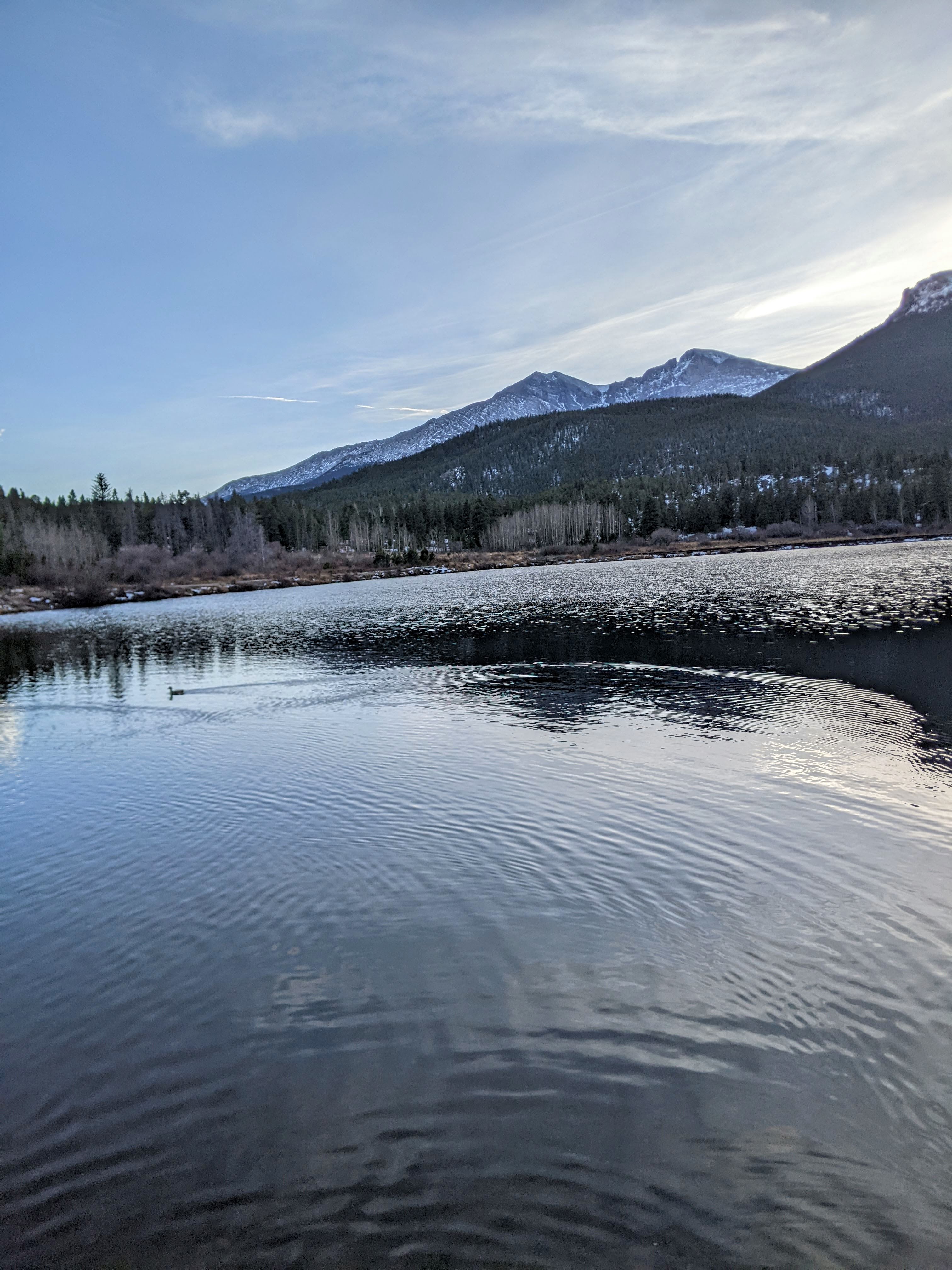

Was wonderful to get away for a couple days to hike in the mountains. Beautiful this time of year too!


 JenResources