Blog Archives
Reducing Nitrogen Inputs
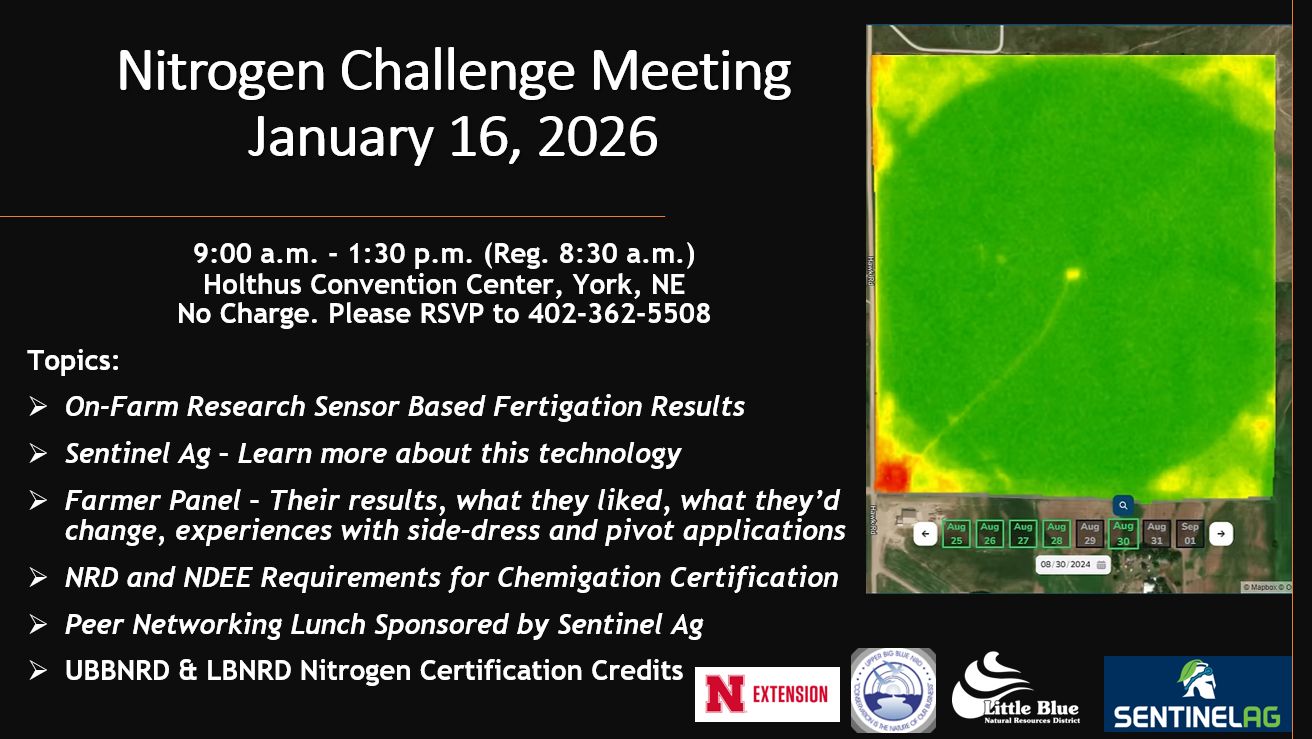
With higher input costs and low commodity prices, I’ve been thinking how to be of help to the farm community I serve during these times. A small group of farmers and I met before Christmas. We talked about the difficulties the farm economy is facing yet also talked about realistic things that can be done to save money right now. One of those is around nitrogen and thus, we planned a Nitrogen Challenge Meeting on Jan. 16th at the Holthus Convention Center in York beginning at 9 a.m. The goals of this meeting are to share the research-based results from using in-season nitrogen management via Sentinel Ag, understand how to use this technology, and share testimonies from growers utilizing this technology. They wanted to create a peer network of famers supporting farmers during the growing season with this technology-so the first step will be a peer networking lunch sponsored by Sentinel Ag. The NRD is providing nitrogen certification credits. There is no charge but please RSVP for the meal count to 402-362-5508 or jrees2@unl.edu.
Why have I stressed nitrogen so much? In the Upper Big Blue NRD newsletter, Terry Julesguard wrote an article about nitrogen in the NRD based on the information provided by the Phase 2 and 3 reports. You can read the full article at: https://www.upperbigblue.org/increased-nitrogen-efficiency-brings-new-questions. In this excerpt Terry shares, “The numbers that stand out are the residual nitrate nitrogen in the soil:
- Corn-on-corn field increases from 33 lbs/A average to 86 lbs/A, an increase of 202%.
- Corn/bean rotation field increases from 32 lbs/A average to 86 lbs/A, a 212% increase.”
I know most farmers are seeking to do their best. The data is showing we’ve increased soil nitrate post-season by over 200%, meaning we’re overapplying N. We talk about the nitrate legacy from past generations, but this is the legacy we’re leaving right now in the soil for our kids and grandkids.
Soil tests in this area of the state from the 2025 season are showing residual soil nitrate is available to reduce the amount of nitrogen applied next growing season. This provides an opportunity to save on nitrogen input costs. No agronomist, including myself, can tell you exactly how much nitrogen you will need because we don’t know the weather/soil conditions for each piece of ground each year. This is why sensing what the plant needs is so powerful using technology like Sentinel Ag.
We have an opportunity to change the nitrogen story now-with us! On-Farm research with Sentinel Ag (2022-2024) in our part of the State showed an average 56 lb N/ac savings without impacting yields, while leaving an average of 5 ppm Nitrate in the top two feet. No other product or practice has proven that in our area of the State via on-farm research. It’s about using technology to manage the nitrogen the plant needs to the best of our ability. Thus, the Nitrogen Challenge in which I’ve asked growers to consider only applying a base rate pre-plant of 50-100 lb N/ac and apply the rest of the nitrogen in-season using a sensor-based technology like Sentinel Ag. Sentinel Ag uses satellite imagery to sense when a corn plant is becoming nitrogen stressed before our eyes can see it. The research was originally developed at UNL and the grad student (Jackson Stansell) then developed a company (Sentinel Ag) around it. Please consider learning more by joining us for the Nitrogen Challenge meeting on Jan. 16th. Farmer testimonials at: https://go.unl.edu/f3si.
Nitrogen Challenge Meeting 2025
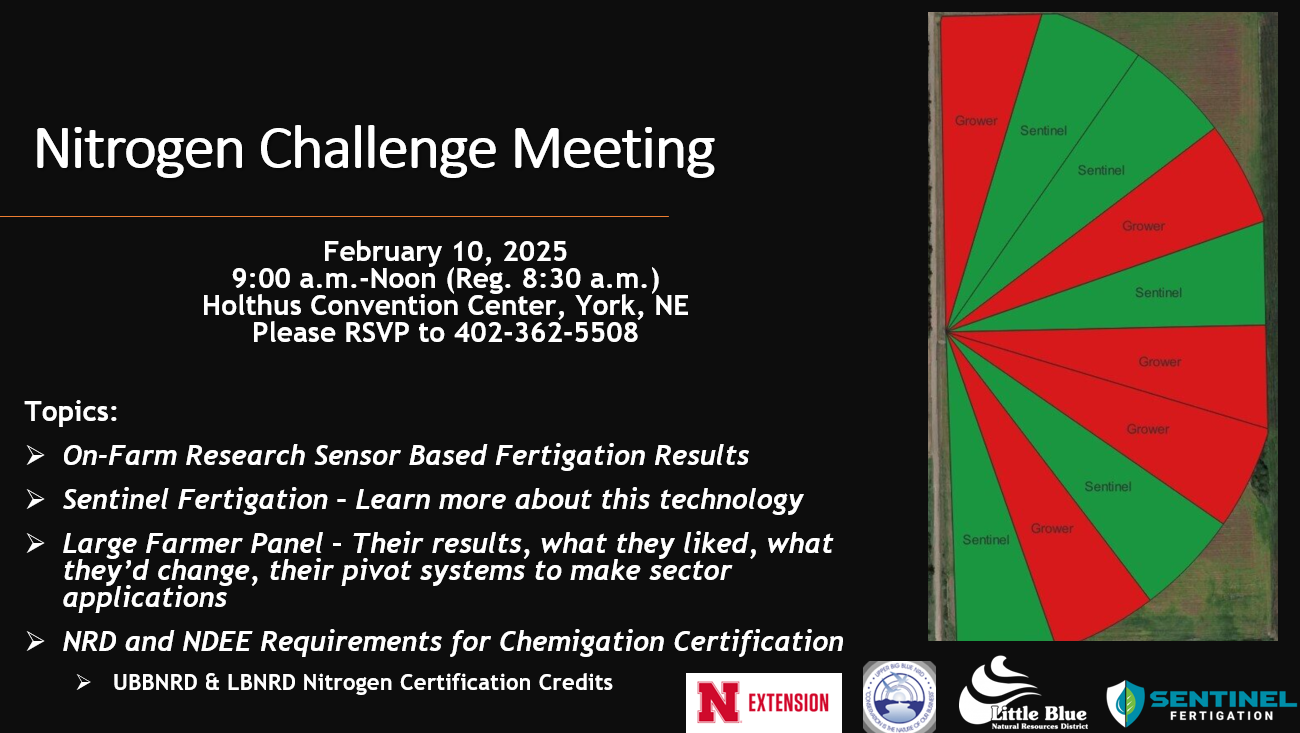
Nitrogen Challenge Meeting Feb. 10: In November of 2023, I issued a nitrogen challenge. As a reminder, my challenge was to everyone with irrigated ground who applies fall anhydrous or spring pre-plant fertilizer:
- Leave 1 piece of ground with a base rate of 70-100 lb N/ac
- Goal is to apply the rest of N in season using a tool like Sentinel Fertigation that senses what the plant needs.
- Only asking to consider for 1 field. Are you willing to join me in this?
Sixteen area producers took the challenge on 4718 acres in 2024. I haven’t heard the combined nitrogen savings yet, but if each reduced nitrogen by 40 lb/ac, that’s a savings of 188,720 pounds of nitrogen. And the greatest impact is that nitrogen use efficiency continues to be improved to on average around 0.6 lb N/bu produced with minimal residual soil nitrate remaining post-season in soil samples. The comments I’ve heard from the growers so far are that they’re so surprised how the technology can see when the crop needs nitrogen before they can and how much nitrogen they saved using the technology while obtaining similar yields.
I don’t have the 2024 on-farm research results yet. The 2023 on-farm research data showed that on average, 57 lb/ac less nitrogen was applied in the Sentinel Fertigation sectors than the grower sectors with similar average yields of 253 bu/ac for the Sentinel sectors and 255 bu/ac for the grower sectors. Average nitrogen use efficiency was 0.57 for Sentinel and 0.77 for the growers (which was actually really good for these growers to begin with!)
My goal for nitrogen management is to see an increasing number of producers use sensing technologies such as this that have been research-proven to help with nitrogen management. The updated Extension Circular published by UNL Nutrient Management Specialists also recommends using sensing technologies and in-season nitrogen applications vs. recommending a rate or even recommending using nitrogen equations. There’s just too much uncertainty with weather conditions to know what a crop will need in any given year.
So, I’m hosting another Nitrogen Challenge Meeting this year. It will be February 10, 2025 from 9 a.m.-Noon at the Holthus Convention Center in York. It will be a similar format to last year where on-farm research results will be presented in addition to an explanation of how the sensing technology works from Sentinel Fertigation. We will hear from NRD staff regarding chemigation requirements and this training qualifies for nitrogen recertification credits for both the UBBNRD and LBNRD. I think the most impactful part of last year’s program was the larger farmer panel, which I will have again. There’s so much we can learn from the growers using the technology and from the differences each of them have in their pivot and chemigation systems. You’ll hear from them about the successes and challenges they had.
For non-irrigated acres, there’s increasing interest to use the satellite imagery to also make applications in season. You’ll learn more about this as well. There is no charge for this meeting but please RSVP to me or to 402-362-5508 so we can plan for refreshments and materials. I hope to see more growers trying the Nitrogen Challenge in 2025!
Farm Succession Meetings: As a reminder, our farm succession meetings begin on Tuesday nights for four weeks beginning Jan. 21. It’s a great opportunity and men are welcome in addition to women. More info: https://wia.unl.edu/succession25/

Nitrogen Challenge Meeting
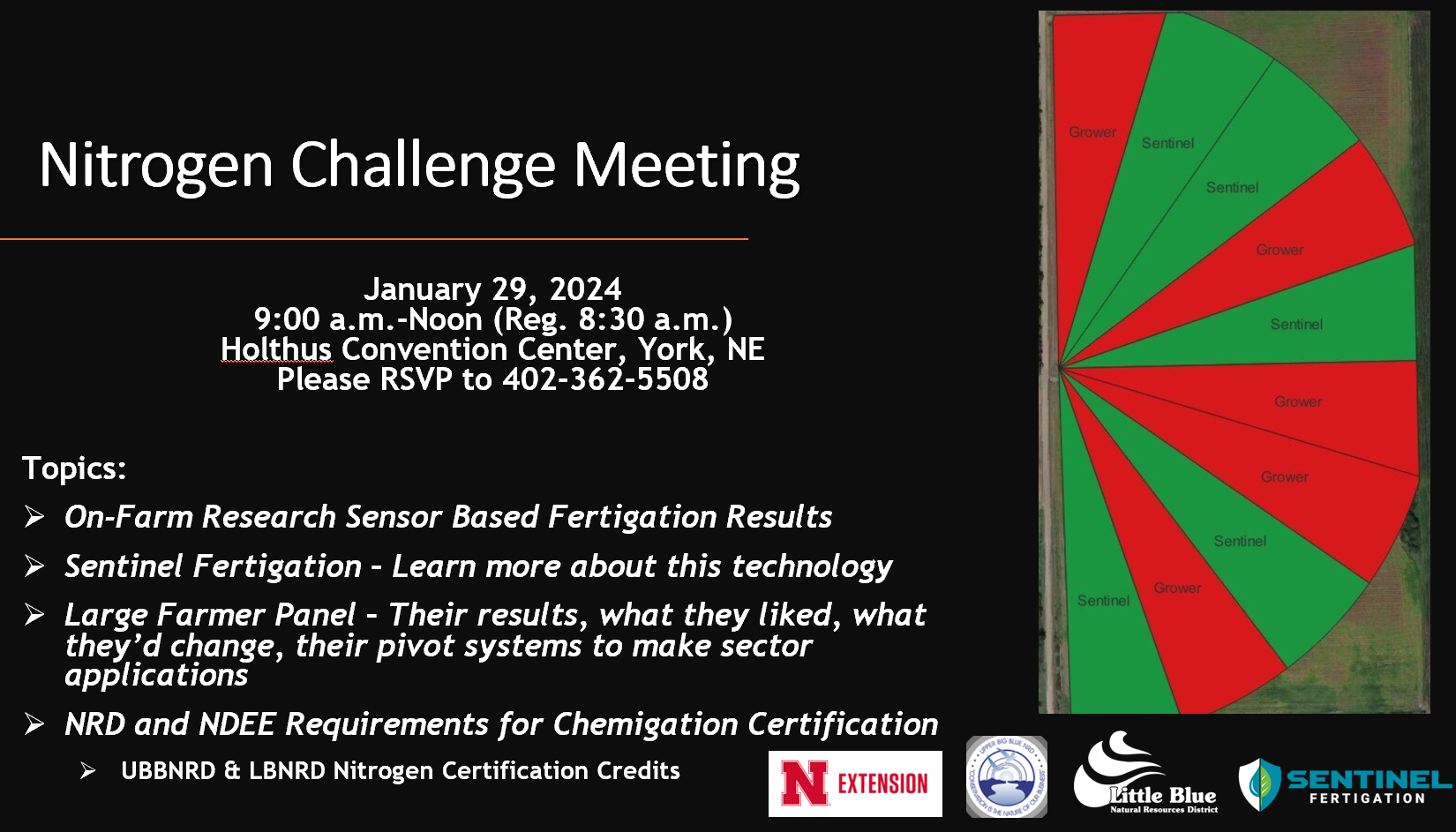
Nitrogen Challenge Meeting Jan. 29: In November I issued a nitrogen challenge. The full article can be found here: https://jenreesources.com/2023/11/12/my-nitrogen-challenge/. My goal is to have an increasing number of producers use sensing technologies such as this that have been research-proven to help with nitrogen management.
Ultimately my challenge was to everyone with irrigated ground who applies fall anhydrous or spring pre-plant fertilizer:
- Leave 1 piece of ground with a base rate of 70-100 lb N/ac
- Goal is to apply the rest of N in season using a tool like Sentinel Fertigation that senses what the plant needs. I will share 2023 research results from area producers this winter. If you decide you don’t wish to try a tool like Sentinel Fertigation, you can apply the rest of N the way you’d like.
- Only asking to consider for 1 field. Are you willing to join me in this?
On January 29th, I’ll be having a Nitrogen Challenge Meeting. It will be from 9 a.m.-Noon at the Holthus Convention Center in York. As promised, on-farm research results from sensor-based fertigation will be shared in addition to learning more about Sentinel Fertigation as a tool for nitrogen management. I also wanted you to hear directly from the area farmers who have used this tool the past few years. Some of the farmers have used this technology in on-farm research fields and some just tried it on fields. In fact, a few of the top 6 National Corn Yield Contest winners who applied 180 lb N/ac or less used Sentinel Fertigation in 2023. A larger farmer panel will share what they liked, what they’d change, and their pivot setup for managing sectors (as there’s different ways of managing this for individual pivots). Information will also be shared about chemigation requirements.
There is no charge for this meeting and the UBBNRD and LBNRD are providing nitrogen certification credits for those who attend this meeting. Please RSVP to 402-362-5508 so we know how to plan if you’re interested in attending. I’m truly hoping to see many producers interested in learning more and joining me in this challenge!
Three State Beef Conference: Re-evaluating today’s management practices for future success: On Jan. 18th in Syracuse, NE from 6-9 p.m. (Registration at 5:30 p.m.), learn more about re-evaluating management of corn residue grazing, development of heifers and management of young cows to help ensure success. Location: Fair Center building, Otoe County fairgrounds, 135 Plum St, Syracuse, Nebraska
Topics include: Corn residue grazing: current recommendations and adjustments based on new data, Dr. Mary Drewnoski, beef systems specialist, University of Nebraska; Developing heifers for the future, Dr. Kiernan Brandt, professional services technician, Trans Ova Genetics; and Managing young cows for longevity and profitability, Dr. Thiago Martins, asst. professor, beef reproduction extension & research, University of Missouri.
Pre-registrations are appreciated for planning purposes. The registration fee is $30 per person which includes a meal and a copy of the conference proceedings. RSVP to: Connor Biehler, Extension Educator, 402-624-8007, cbiehler2@unl.edu.
Also: Reminders of meetings that begin this week including Cow-Calf College, some Crop Production Clinics, and pesticide trainings.


 JenResources