Blog Archives
Nitrogen Management in 2026
With the increasing nitrogen prices, there’s a great opportunity to take the Nitrogen Challenge by trying sensing-based technology on your farm this growing season to help with nitrogen management. How does it work?
- Apply a pre-plant base rate to your field between 50-100 lb N/ac.
- Apply any additional nitrogen the plant needs in season using a sensing based technology like Sentinel Ag.
For the pre-plant base rate, I know only 50-100 lb N/ac is a hard adjustment for many, but in order to use the sensing technology, you really need to have a base rate no more than 120 lb N/ac.
Then somewhere on half of your field, apply a strip of 30 lb N/ac less than your base rate and a strip right next to it of 60 lb N/ac greater than your base rate. Repeat these two strips on the other half of the field. For example, if your base rate is 100 lb N/ac, the low base rate would be 70 lb N/ac and right next to it would be a high strip of 160 lb N/ac. Make sure there’s a high/low paired strip on each side of your field.
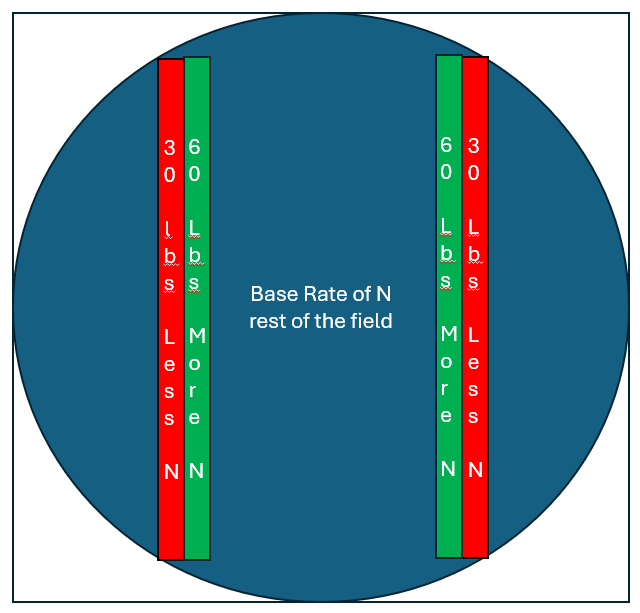
The next step is using a sensing technology like Sentinel Ag to monitor when your plants need any additional nitrogen in season. How do you get started? You can go to: https://www.sentinelag.tech/contact to contact Sentinel Ag and connect with a customer service provider.
From there it’s a matter of getting your field(s) into the system and imagery will be received each day during the growing season when cloud cover isn’t a hindrance. Our on-farm research growers since 2022 have saved on average 52 lb N/ac. We’ve had growers locally use Sentinel Ag who never applied additional nitrogen in the growing season. That usually only happens when there’s already high residual nitrate in the soil. However, it’s a great way to utilize that already existing nitrate and to avoid it leaching to the groundwater.
I also stress this as a nitrogen management tool beyond just reducing the amount of nitrogen applied. The satellite imagery has shown when terminated cover crops released their nutrients to the growing crop. We’ve also seen situations where growers added a 60 lb N/ac in-season rate at the correct timing during rapid growth phase and increase yields by 20 bu/ac. Those are things that we as agronomists can’t predict as we can’t predict mineralization for each field nor can we see the light spectrums that the sensors on the satellites can see that detect stress. It’s a beautiful thing how technology is allowing decades of research to become very practical and usable for growers!
So, for those frustrated by nitrogen prices, this is a great year to try in-season nitrogen management for yourself! And, for anyone using Sentinel Ag this year, we’re beginning peer mentoring groups. What does this mean? It can be scary and hard to try new technologies. Growers who have been using Sentinel Ag have volunteered to serve as peer mentors to other interested growers. We plan to help with understanding the imagery, fertigation, and just walk alongside each other to help with confidence in decisions and what we’re seeing. There’s much power in peer learning! If you’re interested in being a part of the Sentinel Ag Peer Mentoring Groups, please contact me at jrees2@unl.edu. We hope to get started by the end of March/beginning of April.
Richard Ferguson has retired after 40 years of service as a UNL Extension Soils Specialist and he will be greatly missed! His retirement celebration will be this Friday, March 20th from 2-4 p.m. at the Goodding Learning Center at UNL’s East campus. There’s also an online book for well-wishes at: https://go.unl.edu/ferguson-retire.
Precision Ag and Sensor Tech
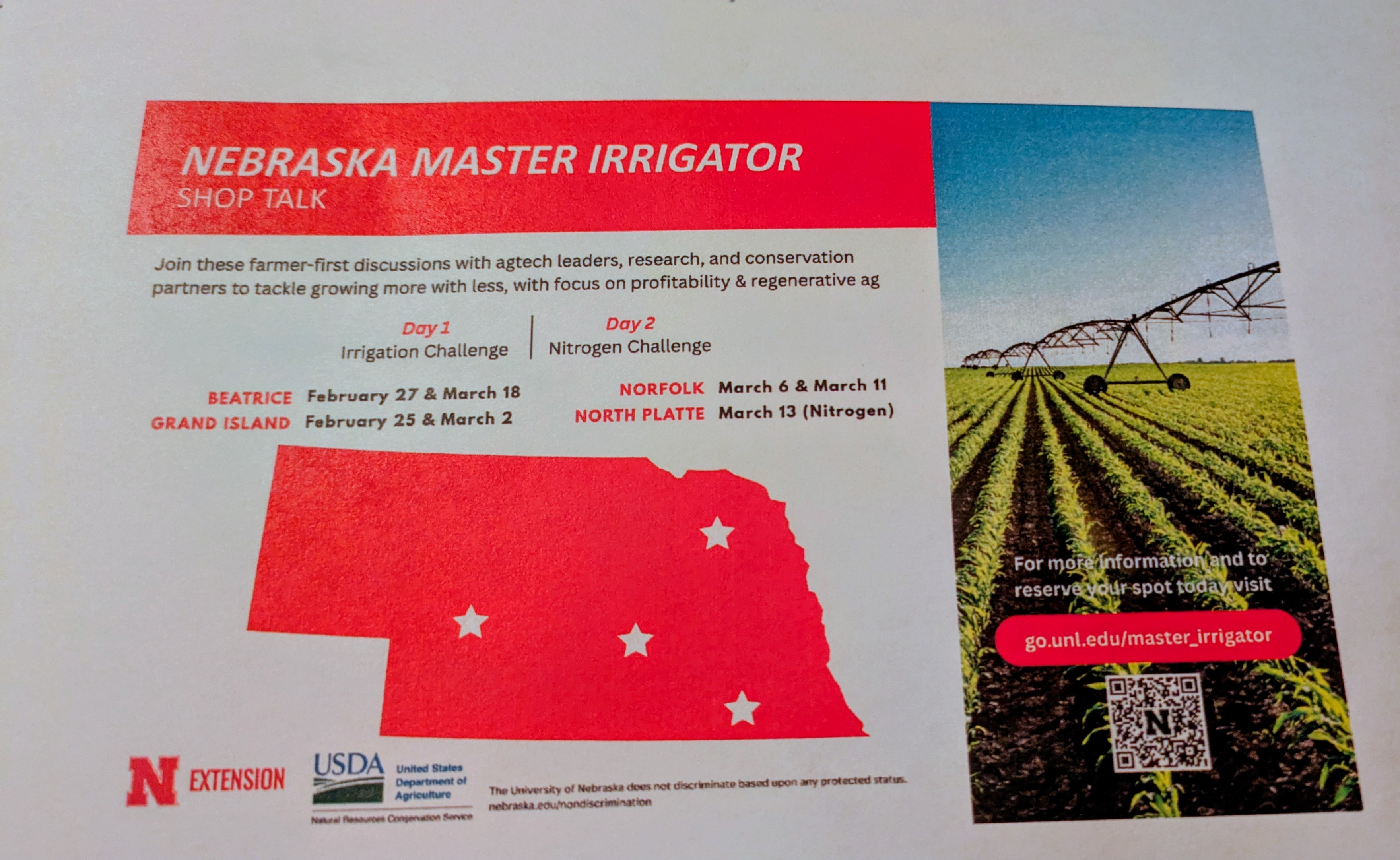
For the past few weeks, I’ve shared nitrogen management research and producer testimonials. The producer testimonials, I felt, were especially insightful considering current input costs, commodity prices, and the focus on groundwater quality for future generations. With November 1st a few weeks away and growers thinking about pre-plant nitrogen applications, I’d encourage you to consider the Nitrogen Challenge that I’ve shared the past few years. It is, for Pre-Plant Nitrogen applications:
- Consider applying a base rate of 50-100 lb N/ac on one field.
- Use a sensing technology like Sentinel Ag to apply the remaining nitrogen when needed based on plant needs. The technology can be used with in-season fertigation and/or side-dress applications.
- Only asking you to consider one field. Will you join us in this?
Our Extension Soil Fertility and Precision Ag Specialists wrote a series of Nitrogen management articles for CropWatch, the latest is using precision ag and sensor technology for nitrogen management, which I will share excerpts of below. Their takeaway based on research? “Applying nitrogen closer to when the crop needs it — guided by precision agriculture tools — reduces waste, increases profits and protects Nebraska’s water resources.”
“Why Precision Ag for Nitrogen? Crop sensors measure crop canopy reflectance during the season, detecting developing N stress before it is visible to the human eye. This enables farmers to adjust fertilizer applications in real time, aligning supply more closely with crop demand. Precision ag tools move nitrogen management from a “predict and apply” approach to a “monitor and respond” approach.”
Active Canopy Sensors are mounted on high-clearance applicators and emit light and measure reflectance to determine crop N status. Applications typically occur once between V8-V12 stages.
- UNL’s Project SENSE (2015–2021, >80 site-years) showed that sensor-based sidedress reduced N rates by an average of 33 lb N/acre compared to grower practices, while maintaining yields and improving profits.
Satellite-Based Sensors are passive systems that use the sun’s energy and satellite reflectance data. It’s practical today due to daily revisit times and ~30 foot resolution.
- Partnering with Sentinel Ag, Nebraska On-Farm Research (2021–2023, 24 sites) found average N savings of 56 lb N/acre with yields nearly identical to grower practice, while partial profits increased by about $24/acre.
Steps for Farmers
- Apply a base rate: Around 50-100 lb N/ac (25% of total) at planting.
- Set calibration: Include N reference strips or use virtual references to benchmark sensor readings.
- Monitor the canopy: Between V8-R2 growth stages, track crop reflectance with active or passive sensors.
- Apply as needed: Fertigate or sidedress 30-60 lb N/ac when the sensors detect developing stress. Multiple applications may be required, typically one to three per year.
- Take advantage of irrigation systems: Center pivots with injection pumps allow timely fertigation. Ensure proper chemigation certification and backflow protection.”


Nitrogen Challenge Meeting
Nitrogen Challenge Meeting Jan. 29: In November I issued a nitrogen challenge. The full article can be found here: https://jenreesources.com/2023/11/12/my-nitrogen-challenge/. My goal is to have an increasing number of producers use sensing technologies such as this that have been research-proven to help with nitrogen management.
Ultimately my challenge was to everyone with irrigated ground who applies fall anhydrous or spring pre-plant fertilizer:
- Leave 1 piece of ground with a base rate of 70-100 lb N/ac
- Goal is to apply the rest of N in season using a tool like Sentinel Fertigation that senses what the plant needs. I will share 2023 research results from area producers this winter. If you decide you don’t wish to try a tool like Sentinel Fertigation, you can apply the rest of N the way you’d like.
- Only asking to consider for 1 field. Are you willing to join me in this?
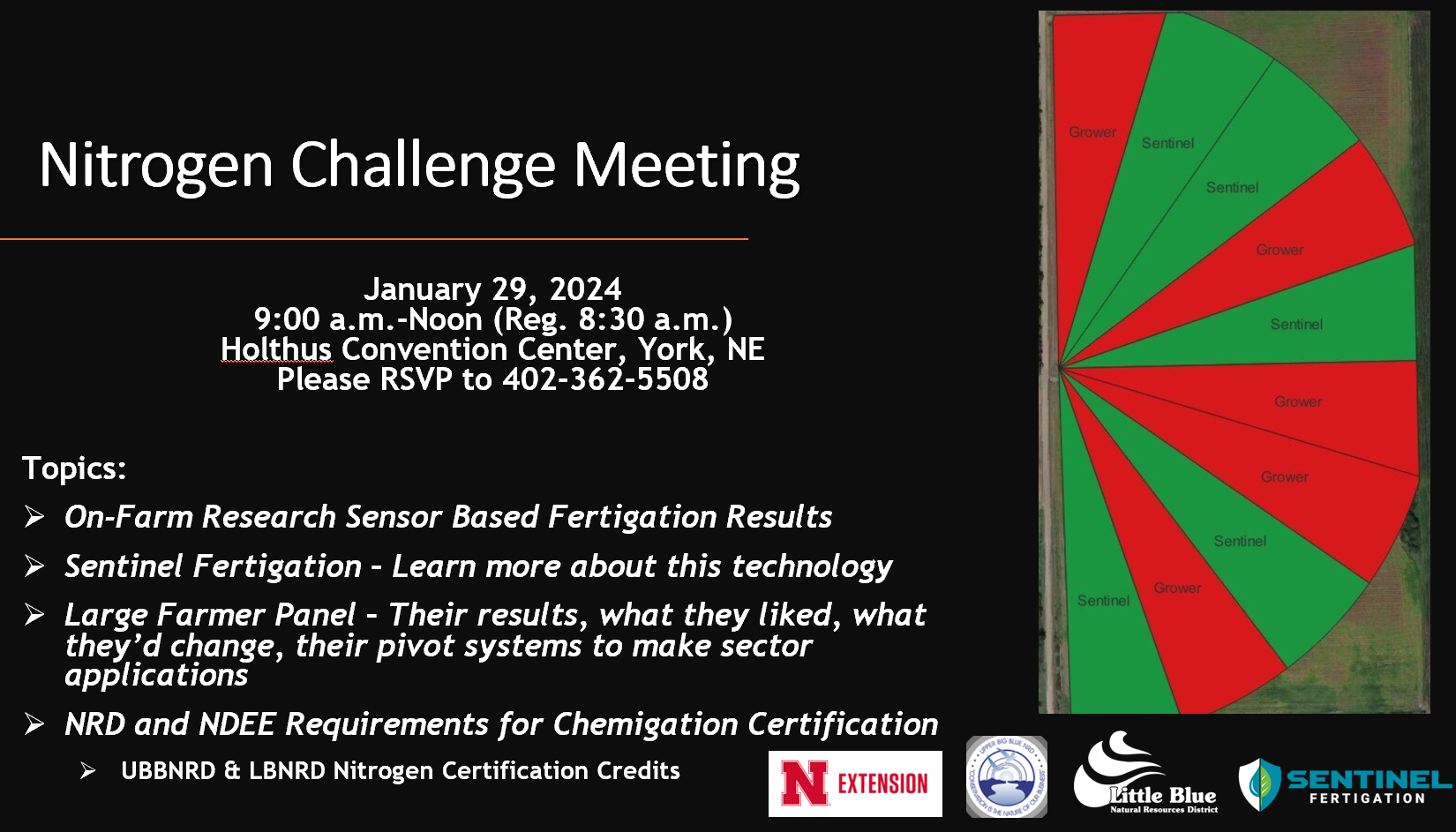
On January 29th, I’ll be having a Nitrogen Challenge Meeting. It will be from 9 a.m.-Noon at the Holthus Convention Center in York. As promised, on-farm research results from sensor-based fertigation will be shared in addition to learning more about Sentinel Fertigation as a tool for nitrogen management. I also wanted you to hear directly from the area farmers who have used this tool the past few years. Some of the farmers have used this technology in on-farm research fields and some just tried it on fields. In fact, a few of the top 6 National Corn Yield Contest winners who applied 180 lb N/ac or less used Sentinel Fertigation in 2023. A larger farmer panel will share what they liked, what they’d change, and their pivot setup for managing sectors (as there’s different ways of managing this for individual pivots). Information will also be shared about chemigation requirements.
There is no charge for this meeting and the UBBNRD and LBNRD are providing nitrogen certification credits for those who attend this meeting. Please RSVP to 402-362-5508 so we know how to plan if you’re interested in attending. I’m truly hoping to see many producers interested in learning more and joining me in this challenge!
Three State Beef Conference: Re-evaluating today’s management practices for future success: On Jan. 18th in Syracuse, NE from 6-9 p.m. (Registration at 5:30 p.m.), learn more about re-evaluating management of corn residue grazing, development of heifers and management of young cows to help ensure success. Location: Fair Center building, Otoe County fairgrounds, 135 Plum St, Syracuse, Nebraska
Topics include: Corn residue grazing: current recommendations and adjustments based on new data, Dr. Mary Drewnoski, beef systems specialist, University of Nebraska; Developing heifers for the future, Dr. Kiernan Brandt, professional services technician, Trans Ova Genetics; and Managing young cows for longevity and profitability, Dr. Thiago Martins, asst. professor, beef reproduction extension & research, University of Missouri.
Pre-registrations are appreciated for planning purposes. The registration fee is $30 per person which includes a meal and a copy of the conference proceedings. RSVP to: Connor Biehler, Extension Educator, 402-624-8007, cbiehler2@unl.edu.
Also: Reminders of meetings that begin this week including Cow-Calf College, some Crop Production Clinics, and pesticide trainings.


 JenResources