Blog Archives
Farmer Testimonials: Sentinel Ag
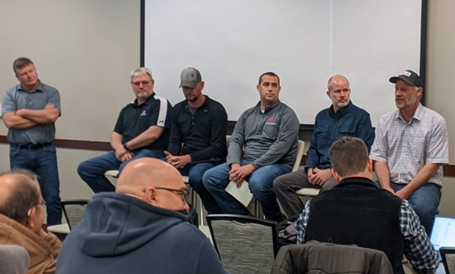

Photos (Left): 2024 Nitrogen Challenge Farmer Panel: Jason Richters, Scott Richert, Mike Spray, Tyler Smith, Phil Christenson, Jesse Williams (photo by Jenny Brhel). (Right): 2025 Nitrogen Challenge Farmer Panel: Jason Richters, Todd Schmieding, Erik Friesen, Tyler Smith (photo by Abigayle Warm).
***Newspaper Editors: Please note this week’s column is longer; because it’s unique, I would appreciate you printing it all if possible-even if it needs to be over a few editions. Thank you!***
Farmers appreciate hearing from other farmers’ experiences. So, I asked farmers who tried Sentinel Ag in the Upper Big Blue and Little Blue NRDs if they’d be willing to share: their why, their experiences, and advice to farmers considering trying it. The following were willing and have used Sentinel Ag for more than one year. I appreciate the vulnerability from these farmers in sharing!
Jason Richters: I had a desire to improve my nitrogen use efficiency, so I decided to try the Sentinel Ag nitrogen management system three years ago. The ability to know if the crop needs a nitrogen application based on satellite imagery is a game changer, and we have learned that we can better manage and reduce our nitrogen application rates while maintaining yields. This is good for our bottom line and may eventually reduce nitrate levels in our groundwater.
Using a nitrogen management system is a management change, but more importantly it’s been a management improvement. I encourage other farmers to try this technology, especially if they are already split applying their nitrogen.
Tyler Smith: My experience is a little different than most producers because I was able to be a part of the development of the concept that grew into Sentinel Ag with my role at UNL. As far as my personal farm operation, I had started fertigating about 15 years ago and had seen the benefits of spreading out my nitrogen applications but there were years where I wondered if I needed that last fertigation. After Sentinel became commercially available, I could see the promise of the method and I enrolled a couple of fields in 2022 and 2023. I was realizing nitrogen savings without losing yield. In 2024 and 2025, I’ve had all of my irrigated corn acres enrolled and I’ve been able to lower my nitrogen use by 10-40% while achieving several new field best yields.
What I’ve observed is that nitrogen availability is so variable in both total growing season need and the timing of that need that I don’t know how I can ever hope to accurately predict it. It’s much easier to let the corn tell me when it needs it and, at the end of the season, I’ll know what the total need was, not at the beginning. We don’t decide how much irrigation we will need for the next growing season in November or March, it’s a real-time decision that we make as we go through growing season that accounts for changes in weather, yield potential, ROI, etc. We have the ability to manage nitrogen the same way that accounts for all of the unknowns in real-time with a sensor-based approach.
Scott Richert: I started my in season nitrogen a while ago with the Nsense program using sensors on a Hagie sprayer. I had been sidedressing for years but wanted to see if I could get better. What I found was I was close. I was putting on enough to have a good yield but the sensors had better ROI. From there we kept adjusting and when the Sentinel program came out I put 2 fields in. I found the same thing that I was getting a good yield but the sensors were having a better ROI. So ROI is great but the other thing that means is that I was over applying nitrogen. In the Upper Big Blue NRD I live in one of the areas that has not moved up on the list for testing and reporting. Looking at how the numbers have been moving though it’s just a matter of time. For my soil it takes 30 years for the nitrate to make it to the water table. It basically takes most of a farming career for the nitrogen you apply to make it to the aquifer.
If we want to make things better for the people that come behind us we need to make changes now. With in season application I have nitrogen in the system only when my crop is there and using it. I have the nitrogen that the crop needs now not for the whole season. If we have adverse weather I can adjust to that. If it is hailed out I save the balance of my fertilizer and don’t let it leach away. If the plant is telling me it needs more I can put it on. If the mineralization is really good the plant will tell me it is happy and I can save an application.
There are some issues to work through. You don’t really know how much nitrogen you are going to use on each farm each year. You may need to purchase more later in the season or you may need to store some until next year. Sometimes it has been hard to apply when you want. It can rain at an inopportune time but I’ve never not got the application done. The sensors have a seven day window of time to make an application.
Todd Schmieding: Sentinel has allowed me to manage nitrogen as it is needed on the field. It accounts for release from cover crops in a way that gives me the full credit when it is available. It does add challenges in timing and changing when my work occurs, as it is not predictable. I have also seen changes in status before I applied the nitrogen, creating additional questions as to what is happening in the field. If you’re considering adding this to your program start on one field at first, and then expand from there.
Jesse Williams: Using in season nitrogen application through the pivot allows you to spread the applications out and “spoon Feed” the crop. Adding a sensor system such as Sentinel provides an additional tool to monitor crop needs. The big benefit to this in my mind is the ability to apply nitrogen based on crop needs and potential throughout the season. Applying a full rate upfront of 1-1.2lb per expected bushel can prove to be extremely wasteful if you encounter weather related issues such as hail, heavy rainfall or wind damage. Using the spoon feed approach with fertigation for the last three years I have typically been able to keep my Nitrogen use under .8lb per bushel.
Challenges for me have been gaps in imagery due to cloud cover/smoke. This year I probably shot from the hip more on applications due to the fact that I was going a week or more between imagery updates and trying to time applications between rainfalls. I think sentinel has some solutions to help with this including capturing drone imagery and modeling expected uptake based on planting date, maturity and GDU’s. We had thought linking my Field View account would bring some of this information in but Field View seems to be struggling to link with any partners this year. Another challenge is working with applicators on variable rate Nitrogen applications since there seems to be very few farmers in the area doing variable rate Nitrogen so their experience in applying it is not where it should be; I have also struggled to get as applied maps back from applicators after the application is done.
Brad Morner: This has been my third season using Sentinel and my experience with in-season nitrogen has been good. I am glad I’ve tried it. It’s made me aware of how much less nitrogen I can use and still have good yields. Working with sentinel has been a very good experience. They are so easy to work with and always get back to me quickly when I have questions. I like it because Sentinel tells me when the corn needs more nitrogen based on the satellite sensing technology, so I’m not just guessing when to apply more. I realized that I could get by with less nitrogen and still get the same yields. The biggest challenge is that it takes a little more time during the season. I used to fertigate once during the season. With Sentinel, I do 2 or 3 smaller applications instead of one large application but I also realize that it is worth the extra time because I am applying the nitrogen more efficiently as needed.
Erik Friesen: Yesterday we took out 2 NCGA (National Corn Grower Association) contest plots. Both were about 140#’s N, two different hybrids and both did 295. These were also non gmo white corn. This year every acre we have has less than 150#’s N. If people can update equipment, adapt to different tillage practices, use of autosteer and technology, why do people still use the same idea that they did 40 years ago when it comes to fertilizer recommendations? The struggle I see is the time it takes, big farmers will just keep doing the same thing. But I guess this is what makes me more competitive with them, raising high value crops, using less inputs.
Grateful to these farmers for sharing their experiences! Please reach out to them with questions if you’re interested in trying Sentinel Ag this coming year.
Nitrogen Reduction Incentive Act
Thank you to those who responded to last week’s poll question whether via the poll or contacting me via email or phone. The poll results are shared on my blog site.
Nitrogen Reduction Incentive Act (NiRIA): With high input prices, one opportunity to reduce costs is to become more efficient with nitrogen fertilizer applications. (Information from this article comes from the NiRIA Program website, guidance documents, and UNL CropWatch). Established under LB 1368 (2024), NiRIA is a state program that offers payments to producers who reduce their nitrogen fertilizer application rates by the lesser of 40 pounds per acre or 15% of their baseline rate. The program is available to corn, sugarbeet, wheat and potato producers statewide, with total funding for 2026 capped at $1 million.
Producers who successfully participated in the 2025 program may enroll again if reductions are on different fields. Administration and funding of NiRIA are done through the partnerships of the Nebraska Department of Water, Energy, and Environment (DWEE), local Natural Resources Districts (NRDs), and the Nebraska Corn Board.
Each participant will need to identify the practice(s)/product(s) they plan to implement to achieve the 40 lb N or 15% reduction of N per acre. Practices/products are subjected to individual NRD approval:
- Reduction in nitrogen application
- Implementation of in-season sensor-based technology
- Implementation of a nitrogen stabilizer
- Implementation of a biological product
- Implementation of other technology utilizing nitrogen timing and/or rate
Applications due to local NRDs by Nov. 15, 2025, with approvals announced by Dec. 15, 2025. Payments range from $10 to $15 per acre, depending on your priority area (A, B or C). Each NRD manages application approval and prioritization based on available funding. Contact your local NRD for assistance in determining your priority area and for submission details. NiRIA program information, application form, and NRD’s point of contact can be found on the NDEE website.
Nebraska On-Farm Research conducted in the York/Seward and surrounding county area has found the following regarding the various practices shared in the options above.
- Nitrification Inhibitor: Only one study (which used ATS as the inhibitor with 32%) in 22 site-years-worth of studies found a positive yield increase when using nitrification inhibitors (mostly with anhydrous) in heavier textured soils. Minimal savings in N leaching was found.
- Rate and Timing: No yield difference when applying N pre-plant vs. split application. No yield differences when nitrogen was applied +/- 50 lb N/ac vs. the grower rate. (7 site-years)
- Pivot Bio: Across 64 replications, 27% of studies showed a 5 bu/ac or greater yield increase, 17% showed a 5 bu/ac or greater yield decrease, and 56% of studies were within 5 bu/ac.
- In-Season Sensor-based technology using Sentinel Ag: average of 57 lb N/ac of nitrogen savings between grower and Sentinel treatments in 2023 and 42 lb N/ac over 17 site-years (2023-2024) without significant yield differences. It can be used with fertigation and/or sidedress applications in both irrigated and non-irrigated acres.
Poll results from 9/29/25: What’s the 1-2 main reasons holding you back from trying technology like: Fertigation and/or In-Season Plant Sensing Technologies like Sentinel Ag? (11 responses)
Anonymous: I have not fertigated because I utilize ydrop application. I’m not opposed to fertigating, it is just 1 more certification we have to obtain on an already certificate happy society. Ydrop application definitely has its downfalls though like time for extra passes, more hours on a machine, not very fun to apply, labor and most likely limited to just 1 pass. Have not had much experience w plant sensing technology and have always questioned its accuracy, especially on the go at a high speed. Fertilizer is a pretty important pass, would hate to not get it right. Usually when you see signs of shortages it’s too late.
Anonymous: Available time to do fertigation.
Anonymous: I often ask this same question if we are trying to be more efficient and we have the data to back it why are we allowed to put so much pre plant fertility out the data shows less applied more times = efficient
Anonymous: My side dressing works well.
Anonymous: I already fertigate all corn 1 time per season. It’s hard to find time with water needs, weather, crop stage, getting fertilizer to the pivots etc to do numerous passes.
Anonymous: Cost Not sure it fits my farm
Anonymous: Fertigation is an “upper level” management practice. Many farmers do not have the time, education, or experience it takes to fertigate correctly and safely. There is expense involved with the permit and the equipment involved. (Example: The gasket in my chemigation valve had a small crack from age so it did not pass inspection by NRD. A new valve was over $900 plus the labor and time to replace it!) Plant sensing technologies come with an expense and a learning curve also.
Anonymous: 32% is more expensive than anhydrous Cost of equipment and management of fertilizing with numerous pivots
Anonymous: time, labor
Anonymous: Trusting that the technologies actually work and give consistent results.
Anonymous: Lack the knowledge to do this.


 JenResources