Blog Archives
Nitrogen Use Efficiency
I’ve had permission to share share information from a revised nitrogen management NebGuide from Ferguson, et. al that will soon be available. For those applying pre-plant nitrogen, a reminder to consider only applying a base rate of nitrogen (70-100 lb N/ac) this fall or spring pre-plant and apply the rest in season using a technology like Sentinel Fertigation. As these excerpts show, while good strides have been made, in general, we have opportunity to reduce nitrogen application rates.
“A recent survey in Nebraska found that 45% of farmers apply all N in early spring (33% pre-plant and 12% at planting), 14% in the fall, 12% during the growing season, and 29% use split application (Balboa 2023). The survey also found corn producers applying an average of 169 lb N/acre, with 80% using soil lab recommendations and 67% relying on personal experience/intuition. More advanced N recommendation tools generally had low adoption (crop models 23%, sensor-based algorithms 11%, and other digital tools 11%), indicating there is potential for growth in the use of these tools.”
Nitrogen Use Efficiency (NUE) is a measurement of how many pounds of fertilizer were used to obtain the grain yield in bushels. “Fertilizer N application by corn producers in Nebraska has gradually reduced over the past 50 years from around 1.7 lb fertilizer N/bu corn grain in 1965 to around 0.8 lb fertilizer N/bu corn grain in 2021. This is a tremendous improvement in fertilizer use efficiency, resulting in increased profit for Nebraska farmers and reduced environmental impact. Unfortunately, there continues to be significant areas of Nebraska with groundwater nitrate-N in excess of the EPA drinking water standard of 10 ppm.”
“In much of Nebraska, this trend for continuing increase in groundwater nitrate-N levels is partially due to the transit time of nitrate through the vadose zone. Due to the depth of the aquifer, nitrate entering the aquifer may have leached from the root zone several years to several decades ago and does not reflect current crop management practices. However, areas of the state with shallow aquifers also continue to see increasing groundwater nitrate concentrations (Juntakut et al., 2019), suggesting that more should be done to reduce nitrate loss from commercial fertilizers. Research at UNL in collaboration with NRDs calculated the partial N balance (difference between N inputs and grain N removal) across corn producers over several years as a proxy of N losses to the environment (Tenorio et al., 2021). About 70% of corn producers had a surplus N balance, indicating that N inputs were higher than N removal with grain. Corn producers with a large surplus of N were consistently over-applying N over the years.”
The “average grower fertilizer N application was around 0.8-0.9 lb fertilizer N/bu corn grain from 2000-2021. This lack of further reduction in N application per bushel raises the question of whether we’ve reached a limit to improving nitrogen use efficiency (NUE), or if broad adoption of different practices is needed to further improve NUE.”
“Nitrogen exists in many organic and inorganic forms in soil which are highly influenced by weather – particularly rainfall and temperature. Nitrogen is subject to loss from the soil via leaching and gaseous emissions (N2O and NH3). Consequently, our ability to predict N dynamics in soil, and availability of N from soil and fertilizer to the crop, is dependent on our ability to predict weather. Until we can perfectly predict weather, we cannot perfectly predict N availability to a crop…we believe that reactive management, applying most of the N fertilizer during the growing season, and basing the application rate on crop N status, can increase NUE for most growers, particularly for irrigated fields capable of fertigation.” For perspective, our on-farm research producers using Sentinel Fertigation had NUE ranging from 0.35-0.8. The goal would be an average of 0.5-0.7/year. I realize it’s hard to imagine that type of NUE, but our research keeps proving it is possible without hurting yields, with timely in-season N applications. It would also require time for a large infrastructure change for more in-season N to occur.
Reminders: Dec. 3: Cash Lease Workshop in York from 10:30 a.m.-2 p.m. (no charge and meal included thanks to Farmer’s National) on Dec. 3 at the 4-H Bldg. in York. RSVP: 402-362-5508.
Also Dr. Kohl is at the Bruning Opera House at 1 p.m. on Dec. 3 (no charge).
Dec. 5 is the Transition to Organic Workshop at ENREEC near Mead. No charge, RSVP and info. at: https://extension.unl.edu/statewide/enreec/2024-transition-to-organic-farming-conference/
Virtual Trade Show Webinar for Beef Producers at 7 p.m. each evening. Dec. 5: Water Monitoring Solutions and Dec. 9: Virtual Fencing. Register at: https://go.unl.edu/BeefTech.




JenREES 4/19/24
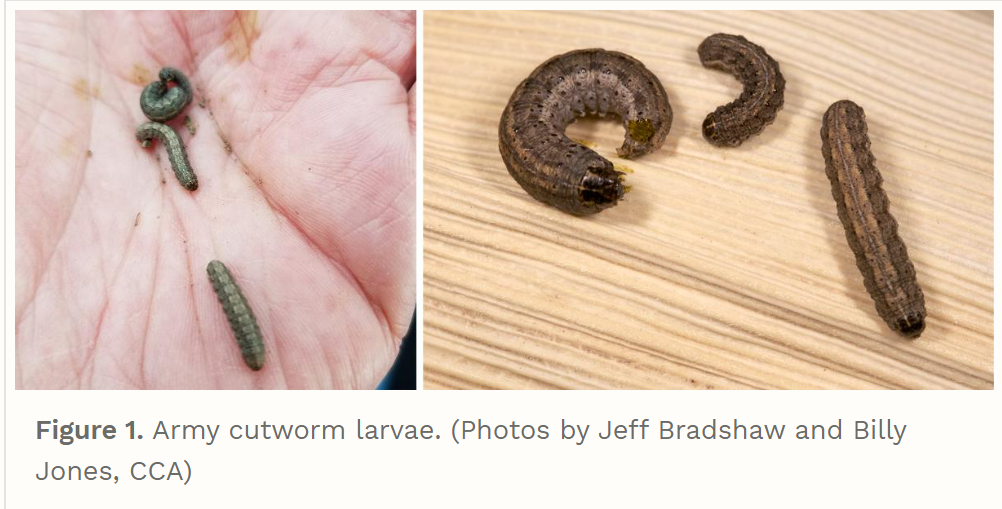
Army cutworms have been found in some wheat and alfalfa fields. I honestly haven’t looked at pastures but have gotten several calls about pastures this week, so perhaps be looking at them as well. The threshold is four or more cutworm larvae per square foot of winter wheat or alfalfa. A lower threshold is necessary for stands that are new or had some winterkill/drought-stressed. Damage looks like chewing on the leaves stems to complete stand reduction. Army cutworm larvae are greenish-brown to greenish-grey caterpillars, approximately ½ to two inches in length. They feed at night so you may have to look under residue or dirt clods to see them in the day.
Nitrogen Fertilizer Trends in Nebraska from 1955-2023: Dr.’s Richard Ferguson, Bijesh Maharjan, and Javed Iqbal wrote a nice updated article on nitrogen fertilizer trends for CropWatch this week. I pulled out a few excepts here, but please also check out the full article with the graphs and figures here: https://go.unl.edu/ki69.
“As farmers embark on another growing season in Nebraska, most will be applying some form of nitrogen fertilizer to optimize crop production. … Initially, ammonium nitrate, mostly sold in bags, and anhydrous ammonia were the dominant fertilizer sources. Nitrogen fertilizer use grew steadily from 1955 into the 1970s as fertilizers became more available and farmers saw the benefit for crop production. During this period, urea and urea ammonium nitrate solutions became more available and their use grew. Anhydrous ammonia dominated fertilizer sales during this period, peaking in 1968 with over 75% of total N sold as anhydrous ammonia.
Use of urea ammonium nitrate (UAN) solution (both 28% and 32% N) began to take off in the 1980s, and today is the most dominant form of nitrogen fertilizer used in Nebraska. In 2022, 57% of all N consumed in Nebraska came from UAN solutions, while 23% came from anhydrous ammonia, and about 14% from urea.
Total nitrogen used in Nebraska began to plateau around 1980 until about 2010. Since then, trends for increasing total N use have been observed. This trend generally coincides with an increase in land area from which corn is harvested. Approximately 8.85 million acres of corn were harvested in Nebraska in 2010, while 9.5 million acres of corn were harvested in 2023.

Figure 4 shows a very positive overall trend, with fertilizer N use of around 1.6 to 1.7 pounds fertilizer N per bushel of corn in 1965, to around 0.8- to 0.9-pound fertilizer N per bushel of corn in 2022. This positive trend illustrates that Nebraska farmers have become much more efficient through the years in managing nitrogen fertilizer.
There are many factors influencing this trend, including genetics advances and overall improvement in production practices. However, it’s likely that a major factor in this trend has been growing awareness of the risk of environmental degradation from excessive nitrogen application, influenced by many educational programs conducted by the University of Nebraska-Lincoln and natural resources districts. This trend is also influenced by requirements in some groundwater management areas for producers to follow nitrogen and irrigation best management practices.
While the general trend for the past 60 years is positive, Figure 4 also shows very little change recently in fertilizer nitrogen use efficiency: it has remained around 0.8- to 0.9-pound fertilizer N/bu since 2000 (circled data points). This data also does not illustrate variations in efficiency that occur in regions across the state. This lack of recent improvement suggests that current widely used practices may have reached their limit in terms of nitrogen use efficiency, and adoption of other tools, such as in-season application and sensor-based fertigation, may be required to further increase nitrogen use efficiency.”

I took a picture of this so here is a clickable link to register for the webinars: https://go.unl.edu/annualforagewebinar
Sensor-Based N Fertigation
Understanding the Soil Microbiome: For those interested, this Friday, March 3, will be our last Friday conversation on ‘understanding the soil microbiome’ at the 4-H Building in York from 10 a.m.-Noon. Dr. Rhae Drijber, UNL soil microbiologist, will kick off our conversation and I’m looking forward to the discussion. If you plan to attend, please let us know at 402-362-5508.
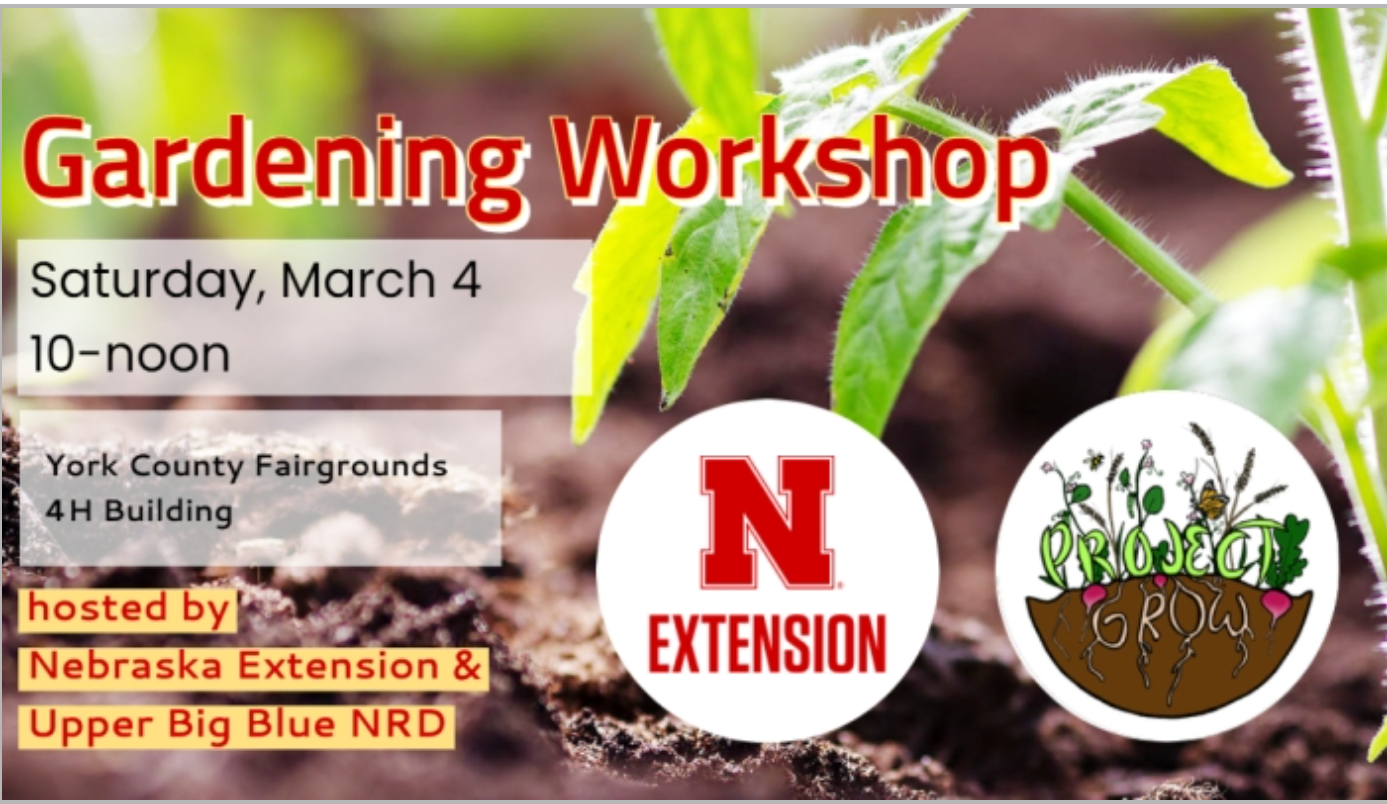
March 4 Gardening Workshop will be held from 10 a.m.-Noon at the 4-H Building in York. Sarah Browning, Extension Educator, will share on vegetable planting basics such as site selection, rotational plan, summer care, and troubleshooting problems such as insects/diseases/weeds. Please bring your questions! This workshop is sponsored by the UBBNRD and Nebraska Extension; there’s no charge and refreshments are provided. No RSVP is required, but it does help with refreshments if you could please let us know at 402-362-6601 or 402-362-5508. If you’re interested in gardening, but don’t have the space at home, check out the Project GROW community garden in York. Plots are available for the 2023 growing season. You can reserve your space now or come to the Gardening Workshop and sign up in person.
Sensor-Based Nitrogen Fertigation: This week also brings the last of our on-farm research updates (Mar. 1 in North Platte, Mar. 2 in Kearney, and Mar. 3 in Beatrice). You can still sign up at https://go.unl.edu/2023ofr.
One of the most impactful on-farm research studies being shared (I feel) is on sensor-based nitrogen fertigation occurring since 2019. It’s similar in concept to Project Sense, for those of you familiar with sensors being retrofitted on ground rigs for in-season nitrogen applications.

Sensors mounted onto a drone could allow for improved nitrogen use efficiency (NUE) by responding to actual plant needs in season. A grower determined base rate was applied to the field across treatments. Then grower fertigation management was compared to the sensor-based approach in 15 degree sectors on half a pivot. Indicator and reference plots in the field received at least 30 lb/ac less N and 30 lb/ac more N respectively and were established around V7. The field was flown weekly with a drone, imagery was analyzed, and fertigation decisions were made for each treatment sector.
The treatments were: 1) Grower rate 2) Risk averse post-establishment (RAP) (fertigation events applied up to R4 but 30 lb N/ac applied when needed between V9-V14) and 3) Risk averse post-establishment Increased Rate (RAP-IR) (fertigation events applied up to R4 but 60 lb N/ac applied when needed between V9-V14).
Since the beginning of this effort, 100% of the RAP-based sensor treatments were more efficient across all sites than the typical N grower management. Encouraging to me about this method is that it’s all based on what the plant needs after what the soil provides to the plant. There’s no determination of an N rate ahead of time based on plant removal, yield goal, etc.
There were 4 studies in 2022, but I will share on two of them. In a Hall county field with silt loam soils, both sensor based fertigation treatments triggered a total application of 95 lb N/ac vs. grower applying 196 lb N/ac. The grower treatment resulted in a yield of 277 bu/ac at 0.71 lb N/bu NUE. The two sensor based treatments resulted in yields of 271 and 274 bu/ac at only 0.35 lb N/bu NUE! That was pretty incredible for me to see 0.35 NUE and those kind of yields! It shows there is opportunity to consider further reductions in nitrogen applications. At a Saunders county field, no grower rate was used and the beginning base rate was only 33 lb N/ac. The RAP sensor treatment had 108 lb N/ac total applied yielding 258 bu/ac with 0.42 lb N/bu NUE. The RAP-IR sensor treatment had 101 lb N/ac total applied yielding 274 bu/ac with a 0.37 lb N/bu NUE.
You can read more details of this study via the online version of the 2023 On-Farm Research book found at: https://on-farm-research.unl.edu/ (beginning on page 80). For 2023, growers interested in trying this via on-farm research can receive monetary support through a Conservation Innovation Grant to help with purchasing fertigation equipment and/or for the aerial imagery services through Sentinel Fertigation. I would love to see 5 of these in our area of the State this coming year. Please let me or Laura Thompson (laura.thompson@unl.edu) know if you’re interested!

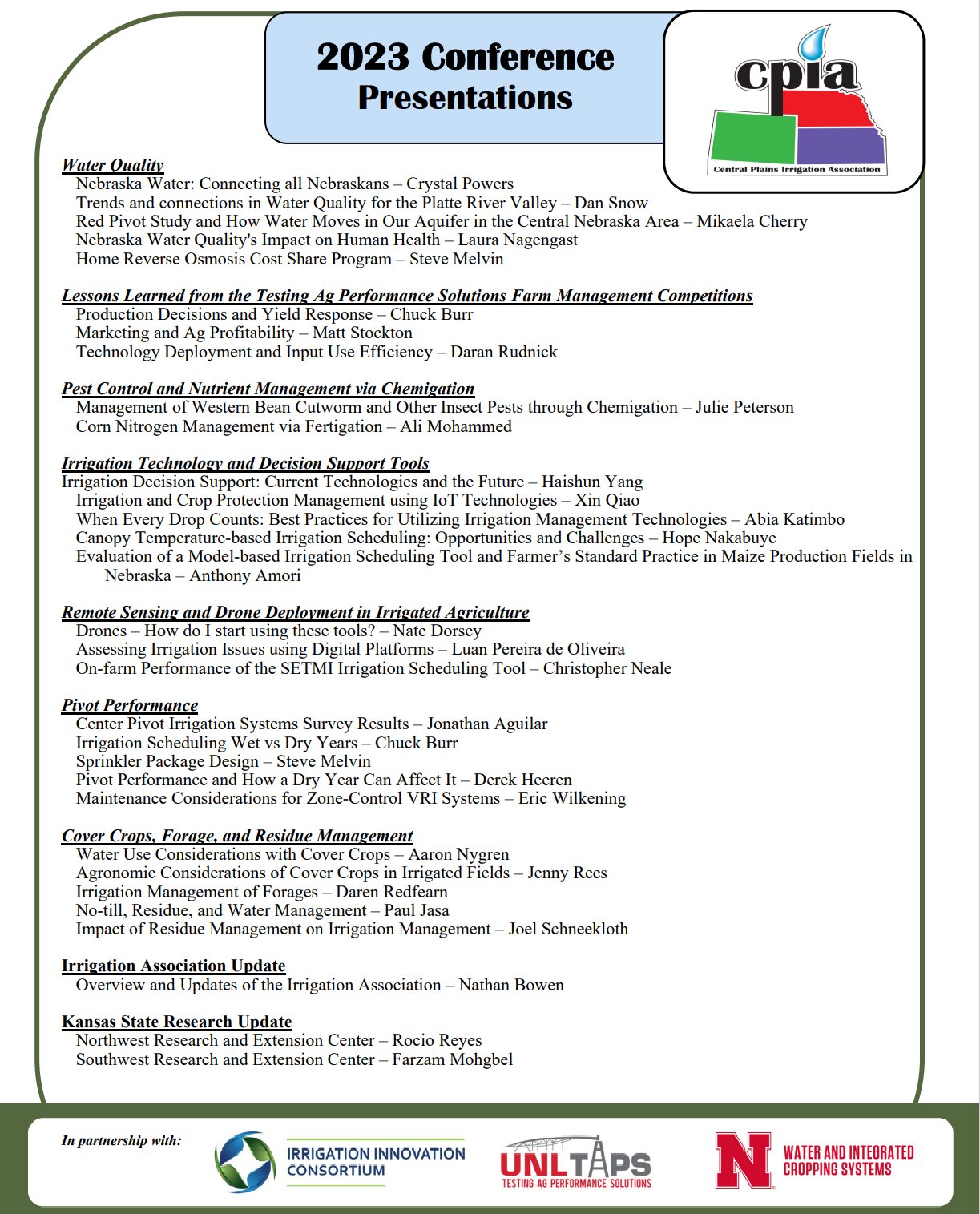
You can still register for the CPIA Conference or walk-in the day of the event. Really practical info. for growers and ag industry!

JenREES 12/19/22
In some ways, it’s hard to believe that Christmas is this coming week; wishing you and your family a very blessed Christmas! For holiday food safety tips, please check out: https://food.unl.edu/article/holiday-food-safety-tips.
Extension is an interesting career that’s hard to explain what all it entails. Many people realize we’re involved with the fair and 4-H. Beyond this, the responsibilities just change with each season. For me, January and February are filled with winter meetings where I have the opportunity to teach and learn throughout the state each day. This past month was spent scheduling and planning for those meetings. Pesticide letters and winter program brochures should be mailed from local Extension offices in the next few weeks. The winter program brochure is also here: https://jenreesources.com/upcoming-events/.
Winter meetings mostly entail certification training and learning opportunities to discuss the past year and preparing for the coming one. Anyone who applies restricted use pesticides take pesticide certification training every three years to handle and apply pesticides safely. Those who apply chemicals and fertilizer through irrigation systems take chemigation training to do so safely. Nitrogen certification training is taken for those who farm in areas of NRDs that have groundwater nitrate levels higher than 7 ppm. Livestock operations of designated sizes take training on the proper handling, storage, and application of manure. Organic producers also go through a certification process. All the certifications mentioned above require our farmers, applicators, and livestock producers to keep records of what they are doing, and random inspections can occur for some of the certifications to ensure they’re in compliance.
Beyond the required trainings, many attend meetings throughout the winter to continue learning and improving efficiencies in their operations. While there’s always a few outliers in any industry, the majority of farmers I know are seeking increased nitrogen use efficiency (applying less nitrogen per bushel of grain received). We can’t change the past for what wasn’t known back then of fertilizer and water applications that would eventually impact nitrates in groundwater. In general, while there are some outliers, practices have changed and farmers seek to be increasingly efficient with fertilizer and water use.
UNL Soil Specialists share of these improved efficiencies in an article found at https://go.unl.edu/mxu0, “Partial factor productivity (PFP) is a measure of efficiency of input use…PFP is commonly expressed as yield per unit input, e.g. bushels of corn per pound of fertilizer nitrogen (N) applied (bu/lb N). PFP can be adapted to units of nutrient removed in grain harvest to units of nutrient applied, such as corn N harvested relative to fertilizer N applied (PFPN, lb/lb).
The PFPN used for the analysis in this article was derived from growers’ practices statewide with the assumption that growers’ N use was aimed at profit maximization. The average PFP of fertilizer N for corn in Nebraska was estimated to average 1.16 bu/lb N in 2012 compared to 0.57 bu/lb N in 1965 (Ferguson, 2014). This represents a doubling in PFP for fertilizer N applied to corn. The trend of increase was linear from 1965 to 2012.” (What they’re showing is increased nitrogen use efficiency between 1965-2012 of more corn produced per pound of nitrogen applied). The ratio can also be flipped to look at how many pounds of N are being used to produce 1 bushel of grain.
Most farmers I talk with, for the yields they are receiving compared to nitrogen applied, have nitrogen use efficiencies of 0.8-1.0 lb of N per bushel of grain produced. There’s an increasing number of farmers I know who are working to push that further to 0.6-0.8. There’s also those above 1.0 who could improve.
In my nearly 19 years of Extension, I have yet to meet a farmer or livestock producer that didn’t care about the future of his/her land, about water, about making improvements for the next generation. An increasing number of producers are testing ways to improve nitrogen and other input efficiencies via on-farm research. I will share results from these studies on what our growers are learning over the first few months of next year.


 JenResources