Blog Archives
Week of Feb. 15th Events
This beautiful weather resulting in a warm, dry winter, provides an important opportunity to be watering evergreen trees and lawns. Our horticulture educators have the following information to share. Now is the time to water trees and lawns to prevent desiccation, especially with warm temperatures in the extended forecast. If you want to prevent evergreens from turning ever-brown, take time over the winter to provide supplemental water. Any time air temperatures are above 40°F you can do a slow soak of water around your evergreen trees and shrubs (and even lawns). Allow enough time for the water to infiltrate before temperatures drop below freezing. For information about this and other winter tree care tips read more here: https://water.unl.edu/article/lawns-gardens-landscapes/tree-care-during-winter/.
Friday Conversations: This past week’s conversation on nutrient balance could’ve lasted much of the afternoon as it went two hours over the scheduled time. Will write on that topic next week. Friday Feb. 20th’s conversation will be on Cows, Compost, and Covers. Hear from growers who have converted crop ground to annual forages for grazing and the economics of that, especially compared to corn and soybeans this year. There’s still time to make that change for 2026. We’ll share options for different classes of cattle, including custom grazing if you don’t own/have enough cattle. I’ve heard some growers struggling with landlords/lenders to make that decision. If you are in that situation, please contact me and I’d be happy to talk with them and you. We need more diversity in our operations to spread risk and reduce pests! You’ll also hear how we’re using compost extracts on our farms to aid in biology and other benefits. You’ll also learn from the growers why they use various species of cover crops in their operations and what each species does for their soils and their system. If you’re interested, please join us from 10 a.m.-noon this Friday, Feb. 20th at the 4-H Building in York. RSVP to 402-362-5508 isn’t required, but is helpful to ensure I have enough handouts.
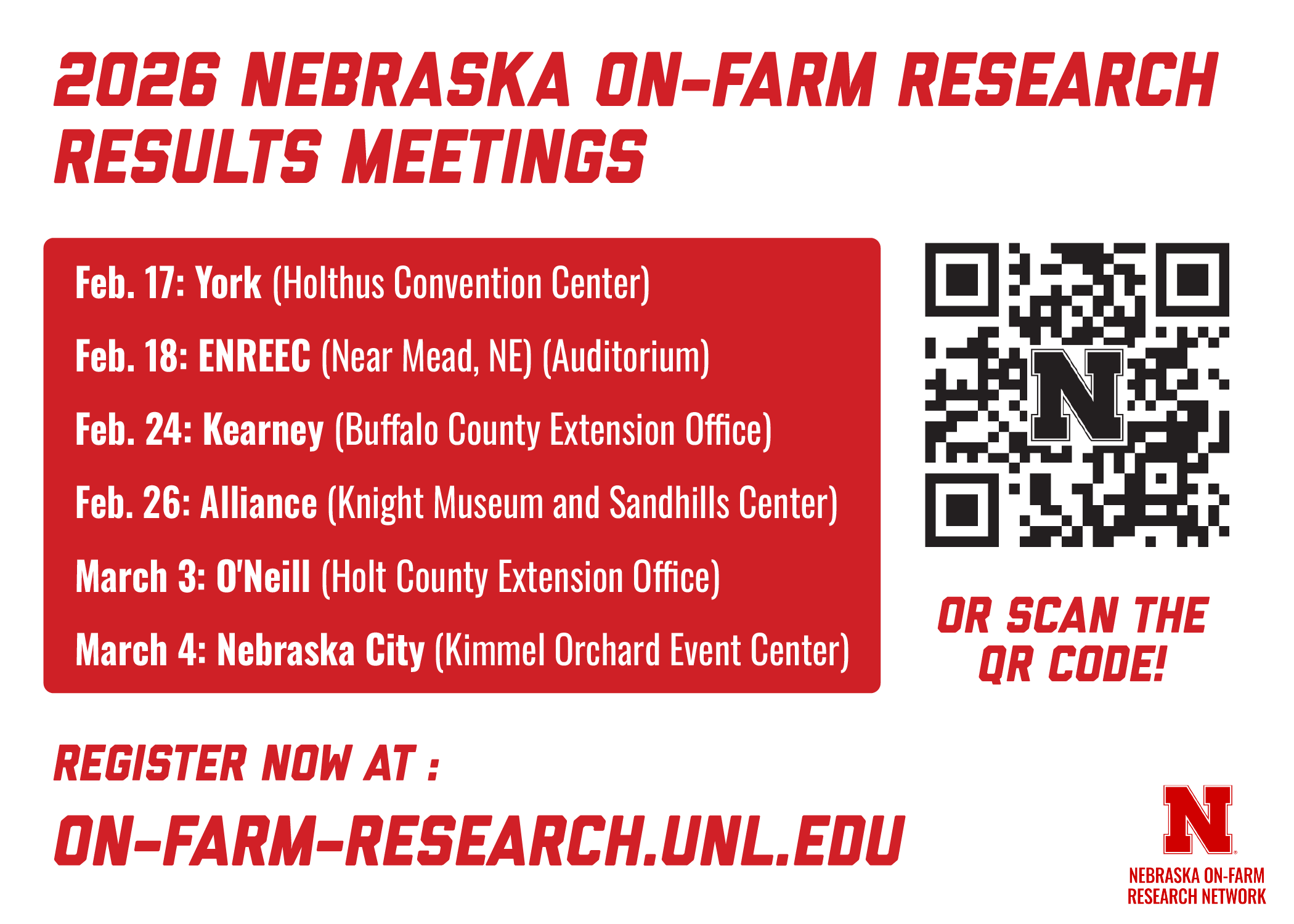
On-Farm Research Updates: There’s several on-farm research updates upcoming with the first being this Tuesday, Feb. 17th at the Holthus Convention Center followed by Feb. 18th at ENREEC near Mead. Program starts at 9 a.m. with registration at 8:30 a.m. If you’re looking to hear what other growers are trying on their farms and their results, it’s a great opportunity. More info.: https://on-farm-research.unl.edu/.
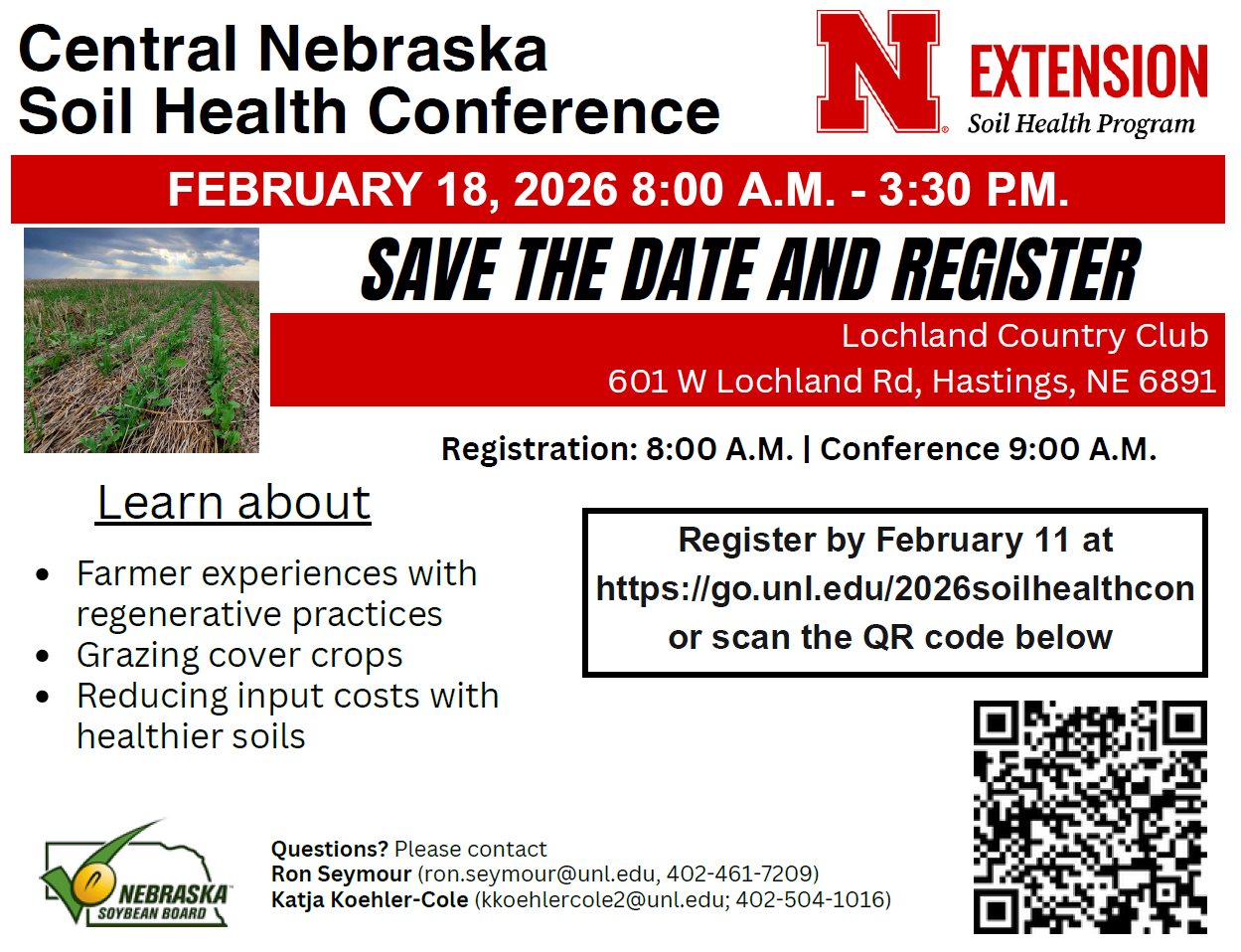
Central Nebraska Soil Health Conference will be held Feb. 18th in Hastings at the Lochland Country Club with program beginning at 9 a.m. and registration at 8 a.m. At that meeting, you will hear from some of our producers utilizing cover crops for grazing with the economics and how they are also reducing inputs in the corn the following year after that cover crop grazing year. You will also hear from growers who are reducing inputs in soybeans using soil health practices. The keynote speaker will share on biochar. More info. and RSVP: https://go.unl.edu/2026soilhealthcon.
York Co. Corn Grower Tour will be held Wed., Feb. 25. We’ll meet at the York Co. Extension Office at 9:40 a.m. First stop will be Timpte Manufacturing in David City. Lunch will be at La Carreta in Seward followed by tours at Hughes Brothers Inc. and Bottle Rocket Brewing Co., both in Seward. Please RSVP to the Extension Office at 402-362-5508 if you’re interested in attending.


JenREES 2-21-21

On-Farm Research Updates: This week brings my favorite winter meetings, the on-farm research updates on Feb. 25 and 26! I’m passionate about on-farm research as it’s such a practical, inexpensive way to address the research questions growers have! These meetings are more meaningful to me because we get to hear from the farmers themselves who conducted the studies and have more discussion around the topics. They do look different this year with a huge number of people registered virtually vs. in-person. They’re also only a half day and we won’t cover the entire book of studies that were conducted. However, whether you participate virtually or in-person, you will hopefully hear from farmers who conducted on-farm research studies. And, this ‘in-person’ meeting does have people at most local sites also presenting in person. I realize that’s been a point of confusion/frustration as we’ve hosted many zoom meetings as ‘in-person’ watch events where no one presented live at the location. Register for virtual or in-person at: https://go.unl.edu/h83j.
I enjoy hearing from the farmers themselves regarding why they conduct on-farm research. The following YouTube video produced in 2020 highlights area farmers David and Doug Cast of Beaver Crossing and Ken Herz of Lawrence: https://youtu.be/tEy-I43CT0E.
Succession/Estate Planning opportunities are upcoming with a two-part webinar event held Feb. 25 and Mar. 4 at Noon. You can register for those at: https://farm.unl.edu/webinars . There’s also an in-person event at Central City at the Fairgrounds on March 2 at 9:30 a.m. and please RSVP to 308-946-3843 if you’d like to attend.
Tree and Houseplant Webinars: A webinar focused on trees will be Feb. 26 from 9 a.m.-Noon with registration here: Go.unl.edu/ProHort. A houseplant webinar series will occur on Feb. 27 and Mar. 6 from 10-noon with registration here: https://go.unl.edu/houseplants101.
Nitrogen Studies: With spring nitrogen applications around the corner, perhaps you are interested in testing different rates, timing, or inhibitors on your farm? On-farm research is a great option to consider! For some specific precision nitrogen studies (including inhibitors), there are stipends of $1300 available to producers interested in those studies. More info: https://cropwatch.unl.edu/precision-nitrogen-management-farm-research-project. There’s also a partnership with the Upper Big Blue NRD where those interested in conducting nutrient management or cover crop studies may receive $300 in reimbursement costs. If you’re interested in a study like this, please let me know. Next week I’ll share on nitrogen rate and timing results.
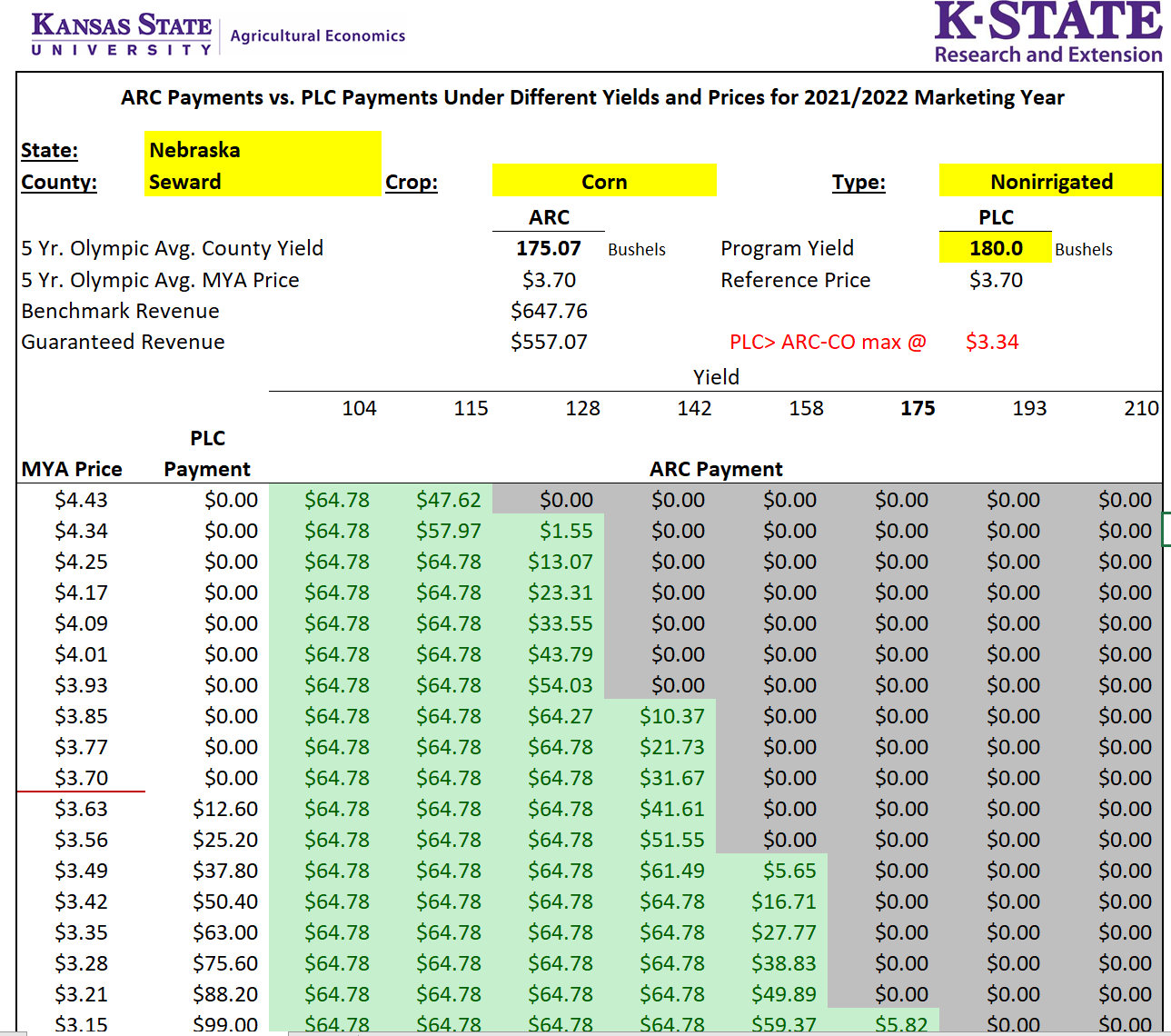
Farm Bill: Another tool that may be more visual in helping you make these decisions is the K-State tool at: https://www.agmanager.info/ag-policy/2018-farm-bill/tradeoff-between-20212022-arc-and-plc and I added it to my Farm Bill Decision Tools blog post. It shows you in one chart what happens with potential ARC-CO or PLC triggers by crop depending on what market year average price does or what county yield does. It doesn’t allow you to put in a historical irrigated percentage (HIP), so you need to consider that when selecting ‘irrigated’ or ‘nonirrigated’ in the tool. With it being in one chart, visually, perhaps that would help some of you more? It honestly doesn’t change what I’ve shared with you before, but it seems people are really struggling with this decision, so if you need another way to visualize what to do, it may help. Ultimately, no matter what tool is used, PLC is favored most often in corn, milo, and wheat. Soybeans often could go either way, and likely there may be no payment for soy or corn unless something substantial happens with MYA price or county yields. If you’re really on the fence, it may be helpful/wise to just split decisions between the two programs for different farms? For counties where there’s split irrigated/non-irrigated payments, particularly in areas that are drought-prone, look at what county average yield will trigger ARC-CO for your specific county using the tool. Crop insurance and marketing are ultimately a huge chunk of risk management too. Ultimately, the decision is up to you and no one can predict prices/yields. This information is just shared as a way to hopefully help with your decision making.
I still haven’t heard/seen that 2020 county average yields have been released for me to help anyone with looking at ARC-IC. From the past, we needed around 20% farm level yield loss compared to county average yield for ARC-IC to trigger. So, for those with significant yield loss from wind events, depending on how your farms are grouped, it still may be something to look at. Hopefully county average yields will be available soon.


JenREES 1-10-21
It was great to have in-person meetings last week! Even though the set up and planning was more taxing, I’m grateful we were able to have them. Also, wanted to thank those who responded to the Extension survey for me; your feedback is greatly appreciated!
In-person Extension meetings are ‘a go’ for this coming week for this part of the State. For Crop Production Clinics, groups are allowed to watch together at Coops or businesses if you prefer. You will still need to register individually. Your ‘ticket’ for recertification is to individually complete the program evaluation and provide the codes provided during sessions throughout the day. Please also know any of the area Extension offices will work with you regarding picking up weed guides regardless of where you said you’d pick them up. Thank you for your patience as we navigate all this together!
Farm Bill: Received a number of calls this week regarding 2021 election sign-up. Honestly, I haven’t had the opportunity to run numbers in the tools yet. Will provide more info. in a future column.
On-Farm Research: This past week, we also peer reviewed all the on-farm research studies conducted in 2020. There were 20 studies where farmers worked with me in this part of the State and I’m grateful to all of them for their efforts! My hope is to share research results in the coming weeks as reports are finalized. Our on-farm research updates will occur on Feb. 25 and 26 and I’m really pumped about the format! The meetings will be morning only, hosted by the local Extension educator, providing more discussion of studies shared by the farmers, and allow planning for the upcoming year. Those attending virtually will discuss as their own group. Please pre-register early to ensure a spot. Registration at: https://cropwatch.unl.edu/nebraska-farm-research-network-results-update-meetings-2021.
De-Icing Agents are sometimes needed for safety but can be harmful to plants. You may wish to check what you’re using at home. Common deicing compounds are listed below. These may be used alone or blended together to improve performance or reduce damage to concrete or landscapes. Also, keep products on hand that improve footing on slick surfaces, like sand, sawdust, or cat litter. They can be used instead of traditional deicing products, or blended with them to improve traction and limit deicer use.
- Sodium chloride, urea, and potassium chloride have high potential of damaging landscape plants.
- Calcium chloride is the most effective deicing product at low temperatures, working down to -25°F. It will not damage vegetation if used as directed.
- Magnesium chloride is sprayed on roadways before a snowstorm to prevent ice bonds from forming, making ice and snow removal easier. It causes very little damage to concrete or metal. It’s also gentle on landscape plants and pet safe if used as directed.
- Acetates can be found in three forms – calcium magnesium acetate (CMA), sodium acetate and potassium acetate. CMA is a salt-free product and is the safest product for use around pets and landscape plants. CMA is made from dolomitic limestone and acetic acid (the principal component of vinegar). Studies have shown the material has little impact on plants. It also has a very low level of damage to concrete or metal.
- Beet juice deicers, a newer organic option, are products derived from beet juice. They contain only 12% sodium chloride (salt), much less than traditional sodium chloride. Beet juice products are fully biodegradable, but shouldn’t be applied where melt runoff will move to aquatic areas.


 JenResources