Blog Archives
JenREES 9/17/23
It was great getting to see and catch up with several people at Husker Harvest Days last week! The main update I have is that tar spot is being found more in this area of the State. Grateful it has only ever occurred at the end of the season for us. Next week I’ll share on an invasive grass that cattle won’t eat being found in some area warm-season pastures.
Harvest Safety: With harvest, it’s up to all of us to be safe and watchful on the roads. It’s so dry and hard to see on gravel roads when there’s traffic. Please be safe, slow down at intersections and railroad crossings, lights on, and be watchful/slow down as you come up on slow moving vehicles. For our farm families, we know things happen so quickly so please think safety with machinery, watch for people and objects around you, watch for power lines, and take your time on machinery and bin steps. Brandy VanDeWalle, Extension Educator, shares additional info. on her blog: https://vandewalleviews.com/2023/09/15/harvest-safety-11/. Here’s wishing everyone safety this harvest season!
Pricing corn silage: This was written by Shannon Sand, UNL ag economist, “According to UNL research, corn silage priced standing in the field before harvest would be valued at 7.65 times the price per bushel of corn, where a ton of corn silage is harvested at 60-65% moisture. For example, corn near $5.00/ bushel at harvest puts corn at $38.25 per ton. This accounts for not having to combine or haul grain to market but should also be harvest corn prices as we add storage costs to silage. According to the 2022 Nebraska farm custom rates publication, the average for harvest, hauling and packing of corn silage was $13.50 per ton. At $38.25 per ton plus $13.50 per ton for custom work, this gives us $51.75 per ton in the pile. When $3.00 per ton is added for storage, the price is now $54.75.” Additional information can be found in the following NebGuide: https://go.unl.edu/mik9.
Planting Trees: Fall is tree planting time and sometimes tree problems I diagnose are the result of incorrect planting. Kelly Feehan, Extension horticulture educator shares, “It is very important not to plant trees too deep. If a tree is planted the same depth it is in the container; or, the soil beneath the root ball is loosened when digging; then the tree is likely planted too deep. When I diagnose tree problems, I look at the trunk near the soil line. If it looks like a telephone pole going into the ground and there is no trunk taper at the base, I know the tree was planted too deep and that may be the cause of decline. Planting trees too deep leads to slower growth, decline and girdled roots that can cause tree failure. To plant a tree at the correct depth, never dig the hole until you find the first lateral root growing off of the trunk. Soil may need to be scraped away to locate this root. Once found, dig a hole that is a depth where the first root will remain just below or at the soil line. Do not disturb the soil under the root ball; but dig the hole one to two feet wider than the root ball.”
Lawn Weed Control: Those without irrigation systems struggled with thin lawns and both annual and perennial weeds this year. Perennials weeds have included dandelions, ground ivy, and bindweed. Annual weeds have included crabgrass, prostrate spurge, and purslane. So what can you do for the future? Late September through mid-October is the best time to control perennial broadleaf weeds with herbicides labeled for their control in grass. During the fall, the weeds will take the chemical into the root system increasing the opportunity for their death. Annual weeds will die with a hard frost. You can hand-pull or power-rake if you’re still working on reseeding lawns, but seed most likely has been produced. In May next year, you can apply a pre-emergence herbicide to prevent the weed seeds from emerging. Because we often get another flush of weed seeds germinating, if you had a lot of weed pressure this year and have a thin lawn, you can consider making a second pre-emergence application 8-10 weeks later. Thicker lawns help reduce weed seed germination if you can get a thicker lawn established as well.


I realized for all those who subscribe to my blog but don’t receive my email that I haven’t been posting the irrigation needs each week like I have on my email. So, adding that again as a reference for everyone finishing up.
October Landscape Projects
In the landscape, October is the month to water, control weeds, and plant bulbs, trees and shrubs. It is also the month to wait until after a freeze to cut back perennial plants and wait for the soil to freeze before covering tender plants with winter mulch. Kelly Feehan, UNL Extension Educator, provides the following information.
Water
Sometimes people ask if trees and shrubs should be watered at this time of year since their leaves will soon drop off; and how late in the season lawns should be watered. As long as the soil is dry, go ahead and water. Plant roots continue to grow long after leaves drop off trees and shrubs and after grass stops growing. Roots, rhizomes and stolons can grow well into November and fall watering promotes this growth helping plants recover from summer stresses. Plant energy can be used for root growth during fall since energy is no longer needed for leaves, flowering or seed production. Roots continue to grow until soil temperatures drop below 40 degrees Fahrenheit with available moisture.
Water enough to moisten the soil to a depth of about eight to twelve inches for trees and shrubs and six inches for lawns. Keep in mind that a lack of oxygen due to a saturated soil is just as damaging to roots as a lack of water. Allow the soil to dry between watering.
Planting
Because roots continue to grow well into fall, September through October is a good time to plant deciduous trees and shrubs. For spring flowering 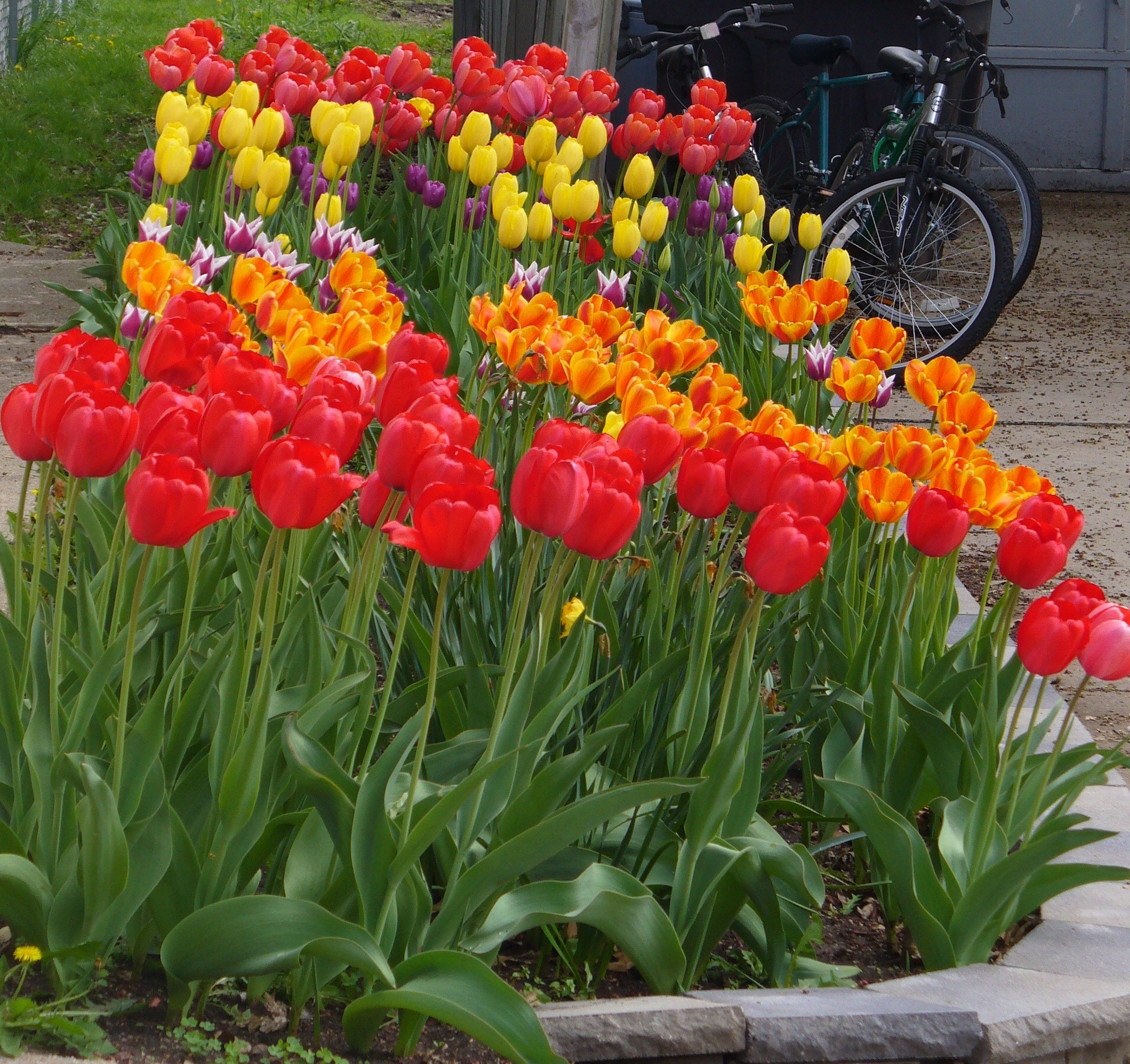 bulbs, wait until soil temperatures drop to 60 degrees Fahrenheit to plant.
A common question asked about fall planting is if a starter fertilizer needs to be used at planting time. Starter fertilizers are high in phosphorous, a nutrient important to root production. The only way to know the answer to this question is to have a soil test taken. However, most landscape soils are high in phosphorous (P). Fall soils are often warm and dry which makes P more readily available. In most cases a starter fertilizer does not need to be used during fall planting.
More important is to plant at the correct depth. With bulbs, follow label directions for planting depth. It varies depending on bulb size. Some recommendations say to plant about one to two inches deeper than recommended. The opposite is true for trees and shrubs. Before planting trees, locate where the trunk flares out at the trunk base then plant at a depth so the flare is visible above ground. Do not loosen the soil beneath the root ball or the tree may settle and end up planted too deep. In heavier clay soils plant so the trunk taper is one to two inches above the ground.
Weed Control
October is the best time to control perennial broadleaf weeds like dandelions, ground ivy and clover. There is no ideal time during fall to apply lawn weed and feed products together. The best time to fall fertilize lawns is in early September and again in late October or early November. The best time to apply herbicides for lawn weeds is about mid-October before a hard freeze.
Weed control can be more effective and less herbicide will be applied where it is not needed by avoiding the use of combined weed and feed products during fall. One can achieve better weed coverage and control of established broadleaf weeds if the weeds are spot treated, typically with a liquid formulation of herbicide.
Here’s wishing you a great October of accomplishing landscaping projects!


 JenResources