Blog Archives
Pruning Fruit and Shade Trees
Pruning Fruit and Shade Trees: Sarah Browning, Extension Horticulture Educator, shared great information at the spring gardening program last Saturday! February-March is a good time to prune most trees. It’s best to not remove more than 12-15% of a tree at one time, no more than 20% if it’s pruned heavier.
She shared a study where they found that wood rot enters trees more through improper pruning cuts vs. other damage to the tree. I have a diagram sharing how to properly prune using the 3-cut method at jenreesources.com. Sarah shared the following below in an article she wrote:
“Many gardeners have questions at this time of year about spring pruning…it’s important to understand woody plant leaf and flower buds were formed last fall. They are already present on branch twigs, so you should be able to find dormant buds when doing a close examination of your plant now. The presence of buds now is normal and does not mean plants are actively growing yet. Does pruning cause early leaf and flower bud development? No, pruning actually has a slight delaying effect on bud growth.
After pruning, a plant has to adjust and begin sending growth hormones to new buds, since the preferred buds at the tips of branches removed are now gone. This process could take about 10 days, so bud development is slowed down a little. Note: it’s risky for growers to use pruning to slow down and “protect” flower buds.
Best time to prune fruit trees: Less winter-hardy fruit trees like peach, apricot, and sweet cherry, should always be pruned late, usually mid-March to early April, no matter how much warm mid-winter weather we experience. Pruning is done just before new growth starts. This is also the best practice for the more cold-hardy fruits, like pear, apple, plum, and tart cherry, as well as shade trees. Pruning at this time has two big benefits. First, there is less chance of cold damage at the pruning sites. Second, plants heal pruning wounds much faster if the cuts are made just before new growth begins.
There’s still plenty of time for cold late winter temperatures and freezes, which will slow bud development down. Early pruning leaves plants susceptible to cold temperature injury at the pruning sites.
Best time to prune shade trees: For homeowners who can choose the ideal time to prune, shade trees should also be pruned just before growth begins in spring. If you need to hire an arborist to prune a large tree, anytime before early May would be a great time to do it. When seeking a tree company, ask if they have someone on staff that is certified with the Nebraska Arborist Association or International Society of Arborists. It’s best if the company is not only a member of one of these associations but also has a certified arborist on staff.
Additional resources with diagrams on which limbs to prune can be found at: Pruning Fruit Trees (https://go.unl.edu/z75s) and https://byf.unl.edu/pruning-trees-shrubs/.
Seward County Ag Banquet will be held Monday, March 24, 2025 at the Fairgrounds in Seward. Tickets for the prime rib dinner are $35 and can be purchased by contacting Nick Bauer (402-429-6119) or Shelly Hansen (402-643-3636). Come out and enjoy an evening celebrating agriculture and the Kiwanis Farm Family, SDDP Agribusiness, and youth scholarship award winners!

ridge and angles down and slightly away from the stem, avoiding injury to the branch collar. Do not make flush cuts that remove the branch collar.”


JenREES 2/25/24
Spring Fertilizer: It’s hard to believe March begins this week! With the approaching of March 1st and the nice weather, some may be thinking about fertilizer applications. Three quick reminders:
1-Soil temperatures can be viewed at: https://cropwatch.unl.edu/soiltemperature. Soil temperatures below 50F allow for a slower conversion of ammonium to nitrate by soil microorganisms.
2-There was a high amount of mineralization that occurred last growing season due to the warm soil temperatures. Higher soil residual nitrate was common in soil samples in the area; thus, you can believe the fact that there’s a higher amount of soil residual nitrate and adjust fertilizer recommendations accordingly. If you’re unsure or if the soil samples didn’t pull well due to the dry fall conditions, soil samples can be pulled again this spring to gain confidence in recommendations.
3-Reminder of my nitrogen challenge! The higher residual nitrate provides a great opportunity in putting down a lower base rate and use a tool like sensor based fertigation via Sentinel Fertigation to apply only what the plant says it needs throughout the growing season. You could also consider an on-farm research study using a few different rates. Please let me know if you’re interested in these options.
Pruning Tips: With the coming of March also comes questions regarding pruning. My horticultural colleague, Elizabeth Killinger, shares some tips with some updated research on pruning timing for different plants. Full article: https://huskerhort.com/2024/02/25/a-pruning-primer/#more-1466.
“The first step to pruning is surveying the plant. This will ensure whether or not pruning is needed. Look for and remove any dead, diseased, damaged, rubbing, or crossing branches first. Remove suckers, little saplings at the base of the tree, and water sprouts, small vertical stems on the main branches. Also look at the plant in terms of safety. Be sure the plant is not blocking vehicle sight lines or covering sidewalks. Remove any low hanging branches that are hanging over a sidewalk.
Pruning Tools: In order to make cuts that heal correctly on plants, the proper tools are needed. When pruning small branches, those that are 1” in diameter or smaller, hand pruners are recommended. If you have to twist the pruners or take multiple ‘bites’ at the branch, a different tool is needed. For branches that have a diameter greater than 1”, loppers are recommended. Pruning saws are extremely sharp and work well to get into the tight places that the pruners and loppers don’t fit. They can also cut branches that are larger than 1.5” in diameter. The last tool of the trade is the hedge shears. They are used for shearing hedges or shaping plants and shouldn’t be used as substitutes for other pruning equipment.
Deciduous shade trees, It was previously recommended the best time to prune most shade trees was during winter dormancy. New research shows the optimum time to prune living branches is late spring and early summer because pruning at this time promotes the quickest sealing of pruning wounds, known as CODIT or Compartmentalization of Decay in Trees. Late spring and early summer is when tree cells are most active during the growing season, hence sealing occurs the quickest.
Evergreen Trees keep their leaves throughout the winter. Pine trees rarely need to be pruned, if you choose to do so it is best done June into July, or when the new growth is between half and fully grown. If pine trees are pruned too early, the tree could be deformed and pruning too late could cause the tree to be stunted. Be sure to prune only the current years’ growth. If the trees are pruned too far back onto older growth, new growth will be delayed a year. Spruce and fir are two evergreen trees that rarely need pruning. If pruning is needed, they can be pruned between November and April.
Evergreen Shrubs, like arborvitae, Japanese yew, and juniper, are best pruned in late winter between November and April. The cuts will heal quickly and will be covered by new growth.
Deciduous Shrub pruning depends on blooming time. If the shrub blooms in the spring, before June 15th, wait to prune until after it flowers. Lilac, forsythia, and dogwoods are considered spring bloomers. If the shrub is a summer bloomer, like a potentilla, flowering quince, or privet, then late winter to early spring is the best time to prune.”



Proper Tree Pruning
Special thanks to Dr. Scott Dewald for the wonderful evening of information he provided at our tree care workshop last week!

Scott Dewald explaining what to look for when considering pruning a tree. Scott shared that one should never prune more than 1/3 the height of a tree in one season. Pruning should also be done to obtain a main leader and overall structure. It’s also best not to prune limbs more than 2″ in diameter. If the limb needs to be pruned but it encompasses more than 1/3 of the limit of what should be removed in a season, one could “head” the limb by removing a portion of it one year and then complete the cut the following year. This will slow the growth of that limb.
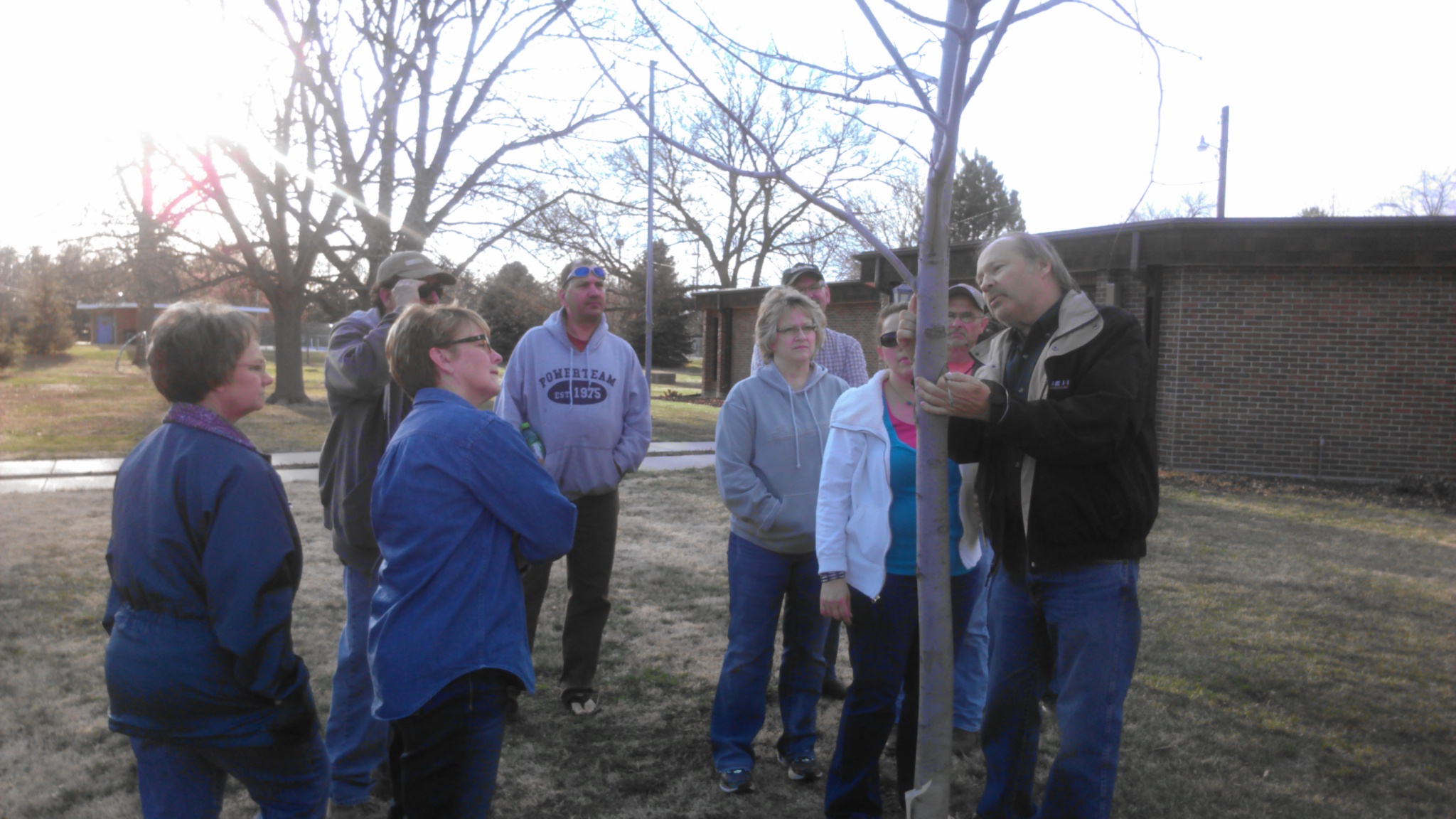
Pruning cuts should always be made at the “bark collar ridge” which produces a round cut and allows the tree to naturally heal. Scott shows attendees where the bark collar ridge is on this branch.
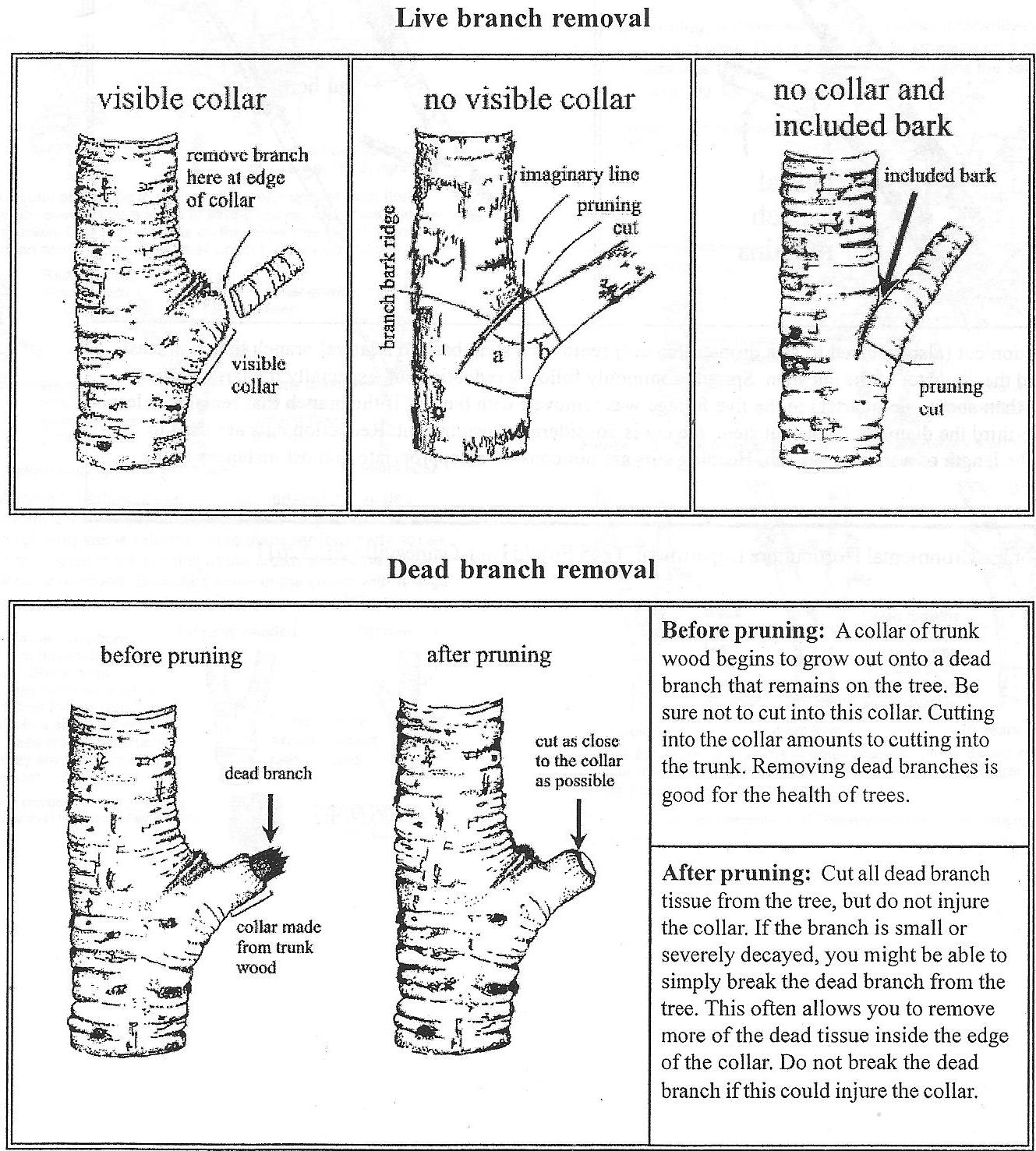
Pruning Fact Sheet ENH847 from University of Florida Extension written by Edward Gilman with good visuals of where proper pruning cuts should occur.
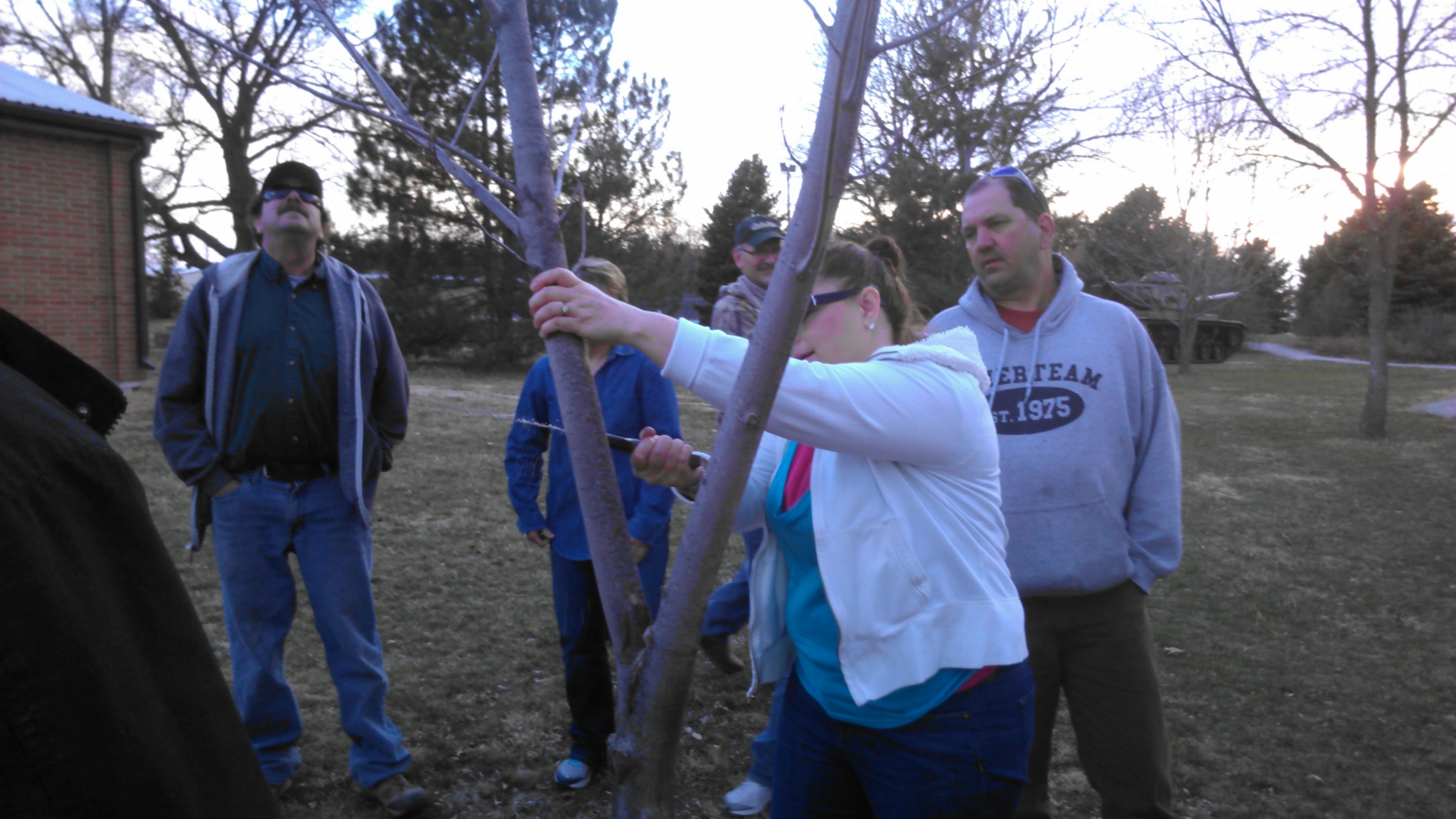
We learned that on large branches, it’s good to make a cut farther out to remove the weight first, and then go back and make the proper cut at the bark collar ridge. Improper pruning can result in further damage to the tree. Here we were trying to correct this tree for not having a main leader. Typically one would leave the southern-most branch according to Scott, but in this case, the northern-most branch was stronger. Scott said there was no need to stake the tree or try to get the northern-most branch to straighten out as it would naturally do this in time on its own.

After a large part of the branch weight has been removed, this attendee is now making the proper cut at the bark collar ridge.
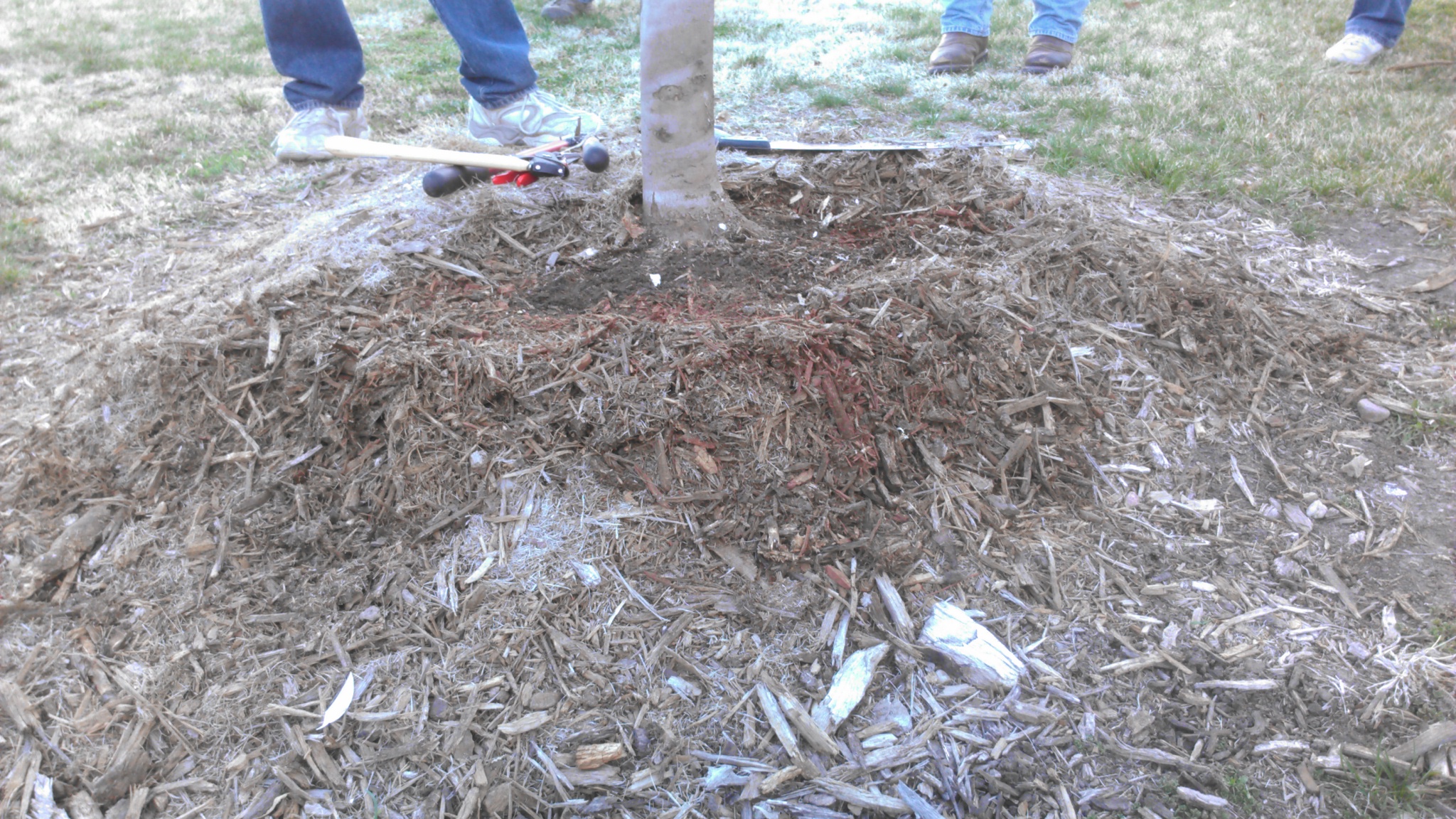
We also walked from tree to tree in the park looking at additional problems. I noticed how high the mulch was piled on some of the trees. Mulch should never be placed against the base of the tree as it can cause rot. But in this case, it was observed that the person who planted the tree did not dig a deep enough hole. What appeared to be a pile of mulch was the actual root ball and soil mounded up above ground.

This situation also most likely was a result of improper planting. In this case, the tree roots began wrapping around the base of the tree girdling it (like choking it).

This is the most common problem I see with tree calls. A huge enemy to trees are weed whackers! In this case, you can see extensive damage to the bark and the base of this tree. Depending on the damage and how well the tree can seal the wound will depend on if the tree will survive or not. Often, as in the case of this tree, the tree will be weakened with few leaves appearing on branches. It’s best to place mulch around trees in order to avoid having to use weed whackers on them-but again, don’t place the mulch up against the base of the tree!
This was a fun workshop for me with the right size of group and great hands-on demonstration where we also learned from pruning mistakes and how best to correct them. Thanks again Scott!
Tree Care Workshop

The Memorial Day and August 1st storms of 2013 did significant damage to our trees in Clay County. This workshop is designed to provide demonstrations on pruning techniques, what to look for, and learning how care for your storm damaged trees in future years. There is no charge and all are invited to attend. Please spread the word as many trees were damaged last year!


 JenResources