Blog Archives
Pruning Fruit and Shade Trees
Pruning Fruit and Shade Trees: Sarah Browning, Extension Horticulture Educator, shared great information at the spring gardening program last Saturday! February-March is a good time to prune most trees. It’s best to not remove more than 12-15% of a tree at one time, no more than 20% if it’s pruned heavier.
She shared a study where they found that wood rot enters trees more through improper pruning cuts vs. other damage to the tree. I have a diagram sharing how to properly prune using the 3-cut method at jenreesources.com. Sarah shared the following below in an article she wrote:
“Many gardeners have questions at this time of year about spring pruning…it’s important to understand woody plant leaf and flower buds were formed last fall. They are already present on branch twigs, so you should be able to find dormant buds when doing a close examination of your plant now. The presence of buds now is normal and does not mean plants are actively growing yet. Does pruning cause early leaf and flower bud development? No, pruning actually has a slight delaying effect on bud growth.
After pruning, a plant has to adjust and begin sending growth hormones to new buds, since the preferred buds at the tips of branches removed are now gone. This process could take about 10 days, so bud development is slowed down a little. Note: it’s risky for growers to use pruning to slow down and “protect” flower buds.
Best time to prune fruit trees: Less winter-hardy fruit trees like peach, apricot, and sweet cherry, should always be pruned late, usually mid-March to early April, no matter how much warm mid-winter weather we experience. Pruning is done just before new growth starts. This is also the best practice for the more cold-hardy fruits, like pear, apple, plum, and tart cherry, as well as shade trees. Pruning at this time has two big benefits. First, there is less chance of cold damage at the pruning sites. Second, plants heal pruning wounds much faster if the cuts are made just before new growth begins.
There’s still plenty of time for cold late winter temperatures and freezes, which will slow bud development down. Early pruning leaves plants susceptible to cold temperature injury at the pruning sites.
Best time to prune shade trees: For homeowners who can choose the ideal time to prune, shade trees should also be pruned just before growth begins in spring. If you need to hire an arborist to prune a large tree, anytime before early May would be a great time to do it. When seeking a tree company, ask if they have someone on staff that is certified with the Nebraska Arborist Association or International Society of Arborists. It’s best if the company is not only a member of one of these associations but also has a certified arborist on staff.
Additional resources with diagrams on which limbs to prune can be found at: Pruning Fruit Trees (https://go.unl.edu/z75s) and https://byf.unl.edu/pruning-trees-shrubs/.
Seward County Ag Banquet will be held Monday, March 24, 2025 at the Fairgrounds in Seward. Tickets for the prime rib dinner are $35 and can be purchased by contacting Nick Bauer (402-429-6119) or Shelly Hansen (402-643-3636). Come out and enjoy an evening celebrating agriculture and the Kiwanis Farm Family, SDDP Agribusiness, and youth scholarship award winners!

ridge and angles down and slightly away from the stem, avoiding injury to the branch collar. Do not make flush cuts that remove the branch collar.”


JenREES 8/15/21
Crop Update: It was great to see people at soybean management field days last week and to hear their experiences around cover crops and weed management! White mold in soybean was the primary question received last week. It was already heavy in some Butler and Polk county fields and has since increased in York county with calls over the weekend. I don’t get too concerned about managing different insects/pathogens/weeds as we have various management strategies for them. White mold, though, is a very difficult one to manage.
It’s a soil-borne disease in which the fungus survives in a black structure (sclerotia) that resembles mouse droppings. Rain events and irrigation during flowering can favor it along with extended dew periods and fog like we’ve experienced this year. If you see random plants in an area that are turning brown but remaining upright, look into the canopy and see if there’s white cottony fungal growth on the stem. You may also see the black sclerotia on either the outside or inside of the stems. It can continue to spread from plant to plant. Management right now includes managing soil moisture and irrigation. It’s important to keep the top portion of the soil as dry as possible (which I realize is practically impossible with heavy dews). When it comes to irrigation management, infrequent, heavy watering is better than light, frequent watering in heavy-textured soils. It’s a good idea to keep notes on areas of the field you’re seeing it this year so you’re aware of it the next time soybeans are planted.
Some cultural and crop rotation things going forward that may or may not fit for your operation, yet good to be aware of: No-till allows the sclerotia to die more quickly on the soil surface (within 2-3 years), whereas tillage allows sclerotia that are buried to survive longer. Also, as we think of cover crops and crop rotations, fields with a history of white mold should avoid rotations for 2-3 years with edible beans, field peas or other pulses, canola, turnips, radishes, sunflowers, or potatoes. Grass crops (corn and sorghum) and using small grains like wheat, rye, oats, etc. in rotation can help reduce the amount of sclerotia that survive. For more detailed information, check out: https://soybeanresearchinfo.com/soybean-disease/white-mold/.
Watch insects in soybeans regarding clipping pods; not seeing too much of that yet. Am seeing bean leaf beetles and grasshoppers in several counties. Saw woolly bear and green cloverworms in Nuckolls co. last week. I have no idea why Japanese beetles are still around for all who keep asking!
Have been seeing sudden death syndrome (SDS) for several weeks now. For those seeing it in fields where beans were treated with ILeVO or Saltro, the symptoms can still appear on beans treated with those products. In spite of this, from our on-farm research fields that had a history of SDS, the symptoms were less in the treated beans than the check treatment.
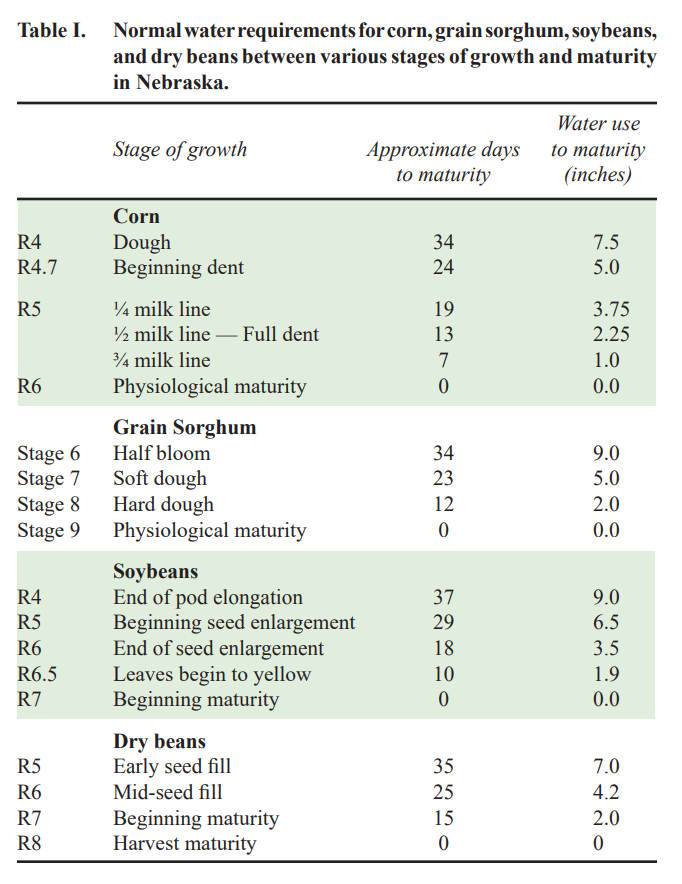
Mid-August brings a sigh of relief to many agronomists in getting closer to the end. I’m sure our farmers will be grateful to get to the end of irrigation season this year too. Many soybeans are at R5-R5.5 (can see seed development in pods on upper 4 nodes). At this point, flowering stops. Soybeans at R5 still need around 6.5” of moisture to finish. At R6 (full seed), that amount drops to 3.5”. We don’t talk about last irrigation yet for corn at milk stage. For fields at dough (R4), corn needs around 7.5” of moisture yet to finish and 5” at beginning dent.
Seward County Ag Banquet to be Held August 23: The Kiwanis Club of Seward partnered with SCCDP and Seward Co. Ag. Society will honor Seward County Ag Leaders on Monday, August 23, 2021 with our 53rd Annual Agriculture Recognition Banquet. The banquet begins with wine, cheese, and sausage at 5:30 p.m. and a prime rib meal at 6:30 p.m. Ag Promoter, Educator, and YouTube Sensation, Greg Peterson will be the evening’s entertainment. This event provides an excellent opportunity to recognize the importance of agriculture in Seward County. The evening will honor the Seward County farmers, producers, ag businesses and ag students for their continued economic contributions to our strong local agricultural economy. Due to COVID not allowing us to have a banquet in 2020, we will be honoring individuals and families selected in 2020 and 2021. Please contact Pam Moravec, Banquet Chair, 402-643-7748, or Shelly Hansen, 402- 643-3636 information about becoming a banquet sponsor. The cost to attend the banquet is $30.00 per person. You can contact Pam or Shelly to reserve you seat. The Kiwanis Club of Seward will use the proceeds from the event to support the youth of Seward County through a variety of programs and events, including the Agronomy Academy.


 JenResources