Blog Archives
August 2025 Events
Thank you to all who helped make the 2025 York County Fair a success! I didn’t get out to the fields this past week so sharing reminders on some upcoming field days.
Aug. 5 Grazing Cover Crops Field Day of area farmer Alex Daake will be held from 4-6 p.m. at 4136 Superior Rd. near Utica, NE. Alex split a pivot into 4 quarters where he rotates corn, soybeans, rye for seed, and grazed cover crops. The focus will be primarily on what he’s doing for grazing covers and the economics of this system where pasture is limited for cattle production. Alex also has an on-farm research nitrogen study on the corn portion of this pivot where he’s looking at reducing nitrogen inputs due to the grazed cover crops. He’s monitoring the nitrogen strips with Sentinel Fertigation. If you’re interested, you’re welcome to RSVP to jrees2@unl.edu. Walk-ins are also welcome and cookies/water will be provided by Nebraska On-Farm Research.
Aug. 7 South Central Ag Lab Field Day will be held 8:45 a.m.-3:10 p.m. (Registration at 8:30 a.m.) Attendees can tailor their schedule by selecting from various presentations and interactive demonstrations (Irrigation, Diseases, Insects, Weeds (including robotic weeders), Nutrients). There is no charge and CCA credits will be provided. Please RSVP at: go.unl.edu/scalfieldday.
Dan Snow is the keynote speaker and will discuss nitrate challenges in groundwater. This talk will cover findings from a study with the Upper Big Blue NRD and UNL focusing on nitrate and agrichemical levels in the vadose zone across 12 water quality management zones. Lunch talks also feature a farmer panel discussion, providing an opportunity for attendees to engage and interact at the local level.
The SCAL Research Farm is located at 851 Hwy. 6 near Harvard, NE. Directions: 13 miles east of Hastings on Hwy. 6 or 4.5 miles west of the intersection of Hwy. 14 and Hwy. 6 north of Clay Center. Field day GPS coordinates: 40.575256, -98.137824. More info please call (402)762-3536.
Soybean Management Field Days will be held Aug. 12-15. Topics will vary by location and the first three days are twilight tours from 6-8 p.m. There is no charge but registration is requested two days in advance at: https://enreec.unl.edu/soydays/.
- Tuesday, Aug. 12 – Ravenna, NE. Lonnie and Scott Bohn farm 6:00 p.m. to 8:00 p.m. (5:30 p.m. – Registration)
- Wednesday, Aug. 13 – Concord, NE. UNL Haskell Ag Lab 6:00 p.m. to 8:00 p.m. (5:30 p.m. – Registration)
- Thursday, August 14 – Weeping Water, NE, Rick Meyer farm 6:00 p.m. to 8:00 p.m. (5:30 p.m. – Registration)
- Friday, August 15 – Mead, NE, UNL Eastern Nebraska Research, Extension & Education Center – (10:00 a.m. – Registration)
Aug. 25 Regenerative Ag Field Day will feature area farmer Jordan Uldrich. The field day will be from 10 a.m.-Noon, ½ mile east of 1606 County Road J, Geneva, NE. Lunch will be provided following the field day. Jordan has interseeded cover crops into his corn to aid with soil health and weed management. He will also discuss the economics of alternative farming practices. For more information, please call Andrew at 402-590-7096.


JenREES 7/25/21
Last week I heard several mention close calls on gravel roads. Please, slow down/stop before crossing unmarked intersections, fully stop at marked ones, and please remind young people of this too.
Crop Update: Keep watching silk clipping on corn that’s pollinating; rootworm and Japanese beetles clipping silks to ½” long triggers treatment thresholds. Southern rust was found in Nemaha and Greeley Counties last week from two samples at low incidence and severity. You can view updates at: https://corn.ipmpipe.org/southerncornrust/. Consultants and farmers with suspect samples are welcome to get them to me as in the past, or send to the Plant and Pest Diagnostic clinic in Lincoln. I’ve only seen gray leaf spot on the lowest leaves of fields last week so far, so disease is currently very low.
South Central Ag Lab Field Day: Reminder of this field day near Clay Center this week on July 28th which will cover nutrient, insect, disease, and weed management topics in addition to irrigation, cover crops, and biomass ones. There was a press release from UNL that had the wrong date, so just want to make sure those in the area interested in attending are clear that this will be held on July 28th from 8:45 a.m.-4 p.m. (Registration at 8:30). More details and registration at: https://enrec.unl.edu/2021scalfieldday. Walk-ins are also welcome; we just ask for pre-registration to aid in meal planning purposes.
Workshops on ag land management, leasing, carbon credits: Nebraska Extension and the University of Nebraska-Lincoln’s Center for Agricultural Profitability will host a land management workshop. It will offer updated leasing information relevant to landlords and tenants, including the latest financial trends in Nebraska agriculture, updated land values and cash rental rates for the state, strategies for equitable leasing and farm succession considerations. The latest information on carbon credit contracts for ag producers and landlords will also be discussed. The presentations will be led by Jim Jansen, an extension educator and agricultural economist, and Allan Vyhnalek, an extension educator specializing in farm and ranch transition and succession. The meeting is free to attend with meal sponsored by People’s Company, but registration is required. Locations include:
- July 28, 10:30-1:30 p.m., Extension Office, Columbus, Reg. 402-563-4901.
- Aug. 2, 10:30-1:30 p.m., Fairgrounds, Auburn. Reg. 402-274-4755.
- Aug. 3, 10:30-1:30 p.m., College Park, Grand Island. Reg. 308-385-5088.
- Aug. 17, 10:30-1:30 p.m., Extension Office, Lincoln. Reg. 402-441-7180
- Aug. 18, 9-Noon, Extension Office, Wilbur, Reg. 402-821-2151
Leaf Drop in Trees: Still receiving questions on this. For leaves such as Linden and Birch trees that have a lacy appearance of feeding on them, this is due to Japanese beetles. We hopefully are on our last week of them. For crabapple, flowering pear, ash, maples whose leaves are turning yellow/brown and dropping, this is due to fungal diseases and we wouldn’t recommend you do anything for this either. Next week I’ll talk about iron chlorosis and treatments for trees.
Brown Leaves on Oak Trees: Browning on leaf margins of individual leaves is anthracnose, which is a common fungus of shade trees. We don’t recommend that you do anything for this.
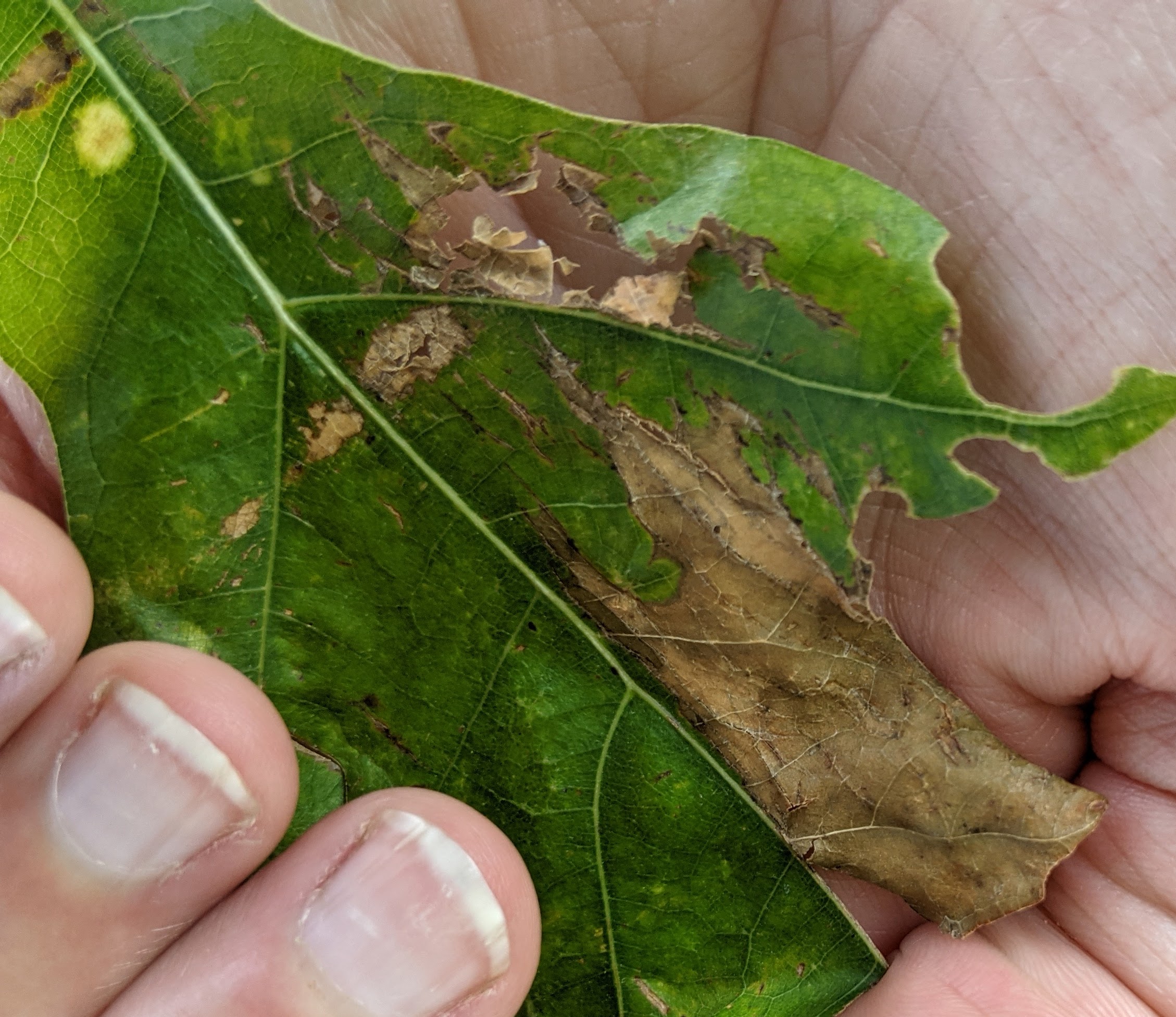
The past few years around fair time, we’ve seen oak trees (but sometimes others such as hackberry, honeylocust, elm, linden) that get a cluster of brown leaves towards the ends of branches. This damage is caused by twig girdlers or twig pruners, different types of beetles. Basically, the adult beetles chew a circle in the bark between where the old and new wood occurs on a twig. This girdles the twig, cutting off the water and nutrient supply causing its death. Eggs are then deposited and larvae hatch, tunnel, and survive in the dead twigs. Twigs girdled by any of these insects may stay attached to the main branch for several weeks or be broken out of the tree by wind. Tunneling in the twigs may not be evident in the fall if twigs fall out of the trees before the insect eggs have hatched. Mature trees with heavy infestations can look bad, but the damage isn’t a serious health problem to the tree and no chemical control is recommended. You can burn or discard infected twigs in the fall and spring that contain developing larvae to minimize the impacts for the future.


 JenResources