Blog Archives
Differentiating Soybean Problems
Crop Update: It was great catching up briefly with so many people at Husker Harvest Days last week! We didn’t get the traditional rain anytime during husker harvest days and soybeans and non-irrigated crops turned quickly. Please slow down and watch out for slow moving vehicles as harvest has started in the area. Here’s wishing everyone a safe harvest season!
For about 10 days I was getting called to fields and answering calls about sudden death syndrome in soybeans. The majority of the situations I was called out to actually wasn’t sudden death syndrome. So, I’d like to share what to look for in order to differentiate soybean diseases. Even though soybeans are turning now, it’s helpful to know what you’re truly dealing with as you think about soybean varieties in the future.
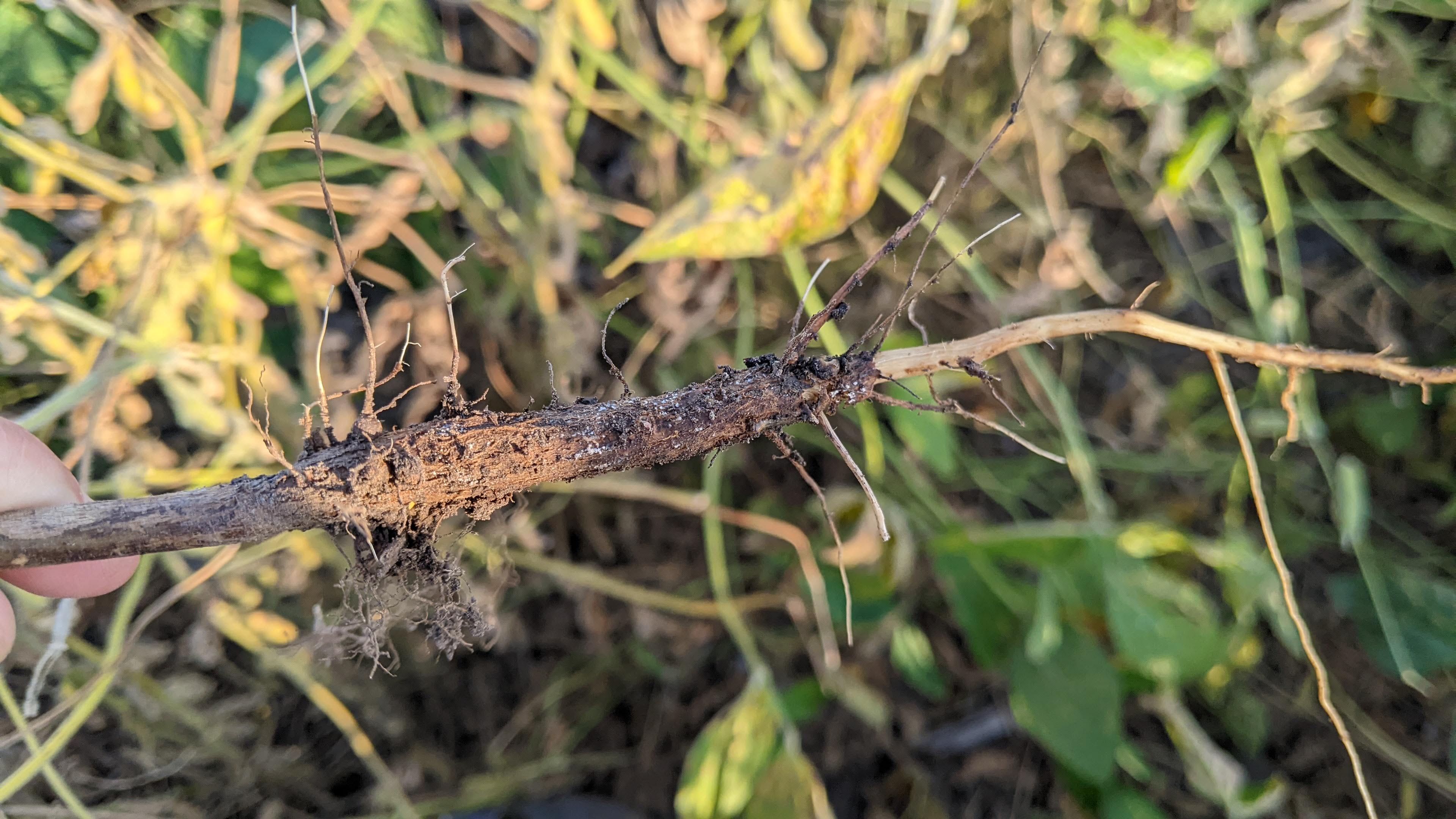
Sudden Death Syndrome (SDS) and Brown Stem Rot (BSR) are both soil-borne fungal diseases in which the fungus is in the root and/or stem but toxins from the fungus create yellowing/brown between leaf veins on the plants. For SDS, I can usually pull those plants very easily from the soil as there’s a clear rotted taproot associated with that disease. Sometimes, you will see gray/blue fungal growth on the rotted taproot as well.
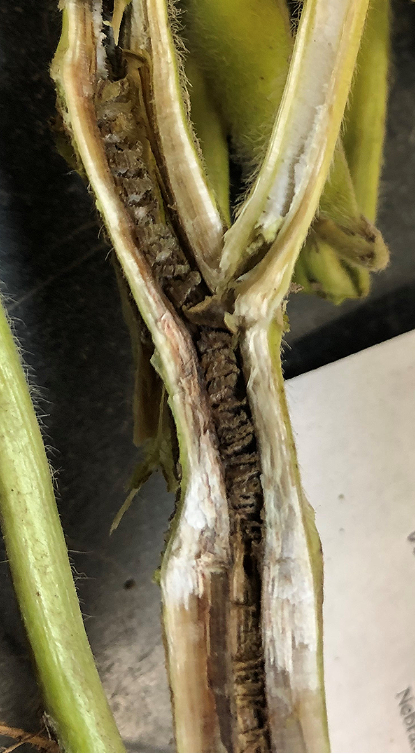
I also split the stem open, especially if the plant didn’t pull easily yet had the leaf symptoms. If the pith is brown in discoloration and is “stacked” like there’s layers of plates of tissue in it, the culprit is most likely brown stem rot. There are instances where you will have both a rotted taproot and a brown stem. In those cases, both SDS and BSR are present.
Brown pith tissue that is hollowed out and has sawdust in it is from dectes (soybean) stem borer. Dectes will not cause the leaf symptoms that SDS and BSR will. It will create a petiole with a trifoliate leaf that “flags”, meaning, it looks wilted and dying.
To be honest, the most common thing I’ve seen is the lack of a disease present. Most of the time, the taproot is in tact with a good root system, and often, there’s either whole fields or “lines” to where the symptoms are present. In those cases, I’ve suggested that this isn’t a disease issue but instead, Triazole fungicide phytotoxicity. These symptoms typically occur 2-3 weeks after a fungicide has been sprayed and either follow a spray pattern (including drift in some cases) or have field-wide distribution. Triazoles are in the Group 3 fungicide class and they move in the xylem (water-carrying vessels of the plant). Thus, their movement is dependent upon moisture. Plants that are drought-stressed lead to the fungicide product being in the tissue longer, allowing for greater injury. Other characteristics that impact the level of triazole phytotoxicity include the fungicide rate, adjuvants used, soybean genetics, and environmental conditions at the time of application. Usually leaves in the upper canopy are impacted as they were undergoing cell division (expanding) during the time of the fungicide application. For more info. please see: https://go.unl.edu/t4cg and https://cropprotectionnetwork.org/news/fungicide-phytotoxicity-on-soybean-triazole-injury-sparks-concern.
Why is this important to know? Because the next time you grow soybeans, it’d be helpful to know if you need to look for specific disease resistance in the variety selected or if one needs to consider a seed treatment for SDS. If the culprit ends up being triazole fungicide phytotoxicity, take note on the fungicide and adjuvants used and also the specific soybean variety as all those factors make a difference.
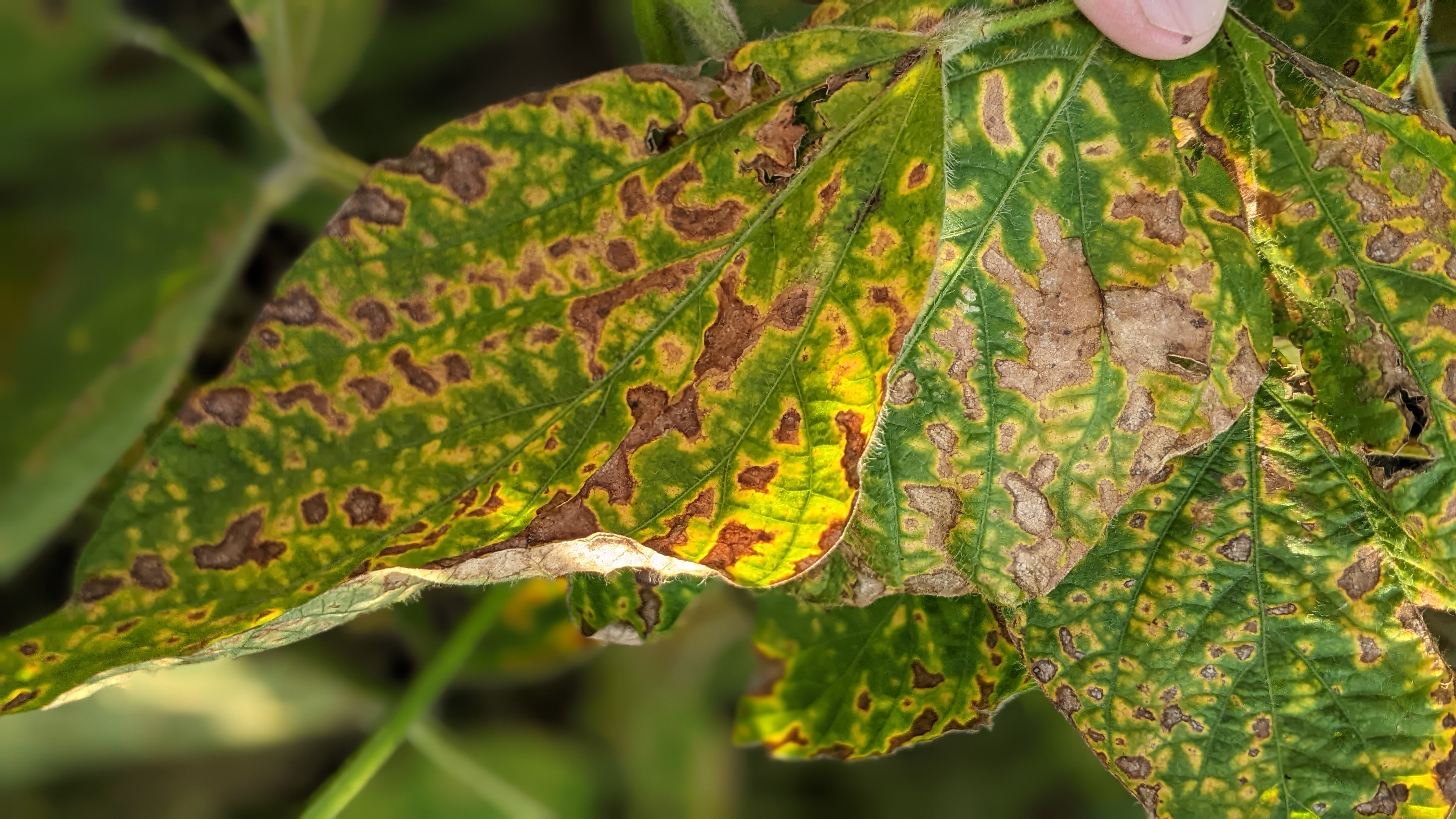
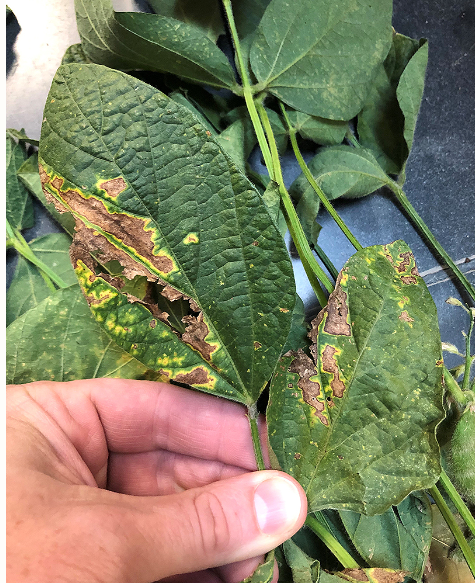
(Above photo captions): Yellow/brown chlorosis between the leaf veins in the left photo due to SDS (but very similar with BSR) (photo by Jenny Rees). Right photo shows yellow/brown chlorosis between the leaf veins due to triazole fungicide phytotoxicity which looks very similar to the leaf symptoms on SDS and BSR. (Photo via Kyle Broderick).


Photos Above: Dectes stem borer hollowed out the pith of this stem. Notice the hollowed out look and absence of “stacking” in the pith. One will also observe sawdust if dectes is present. Splitting the stem further the dectes stem borer can be found (right picture-I accidentally cut it). I don’t worry about dectes for causing yield loss; we’ve been dealing with it in Nuckolls/Thayer counties since before I started in Extension. It eats out the pith but the vascular bundles in soybean are on the outside (think of tree rings)…so they’re not causing xylem and phloem disruption (or very minimal if so). The main issue with dectes is creating lodging if a windstorm occurs prior to harvest.
JenREES 8/1/21
Reminder of the Seward and York County Fairs this week! August also brings the season of field days! Soybean Management Field Days will be held next week at various locations in the State from Aug. 10 to Aug. 13. The closest to this part of the State is Aug. 12th near Rising City at the Bart & Geoff Ruth Farm. More info. at: enrec.unl.edu/soydays.
Corn Update: I realize this week’s column shares lots of problems seen in the field last week. My goal is always to increase awareness, but sometimes it feels ‘heavy’ hearing about the problems. Grateful we’ve had few problems overall this season till now! The high humidity has allowed non-irrigated crops to hang on and crops in general to not use as much water as anticipated for crops at this stage. In general, fungal disease is still low in fields. I’m starting to see baby lesions that will most likely become gray leaf spot around mid-canopy, so that will be something to watch in coming weeks. Spidermites have also been flaring above the ear in some fields, particularly non-irrigated.
For our area of the State, southern rust has been confirmed in Adams, Nuckolls, Thayer, Gage, Saline, Clay, and Fillmore counties. There are probable samples at time of writing this for Seward and Jefferson counties (https://corn.ipmpipe.org/southerncornrust/). In all the samples, incidence and severity were very low. Many are being found around waist-high in the canopy. Three samples I confirmed last week were from fields that had already been sprayed and the pustules were found mid-canopy. This happens every year, regardless of the residual applied in the first application. I know a couple farmers who have paid a little extra to have the aerial applicator increase gallonage from 2 gal/ac to 3 gal/ac. They felt that aided in coverage a little further into the canopy. For those with chemigation certification, I also know several growers who chemigate their insecticide and/or fungicide effectively, which allows for better plant coverage into the canopy (as long as pivot doesn’t have drop nozzles below canopy).
I really enjoy observing what occurs with plants, yet I honestly don’t know anyone who wishes to see abnormal corn ears, especially after wind events such as July 9. I feel it’s important to observe and document what occurs on these plants that bent and didn’t break. The goal is awareness to know what type of ear development exists so there’s not such a surprise at harvest if yields are off, and to be aware when working with your crop insurance agent. There’s unfortunately some ugly looking ears out there. Some similar stress events occurred this year comparable to 2016, minus the drop in temperature prior to the wind event. I’m not seeing anything yet to the level like what we saw in 2016, which is encouraging. What I’m seeing ranges from row abortion above where the ear stress occurred to torpedo and banana shaped ears to pinched areas on ears including various forms of ‘barbells’. Finding greater damage in fields where the plants were within a week of tasseling when the wind event occurred. It also appears like those fields that were 2 weeks or more from tasseling at the time of the wind event aren’t as impacted. For growers that had plants that blew down or leaned and then righted themselves but didn’t break, it’s wise that you and/or your agronomist are checking ear development on them. Each field can be unique depending on stage of development the particular hybrid was in at the time of the wind event. Pictures of what is being observed are at jenreesources.com.
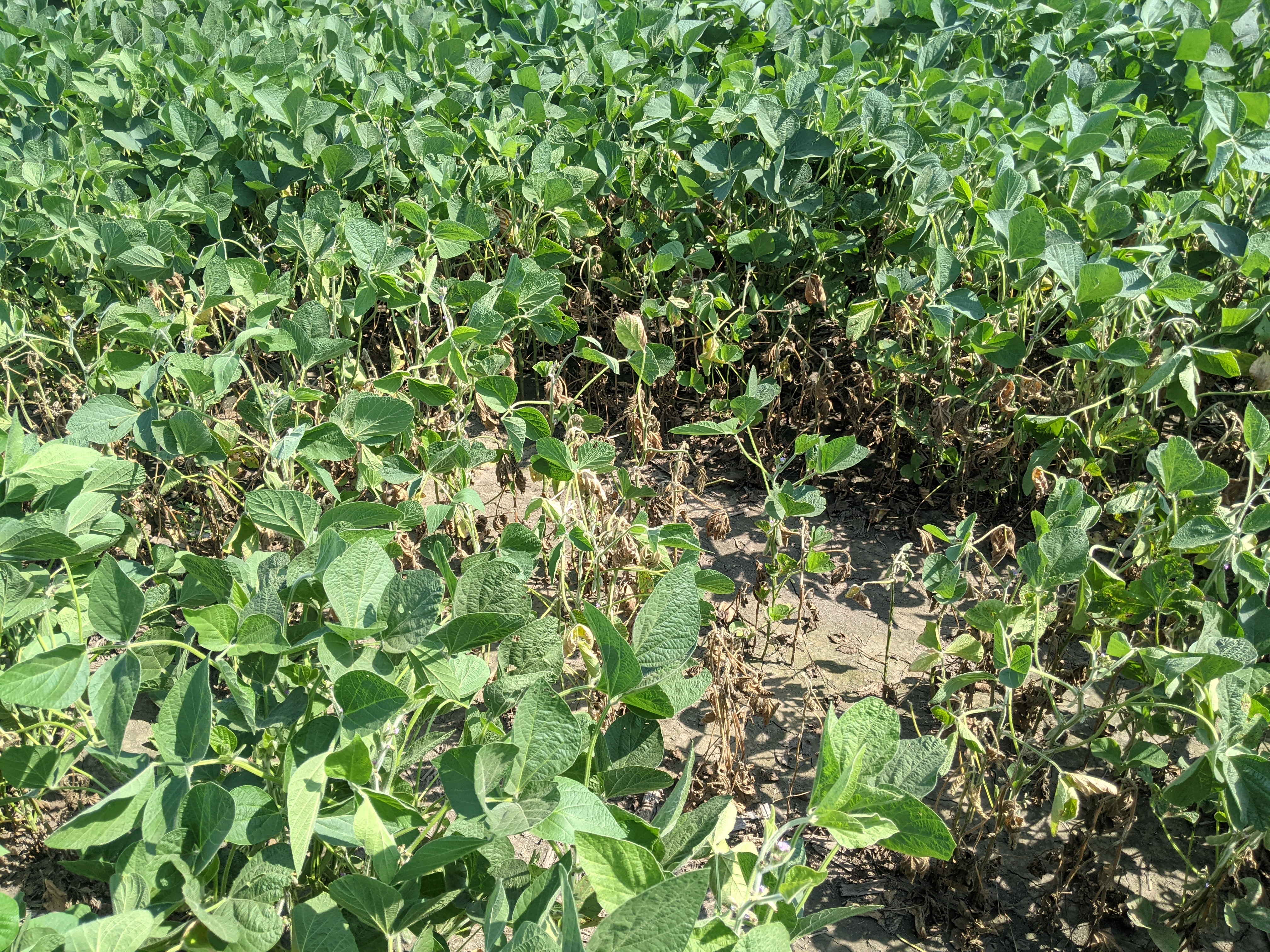
Soybean Update: Received a number of calls regarding poor-looking patches in soybean fields this week. Drought stress is showing up in non-irrigated fields. Be checking those areas for spidermites as well. If they’re present, I tend to find them towards the edge of the patch between the impacted area and what appears to be healthier beans. White mold in soybeans is something that’s becoming more common in counties such as Butler. It can have patterns such as several plants in a row impacted and/or a patchy area in the field. The plants will have a white cottony fungal growth on them and eventually the stem (upon splitting) has black fungal structures that look like mouse droppings in them.
Sudden death syndrome (SDS) and/or brown stem rot are also showing up in small patches of fields where the leaves have a chlorotic/necrotic look between the veins. The humidity has allowed the blue/gray fungal growth characteristic of SDS on the rotted taproots to be observed even mid-day. If you split the stem and the pith is brown, the culprit is most likely brown stem rot; if it’s not but the taproot is rotted and you can easily pull it from the soil, it’s probably SDS. Plants can sometimes have both diseases. All of these are soil-borne fungal diseases and there’s no control measures for this time of year. It would be wise to pull 0-8” soil samples to check for soybean cyst nematode in areas of fields you’re finding SDS and brown stem rot in. Dectes (soybean) stem borer tunneling can be confusing when determining dectes vs. brown stem rot. At this time of year, I don’t typically see dectes moving far (more than 1-2″ either direction) from the initial point of hatching near the petiole. This is in comparison to brown stem rot which would have browning of pith from soil line. Dectes also will not kill plants (just create conditions for lodging and breaking off near harvest). This is because the vascular bundles of soybeans are found on the outside edge and not in the center of the stem. Thus, death of plants this time of year are due to another cause.
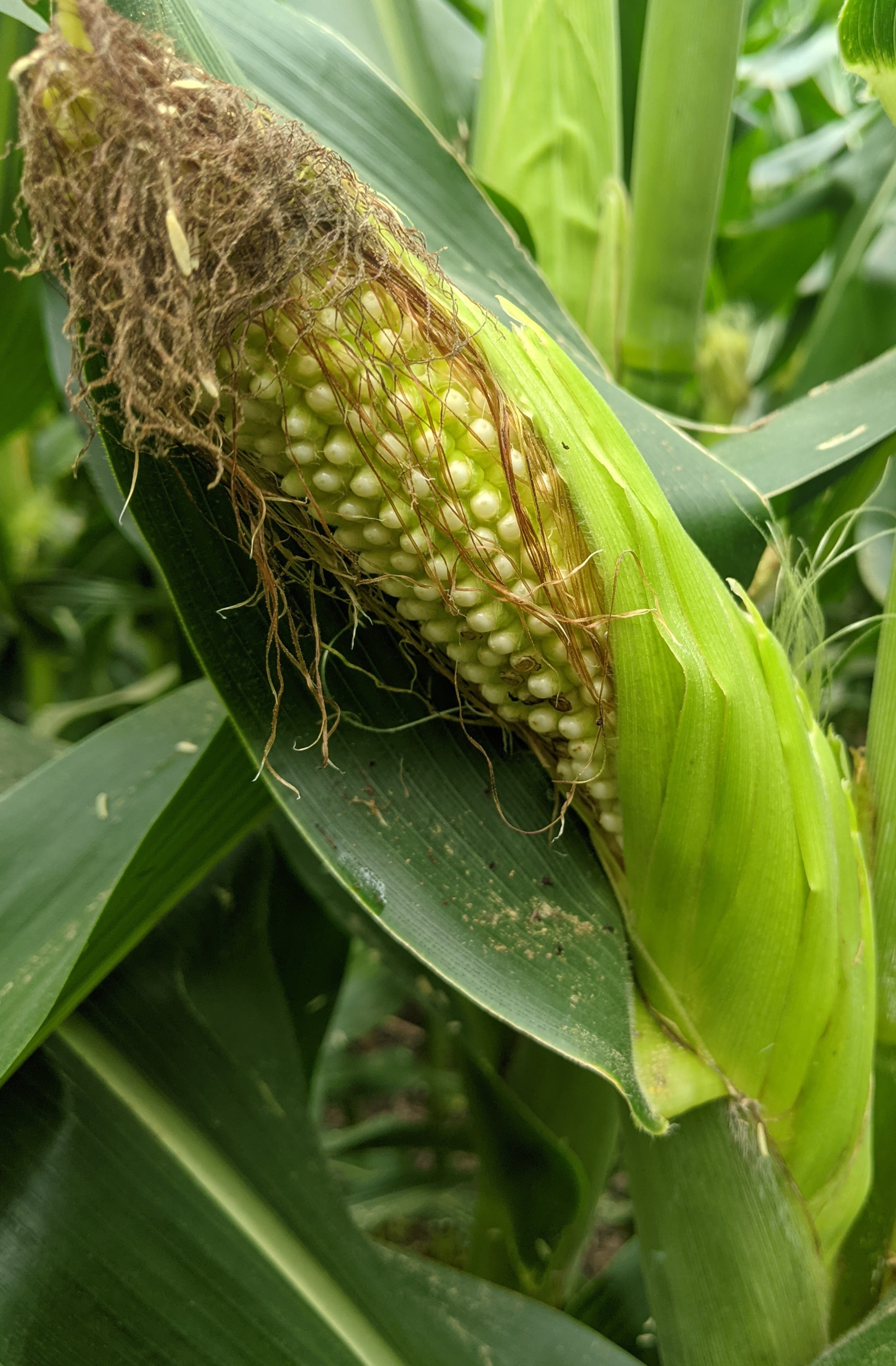

Two examples of shortened husks on developing ears. Husking back these ears often shows a pinch point that occurred during the windstorm resulting in jumbled kernels.


JenREES 8-25-19
Crop Updates: An increase in disease pressure has been the theme the past few weeks.  Sudden death syndrome is increasing in soybeans, but there’s also brown stem rot (BSR) and frogeye leaf spot in some fields. The foliar discoloration is the same for SDS and BSR with the yellow/brown discoloration between leaf veins. You can tell the difference by pulling a plant out of the ground. SDS is usually easy to pull as the taproot is rotted. Splitting the stem open, the root will show rot at the soil line but the stem pith will be white and healthy. With brown stem rot, the pith will have brown discoloration. The addition of stem borer can make it more difficult to tell the difference sometimes. Unfortunately there’s nothing one can do for SDS or brown stem rot now as both are caused by soil borne fungi. I would recommend taking soil samples for soybean cyst nematode (SCN) in areas currently impacted by SDS as the combination of diseases is synergistic in impacting yield loss. You only need 0-8” samples and they can be taken during soil fertility samples if you don’t want to take them now. The samples are free via your checkoff dollars and they can be sent to the Plant and Pest Diagnostic Lab at UNL in Lincoln.
In corn, foliar disease is increasing in mid-canopies. Most concerning are the number of stalk rot samples/situations I was called to the past week. They all appear to be bacterial stalk rot thus far. Symptoms include watersoaked nodes and below the nodes with plants breaking off/falling over. Damaged nodes are from the soil line to upper canopy. The bacteria disintegrates these stalks creating a stringy appearance within them where the nodes break and when slitting open stalks. It also has a distinct foul smell. This is more of a problem in wet years such as this and hybrid susceptibility varies. The bacteria doesn’t typically transfer from plant to plant. I have photos of what I’m seeing on my blog at https://jenreesources.com.
There have been multiple late-season hail events in the area. For those fields hit by the  August 6th storm, the rainy, cool conditions have allowed for increase in mold on the hail damaged side since many of those damaged ears were at milk stage. However, I’m also seeing mold damage on some back-side of ears in hybrids with tighter husks. The white/pink fluffy growth on the hail damaged side is caused by Fusarium/Gibberella fungi. The presence of these fungi does not automatically mean mycotoxins are present; they do have the potential to produce mycotoxins. The green fungal growth in ears are caused by secondary and minor fungal pathogens that don’t produce mycotoxins. The white fungus overtaking ears on some tight-husked hybrids is diplodia which can cause for light test weight but does not produce a mycotoxin. It will be important to continue to watch grain quality over time prior to harvest.
Wild and Burcucumber on Trees has also been a huge question. Do Not apply 2,4-D to trees for
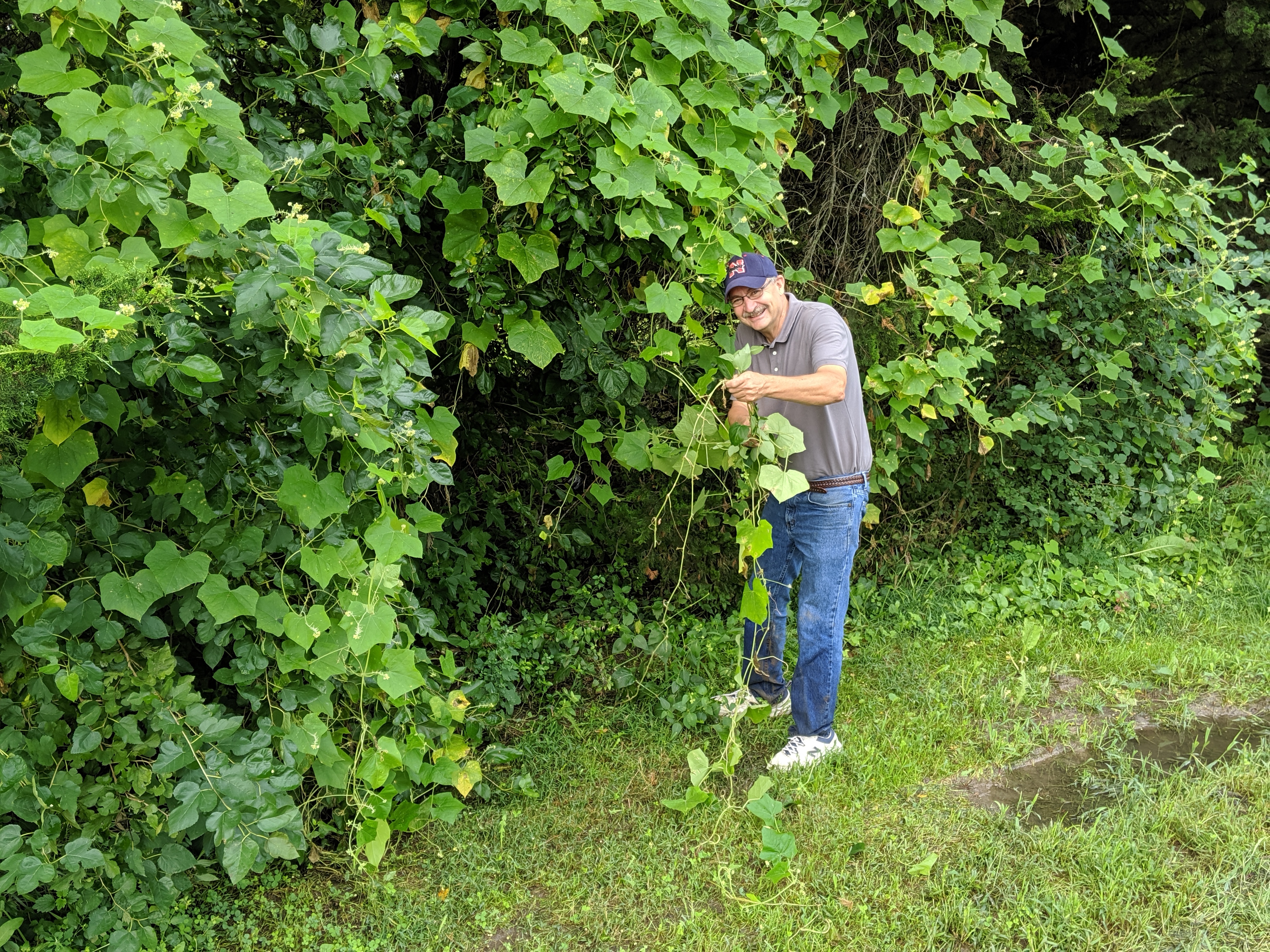
Thanks to Randy Pryor for demonstrating how easy these are to pull while we were on a field call together!
control as that has been the most common question! The simplest way to kill wild and burcucumber is pull or hoe the plant at its base below the tree. There’s not much to the plant root and the vines will then die on the tree!
It’s been a hard year for our growers and livestock producers with continued challenges. Seeking to end this column on a positive note, this year is the 10th year of the Nebraska State Fair in Grand Island and the 150th Fairabration. I’m grateful for the focus on agriculture, families and youth! And, it’s encouraging to me to see youth learning life skills whether competing in public speaking,  working with and showing livestock, or studying and competing in contests such as weed and grass ID at the State Fair. 4-H is where I got my start and it’s exciting for me to wonder at the futures these 4-H and FFA youth have ahead of them as they continue to work hard and put into practice the life skills they are learning! Hope you can make it out to the State Fair at some point!
*End of News Column. Bacterial stalk rot photos below.

Plants still standing showing various symptoms of dying and death

Some plants exhibiting bacterial stalk rot are already lodged or broke off at or around plant nodes.
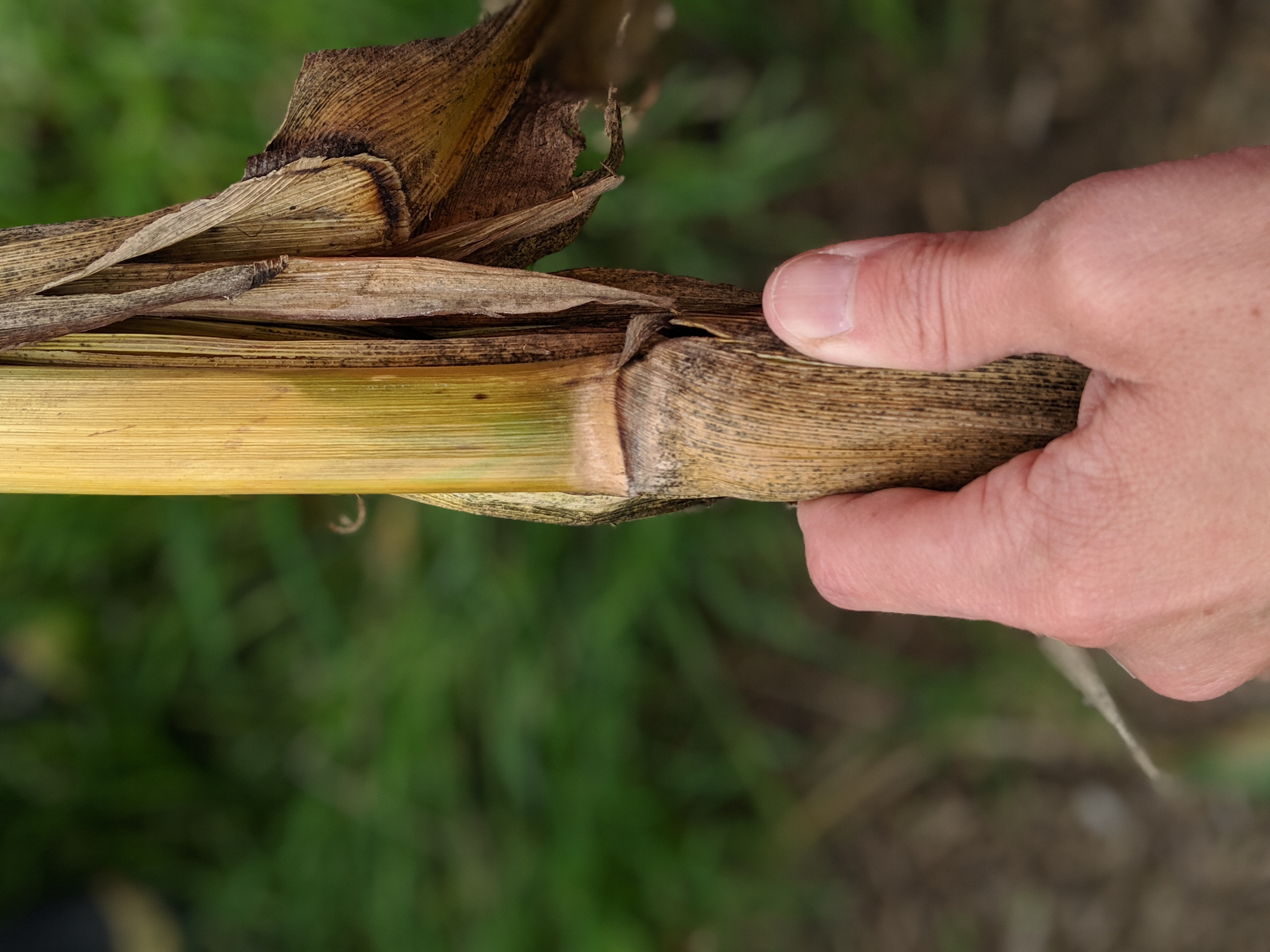
Plant nodes show discoloration with watersoaking around the nodes (notice the soaked appearance on internode where I removed the outside sheath).

Majorly impacted nodes and internodes by bacterial stalk rot. There’s a distinct foul odor. Notice how wet and watersoaked nodes and internodes are and there’s even bacterial ooze in this case on the stalk.

Plants break at nodes. Also notice the stringy appearance of stalk pith.

Commonly seeing this with impacted nodes from the soil line through upper canopy…stringy appearance of pith tissue.


 JenResources