Blog Archives
JenRees 9/3/23
Water use till maturity for Corn: Beginning Dent 5”, ¼ milk 3.75”; ½ milk 2.25”; ¾ milk 1”.
Water use till maturity for Beans: Beg. Seed 6.5”; Full Seed 3.5”; Leaves beg yellow 1.9”.
Crop Update: Harvest is coming early and will probably start rolling this week for some non-irrigated crops. Please be safe with the heat and dry conditions and keep fire safety in mind! Quality in non-irrigated corn ranges but some is very poor; please assess your fields before choosing to store it. Soybeans took a yield hit with the last few heat waves. If you have non-irrigated soybeans that are turning brown, it may be good to check pod fill. Regarding irrigation, corn should be wrapping up soon and it will be tempting to quit on beans too. However, beans still need nearly two inches of water when the leaves begin to turn yellow. Technically, when the white membrane has separated from the seed inside the top several pods, they are no longer using moisture. Evaluating the soil moisture status in each field will help you determine if/how much more irrigation you need. Here’s wishing a safe finish to the growing season and harvest to all!

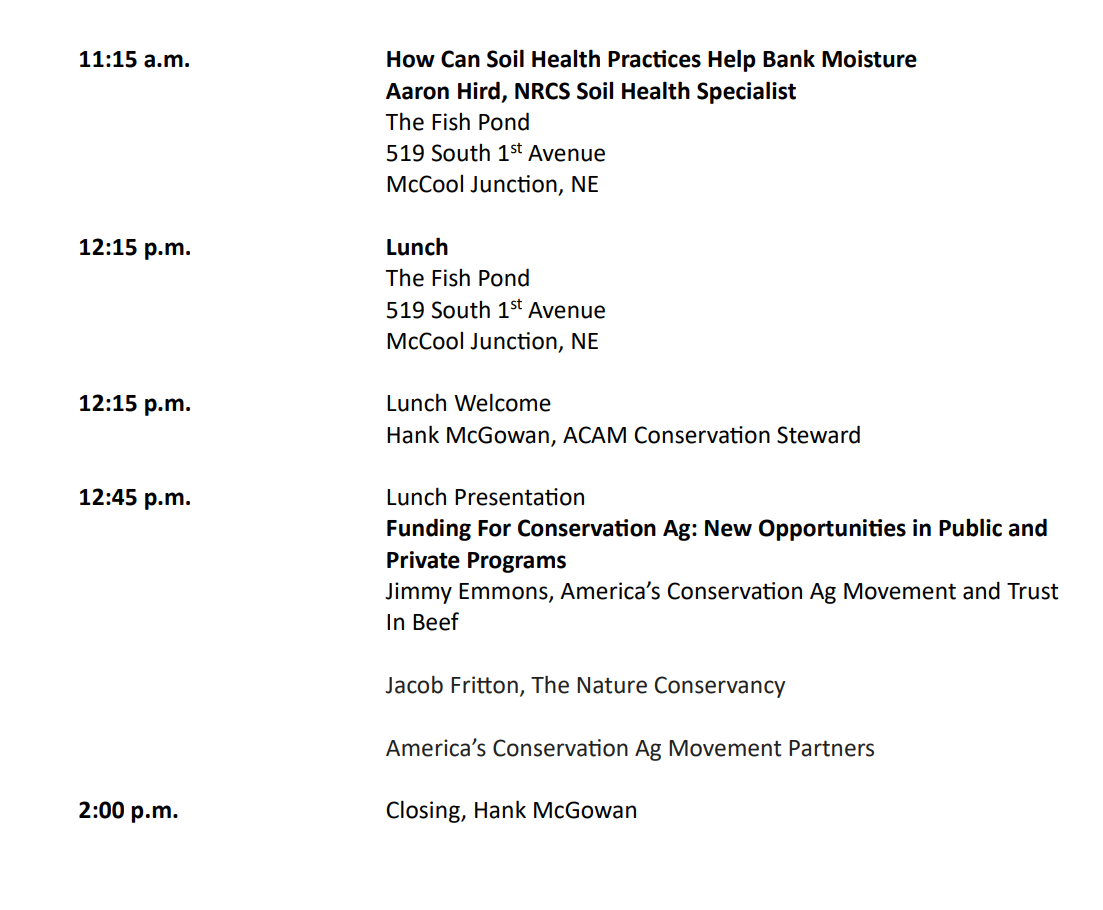
A Soil Health Field Day will be held Sept. 8 from 8 a.m.-2 p.m. (Reg. at 7:30 a.m.) at McGowan Farms, 1213 Rd. 4 McCool Junction. Several farmers will share their experiences with intercropping/relay cropping, integrating perennial cover crops and livestock with cash crops. Additional topics include: animal health strategies, soil health and moisture, and soil health funding opportunities. No charge, info and RSVP at: https://events.farmjournal.com/acam-sept8?i=NKF6zLCT4K-TcK44GTpfFL3hKF56pMmH.
Soybean Gall Midge: Most of the area I serve thankfully does not have this pest yet; however, it has increased in Seward county this year. Travis (TJ) Prochaska, recently joined us as an Extension Educator in Colfax county from serving as an Extension Crop Protection Specialist at NDSU. He has his doctorate in entomology and his family farms in Seward county. We’re glad to have him join Nebraska Extension!

Travis wrote the following along with Justin McMechan, “Soybean gall midge was first detected in Seward County during the 2019 growing season. However, the 2023 growing season has presented several growers in the area with their first experience with the emerging pest, especially in areas near the city of Seward and west. Other counties in eastern Nebraska have been dealing with the pest for several years. Typically, adults emerge in early- to mid-June. To receive alert notifications of soybean gall midge adult emergence, go to soybeangallmidge.org and register for the alert network. Overwintering adult soybean gall midge emerge from the previous year’s soybean fields and fly to an adjacent soybean field to lay eggs on young soybean plants. As the eggs hatch, the immature larvae feed on stem tissues underneath the epidermis, disrupting water and nutrient uptake within the plant. As the larvae grow, they will transition from a white to a bright orange color specimen.
Infested soybean plants can wilt or lodge at the feeding site and, in some cases, result in the death of the plant. Plants become susceptible to infestation around the vegetative V2 leaf stage as fissures (small cracks) develop near the base of the stem, providing an entry point for females to lay eggs. Management has been hit-and-miss. Research studies completed by Dr. Justin McMechan’s lab have shown some results, but foliar-based treatments have been inconsistent between locations and years. Chemical control should only be considered if the history of gall midge has been recorded or an adjacent field has shown a history of gall midge. Gall midge is a field edge pest, so any treatments be should be confined to the first 60-120 feet of the field. Research has shown that hilling, a process where soil is used to cover the base of the stem can be an effective strategy to control, however, it is difficult to implement at the V2 stage and not cover up the small soybean plants. Granular at-plant applications with Thimet 20G have shown consistent control, but its use is limited due to the need for additional specialized equipment. A multi-year field study funded by the Nebraska Soybean Board has shown that delaying soybean plantings until late-May can reduce infestation and injury. Studies led by Dr. Bob Koch, University of Minnesota, are showing some success with biological control and predators (i.e., ground beetles, parasitic wasps, etc.); however, further studies are needed to fully understand their impact.
As with any insect-related program, scouting will be key. Scout field edges of soybean that are adjacent to fields that were planted to soybean last year. To assess a soybean plant for larval infestation, look for any dark brown or black discoloration near the base of the stem below the cotyledonary nodes. If found, peel back the outside layer of the stem to reveal any possible white or orange larvae. As we approach September, there are no practical management tactics this late in the season. However, scouting to build a profile and a history will be helpful for possible treatments for the 2024 crop.”

Quick note for those who replanted soybeans and mentioned they’re flowering, Dr. Jim Specht ran the SoySim model for me and gives approximations of when to expect maturity is reached for the weather conditions thus far. First column is 1.5, middle is 2.0 and last column is 2.5. Based on this, should be seeing beginning pods this week. The harder part will be looking at the physiological maturity line, depending on when we receive a frost. I realize this isn’t encouraging to see either.



 JenResources