Blog Archives
August 2025 Events
Thank you to all who helped make the 2025 York County Fair a success! I didn’t get out to the fields this past week so sharing reminders on some upcoming field days.
Aug. 5 Grazing Cover Crops Field Day of area farmer Alex Daake will be held from 4-6 p.m. at 4136 Superior Rd. near Utica, NE. Alex split a pivot into 4 quarters where he rotates corn, soybeans, rye for seed, and grazed cover crops. The focus will be primarily on what he’s doing for grazing covers and the economics of this system where pasture is limited for cattle production. Alex also has an on-farm research nitrogen study on the corn portion of this pivot where he’s looking at reducing nitrogen inputs due to the grazed cover crops. He’s monitoring the nitrogen strips with Sentinel Fertigation. If you’re interested, you’re welcome to RSVP to jrees2@unl.edu. Walk-ins are also welcome and cookies/water will be provided by Nebraska On-Farm Research.
Aug. 7 South Central Ag Lab Field Day will be held 8:45 a.m.-3:10 p.m. (Registration at 8:30 a.m.) Attendees can tailor their schedule by selecting from various presentations and interactive demonstrations (Irrigation, Diseases, Insects, Weeds (including robotic weeders), Nutrients). There is no charge and CCA credits will be provided. Please RSVP at: go.unl.edu/scalfieldday.
Dan Snow is the keynote speaker and will discuss nitrate challenges in groundwater. This talk will cover findings from a study with the Upper Big Blue NRD and UNL focusing on nitrate and agrichemical levels in the vadose zone across 12 water quality management zones. Lunch talks also feature a farmer panel discussion, providing an opportunity for attendees to engage and interact at the local level.
The SCAL Research Farm is located at 851 Hwy. 6 near Harvard, NE. Directions: 13 miles east of Hastings on Hwy. 6 or 4.5 miles west of the intersection of Hwy. 14 and Hwy. 6 north of Clay Center. Field day GPS coordinates: 40.575256, -98.137824. More info please call (402)762-3536.
Soybean Management Field Days will be held Aug. 12-15. Topics will vary by location and the first three days are twilight tours from 6-8 p.m. There is no charge but registration is requested two days in advance at: https://enreec.unl.edu/soydays/.
- Tuesday, Aug. 12 – Ravenna, NE. Lonnie and Scott Bohn farm 6:00 p.m. to 8:00 p.m. (5:30 p.m. – Registration)
- Wednesday, Aug. 13 – Concord, NE. UNL Haskell Ag Lab 6:00 p.m. to 8:00 p.m. (5:30 p.m. – Registration)
- Thursday, August 14 – Weeping Water, NE, Rick Meyer farm 6:00 p.m. to 8:00 p.m. (5:30 p.m. – Registration)
- Friday, August 15 – Mead, NE, UNL Eastern Nebraska Research, Extension & Education Center – (10:00 a.m. – Registration)
Aug. 25 Regenerative Ag Field Day will feature area farmer Jordan Uldrich. The field day will be from 10 a.m.-Noon, ½ mile east of 1606 County Road J, Geneva, NE. Lunch will be provided following the field day. Jordan has interseeded cover crops into his corn to aid with soil health and weed management. He will also discuss the economics of alternative farming practices. For more information, please call Andrew at 402-590-7096.


JenREES 8/7/22
The buildings and barns are now emptied, exhibits taken home and people are weary. But what remains
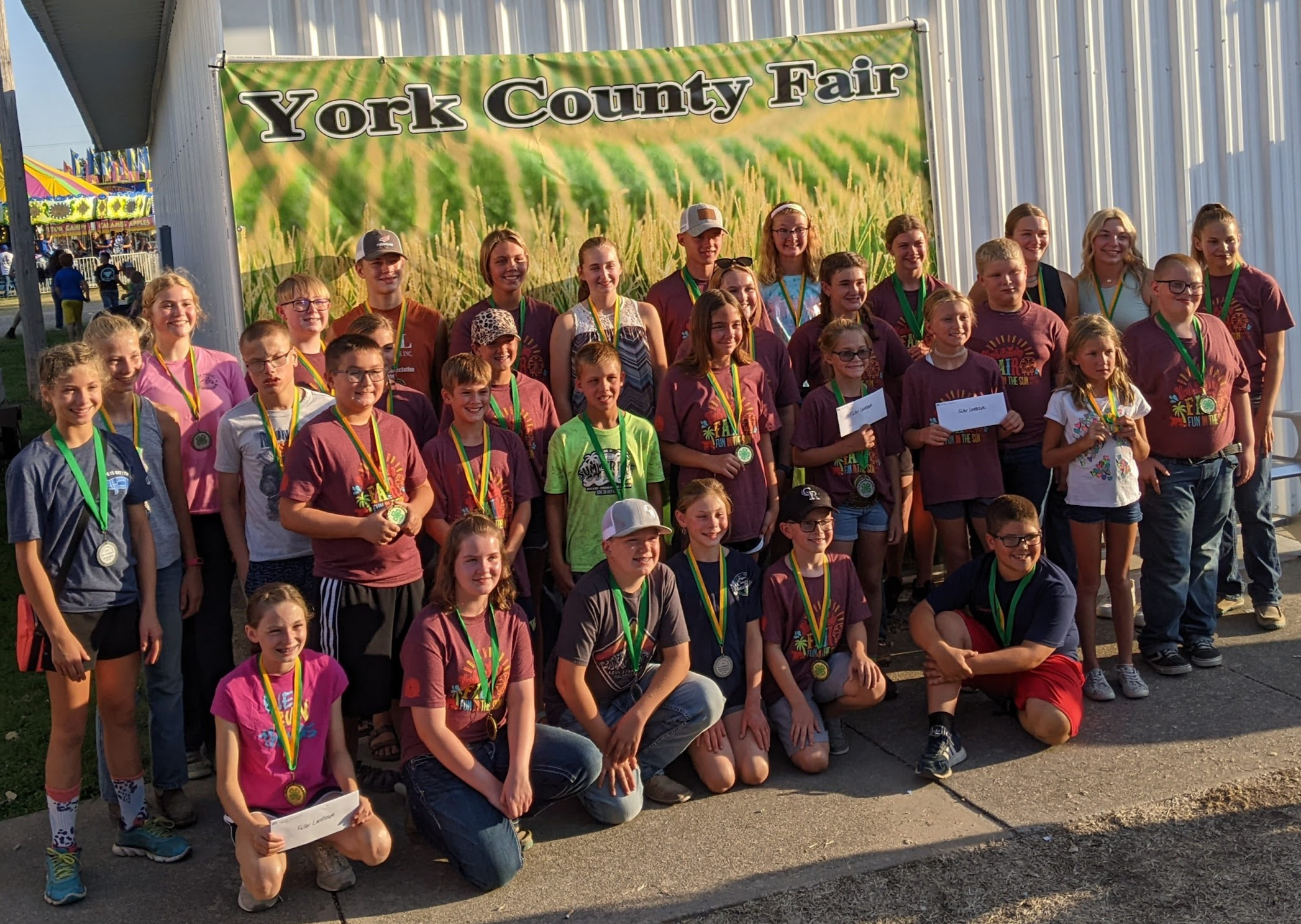
are the friendships, the connections re-established, the smiles, the gratitude, the pulling together, the awards given to the youth, the lessons learned. When I was in 4-H, I had no idea the amount of time that Ag Society, Extension staff, volunteers, my 4-H leaders or even my parents put into the fair. I could’ve said ‘thank you’ so much more! This was my 19th county fair on ‘the other side’ and it never ceases to amaze me the list of items to accomplish in order to ensure a successful fair. It takes many dedicated people to achieve all of this. I’m so grateful to the ag society, 4-H Council, Extension staff and board, FFA advisers, 4-H leaders, numerous volunteers, and parents that pull together each year to pull off county fairs! As I reflect, things that make my heart happy and make me smile are thinking about the number of wonderful people who help me in Ag Hall each year, the youth proudly wearing their medals around the fairgrounds on Thursday evening after the award’s ceremony in York Co., the crop plot for ag literacy in Seward Co., seeing the fairgrounds so busy in spite of the heat, watching people from across the counties reconnect, people pulling together in the midst of adversity, and the hard work that especially ag society puts into the fair behind the scenes to ensure that attendees enjoy the fairs. Thank you also to all of the sponsors! Grateful to all for making the York and Seward Co. fairs a success!
Produce not Ripening: Many have green tomatoes. My colleague, Scott Evans shared it’s due to the heat as temps over 90F prevent the plant from producing lycopene and carotene. You can bring mature green tomatoes indoors to ripen (sunlight isn’t needed) or you can wait for cooler weather for them to turn. How do you know if they are mature enough to bring indoors for ripening? Look for an off-green to a tinge of white on the shoulders of the fruit on the stem side on fruit that is the right size of for that variety. He said the same can be done for peppers that aren’t turning orange, red, or yellow. For cucumbers, fruit production declines with the heat but doesn’t impact maturity.
Spidermites: Just a reminder of this helpful article as the heat has really brought on spidermites in crops: https://go.unl.edu/9v6u. For those with gardens, spidermites are also impacting vegetable and flower plants. Symptoms include webbing and yellowish ‘stippling’ or tiny spotting on the leaves which eventually turn brown. You can take a white piece of paper and knock the leaves on it. If you see tiny insects the size of pinpoints moving, it’s most likely spidermites. Spraying plants with heavy streams of water ensuring each side of the leaf is hit helps knock them down. Proper watering (reducing drought stress) can help reduce spidermites. Those two things can drastically and naturally help with spidermites in garden settings. Insecticidal oils and some plant extract products can help. Just be sure to read the labels to ensure the product is safe for the plant you’re applying it to and never apply these products when temperatures are above 90F to avoid damage to the plant.
Irrigation: The heat is progressing plant and seed development in crops not replanted. Corn at dough needs 7.5” till maturity, 5” at beginning dent, 3.75” at ¼ milk, 2.25” at ½ milk, and 1” at ¾ milk. Soybean at beginning seed (R5) needs 6.5”, end of seed (R6) needs 3.5”, and 1.9” at leaves beginning to yellow.
Soybean Management Field Days are this week (Aug. 9-12)! Last year a team of us tried an approach of more discussion with attendees and this year we’re seeking to format more parts of the field days this way. Each location will be unique to the situations that area of the state is experiencing. Join us for discussions on insects, diseases, weed management, cover crop implementation, precision ag, economics, irrigation, and biodiesel. Closest locations are Blue Hill on Aug. 9 and Central City on Aug. 10. Hope to see many at one of the locations this week! More info. here: https://go.unl.edu/xukf.


 JenResources