Blog Archives
Water Jamboree & Removing Irrigation Scheduling Equipment
Last week was fun and somewhat exhausting teaching with my colleagues in Extension and several area Agencies at the Water Jamboree at Liberty Cove in Lawrence. Water Jamboree started over 15 years ago to teach 5th and 6th graders about the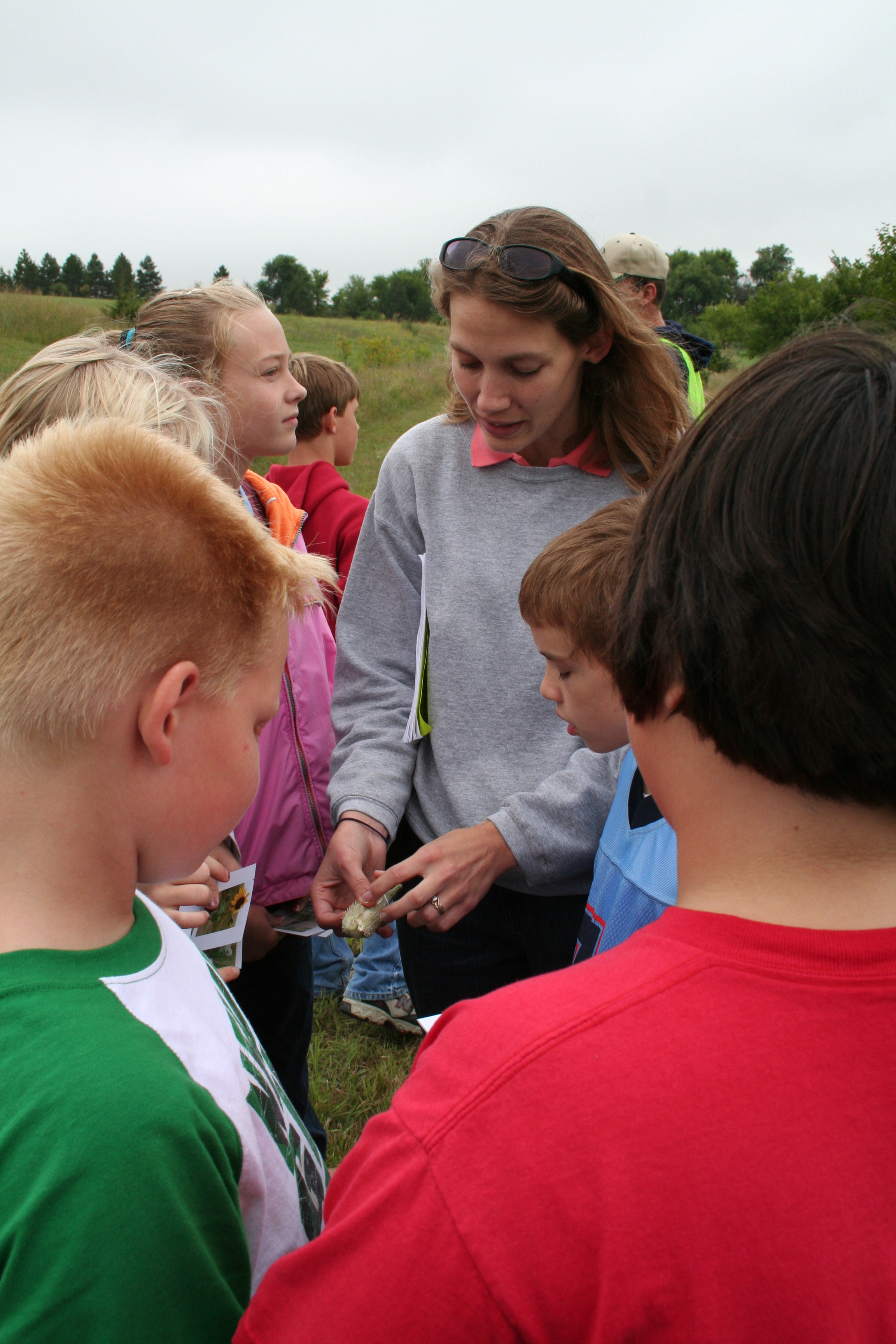 importance of water and water-related subjects. Nearly 800 youth learned about where water goes when it goes down the storm drain, about irrigation and siphon tubes, the aquifer, life inside and outside of the lake, mosquitoes, water movement, and much more. Holli Weber and I utilized the nature trails through the tallgrass prairie to teach a session on life outside the lake focusing on the importance of plants as buffers to filter chemicals and allowing youth to run through the trails doing a photo ID scavenger hunt of the area plants (also to burn off energy!). While I’ve done this session the past 5 years, this year I took time to show the youth specific characteristics to ID grasses. God created each plant unique and I was showing them how Indiangrass has rabbit ears when you pull the leaves back from the stem…or the M/W on the smooth brome leaves. It was fun watching the youths’ faces light up and then try to find these and other characteristics for themselves while on the trails. It was a great day, although I really don’t know how teachers do it day in and out! I wish I could’ve attended something like this when I was young! A special thanks goes to Marlene Faimon at the Little Blue NRD for coordinating this each year.
After Water Jamboree, I headed to my research plot at Lawrence. It’s been a trying year of coon damage and most recently a skunk inside our traps instead of the coons (and it still smelled like skunk out there!). Anyway, I was pulling watermark sensors and the 1st and 2nd foot ones were really rough but the 3rd and 4th feet came out easily. So just a reminder, when pulling watermark sensors, clamp a vice grip below the cap, twist and pull up. I’ve taken out hundreds of these and have only pulled apart four. If your sensor won’t pull up, simply take a spade and dig around the sensor and also bring a jug of water with you. This is the first time I’ve had to dig sensors out but the water really helped as I got it to run down the tube, it eventually loosened at the base to pull out easily without removing the sensor from the pvc pipe. Sensors can be gently washed with a hose or in a bucket of water using your fingers to gently clean them-don’t use a brush. Allow to dry and store in your shed, garage, basement, etc. Also a reminder (although I should’ve done this during the cold of Husker Harvest Days), to get your ET gages inside. Pour out the water and empty the ceramic top by pulling out the tube and then store that inside where it won’t freeze during the winter.
Last Irrigation Scheduling
With corn in various stages of dent and starch fill, you may be wondering how to schedule for last irrigation. For those of you in our Nebraska Ag Water Management Network using watermark sensors, the goal is to use them to determine when the soil profile reaches 60% depletion (for silty-clay soils in our area aim for an average of 160 kpa of all your sensors). You may be thinking, “An average of 90kpa was hard enough!” but as Daryl Andersen from the Little Blue Natural Resources District points out, you’re only taking an additional 0.30 inches out of each foot. So if you’re averaging 90kpa on your three sensors, you have depleted 2.34 inches in the top three feet so you still have 0.96 inches left (see the Soil Moisture Depletion Chart). If you add the fourth foot (using a similar number from the third foot), it would bring the water available to the plant up to 1.28”.
At beginning dent corn you need 24 days or 5 inches of water to finish the crop to maturity. If you subtract 1.28 from 5 you will need 3.72” to finish out the crop. Corn at ½ milk line needs 13 days or 2.25” to finish the crop to maturity-so subtracting it from 1.28 would be only 0.97”. Taking into account the good potential for rainfall and what moisture is in the profile, you should be done irrigating corn. Soybeans at the beginning of seed enlargement (R5) need 6.5”. Most soybean fields that I’ve looked at are in R6 or full seed which needs 3.5 inches yet for maturity. Subtracting off the 1.28” in the four foot profile would lead to 2.22”. If we don’t get a few more rains then beans may need one more round. The UNL NebGuide Predicting the Last Irrigation of the Season provides good information on how determine your last irrigation in addition to showing charts on how much water the crop still needs at various growth stages.
Daryl Andersen explains how to use this information in a simplified way. One way to look at this is by the numbers of days left. At 1/4 starch, there are about 19 days before maturity so you can let your sensors average 130kpa on the first week and 150kpa on the next week. If these targets are met during the week, you would put on about 1 inch of water. By going to these numbers, it might give you a higher probability for rain in the next couple of weeks. ET rates this summer have been running less than 0.25” per day for the most part, so with the humidity we’ve had, the crops have not been using much water, which has really helped our dryland corn again in areas where we aren’t receiving rain events.
Discussion: Irrigation Scheduling
I’m adding this post as a discussion topic as we get into the growing season for producers to post their irrigation scheduling questions or to share what their sensors and ET gages are reading. With the Nebraska Ag Management Network, we’ve learned that producers often need other producers to check their readings with-kind of like a support group for producers involved with this effort. That’s because it’s hard to not irrigate when neighbors are irrigating and your irrigation scheduling tools are telling you that you don’t need to irrigate! We’ve had some good discussions in the past so I look forward to the discussions this coming year!


 JenResources