Blog Archives
JenREES 10/23/22
With each of these red flag days, am grateful for our firefighters, first responders, and all involved helping fight fires; praying for all of them and those who are impacted. Sharing this week on some upcoming November programs and a grain question I received when it was cold last week.
Should low moisture corn be cooled in bins? Will running air remove much more moisture? Dr. Ken Hellevang with NDSU answered the following question. “The temperature of the corn will change many times faster than any moisture content change. We can estimate the cooling time by dividing 150 by the airflow rate. So, if the airflow rate is 1.0 cfm/bu, it will only take about 15 hours to cool the corn. To change the moisture content of all the corn at that airflow rate will take about 40 days. Even at a typical aeration airflow rate of about 0.2 cfm/bu it only takes about 3 days to cool the corn.
Anytime we cool the corn, there will be a minor (fraction of a percent) reduction in moisture. Therefore, with dry corn running the fan at night during higher humidity conditions is beneficial. I would run the fan all day and night for the most rapid cooling and just at night if willing to be controlling the fans.
I encourage farmers to cool the corn whenever outside temperatures are 10-15 degrees cooler than the corn, so they certainly could utilize the cooler air to cool the corn.
With the corn at moisture contents of 13% or less, it will store at the warmer temperatures for a while, so there is not a problem with waiting. They will need to cool the corn for winter storage at some time to limit the potential for moisture migration and wet corn at the top of the bin. This occurs if there is consistently at least a 20 degree difference between outdoor air temperature and the corn temperature.”
2022 Nebraska Ballot Initiatives are explained by Dr. Dave Aiken in this document https://agecon.unl.edu/2022-nebraska-ballot-issues and webinar https://go.unl.edu/n2pw.
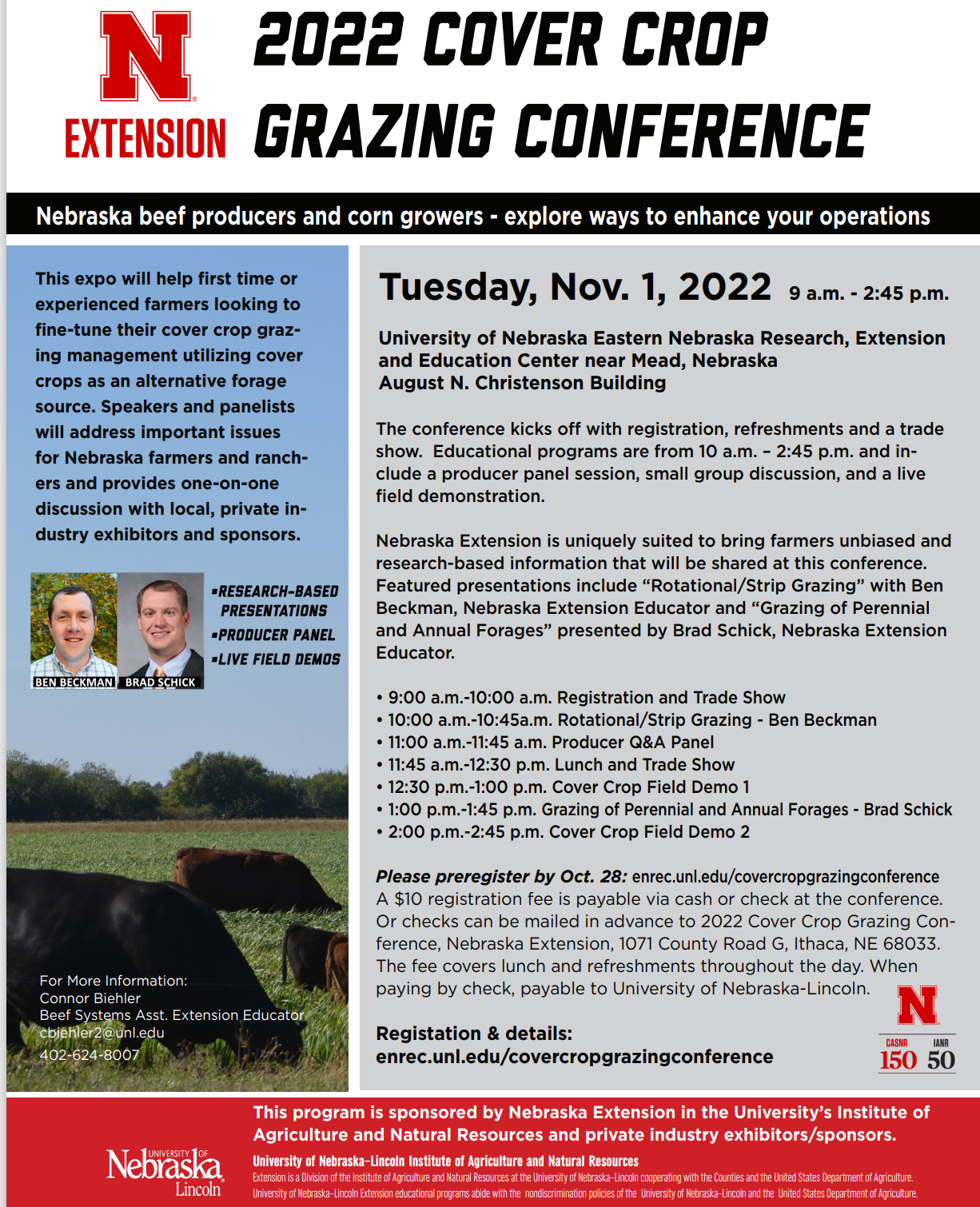
Cover Crop Grazing Conference will be held November 1st at the Nebraska Research and Extension Center near Mead (1071 Co. Rd. G). This conference is designed for crop and livestock producers with a trade show, speakers, producer panel, and cover crop field demonstrations. The day begins at 9 a.m. with registration and a trade show with the program running from 10 a.m. to 2:45 p.m. Speakers include Ben Beckman (Rotational/Strip Grazing) and Brad Schick (Grazing of Perennial and Annual Forages). There is a $10 registration fee payable via cash or check at the conference to cover lunch and refreshments. RSVP at: https://enrec.unl.edu/covercropgrazingconference/. If interested in exhibiting in the trade show, please contact Connor Biehler at cbiehler2@unl.edu or 402-624-8007.
Nebraska Extension Weed Science School will be held Nov. 9 at the Eastern NE Research and Extension Center near Mead (1071 Co. Rd G). Registration begins at 8:30 a.m. with program from 8:45-2:30 p.m. CCA credits are available. Speakers and topics include: Amit Jhala (Nebraska Weed Management Survey Results); Kevin Bradley with University of Missouri (Future of Weed Management in 2023 and Beyond); Jenny Rees (Herbicide options when interseeding cover crops into corn and soybeans); Nahar Neta with Greeneye Technology (Spot herbicide application technology for weed management in corn and soybean); Bob Klein (Spray quality and carrier rate-how they affect herbicide efficacy and spray drift?); Stevan Knezevic (Soybean response to 2,4-D and dicamba); Sam Wortman (Off target injury of dicamba or 2,4-D in specialty crops). No fee but please RSVP for lunch: go.unl.edu/weedscienceschool.
Central NE Regenerative Ag Conference will be held Nov. 18 at the Tassel Performing Arts Center in Holdrege, NE from 1-4:30 p.m. with Gabe Brown as the featured speaker. Fee is $15 if pre-register by Nov. 14; otherwise the fee is $25. Registration is through Central Community College in Holdrege. Register online or you can call them at 308-995-8133. Just FYI, it gave me a confirmation email saying I registered for “Entrepreneurship”, but the day and time were correct. More information at: https://greencover.com/event/soil-health-and-regenerative-agriculture-conference/.

JenREES 1-12-20
Great to see and meet so many at the York Ag Expo last week! And, to the 156 of you who attended pesticide training, thank you again for your kindness and grace with the packed room and overflow to the hallway. Sharing this week on February upcoming ag programs and adding the flyers to https://jenreesources.com.
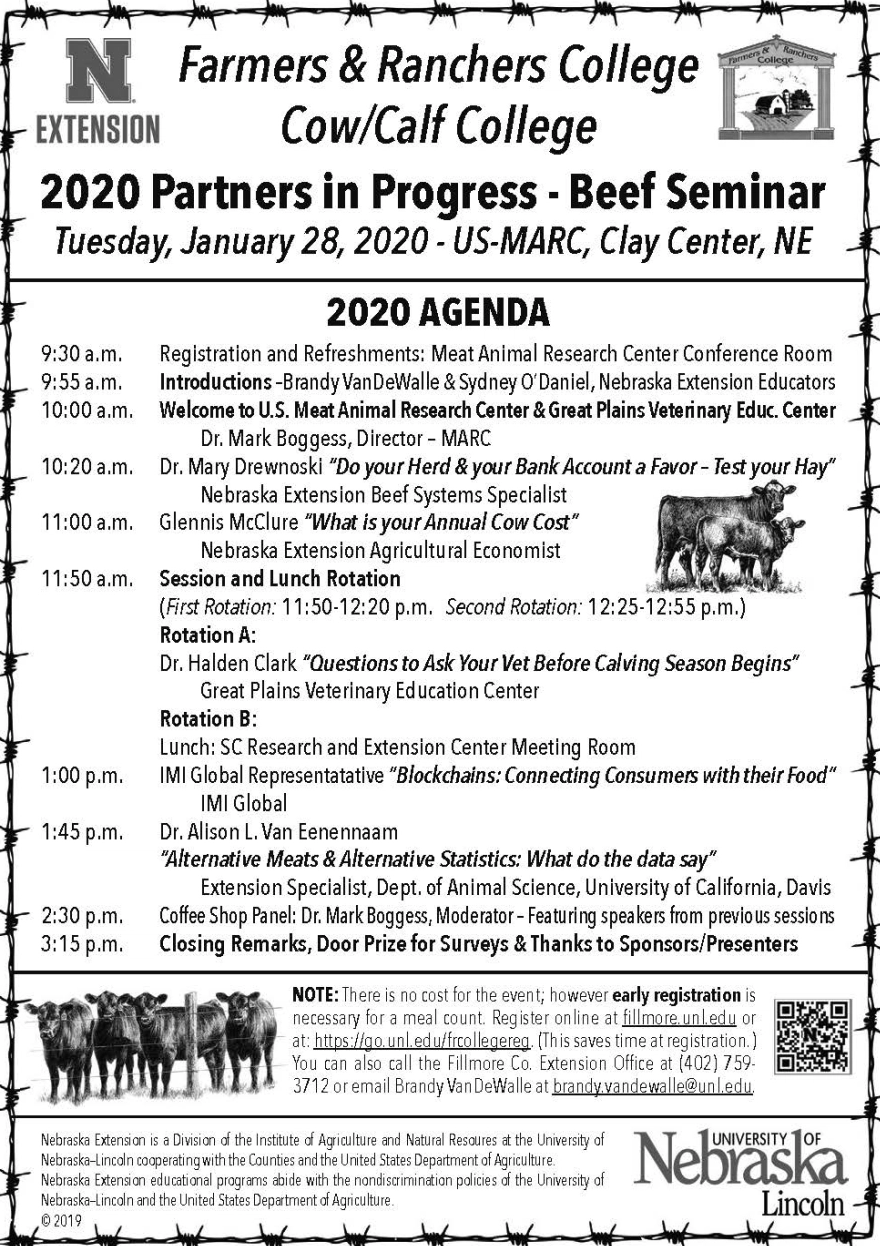
Jan. 28th is the Farmers and Ranchers Cow-Calf College at the US Meat Animal Research Center near Clay Center. Registration begins at 9:30 a.m. with program beginning at 9:55 a.m. Topics include: Forage Sampling, Understanding Annual Cow Costs, Questions to Ask Your Vet before Calving Season, Blockchains: Connecting Consumers with their Food (IMI Global), and Alternative Meats and Alternative Statistics: What the data says. There is no charge and meal is provided. It’s best to pre-register to save time and you can do so at https://go.unl.edu/frcollegereg. You can also RSVP at (402) 759-3712.
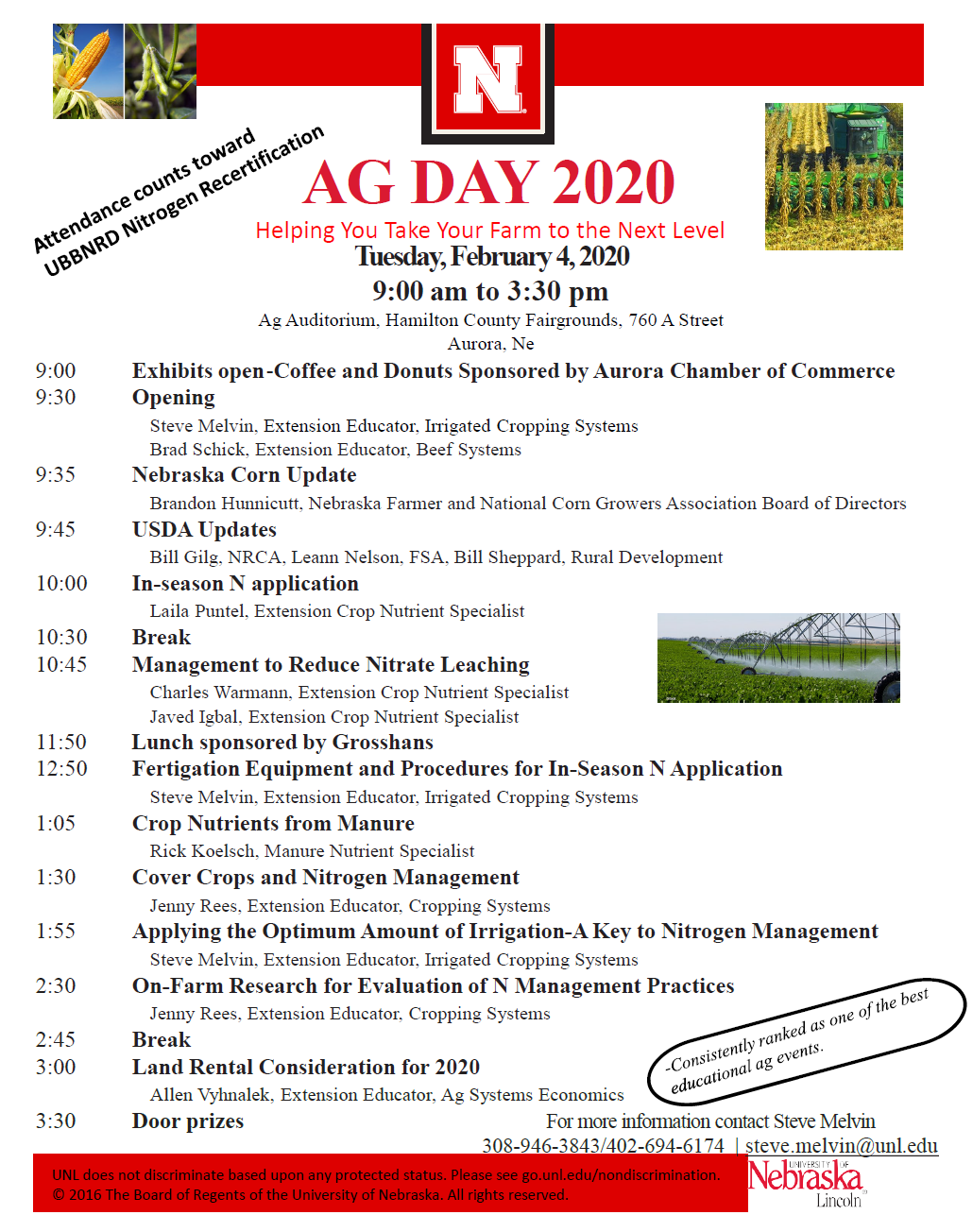
Feb. 4 is the Hamilton County Ag Day at the fairgrounds in Aurora (Reg. at 9 a.m. with program beginning at 9:30 a.m.). Attendance at this event qualifies for UBBNRD nitrogen management training. Many have asked about nitrogen research and this event is geared towards providing that. Topics include: In-season nitrogen application, management to reduce nitrate leaching, fertigation equipment & procedures for in-season management, crop nutrients from manure, cover crops and nitrogen management, optimum irrigation application, on-farm research for evaluating N management, land rental considerations for 2020, in addition to updates from Nebraska Corn and USDA. There is no charge.
Feb. 13 is the Nebraska Cover Crop Conference near Mead with registration beginning at 8:30 a.m. and program from 9 a.m.-3:30 p.m. This year’s focus is on interseeding cover crops into corn/soybean. Loran Steinlage from Iowa will share what he’s doing with 60” row spacings and keeping something growing in his fields 365 days of the year. Noah Seim from Merrick County (30” rows for a few years) and Jay Goertzen from York County (36” rows for 1 year) both have interseeding projects with Nebraska on-farm research and will share their experiences. Additional Topics/Speakers include: Finding the right fit with cover crops (Abbey Wick from NDSU), Selling cover crop seed in Nebraska (Steve Knox with Nebraska Crop Improvement), Accelerating soil health adoption by quantifying economic and environmental outcomes (Brian Brandt, Ohio), Review of cover crop demonstrations in the Central Platte NRD (Dean Krull), Cover crops by helicopter: FAQ (Brent Wulf, Hexagon Helicopters, Inc.), and Soil Health (Aaron Hird, NRCS). There is no charge for this event including meal and it’s a large event. Registration is required by Feb. 7. More info. and register at: https://extension.unl.edu/statewide/enre/nebraska-cover-crop-conference/ or 402-624-8030.
Nebraska On-Farm Research Updates: Believing in the value of on-farm research, these are among my favorite meetings each year! These meetings give you an opportunity to hear from your peers regarding research they’re trying in cooperation with Nebraska Extension. We often wouldn’t have research on topics many of you ask me about if it wasn’t for our on-farm research cooperators, so I’m grateful to them! Dates include: Feb. 18 at Holiday Inn Express in Beatrice, Feb. 19 near Mead at ENREC, Feb. 20 in Norfolk at the Extension Office, Feb. 26 in Kearney at the Extension Office, and Feb. 28 in York at the Holthus Convention Center. The Feb. 28 meeting in York will be unique focusing only on cover crop and soil health research and that meeting also qualifies for UBBNRD nitrogen management training. Each meeting runs from 9 a.m.-4 p.m. (registration at 8:30 a.m.). Meal is included and there’s no cost thanks to our partnerships with Nebraska Corn, Soybean, and Dry Bean Boards and Growers’ Associations. Please pre-register at least 2 days in advance for meal planning purposes to: onfarm@unl.edu or 402-624-8030.



JenREES 1-5-20
Winter programming is upon us and there’s plenty of opportunities to attend meetings somewhere nearly every day! Below is more information regarding some January opportunities from Extension. Also, thank you to those who provided feedback to my end of the year survey! It really is short, so if you haven’t provided feedback, please consider doing so at https://slido.com and enter the code 4EXT. It really helps me as we have to justify the ways that we serve our constituents in our annual reports. Thank you!
Crop Production Clinics (CPC) provide an opportunity for commercial, non-commercial, and private pesticide applicator recertification. CCA credits can also be obtained. Besides the ‘traditional’ track of insect, disease, and weed science information, topics at the York location (Holthus Convention Center) on Jan. 14 also include: farm bill info, financial considerations for 2020, extreme weather impacts on ag, cover crops and forage management, manure and other soil amendments, pivot performance, and sprinkler packages. Registration at: https://agronomy.unl.edu/cpc.
Nebraska Crop Management Clinic (NCMC) at the Younes Convention Center in Kearney Jan. 22-23 expands the offerings of the CPC into a 2-day conference with additional outside speakers. Commercial, non-commercial, and private recertification training are options in addition to obtaining up to 14 CCA credits (over 2 days) and chemigation training. Registration at: https://agronomy.unl.edu/ncmc.
Good Farmer, Great Manager: I’m really excited to bring this program to the area! This program isn’t about teaching specific tools like Quicken, Quickbooks, or others. It’s about better understanding the true financial position of the farm. Keeping good records make it possible to track an operation’s true financial position. Inaccurate records can lead to misguided management decisions. Tina Barrett, Executive Director of the Nebraska Farm Business Inc., will teach this class on Jan. 23 (1-5 p.m.) and 24 (8 a.m.-Noon) at the 4-H Building in York. It is required to attend both days, cost is $50, and the class is limited to 25 participants. Topics include understanding what are good tax records, getting good tax records, moving to management records, and financial statements and ratios. You can register at: https://wia.unl.edu/GFGM. You can also hear Tina share more about this class at: https://youtu.be/LaVZRPzG1HM.
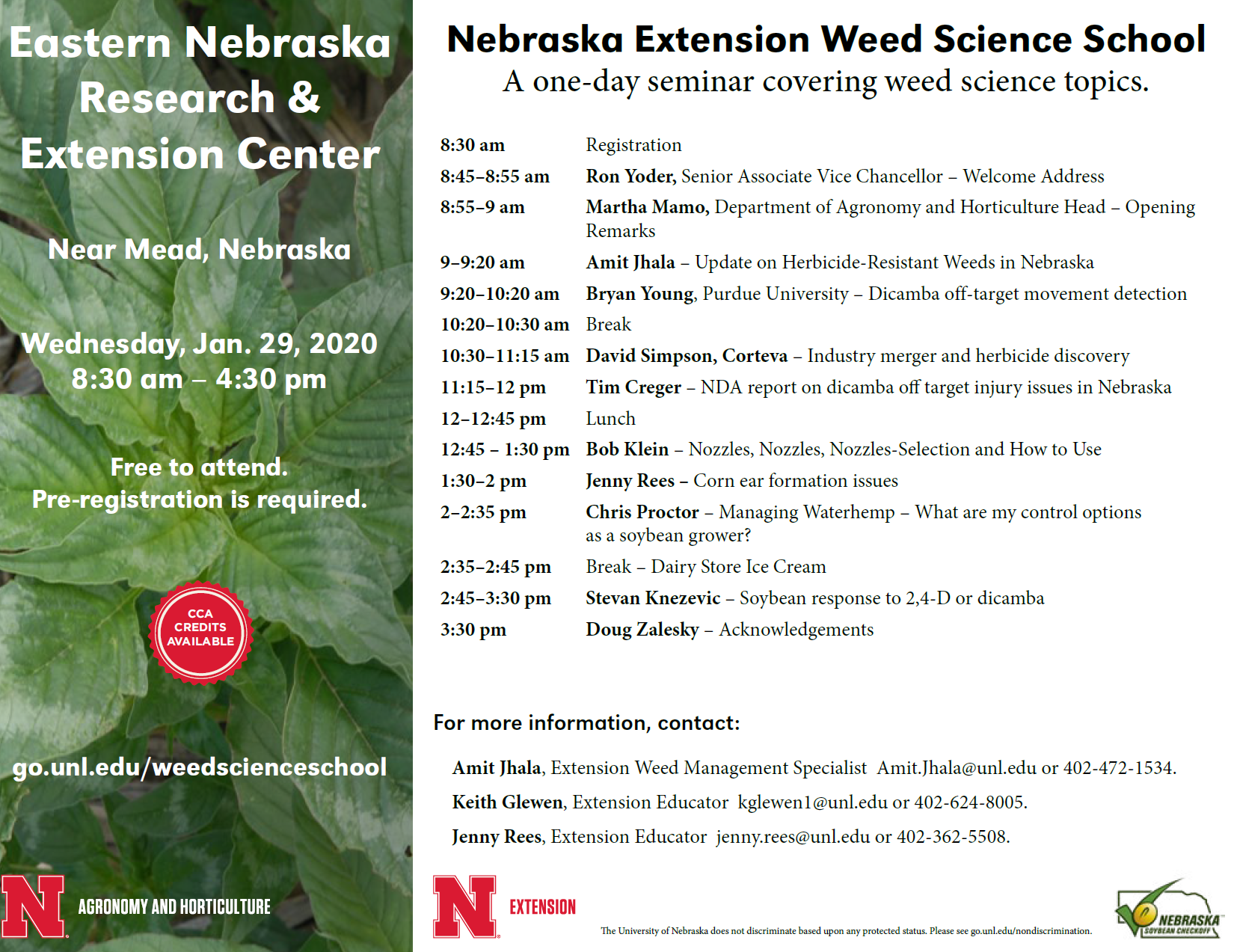
Weed Science School will be held at the Eastern Nebraska Research and Extension Center near Mead, starting at 8:30 a.m. and ending at 3.45 p.m. on January 29th. “Dr. Bryan Young, professor of weed science at the Purdue University is an invited speaker to present his research experience for dicamba off-target movement in soybean,” said Amit Jhala, extension weed management specialist and program coordinator. Tim Creger, pesticide/fertilizer program manager with the Nebraska Department of Agriculture, will be discussing NDA’s experience investigating dicamba complaints the last three years, including what evidence they look for, types of violations, and the regulatory action taken in response to violations. Additional topics include: Overview of Weed Control and Herbicide-Resistant Weeds in Nebraska (Amit Jhala); Herbicide Discovery in an Era of Industry Acquisition and Merger (David Simpson, senior product development manager, Corteva); Corn Ear Formation Issues (Jenny Rees); Soybean Response to 2,4-D or Dicamba (Stevan Knezevic); Weed Identification (Ethann Barnes and Parminder Chahal Agronomy research assistant and associate); Managing Waterhemp (Chris Proctor, weed science extension educator); Nozzles, Nozzles, Nozzles: Selection and How to Use (Bob Klein, Extension western Nebraska crops specialist). There is no cost to attend; register at https://agronomy.unl.edu/weedscienceschool. Certified Crop Advisor (CCA) Continuing Education Units will be available.


 JenResources