Blog Archives
System’s Approach to Soybean White Mold
Grateful for seasons, for fall, and that we have such beautiful fall colors this year! For whatever reason, it just doesn’t seem like we’ve seen colors like this for a few years and several have commented about the beauty this year. May we take time to notice the beauty around us each day! Also grateful for harvest being completed or nearing completion for many! Each day is one day closer to the end!

White Mold in Soybean: Sclerotinia sclerotiorum (the pathogen that causes white mold) impacts over 400 plant species from 75 families including soybean, dry bean, potato, sunflower, peas. Host weed species include: pigweeds, velvetleaf, henbit, lambsquarters, ragweeds, nightshades, mustards, sunflower. Cover crop hosts include: peas, lentils, turnips, radishes, collards, common vetch, (alfalfa and clover to a lesser extent). Just reading all that is discouraging. The fungus survives in a hard, black structure called a sclerotia that looks like mouse/rat droppings and can survive in the soil for 5 years (3 years in no-till fields). Frequent irrigation, plant wetness/fog/cool conditions at flowering (like we had in 2023), narrow rows, high plant populations, and cooler weather conditions of 46-75F allow the sclerotia to develop apothecia (look like circular tan mushrooms). Under a specific pressure, the apothecia shoot spores into the canopy where they infect the soybean plants whenever they land on senescing soybean flowers.
Flowering occurs from R1-R5 in indeterminant soybeans. Thus, why white mold is difficult to control and why we can see it develop so late into the year. The fungal infection moves from the flower into the stem, disrupting water transport. Thus, why you will often see plants that look wilted as an early symptom even before you see the signs of the white fungal growth. Wilting of plants leads to premature death impacting yields like we saw with large yield hits this past year. New sclerotia are formed within and also stick out of the plant stem and pods. They fall to the ground and the cycle continues when a susceptible host is grown.
So, what do we do about it? The following information is for fields that have a history of white mold. I’d suggest looking at this from a system’s approach. One piece is to consider varieties with disease resistance. I won’t argue that’s important. However, I’m honestly hesitant to start there as I’m unsure we have strong disease packages. And some defensive varieties give up too much yield. This is my perspective and I don’t expect people to agree. For now, I suggest finding the strongest yielding genetics first because there’s large yield variation in soybean.
From there, it becomes managing the other factors that can aid in disease. Manage weeds and avoid susceptible cover crops in the field. Crop rotation is not effective if it’s only a 2 year corn/soy rotation. While I realize they won’t work for everyone’s operation and they take more management, using small grains like cereal rye before soybeans is a tool that can help with both weed and disease suppression and doing so adds another crop to a 2 year rotation. Avoid irrigation at flowering (I realize 2023 was tough) and seek to irrigate deeper and less frequent.
There’s also tradeoffs within the system regarding row spacing for weed or disease control. Results from 18 site-years of research from Wisconsin, Michigan, Ohio, Indiana, and Iowa showed:
- If planting in row spacings of 15 inches or less and in fields with a history of white mold, use a seeding rate no greater than 110,000 seeds/ac.
- If planting in fields with a history of severe white mold, widen the row spacing to 30 inches and use a seeding rate no greater than 110,000 seeds/ac. UNL research shows you don’t give up yield with final plant stands at 100,000 plants/ac.
- Fungicide applications remain an effective tool for reducing white mold levels if applied between the R1 (most effective) and R3 (less effective) growth stages. Fungicides provide 0-60% control. They’re most effective if sprayed below the canopy.
- Not all fungicide products are equally effective at controlling white mold, with Endura® remaining the most effective product if applied between the correct growth stages.
- Consider downloading the Sporecaster app for white mold to better time fungicide apps based on weather conditions (found to be 81.8% accurate).
Most biological control agents should be applied at least 3 months before flowering for fungal colonization. Biological control agents and seed treatments such as Heads Up® were shown as effective tools to reduce severity of white mold and SDS based on Iowa State research. Plant nutrition is also showing promise and that’s something I’d like to try next year with a few growers; please let me know if you’re interested. Hydrogen peroxide products had little to no success in Wisconsin research (provided only 4 hours of activity killing spores). None of the things mentioned here are exclusive, but a combination of many of these factors as a system’s approach can help in the battle against white mold.
To view tables of the fungicide research results for white mold go to: https://cropprotectionnetwork.org/publications/modern-integrated-management-practices-for-controlling-white-mold-of-soybean
JenREES 8/15/21
Crop Update: It was great to see people at soybean management field days last week and to hear their experiences around cover crops and weed management! White mold in soybean was the primary question received last week. It was already heavy in some Butler and Polk county fields and has since increased in York county with calls over the weekend. I don’t get too concerned about managing different insects/pathogens/weeds as we have various management strategies for them. White mold, though, is a very difficult one to manage.
It’s a soil-borne disease in which the fungus survives in a black structure (sclerotia) that resembles mouse droppings. Rain events and irrigation during flowering can favor it along with extended dew periods and fog like we’ve experienced this year. If you see random plants in an area that are turning brown but remaining upright, look into the canopy and see if there’s white cottony fungal growth on the stem. You may also see the black sclerotia on either the outside or inside of the stems. It can continue to spread from plant to plant. Management right now includes managing soil moisture and irrigation. It’s important to keep the top portion of the soil as dry as possible (which I realize is practically impossible with heavy dews). When it comes to irrigation management, infrequent, heavy watering is better than light, frequent watering in heavy-textured soils. It’s a good idea to keep notes on areas of the field you’re seeing it this year so you’re aware of it the next time soybeans are planted.
Some cultural and crop rotation things going forward that may or may not fit for your operation, yet good to be aware of: No-till allows the sclerotia to die more quickly on the soil surface (within 2-3 years), whereas tillage allows sclerotia that are buried to survive longer. Also, as we think of cover crops and crop rotations, fields with a history of white mold should avoid rotations for 2-3 years with edible beans, field peas or other pulses, canola, turnips, radishes, sunflowers, or potatoes. Grass crops (corn and sorghum) and using small grains like wheat, rye, oats, etc. in rotation can help reduce the amount of sclerotia that survive. For more detailed information, check out: https://soybeanresearchinfo.com/soybean-disease/white-mold/.
Watch insects in soybeans regarding clipping pods; not seeing too much of that yet. Am seeing bean leaf beetles and grasshoppers in several counties. Saw woolly bear and green cloverworms in Nuckolls co. last week. I have no idea why Japanese beetles are still around for all who keep asking!
Have been seeing sudden death syndrome (SDS) for several weeks now. For those seeing it in fields where beans were treated with ILeVO or Saltro, the symptoms can still appear on beans treated with those products. In spite of this, from our on-farm research fields that had a history of SDS, the symptoms were less in the treated beans than the check treatment.
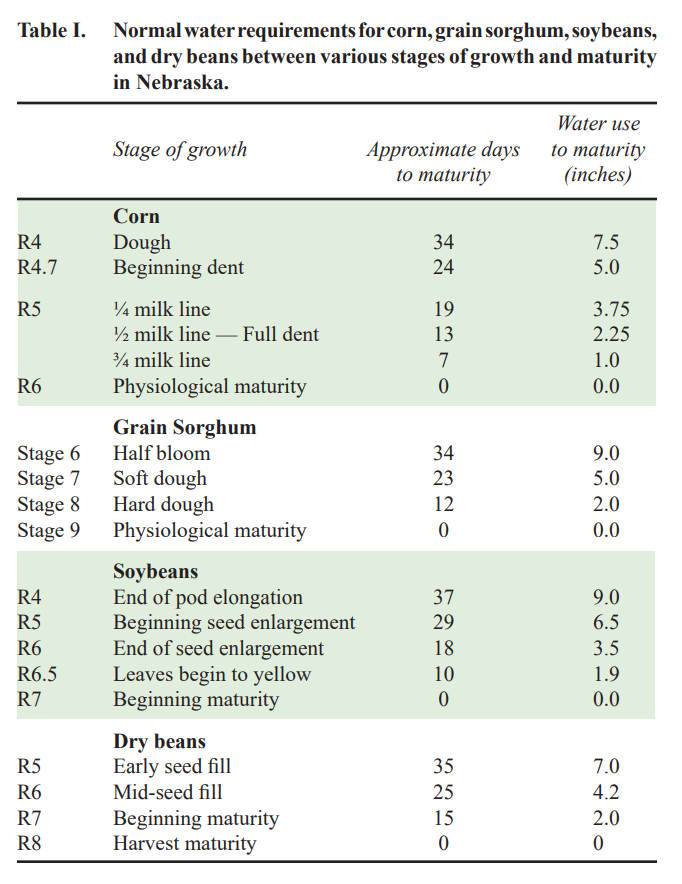
Mid-August brings a sigh of relief to many agronomists in getting closer to the end. I’m sure our farmers will be grateful to get to the end of irrigation season this year too. Many soybeans are at R5-R5.5 (can see seed development in pods on upper 4 nodes). At this point, flowering stops. Soybeans at R5 still need around 6.5” of moisture to finish. At R6 (full seed), that amount drops to 3.5”. We don’t talk about last irrigation yet for corn at milk stage. For fields at dough (R4), corn needs around 7.5” of moisture yet to finish and 5” at beginning dent.
Seward County Ag Banquet to be Held August 23: The Kiwanis Club of Seward partnered with SCCDP and Seward Co. Ag. Society will honor Seward County Ag Leaders on Monday, August 23, 2021 with our 53rd Annual Agriculture Recognition Banquet. The banquet begins with wine, cheese, and sausage at 5:30 p.m. and a prime rib meal at 6:30 p.m. Ag Promoter, Educator, and YouTube Sensation, Greg Peterson will be the evening’s entertainment. This event provides an excellent opportunity to recognize the importance of agriculture in Seward County. The evening will honor the Seward County farmers, producers, ag businesses and ag students for their continued economic contributions to our strong local agricultural economy. Due to COVID not allowing us to have a banquet in 2020, we will be honoring individuals and families selected in 2020 and 2021. Please contact Pam Moravec, Banquet Chair, 402-643-7748, or Shelly Hansen, 402- 643-3636 information about becoming a banquet sponsor. The cost to attend the banquet is $30.00 per person. You can contact Pam or Shelly to reserve you seat. The Kiwanis Club of Seward will use the proceeds from the event to support the youth of Seward County through a variety of programs and events, including the Agronomy Academy.


 JenResources