Blog Archives
2012 #Corn Yield Predictions
The past few weeks I’ve received questions on how the weather conditions are impacting corn yields. One way to help predict this is by running the Hybrid Maize model developed by researchers in the Agronomy and Horticulture Department at UNL. I ran Hybrid Maize model simulations for various planting dates in the Clay Center, NE area. This model predicts corn yields using weather data under “perfect conditions”-nothing such as nutrients or water is limited and there is no disease or insect pressure in these simulations. Reality is that all these things do occur. To use the model, I input current season weather data from the High Plains Regional Climate Center which allows me to compare the current growing season weather conditions and potential yield impacts to a long term median 30 years worth of weather and yield data.
For the simulations I ran right now using Clay Center weather data, I found that overall, we are trending below the 30 year median average yields for both irrigated and rainfed corn. Right now the long-term median yield for all irrigation simulations is trending towards 259 bu/ac at planting populations of 32,000 seeds/acre with 113 or 115 day relative maturities. The following are a few simulations and please check out this week’s CropWatch to view simulations across the Corn Belt. Click on the images below to view them closer up. Compare the 2012 median yield line (in red) to the long-term median line (yellow).
- Mar. 27 planting date, 115 day rm: Best yield 300 bu/ac. Predicted mean is 241 bu/ac.
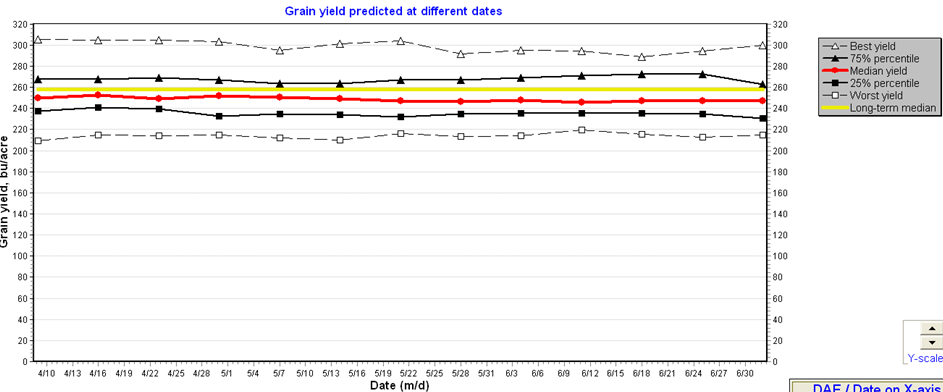
- Apr. 15 planting date, 113 day rm: Best yield 293 bu/ac. Predicted mean is 242 bu/ac.

- Apr. 15 planting date, 115 day rm: Best yield 200 bu/ac. Predicted mean is 253 bu/ac.
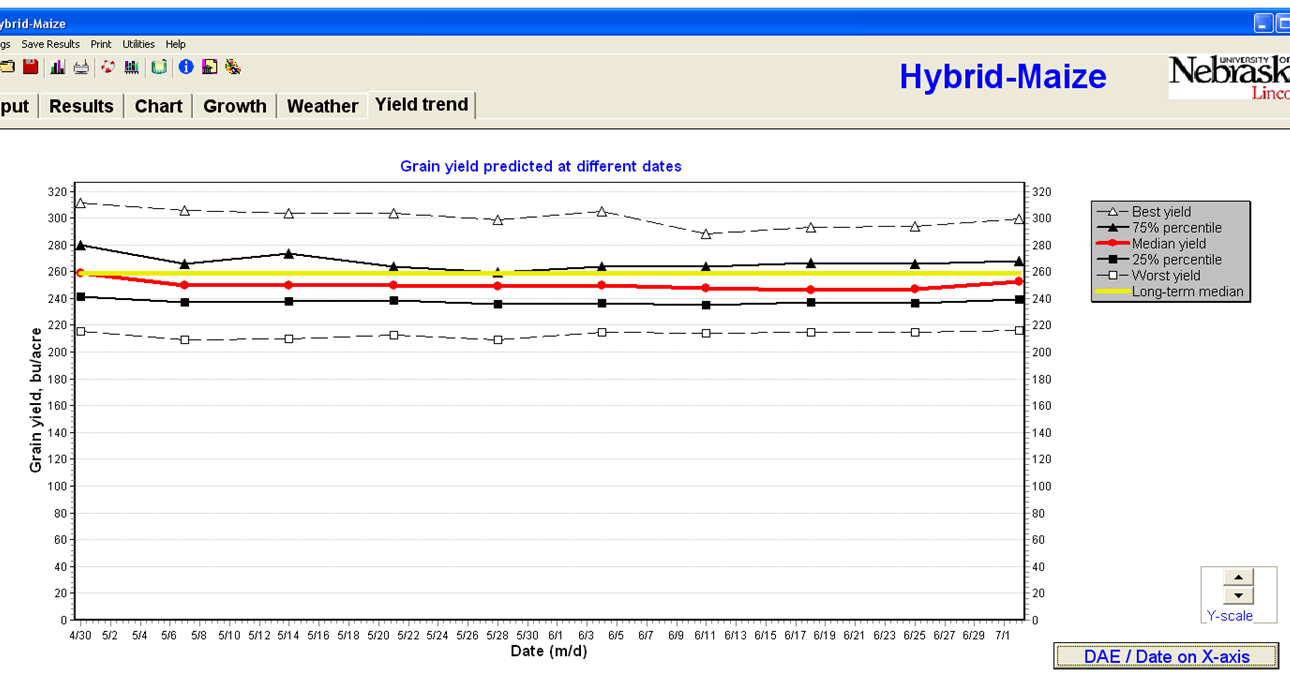
- May 1 planting date, 113 day rm: Best yield is 286 bu/ac. Predicted mean is 248 bu/ac.

- May 1 planting date, 115 day rm: Best yield is 293 bu/ac. Predicted mean is 252 bu/ac.

- May 15 planting date, 113 day rm: Best yield is 310 bu/ac. Predicted mean is 253 bu/ac.
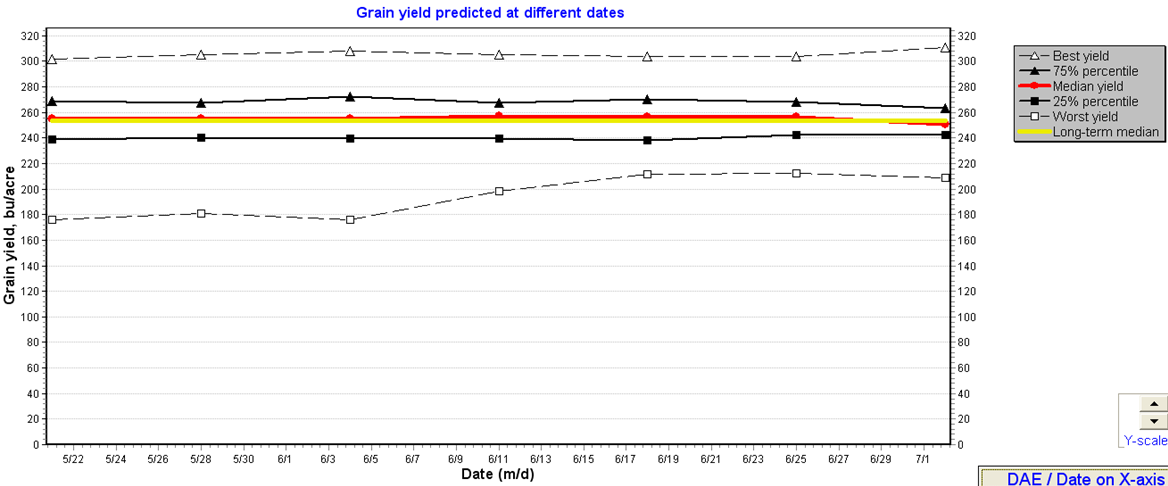
The best comparison is the predicted mean to the long-term median so right now we’re seeing a slight drop below the long-term median for all the planting dates and relative maturities run in these simulations. However, if we receive cooler night-time temperatures and a longer fill period like last year, we may see these yield trends turn up.
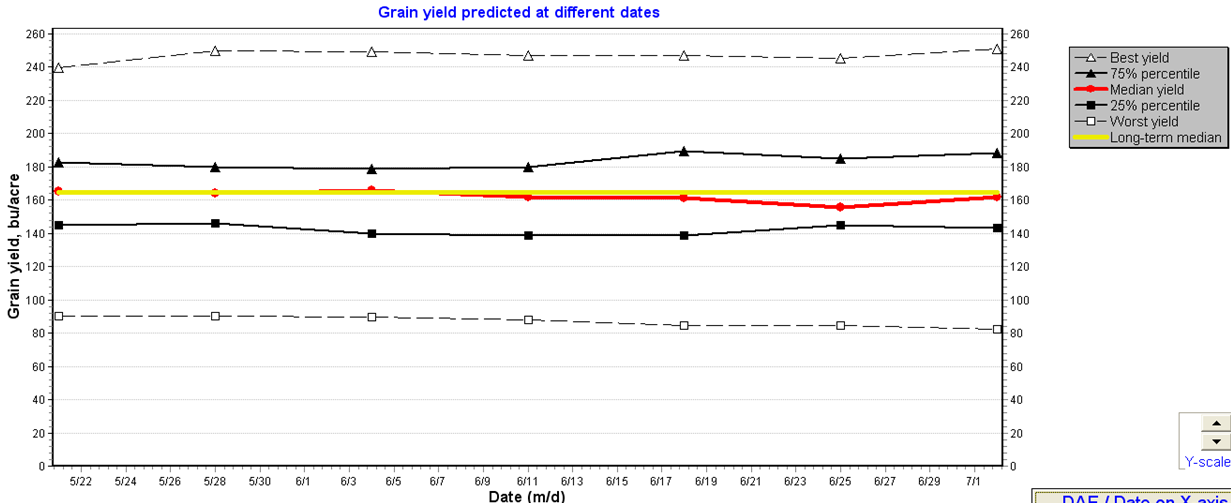
For rainfed conditions, I did not run optimal simulations. I ran real-time water limited situations assuming full soil moisture from 0-40” into the profile at the beginning of the season. Here are the results for a planting population of 22,000 plants/acre with 113 day relative maturities:
- Mar. 27 planting date, 115 day rm: Best yield is 202 bu/ac. Predicted mean is 140 bu/ac vs. long term median of 163 bu/ac.
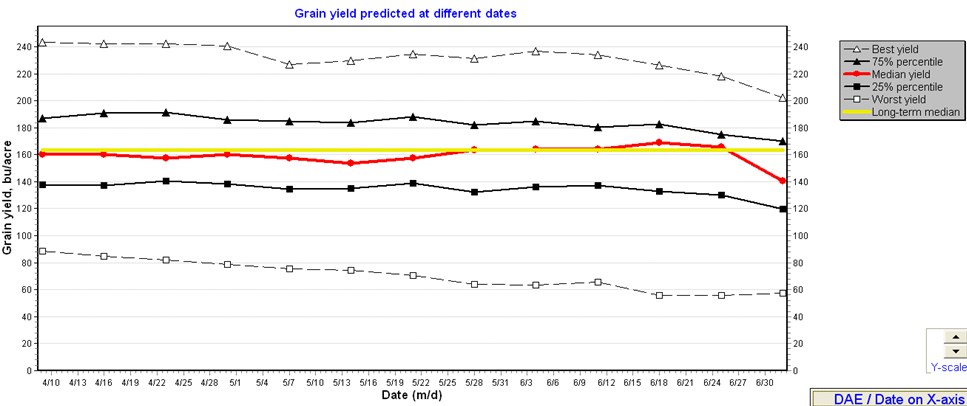
- April 15 planting date, 113 day rm: Best yield is 224 bu/ac. Predicted mean is 146 bu/ac vs. long term median of 167 bu/ac.

- May 1 planting date, 113 day rm: Best yield is 223 bu/ac. Predicted mean is 152 bu vs. long term median of 167 bu/ac.
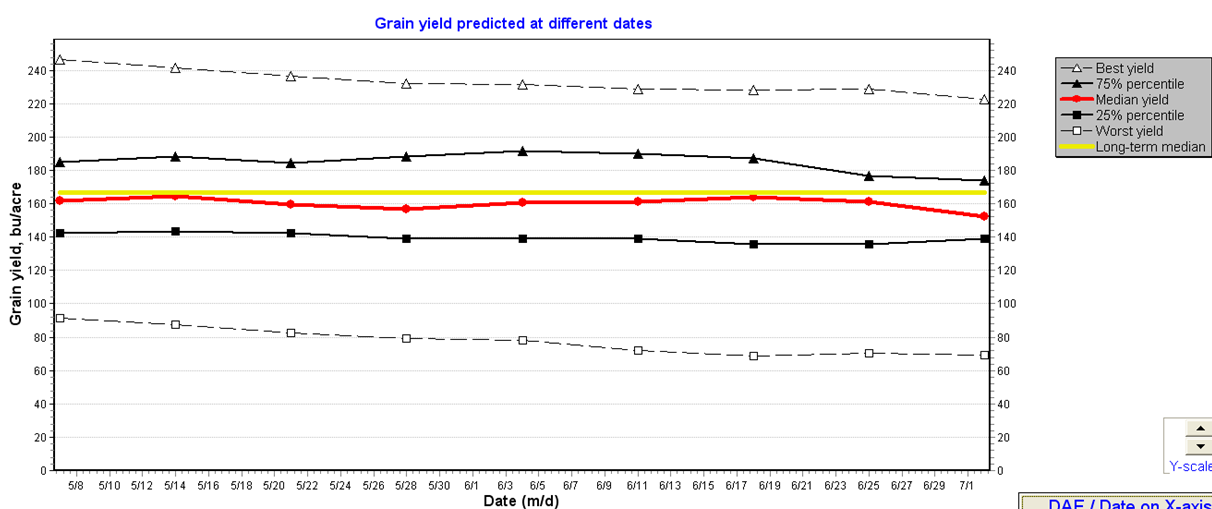
- May 15 planting date, 113 day rm: Best yield is 250 bu/ac. Predicted mean is 161 vs. long term median of 165 bu/ac.
Predicted 2011 Corn Yields
Well, it was great to take a week off and the weather sure was nice in Colorado! It seems like it was a poor week to miss in regards to crop happenings, though. Several of you have been asking for a month now for me to run the Hybrid-Maize model for 2011 corn yield predictions and I just haven’t taken the time to relearn how to input the current weather file and run the simulations-but I did tonight.
In my May 1 post, I was showing impact of planting date on yield- essentially we weren’t seeing much based on the models. At the time I showed potential yield results of: 113 day hybrid planted April 15 vs. May 1 vs. May 10, the frost risk increased from 10%, 17%, and 21% respectively with average yields in a “perfect year-no limiting conditions” of 248, 254, and 244 bu/acre respectively. For a 110 day hybrid planted the same days, yields ranged from 233, 242, and 243
 bu/acre respectively with frost risks of 3%, 10%, and 17% respectively. Granted this is just a model and can’t predict perfectly what will happen.
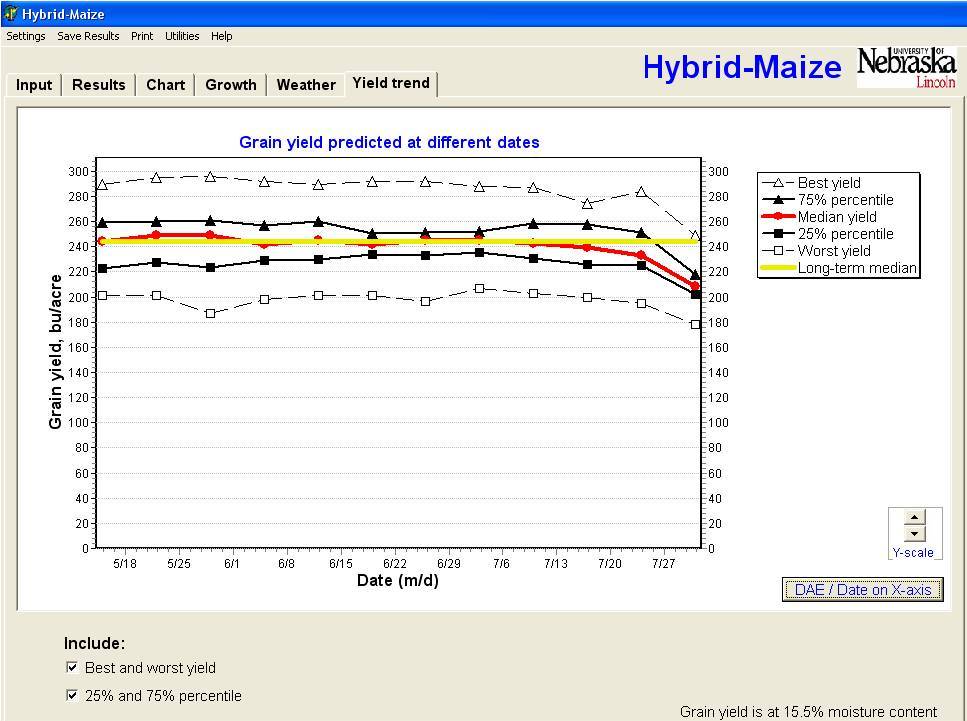
Again, I’ll repeat it’s just a model and is looking at “a perfect year with no limiting conditions”. I already knew we wouldn’t be looking at record yields. The corn had looked even and good for the most part once it got taller, but it hid the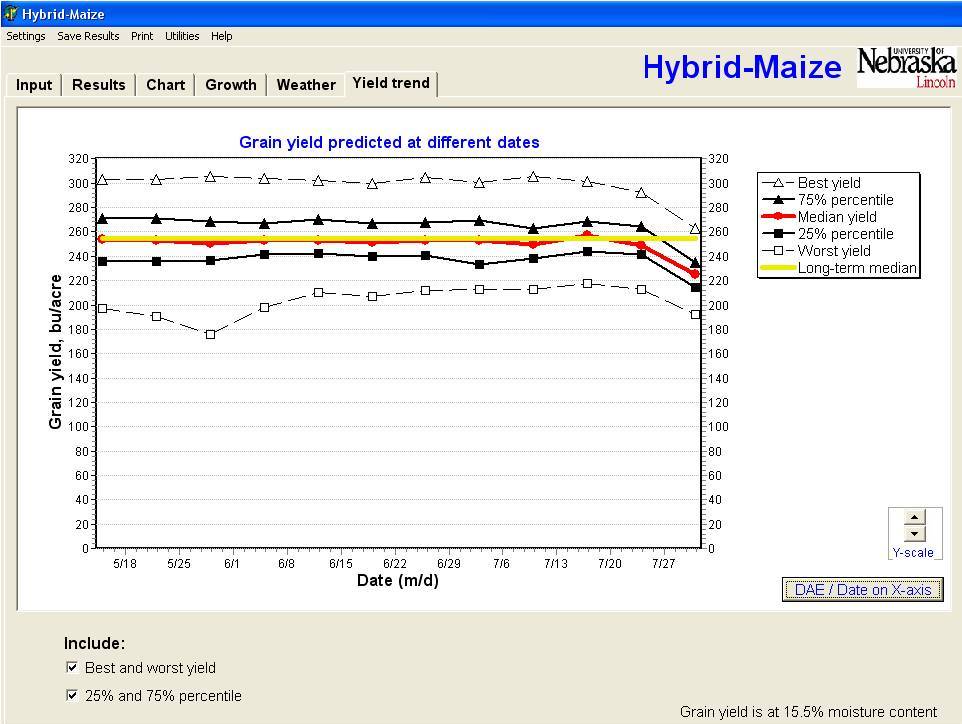 many problems including stand problems from rain washing, residue, Pythium, greensnap, etc. Looking at the actual weather data (from Clay Center, NE station), night time temperatures were really high and may have led to the sharp predicted drop off in yields. I remember well the one hot, dry, non-humid week in August 2010. The model showed a sharp yield reduction then and the corn essentially shut down after that. I hope it doesn’t shut down after last week. The other caveat is that I used “generic” hybrids, did not input specific GDD’s or silking dates, and a planting population of 32,000 plants/acre. Changing any or all of these factors can influence what the model predicts for yield.
Prior to last week, the average yield for 2011 based on Clay Center weather data was tracking at or slightly above the long term 30 year average yields which were similar to the predicted yields I listed above when I ran the simulations for planting dates. For the 2011 season, a 113 day hybrid planted April 15 vs. May 1 vs. May 10 based on in-season weather conditions at this point may yield 221, 225, and 236 bu/acre respectively. A 110 day hybrid planted the same days based on in-season weather conditions at this point may yield 214, 208, and 225 bu/acre. I don’t mean to get anyone
 bummed about this year’s crop-again, this is just a model! I’m just sharing as several have asked me to and it did such a good job of predicting in-season yields last year. It’s also predicting maturity really early-within the first two weeks of September this year which can affect grain fill and ultimately yield as well.


 JenResources