Monthly Archives: June 2024
JenREES 6/30/24

Holiday Food Safety: The Fourth of July is the most popular U.S. holiday for grilling, according to a 2020 survey of American grill owners. Some 68 percent of respondents like to throw barbecue parties on that day. Food safety can be challenging when eating outside. Did you know that you are more likely to get food poisoning (foodborne illness) during the summer months than any other time of the year? Given the right environment, harmful bacteria can quickly multiply on food to large numbers. To prevent a food borne illness, check out this resource: https://go.unl.edu/o2n0.
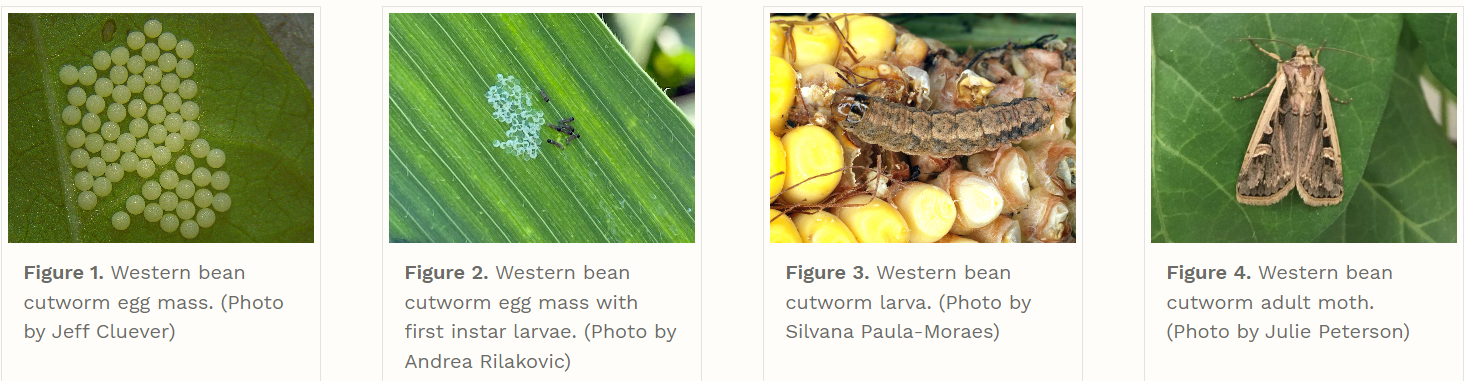
Western Bean Cutworm GDDs: With corn beginning to near tasseling, it’s time to be scouting corn for western bean cutworms. The updated Western Bean Cutworm degree day model was developed in Nebraska by Drs. Bob Wright and Tom Hunt in collaboration with entomologists in Minnesota. It’s really done a good job the past few years. The model is based on a lower threshold of 38°F and upper threshold of 75°F beginning on March 1. It’s recommended to start scouting when 25% of moth flight occurs based on accumulating 2,577 degree-days. Lincoln hit 25% on June 29th, Grand Island is predicted to reach 25% on July 4, Columbus July 5, York July 6th, and Clay Center July 6th. The economic threshold is 5-8% egg masses/live larvae.
When scouting, we typically find western bean cutworm egg masses on upper leaf surfaces of corn leaves with masses containing 50-85 eggs. Normally we’re taught to look at the upper portion of the plants closer to the tassels, but with silks emerging prior to tassels most of the time, I tend to also find masses on leaves around the ear leaf and sometimes directly on the husks (especially during periods of high heat). Egg masses are white and raised when newly hatched; they turn a purplish color when they’re getting closer to hatching. Larvae have two dark rectangular spots right behind their heads. More western bean cutworm info. including the dates for predicted flight moth percentages can be found at: https://go.unl.edu/60s2. You can view all the light trap data throughout the State at: https://entomology.unl.edu/fldcrops/lightrap.
Fertigating during pollination is ok. Dr. Tom Hoegemeyer had shared that pollination mostly occurs between 8:30 a.m. and noon. Heat kills pollen when the temperature is 90°F to 95°F and is seldom viable past 2 p.m. That leaves lots of time to run pivots, apply N, etc. when it won’t harm pollination. Silks tend to be viable for three or four days at these temperatures, so if a plant isn’t pollinated one day, generally the next day will work just fine. The UNL recommendation for fertigation is to use 30 lb of N with 0.25″ of water or 50-60 lb of N with 0.50″ of water. With a high capacity pump, you can apply up to 60 lb of N in 0.25” of water.

Earwigs: These insects look menacing. There’s been several calls on them. Indoors, they seek areas with moisture like basements, bathrooms, etc. They don’t harm humans or pets as they only feed on living and dead plants and small insects. They get into homes via cracks/crevices and often one tends to see them more when there’s a lot of landscaping around the home with cracks in the foundation, gutters that aren’t cleaned out, etc. Prevention includes caulking, sealant or weather stripping to eliminate pest entry. Perimeter sprays (ex. Ortho Home Defense) or any that list earwigs can help. Water landscaping around the home earlier in the day (as they’re active during the evening). For more info., please visit the following resource: https://go.unl.edu/n2kc.
Japanese Beetle Management Resource: https://go.unl.edu/xgd6.
4 R’s of Nutrient Management Field Day will be held July 11th. More info: https://go.unl.edu/c5d2.
(end of news column)
Cover Crop Survey: Researchers at Kansas State University are asking 15-30 Nebraska farmers to take a questionnaire about video messages related to cover crops, regardless of your current use of cover crops. This questionnaire will take you about 10 minutes to complete; it measures knowledge and perceptions about cover crops, and after watching a 90-second video about cover crops, there are several questions about your reactions to the video message. After receiving your response to these questions, along with your feedback about the questions, we will send the questionnaire to Kansas farmers as part of a research study. Thank you for your time and feedback. If you have any questions related to this study, please feel free to contact Katie Starzec.
Odd Crop Things
I’m grateful for the good start to the growing season that many in the area I serve have experienced thus far. Soybeans have started flowering or will soon. Earliest planted corn isn’t far from tassel! Some areas continue to miss rain and other areas get far too much. For those dealing with flooding, the following are some rules of thumb:
- Corn Prior to V6: Plants can survive under water for 2-4 days if temperatures do not exceed 77°F.
- V7—V10: Plants can survive 7-10 days if temperatures do not exceed 86°F.
- VT—R1: Reduced nutrient uptake and successful pollination if standing water is present longer than 2-4 days. Yield losses may occur.
- Soybeans: Yield losses minimal if flooding lasts less than 48 hours. Flooded for 4-5 days, fewer nodes develop and plants will be shorter; possible stand and yield loss beyond that.
- Soybeans at flowering: Potential yield loss, especially on poorly drained soils.
We’ve seen several oddities this year in crops, which I haven’t talked much about, but a crop consultant suggested I should write a column on them. The following have been found from Saunders County through the Gothenburg area this year.
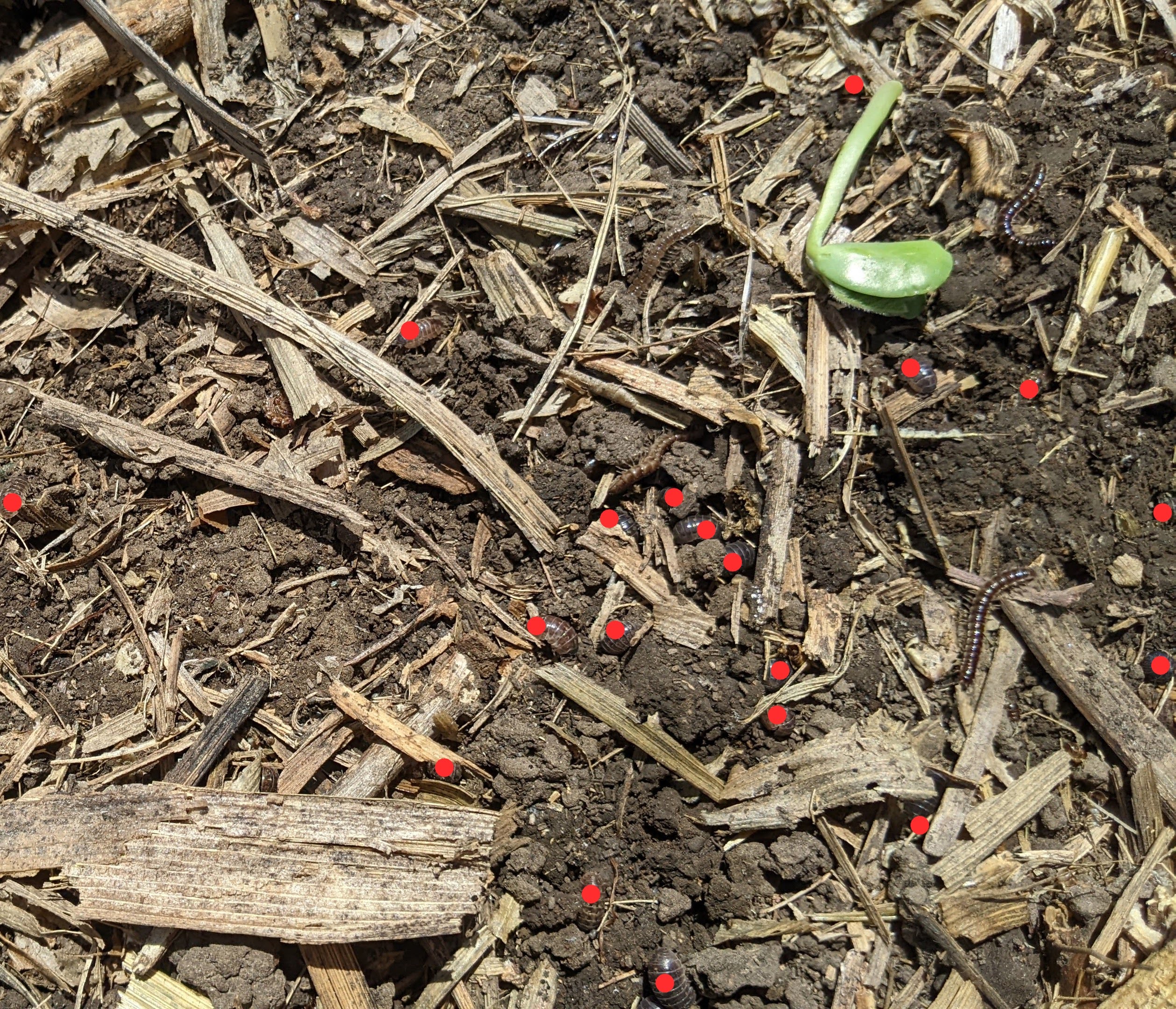
The warm February, reminiscent of 2017, provided the potential for greater insects. Thankfully haven’t seen more than 10% damage from wheat stem maggots to corn planted green into small grains (compared to 2017). Pill bugs (roly polys) and centipedes which typically feed on decaying material and other small insects/spiders, respectfully, have caused damage to soybeans in some fields. I’ve never seen these numbers nor damage before! However, this year, in heavy residue fields, we’ve observed them eating soybeans to the point of fields needing replanting. Slugs and snails have plagued some double crop small grain/soybean fields with one consultant sending me a picture of a planter bar loaded with snails.
Been some issues with seed germination in some hybrids/seed lots. Heard situations of non-liberty tolerant refuge in liberty link corn hybrids. There’s also the failing to remember which trait is in which field before spraying herbicides, so a reminder to double check that before herbicide applications occur. There’s been a lot of uneven corn within rows this year. Each field has various circumstances, but common culprits have been: solar storm throwing off GPS which got seeds too close to fertilizer bands; residue blowing back over portions of rows; planting depth and/or sidewall compaction issues; seed issues; and “weaker” corn plants having a hard time outgrowing HPPD (bleacher chemistry) herbicides in portions of fields. With corn rapidly growing and canopying, unevenness in fields doesn’t look as bad anymore. Overall, these oddities are few and I’m grateful for a good start to this growing season!
Japanese beetles are unfortunately starting to appear. Reminder: don’t use traps as they attract more beetles to your yard! Beetles can be knocked off plants into soapy water in the evening hours and disposed of. The following contains conventional and organic insecticide information: https://go.unl.edu/xgd6.
Reflection: Some know that I’ve been out off/on helping family and I’m grateful for that opportunity. We had celebrated making it through each surgery with Cheesecake Factory Cheesecake and are praising the Lord for healing😊As I drove home this weekend from celebrating family birthdays, I was reminded again how blessed we are to live this life and how short it truly is. How often we miss the little things or don’t take time to celebrate! Some recent conversations included how often the china stays in the cupboard, taking time to smell a blooming flower instead of just walking by or just stopping to admire a sunrise/sunset. Simple things. But I think the result is gratitude. This week, perhaps we can seek to live life more intentionally with the people around us.
Reminder of Weed Management Field Day at South Central Ag Lab near Clay Center June 26!


Windbreak Care
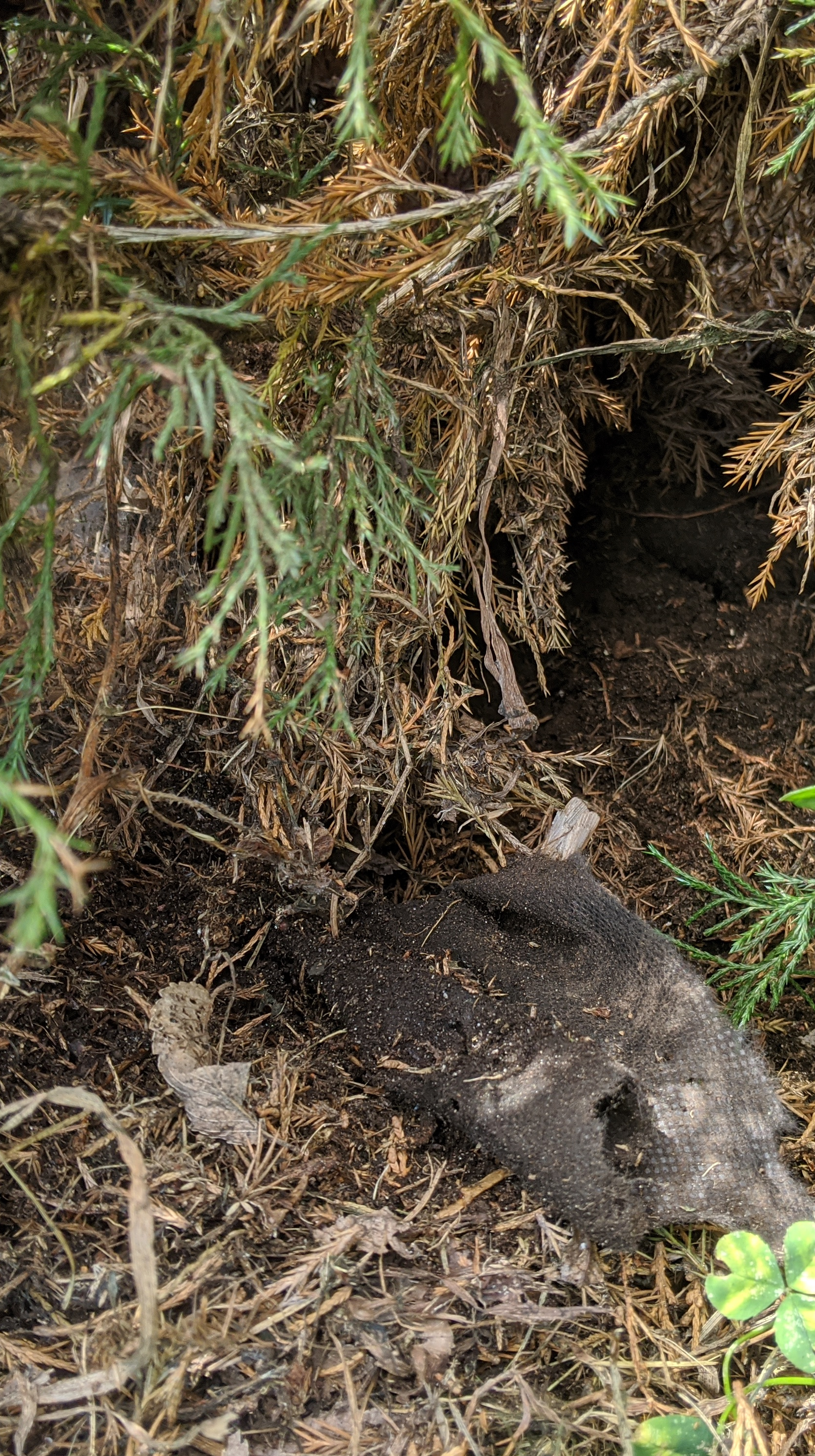
Windbreak Care: With new windbreak establishment, I’ve been seeing some transplant shock where the needles, twigs, and entire seedlings were turning brown. In talking with a district forester, he shared that environmental stresses of tree planting are likely when considering the trees are going from a 36F cooler and planted when air temperatures were in the 70’s and 80’s. He also mentioned two other environmental culprits to browning of needles: air pockets in the soil around the tree roots and/or planting depth issues. To get a feel if trees will survive or not, gently bend twigs to see if they are flexible or brittle. If flexible, they should still survive. If brittle, check on several tree twigs to see if there are a few twigs that won’t survive on the majority of the tree. In the case of the new transplants I looked at, the twigs were still pliable and not brittle. Also look closely at the axillary buds (where twigs meet the main stem) to determine if any new green bud growth is present. I saw new buds on most of the newly planted trees I’ve looked at, which is good and shows they will hopefully look greener in 3-4 weeks. Photos of what I’m describing are at: https://jenreesources.com.
In established windbreaks, I continue to find the problem of landscape fabric harming and killing trees that are 7-20 years established. For anyone with windbreaks where landscape fabric was placed, I’d encourage you to wear gloves and long sleeves and check under the trees for the following things. (Also watch for critters as you get under the trees and examine them!)
1-The “brome mat”…or essentially a mat of needles, grass, weeds that create a mat on top of the fabric beneath the tree. This mat makes it hard to find the fabric and keeps one from realizing the problem that’s occurring. The mat prevents any decomposition of the fabric and prevents moisture from getting to the tree. Many are surprised how dry the soil is under the fabric where the mat was.
2-Check to see where the fabric is in comparison to the tree trunk. Normally I find the fabric growing into the trunk of the tree as the fabric doesn’t expand as the trunk enlarges. This creates a “girdling” effect where the tree essentially chokes itself. Often when I’m called out to established windbreaks that are suddenly dying or where the needles are browning, the landscape fabric and girdling of the trunks is partly the culprit.
So what can you do? Windbreak maintenance. For anyone who has windbreaks where fabric for weed barrier was placed, it should be removed no longer than 5 years after the trees are planted. For those who had windbreaks planted in the past 1-3 years, you really should go and cut the holes larger around each tree if you’re not removing the fabric yet. What I kept finding this year is that the trees were placed against one side of the fabric compared to the center of the holes, which can also create problems down the road with girdling. For those with more established windbreaks, do your best to remove the weed barrier fabric now. It will take harder work and effort to get under the trees and cut the fabric. Some were using anything with hooks to try to grab and pull it loose-but sometimes it’s hard to find the fabric with the mat layer. Some were then using loaders to pull the fabric between trees in the row. Again, it’s hard work and not fun with how poky the needles are, but it will help you in saving your trees.
For those who chose to not use the weed barrier fabric, wood chips can be used instead as long as they are kept 3-5” from the tree trunk. It takes a lot of wood chips for a windbreak, so they often are not used in those situations even though they’d be recommended. It’s not recommended to use grass clippings or straw as those mulches can attract rodents that can cause damage to new seedlings. Planting directly into the grass is also an option, or killing the grass directly where the trees will be planted is an option for weed control as well. The brome will compete with the seedlings for moisture and the trees may establish more slowly as a result. For more specific information on windbreak care, including information on insects and diseases, please see the following publication: https://nfs.unl.edu/publications/windbreak-management.

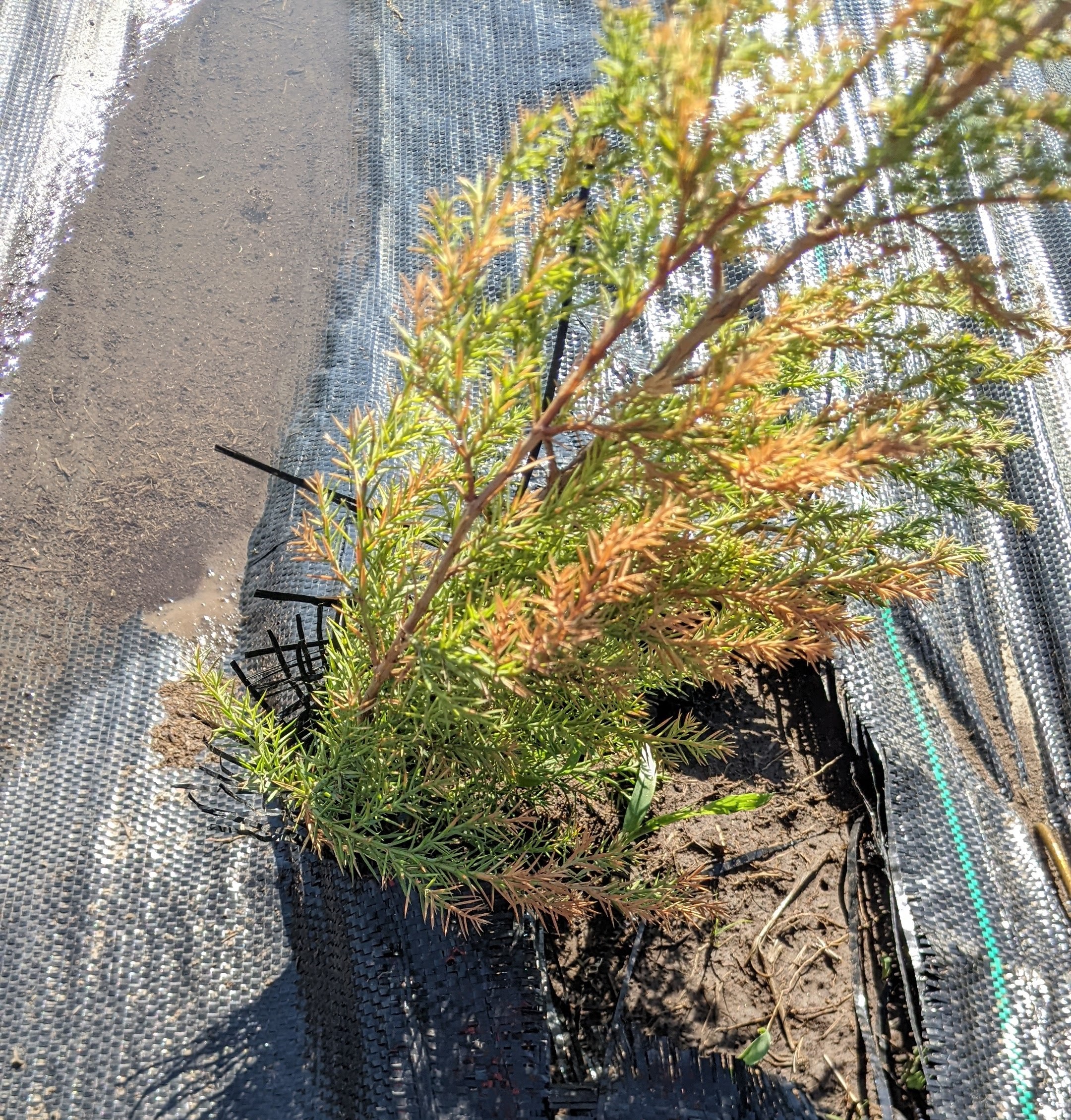
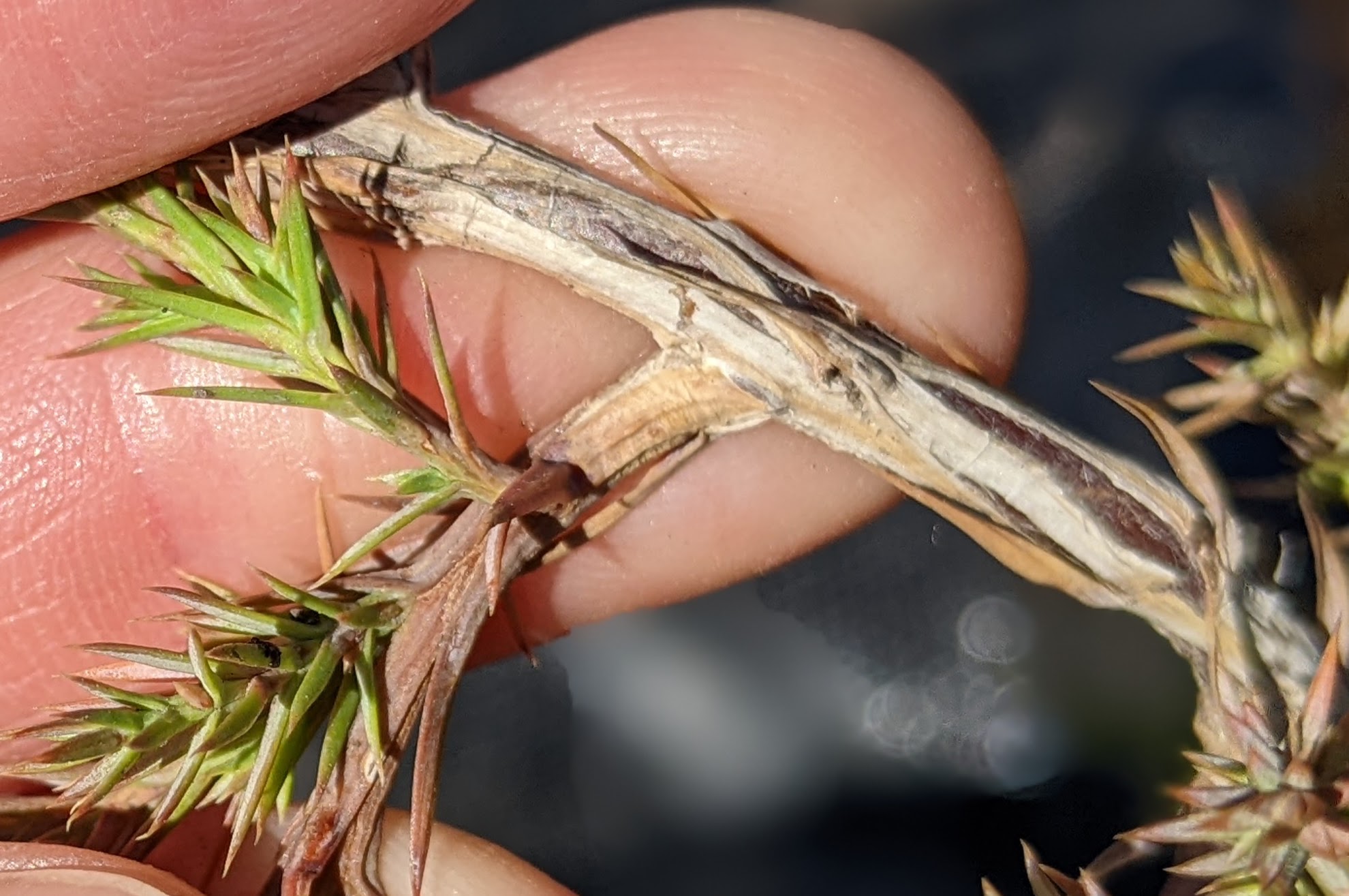
New growth observed in axillary buds on this tree seedling. It should look greener in 3-4 weeks.
JenREES 6/10/24
The scent of linden trees has been extra heavenly this spring! Am also grateful for the rains received and that we avoided a repeat of June 7, 2022.
Ground squirrels: The biggest question/complaint/concern I’ve received this spring is on ground squirrels as it seems they’ve been especially destructive to corn. In talking with various farmers and extension people about additional options for management, I heard the following: plant deeper (a couple plant 2 ¾” as they will dig to 2 ½”), get a badger!, and the majority try to bait holes and then replant. Zinc phosphide is labeled for use for ground squirrels. Nathan Mueller shared a pre-plant option with me (ZP® Rodent Bait AG) for consideration for next year. That product can be applied pre-plant or at planting according to labeled instructions.
Pill bugs/Roly Polys: I hadn’t mentioned this as a problem as I wasn’t aware anyone in our area was dealing with this. We did hear of some issues of pill bugs impacting soybeans in the Saline Co. area, but received a few comments about this in nearby counties last week too. Pill bugs are crustaceans that decompose organic matter. Often we see them under leaf litter, rocks, etc. in gardens and around homes. They are not considered a pest in general as they just decompose residue. However, there’s been reports of them munching on soybean hypocotyls in fields with a high amount of corn residue this year. More information can be found in this article: https://go.unl.edu/52n8.
Lawn clippings around plants: Many homeowners apply herbicides (or pay a company to apply them) to their lawns. Herbicides include products that control dandelions, clover, and other weeds in lawns. They are also contained in “weed and feed” products. Most of these herbicides have restrictions that require at least 3-4 mowings of the lawn (so essentially think 3-4 weeks) before lawn clippings can be placed around garden plants. Samples and pictures I’ve received of dying and/or curling leaves on tomatoes, peppers, potatoes, and flowers the past few weeks have all been attributed to people placing lawn mulch around plants too soon.
Mulch and termites: Does using wood mulch around the home attract termites? No as the chipping process kills termites. The most noted study was conducted by Long, et al. in 2001 which compared different types of mulches. They found termites prefer higher nutrient woody materials like cardboard placed under inorganic mulches like pea gravel compared to wood or needle mulch. However, mulches can create a hospitable environment for subterranean termites already established in the soil near the home or building. Termites prefer a moist environment, so soil desiccation (letting the soil dry) near the house foundation is an important barrier. Some keys with applying mulch include: don’t apply more than 2” thick layer of mulch in landscape beds, ensure a 6” gap between the top of the mulch layer and the house siding, and avoid watering mulch or soil close the house foundation walls. Mulch can be applied up to the house foundation to within 12” of the foundation. One may also consult a professional to set up monitoring or barrier control methods for termites around the home or building. The following guide has additional helpful thoughts on termite prevention and control: https://edis.ifas.ufl.edu/publication/IN1277.
Second Tuesday at 9 Weather Updates: Join Eric Hunt, agricultural meteorology and climate resilience extension educator, at 9 a.m. CT/8 a.m. MT on the second Tuesday of each month to hear insights on weather conditions across the state of Nebraska and Midwestern region, and updates on the long-range outlook. Participants will also have the opportunity to ask questions during the webinar, using the Q&A function in Zoom. Questions will be answered near the end of the webinar, as time permits. First webinar is this Tuesday, June 11th. Registration and recordings at: https://cropwatch.unl.edu/second-tuesday-9 .
June 2024 Events
Happy June! This week sharing on June upcoming events.
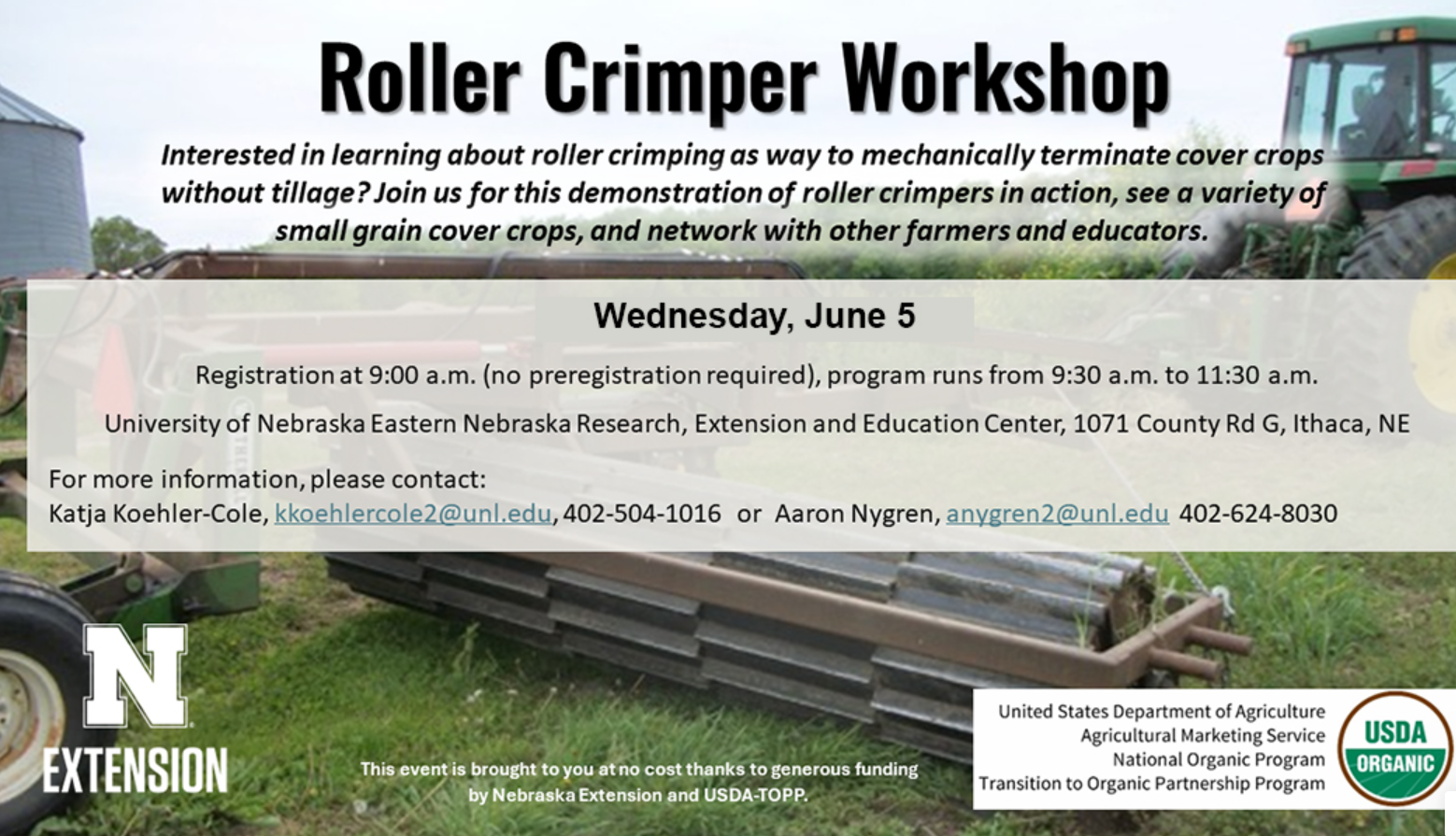
Roller crimping workshop will be held June 5th from 9:30-11:30 a.m. (Registration at 9 a.m.) at the Eastern Nebraska Research, Extension and Education Center, 1071 County Rd G, Ithaca. No pre-registration necessary and anyone interested in learning and/or sharing their experiences is welcome. During this short program, we will show a roller crimper in action, invite farmers to share their experiences with crimping, and discuss what conditions must be met to be successful with this termination method. Demo plots include barley, oats, rye, triticale, and wheat.
Progressive Ag Safety Day: Youth ages 5-14 are invited to attend the Progressive Ag Safety Day at the Fairgrounds in York on June 11 from 8:30 a.m.-1 p.m. Safety topics include: Electrical, grain, sun, drug, equipment, and water safety. Registration fee is $5 which includes lunch, snacks, t-shirt, and goody bag. RSVP by calling 402-362-5508. This event sponsored by York Co. Farm Bureau and York Co. Extension.
SCAL Weed Management Field Day: Growers, crop consultants and educators are encouraged to attend Nebraska Extension’s Weed Management Field Day from 9 a.m. to 1 p.m. (Registration at 8:30 a.m.) June 26 at the South Central Agricultural Laboratory near Clay Center. It’s located five miles west of the intersection of Highways 14 and 6, or 13 miles east of Hastings on Highway 6. GPS coordinates for the field day site: 40.57539, -98.13776.
The field day includes on-site demonstrations of new technology and new herbicides for corn, soybean and sorghum. Projects include using cover crops such as cereal rye or interseeding small grains (wheat, oat, barley) for weed suppression, See and Spray Precision Sprayer, iGrowth and INZEN sorghum. Attending this field day will provide an opportunity to stakeholders to learn about management of herbicide-resistant weeds. There is no cost to attend, but participants are asked to pre-register online at https://agronomy.unl.edu/fieldday. CCA credits are available.
Paraquat Trainings: Syngenta is offering Paraquat Training Webinars for June 2024 for those who plan to apply this herbicide this year. The trainings are held from 1-2 p.m. CST on: June 5, 18, 20, 25, 26. Registration is required at: https://syngenta.zoom.us/webinar/register/WN_Gh1T5t4tTS-S3QbFJUJe-w#/registration. Registration will require: first and last name, email address, state, and pesticide certification license number. There is a mandatory quiz at the end of the webinar that will be conducted thru zoom, so you need to stay on until the end of the webinar.
Yellow Nutsedge Control: Kelly Feehan shared the following, “It is time for yellow nutsedge control if using herbicide for control. While we may not be able to see much sedge yet, it is starting growth and control from first week of June up to June 21st is important. Yellow nutsedge is the yellow grass-like plant with waxy blades that grows taller than Kentucky bluegrass. Larger plants are most noticeable after June. This perennial sedge begins to emerge from underground tubers in late May. To help reduce nutsedge, mow tall at 3.5 inches, and avoid overwatering. Hand-pulling can be effective where there are very few plants. If herbicides are used, products containing sulfentrazone, known as Dismiss, halosulfuron or Sedge-Hammer, and mesotrione such as Tenacity are labeled for postemergence control in cool-season turfgrasses. As always, follow all label directions.”


 JenResources