Monthly Archives: February 2026
Crop Ground to Annual Forage Grazing
Converting Crop Ground to Annual Forage Grazing: A handful of producers have been doing this in the area with more considering it for 2026. Why? With the high input costs and low commodity prices, producers are searching for alternatives. The economics of grazing covers is good compared to planting corn and soybeans. Pencil it out for your operation. Input costs for grazing annual forages include cover crop seed and seeding, land costs, potentially one herbicide application between rye and planting a summer cover crop, water and fence infrastructure, and irrigation for establishing covers on irrigated ground. Here’s a potential rotation to make this work: rye planted in the fall or oats planted in March. Strip graze the rye or oats in April-May. Plant a summer annual cover crop mix in June/early July. Strip-graze the summer mix in late July-October. Some people will move livestock off the crop ground between light frosts until a hard freeze if sorghum species are in the summer mix (to avoid any prussic acid poisoning). Then livestock can continue grazing any remaining forage after frost with minimal loss in quality. If cool season cereals like rye/wheat/oats were added to the summer mix, they will come on in the fall and add additional quality to the forage into the winter. Or, a cool season cereal can be planted in the fall after the summer annual forages are grazed off. There’s multiple options for doing this!
Those cash renting ground were often able to pay for the cash rent of irrigated or non-irrigated crop ground in 1 to 2 grazings. How to figure costs? UNL farm real estate reports share an average cost of $68/cow-calf pair/month to graze on pasture in Eastern and Central NE. Annual forages would have a higher quality, so that should be taken into consideration for the value received. If you would graze cattle for someone else, such as grazing custom cattle, you can expect to receive anywhere between $1.50-$2.50/1000 lbs of cow (standard animal unit)/day depending on one’s location. This is also the value you’re creating if you’re using your own cattle to graze the covers. If you own cattle and want to retain your calves and add weight after weaning, consider putting the calves on the forages for the highest value return and gains. Pencil it out for your operation. We converted half our crop acres this year to forages for custom grazing cows. And, the benefits are beyond a single year of economics. I’ve seen how strip-grazing plants with animals can improve ground through improving pH, improving water infiltration through better soil aggregation, increased soil microbial communities, and nutrient release. A risk for consideration is lack of rainfall on non-irrigated ground to establish covers and maintain growth. Producers will also share specific examples with their economics on this Friday’s Feb. 27th conversation from 10-noon at the 4-H Building in York.
Farmers Bridge Assistance (FBA) Program: This program provides $11 billion in one-time bridge payments to row crop producers in response to temporary trade market disruptions and increased production costs. The FBA enrollment period opens Feb. 23 and closes April 17, 2026. There will not be mailed prefilled applications anymore. Producers are encouraged to use/create a login.gov on farmers.gov to apply or they can still apply in person in the office. More info: https://www.fsa.usda.gov/news-events/news/02-20-2026/usda-announces-enrollment-period-farmer-bridge-payments?utm_campaign=022026fbaenrollment&utm_medium=email&utm_source=govdelivery.
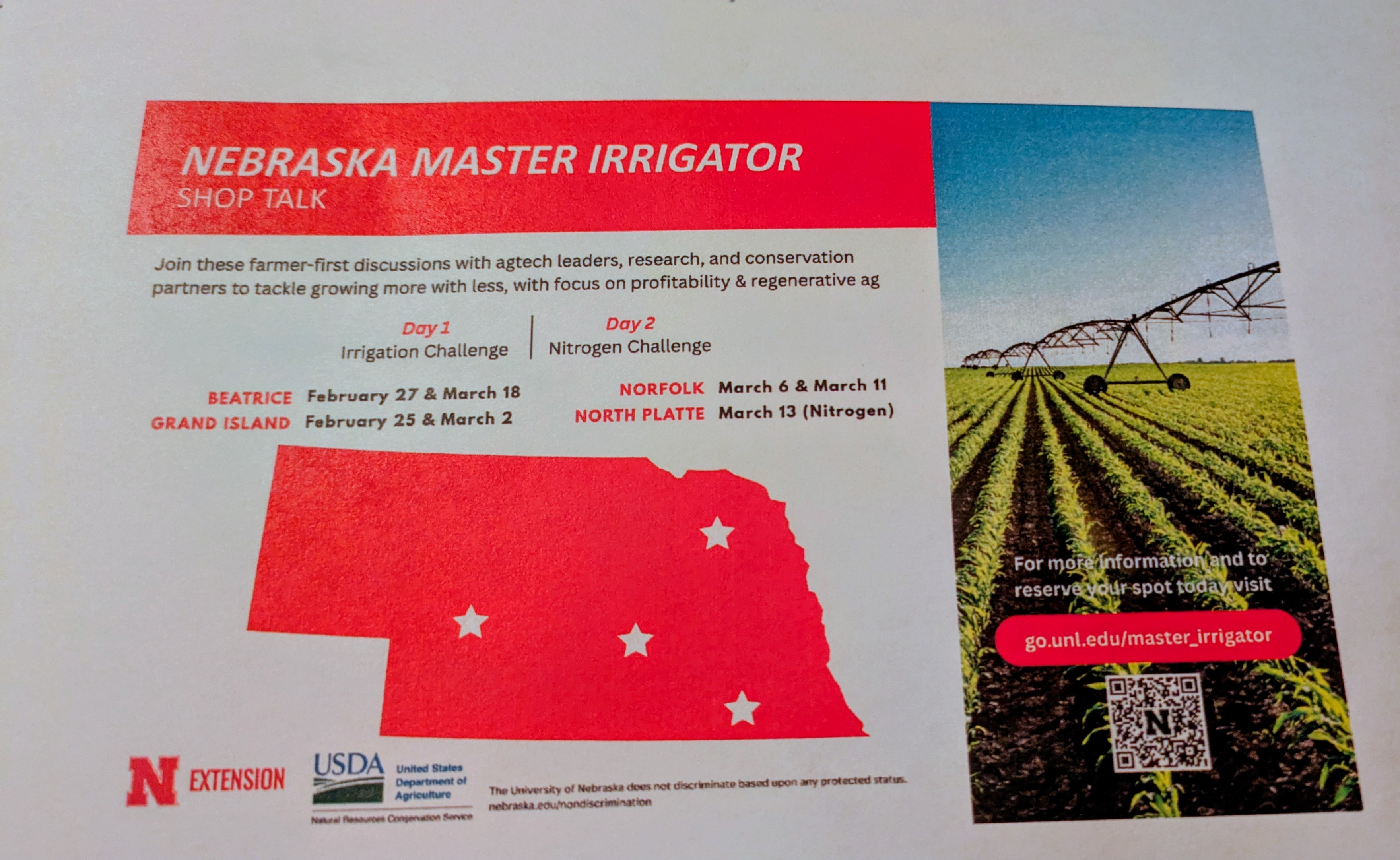
Master Irrigator Program: Nebraska Extension invites farmers, agricultural professionals and conservation partners to participate in a local 2026 Nebraska Master Irrigator “Shop Talk” discussion. These will be two‑day, discussion‑based programs focused on tackling today’s most pressing irrigation and nitrogen management challenges. The first day of each location will focus on irrigation and the second day will focus on nitrogen. Registration and info at: https://go.unl.edu/master_irrigator. Walk-ins are welcome. Closest sessions include: Grand Island Extension Office on Feb. 25 & Mar. 2; Extension Office in Beatrice on Feb. 27 & Mar. 18.

Week of Feb. 15th Events
This beautiful weather resulting in a warm, dry winter, provides an important opportunity to be watering evergreen trees and lawns. Our horticulture educators have the following information to share. Now is the time to water trees and lawns to prevent desiccation, especially with warm temperatures in the extended forecast. If you want to prevent evergreens from turning ever-brown, take time over the winter to provide supplemental water. Any time air temperatures are above 40°F you can do a slow soak of water around your evergreen trees and shrubs (and even lawns). Allow enough time for the water to infiltrate before temperatures drop below freezing. For information about this and other winter tree care tips read more here: https://water.unl.edu/article/lawns-gardens-landscapes/tree-care-during-winter/.
Friday Conversations: This past week’s conversation on nutrient balance could’ve lasted much of the afternoon as it went two hours over the scheduled time. Will write on that topic next week. Friday Feb. 20th’s conversation will be on Cows, Compost, and Covers. Hear from growers who have converted crop ground to annual forages for grazing and the economics of that, especially compared to corn and soybeans this year. There’s still time to make that change for 2026. We’ll share options for different classes of cattle, including custom grazing if you don’t own/have enough cattle. I’ve heard some growers struggling with landlords/lenders to make that decision. If you are in that situation, please contact me and I’d be happy to talk with them and you. We need more diversity in our operations to spread risk and reduce pests! You’ll also hear how we’re using compost extracts on our farms to aid in biology and other benefits. You’ll also learn from the growers why they use various species of cover crops in their operations and what each species does for their soils and their system. If you’re interested, please join us from 10 a.m.-noon this Friday, Feb. 20th at the 4-H Building in York. RSVP to 402-362-5508 isn’t required, but is helpful to ensure I have enough handouts.
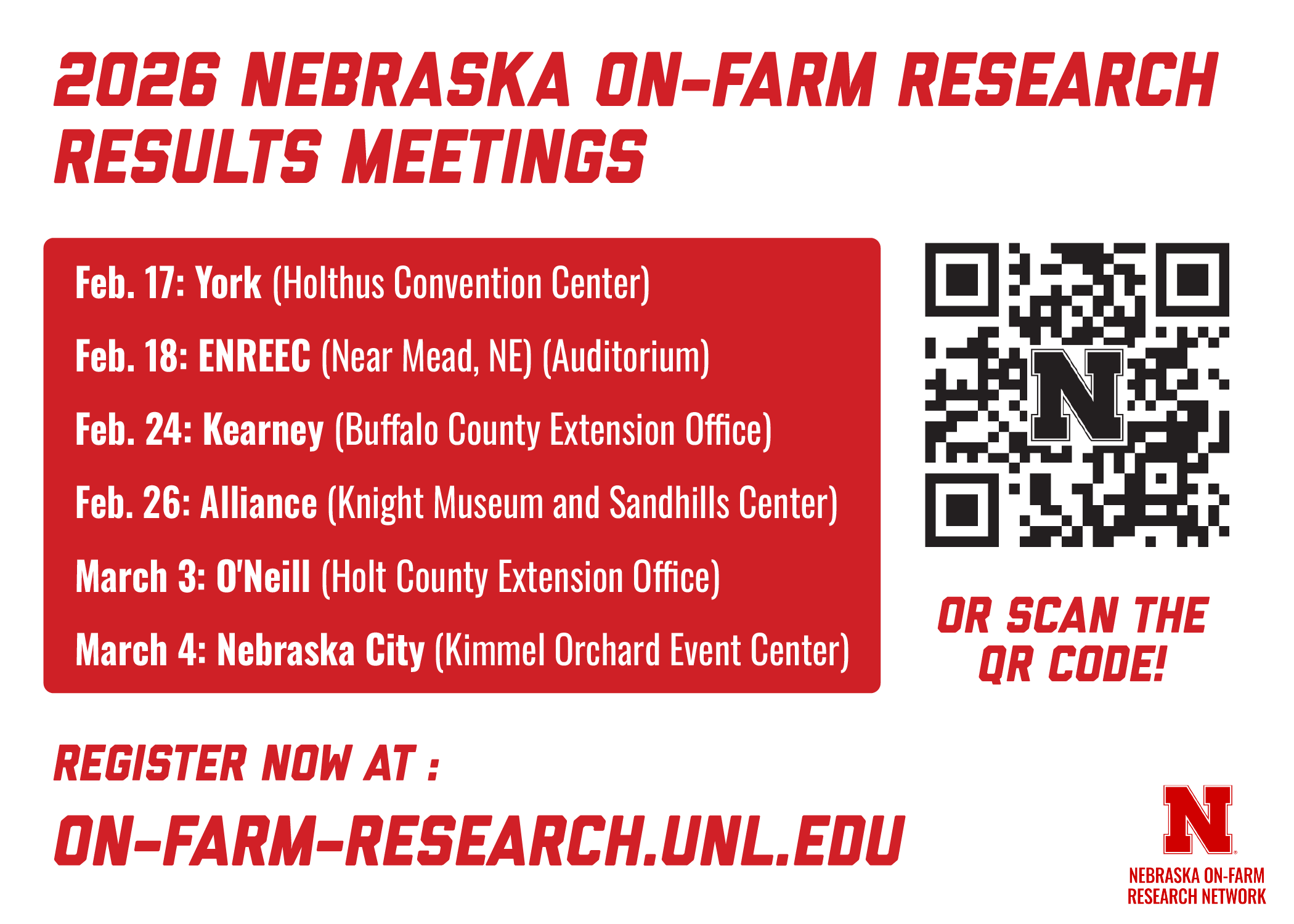
On-Farm Research Updates: There’s several on-farm research updates upcoming with the first being this Tuesday, Feb. 17th at the Holthus Convention Center followed by Feb. 18th at ENREEC near Mead. Program starts at 9 a.m. with registration at 8:30 a.m. If you’re looking to hear what other growers are trying on their farms and their results, it’s a great opportunity. More info.: https://on-farm-research.unl.edu/.
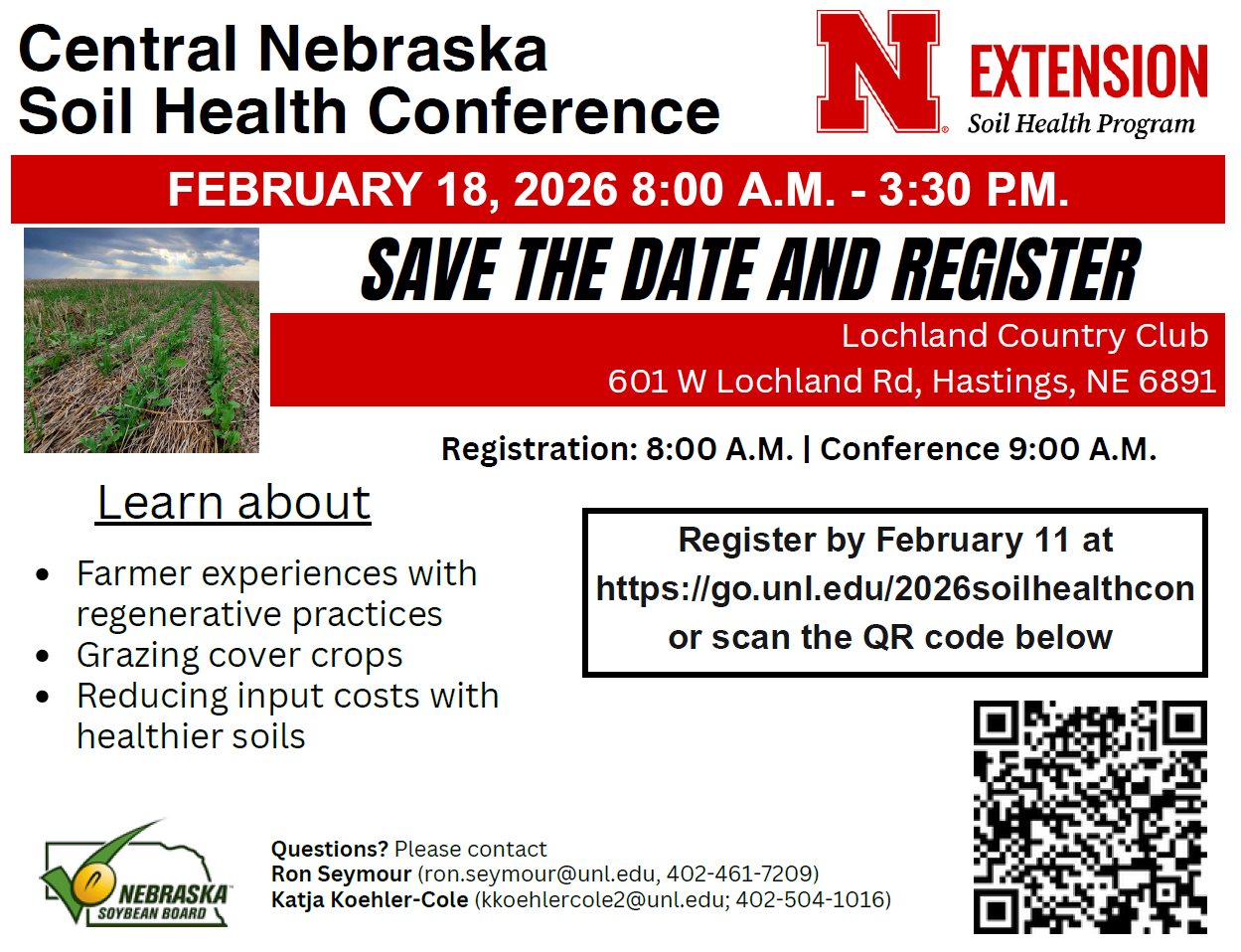
Central Nebraska Soil Health Conference will be held Feb. 18th in Hastings at the Lochland Country Club with program beginning at 9 a.m. and registration at 8 a.m. At that meeting, you will hear from some of our producers utilizing cover crops for grazing with the economics and how they are also reducing inputs in the corn the following year after that cover crop grazing year. You will also hear from growers who are reducing inputs in soybeans using soil health practices. The keynote speaker will share on biochar. More info. and RSVP: https://go.unl.edu/2026soilhealthcon.
York Co. Corn Grower Tour will be held Wed., Feb. 25. We’ll meet at the York Co. Extension Office at 9:40 a.m. First stop will be Timpte Manufacturing in David City. Lunch will be at La Carreta in Seward followed by tours at Hughes Brothers Inc. and Bottle Rocket Brewing Co., both in Seward. Please RSVP to the Extension Office at 402-362-5508 if you’re interested in attending.


Beginning a Soil Health Journey
This was the topic of last week’s Friday February conversation. $700 million has been designated by USDA for regenerative ag and soil health. USDA’s defintion: “Regenerative Agriculture is a conservation management approach that emphasizes natural resources through improved soil health, water management, and natural vitality for the productivity and prosperity of American agriculture and communities.” From the website at: https://www.nrcs.usda.gov/programs-initiatives/regenerative-pilot-program, participants work with their local NRCS office to determine a whole farm plan addressing soil, water, and nutrient concerns. A soil sample is required in the first year and last year of the program. I’m grateful there’s finally a program that helps farmers who are either beginning or more advanced. For those beginning, practices such as reduced tillage, cover crops, etc. can be implemented. Those more advanced have additional options such as soil amendments. The original application was due Jan. 15 to qualify for 2026; however, several NRCS staff have told me to contact your local NRCS to fill out an application if you’re interested.
Why does this matter? The soil is a big deal! The majority of food and feed is raised in the soil. Healthier soil can lead to healthier people and animals. There’s an increasing number of labs that are documenting the nutrition density of foods grown in conventional vs. regen/organic systems. As I continue to learn results from these labs, it’s sad to hear how much we’ve lost in food nutrition. It’s also important for us to steward the resources we’ve been given well.
The following are a few thoughts shared by the farmers from the conversation. The greatest obstacle to overcome is one’s mindset…all the reasons we tell ourselves that we can’t change in addition to the social implications (family and friends) of doing something differently. We are only given so much time and so many seasons to farm. If you’re thinking about any change, try it now!
Advice to begin: Focus on one or two fields and continue the practices (reduced tillage or cover crops) on them for several years. It takes at least three years to see changes based on their experiences and our on-farm research studies. Planting cover crops on this or that field without consistency each year leads to frustration as one may not see improvements over time.
- Cereal rye before soybeans is the easiest way to start. Before corn, we’d recommend planting winter wheat or winter barley in the fall or spring oats.
- Either plant your crop into dead brown covers or green growing ones; don’t plant into the in-between stage. If terminating pre-plant, use clethodim to allow more structure to the covers and follow label restrictions before planting corn.
- Money savings can occur through reduced herbicide, fungicide, and seed treatment costs. Also through reduced irrigation if reducing tillage, which improves soil structure.
- Challenges are markets for alternative crops or to be paid for raising crops with less inputs.
- Challenges are also economics. Choosing to continue using the same amount of inputs with reduced tillage and covers makes the economics challenging. Personally, I see how growers on this journey could reduce inputs more; however fear is a factor in addition to advisors uncomfortable with recommending less.
- Peer support is key. You don’t have to do this alone! If you’re interested in being connected to others, please reach out to me (jrees2@unl.edu). Another resource working to establish producer groups is the Nebraska Soil Health Coalition: https://www.nesoilhealth.org/. This Friday’s conversation (Feb. 13) is on nutrient balance from 10-Noon at the 4-H Bldg in York. The Central Nebraska Soil Health Conference is Feb. 18th at the Lochland Country Club in Hastings beginning at 9 a.m. (Reg. at 8 a.m.), RSVP: https://go.unl.edu/2026soilhealthcon.
February 2026 Events
Fridays in February are conversations held each Friday in February from 10 a.m.-Noon at the 4-H Building in York. Farmers and ag industry professionals share their experiences around various topics. I ask a few people to lead the conversation and the discussion ensues from there. These are very informal and they’ve spurred increasing changes to producer operations. Topics this year are focused on economics. Walk-ins are welcome, but RSVP is preferred to 402-362-5508 to ensure enough handouts for the discussions.
Fri. Feb. 6: Beginning Steps using Regen Ag Practices for Soil Health. With the $700M designated for soil health practices, this conversation will focus on practical steps to begin one’s soil health journey. Hear from farmers about the challenges, successes, and their recommendations regarding beginning one’s soil health journey.
Fri. Feb. 13: Understanding Nutrient Balance. For years, the focus has been on Nitrogen, Phosphorus and Potassium in ag, but too much of these nutrients create imbalances with other nutrients in the soil and plants. There’s an increasing number of ag professionals sharing how too much N contributes to increased disease and insects in the system due to plants lacking in availability of other critical nutrients. Hear from a few farmers and ag industry professionals about what nutrient balance looks like to them and how they go about it in fields.
Fri. Feb. 20: Producer Updates: Crops, Cows, Compost. This session is an update of last year’s conversations. Hear from the producers who made changes in their operations as a result of the conversations and the economics of these changes in their system. Some changes include: adding alternative crops in rotation, converting crop ground to annual forages for grazing, and using compost extracts on fields.
Fri. Feb. 27: Strengthening Nebraska’s Ag Economy. These conversations will share research-proven ways to reduce input costs without impacting yields. Information will be shared by producers and Extension educators who studied these topics via on-farm research. Come learn ways to reduce input costs on your farm this year and try some of these ideas for yourself!
Chemigation Training for the York area will be held on Thursday, Feb. 5th at 1 p.m. in the 4-H Building at the Fairgrounds in York. There are also chemigation trainings on Feb. 19th at 1 p.m. in Davenport at the Community Center, Feb. 19th at 1:30 p.m. at the Extension Office in Grand Island.
On-Farm Research Updates will be held Feb. 17th in York at the Holthus Convention Center, Feb. 18th at ENREEC near Mead, and Feb. 24 at the Extension Office in Kearney. The program at each location begins at 9 a.m. with registration at 8:30 a.m. Hear from the producers who conducted the research to learn what they tried and the results they found. No charge, but please RSVP at: https://on-farm-research.unl.edu/.
Central Nebraska Soil Health Conference will be held on Feb. 18th at the Lochland Country Club in Hastings. The conference will run from 9 a.m. to 3:30 p.m., with registration beginning at 8 a.m. Local growers will share information on converting crop ground for grazing, regenerative ag practices in raising soybean, and a producer panel. The keynote will share on biochar in ag. No fee, registration is requested for lunch count: https://go.unl.edu/kx80.


 JenResources