Author Archives: JenBrhel
JenREES 5/6/24
I’m so grateful for the rain and the green is so beautiful!!! The rain has led to some questions.
Corn Yields: it’s still early! I’ve mentioned this often to people the past week. We now set at May 5. In 2023, Dr. Jim Specht led a CropWatch article looking at NASS yields and 50% planting progress over 43 years (https://go.unl.edu/dge7). A summary of the data showed, delays in the Nebraska corn 50% progress date that occur within the May 2-12 planting period do not seem to have an appreciable impact on resultant corn yield. You have heard me and others talk about planting windows for several years based on data that Dr. Roger Elmore had previously shared and that information has been consistent with data from Iowa, Indiana and the U.S that corn yield doesn’t appear impacted till after mid-May. For perspective, think about the 2022 replant corn yields.
Regarding soybeans, Dr. Specht shared (in 2023), “one other notable feature is that Nebraska producers have advanced the 50% soybean progress date from a 43-year mean of May 22 by eight days to a projected date of May 14 for the year 2023. That eight-day shift to earlier soybean planting in Nebraska would have generated 0.99 x 8 = ~ 8 bu/ac greater yield for irrigated soybean producers and 0.54 x 8 = ~ 4 bu/ac greater yield for rainfed soybean producers.” The soybean planting date is more critical than corn. A number of producers have either finished soybeans before corn or have been planting at the same time to take advantage of increased soybean yields.
Pre-Plant Nitrogen movement with rains: In short, “it depends” is the best answer based on soil type, nitrogen source, soil moisture, amount of nitrate in the soil, and soil temp. Additional sampling such as soil, tissue, or using tools like Sentinel Fertigation can help in season to better understand plant nitrogen needs. University of Minnesota shares, “As a rule of thumb, with each inch of water moving down through the soil, nitrates will move down with that water five to six inches in silt loam and clayey soils, and up to 12 inches in sandy soils.” Ammonia binds to soil particles and is more stable in the soil. Urea will move with water if applied shortly before a heavy rain and can leach; however, it also quickly converts to ammonium in the soil, which is a stable source of nitrogen not easily leachable. A CropWatch article written in 2013 helps in a year like this without a full soil moisture profile, “If nitrogen was applied as a surface broadcast application immediately before rainfall (to a silt loam soil), it would move down with the rainfall. Its distribution in the soil would not be uniform, but 3 inches of infiltrated rain would distribute the nitrogen in the top 18 inches of soil. There would still be some nitrogen in the top 6 inches, but the “bulge” of the nitrate concentration would be at about 12 inches. Corn roots will grow into that nitrogen and there should not be an N deficiency as early plant needs would be met.” (https://go.unl.edu/76yw)
University of Minnesota shares that microbes will convert various nitrogen sources to nitrate twice as fast with each 10F temperature rise. Their example was, “urea that takes 24 days to fully convert to nitrate at 50°F will fully convert to nitrate in six days at 70°F.” For perspective, we’ve been holding around 58F for the past week. So the short answer is for most situations, we most likely haven’t lost much if any pre-plant nitrogen beyond the root zone due to the soil conditions thus far. Use in season tools and sampling to understand specific field situations.
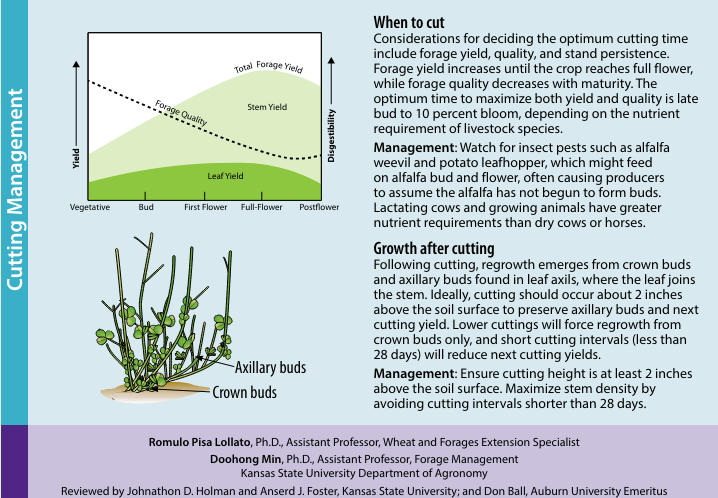
Alfalfa Weevil Control Tradeoffs: With current hay prices and alfalfa in the late vegetative to early bud stage, we’re looking at alfalfa weevil thresholds of 1.5-2 weevil larvae per stem (threshold charts here: https://go.unl.edu/p6ym). The challenging decision right now is if you wish to cut alfalfa early or treat with a shorter pre-harvest interval product. Reports in the Holdrege area have shared weevil resistance to products with lambda-cyhalothrin (Warrior, etc.). Steward is a product that contains a different active ingredient (indoxacarb) and is safer for beneficial insects, but costs more. It could be an option for those of you further out from first cutting. For those of you getting towards early bud, perhaps the option is to take an early first cutting and watch regrowth of second cutting if you’re at the economic threshold?

Smaller Trees for Landscapes
What a blessing to receive rain!!! Also a blessing for all the acres planted the past week in good conditions!
Crabgrass Preventer timing: Crabgrass germinates when soil temperatures are maintained at 55F for 5-7 consecutive days. As I write this, soil temps for the York area have averaged 55F for the past week. So, it would be a good idea apply crabgrass preventer soon. You can consider splitting your crabgrass herbicide application by applying half of the highest labeled rate now and the other half 6-8 weeks later. Often there’s a flush of crabgrass later in the season and splitting the application can help with that.
Paraquat Training Webinars for anyone who needs certification or re-certification for Paraquat Handling. Paraquat Training Webinar Registration 2024 (https://syngenta.zoom.us/webinar/register/WN_D4RPlS2_RAyWTDJ_tBtv3A#/registration). The registration link will require: first and last name, email address, and certification license #. There is a mandatory quiz at the end of the webinar that will be conducted thru zoom, so attendees have to attend the entire webinar and take the quiz. Webinar dates: April 30th from 1-2 p.m. and May 1 from 2-3 p.m.
Smaller Trees for Landscapes: Last Friday was Arbor Day and Kelly Feehan, Extension horticulture educator, shared information on smaller trees to consider for landscapes. “Following are suggestions for smaller trees for Nebraska. These are hardy trees under 30 feet tall that are aesthetically pleasing for more than one season. Be careful of selecting trees with one good characteristic, like leaf color, but have nuisance characteristic like root suckering such as Canada red or Schubert chokecherry and Quaking aspen.
A small ornamental tree we need more of is Serviceberry (Amelanchier sp). Trees range from 15 to 25 feet tall and are native or regionally native depending on the species. They have white April blooms, making them a replacement for overplanted ornamental pear. Edible fruit produced in June attracts songbirds who devour all the fruit. Most have orangish fall color like the cultivar “Autumn Brilliance”.
Hardy northern sources of Eastern redbud (Cercis canadensis) are good to plant. With purplish pink blooms in April, they stand out each spring. They are native and prefer part shade, especially afternoon shade in hot Nebraska. ‘Alba’ and ‘Royal White’ are white booming cultivars.
Ironwood or American Hophornbeam (Ostrya virginiana) is a tough, durable tree. It tolerates alkaline soil and dry sites. Another native, it typically grows 25 to 30 feet tall and has interesting fruit and bark. The bark is flaky and the fruit, resembling clusters of hops, appear in July or August.
Hawthorns are also tough trees but many have thorns. Thornless cockspur Hawthorn (Crataegus cusgalli var. inermis) is a good choice. These 15 to 25 foot tall tree has glossy green leaves, white spring flowers, and persisting red fruit. When fruit persists into winter, they add winter interest and provide food for wildlife. Hawthorns tolerates alkaline soils and dry or wet sites.
Japanese tree lilac (Syringa reticulata) is a tree form of lilac growing up to 20 to 30 feet. They bloom in June with white, fragrant flowers and are proving to be tolerant of clay soils and urban conditions. Peking tree lilac is a subspecies. The cultivar ‘Copper Curls’ has exfoliating coppery bark and trees are growing in the Blair NE arboretum and at the North Platte research station.
Corneliancherry dogwood (Cornus mas) is hardier than flowering dogwood (Cornus florida) and has yellow flowers in April. It grows to 15 to 25 feet and has sour but edible fruit for use in jams and jellies. Kousa dogwood (Cornus kousa) has interesting white flowers in May and red fall color. It needs uniform moisture or leaves can scorch causing the edges to turn brown.
Fringetree (Chionanthus virginicus) ranges in height from 12 to 20 feet. It has very interesting white flowers that resemble fringes and bloom in May. They are fragrant and followed by bluish fruit to attract songbirds. With yellow fall color and good adaptability to urban sites, it’s worth trying.
A smaller maple to use is Shantung maple (Acer truncatum). The leaves resemble Japanese maple leaves, but this maple is hardier. It has orangish yellow fall color and reaches 20 to 25 feet tall. It is listed as having good drought and heat tolerance once established.”

I took a picture of this so here is a clickable link to register for the webinars: https://go.unl.edu/annualforagewebinar.
JenREES 4/19/24
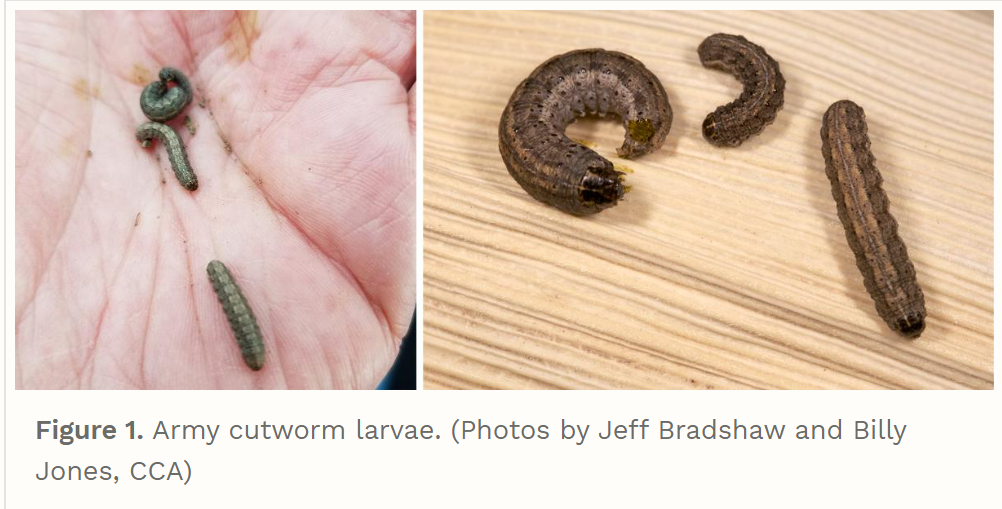
Army cutworms have been found in some wheat and alfalfa fields. I honestly haven’t looked at pastures but have gotten several calls about pastures this week, so perhaps be looking at them as well. The threshold is four or more cutworm larvae per square foot of winter wheat or alfalfa. A lower threshold is necessary for stands that are new or had some winterkill/drought-stressed. Damage looks like chewing on the leaves stems to complete stand reduction. Army cutworm larvae are greenish-brown to greenish-grey caterpillars, approximately ½ to two inches in length. They feed at night so you may have to look under residue or dirt clods to see them in the day.
Nitrogen Fertilizer Trends in Nebraska from 1955-2023: Dr.’s Richard Ferguson, Bijesh Maharjan, and Javed Iqbal wrote a nice updated article on nitrogen fertilizer trends for CropWatch this week. I pulled out a few excepts here, but please also check out the full article with the graphs and figures here: https://go.unl.edu/ki69.
“As farmers embark on another growing season in Nebraska, most will be applying some form of nitrogen fertilizer to optimize crop production. … Initially, ammonium nitrate, mostly sold in bags, and anhydrous ammonia were the dominant fertilizer sources. Nitrogen fertilizer use grew steadily from 1955 into the 1970s as fertilizers became more available and farmers saw the benefit for crop production. During this period, urea and urea ammonium nitrate solutions became more available and their use grew. Anhydrous ammonia dominated fertilizer sales during this period, peaking in 1968 with over 75% of total N sold as anhydrous ammonia.
Use of urea ammonium nitrate (UAN) solution (both 28% and 32% N) began to take off in the 1980s, and today is the most dominant form of nitrogen fertilizer used in Nebraska. In 2022, 57% of all N consumed in Nebraska came from UAN solutions, while 23% came from anhydrous ammonia, and about 14% from urea.
Total nitrogen used in Nebraska began to plateau around 1980 until about 2010. Since then, trends for increasing total N use have been observed. This trend generally coincides with an increase in land area from which corn is harvested. Approximately 8.85 million acres of corn were harvested in Nebraska in 2010, while 9.5 million acres of corn were harvested in 2023.

Figure 4 shows a very positive overall trend, with fertilizer N use of around 1.6 to 1.7 pounds fertilizer N per bushel of corn in 1965, to around 0.8- to 0.9-pound fertilizer N per bushel of corn in 2022. This positive trend illustrates that Nebraska farmers have become much more efficient through the years in managing nitrogen fertilizer.
There are many factors influencing this trend, including genetics advances and overall improvement in production practices. However, it’s likely that a major factor in this trend has been growing awareness of the risk of environmental degradation from excessive nitrogen application, influenced by many educational programs conducted by the University of Nebraska-Lincoln and natural resources districts. This trend is also influenced by requirements in some groundwater management areas for producers to follow nitrogen and irrigation best management practices.
While the general trend for the past 60 years is positive, Figure 4 also shows very little change recently in fertilizer nitrogen use efficiency: it has remained around 0.8- to 0.9-pound fertilizer N/bu since 2000 (circled data points). This data also does not illustrate variations in efficiency that occur in regions across the state. This lack of recent improvement suggests that current widely used practices may have reached their limit in terms of nitrogen use efficiency, and adoption of other tools, such as in-season application and sensor-based fertigation, may be required to further increase nitrogen use efficiency.”
I took a picture of this so here is a clickable link to register for the webinars: https://go.unl.edu/annualforagewebinar
Planting Considerations
Planting Considerations: The warmer air and warming trend of soil temperatures have allowed for planting to begin last week for some. This week hopefully brings some moisture. It also looks like a cooling trend will occur the mid-half of the week with frost potential by the weekend.
Agronomically we’ve come a long way with genetics and seed treatments. Because of this, some don’t worry about soil temps. Yet every year I think most agronomists would say we can trace various problems back to a specific planting date(s) or planting window. So, I still feel they’re an important consideration.
We often hear a preference of planting corn and soybeans in as close to 50F or greater soil temperatures as possible. Below 50F, I prefer to see corn planted on a warming trend of 5-7 days like what we saw last week. The consideration is for soil temps in the mid-40’s on a warming trend with no chance of a cold snap (cold rain/snow) within 8-24 hours for soybean and 48 hours for corn. The time-frame is due to the imbibition (critical water uptake) time-frame for corn and soybean. Soybean seed uptakes water more rapidly than corn and once the imbibition phase is complete, the soybean going through the osmotic phase can tolerate 35-40F soil temps as long as soil is not saturated. Soil temps for your field can be monitored by using a thermometer or checking out CropWatch soil temps at: https://cropwatch.unl.edu/soiltemperature.
Besides soil temperatures, another part of the soil being fit for planting include the soil not being too wet to create sidewall compaction and getting the seed vee closed. I think the greater thing some will deal with is making sure there’s moisture where the seed is placed. I recommend putting corn and soybeans in the ground at 2”. That may seem deep for beans but our UNL research found 1.75” seeding depth provided the highest yield for soybean. It also provides buffered soil moisture and temperature conditions when planting soybeans early. Bob Nielsen, emeritus professor at Purdue said corn can be seeded 2.5-3” deep if that’s where uniform soil moisture is located in order to achieve uniform germination and emergence. We don’t recommend planting soybean deeper than 2.5”.
For corn seeding rates, it’s best to check with your local seed dealer as all our research shows that optimal corn population varies by hybrid. However for soybean, our recommendation after 17 years of on-farm research studies (2006-2023) in heavier textured soils and 30″ rows continues to be: plant 120,000 seeds/acre, aim for a final plant stand of 100,000 plants/acre and you’ll save money without reducing yields. If that seems too risky, try reducing your rate to 140,000 seeds/acre or try testing it for yourself via on-farm research!
One final thought, make sure you’re keeping yourself and those in your operation safe by wearing proper PPE when handling treated seed, including filling boxes, when seed gets plugged, or when digging up seed. Seed tag labels will list PPE required for the seed treatments in case you weren’t aware of this. Here’s wishing you all the best whenever the planting season begins for your farm!
Alfalfa Weevils and Army Cutworms have been showing up in some alfalfa fields and it would be good to check wheat and other small grain fields for army cutworms. The last time we saw alfalfa weevils this early was back in 2012. Larvae are green with a dark head and white stripe down the back. They can often be found near the soil during the day. Use a sweep net if possible to detect their presence, and if they are present, randomly select at least five sampling sites from across the entire field. At each site, gently pick or cut at least 10 alfalfa stems at ground level. Shake the larvae off the stems by beating the stems into a deep-sided bucket, also looking for any larvae in folded leaflet tips. Count the larvae and determine the average number of larvae per stem. Economic threshold for the mid-vegetative stages of 10-15” tall are 1.5-2 alfalfa weevils/stem (chart can be found at: https://go.unl.edu/pxhk). Highly effective insecticides for alfalfa weevil control include those that are pyrethroids (active ingredient ends in “thrin”, such as Permethrin) and products containing indoxacarb (e.g., Steward). If you spray prior to harvest, check pre-harvest interval (often 7-14 days).
Vegetables and Lawns
Wishing everyone a blessed Easter! While I won’t get to it this year, there are people like me who traditionally plant potatoes on Good Friday. So, that led me to thinking of lawn and garden things. A vegetable planting guide for our area compiled by Emeritus Extension Educator, Gary Zoubek can be found here: https://go.unl.edu/fecq.
Kelly Feehan, Extension horticultural educator shares, “Late March through April is typically the time to plant cool season vegetables. These vegetables germinate and grow in cooler soils and can tolerate light frosts. They include onions, potatoes, radish, lettuce, carrots, beets, peas, broccoli, and cabbage.
A tip for growing large onions that store well is starting from transplants instead of sets. Plants grown from sets may begin blooming in mid-summer. Once this happens, bulbs will not grow larger. Flowering happens because onions are biennials. They grow foliage and a bulb the first season, then bloom and set seed their second season. Growing sets for sale counts as one season and so plants from sets are primed to bloom when growth resumes in our gardens.
When growing onions from seed or transplants, plants are not primed to bloom the year we plant them. Some garden centers and catalogs now sell onion transplants for this reason. If you prefer to start from sets, use dime size or smaller sets as these are less likely to bloom the year of planting.
Potatoes are planted in April, sometimes late March or early May. A tip for increasing potato yields is hilling potatoes after they begin to grow. Once they are 12 to 20 inches tall, carefully scrape soil up around the plant to create a hill.
Potato tubers grow on stolons, underground stems, above the roots. Hilling provides more space for tubers to grow and maintains cooler soil temperatures, especially if hills are mulched. As a cool season crop, cooler soil will increase tuber production.
If potato hills are spaced closer together, tubers grow smaller. If hills are spaced farther apart, tubers grow larger. The recommended spacing is 12 inches between hills and 3 feet between rows. The 12-inch spacing will result in smaller tubers. An 18 to 24 inch spacing will result in larger tubers.”
Soil Temperatures can be found at: https://cropwatch.unl.edu/soiltemperature. This is helpful for knowing when to plant vegetables, when to plant crops, and what the soil temp is when applying fertilizer to fields. It’s also helpful for homeowners to wait to apply crabgrass preventer for lawns until soil temps are at least 50-55F for 5-7 days straight. In spite of the warmer temps, it’s far too early for crabgrass preventers!
Lawn Seedings: For those who didn’t seed or overseed turf grass last August-September due to the dry conditions, aim to seed or overseed as soon as possible. Weed control can be a challenge with spring seedings, but a new product has helped with this. I tried it last year and it worked well for me. Just know that your weeds will turn white in the lawn. “Scotts Turf Builder Triple Action Built for Seeding” (blue bag) contains fertilizer and the herbicide mesotrione which provides PRE and POST control of weeds without affecting the new bluegrass or fescue seeding.
Male birds: To keep male birds from attacking your windows upon seeing their reflection when they’re establishing territories, consider placing a thin layer of liquid dish soap on the outside of the window. It can easily be washed off in late spring but will protect your windows and the male birds.
Cover Crop Termination Timing
Cover Crop Termination Timing Tradeoffs: The warmer spring soil and air temperatures until this weekend have allowed small grains like rye, wheat, and triticale to gain quick growth. A small grain cover crop can impact corn and soybean in several ways including: reducing soil erosion, tying up nitrogen, reducing soil moisture prior to planting, increasing insects (beneficial and pests), reducing weed pressure (either via allelopathy towards small weed seeds or choking out weeds), and reducing soil-borne pathogens that cause soybean diseases. Termination timing is often a question. While I’m a fan of planting green, that doesn’t fit each farmers’ goals or situations. The following are things to consider for termination timing.
Termination prior to planting may be of interest to those who are concerned about soil moisture, who are new to cover crops, who have a subsurface drip irrigation system, or are not allowed to plant seed corn green.
One consideration if terminating prior to corn or soybean planting is to consider using clethodim as it doesn’t die as quickly, allowing for longer-lasting erosion and weed control. We’ve been using 10 oz/ac of clethodim. If you do choose to use clethodim vs. glyphosate prior to corn planting, it needs to be applied at least 7 days prior to planting corn. There are no restrictions with soybean.
Termination at or after planting (planting green) is an option for those who want more cover crop biomass for erosion and for weed and disease suppression. When planting soybeans green, the goal is often to off-set the PRE herbicide cost with the cover crop seed and application cost. Reality is, if you’re going to lie awake anxious about this decision, planting green may not be for you. Often, corn plants will not look as good the month of June, but things often turn around come July.
The following are things to consider as there’s more risk involved. Apply nitrogen as a starter or 2X2 with corn when planting green to help with nitrogen tie-up. Some prefer to wait for the corn or soybean seed to germinate before terminating the cover crop while others terminate the same day as planting. If irrigation is available, have the irrigation system ready to go prior to planting in the event you need to add some moisture into a dry seedbed. Upon planting the field, observe if any adult wheat stem maggot flies are present, and also for the presence of beneficial insects before automatically adding any insecticides in with the herbicide.
Termination of rye occurred closer to heading when wanting greatest biomass in soybean. Roller crimping for termination occurs around pollination. When rye is greater than 12”, consider 15-20 gal/ac of carrier for better coverage. A residual herbicide is helpful at some point. Plan on 0.5-1” of irrigation or rainfall to get the residual to the ground, especially on rye taller than 12”. Some add the residual in with the product used for termination, while others prefer to spray the residual in a second pass once the cover starts dying. Those applying a residual at termination time had irrigated fields and planned on 0.5” irrigation after the rain-fast period. If no rainfall was received in 7 days, they often planned on another 0.5” of irrigation to help move residual down to the soil.
With the quick growth this year, it may be wise to have a Plan A and Plan B in mind if you plan on planting green but the cover crop is getting taller than you are comfortable with, especially for corn. For example, Plan A may be that you’re planning on planting green unless the cover is X inches tall by a certain date (ex. April 5-15), upon which you will choose to terminate pre-plant instead (Plan B). There’s no one size fits all approach, so feel free to call and talk through this if you prefer.
Additional Resources:
Photo gallery from farmers’ fields: https://jenreesources.com/2022/04/03/cover-crop-termination-including-planting-green/
Cover Crop Termination Tradeoffs: https://cropwatch.unl.edu/2021/cover-crop-termination-tradeoffs

2024 National Ag Week
Happy National Ag Week! What happens in ag impacts all Nebraskans as 1 in 4 Nebraska jobs are connected to ag. A strong ag economy (Nebraska ranks #1 in farm cash receipts of all commodities/capita) helps Nebraska’s overall economy. “In 2021, every dollar in agricultural exports generated $1.07 in economic activities such as transportation, financing, warehousing and production. Nebraska’s $9.98 billion in agricultural exports in 2022 translates into $10.68 billion in additional economic activity.” Also, 92% of Nebraska’s land is used for farming and ranching to grow the food, fiber, and fuel we rely on each day. In 2023, Nebraska had 44,400 farms and ranches, the average size of which was 991 acres. The following are from the 2024 Ag Facts card: https://nda.nebraska.gov/facts.pdf. Thank you to all who are involved ag-related careers and there’s numerous opportunities for youth to pursue ag-related careers!
#1: Nebraska’s largest ag sector is beef production with Nebraska leading the nation in commercial cattle slaughter at 6.8 million head. We moved up to #1 in beef and veal exports. We also have the most irrigated acres in the nation. #2 in all cattle and calves, all cattle on feed, and commercial red meat production.
#1: Nebraska also ranks 1st in Great Northern bean production, 2nd for pinto bean production and 4th in the nation for all dry edible bean, dry edible peas, and light red kidney bean production.
#2: Nebraska is #2 in ethanol production capacity. Nebraska produces 2.3 billion gallons of ethanol annually from 24 ethanol plants. Distillers grains, a co-product of ethanol production, is an important livestock feed. Nebraska is also #2 in bison production. We fell to #2 in popcorn production in 2023. We are also #2 in no-till cropland acres.
#3: Nebraska is #3 in corn production and exports; also, in cash receipts of all farm commodities.
#4-7: Nebraska is ranked #4 in hay production, land in farms and ranches, and for cover crop acres. We rank 5th in soybean exports and 6th in soybean production. We also rank 5th in grain sorghum, alfalfa hay, and sunflower production and 5th in the nation for production of sugar beets, with half of U.S. sugar production coming from sugar beets. Nebraska is 6th for all hogs and pigs on farms and in commercial hog slaughter. Nebraska ranks 7th in pastureland acres.
Nebraska is the 14th largest winter wheat producing state. We are ranked 14th for organic cropland acres.
When it comes to our natural resources, the aquifer below us is a blessing for irrigated agriculture. “If it was poured over the surface of the state, the water in those aquifers would have a depth of 37.9 feet”. Nebraska has nearly 80,000 miles of rivers and streams and 22 million acres of range and pasture, half of which are in the Sandhills.
There’s so much to be proud of regarding agriculture in Nebraska! As we’re seeing throughout the world, we can’t take farming and food production for granted. May we seek to celebrate and support ag now and in the future! Happy National Ag Week!
Earliness of Spring: Several have commented the tree buds and flowering bulbs seem early. According to the USA National Phenological Network, Omaha, NE is 20 days ahead for spring leaf out of lilacs and honeysuckles compared to the 1991-2020 long-term average, which means we’re currently earlier than 2012 at this point. We’ll have to watch what happens.
Sprayer Drone Conference March 28th at the Leadership Center in Aurora from 9 a.m.-3 p.m. More info. and registration at: https://go.unl.edu/8pam.

Soybean Seed Treatments
Appreciated everyone who attended and shared at our on-farm research update in York last week! I’m so grateful to all the farmer-cooperators who have worked with me through the years and who continue to do so! We wouldn’t have as much innovative and practical research without them!
Soybean Seed Treatment Comparison: This week sharing on a soybean seed treatment study. Some producers are interested in alternative methods of protecting seed from insects and disease beyond traditional insecticide/fungicide seed treatments. This can be due to cost, impacts to pollinators, soil microbes and the environment, and/or human safety.
The grower tested three fields in York, Seward, and Hamilton counties via a split planter design for a total of 21 reps. The biological seed treatment consisted of a blend of: 2 oz PhycoTerra® ST, 1 oz Heads Up®, 1 oz N-Gage Ultra ST, 0.75 oz Bio ST VPH in 100 gal solution. In a second tank, 2 oz of Exceed Soybean inoculant was used per 100 gal. The biological seed treatment was applied by the grower. Cost was $9.20/ac for the full biological seed treatment.
The biological seed treatment was compared to Pioneer’s full seed treatment on two fields and Golden Harvest’s full seed treatment on one field. These treatments were applied by the seed dealers. Cost was $28/ac for Pioneer’s seed treatment and $16.63 for Golden Harvest’s seed treatment.
Field 1: Pioneer’s full seed treatment (62 bu/ac) vs. biological seed treatment (61 bu/ac) No difference. Field 2: Pioneer’s full seed treatment (65.7 bu/ac) vs. biological seed treatment (67.1 bu/ac) Significant difference. Field 3: Golden Harvest’s full seed treatment (69 bu/ac) vs. biological seed treatment (68 bu/ac) No difference. Combining the three locations, the standard seed treatment yielded 65.6 bu/ac vs. 65.4 for the biological seed treatment.
Soybeans were planted green into rye in all three fields. The original plan was to roller crimp the rye, but the soybeans were too elongated due to stretching for sunlight in the tall rye and we were concerned about them being damaged with a roller crimper. Irrigation was also necessary to get the soybeans out of the ground and growing with the tall rye in Fields 1 and 2. However, it was interesting for me to see these fields in the summer in a high white mold pressure year, especially in the fields with previous white mold pressure. I never saw white mold impact the soybeans. Any fungal structures on the ground that germinated seemed to be trapped by the rye mat. Biological products like Heads Up® have been shown by other Universities to help reduce white mold and SDS incidence while ILeVO® and Saltro® have been shown to reduce SDS and soybean cyst nematode incidence.
Hopefully this information is helpful for those who are rotating fields to soybeans this year that have had incidence of disease in the past or who are interested in seed treatment options. If you’re interested in trying a seed treatment study for on-farm research, please let me know.
Also, if you didn’t plant rye due to the dry fall, you can consider planting oats this month if you’re growing soybeans this year in a field with SDS and SCN pressure. Oats was the best small grain to reduce the pathogens causing those diseases according to Iowa State research.
Tree Care and Fruit Tree Basics Workshop will be held Sat. March 9 from 10 a.m. to Noon at the 4-H Building in York. Extension Educator Sarah Browning is joining us again! Refreshments will be provided and there is no cost to attend, but registration is requested to Upper Big Blue NRD at 402-362-6601. Bring your questions! For those interested in gardening but don’t have the space at home, check out the Project GROW community garden in York. Plots are available for the 2024 growing season. You can reserve your space now or come to the Tree Care and Fruit Tree Basics Workshop and sign up in person.
Wildfire Resources and Donation Options: https://go.unl.edu/dpar.

JenREES 2/25/24
Spring Fertilizer: It’s hard to believe March begins this week! With the approaching of March 1st and the nice weather, some may be thinking about fertilizer applications. Three quick reminders:
1-Soil temperatures can be viewed at: https://cropwatch.unl.edu/soiltemperature. Soil temperatures below 50F allow for a slower conversion of ammonium to nitrate by soil microorganisms.
2-There was a high amount of mineralization that occurred last growing season due to the warm soil temperatures. Higher soil residual nitrate was common in soil samples in the area; thus, you can believe the fact that there’s a higher amount of soil residual nitrate and adjust fertilizer recommendations accordingly. If you’re unsure or if the soil samples didn’t pull well due to the dry fall conditions, soil samples can be pulled again this spring to gain confidence in recommendations.
3-Reminder of my nitrogen challenge! The higher residual nitrate provides a great opportunity in putting down a lower base rate and use a tool like sensor based fertigation via Sentinel Fertigation to apply only what the plant says it needs throughout the growing season. You could also consider an on-farm research study using a few different rates. Please let me know if you’re interested in these options.
Pruning Tips: With the coming of March also comes questions regarding pruning. My horticultural colleague, Elizabeth Killinger, shares some tips with some updated research on pruning timing for different plants. Full article: https://huskerhort.com/2024/02/25/a-pruning-primer/#more-1466.
“The first step to pruning is surveying the plant. This will ensure whether or not pruning is needed. Look for and remove any dead, diseased, damaged, rubbing, or crossing branches first. Remove suckers, little saplings at the base of the tree, and water sprouts, small vertical stems on the main branches. Also look at the plant in terms of safety. Be sure the plant is not blocking vehicle sight lines or covering sidewalks. Remove any low hanging branches that are hanging over a sidewalk.
Pruning Tools: In order to make cuts that heal correctly on plants, the proper tools are needed. When pruning small branches, those that are 1” in diameter or smaller, hand pruners are recommended. If you have to twist the pruners or take multiple ‘bites’ at the branch, a different tool is needed. For branches that have a diameter greater than 1”, loppers are recommended. Pruning saws are extremely sharp and work well to get into the tight places that the pruners and loppers don’t fit. They can also cut branches that are larger than 1.5” in diameter. The last tool of the trade is the hedge shears. They are used for shearing hedges or shaping plants and shouldn’t be used as substitutes for other pruning equipment.
Deciduous shade trees, It was previously recommended the best time to prune most shade trees was during winter dormancy. New research shows the optimum time to prune living branches is late spring and early summer because pruning at this time promotes the quickest sealing of pruning wounds, known as CODIT or Compartmentalization of Decay in Trees. Late spring and early summer is when tree cells are most active during the growing season, hence sealing occurs the quickest.
Evergreen Trees keep their leaves throughout the winter. Pine trees rarely need to be pruned, if you choose to do so it is best done June into July, or when the new growth is between half and fully grown. If pine trees are pruned too early, the tree could be deformed and pruning too late could cause the tree to be stunted. Be sure to prune only the current years’ growth. If the trees are pruned too far back onto older growth, new growth will be delayed a year. Spruce and fir are two evergreen trees that rarely need pruning. If pruning is needed, they can be pruned between November and April.
Evergreen Shrubs, like arborvitae, Japanese yew, and juniper, are best pruned in late winter between November and April. The cuts will heal quickly and will be covered by new growth.
Deciduous Shrub pruning depends on blooming time. If the shrub blooms in the spring, before June 15th, wait to prune until after it flowers. Lilac, forsythia, and dogwoods are considered spring bloomers. If the shrub is a summer bloomer, like a potentilla, flowering quince, or privet, then late winter to early spring is the best time to prune.”




 JenResources