Author Archives: JenBrhel
JenREES 2/18/18
Dicamba Best Management Practices: Last week I finished pesticide and dicamba trainings for our area. In each of the meetings, off-target injury from dicamba in 2017 was discussed. A few weeks ago in my column, I shared how dicamba applications to corn played a role in our area of the State. I’ve also received questions regarding best management practices for all dicamba applications in 2018. A team of Nebraska Extension Specialists and Educators have been discussing this for several months based on the research we could find in the literature. Grateful for this team working together and you will see three articles in this week’s UNL CropWatch at http://cropwatch.unl.edu. These articles include: best management practices for all dicamba applications in 2018, potential off-target movement from corn applications, and the tricky task of removing dicamba residues from sprayers. Please check them out! This week’s CropWatch also features several student intern reports on soil, forage, and cover crop research.
Farm Bill Meetings: A new federal farm bill is due this year and is under development in Congress. With action completed on a federal budget including some agricultural programs, the farm bill process could pick up quickly with proposals and legislation fully debated in the coming weeks.
Reminder of the last Farmer/Rancher College program Feb. 23 in Geneva (10 a.m.-3 p.m.) at the Fairgrounds on the farm bill and crop insurance. Great lineup of speakers including Steve Johnson from Iowa State University and Brad Lubben with UNL. No charge but please RSVP (402) 759-3712 as they are still taking registrations.
There’s also a series of Farm Bill Meetings upcoming in Nebraska and Kansas in late February/early March. The meetings will provide an overview of the current debate and current economic conditions in agriculture which help frame the discussion and will look at crop and dairy commodity programs, conservation programs, and nutrition programs and other policy issues, as well as proposed crop insurance changes.
Leading the discussion will be Mykel Taylor and Art Barnaby from Kansas State University and Brad Lubben from the University of Nebraska-Lincoln. Taylor is a farm management specialist with expertise in producer decision-making, including in-depth analysis of the 2014 farm program enrollment decision. Her analysis of past decisions and outlook will provide perspective on the commodity programs, the potential changes and the decisions ahead in 2019. Barnaby is a national expert in crop insurance with keen insight on the features and performance of crop insurance. His work will explore the proposed changes and the potential ramifications to the program and to producer crop insurance and risk management decisions. Lubben is a noted expert in agricultural policy with insight on both the farm bill issues and the process. He will help frame the debate and the expectations for new programs and policies to provide perspective on the broader budget and policy challenges facing members of Congress in writing the new farm bill.
Each meeting will run from 9:00 a.m. to 2:30 p.m. Registration will begin at 8:30 a.m. with refreshments and lunch served. The registration fee is $20 if pre-registered five days before the date of each meeting, and will increase to $30 after the deadline or at the door. The fee covers the meal, refreshments and meeting materials. To register, visit http://www.agmanager.info/events/2018-farm-bill-meetings and click on the meeting you wish to attend. Locations include:
• DODGE CITY, KS.: Feb. 28, Knights of Columbus Hall, 800 W. Frontview, Dodge City, KS. Host: Andrea Burns, aburns@ksu.edu or 620.227.4542
• MANHATTAN, KS.: March 1, Pottorf Hall – CiCo Park, 1710 Avery Ave., Manhattan, KS. Host: Rich Llewelyn, rvl@ksu.edu or 785.532.1504
• MEAD, NEB.: March 5, ENREC near Mead, Eastern Nebraska Research and Extension Center, 1071 County Road G, Ithaca, NE. Host: Keith Glewen, kglewen1@unl.edu or 402-624-8030
• HASTINGS, NEB.: March 7, Adams County Fairgrounds, 946 S. Baltimore, Hastings, NE. Host: Ron Seymour, rseymour1@unl.edu or 402-461-7209
Further information is available at http://agmanager.info or http://farmbill.unl.edu or by contacting the meeting host at each location.
Central Nebraska Cover Crops Conference: From grazing cover crops, seeding methods, innovative methods to incorporating cover, and more, the Central Nebraska Cover Crops Conference offers the latest information to help Nebraska growers profitably incorporate cover crops into their operation. The event will be held Friday, March 2 at the Merrick County Fairgounds with donuts provided by Lincoln Creek Seed at 9:00 a.m. The event has a great lineup of speakers including Paul Jasa, Extension Engineer; Keith Berns, Green Cover Seed and Nebraska Farmer; Dean Krull, Extension Demonstration Project Coordinator; Mary Drewnoski, Extension Beef Specialist; Daren Redfearn, Extension Forage Specialist; and Steve Melvin, Extension Educator.
Exhibitor space is still available for anyone wanting a booth. The event is free but please RSVP to (308) 946-3843. More information is available at https://extension.unl.edu/statewide/merrick/.
SE Nebraska Soil Health Conference will be held March 5 at the Kimmel Expo Center in Syracuse, NE. The program begins at 9 a.m. (Registration 8:30 a.m.) with topics including no-till/cover crop research update, best management practices for planting into cover crops, grazing cover crops, and two Iowa farmers sharing on how they utilize cover crops in corn and soybeans and on their farms. This event is free and lunch is included but pre-registration is necessary by calling (402) 274-4755 or at http://go.unl.edu/senebsoilhealth.
A Sprayer Applicator Clinic will be held on Tuesday, March 6, 2018, from 11:30 a.m. to 4:00 p.m. at the Kimmel Ag Expo Building in Syracuse, NE. “By attending this clinic, you will be a better prepared spray applicator,” says Greg Kruger, Weed Science and Pesticide Application Technology Specialist from North Platte, NE. Register by Friday, March 2, 2018, by contacting Nebraska Extension in Nemaha County at 402-274-4755. The cost of the program is $20 per person. Checks should be made payable to University of Nebraska-Lincoln and mailed to the Nemaha County Extension Office, 1824 N St, Ste. 102, Auburn NE 68305. Lunch is being provided by these sponsors: Midwest Farmers Cooperative, Dean Seeds – Syracuse NE, Andy Wellensiek – Channel Seed, Cook, NE, and University of Nebraska-Lincoln Extension. For more details regarding the clinic see the https://extension.unl.edu/statewide/nemaha/unl-sprayer-applicator-clinic/.
JenREES 2-11-18
Palmer Amaranth: I’ve been speaking a lot this winter on palmer amaranth and a few shared it’s fairly depressing. The positive side of this is we have an opportunity to learn from the research conducted in the Southeastern U.S. regarding palmer management so we don’t get to where they’re at! Their top question for cash renting or purchasing ground is “do you have palmer?”…so we have an opportunity to manage it here now!
In order to do that, though, we need to think of a system’s approach. This approach may not be economical for every year, but a system’s approach looks at the long-term benefits as a whole.
The keys for palmer (or any weed) are to keep it from germinating and then, once germinated, keep it from seed production. Palmer germination has been found to be induced more by natural and red light than soil temperature. Thus, bare soil in the first few weeks of May allow for a good situation for palmer germination and emergence. Management to avoid early germination include: keeping the soil covered with residue, small grain, or cover crop; burndown apps and pre-plant herbicide applications. Palmer can continue to germinate throughout the growing season to mid-September. During the growing season, quicker canopy closure and post-herbicide apps with residual are key.
At harvest, management includes seriously considering not running your combine through palmer patches. We’ve had farmer success stories in 2016 when farmers didn’t harvest their soybean endrows but did harvest the rest of their fields. Instead, some chose to disk down endrows with heavy palmer pressure and planted a wheat or rye cover crop in them. In 2017, they shared it made a big difference in reducing palmer in those fields. I’ve also received farmer testimonials sharing the opposite; they wish they didn’t harvest the endrows or the one patch that had palmer in the field as now they’ve spread it throughout the field. Research has shown 99% of the palmer seed going through the combine is still viable; thus we’re just moving it throughout the field and from field to field.
Fire was not found to be effective to get hot enough to kill the seed when the whole field was burned. Instead, crews carry black trash bags, pull the female palmer plants, and haul them out of the fields burning them in burn barrels.

Palmer seed production from soil surface-Clay Co.
The University of Georgia found they had to hoe the plants 2” below the soil surface in order to kill them. An average palmer plant can produce 500,000 seeds/plant. The plant on the edge of the field can produce up to 1.8 million seeds. I had a hard time believing the seed production research from the soil surface (22,000 seeds on average) and 1” stem (36,000 seeds on average), until I saw it walking fields last summer. I remember tweeting out the pictures saying #hatethisweed.
A study conducted in Kentucky compared 1-Wheat with double crop soybean 2-Wheat fallow (no herbicides were applied) 3-Full season soybean. They counted palmer plants in 100 square feet in each replicated treatment. No palmer could be found in the wheat other than in the tram lines; the double crop soybean into the wheat stubble only had 5 plants/100 sq. ft. In comparison, the full season soybean

ranged from 18-40 plants/100 sq. ft. while the fallow ground had 80 plants/100 sq. ft. A system’s approach is considering adding a small grain like wheat back into the system. Or, at least consider wheat/rye as a cover crop to help reduce light interception onto the soil surface in early spring.
We’ve also heard more about tillage in the southern states. Palmer is a small seeded plant and the seed can actually germinate within the top two inches of soil. Spring tillage doesn’t appear to significantly reduce palmer germination compared to fall tillage. So the following is all from fall tillage research. Research has found that burying palmer seed at least 2” can reduce densities similar to control with pre- and post-herbicide applications. Research from at least three studies has shown burying palmer seed with a plow to 4” or using inversion tillage reduced palmer germination anywhere from 50-80%. Leaving the seed
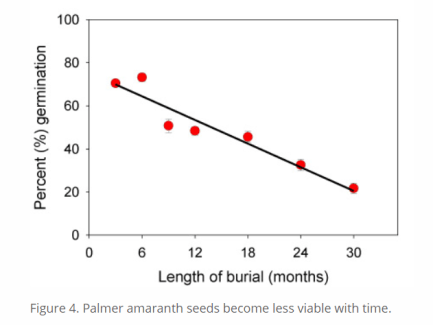
buried for three years reduced palmer germination further. So, the suggestion is if you deep till, do it once and then get a small grain cover on the field to knock out the early spring light interception. At least two studies showed that fall inversion tillage followed by cover crop resulted in 85% reduction of palmer the next spring. I share this knowing we can’t afford plowing for soil loss, soil moisture loss, and tillage doesn’t fit some of your systems. It is a management option to consider if other options aren’t working for you. Summary: fall tillage once, get a cover on it, and then leave it alone.
Ultimately, the management keys are to ‘start clean and stay clean’ using burndowns, pre’s, several effective modes of action, keeping the ground covered to reduce light interception, and incorporating a small grain and/or cover crop into your system. Hopefully this helps as we think about managing palmer this coming growing season.
On-Farm Research Updates: One of my favorite winter programs is our Nebraska On-Farm Research Updates because of our growers presenting the research they conducted with us. These are upcoming next week starting Feb. 19 at former ARDC near Mead and Feb. 21 at College Park in Grand Island. Programs most days run from 9 a.m.-4:30 p.m. with registration beginning half an hour before each day’s program. Full details of dates, locations, and RSVP can be found at: https://cropwatch.unl.edu/2018/growers-statewide-share-farm-research-5-sites. Over 80 on-farm research projects will be presented this year including a wide range of topics: cover crops, variable rate seeding, planting populations, multi-hybrid planting, starter fertilizer, etc. Certified Crop Advisor Credits are applied for. Growers take an active role in the on-farm research project sponsored by Nebraska Extension in partnership with the Nebraska Corn Growers Association, the Nebraska Corn Board, the Nebraska Soybean Checkoff, and the Nebraska Dry Bean Commission. To learn more about the Nebraska On-Farm Research Network, visit http://cropwatch.unl.edu/farmresearch. Hope you consider attending!
Crop Insurance, Farm Bill Policy Update: Also reminding you about the final “Farmers and Ranchers College” program for our area this year to be held Feb. 23 in Geneva at the Fairgrounds. This workshop on Crop Insurance, Farm Bill Policy Update and More, will run from 10 a.m.-3 p.m. with registration beginning at 9:45 a.m. You can view the whole agenda and speakers at: https://vandewalleviews.wordpress.com/2018/02/02/crop-insurance-farm-bill-and-more/
Introductory Beekeeping Classes: Was asked to share about upcoming beekeeping classes. There are two course levels: one for beginning beekeeping and one for those who are currently keeping bees and want information on colony health and maintenance. Workshop details can be found at: https://entomology.unl.edu/bee-lab#tab2.
Mixer/Loaders and RUP Dicamba: Mixer/loaders are now required to have RUP dicamba training; however, they may not have a pesticide applicator license. On the RUP dicamba training registration sheets, just put “mixer/loader” instead of a pesticide applicator number. New pesticide applicators who haven’t received their number yet can just put “pending”.
Crop Insurance, Farm Bill and More
The last Farmers and Ranchers College for this season will discuss Crop Insurance, Farm Bill Policy, and More! Consider attending!


Today’s farmers and ranchers not only have to be efficient with production practices, but also need to be well-informed with risk management and economics of their business. With that in mind, the Farmers and Ranchers College is offering the program, “Crop Insurance, Farm Bill Policy Update and More” at the Fillmore County Fairgrounds in Geneva, NE on February 23rd. This workshop will start at 10:00 a.m. with registration at 9:45 and will wrap up at 3:00 p.m. Due to the generous contributions of many businesses and organizations, the program is free; registration is preferred for an accurate meal county by February 16th. Call the Fillmore County Extension office at (402)759-3712 or email Brandy at brandy.vandewalle@unl.edu to register.
Speakers for the program will be Steve Johnson who has served as the Farm & Ag Business Management Specialist in Central Iowa for Iowa State University Extension and Outreach…
View original post 378 more words
JenREES 2-4-18
Dicamba Updates: For those of you who farm in both Nebraska and Kansas, or have customers that do, the following is what is needed for RUP-dicamba training. Nebraska and Kansas have a reciprocal agreement regarding private, commercial, and non-commercial applicator training. Those who have a KS applicator license who wish to apply RUP dicamba in Nebraska don’t need to take additional pesticide training in Nebraska. They do need to apply for a reciprocal license in Nebraska through the NDA and pay the $25 fee (private) or $90 fee (commercial/non-commercial) for a Nebraska pesticide applicator license. There is no additional fee for dicamba training in Nebraska. Kansas Dept. of Ag accepts Nebraska’s dicamba training with no further requirements. Nebraska will accept Kansas dicamba training IF you can also prove you watched the NDA Nebraska specific requirements video. Otherwise, it’s perhaps simpler to take the RUP online dicamba training from Nebraska or attend a Nebraska face to face session.
If you missed the UNL face to face sessions for your area, you can also attend Industry trainings which are upcoming and listed on the NDA website at: http://www.nda.nebraska.gov/pesticide/dicamba.html (please refresh your browser). And, you may wish to attend an industry training anyway depending on the product which you plan to apply to hear more about specific buffer requirements and ask specific questions.
Also, to be clear, anyone who has attended UNL trainings will not receive certificates. Your proof of training will be to download the excel spreadsheet at the NDA website listed above and ensure your name is on that spreadsheet. I’ve been asking that you give NDA 7-10 days before checking it with all the paperwork coming in right now. If you attend a training and don’t see your name, please contact the trainer whose session you attended. It may take longer for those of you who became new pesticide applicators.
The York UNL dicamba training has been rescheduled to February 16 from 10:00-11:30 a.m. at the 4-H Building at the Fairgrounds in York. Updated FAQs can be found at this site (https://pested.unl.edu/documents/RUP_Dicamba_FAQ_2018.pdf) as we receive questions and verify answers with NDA and EPA (please refresh your browser for the updated info.)
Converting ground to annual/perennial forage systems: For the past few years, some of you have spoken with me about converting a pivot to an annual forage system if you owned the land and had cattle. We’ve worked through some economics and a handful of you have tried various options. With current corn and soybean prices, I’ve received an increasing number of questions regarding this topic from farmers and ag lenders. A team of Extension specialists including Dr.’s Jay Parsons, Mary Drewnoski, and Daren Redfearn are seeking your input into what they’ve put together for economics of example systems this coming year. A webinar is scheduled for Tuesday, February 13th beginning at 6:00 p.m. CST. To participate, you can click on the following url: https://unl.zoom.us/j/827594794. Audio can be through your computer speakers or you can also call in. Full details regarding phone number options and additional information can be viewed at: https://cropwatch.unl.edu/2018/economics-annual-and-perennial-forages-webinar. The goal of this webinar is to explain economic examples for both annual and perennial forage systems using different classes of cattle and allow you to provide input into those numbers and ask questions. For those of you interested in this topic and/or are already using annual forages/converted pivots to perennial grass systems, we’d greatly appreciate your input and please do consider sharing your insight!
York County Corn Grower Tour: Gary Zoubek, Extension Educator Emeritus, has planned a great Corn Grower tour for those interested in attending on February 13th! Please call the York County Extension Office at (402) 362-5508 if you plan to attend. Attendees will meet at the York County Extension Office at 8 a.m. with travel to Lincoln at 8:30 a.m. Tours in Lincoln will include Nebraska Innovation Campus (including Nebraska Innovation Studio (the makerspace), the Food Innovation Center, and the Greenhouse Innovation Center, home of the LemnaTec High Throughput Plant Phenotyping system). Attendees will then tour Quantified Ag that developed cattle ear tags equipped with sensors to monitor the health of the individual as well as the herd. Lunch at Valentinos will be followed by Campus visits including learning about biobased textiles, the Ag Econ Marketing Lab/Commodity Trading Room, and the UNL Dairy Store. The final stop will be at Neogen labs that develops, manufacturers, and markets a diverse line of products dedicated to food and animal safety before traveling back to York around 5:15 p.m. You can view more details and the full itinerary at: https://jenreesources.com/2018/01/29/york-co-corn-grower-tour-feb-13/.
York Co. Corn Grower Tour Feb. 13
Gary Zoubek, Extension Educator Emeritus, has put together a great tour for the York County Corn Growers. Please RSVP to York County Extension Office at (402) 362-5508 if you’re interested in attending!
York County Corn Grower Agricultural Tour
Tuesday, Feb. 13, 2018
8:00 a.m. Meet at the Extension Office
8:30 a.m. Travel to Lincoln and Innovation Campus
9:45 – 11:00 a.m. Tour Nebraska Innovation Campus, 2021 Transformation Drive, Lincoln, NE 68508 https://innovate.unl.edu/
11:00 – 11:40 a.m. Vishal Singh, CEO and Founder of Quantified Ag will share what Quantified Ag does, how it was formed and future plans, 1901 N. 21st St., Suite 271, Food Innovation Center http://quantifiedag.com/
11:45 a.m. Travel to Valentino’s, 3457 Holdrege St, Lincoln, NE
12:00 noon Lunch
1:15 p.m. – 2:00 p.m. Yiqi Yang, Professor of Textiles, Merchandising & Fashion Design, will show us his Lab’s (Biofiber/biobased materials development lab (BDL) and Splinter Lab) 221 HECO Building
2:15 p.m. – 3:15 p.m. Jeff Peterson, Assistant Professor, will visit about the Ag Econ’s Marketing Lab/Commodity Trading Room. Filley Hall, East Campus https://agecon.unl.edu/cornhusker-economics/2016/commodity-trading-room
3:15 p.m. – 3:45 quick stop at the UNL Dairy Store Filley Hall
3:45 p.m. travel to Neogen Corporation, 4131 N 48th Street, Lincoln, NE
4:00 p.m. – 5:00 p.m. Tour Neogen labs Neogen develops, manufactures and markets a diverse line of products dedicated to food and animal safety. http://www.neogen.com/en/
5:15 p.m. Travel back to York
Nebraska Innovation Campus (NIC)
NIC is creating spaces and cultures that inspire. NIC is a research campus designed to facilitate new and in-depth partnerships between the University of Nebraska and private sector businesses. NIC is adjacent to the University of Nebraska–Lincoln and strategically provides access to research faculty, facilities and students. At full build-out, NIC will be a 2.2 million square-foot campus with uniquely designed building and amenities that inspire creativity and engagement, transforming ideas into global innovation. During the tour, guests will visit Nebraska Innovation Studio (the makerspace at NIC), the Food Innovation Center, and the Greenhouse Innovation Center (home of the LemnaTec High Throughput Plant Phenotyping system).
Nebraska Innovation Studio, a makerspace, is where creators of all sorts can share ideas, tools and knowledge. It features collaborative workspace, a machine/metal shop and areas for woodworking, fine arts, and rapid prototyping and electronics. University faculty, students, staff and community members are welcome to join the studio for a monthly fee. Members can take part in workshops, be trained on available machines and ultimately, make things here.
The Food Innovation Center is a 178,000 square-foot complex serving private/public partnerships. The center provides world-class facilities for the University of Nebraska–Lincoln Food Science and Technology Department and other private companies in leased space. It features wet/dry lab research space, food grade/non-food grade pilot plant space, a state-of-the-art distance education classroom and office space.
The Greenhouse Innovation Center is 45,000 square feet of greenhouse and headhouse space. The facility features state-of-the-art computer environmental controls, a LemnaTec High-Throughput Plant Phenotyping system, and 22 foot eve heights to allow for optimal air circulation. The greenhouses are heated and cooled with sustainable energy.
Quantified Ag
Cattle health management, tags, and software, simplified. With cattle ear tags equipped with sensors to monitor health of the individual as well as the herd, there is no more guess work involved. Now you can know exactly which animal is sick within hours rather than days. Vishal Singh, CEO and Founder of Quantified Ag will share what Quantified Ag does, how it was formed and future plans. http://quantifiedag.com/
Yiqi Yang, Professor of Textiles, Merchandising & Fashion Design, Lab’s Biofiber/biobased materials development lab, BDL, where we produce fibers from corn proteins, and other agricultural by-products and co-products. It is also a material/fiber characterization lab. Splinter lab, where we extract natural cellulose fibers from cornhusks and other stovers.
Information about the Ag Econ’s Marketing Lab/Commodity Trading Room. Jeff Peterson will provide
Neogen Corporation
Elizabeth Coker will provide. Our Mission Statement The mission of Neogen Corporation is to be the leading company in the development and marketing of solutions for food and animal safety.
JenREES 1-28-18
Last week was the first week I hosted dicamba trainings. Socially I haven’t seen the divisiveness within conventional ag that I’ve observed around this topic.
As I showed the dicamba videos, I stopped on a couple of slides to make a few points that were true for our area of the State last year; some farmers thanked me for doing so at the end of my trainings. This column is going to focus on these points because they’re not being discussed and by not talking about them, we’re not sharing the entire story of what happened in Nebraska last year. Caveat: I’m speaking only from my observations for the area of the State I serve and my news column is not peer reviewed.
The majority of my calls still come from Clay, Nuckolls, Thayer, and to a lesser extent Fillmore Counties because we’ve built relationships and I continue to serve you till we have a new educator in Clay County. I received my first dicamba call in June. All but three soybean fields along the way to the field I was asked to look at were cupped for the entire field. There was drought stress in the area and at first I wondered if there was something environmental occurring. Then I started making phone calls as to what herbicides were applied to crops in the area. No one met me at the fields that day-I just spent the entire afternoon/early evening walking fields and taking pictures for a 20 mile radius. In my inquiries I learned numerous corn fields all had corn dicamba formulations applied to them; the soybean fields sprayed at that time only had burndown apps but not post-apps. I continued to look at damaged soybean fields for six weeks in 10 counties.
When we think about last May, it was wet, cold and windy delaying corn post
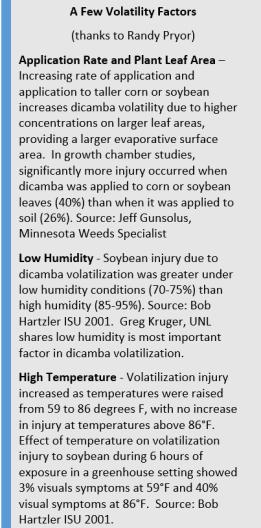
applications. The first few weeks of June were very hot and humid and in my notes I mentioned “seemed like the whole countryside was spraying corn at one time”. Humidity may have decreased during the night and some felt light winds may have shifted directions some evenings. There was potential for increased volatility and temperature inversions and in discussions a handful of agronomists agreed that “herbicide seemed to hang in the air”. Palmer had gotten too tall very quickly and corn dicamba formulations went on hundreds of thousands of acres in the area-more than what we’ve before experienced-and, they did a nice job against palmer in most situations.
Much of what we see and hear is about the three now RUP dicamba products that were used last year. I’m not saying that damage didn’t potentially occur from these formulations. However, at least 90% of off-target movement I looked at primarily in Thayer, Fillmore, Nuckolls, and Clay started with corn dicamba formulations. I don’t know if that is the case in other parts of the State. I was able to determine the same thing in specific situations I was called out to in York, Seward, and a few central Nebraska counties. As the summer progressed, the soybean formulations came more into play and we were also finding 2,4-D damage based on samples sent to the South Dakota lab, which is also interesting. There’s fields I looked at that were affected by off-target movement twice and a couple even perhaps three times as the summer progressed.
Why do I say so much damage started with corn apps? When I couldn’t figure out what

was occurring, I let the plants tell the story. UNL Research from Dr. Jim Specht says a soybean will produce a new node every 3.75 days. Research on dicamba shows that it takes 7-14 days for leaf damage to occur on susceptible plants. So I started counting nodes. I counted how many total nodes were on the plant and multiplied by 3.75 to figure out how many days old the plant was. I then figured out about the date of the trifoliate with the leaf cupping damage and counted back on the calendar 7-14 days. This correlated over 90% of the time to a corn dicamba product applied…and often several farmers or Coops in the area applied products so it was hard to tell where it came from. Most I talked to agreed to just wait till harvest because with whole-field damage, there wasn’t a good way to compare yields. There may be a better method and I wasn’t aware of others doing this till I started sharing it last summer in my news column-but it’s the only thing I could figure out at the time. I chose not to report the number of calls I received nor acres damaged as I was unsure how the information would eventually be used; thus, to answer the questions why on power-point presentations, the areas I serve remain blank regarding reporting when you all know we had large numbers of acres damaged.
Another point. There’s a number of ways that pesticides can move off-target including particle drift, through tank contamination, temperature inversions, and volatility. New research is also looking into movement on dust particles. If we just look at the potential for volatility, we know the three RUP products do not have ammonium sulfate (AMS) in them and it is off-label to add AMS. Research has also shown these three RUP dicamba formulations to be 50-70% less volatile than other dicamba formulations. There’s over 30 corn dicamba formulations registered for use in Nebraska; some have AMS in them or most allow AMS to be added to them.
Why is this important? AMS can increase the potential for volatility. In research from the University of Arkansas and from Purdue, soil was treated and placed in low tunnels between two soybean rows. The low tunnels were removed after 48 hours then percent soybean injury was measured. For example, adding AMS to Xtendimax (which is off-label but allowed for research purposes) resulted in a 20-30% increase in soybean injury due to volatility. The injury observed was similar to that of Banvel. The non-RUP corn dicamba labels allow for use of AMS while the RUP dicamba labels don’t. The label is the law and a legal document.


So what do we recommend for best management practices for corn dicamba apps? We’ve had numerous conversations within Nebraska Extension. I’m truly hoping we can come to some consensus based on the research that is known to provide BMPs for you in the next few weeks.
One consideration as we think about resistance management: UNL research found it only took three generations of spraying palmer amaranth in greenhouse settings before resistance occurred. One best management practice would be to not use dicamba in both corn and soybeans each year as it’s a tool too critical for us in managing palmer.
Ultimately, while I’m speaking of dicamba here, the overarching issue is pesticide applications in general and what off-target movement does to all sensitive plants and even what we’re breathing. I realize we can’t control weather. However, we all need to do what we can to always read and follow label requirements to avoid off-target movement of pesticides in all situations. To have another year like last year with great off-target pesticide movement may potentially impact pesticide applications in large ways in the future.
JenREES 1-21-18
Dicamba Questions: This continues to be the main question topic each day. Some questions I can answer for you: Yes, the UNL training (whether online or in person) does certify you to apply RUP dicamba next year. At the in person training hosted by local Extension Educators, you will only be viewing the same videos as the online training. You will need to bring your pesticide applicator number found on your green pesticide card as you will need that at registration. There is no fee for these trainings in our part of the State. We aren’t allowed to answer specific questions regarding the RUP labels. Please direct your RUP label questions to NDA. You may also find it helpful to attend the specific industry training based on the product you intend to apply to answer more label-specific questions. You can find all the record keeping, approved trainings, and dicamba certification list at the NDA website: http://www.nda.nebraska.gov/pesticide/dicamba.html. Extension is doing our best to put together Frequently Asked Questions (FAQ) with NDA based on the questions we’re receiving-particularly when it comes to buffer questions and record keeping.
- FAQ Direct Link (please refresh your browser to view the latest version): https://go.unl.edu/qhnz
- UNL Pesticide Office Resources: https://go.unl.edu/yxtd and https://pested.unl.edu/dicamba
Nebraska Crop Management Conference: Reminder this conference will be held in Kearney at the Younes Convention Center this week on Wednesday and Thursday! Have received numerous questions regarding this. You can attend either one day or both days. If you need commercial/non-commercial/private applicator recertification, you can attend either day to receive it but you must take the recertification courses highlighted on the agenda (this part is like regular Crop Production Clinics). The pesticide application recertification portion ALSO includes dicamba training, so attending that portion also allows you to be certified for dicamba training. There is also the opportunity for chemigation certification in a separate class. There are a number of additional topics that I’d encourage you to check out to determine which day you attend if you choose not to attend both. You can still register and can view all the information at: https://agronomy.unl.edu/NCMC.
Beef Profit Tip Workshops: During the winter of 2018, Nebraska Extension will host 17 Beef Profitability Workshops in Eastern Nebraska counties to help beef producers evaluate their operations in order to make them more profitable through the latest research information. These workshops have been held across Nebraska for the past fifteen years. Extension Educators will present topics such as Composting Livestock Mortality Carcasses, Mineral Nutrition, Grass Production, Cover Crop Production, Hay Storage and Hay Waste, Fencing and Watering Options on Crop Residue, Nebraska Fence Laws and others. Topics will vary based on the location. The cost is $15.00 but may vary from location depending on local sponsorship. Please register three days in advance with the local Extension Office for the location you plan on attending. Closest locations include: February 8, 2018 – Fillmore County @ Fairgrounds Ag Hall in Geneva, NE at 1:00 p.m. Contact Brad Schick at 402-746-3417. February 26, 2018 – Saunders County Extension Office at 1:00 p.m. @ ENREC near Mead, NE. Contact Kristen Ulmer at 402-624-8030. February 28, 2018 – Saline County at 1:00 p.m. @ Lutheran Church Fellowship Hall in Wilber, NE. Contact Randy Pryor at 402-821-2151. All locations can be viewed at: http://newsroom.unl.edu/announce/beef/7388/42220.
Master Gardeners: Are you an individual who enjoys gardening and giving back to others? Then you should consider becoming a Master Gardener. Who are Master Gardeners? They are people who love plants, and enjoy sharing their knowledge with others. Training includes forty hours of classroom instruction in general horticulture, plus basic insect and disease control knowledge. After training, Master Gardener interns give back 40 hours of volunteer service in their community through a variety of activities including helping Extension staff with clientele questions, teaching youth or adult programs, and working in demonstration landscapes. If you’re interested in joining Master Gardeners in York or Seward, you will need to complete and submit an application. Sarah Browning and Mary Jane Frogge, Lancaster Co. Extension, oversee the Master Gardener program in York and Seward. There are a few options for completing the program:
Option 1 – One year training program, weekday classes- 9:00 a.m. to 4 p.m. Classes are held from mid-February through early April, at the Lancaster County Extension Office, 444 Cherrycreek Road. Complete an application on-line at http://go.unl.edu/mgapplication, or contact Mary Jane Frogge for more information. Email: mfrogge2@unl.edu, (402) 441-7180. Program cost is $190.00 per person.
Option 2 – Two year training program, Tuesday evening webinars- 6:30 p.m. to 9:30 p.m. Webinars are held from February 6 through March 13 at the York County Extension Office (RSVP 402-362-5508). They are also held at the Clay County Extension Office in Clay Center (RSVP 402-762-3644). Complete an application on-line at http://go.unl.edu/mgapplication, or contact Mary Jane Frogge for more information. Email: mfrogge2@unl.edu, (402) 441-7180. Program cost (for new master gardeners) is $190.00 per person. Application deadline – January 30.
4-H FEST: Megan and Tanya in the York County Extension Office are planning this fun event for the whole family. It will be held Feb. 18th from 4:00-6:00 p.m. at the Cornerstone Building at the Fairgrounds in York. Enjoy FREE hands-on activities and carnival-style games while experiencing the variety that 4-H has to offer. The first 50 youth in the door will receive a 4-H prize! There will be pictures with Lil’ Green, inflatables, prizes and it’s all FREE! Concessions will also be available. Open to all York County families. (4-H is for youth ages 5-18)

JenREES 1-13-18
Winter meetings are going full throttle, as is the flu season, it appears. Grateful for all

Farmer Panel: Tyler Burkey, Kim Siebert, Scott Gonnerman, Paul Althouse, and Chad Dane (not pictured).
the speakers, farmer panelists, and distance technology that allowed speakers to present in spite of the flu with the AgExpo last week! Also grateful to have those educational sessions and the good discussions for those who attended. Thank you to all the exhibitors and everyone who worked so hard to make the Expo happen! Lyndy Phillips gave a wonderful performance and his message was great for all of us… “laugh more, stress less!”.
Face to Face Dicamba Trainings: Several Extension Educators have decided to provide one face-to-face dicamba training per county. During this training, attendees will watch the same video series that you can view in the online training. All state-wide face-to-face trainings offered through UNL will be posted at the NDA website at: http://www.nda.nebraska.gov/pesticide/dicamba.html
Anyone attending will need to know your pesticide applicator number which is found on your green pesticide card. Also, please be sure to check out this week’s CropWatch at http://cropwatch.unl.edu regarding several dicamba-related articles. Area upcoming trainings include:
Jan. 22: York County: Cornerstone Event Center, Fairgrounds, York, 2:00-3:30 p.m.
Jan. 23: Nuckolls County: Auditorium in Nelson, 10:00-11:30 a.m.
Jan. 23: Clay County: Activity Bldg., Fairgrounds, Clay Center, 3:00-4:30 p.m.
Jan. 29: Thayer County: Community Center in Davenport, 5:00-6:30 p.m.
Jan. 31: Seward County: Civic Center in Seward, 5:00-6:30 p.m.
Feb. 6: Kearney County: Fairgrounds in Minden, Noon-1:30 p.m.
Feb. 12: Merrick County: Fairgrounds in Central City, 10:00-11:30 a.m.
Feb. 14: Gosper County: Fairgrounds in Elwood, 1:00-2:30 p.m.
Feb. 15: Fillmore County: Fairgrounds in Geneva, 2:00-3:30 p.m.
Feb. 22: Hamilton County: 4-H Building, Fairgrounds in Aurora, 10:00-11:30 a.m.
Feb. 22: Harlan County: Courthouse meeting room in Alma, 11:30 a.m.-1:00 p.m.
Feb. 26: Polk County: Polk Co. Fairgrounds, Osceola, 10:00-11:30 a.m.
Mar. 6: Webster County: Webster Co. Fairgrounds, Bladen, 4:30-6:00 p.m.
Mar. 15: Adams County: Adams County Fairgrounds, Hastings, 4:30-6:00 p.m.
Farmers and Ranchers Cow/Calf College – Jan. 30: The annual Farmers and Ranchers Cow/Calf College “Partners in Progress – Beef Seminar” will be held at the U.S. Meat Animal Research Center and Great Plains Veterinary Education Center near Clay Center on Jan. 30 with registration, coffee and donuts starting at 9:30 a.m. This program is sponsored by Nebraska Extension’s Farmers and Ranchers College. There is no cost; it does include a noon meal, which means that early registration is necessary to reserve materials and a meal. Please pre-register by Jan. 23rd, to Fillmore County Extension by calling (402) 759-3712 or registering online at https://go.unl.edu/t38n to ensure a seat and lunch. Walk-ins are accepted, but may not get a lunch. Your contact information is required to be on the U.S. MARC property, so pre-registration is helpful and will save you time at the door!
The program begins at 10:00 a.m. with a welcome by Dr. Gary Bennett of USMARC and Dr. Dale Grotelueschen, Director of the Great Plains Veterinary Education Center. Brett Crosby with Custom Ag Solutions will kick off the event with “Ways to Optimize Cattle Marketing”. Mary Drewnoski, Nebraska Extension Specialist will present on “One Size Does Not Fit All: Grazing residue with various classes of cattle.” She will talk about some of the issues many producers had this year with so much corn in the stalks and strategies for effectively grazing residue. Lunch session will feature “Livestock Disaster Assistance Programs” from Fillmore County FSA Director, Ryne Norton. The afternoon session will start with Rob Eirich, Nebraska Extension Educator with the “Beef Quality Assurance Audit”. It is important to know how beef producers have done in regards to quality assurance and results were just released in the summer of 2017. Dr. Kip Lukasiewicz, Sandhills Cattle Consultants Inc., will lead you through “Implementing BQA and Animal Husbandry”. A popular presenter, Dr. Kip is sure to entertain you while being right on target to address some of critical quality assurance issues that face beef producers. For our beef producers Dr. Kip will also inform participants on effective animal husbandry and stockmanship techniques. A presenter panel will wrap up the event.
York/Hamilton County Cattlemen’s Banquet: The 70th Annual York-Hamilton County Cattlemen’s Banquet is scheduled for Tuesday, January 30 (6:30 p.m. social, 7 p.m. prime rib) at the Holthus Convention Center in York, reported Gerald Peterson, Cattlemen’s Secretary.
The Annual Cattlemen’s Banquet will feature entertainment by The Peterson Farm Brothers of Assaria, Kansas. The brothers Greg, Nathan, Kendall and their ‘honorary bro’ Laura started their entertainment careers by producing farming and agriculture oriented videos to help inform the general public about day to day farm life. Since 2012 the Brothers have been producing videos, writing songs and traveling the Midwest with their Advocacy for Agriculture message. Their first song “I’m Farming and I Grow It” received over 5 million YouTube views from over 200 countries in two weeks.
Kim Siebert, York-Hamilton Cattlemen’s President said tickets are $25 and are available from any of the York-Hamilton County Cattlemen’s Directors or at the Extension Offices in York and Hamilton Counties. York-Hamilton County Cattlemen Directors for 2017 include: Brock Ekhoff and Terry Ross of Aurora, David McDonald of Phillips, Allen Klute and Mark Klute of Hampton, Jeff Underwood of Exeter, Jeff Meradith, Josh Chrisman and Kim Regier of York, Chad Hoffschneider of Waco, Brian Blasé of Hordville, and Kim Siebert of Henderson.
Long-Term Irrigation Water Requirements for Corn in the Little Blue Natural Resources District Counties
Irmak S-Newsletter Article LBNRD-Final (PDF version of this article)
Authored by:
Suat Irmak
University of Nebraska–Lincoln
239 L. W. Chase Hall, P.O. Box 830726, Lincoln, NE 68583-0726
E-mail: sirmak2@unl.edu Ph: (402) 472-4865
http://engineering.unl.edu/bse/faculty/suat-irmak-0/|
(Author’s note) The scientific and research-based data and their interpretation presented in this article is intended solely for informational purposes and should not be interpreted otherwise in any shape or form. As a University faculty member, the author cannot and will not take sides with respect to water resources allocation decisions. Thus, the author is not for or against any potential water allocation. The author sees his role as an unbiased university faculty member is to share information and data with all people we serve to aid in making better-informed decisions. The following information was presented to the Little Blue Natural Resources District Board by the author on December 6, 2016.
Water allocations may occur in areas where long- or short-term rate of depletion of water resources exceeds water availability. Availability (decline or increase) of water resources can be impacted by numerous natural and human factors, including:
- Overpumping of surface and/or groundwater resources due to suboptimal irrigation management that result in over-irrigation [optimal irrigation management is considered as using one of the or a combination of the technologies available (soil-based, climate-based, or plant-based) to determine the proper irrigation timing and amount to meet crop water requirements for optimum crop growth and yield],
- Change in climatic variables, including air temperature, precipitation, solar radiation, wind speed, vapor pressure deficit,
- Soil physical properties,
- Potential changes in crop water use as a result of changes in climatic and other hydrologic variables,
- Changes in growing season length,
- Cropping patterns, including changes in crop hybrids, varieties, and cultivars, and switching from agricultural lands to natural land use (e.g., grasslands) and vice versa,
- Irrigation methods used as well as irrigation management practiced,
- Soil and crop management practices,
- Geologic conditions, including elevation,
- Other factors.
Thus, when water allocation programs are planned, the aforementioned factors should be taken into account to develop and implement a reasonable, but effective, allocation program. Discussions have been occurring in the Little Blue Natural Resources District (LBNRD) in terms of potential water allocations. In this article, long-term (30 years) data are presented to evaluate the impact(s) of various water allocation amounts in terms of meeting (or not meeting) crop water requirements for one of the major agronomic row crops produced in the district (corn). The counties considered in the analyses are: Adams, Clay, Jefferson, Thayer, Webster, Nuckolls, and Fillmore. Dr. Irmak has been conducting numerous scientific research projects in this part of the state for corn, soybean, sorghum, winter wheat, sweet corn, seed corn, and other cropping systems since 2003. Some of the major research topics include, but are not limited to: soil-water resources and irrigation engineering; crop water use efficiency; variable rate irrigation and fertigation; agricultural water management and conservation; measurement and modeling of surface energy balance, evapotranspiration, transpiration, evaporation and water productivity of agro-ecosystems; spatio-temporal plant water extraction; agro-meteorology; impact of change in climate variables on water resources and agro-ecosystem productivity; impact of tillage practices on water and energy balance; cover crop impact on soil quality and water and energy balance; measurement and modeling of soil moisture dynamics and soil physical properties.
Using long-term climate and crop water production functions that have been measured in Dr. Irmak’s research fields, crop water requirements were calculated for each growing season from 1986 to 2015 for corn. Detailed procedures are presented in refereed scientific journal articles published by Dr. Irmak and his research team and all these scientific publications are available.
Precipitation Trends
One of the critical variables that impact water availability and water balance components in any given area is precipitation. The growing season total precipitation amounts from 1986 to 2015 for seven counties are presented in Figure 1. While it varies with various factors, the growing season in this article was assumed to be from planting in May 1 to physiological maturity in September 30. The growing season precipitation has a fluctuating trend, but overall, there are declining trends in all counties. The magnitude of decline in precipitation exhibited substantial variation between the counties. The growing season precipitation has declined by 5.58, 6.41, 1.21, 2.68, 4.51, 4.45, and 1.73 inches in Adams, Clay, Jefferson, Thayer, Webster, Nuckolls, and Fillmore County, respectively, from 1986 to 2015. When the average of all counties is considered, the LBNRD has been receiving 3.79 inches of less precipitation in recent years than it did in mid-1980s and early 1990s, which can considerably impact water availability in the area and these changes in precipitation trends as well as magnitudes can substantially impact water balance analyses. It should be noted that the aforementioned magnitudes of trends are calculated from 1986 to 2015 and if a different period was used, the magnitudes and trends may change. However, the important point in Figure 1 is the significant overall decline in precipitation over time.
Gross Irrigation Requirements for Corn
Gross irrigation requirement (GIR) is defined as the amount of water required to be pumped to meet the net crop water requirement in the field. Not all pumped water can make it to the crop root zone due to losses during the water transport and application process. Since some amount of water is lost during this process due to conveyance, distribution, field application, evaporation, canopy interception, leaks, etc. additional amount of water is needed to be pumped to ensure adequate net irrigation requirement in the crop root zone is met. The net irrigation requirement (NIR) is the amount of water that is actually needed in the crop root zone to meet crops’ evaporative demand (evapotranspiration) to maintain adequate growth and development for optimum yield production. The amount of water that needs to be pumped to achieve net irrigation requirement is a function of the efficiency of the irrigation system used and other factors. By definition, the NIR does not include losses that may occur during the transport, distribution, and application of water in the field as opposed to gross irrigation water requirement. Thus, the NIR needs to be adjusted with the irrigation system’s efficiency. It should be noted each irrigation system has a different irrigation efficiency value and this value is not constant, rather it is dynamic and change over time, even in the same growing season as a function of numerous factors, including climatic factors and canopy development. For example, not all center pivots have the same or similar irrigation efficiency value and the values can change significantly depending on numerous factors, including how any given system is managed (in addition to climatic conditions and canopy development). Thus, using accurate irrigation system efficiency value is important for accurate quantification of GIR.
Annual gross irrigation requirements (GIR) of corn for all counties for each year are presented in Figure 2. As expected, GIR varied substantially from year to year as a function of numerous factors that influence crop water use, primarily climatic variables, including precipitation. These GIR values were determined for a healthy center pivot-irrigated corn crop that is actively growing and transpiring water vapor and result in very good grain yield (e.g., 230-250 bu/ac). The GIR values were adjusted by the irrigation efficiency of the center pivot, which is assumed to be 85%. It should be noted that the irrigation efficiency of a center pivot system is not a constant value, and can significantly change with numerous factors, including pivot operation conditions, maintenance, crop growth stage, crop management, and other factors. Thus, even for the same center pivot system, the efficiency value can change over time within the same growing season. Even a well maintained center pivot can have very low irrigation efficiency, depending on the conditions in which the irrigation application is practiced. This is valid for all other irrigation systems, but with different irrigation efficiency values.

Figure 1. Temporal (1986-2015) distribution of growing season precipitation in seven counties in the LBNRD.
The GIR for corn ranged from zero in all counties in 1993 (which was one of the wettest years in Nebraska) to as high as 26.9 inch in 2002 in Webster County (Figure 2e). The GIR values were also very high for all counties in 2012 (about 26 inches). Figure 2 is an example of inter-annual variation in irrigation requirements in that it is different every year. Thus, using an average value for GIR or water allocation programs may not provide a detailed picture of this variation.
For much more effective determinations of adequate GIR for a given county, the standard deviations of the GIR values should be considered. Standard deviation values represent the amount of difference from the mean (average) value. The standard deviation values of long-term average corn GIR for each county is presented in Figure 3. As Figure 3 clearly shows, the long-term average GIR values have very large standard deviations that should be taken into account. The standard deviation of long-term average corn GIR ranged from 5.9 inches in Adams County to as high as 7 inches in Jefferson County with a seven county average value of 6.6 inches. The interpretation of the standard deviation values should also be done very carefully, because it will considerably impact the crop productivity response to an average allocation amount. For example, in Jefferson County, in a given year, the long-term average corn GIR can be as much as 7 inches above the long-term average GIR value, depending on the climatic and other conditions. If this happens in a given year, the crop production and associated farm net income would be significantly jeopardized when the water allocation is determined based on the long-term average value. While it is used in practice very often, when natural systems are considered, there is no such term as “normal” as every year is different when various climatic variables are considered. However, determining the standard deviations and especially determining the allocation amounts based on the standard deviations for multiple counties that have spatial attributes is an extremely difficult task. Therefore, in many applications, long-term values are used instead, perhaps for simplification.
Different Water Allocation Amounts and Meeting the Corn Irrigation Requirements
Different hypothetical amount of water allocation amounts and what percent of the time these amounts are not able to meet corn crop’s GIR in each county are presented in Table 1. In Table 1, the allocation amounts were varied from 7 to 12 inches and the number of years and the percentage (with respect to total number of years from 1986 to 2015, which is 30) when the allocation amount was not able to meet corn GIR were determined. The interpretation of Table is rather very simple. For example, a 7-inch of water allocation was below corn GIR in 17, 17, 14, 17, 22, 21, and 12 years out of 30 years in Adams, Clay, Jefferson, Thayer, Webster, Nuckolls, and Fillmore Counties, respectively. In terms of percentage, a 7-inch water allocation was not enough to meet corn GIR at 56.7, 56.7, 46.7, 56.7, 73.3, 70, and 40% of the time in Adams, Clay, Jefferson, Thayer, Webster, Nuckolls, and Fillmore Counties, respectively. The impact of other allocation amounts (8, 9, 10, 11, and 12 inches) on meeting (or not meeting) corn GIR can be interpreted in the same way in Table 1.
Table 1. Percent of time when different water allocation amounts would not meet corn gross irrigation requirement (GIR).
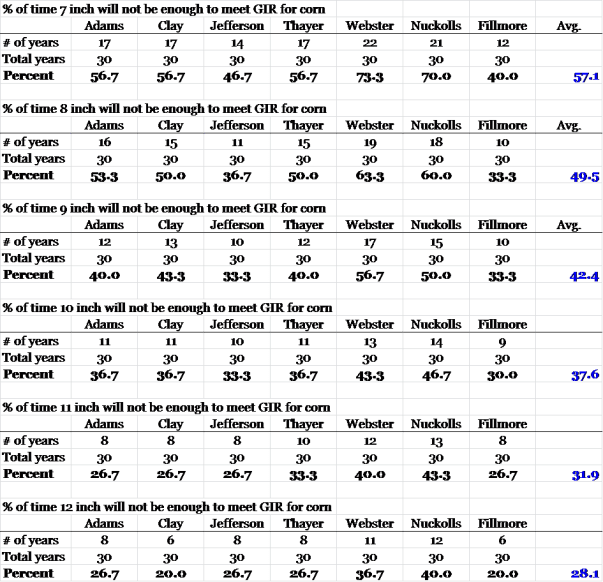
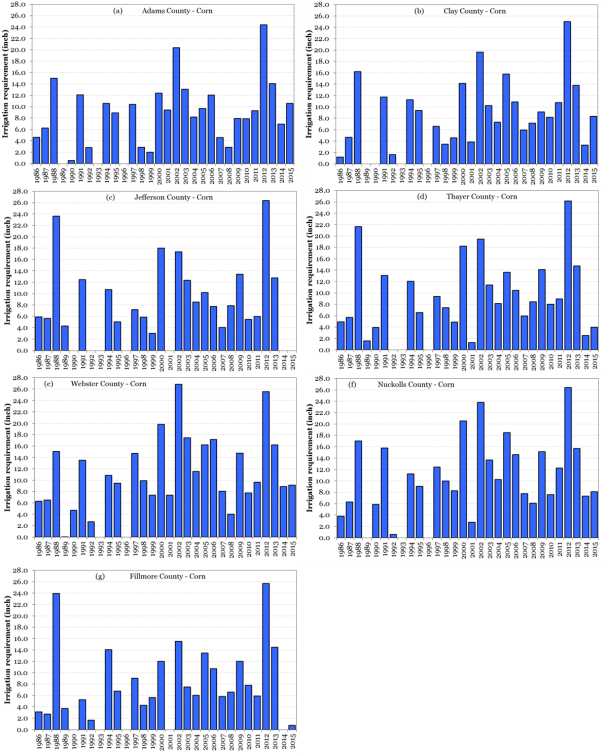
Figure 2. Temporal distribution of corn gross irrigation requirements (GIR) in seven counties in the LBNRD from 1986 to 2015.
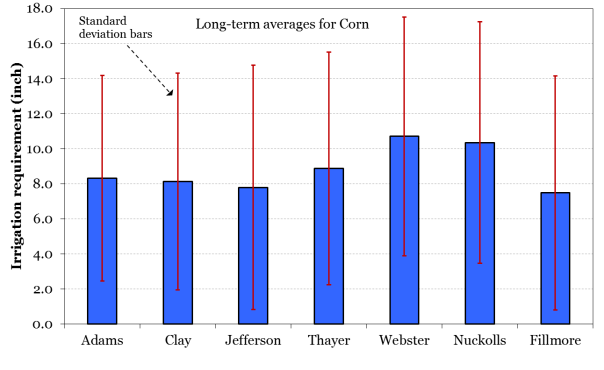
Figure 3. Standard deviation (inch) of gross irrigation requirement (GIR) for corn in seven LBNRD counties. The standard deviation values were calculated for the period from 1986 to 2015.
It is important to note that the analyses for potential impact(s) of various hypothetical water allocation amounts on meeting (or not meeting) corn irrigation water requirement to produce good yields (e.g., 230-250 bu/ac) were carried out for the period from 1986 to 2015 for specific counties in the LBNRD. Analyses, data, and interpretations should not be extrapolated beyond these boundaries.
Information and data provided above are solely for information and education purposes. The author does not take any sides or provide any opinion as to whether allocation should be imposed or not. If the decision is made to go forward with the allocation, some of the most effective water allocation programs are those that incorporate research-based educational and outreach aspects of water management and university can offer technical and scientific aid to growers and others who are involved in crop production and irrigation practices to make the best use of the allocated amount of water resources for optimum crop production. This includes implementation of technology to counter some of the potential negative impact(s) of limited water resources for optimum crop production. There are numerous proven, effective irrigation management strategies, tools, and methods developed at UNL that result in enhanced crop water productivity. This can be achieved by reducing or eliminating over-irrigation and conserving water resources through reducing unnecessary water withdrawal for irrigation. For some of these resources, readers are encouraged to visit the Nebraska Agricultural Water Management Network (NAWMN) website at http://water.unl.edu/cropswater/nawmn. Some of the publications that are related to irrigation science and engineering, evapotranspiration of various cropping systems in each of the NE counties, water management technologies, climate impact(s) on agricultural productivity, and related topics are also listed in Dr. Irmak’s website at https://engineering.unl.edu/bse/faculty/suat-irmak-0/.


 JenResources