
Author Archives: JenBrhel
RUP Dicamba Training for Soybeans
My top question the past two weeks has been about dicamba training. I just received the information regarding this training from our pesticide program coordinators.
First, to clarify some mis-understandings: Dicamba training is required for those applying the following dicamba products: XtendiMax®, FeXapan™, and Engenia®. These products are all Restricted Use Pesticides (RUP) this year; thus, you have to be a certified applicator to purchase and use these products. Dicamba training is not required if you’re applying dicamba corn products (unless it is the above-mentioned products).
Second, pesticide training of any kind is not the same as dicamba training. Dicamba training is completely separate. Having your pesticide applicator license does not qualify you to apply RUP dicamba in 2018.
Third, some have asked if everyone in the operation needs this training or not…specifically the person who is purchasing the RUP dicamba with his/her applicator license but is not the one intending on applying the chemical. NDA says that, “Dicamba-specific training is only required for application of the product, not for purchase of the product.”
- You need to be a certified pesticide applicator to purchase the RUP dicamba products.
- You need to be a certified pesticide applicator and complete dicamba training to apply the RUP dicamba product. So hopefully that helps clarify who in your operations need this training.
Your options for RUP dicamba training include the following:
- Nebraska Extension online training course hosted by eXtension. See the link at : https://campus.extension.org/login/index.php (1.25-1.5 hours).
- Crop Production Clinics or Nebraska Crop Management Conference. Details at https://agronomy.unl.edu/cpc and https://agronomy.unl.edu/ncmc
- County-hosted training sessions at the option of local educators presenting the video which is the same as the online training (1.25-1.5 hours).
- RUP dicamba product (XtendiMax®, FeXapan™, and Engenia®) manufacturer sponsored training. Each manufacturer will advertise individually.
I took the online training so I could better answer your questions. The link to the UNL online dicamba training can be found at the http://pested.unl.edu site or you can go directly to the training at: https://campus.extension.org/login/index.php. Once at this site, you will need to create an account. You will then be sent a confirmation email and upon opening that, you will be logged in. From the course list choose “pest management”.
Then scroll and click on “Online Training for Dicamba Herbicide”. 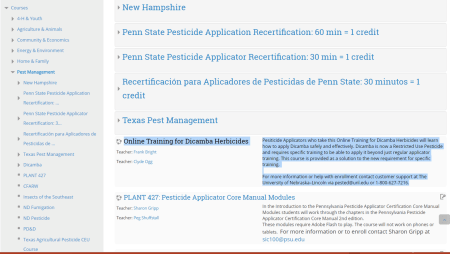
You will then need to register for the training. It will ask you to add your Nebraska pesticide applicator number in a specific field as well. Your name and applicator number are required before you begin the training. You can then click on the first video followed by the first quiz. It keeps track if you completed the entire video or not before you can advance.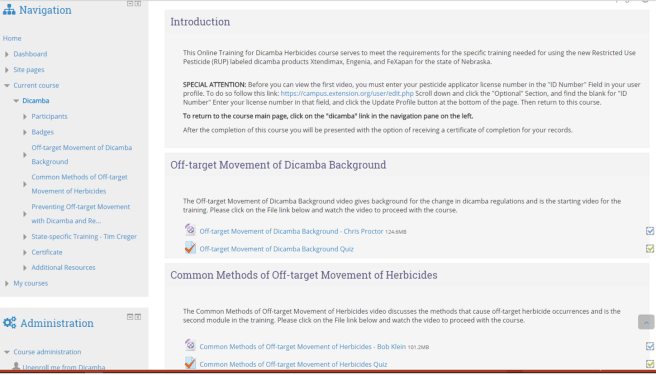
I felt the information was good overall and I appreciated the fact that they mentioned how corn dicamba applications also influenced the problems we saw in 2017. They also share quite a bit of research regarding volatility, conditions/timing of temperature inversions, dosage amounts and effects on yield. The quizzes are short and were fairly common sense. You can click to check each answer once you have selected your choice and will have to submit all your answers before moving on. When you have completed all the videos and quizzes, you can have a certificate emailed to you. You will also be officially entered into Nebraska Department of Ag’s database. NDA said they will only honor those names in their database as those who’ve completed dicamba training.
NDA is asking ag retailers selling these RUP dicamba products to check the NDA database to ensure the person applying the product has received dicamba training. NDA’s dicamba information including record keeping forms, etc. can be found at: http://www.nda.nebraska.gov/pesticide/dicamba.html.
The other thing you need to know: some have asked if a group of people can watch the online training at the same time at your farmstead. The answer is actually no from the standpoint you all would have to watch the training on separate computers/devices. The only way your name is recorded in the NDA database is through your registration name and pesticide applicator number on the training site. It only allows one person to enter his/her information to view the training and complete the quizzes. If you attend an NDA approved face-to-face training such as at Crop Production Clinics, you can train as a group but will still need to supply your individual names and pesticide applicator numbers at the training.
Hopefully this helps clarify some of the questions you have and during this cold weather, you have the opportunity to get this training completed if you need it for 2018.
Reminder: York Ag Expo at the Holthus Convention Center in York January 10-11. Schedule of Events and Exhibitors: http://yorkchamber.org/yorkagexpo/
Educational Sessions: https://jenreesources.com/2017/12/26/york-ag-expo-educational-sessions/
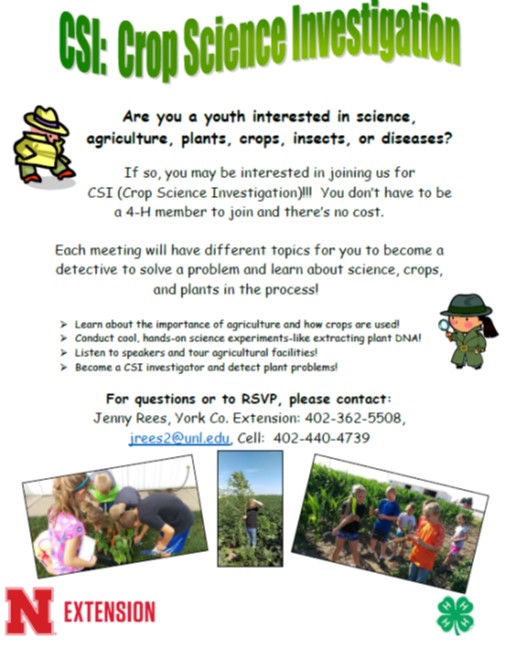
Crop Science Investigation
Youth interested in Crop Science Investigation are welcome from York and surrounding counties. Please also click to view: Crops Monthly Meeting Ideas 2018-2019.
Reflections on 2017
Happy New Year!!! This week has been a good one to reflect on 2017.
It was a year of unusual situations such as the dry winter allowing for nitrogen burn on corn, herbicide carryover, wheat stem maggot in corn from late-terminated wheat/rye, dicamba concerns on soybeans/trees/vegetables, downed corn ears and the challenge of recovering them…I think so often as I reflect, it’s easy to see the problems that occurred as those tended to be the headlines.
But as I also reflect, I think of so much more. It’s been a hard several years both personally and professionally for me and one reason I love Extension is for the relationships I’m so blessed to have. As I reflect on this past year, it was a year of spending time sharing the ways we all were hurting/healing while looking at crop problems, working in on-farm research plots, or just visiting. It was a special year in building even deeper relationships with many of you whom I’ve served in the past and meeting new people in the area I’m serving. Thank you also for your grace as it is a challenge serving regions of counties. I truly am grateful for the friendships and opportunity to serve you!
One of my highlights was pesticide training…yes, pesticide training! I know it’s required for us as private applicators every three years, but it’s my chance to teach/learn from/see so many of you and do my best to share important crop information as well. I enjoy winter meeting time as it always feels like a big reunion to me to see who comes and to catch up! Pesticide training last year was fun to still have the opportunity to train those of you in my former area and meet many in my new area.
Another highlight is a group of youth I meet with each month for Crop Science Investigation (CSI). This was such a rewarding experience for me in Clay County working with Clay/Nuckolls county youth and watching them learn, grow, and some pursue ag careers through the years. In York County I’m blessed with a very young, energetic group of youth who are so much fun and love to learn! Basically, the youth are detectives every time we meet as I give them a real problem to solve. We spend time out in the fields learning about crop growth, weed/insect/disease ID, take industry tours, etc. Our youth right now are mostly in the 6-11 year old range but any youth and parents are welcome to join us if you’re interested. Please just let me know at jrees2@unl.edu for meeting times.
On-farm research plots are always a highlight for me for how much can be learned and this year we had some intense plots regarding data collection! Grateful for the farmer-cooperators in the time spent on these plots and how you’re so good at working with me.
I also am grateful to the media. With fewer of us in Ag Extension, we’re called on more often to share when problems arise. So grateful for the relationships with all our media partners-TV, radio, newspapers, magazines-and all you do in helping us share our research-based information timely!
As I think about 2018, one concern continues to be low commodity prices and ways to make it through. The Farm Bill and what will happen regarding it is another topic. Dicamba unfortunately may continue to be a topic. And, it seems like every year we have varying weather that creates challenges and opportunities. Two things that will continue are the optimism/resiliency I see every year in our farmers and the strong family that Ag in general is. Here’s wishing you a safe and blessed 2018!
York Ag Expo: Reminder of the York Ag Expo January 10-11 at the Holthus Convention Center in York. A full list of exhibitors is available at: http://yorkchamber.org/yorkagexpo/. Lyndy Phillips will be the speaker at the Prime Rib Supper at Stone Creek in McCool Junction with social hour at 5:30 p.m. and supper at 6:30 p.m. Tickets can be purchased for $30 at the York Chamber Office. I’m really excited for the opportunity to provide educational sessions this year and am particularly excited about the cover crops/annual forages for grazing. If you have cattle and are looking for outside-the-box ideas, this session may be helpful. Educational sessions include:
• Chemigation Training by Steve Melvin, Jan. 10 from 9-Noon
• Cover Crops/Annual Forages for Grazing, Jan. 10 from 1-4 p.m.
• Private Pesticide Training by Jenny Rees, Jan. 11 from 9-Noon
• Precision Ag, Jan. 11 from 1-4 p.m.
Winter Ag Program Brochure: You can also find our winter ag program brochure for South Central/Southeast Nebraska at: https://go.unl.edu/vzyg.
Herbicide Grazing Restrictions
Forage Feed Grazing Restrictions
Replant Options Rotation Restrictions-long
Grateful for a nice week for harvesting and for the good yields being reported! It’s also good to see cattle being turned into cornstalks. A reminder to read herbicide labels to understand if there’s any grazing restrictions from corn and soybean herbicides applied in-season.
It’s also important to look for any grazing restrictions on fall-applied herbicides to control marestail and other germinating weeds. These restrictions can also be found in the Forage Feed Grazing Restrictions in the UNL Guide for Weed Management. The forage, feed, and grazing restriction only applies to the crop for which the herbicide was applied. When it comes to grazing cover crops planted into these residues, one must use the replant/rotation restriction guidelines found on the herbicide label and in the UNL Weed Guide: Replant Options Rotation Restrictions-long. I apologize as these scanned blurry; hopefully you can zoom in ok to read what you need.
If the label doesn’t specify any restrictions, then it should be ok. If you want to be on the safe side, a rule of thumb is to use the pre-harvest interval for the amount of time to wait before grazing stalks. Some labels will say that residue should not be grazed or baled and fed to livestock. Sometimes studies were actually conducted to know there is a safety concern. In other cases, the chemical company may not choose to conduct all the studies the Environmental Protection Agency (EPA) required for labeling due to high costs. If that’s the case, the EPA requires the strongest restrictive language be placed on the label. Regardless, if it says there’s a grazing restriction on the label, the label needs to be followed as it is a legal document and the law.
As you plan for next year’s herbicide program, if you’re thinking about fall cover crops, the following NebGuide may be of benefit to you as it goes through the grazing restrictions of various herbicides.
Hail Damage
On-Farm Research Protocols:


Hail and wind damage occurred throughout the area I serve last week. Overall, I’ve been encouraged by the regrowth observed on corn and soybean plants affected by the June 14th storm. We were blessed with warmer weather and sunshine that allowed for regrowth to occur in many situations other than some fields around the Deweese area.


You can look for regrowth on leaves within the whorl of corn plants and on the axillary buds of soybeans. Even what appeared to be soybean ‘sticks’ may show regrowth by now.
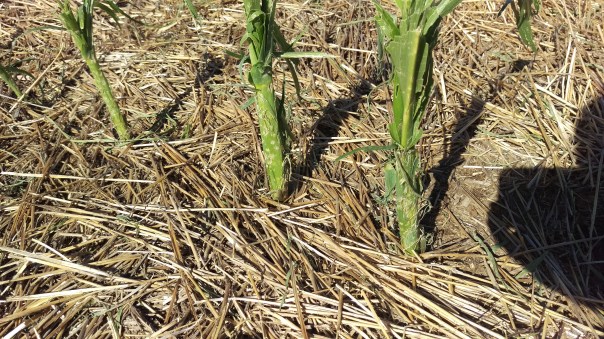
The concerns I have for plants affected by these storms is all the stem bruising on both corn and soybeans and the potential for bacterial diseases to affect corn.
For those of you affected by June 16th storms, we recommend to wait a week to assess damage and any decisions. I realize we’re also at a critical stage for replant decisions as we continue later in the season. Ultimately, decisions need to be made on a field by field basis.
Resources:
- CropWatch Hail Damage Resources
- Resources from storm damage in 2014
- Fungicide Use After Hail or Wind
Fungicide Application
There’s no good research to Dr. Tamra Jackson-Ziems or my knowledge to support this. Fungicides only control fungal diseases. Bacterial diseases are favored after hail events and we have already seen bacterial leaf streak in the area prior to the storm. From past-years’ experience of prior wind/rain events, we can expect to see more of it in about a week. Fungicides won’t help that disease nor Goss’s wilt which is another we often see come in after hail events.
However, if you’re considering this, I’d like to have several farmers prove it to yourselves with on-farm research this year so we do have data for the future. It’s this simple. All you do is spray fungicide in enough width to complete 2 combine passes. Then skip an area for 2 combine passes. Then treat again and repeat across the field. Fungicide Protocol for Hailed Corn and Soybean. Please let me know if you’re interested in this!
Timing of fungicide app: ISU did a study to simulate hail damaged corn at tassel stage within an average of 3 or 8 days post-hail. They didn’t find the timing to provide any yield effects. They also didn’t find a statistical yield increase (90% confidence level) in fungicide application to hail damaged plants vs those which weren’t hailed although they also reported a numerical increase in 12 of the 20 fields.
Herbicide application: I spoke with Dr. Amit Jhala, Extension Weed Specialist for his thoughts regarding this. He said ultimately herbicides shouldn’t be applied to stressed weeds in order to achieve greatest efficacy. The concern for many including me right now is how well the weeds survived the hail and how quickly they are regrowing compared to the damaged corn and soybeans. This again is a field by field assessment regarding how well your corn and soybean regrowth is occurring and how rapidly your weeds are. I watched one palmer plant in one field after June 14 storm: 1 day post hail and 2 days post hail put on two sets of leaves in that time period. I also took pictures of soybeans reduced to sticks while 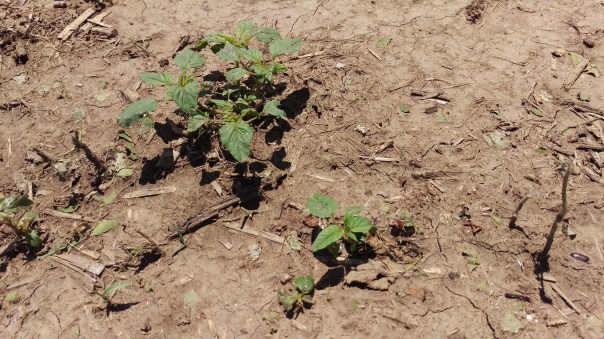 waterhemp in that field was virtually untouched. I think many are trying to wait 5-7 days post-hail to apply herbicides but there were some fields I was suggesting to apply over the weekend with the recovery already occurring and less damage.
Corn replant: The biggest concerns with corn would be stands, eventual stalk rot/downed corn due to stalk bruising, and bacterial diseases. I’ve essentially watched stands reduced over the course of the growing season after early-season hail storms mostly due to bacterial diseases like Goss’ wilt. It will be important to have your crop insurance adjuster look at the field again prior to harvest. Splitting the stems of damaged plants across the field can help you assess any damage to growing points; they should be white/yellow and firm not brown and soft. Tattered leaves that are wrapped around the whorl should eventually turn brown and break off with the wind. They can sometimes impede new growth from the whorl as well though.
Soybean replant: Soybeans can compensate so greatly for reduced stands. From hail at this stage in the past, we’ve said to leave stands of non-irrigated at 60,000 plants per acre and irrigated at 75,000 plants per acre. Some soybeans reduced to sticks are shooting axillary buds. My biggest concern on soybeans is the stem bruising which isn’t accounted for in hail adjustments. If you want to prove replanting or not to yourself, consider slicing in soybeans next to the old row in strips across your field. Be sure to inoculate the soybeans and be sure to take prior stand counts. Soybean Replant Protocol.
There’s nothing like doing these studies and seeing the results on your own ground or from your peers’ farms. In 2006, I worked with a grower in the Lawrence, NE area on a non-irrigated soybean plant population study where he tested seeding rates of 100K, 130K, and 160K seeds/acre. He received hail at the cotyledon stage and because he was non-irrigated, chose to leave the stand. His actual stand counts were 74.4K, 89.4K, and 97.9K plants/acre respectively for the previous mentioned seeding rates which resulted in yields of 38.6, 40.6, 42.7 bu/ac respectively. Another soybean replant study occurred near Columbus, NE where the grower had an average plant stand of 75,000 plants per acre on June 11th. He chose to replant five strips across the field at a diagonal to the existing rows. The replanted soybeans ended up yielding 1 bu/ac less than the original plant stand. I realize it’s hard to want to do these extra steps for on-farm research, but this is why it’s important; it’s the way to answer these questions for yourself! Please contact one of our team members if you’re interested in on-farm research this year!
Weed Management/Cover Crops Field Day — Views from VanDeWalle

During the summer, our crops extension team has some great field days to share research and management strategies to farmers. One of those opportunities to learn more about weed management and cover crops will be on June 28 at the South Central Agricultural Laboratory near Clay Center. There is no charge for the field day […]
via Weed Management/Cover Crops Field Day — Views from VanDeWalle

Corn Concern in Wheat/Rye Cover

What we see is larger plants next to stunted or shorter plants. The smaller plants often show some type of ‘flagging’ of the leaves where one or several leaves or sometimes the whorl is brown and wilted. Upon digging these plants, the roots were healthy and there were no symptoms of damping off or other obvious disease issues. While there have been reports of some wireworms, this also hasn’t been the main issue with these plants I’ve been seeing.

John Mick with Pioneer alerted me to what he was seeing and several of us have since found the same. Carefully unrolling leaves from the stems of these plants revealed feeding on the stems and crown area. You can see from this photo the small larva of what we believe to be wheat stem maggots (top leaf). I’m finding from 1-3 per plant (on this plant there were more in the disfigured area of the stem). I’m also noticing some plants that are tillering such as is shown in this photo after they’ve been damaged.

The larva in another plant.
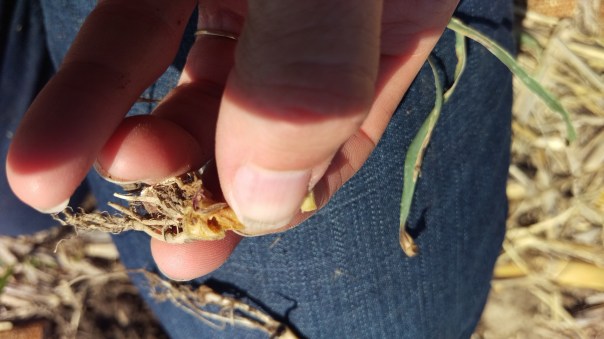
The growing point area of the same plant.
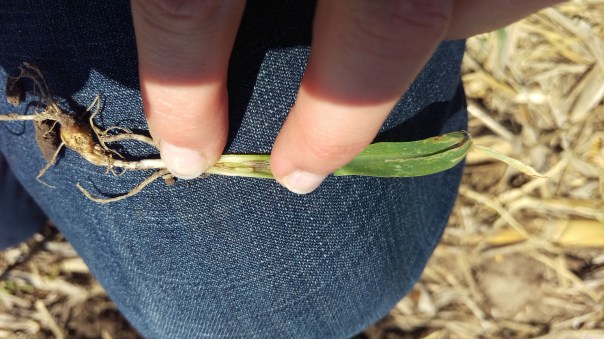
Carefully unroll the leaves to reveal any potential larvae.

Also found wheat stem maggot in some rye stems from rye that didn’t completely die. White heads in wheat and rye can be an indication of their feeding. You can then pull on the head and easy removal reveals where the maggot was feeding.
So two questions:
- Why are we seeing this this year?
- Is there anything we need to do?
The short answer to both is that we really don’t know. Perhaps one hypothesis is our warm winter allowed for an earlier generation of wheat stem maggots to pupate and emerge as flies during corn planting when they would typically do so later in May. Perhaps in fields where wheat or rye wasn’t yet terminated, the flies could lay eggs and the larvae that hatched moved from the wheat or rye to the corn upon emergence and once the cover was terminated.
The larvae we’re finding now are in different stages and some are getting close to pupating. After pupating, they will emerge into flies that will lay eggs in grass crops. We don’t know for certain if the flies will lay eggs in these corn fields again or if they will move to other grassy species. We’re not recommending insecticide applications.
South Dakota State and Kansas State have previously reported rare incidences of this occurring in corn. This is my first time observing this in Nebraska. To date, I’ve seen stand loss range in fields from 5-50%.
This doesn’t mean that all potential stunted plants or stand concerns are due to this particular insect as a number of other factors could be involved. This post is intended to increase awareness of another option to look for with the number of questions I’m receiving right now regarding corn concerns in terminated rye or wheat cover.
Dr.s Justin McMechan and Bob Wright are surveying fields and conducting studies to better understand any potential concerns in future years. We will keep you informed as we continue to learn more.
Crop Update May 25

Yellow banding can be seen on corn plants from the cold temperatures at various times of the plant’s growth. Some have been packed with mud from rains or have wind-whipped leaves. I’m also seeing some evidence of seedling diseases caused most likely by Pythium sp. in portions of fields with excess moisture.


I’ve been asked to look at fields where soybeans appeared to be dying and/or had discoloration of the cotyledons and hypocotyls. Most of what I’m seeing thus far with the discoloration of cotyledons and hypocotyls have been in fields where a pre-emergent herbicide program containing a PPO inhibitor was used. These are helpful products in reducing weeds. We’ve just seen this in the past as well after rain events that the chemical can be rain-splashed onto the cotyledons and/or the plant is unable to outgrow the effects of the chemical quickly enough in comparison to the damage observed. Hopefully most of these fields will still be ok with plant stands if enough plants can grow out of it; we’d say to leave plant stands of at least 75,000 plants per acre because of the way soybeans compensate for reduced populations without a significant yield effect. There may also be situations of damping off diseases occurring in soybeans. They keys are to look at where the damage is occurring. Discoloration of the roots/below-ground stem would most likely be due to seedling diseases whereas, PPO injury will occur on the cotyledon and hypocotyl-so essentially above the soil. There could be instances where the stress of herbicide damage is also complimentary to Rhizoctonia root rot, but I haven’t sent any samples in to confirm this. The following article is from a few years ago, but summarizes the situations in which damage could more likely be anticipated: http://go.unl.edu/2jbf.

The symptoms on this soybean plant with the ‘halo’ effect on cotyledons is typical of what we see with ILeVO seed treatments. The effects will be on the cotyledon but not on the unifoliate leaves or above.

Soybeans planted April 21st at 2″ depth have been battered by recent rain and wind events. Currently close to V1 stage with first trifoliate unfurling.
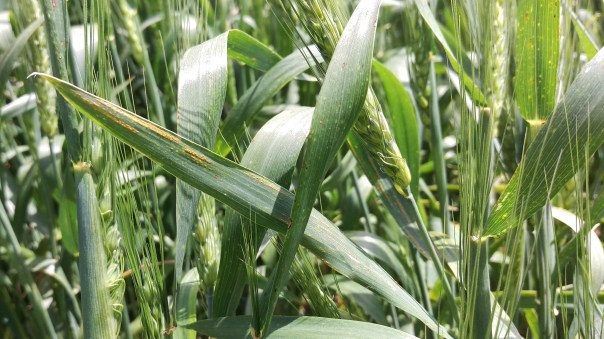
Wheat is in various stages of pollination to beginning filling. Stripe rust and leaf rust continue to spread on leaves but wheat is past the point of fungicide application if it is over 50% pollinated.

Really pretty wheat field I’ve been watching this year. Very even growth and low incidence and severity of rust in this more resistant wheat variety.


 JenResources