Author Archives: JenBrhel
Fair and Drone Conferences
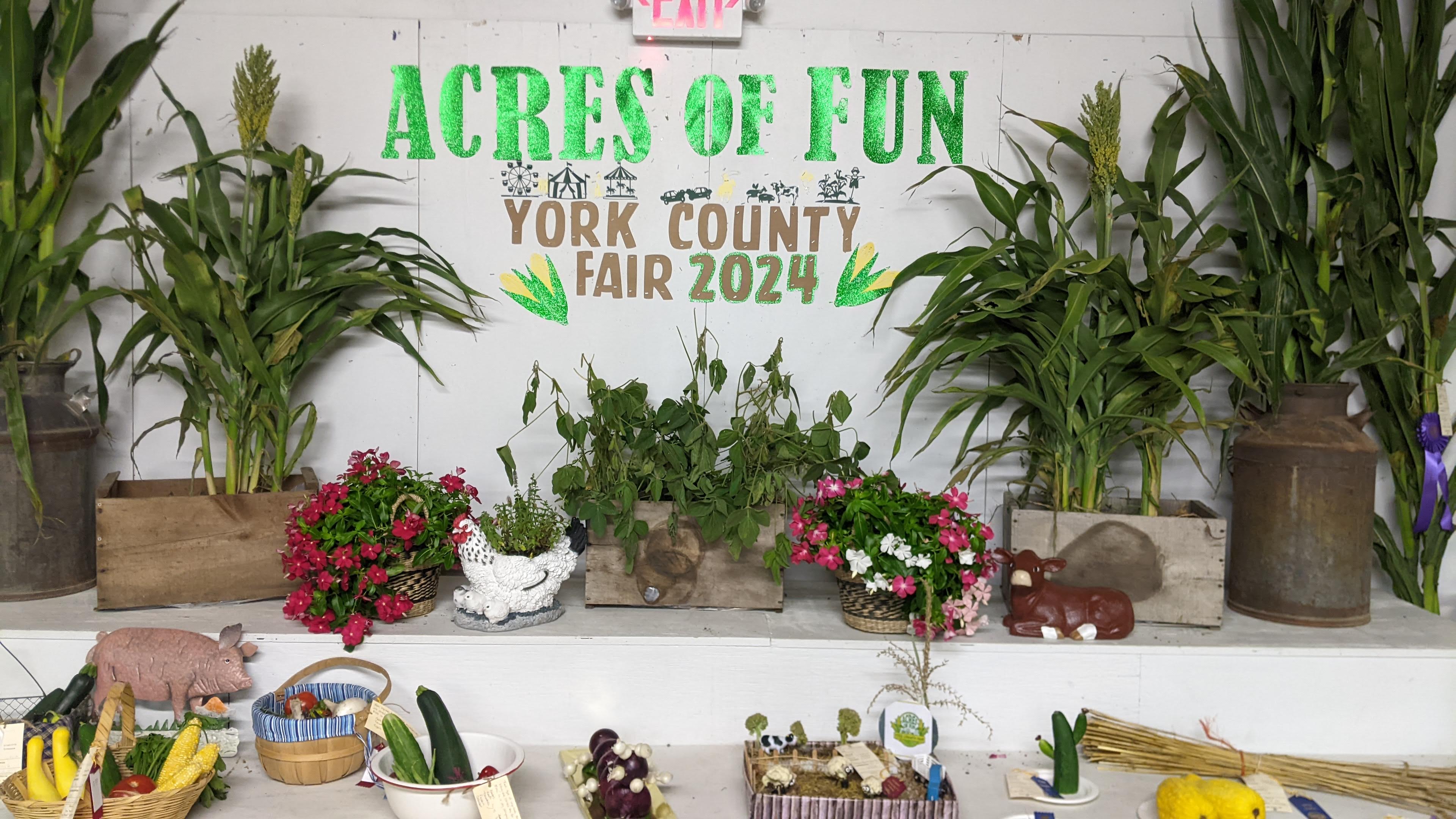
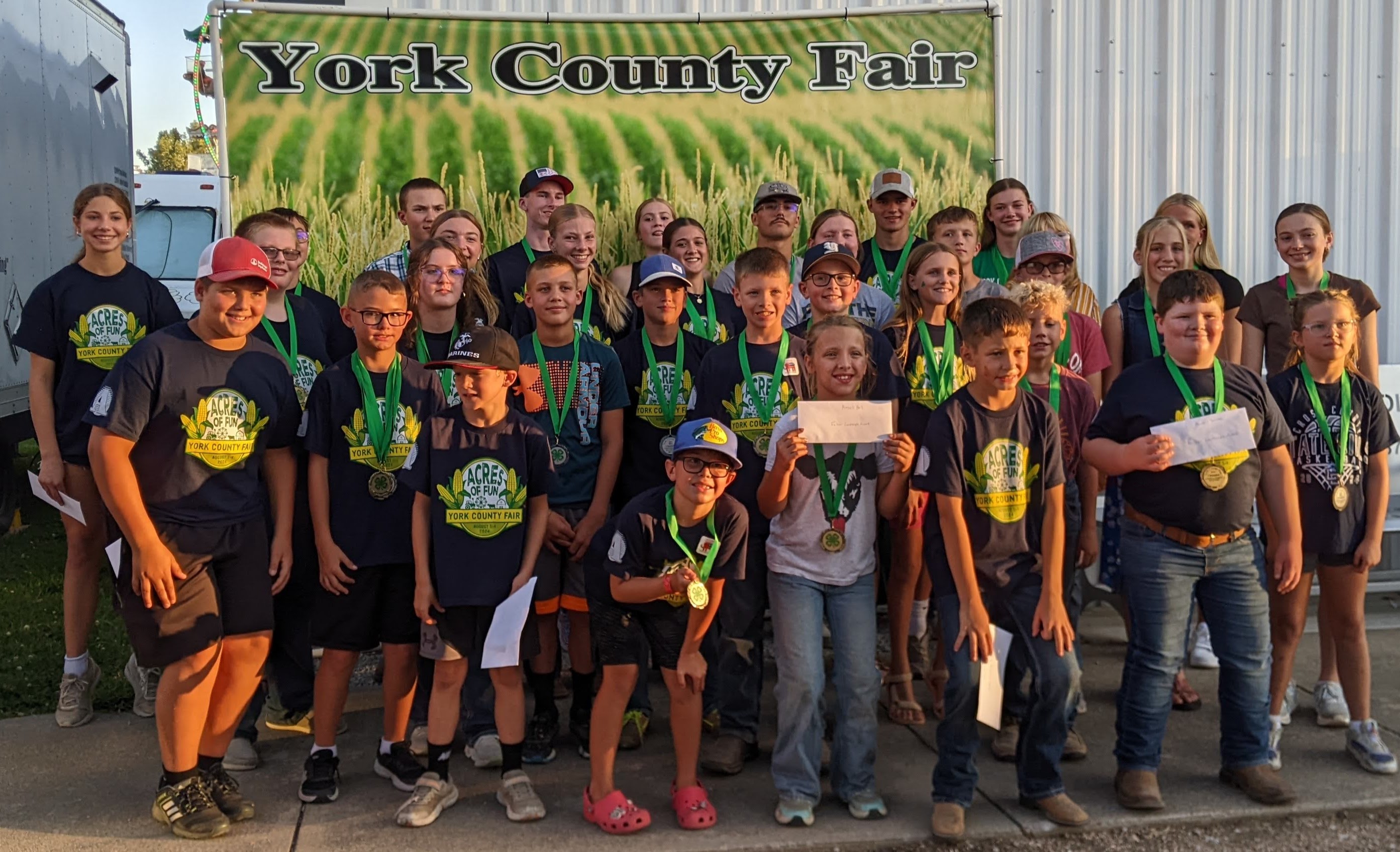
A special Thank You to everyone who helped make the 2024 York County Fair a success! I get to serve with nearly 60 volunteers who serve in Ag Hall each year. Most have served nearly 20 years or more! It’s fun for me to see the buildings and grounds come alive with projects. It’s also fun to observe people catching up with each other and to catch up with people myself. Perhaps my favorite part of fair is seeing the youth awarded for their projects and proudly wearing their medals around the fairgrounds. I’ve been blessed my entire career to work with wonderful people at county fairs and in counties where all the entities work together for the good of the youth, families, and community. Thank You to all the Ag Society, 4-H Council, Extension Board and staff, volunteers, families, sponsors, vendors, police/security who make the York County Fair a success each year! Wishing everyone exhibiting at Seward County Aug. 8-11 all the best as well!
Drone Conference: Nebraska Extension is hosting two drone conferences on Wednesday, Aug. 14 and Thursday, Aug. 15 at West Central Research, Extension and Education Center in North Platte, Nebraska. On Aug. 14th, the Drones in Agriculture Conference will feature Jonathan Rupprecht, Esq. of Rupprecht Law, P.A. Rupprecht is a lawyer, commercial pilot and flight instructor who combines these experiences to help businesses and individuals navigate the complex system of laws for unmanned aircraft systems.
On Aug. 15th, The Nebraska Spray Drone Conference will feature Dr. Steve Li, associate professor and extension specialist of weed science at Auburn University. His research team works on evaluating the application efficiency of spray drones and understanding how to optimize flight and spray parameters to mitigate spray drift.
In addition to these speakers, the conferences will feature presenters from Federal Aviation Administration, Nebraska Department of Agriculture, Nebraska Extension, Pix4D Agriculture, Lifted Vision, Aurora Cooperative, Agri Spray Drones, and Volitant Technologies. Spray drone demonstrations will be provided by Agri Spray Drones and Volitant Technologies. Please refer to the registration page for more information on speakers and conference agendas.
The conference registration fee is $150 per conference, or $250 when registering for both. An educational discount is available to students and educators through an application process available on the registration page. For more information and to RSVP, please go to: https://go.unl.edu/ihd5.
Extension Educator, Dirk Charlson, is also hosting a Part 107 Remote Pilot Exam Prep Course on August 16th from 9 a.m.-5 p.m. for more information and to register for that, please register at: https://cvent.me/x1AQD2. Please contact Dr. Dirk Charlson for more information on this course and/or the drone conference at Email: dirk.charlson@unl.edu or Cell: 402-460-0742 (Text or Call).
Forage Field Day Webinar will begin at 12:30 p.m. on Tues. Aug. 6th. Topics include: Alfalfa revenue insurance program; Sustainable ag and forage management; Summer annual for forage and soil health; Digestible forages in dairy rotations; Optimizing forage availability with cover crop grazing; Making a “safe” harvest plan; and Alfalfa diseases and pests. More information and online registration is required at: https://go.unl.edu/ad2y.
Reminder on Aug. 8 of UNL’s South Central Ag Lab Field Day near Harvard and also the Soil Health Event at the 4-H Building in York.


August 2024 Events
It’s fair time!!! Hope to see you at the York County Fair this week from Aug. 1-4 and the Seward County Fair next week Aug. 8-11.
For field updates, southern rust was found in a number of counties last week at low incidence. I’m able to find it a low levels in every field I walk into right now but incidence is so low that I still haven’t been recommending to spray. We’ve been seeing southern in lower portions of canopies in fields that have already been sprayed because the product didn’t penetrate that deep into the canopy. The updated map is at: https://corn.ipmpipe.org/southerncornrust/. Depending on when you read this, Seward does need to be filled in because we have confirmed it in Seward Co. too.
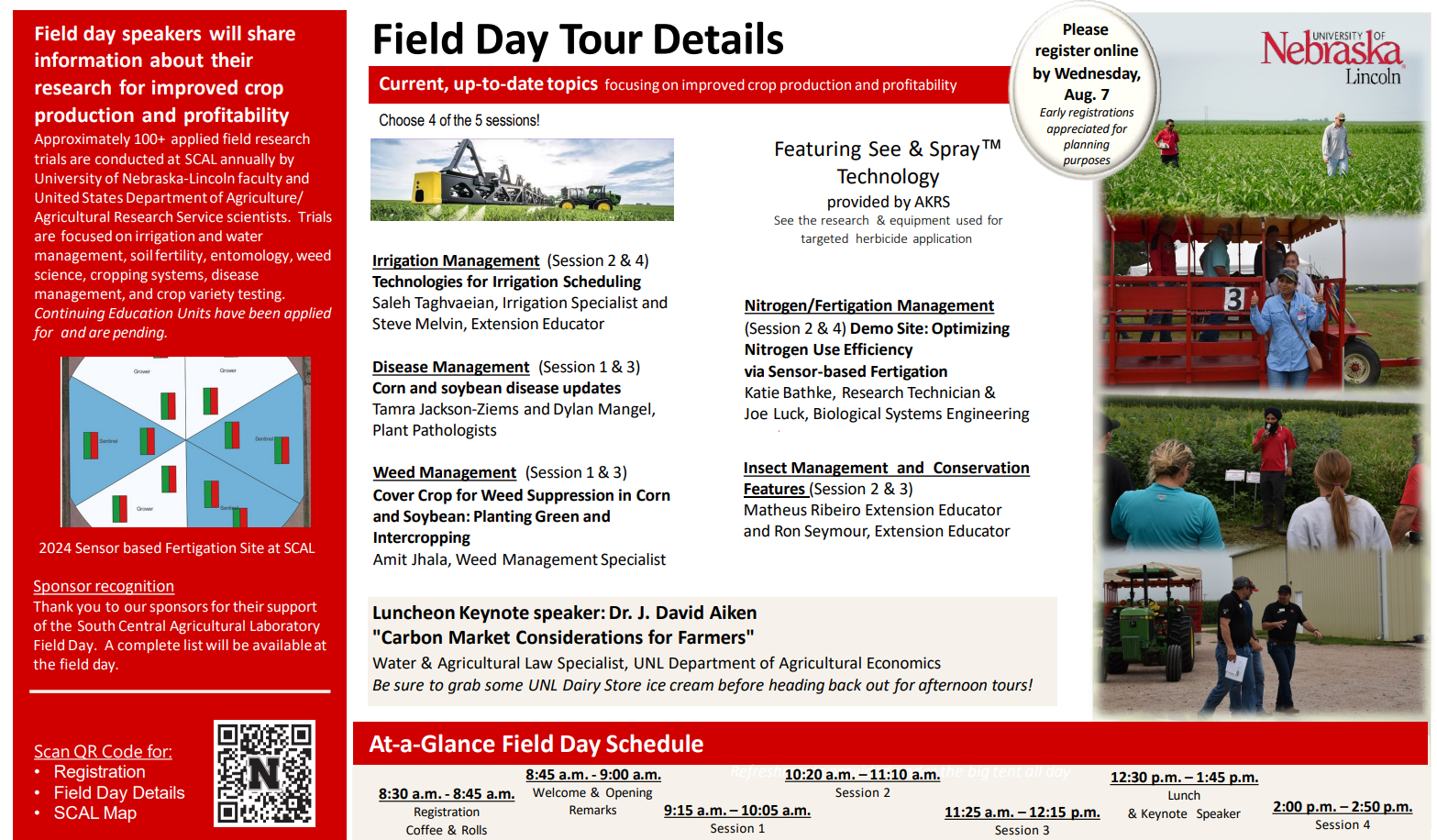
South Central Ag Lab (SCAL) Field Days on Aug. 8th near Harvard will begin with registration at 8:30 a.m. and the program at 8:45 a.m. Tours can be selected depending on what the attendees are most interested in. A special demonstration will provide the opportunity to see real-time, camera-based weed detection technology with the John Deere See and Spray. Topics and presenters include: Irrigation Management Technologies with Saleh Taghvaeian and Steve Melvin; Corn and Soy Disease Management with Tamra Jackson-Ziems and Dylan Mangel; Weed Management focused on Planting Green and Intercropping by Amit Jhala; Nitrogen/Fertigation Management with Katie Bathke and Joe Luck; and Insect Management and conservation features with Matheus Ribeiro and Ron Seymour. The lunch keynote speaker will be Dr. J. David Aiken, water and agricultural law specialist, sharing on “Carbon Market Considerations for Farmers”. SCAL is located at 851 Hwy. 6, near Harvard. There is no cost and RSVP is requested for planning purposes to (402) 762-3536 or https://go.unl.edu/scalfieldday. CCA credits are pending.
Soil Health Field Day will be held Aug. 8th at the 4-H Building in York from 10 a.m.-2 p.m. (Reg. at 9:30 a.m.). Topics include: Making winter wheat a success by Nathan Mueller; Soil health and summer annual cover crops by Katja Koehler-Cole; Protecting your bottom line with resilient cropping systems by Nick Arneson; Cover crop options that help game birds by Nate Pflueger; What we’ve learned so far about compost extracts by Jenny Rees; followed by a cover crop field site visit. 2.5 soil/water CEUs are available. No charge but please RSVP to 402-646-5426 for meal count.
Soybean Management Field Days are following a different format this year. The local field site for our area will be at Scott Richert’s field in the Ulysses/Gresham area on Aug. 15th from 6-8 p.m. (reg. at 5:30 p.m.). Scott planted soybeans green into rye and then roller crimped the rye after soybean emergence. This practice has aided in reducing palmer and white mold in his fields. This location will feature his on-farm research seed treatment study where he’s comparing the seed company’s full seed treatment vs. his biological seed treatment vs. an inoculated treatment vs. untreated check. I’m really looking forward to this format of showcasing the farmers and their research and topics of relevance to our local area. Other evening locations include Holdrege on Aug. 13 and Neligh on Aug. 14. Another option will be Aug. 16 at ENREEC near Mead with program from 10:30 a.m.-2 p.m. (Reg. 10 a.m.). That location will focus more on the TAPS soybean plots, Ag Olympics, and soybean gall midge research plot tours. There’s no charge thanks to sponsorship by the Nebraska Soybean Board, but please RSVP for planning purposes to 402-624-8030 or https://enreec.unl.edu/soydays.

Peer Groups
This past week I attended the National Association of County Agricultural Agents meeting in Dallas, TX. It’s a joy to see my ag educator/agent friends serving people through the U.S. and its territories, to talk through local issues, learn from and encourage each other. Extension is truly like a big family, both within Nebraska, and outside of it, and I’m grateful for that and for peer groups in my life over time. Even though I took care of clientele during my time away, it’s also nice to physically get away at times to reset.
A highlight of these meetings is a tour of local ag for that State. My tour was on cotton production including touring a cotton gin. Others of you probably know this, but I didn’t realize the cotton flowers were so beautiful! They begin white when they bloom. Once they pollinate, they turn pink, then turn into the boll which eventually form burs around it. Cotton is either stripped with a stripper header like some harvest wheat (which essentially leaves the stalk standing), or it is harvested by picking where only the bolls are removed. Most of the farmers in this area of Texas use stripper headers. Some fun facts: a cotton boll has 4 compartments, each with 7 seeds in it. Each bale of cotton removed from a field goes through the gin individually. It comes in at about 10-12% moisture and is dried to 6-7% to allow for easier cleaning. The cottonseed, burrs, sticks, etc. are removed from it and the cleaned cotton is baled and bagged with a sticker tracing that bale back to the original field. The grower is paid for the cleaned cotton and the cottonseed (and often more money is made from the cottonseed than the cotton). The rotation in the area I toured was corn/cotton.
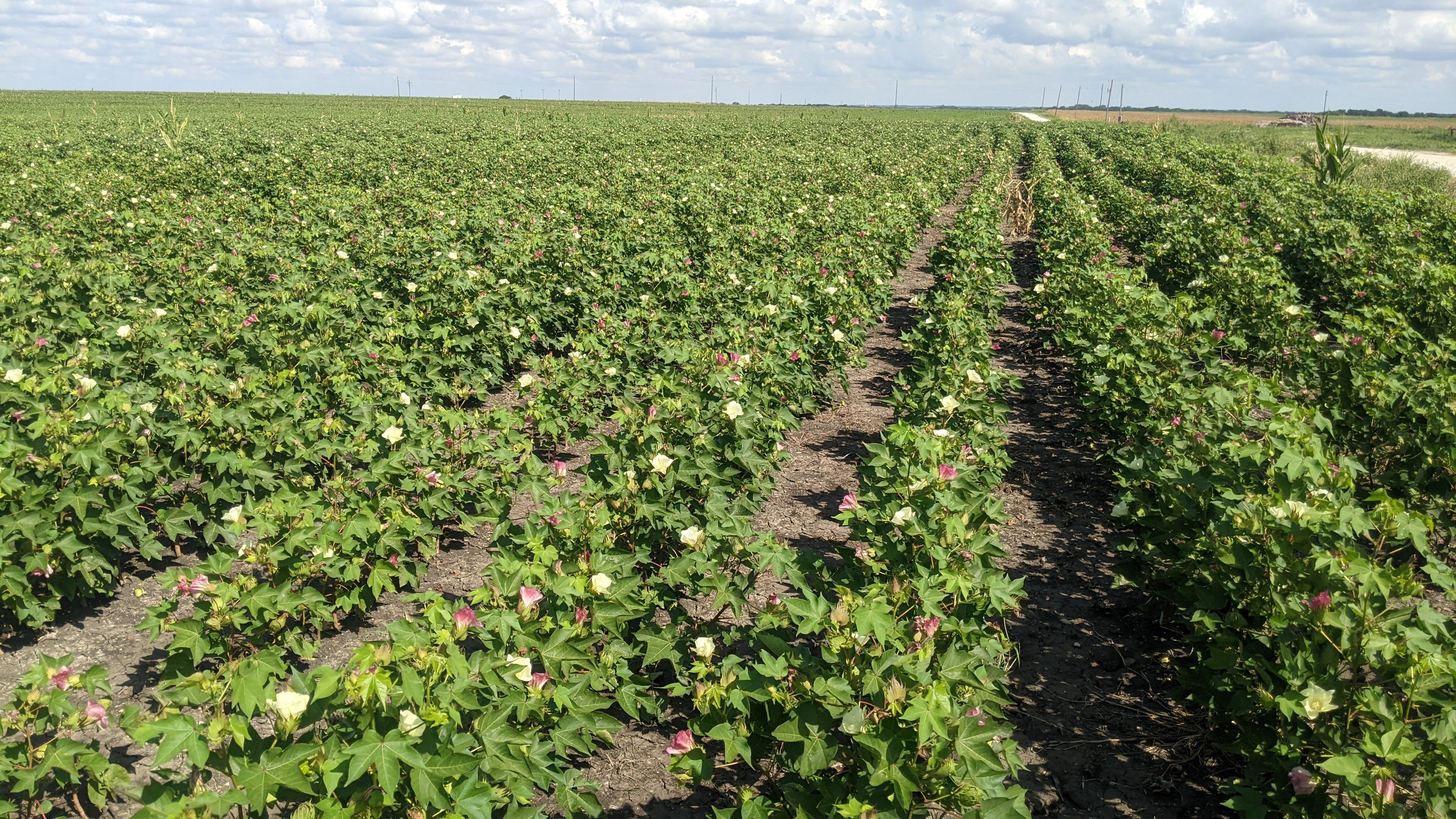


(Captions for photos above: Cotton field (top left); Several flower and boll stages in this pic (top right); First flowers are this beautiful white color but don’t smell (bottom left); How cotton comes into the gin compared to cleaned cotton (bottom middle); cottonseed compared to the remaining material removed from the cleaned cotton (bottom right).)

I also presented on the importance of peer groups. Participating in peer groups with like-minded individuals (regardless of one’s career or the topic) is a rewarding way to learn, encourage, and be more innovative. In 2020, in the midst of covid while serving a large area, one grower encouraged me to connect him to the growers I was telling him about who were like-minded in their thinking regarding regenerative agriculture. So, we started a small soil health support group with growers from three counties and myself, met via zoom at first, then did a late summer driving tour of farms. I’ve watched deep friendships develop, sharing of equipment across county lines, and supporting each other’s businesses including cover crop seed sales, biological product sales, seed treatment, and seed cleaning. These specific peer groups have grown to around 30 farmers in a few groups from 6 counties. The goals were connection of like-minded farmers who were humble and vulnerable in sharing successes and failures, openminded in trying new things, and ultimately that collectively we could “fail forward faster” in finding meaningful solutions to reducing chemical and nutrient inputs.
Because the growers wanted to obtain data around some of their efforts, since 2020, they’ve completed 19 Nebraska On-Farm Research Studies in the regenerative ag space. And because farmers like to hear from other farmers, they have shared on these studies at 13 Ag Industry and Extension meetings thus far. In ag, it’s so easy to isolate and feel alone. Perhaps many careers are this way? Would encourage anyone to consider joining or creating a peer group with like-minded individuals if you’re not already in one.
On-Farm Research: I’m so grateful for all the farmers who have/continue to work with me/my peers via on-farm research to collect meaningful data that benefits all of us! The Nebraska Soybean Board followed a few of our farmers with on-farm research efforts last harvest season and had the following short video created that highlights the importance of on-farm research if you’d like to know more: https://youtu.be/XUyouEjYgIU?si=KIVfrXrDR9pSuN_D.

July 2024 Crop Update
The past 10 days, my top questions have been around fungicide recommendations, control of Japanese beetles, and hail damage. I feel there’s an increasing segment of agronomy that is focused on preventing pests based on fear. I’m grateful for those agronomists who only recommend products when warranted by scouting.
Some thoughts, although not popular, for consideration. Fungicide for white mold in soybean is pricey. If the field didn’t have a history of white mold, I wouldn’t recommend applying a fungicide for white mold. For seed corn fields without a history of white mold, I’d wait to see if white mold develops. If too fearful, would only apply one application at R2. Only fields with a history of white mold would I be considering preventive fungicide applications. And in those fields, if the beans had been planted green into a small grain and/or if a biological product with activity against white mold was used, would suggest scouting and applying only if white mold was present. Fungicide efficacy ratings: https://cropprotectionnetwork.s3.amazonaws.com/soybean-foliar-efficacy-2024.pdf.
Hail: Looked at quite a bit of hail damage in Clay/Fillmore counties last week. Always so hard to see beautiful crops impacted or destroyed. Some hail resources for you: late vegetative/tasseling in corn: https://go.unl.edu/y3of, Soybean decisions: https://go.unl.edu/z7ad; and hail damage info. on my blog at https://jenreesources.com.
Corn Diseases: There’s very little I’ve seen in fields. Bacterial leaf spot (BLS) is common on hybrids and can be confused with gray leaf spot. BLS has longer, thinner lesions with wavy lines when looking at the lesions closely. I’ve seen quite a bit of Goss’ wilt, as early as V8. There’s nothing we can do for either BLS or Goss’s as bacterial diseases, but it’s good to be aware they’re occurring.
Tar spot has been found in Richardson, Nemaha, Saunders, Dodge, Colfax counties but not in our area. Southern rust has been found in northeast Kansas. I still recommend waiting on fungicide applications until we need them. Research found that products applied between tasseling and milk when tar spot was present in low amounts (5%) was effective in controlling tar spot most years. So, waiting could be wise with tight economics, particularly if tar spot, gray leaf spot, and southern rust come in later.
Japanese Beetles in crop fields: Usually the beetles congregate in areas in the field and not whole fields. So even at a 20% defoliation in soybeans during reproductive stages, it’s been hard to pull triggers for spraying because it’s not field-wide defoliation (and we’ve seen soybeans recover in the past). For corn, the threshold is 3 beetles per ear with silks clipped less than ½” and 50% or less of the field is pollinated. A challenge with Japanese beetles is that we have another potentially 4-6 weeks of emergence from grassy areas. So, one can spray an insecticide, but it’s not uncommon to see the beetles damaging fields again once the residual wears off. Spidermites can also be flared upon insecticide applications. Some consider a border app since they begin feeding in the borders. So, those are all things to consider.
Sevin and Japanese Beetles: For homeowners, PLEASE read the pesticide labels before applying products (even if you’ve used that same product in the past). I do mention Sevin as a product that can be applied in different situations in this guide: https://go.unl.edu/xgd6, but not all Sevin formulations are the same; thus, not all the same plants are labeled! We’ve unfortunately seen some plants injured to the point of death in the past. So please, double check that the plant is labeled before applying an insecticide product to control the beetles.

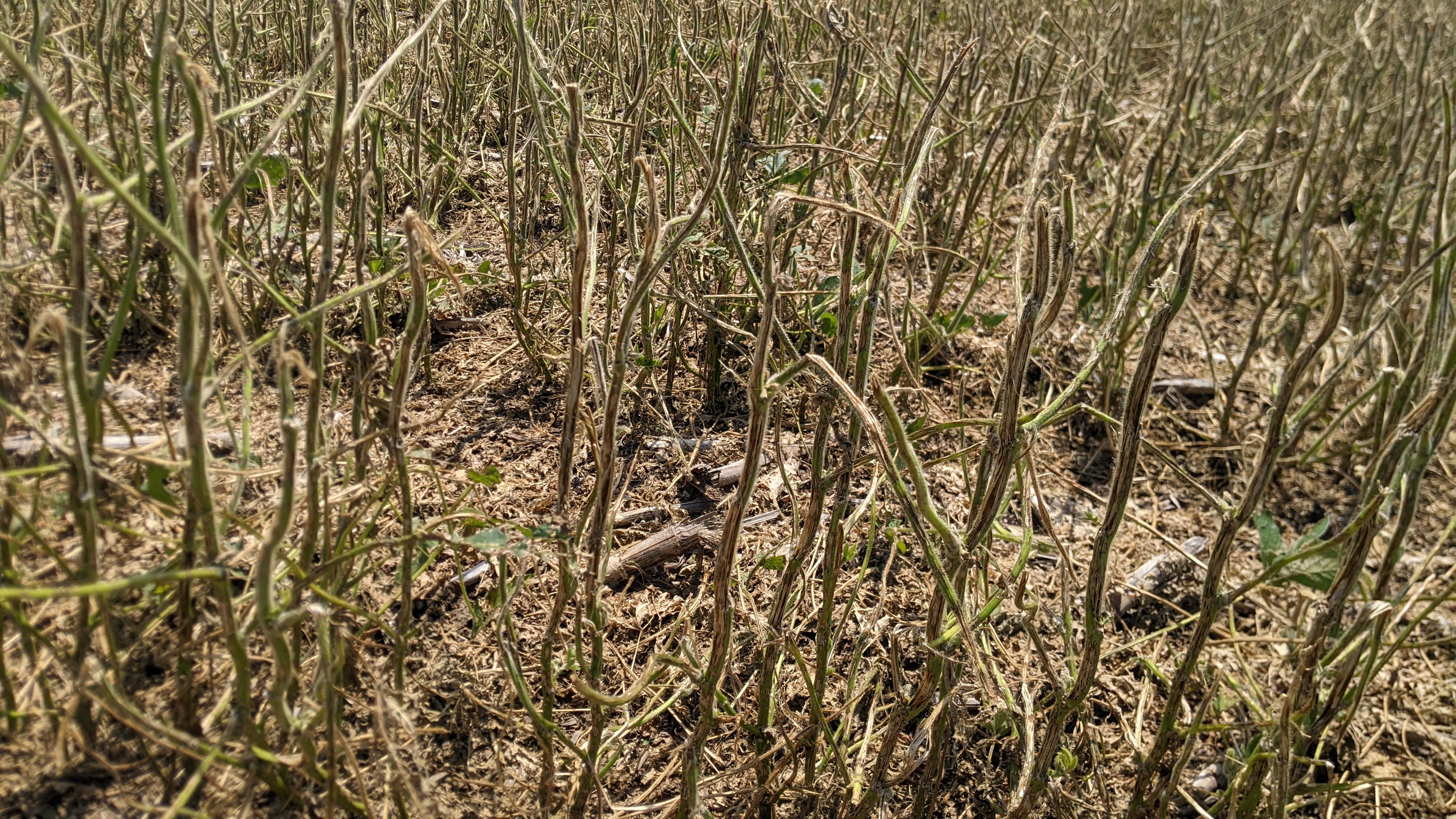


For soybean damage, the situations with pictures shown here (other than the top right) will recover. These fields are already showing new growth in axillary buds including new leaves and flowers. While some canopy was lost, they will look a lot better in 7-10 days. Look for areas of the field (lower right picture) that were protected such as by trees and/or pivot tires, to determine the original development stage when the soybeans were damaged. In the case of the upper right photo, those beans were planted the week of April 10th and were already at a strong R4 to beginning R5. By R5, soybeans will not recover because all new node, leaf, and pod development ceases. If considering to replant any beans, there’s risk of using later than a 2.5 maturity variety with a July 15th planting date in reaching maturity before a frost. By July 20th, aiming for closer to a 2.0 maturity is wise. Also, if you’re replanting into soybeans, we’ve found a fungicide seed treatment is wise as phytophthora root rot tends to be a problem in replant.
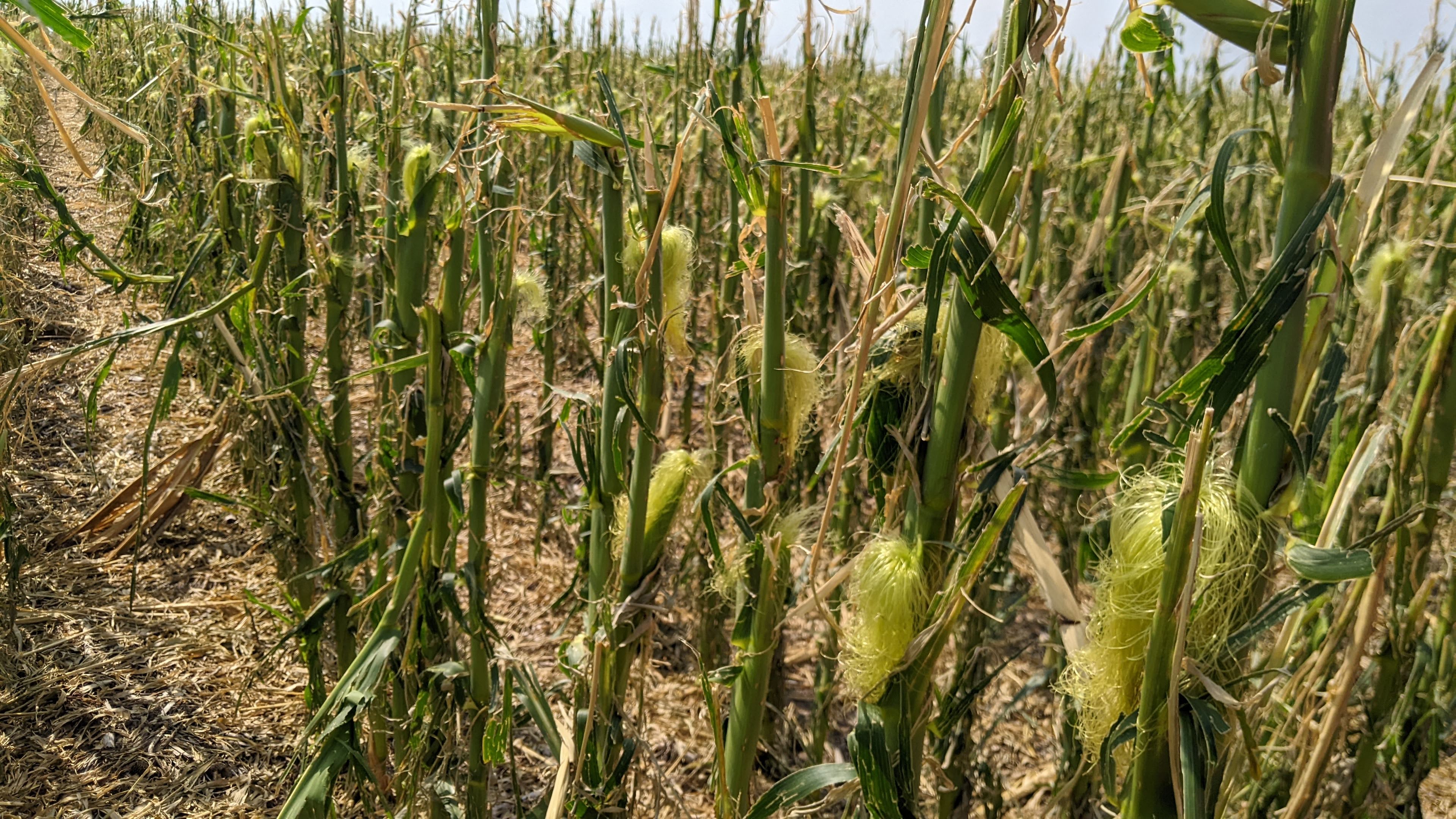


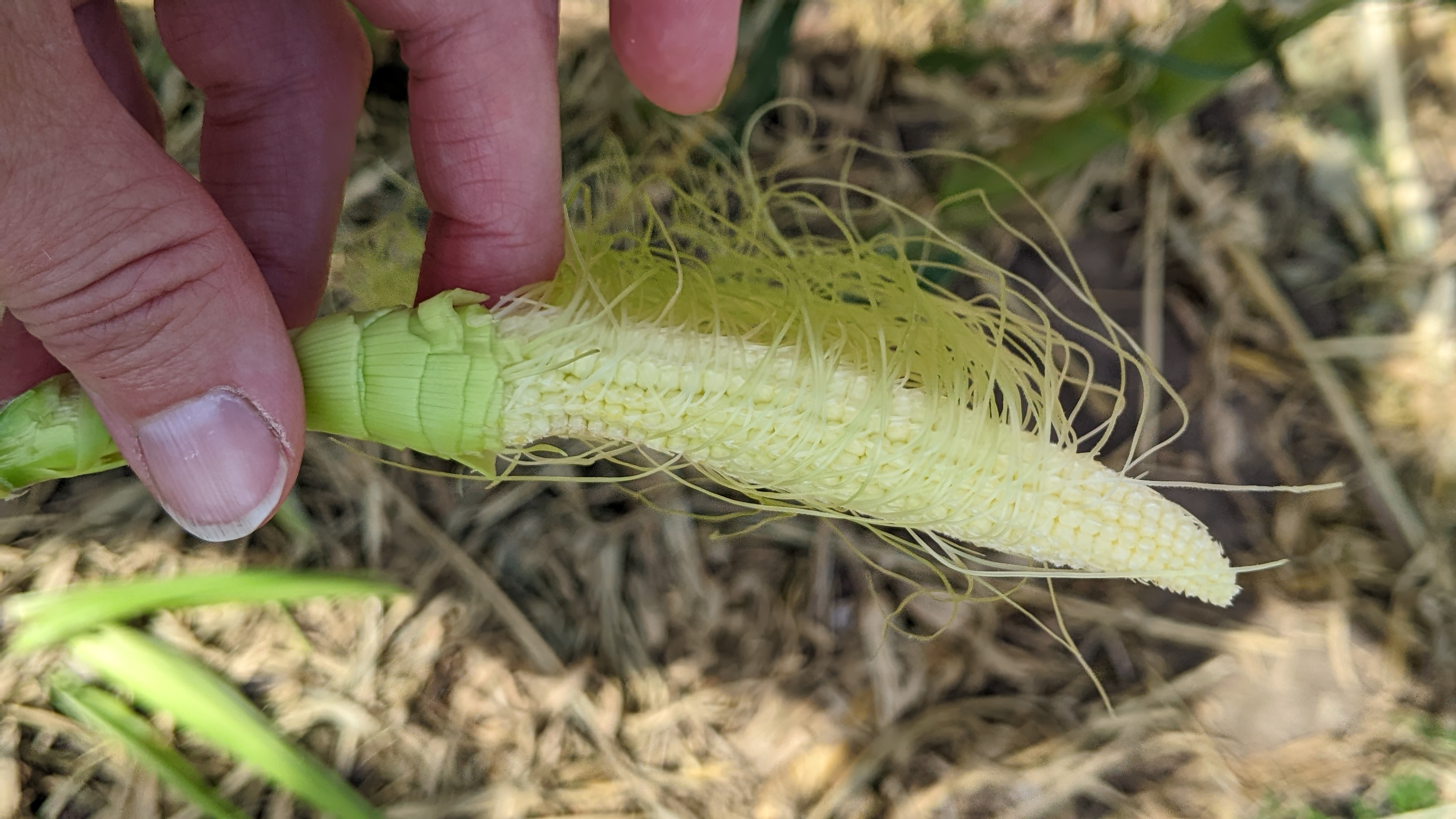


For corn, much of the corn I looked at has mostly leaf stripping and will be ok. There’s also bent/broken plants. Fields vary in the amount of stem bruising. When taking stand counts, I push a little hard on plants to see if they break off when I’m taking counts. A rule of thumb we’ve used in the past: every plant in 1/1000th of an acre we give 10 bu/ac to. So, a count of 12 plants has a potential of 120 bu/ac. That may seem crazy; it depends on how things pollinate, how damaged the ears are, final stand, etc. but it has been in the ballpark in enough cases for me to still use it as a guideline for making hail damage decisions.
In these photos, the fields were far more severely damaged. There’s fields like we saw in 2023 where 1/3 of the field or less still has tassels (top left and middle photos). We saw crop insurance delay that decision in the past to see how the ears would pollinate. I’m not sure what they will decide this year. I was seeing a few brown silks in some of these field situations, but it’s super early too. There’s also a large number of dead tassels in these fields (bottom right photo) that won’t provide any pollen. Tassels remaining tend to be wrapped in the newer leaves but as you see in bottom, middle photo, the tassel is trying to shed pollen inside the trapped leaves. Ears may be misshapen and damaged due to hailstones and/or being damaged and unable to emerge from sheaths (bottom left photo).
What we learned in the past is that palmer comes in quickly once the canopy opens. One can consider warrant with drops as a layby depending on how much Group 15 had been used in the field. Most chose not to go that option. Some seeded covers like brassicas/small grain into fields not totaled (flew on or haggie). Most let the palmer grow.
In the top right photo when fields were totaled, some allowed the weeds to grow and grazed with cattle or sheep. Some seeded a summer annual cover like sorghum sudan/sudangrass/pearl millet. In 2023, several crop producers chose pearl millet so they didn’t have to worry about prussic acid poisoning for those bringing in livestock or wanting to hay. Others just waited till later in the year, shredded down the stalks and planted in a small grain like oats or rye. The “blessing” with a decision in July is it can allow for more time to make a decision compared to if we were in June and the primary option was to replant. That perhaps was the biggest lesson I learned last year in working with producers. If you have specific questions or want to talk through decisions, please give me a call.
Also, it’s important to recognize that these disaster events create loss…in this case, loss of crops, pivots, bins, not only in irrigated acres but in a lot of non-irrigated acres that had more potential than most have seen in years, much less their lifetime. It’s ok to have a range of emotions surrounding this. And, it’s common to feel stressed, numb, and not want to make a quick decision. If I’ve learned one thing in my career, it’s the fact that as people, we all just need to talk about the stress and emotions we all face at times with someone we trust. My biggest piece of advice is to talk to someone just to get outside of one’s own head. There’s so much stress in life, not to mention in ag. The most common comment I’ve heard from people the past several years was they just appreciated being able to share with someone about the stress and what they were feeling. There’s also a number of mental wellness resources on the front page of CropWatch at https://cropwatch.unl.edu.
Resources:
- Summer annual forage grasses: https://extensionpubs.unl.edu/publication/g2183/2013/pdf/view/g2183-2013.pdf
- Making soybean replant decisions-what we learned: https://go.unl.edu/z7ad
- Corn damage to late vegetative/tasseling corn: https://go.unl.edu/y3of
More information and registration at: https://www.grazemastergroup.com/events.
JenREES 7/7/24
I’m grateful for the nice rains that we received and it’s also hard when crops get damaged by wind/hail/flooding. For those who received damage in surrounding counties, I’m willing to look at fields and help with decisions. We did share some additional information in this week’s CropWatch on hail during late vegetative/tasseling in corn: https://go.unl.edu/y3of and mid-season flooding: https://go.unl.edu/ua96 damage.
Tuesdays at 9 is Extension’s monthly climate outlook webinar. The next one is this Tuesday, July 9th at 9 a.m. Join Eric Hunt, agricultural meteorology and climate resilience extension educator on the second Tuesday of each month to hear insights on weather conditions across the state of Nebraska and Midwestern region, and updates on the long-range outlook. Participants will also have the opportunity to ask questions during the webinar, using the Q&A function in Zoom. Questions will be answered near the end of the webinar, as time permits. To register and view recorded webinars, please visit: https://cropwatch.unl.edu/second-tuesday-9.
4R’s Field Day will be held July 11th at the Eastern NE Research Education and Extension Center near Mead with program from 9 a.m.-3 p.m. (Registration at 8:30 a.m.). This event on 4Rs of Nutrient Stewardship features knowledge and tools to improve nutrient management, soil health, crop yields and water quality. Specific topics include discussions on the future of nitrogen management in Nebraska, Enhanced efficiency fertilizers, Updated UNL nitrogen recommendation tool, Can biological products serve as alternatives to chemical nitrogen fertilizers, farmer panel, and a drone fertilizer application demo. 4.5 CEUs on Nutrient Management are available. There is no charge for this event but RSVP is requested for meal count to: https://go.unl.edu/7gjw.
GrazeMaster Field Day will be held Wednesday, July 24th near Denton, NE. The day will begin at Brian Brhel’s farm (481 140th Denton, NE) with registration from 8-9 a.m. and the field day beginning at 9 a.m. Brhel is a farmer and cattle producer implementing cover crops, unique crop rotations, and regenerative grazing. Also presenting will be Zack Smith with his invention – the Stock Cropper, “Stock cropping is a regenerative agricultural system that raises row crops in conjunction with multiple species of livestock simultaneously in the field.” From there the day will continue at the Denton Community Center in Denton with lunch. Afternoon speakers/topics include Rosalie Hillmer of Hillmer Feed & Supply; Vance McCoy of Triple Creek Cover Crops sharing on the importance of a mindset shift being one of the most important aspects of changing one’s farm/ranch in addition to the positives and challenges when improving soil health; Nick Ward of Ward Labs; Farm Legacy Planning; a Profitability panel; and the Lutheran Institute of Regen Ag. There is no charge but RSVP is requested for lunch. More information and registration at: https://www.grazemastergroup.com/events.
ProHort Lawn & Landscape Lunch & Learn will be July 16, August 20, and September 17 from 12-1 p.m. These noon webinars are an informal opportunity for those who serve people in the lawn and landscaping profession to share what’s happening in landscapes, management recommendations and helpful resources. Be ready to share questions or problems you are currently finding in client landscapes. No charge and open to all green industry professionals. Register at: https://unl.zoom.us/meeting/register/tJAscO-ppjgoHNVgh4_StJFZfeM8_d2Lq5aY#/registration
Japanese Beetle Management Resource: https://go.unl.edu/xgd6.
JenREES 6/30/24

Holiday Food Safety: The Fourth of July is the most popular U.S. holiday for grilling, according to a 2020 survey of American grill owners. Some 68 percent of respondents like to throw barbecue parties on that day. Food safety can be challenging when eating outside. Did you know that you are more likely to get food poisoning (foodborne illness) during the summer months than any other time of the year? Given the right environment, harmful bacteria can quickly multiply on food to large numbers. To prevent a food borne illness, check out this resource: https://go.unl.edu/o2n0.
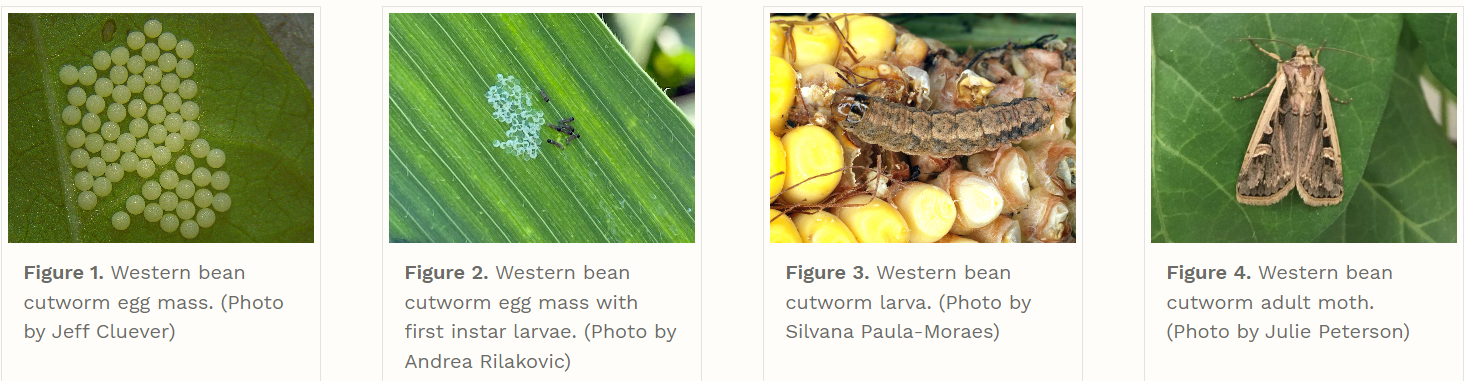
Western Bean Cutworm GDDs: With corn beginning to near tasseling, it’s time to be scouting corn for western bean cutworms. The updated Western Bean Cutworm degree day model was developed in Nebraska by Drs. Bob Wright and Tom Hunt in collaboration with entomologists in Minnesota. It’s really done a good job the past few years. The model is based on a lower threshold of 38°F and upper threshold of 75°F beginning on March 1. It’s recommended to start scouting when 25% of moth flight occurs based on accumulating 2,577 degree-days. Lincoln hit 25% on June 29th, Grand Island is predicted to reach 25% on July 4, Columbus July 5, York July 6th, and Clay Center July 6th. The economic threshold is 5-8% egg masses/live larvae.
When scouting, we typically find western bean cutworm egg masses on upper leaf surfaces of corn leaves with masses containing 50-85 eggs. Normally we’re taught to look at the upper portion of the plants closer to the tassels, but with silks emerging prior to tassels most of the time, I tend to also find masses on leaves around the ear leaf and sometimes directly on the husks (especially during periods of high heat). Egg masses are white and raised when newly hatched; they turn a purplish color when they’re getting closer to hatching. Larvae have two dark rectangular spots right behind their heads. More western bean cutworm info. including the dates for predicted flight moth percentages can be found at: https://go.unl.edu/60s2. You can view all the light trap data throughout the State at: https://entomology.unl.edu/fldcrops/lightrap.
Fertigating during pollination is ok. Dr. Tom Hoegemeyer had shared that pollination mostly occurs between 8:30 a.m. and noon. Heat kills pollen when the temperature is 90°F to 95°F and is seldom viable past 2 p.m. That leaves lots of time to run pivots, apply N, etc. when it won’t harm pollination. Silks tend to be viable for three or four days at these temperatures, so if a plant isn’t pollinated one day, generally the next day will work just fine. The UNL recommendation for fertigation is to use 30 lb of N with 0.25″ of water or 50-60 lb of N with 0.50″ of water. With a high capacity pump, you can apply up to 60 lb of N in 0.25” of water.

Earwigs: These insects look menacing. There’s been several calls on them. Indoors, they seek areas with moisture like basements, bathrooms, etc. They don’t harm humans or pets as they only feed on living and dead plants and small insects. They get into homes via cracks/crevices and often one tends to see them more when there’s a lot of landscaping around the home with cracks in the foundation, gutters that aren’t cleaned out, etc. Prevention includes caulking, sealant or weather stripping to eliminate pest entry. Perimeter sprays (ex. Ortho Home Defense) or any that list earwigs can help. Water landscaping around the home earlier in the day (as they’re active during the evening). For more info., please visit the following resource: https://go.unl.edu/n2kc.
Japanese Beetle Management Resource: https://go.unl.edu/xgd6.
4 R’s of Nutrient Management Field Day will be held July 11th. More info: https://go.unl.edu/c5d2.
(end of news column)
Cover Crop Survey: Researchers at Kansas State University are asking 15-30 Nebraska farmers to take a questionnaire about video messages related to cover crops, regardless of your current use of cover crops. This questionnaire will take you about 10 minutes to complete; it measures knowledge and perceptions about cover crops, and after watching a 90-second video about cover crops, there are several questions about your reactions to the video message. After receiving your response to these questions, along with your feedback about the questions, we will send the questionnaire to Kansas farmers as part of a research study. Thank you for your time and feedback. If you have any questions related to this study, please feel free to contact Katie Starzec.
Odd Crop Things
I’m grateful for the good start to the growing season that many in the area I serve have experienced thus far. Soybeans have started flowering or will soon. Earliest planted corn isn’t far from tassel! Some areas continue to miss rain and other areas get far too much. For those dealing with flooding, the following are some rules of thumb:
- Corn Prior to V6: Plants can survive under water for 2-4 days if temperatures do not exceed 77°F.
- V7—V10: Plants can survive 7-10 days if temperatures do not exceed 86°F.
- VT—R1: Reduced nutrient uptake and successful pollination if standing water is present longer than 2-4 days. Yield losses may occur.
- Soybeans: Yield losses minimal if flooding lasts less than 48 hours. Flooded for 4-5 days, fewer nodes develop and plants will be shorter; possible stand and yield loss beyond that.
- Soybeans at flowering: Potential yield loss, especially on poorly drained soils.
We’ve seen several oddities this year in crops, which I haven’t talked much about, but a crop consultant suggested I should write a column on them. The following have been found from Saunders County through the Gothenburg area this year.
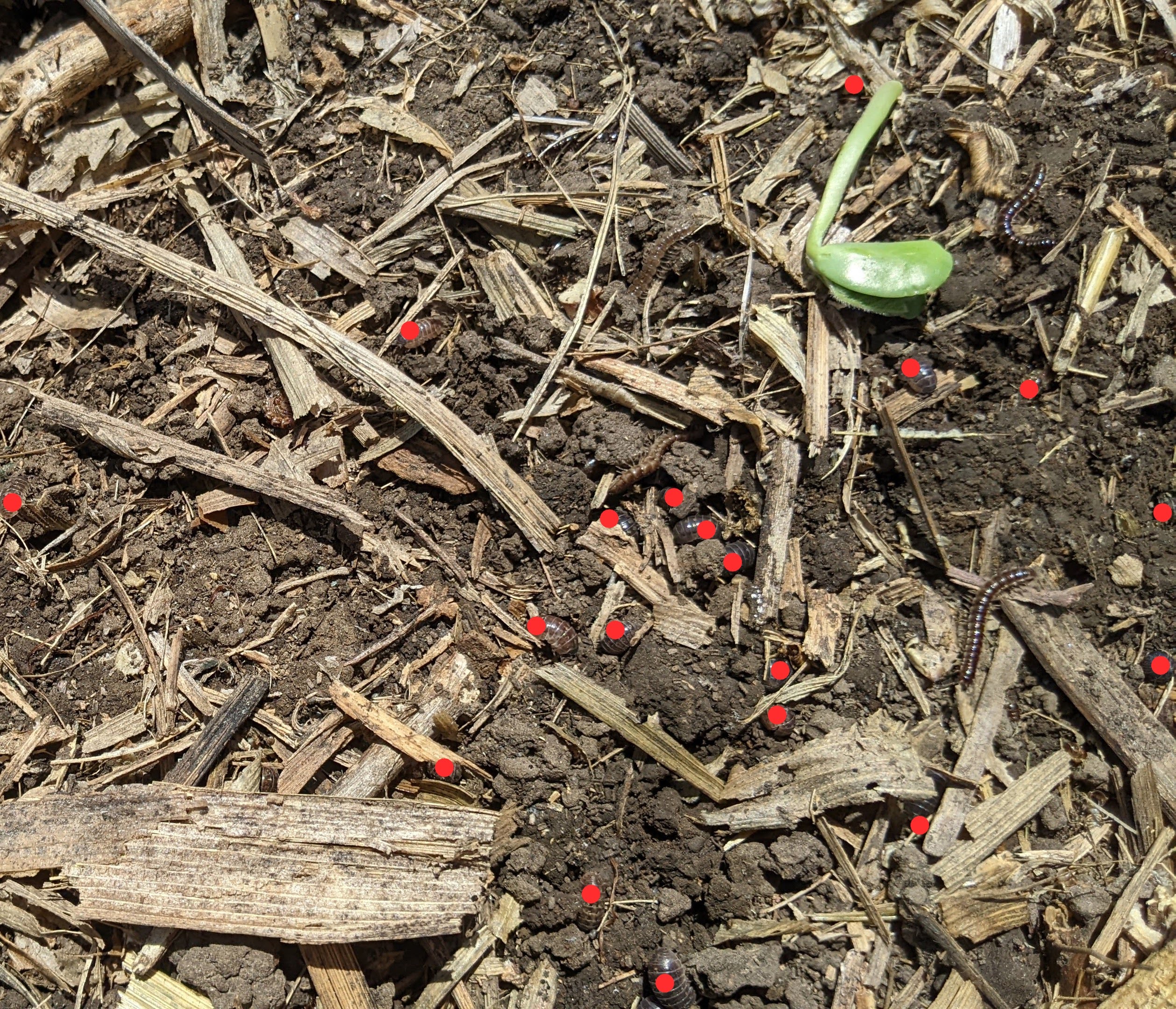
The warm February, reminiscent of 2017, provided the potential for greater insects. Thankfully haven’t seen more than 10% damage from wheat stem maggots to corn planted green into small grains (compared to 2017). Pill bugs (roly polys) and centipedes which typically feed on decaying material and other small insects/spiders, respectfully, have caused damage to soybeans in some fields. I’ve never seen these numbers nor damage before! However, this year, in heavy residue fields, we’ve observed them eating soybeans to the point of fields needing replanting. Slugs and snails have plagued some double crop small grain/soybean fields with one consultant sending me a picture of a planter bar loaded with snails.
Been some issues with seed germination in some hybrids/seed lots. Heard situations of non-liberty tolerant refuge in liberty link corn hybrids. There’s also the failing to remember which trait is in which field before spraying herbicides, so a reminder to double check that before herbicide applications occur. There’s been a lot of uneven corn within rows this year. Each field has various circumstances, but common culprits have been: solar storm throwing off GPS which got seeds too close to fertilizer bands; residue blowing back over portions of rows; planting depth and/or sidewall compaction issues; seed issues; and “weaker” corn plants having a hard time outgrowing HPPD (bleacher chemistry) herbicides in portions of fields. With corn rapidly growing and canopying, unevenness in fields doesn’t look as bad anymore. Overall, these oddities are few and I’m grateful for a good start to this growing season!
Japanese beetles are unfortunately starting to appear. Reminder: don’t use traps as they attract more beetles to your yard! Beetles can be knocked off plants into soapy water in the evening hours and disposed of. The following contains conventional and organic insecticide information: https://go.unl.edu/xgd6.
Reflection: Some know that I’ve been out off/on helping family and I’m grateful for that opportunity. We had celebrated making it through each surgery with Cheesecake Factory Cheesecake and are praising the Lord for healing😊As I drove home this weekend from celebrating family birthdays, I was reminded again how blessed we are to live this life and how short it truly is. How often we miss the little things or don’t take time to celebrate! Some recent conversations included how often the china stays in the cupboard, taking time to smell a blooming flower instead of just walking by or just stopping to admire a sunrise/sunset. Simple things. But I think the result is gratitude. This week, perhaps we can seek to live life more intentionally with the people around us.
Reminder of Weed Management Field Day at South Central Ag Lab near Clay Center June 26!


Windbreak Care
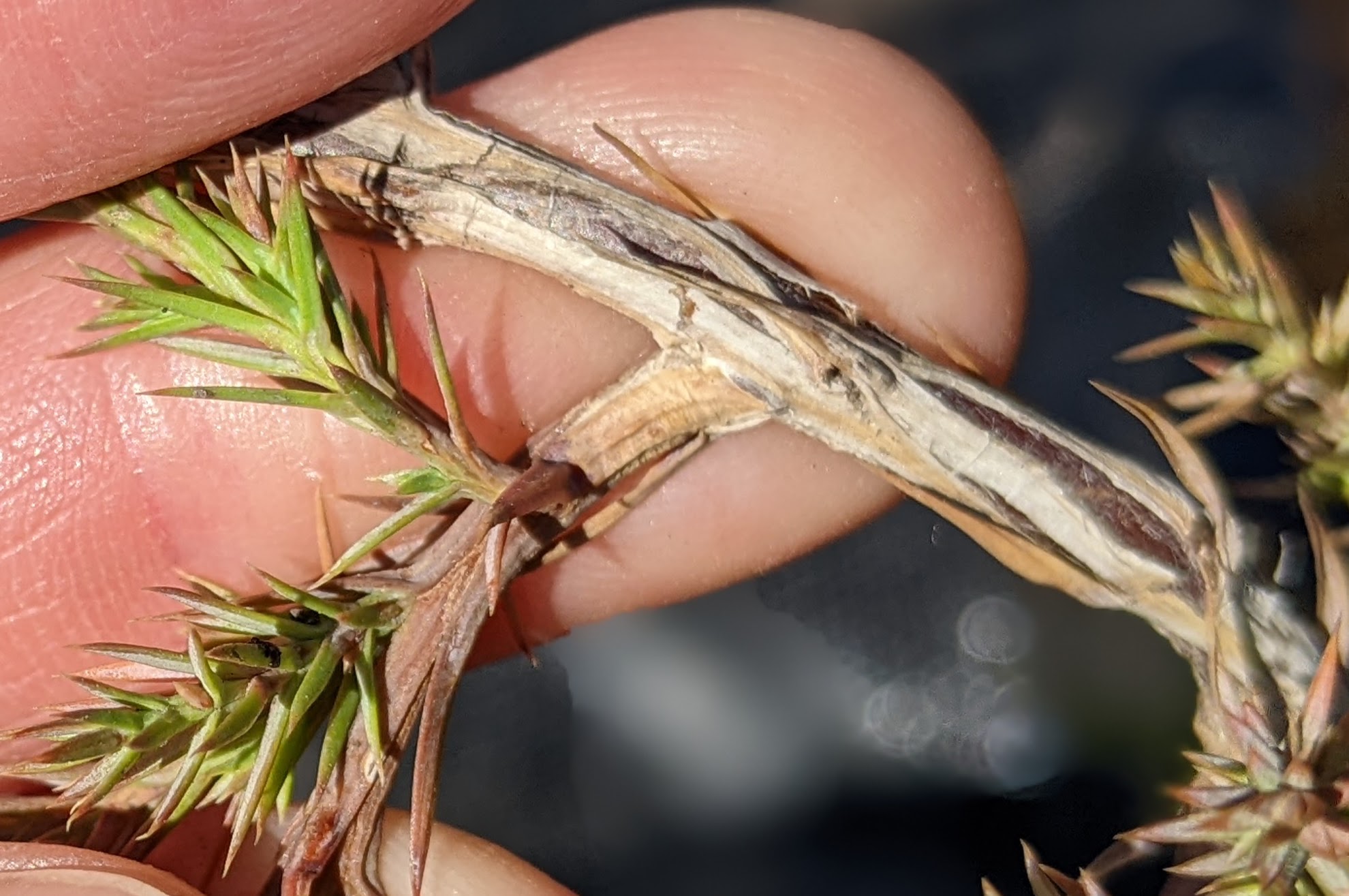
Windbreak Care: With new windbreak establishment, I’ve been seeing some transplant shock where the needles, twigs, and entire seedlings were turning brown. In talking with a district forester, he shared that environmental stresses of tree planting are likely when considering the trees are going from a 36F cooler and planted when air temperatures were in the 70’s and 80’s. He also mentioned two other environmental culprits to browning of needles: air pockets in the soil around the tree roots and/or planting depth issues. To get a feel if trees will survive or not, gently bend twigs to see if they are flexible or brittle. If flexible, they should still survive. If brittle, check on several tree twigs to see if there are a few twigs that won’t survive on the majority of the tree. In the case of the new transplants I looked at, the twigs were still pliable and not brittle. Also look closely at the axillary buds (where twigs meet the main stem) to determine if any new green bud growth is present. I saw new buds on most of the newly planted trees I’ve looked at, which is good and shows they will hopefully look greener in 3-4 weeks. Photos of what I’m describing are at: https://jenreesources.com.
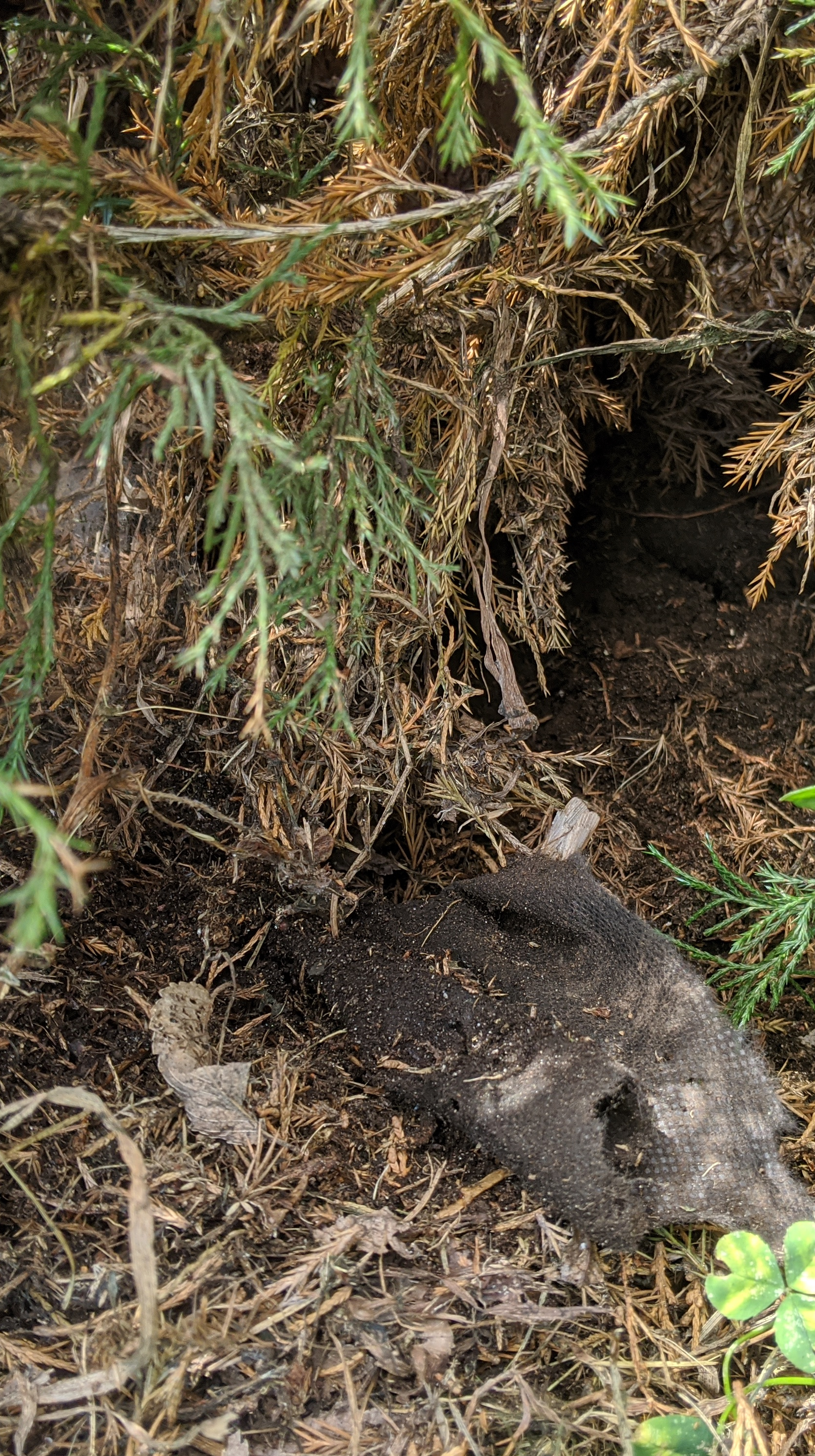
In established windbreaks, I continue to find the problem of landscape fabric harming and killing trees that are 7-20 years established. For anyone with windbreaks where landscape fabric was placed, I’d encourage you to wear gloves and long sleeves and check under the trees for the following things. (Also watch for critters as you get under the trees and examine them!)
1-The “brome mat”…or essentially a mat of needles, grass, weeds that create a mat on top of the fabric beneath the tree. This mat makes it hard to find the fabric and keeps one from realizing the problem that’s occurring. The mat prevents any decomposition of the fabric and prevents moisture from getting to the tree. Many are surprised how dry the soil is under the fabric where the mat was.
2-Check to see where the fabric is in comparison to the tree trunk. Normally I find the fabric growing into the trunk of the tree as the fabric doesn’t expand as the trunk enlarges. This creates a “girdling” effect where the tree essentially chokes itself. Often when I’m called out to established windbreaks that are suddenly dying or where the needles are browning, the landscape fabric and girdling of the trunks is partly the culprit.
So what can you do? Windbreak maintenance. For anyone who has windbreaks where fabric for weed barrier was placed, it should be removed no longer than 5 years after the trees are planted. For those who had windbreaks planted in the past 1-3 years, you really should go and cut the holes larger around each tree if you’re not removing the fabric yet. What I kept finding this year is that the trees were placed against one side of the fabric compared to the center of the holes, which can also create problems down the road with girdling. For those with more established windbreaks, do your best to remove the weed barrier fabric now. It will take harder work and effort to get under the trees and cut the fabric. Some were using anything with hooks to try to grab and pull it loose-but sometimes it’s hard to find the fabric with the mat layer. Some were then using loaders to pull the fabric between trees in the row. Again, it’s hard work and not fun with how poky the needles are, but it will help you in saving your trees.
For those who chose to not use the weed barrier fabric, wood chips can be used instead as long as they are kept 3-5” from the tree trunk. It takes a lot of wood chips for a windbreak, so they often are not used in those situations even though they’d be recommended. It’s not recommended to use grass clippings or straw as those mulches can attract rodents that can cause damage to new seedlings. Planting directly into the grass is also an option, or killing the grass directly where the trees will be planted is an option for weed control as well. The brome will compete with the seedlings for moisture and the trees may establish more slowly as a result. For more specific information on windbreak care, including information on insects and diseases, please see the following publication: https://nfs.unl.edu/publications/windbreak-management.

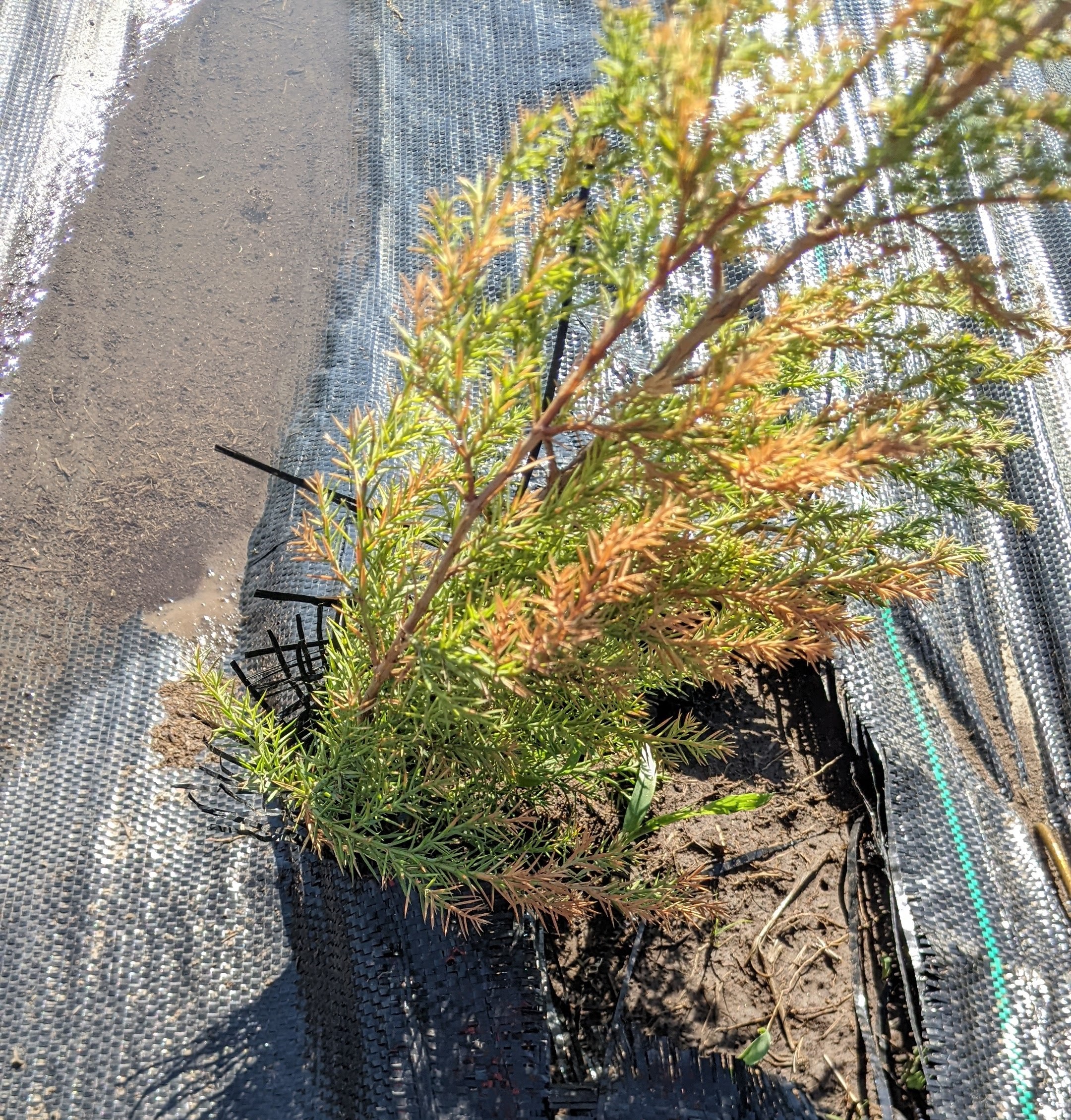
New growth observed in axillary buds on this tree seedling. It should look greener in 3-4 weeks.
JenREES 6/10/24
The scent of linden trees has been extra heavenly this spring! Am also grateful for the rains received and that we avoided a repeat of June 7, 2022.
Ground squirrels: The biggest question/complaint/concern I’ve received this spring is on ground squirrels as it seems they’ve been especially destructive to corn. In talking with various farmers and extension people about additional options for management, I heard the following: plant deeper (a couple plant 2 ¾” as they will dig to 2 ½”), get a badger!, and the majority try to bait holes and then replant. Zinc phosphide is labeled for use for ground squirrels. Nathan Mueller shared a pre-plant option with me (ZP® Rodent Bait AG) for consideration for next year. That product can be applied pre-plant or at planting according to labeled instructions.
Pill bugs/Roly Polys: I hadn’t mentioned this as a problem as I wasn’t aware anyone in our area was dealing with this. We did hear of some issues of pill bugs impacting soybeans in the Saline Co. area, but received a few comments about this in nearby counties last week too. Pill bugs are crustaceans that decompose organic matter. Often we see them under leaf litter, rocks, etc. in gardens and around homes. They are not considered a pest in general as they just decompose residue. However, there’s been reports of them munching on soybean hypocotyls in fields with a high amount of corn residue this year. More information can be found in this article: https://go.unl.edu/52n8.
Lawn clippings around plants: Many homeowners apply herbicides (or pay a company to apply them) to their lawns. Herbicides include products that control dandelions, clover, and other weeds in lawns. They are also contained in “weed and feed” products. Most of these herbicides have restrictions that require at least 3-4 mowings of the lawn (so essentially think 3-4 weeks) before lawn clippings can be placed around garden plants. Samples and pictures I’ve received of dying and/or curling leaves on tomatoes, peppers, potatoes, and flowers the past few weeks have all been attributed to people placing lawn mulch around plants too soon.
Mulch and termites: Does using wood mulch around the home attract termites? No as the chipping process kills termites. The most noted study was conducted by Long, et al. in 2001 which compared different types of mulches. They found termites prefer higher nutrient woody materials like cardboard placed under inorganic mulches like pea gravel compared to wood or needle mulch. However, mulches can create a hospitable environment for subterranean termites already established in the soil near the home or building. Termites prefer a moist environment, so soil desiccation (letting the soil dry) near the house foundation is an important barrier. Some keys with applying mulch include: don’t apply more than 2” thick layer of mulch in landscape beds, ensure a 6” gap between the top of the mulch layer and the house siding, and avoid watering mulch or soil close the house foundation walls. Mulch can be applied up to the house foundation to within 12” of the foundation. One may also consult a professional to set up monitoring or barrier control methods for termites around the home or building. The following guide has additional helpful thoughts on termite prevention and control: https://edis.ifas.ufl.edu/publication/IN1277.
Second Tuesday at 9 Weather Updates: Join Eric Hunt, agricultural meteorology and climate resilience extension educator, at 9 a.m. CT/8 a.m. MT on the second Tuesday of each month to hear insights on weather conditions across the state of Nebraska and Midwestern region, and updates on the long-range outlook. Participants will also have the opportunity to ask questions during the webinar, using the Q&A function in Zoom. Questions will be answered near the end of the webinar, as time permits. First webinar is this Tuesday, June 11th. Registration and recordings at: https://cropwatch.unl.edu/second-tuesday-9 .
June 2024 Events
Happy June! This week sharing on June upcoming events.
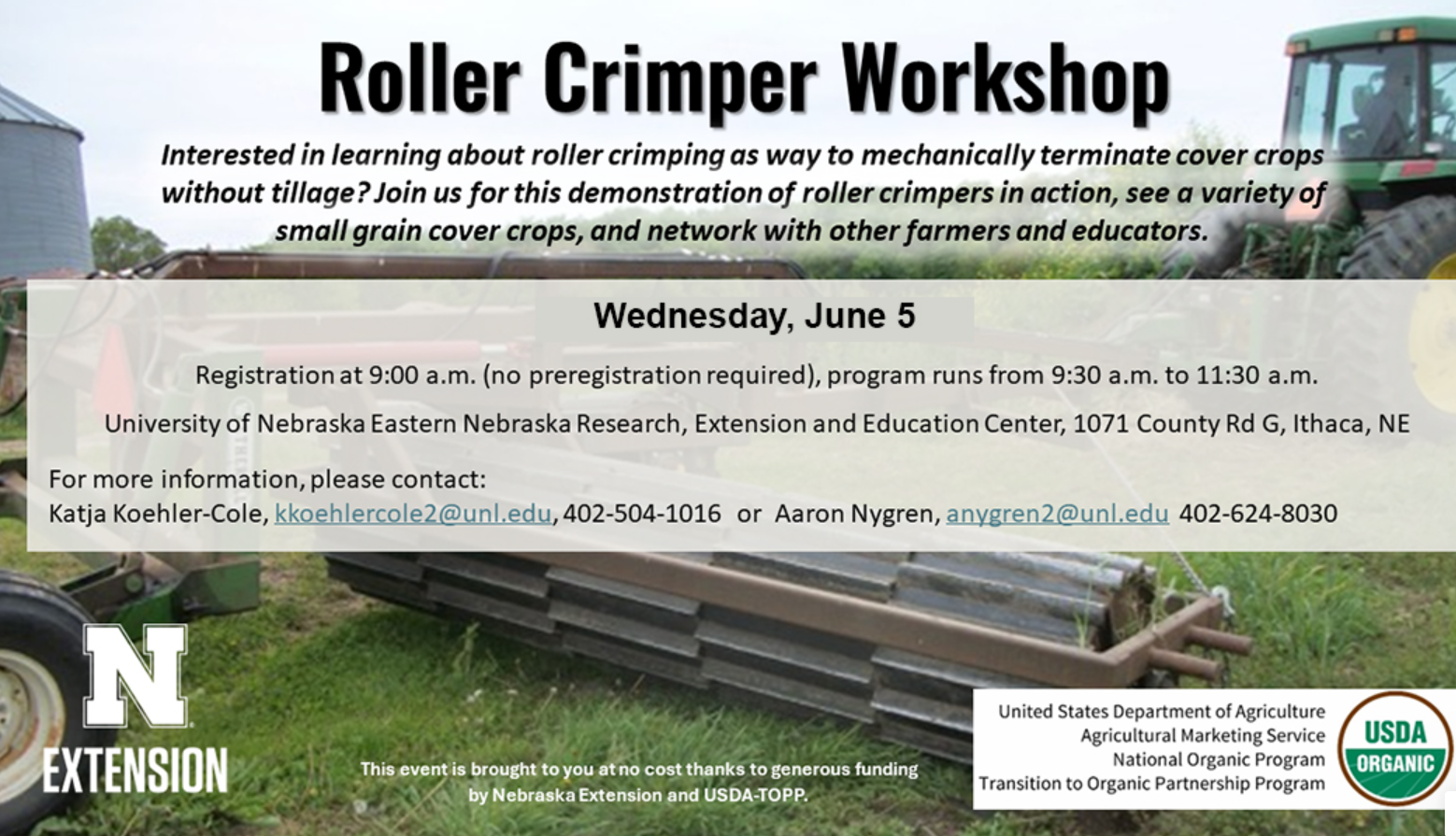
Roller crimping workshop will be held June 5th from 9:30-11:30 a.m. (Registration at 9 a.m.) at the Eastern Nebraska Research, Extension and Education Center, 1071 County Rd G, Ithaca. No pre-registration necessary and anyone interested in learning and/or sharing their experiences is welcome. During this short program, we will show a roller crimper in action, invite farmers to share their experiences with crimping, and discuss what conditions must be met to be successful with this termination method. Demo plots include barley, oats, rye, triticale, and wheat.
Progressive Ag Safety Day: Youth ages 5-14 are invited to attend the Progressive Ag Safety Day at the Fairgrounds in York on June 11 from 8:30 a.m.-1 p.m. Safety topics include: Electrical, grain, sun, drug, equipment, and water safety. Registration fee is $5 which includes lunch, snacks, t-shirt, and goody bag. RSVP by calling 402-362-5508. This event sponsored by York Co. Farm Bureau and York Co. Extension.
SCAL Weed Management Field Day: Growers, crop consultants and educators are encouraged to attend Nebraska Extension’s Weed Management Field Day from 9 a.m. to 1 p.m. (Registration at 8:30 a.m.) June 26 at the South Central Agricultural Laboratory near Clay Center. It’s located five miles west of the intersection of Highways 14 and 6, or 13 miles east of Hastings on Highway 6. GPS coordinates for the field day site: 40.57539, -98.13776.
The field day includes on-site demonstrations of new technology and new herbicides for corn, soybean and sorghum. Projects include using cover crops such as cereal rye or interseeding small grains (wheat, oat, barley) for weed suppression, See and Spray Precision Sprayer, iGrowth and INZEN sorghum. Attending this field day will provide an opportunity to stakeholders to learn about management of herbicide-resistant weeds. There is no cost to attend, but participants are asked to pre-register online at https://agronomy.unl.edu/fieldday. CCA credits are available.
Paraquat Trainings: Syngenta is offering Paraquat Training Webinars for June 2024 for those who plan to apply this herbicide this year. The trainings are held from 1-2 p.m. CST on: June 5, 18, 20, 25, 26. Registration is required at: https://syngenta.zoom.us/webinar/register/WN_Gh1T5t4tTS-S3QbFJUJe-w#/registration. Registration will require: first and last name, email address, state, and pesticide certification license number. There is a mandatory quiz at the end of the webinar that will be conducted thru zoom, so you need to stay on until the end of the webinar.
Yellow Nutsedge Control: Kelly Feehan shared the following, “It is time for yellow nutsedge control if using herbicide for control. While we may not be able to see much sedge yet, it is starting growth and control from first week of June up to June 21st is important. Yellow nutsedge is the yellow grass-like plant with waxy blades that grows taller than Kentucky bluegrass. Larger plants are most noticeable after June. This perennial sedge begins to emerge from underground tubers in late May. To help reduce nutsedge, mow tall at 3.5 inches, and avoid overwatering. Hand-pulling can be effective where there are very few plants. If herbicides are used, products containing sulfentrazone, known as Dismiss, halosulfuron or Sedge-Hammer, and mesotrione such as Tenacity are labeled for postemergence control in cool-season turfgrasses. As always, follow all label directions.”


 JenResources