Category Archives: Crop Updates
JenREES 6-24-18
Crop Update: What a blessing to have rain this past week! Grateful for how it provided much needed moisture into the top two feet in many cases. Updated soil moisture status will be at http://jenreesources.com. Some in our area and in other parts of the State received wind, hail damage, and flooding to crops. This week’s CropWatch at http://cropwatch.unl.edu shares information for those situations. A few summarizing points: for those with greensnap or with severe hail damage, you may wonder what potential yield may be based on your planting date and current plant stand. The following chart from Iowa State University and explanation of how to understand it may be helpful: https://crops.extension.iastate.edu/cropnews/2009/05/assessing-corn-stands-replanting.

Source: Iowa State University
For those with flooding, corn in the V7-10 leaf stage can survive for about 7-10 days in flooded water. Temperatures above 86F can result in greater stress on those plants than if the temps remain cooler than that during that time. Another consideration for the future, it’s not uncommon to find a disease called ‘crazy top’ of corn when the tassels begin to emerge. We’ve seen this the past several years where creeks or areas along waterways or field edges were ponded. There’s nothing you can do to prevent this.
For those with hail damage, damage from V7-10 leaf corn can result in a number of situations depending on the severity of hail. Minimal yield loss is assumed for leaf damage in crop insurance charts. Final plant stands will be important which will account for broken off plants that don’t recover. Stem bruising also isn’t factored in. For corn, bacterial diseases tend to be my larger concern at these growth stages. Bacterial top rot is one in which the plant dies from the top down and has a strong odor to it and creates a soft, slimy mess. Goss’ wilt is another concern-particularly systemic Goss’ wilt. You can check for this if you have a dying plant that doesn’t have a soft rot by taking a
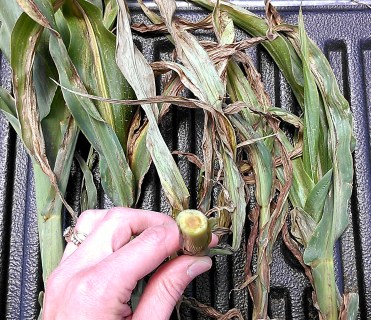
Cross-section of stem showing systemic Goss’ wilt in the discolored vascular bundles.
cross section of the stem and looking for discoloration of the vascular bundles. You can also send plants like this to the Plant and Pest Diagnostic Lab in Lincoln for confirmation.
Regarding fungicide use on hail damaged corn, Iowa State and the University of Illinois did studies finding similar results. Both found no statistical difference in applying a fungicide vs. the untreated check in spite of small numerical differences. Regarding timing, the Iowa State study simulated hail damage at tassel and applied fungicide an average of 3 days and 8 days post-hail. There were no statistical differences on yield of the timing of the applications either. They did find statistically less fungal diseases in the hail-damaged plots vs. the non-hail damaged plots and speculated it was due to more air flow and less leaf area available for disease to occur. I have observed that fungicide can help with stalk strength and maintaining whatever green tissue remains when we had the 2013 hail storm in Clay County at brown-silk to blister corn. But this early, it’s hard to justify a fungicide application based on the data that’s available. If you’re interested in testing this for yourself, the following is an on-farm research Fungicide Protocol for Hailed Corn and Soybean.
For hail damage on soybean, many of the beans are at flowering or approaching flowering. Again, stem bruising isn’t counted in crop insurance assessments. I haven’t really observed bacterial or other disease issues necessarily from stem bruising in soybean. What tends to be more of an issue is those plants hardening off and becoming brittle to walk through. For soybeans, the blessing is that often new buds form and you will see increased branching which can help with canopy closure…it just can hurt right now when soybeans were already near canopy and we’re trying to reduce additional inputs for weed control. Things to consider are that pods may be closer to the ground from this increased branching and you may need to harvest earlier to help with getting beans that become brittle before snapping off in wind storms. I leave plant stands of near 60,000 plants/acre based on our soybean pop studies that received hail damage. If you want to prove any replanting differences to yourself, you may wish to consider the following Soybean Replant Protocol. We’d recommend waiting on herbicide apps till some new growth occurs, which is difficult when I’ve watched palmer essentially be not affected by hail and put on two new leaves within a few days in the past. Last year we started making herbicide apps 5-7 days post-hail. Additional hail resources are at a new resource called ‘Hail Know’ at: https://cropwatch.unl.edu/hailknow. There’s a lot of info I haven’t transferred to this site yet…but you can view photos and comments on hail recovery at numerous growth stages over time at my blog under the ‘Storm Damage’ category: https://jenreesources.com/category/storm-damage-2/.
Last week I shared the following video regarding determining timing of off-target dicamba movement to soybean: https://youtu.be/rQid7-vX-TU. Sharing again with an increase in the number of fields that were experiencing cupped symptoms last week.
JenREES 6-17-18
This past week contained many off-target herbicide concern calls. Prior to Memorial Day I had made a note that post-herbicide applications to corn began in much of the area and anticipated phone calls to begin in about two weeks. Most of the conversations this week were more FYI to let me know they had soybean leaf cupping.
Here’s a few things to consider if you are having soybean leaf cupping.
- First, was a post-herbicide application made to your soybeans? If so, check for any potential tank contamination (Check out this CropWatch article: https://go.unl.edu/fnig). If not, check out this publication (http://ipcm.wisc.edu/download/pubsPM/dicamba2004.pdf) to determine if any of the criteria mentioned could possibly be contributing to the problem.
- Determine how old the plant is by asking when the soybean was planted and even better when it emerged. A soybean plant will produce a new node every 3.75 days.
- To determine the timing of damage, I count the total number of nodes on the plant to the last trifoliolate where leaf edges are not touching. The total number of nodes may differ in different parts of the field such as irrigated and non-irrigated especially after herbicide damage and drought-stress (Example 8 nodes irrigated and 6 non-irrigated). Take the number of nodes X 3.75 to get total approximation of plant age. Then count back on the calendar to determine approximate emergence date. If I use 8 nodes in this example X 3.75 = around 30 days ago the plant emerged.
- I then count the number of nodes to the very first damage I see on leaves (Example 3). Multiply this number of nodes times 3.75 and count forward on the calendar from emergence to that date. For instance, in this case, damage occurred around 11 days after emergence.
- I also like to count how many completely unfurled trifoliolates are affected (Example 6 trifoliolates). Take that number and multiply by 3.75 (Example 6 X 3.75= approximately 23 days ago the damage occurred).
- In this example, it worked to count either direction (from emergence and from current date) to determine approximate timing of off-target movement occurring. In all the situations I’ve looked at thus far, the timing goes back to around Memorial Day with post-dicamba herbicide applications applied to corn.
- Auxin-like herbicides affect only cell division. Thus, fully developed leaves (no longer expanding via cell division) are not affected even though they may be expanding by leaf cell enlargement. Only the tips of the newest exposed soybean leaves may experience damage to dicamba as they are still undergoing cell division. Otherwise, it can take 7-14 days for leaf damage from dicamba injury to appear on susceptible plants and damage will occur typically 4-6 nodes. This is because dicamba is also translocated once inside leaf cells. Thus it impacts cell division of the leaf primordia at the stem apex. We may not even see those leaves yet because they are still enclosed in the stem apex tissue.
- In a matter of weeks, affected fields can go from appearing to have minor damage, to looking really bad, to growing out of damage. It looks worst when those affected nodes push upward giving the field a grayish/white cast to it as the leaves become much reduced in size and are tightly cupped. Eventually the leaves will begin to look more normal again in time (as long as a second off-target movement doesn’t occur).
What can you do? Water via irrigation and/or rainfall is the best recovery tool for dicamba damage. Waiting is another. We’re blessed to grow indeterminate soybean in Nebraska which continues to produce nodes and leaves upon flowering which allows our soybean to grow out of damage.
- Wait till harvest to determine any yield impacts if there are areas impacted vs. those which aren’t. Otherwise, field-scale damage is difficult to discern yield impacts.
- You can talk with your neighbors/ag retailers regarding what they sprayed. In our area of the State, it’s often difficult to pinpoint the source of off-target movement with so many applying dicamba products to corn for palmer control often around the same time-frame. Now that post-apps to soybean are also occurring, that may also become a challenge. Of all the fields I visited last year, less than a handful of farmers sought any sort of compensation and those were more often due to tank contamination issues. If you wish to pursue that route, you need to file a complaint with the Nebraska Department of Ag.
- For future dicamba applications, check out these best management tips: https://go.unl.edu/97ok.
- For those of you reading this in a source outside of my blog, I created a video to hopefully be more visual and clear on understanding this method of diagnosing timing. You can check it out at my YouTube site: https://www.youtube.com/user/jenreesources.
Bagworms: It’s June and one of my top questions has been “Have I found bagworms yet?” Well, they’re now feeding and forming new bags on junipers and spruces. What you’re looking for are not the old bags at this point, but very small (fingernail size) new bags that move as the caterpillar is feeding and making the larger bag. This video from Backyard Farmer (https://youtu.be/05A2quj9nO4) does a great job of showing various stages of bagworms and sharing on control methods. Check it out!
Irrigation Scheduling Workshops: Steve Melvin, Extension Educator in Hamilton/Merrick Counties asked I share about upcoming irrigation workshops hosted by UNL and Upper Big Blue NRD. The program will focus on installing the equipment and making irrigation scheduling decisions using the data generated by Watermark sensors. The workshops will be held from Noon-1:30 p.m. on June 25th at the Corner Café, 221 Main St in Stromsburg and also at the same time June 28th at the Hordville Community Building, 110 Main St. The Upper Big Blue NRD will provide the lunch. The first presentation will be Installation of Watermark Sensors and Data Logger presented by Dan Leininger, Water Conservationist with the Upper Big Blue NRD. The second will be Deciding When and How Much Water to Apply Using Watermark Sensor Readings presented by Steve Melvin. The irrigation scheduling strategies presented in Steve’s presentation can be used with any soil water monitoring equipment data. More information is available by calling Steve Melvin at (308) 946-3843 or visiting https://extension.unl.edu/statewide/merrick/.
JenREES 6-10-18

Thank you to Tena with Faller Landscape in York and to all the youth who participated in our 4-H landscape design workshop and helped plant the Nebraska area! It will hopefully be beautiful for fair!
Crop Update: Rain continues to be spotty and windstorms have resulted in various levels of greensnap in some fields. Overall crops are growing and getting a decent canopy. It’s been interesting watching the radar on weather apps as so often they look like precipitation should be occurring yet that’s not always the case. Grateful for all of you who share crop updates-including things such as impacts on hay crops, pastures, etc. and for our farmers working with me on soil moisture monitoring. I was told this past week of the impact of our groundtruthing on the drought monitor; radar would make it appear we’re not as dry as we truly are. So just wanted to share that with you-that your input is important as we then share that input with those who work with the models and maps! I plan to get soil moisture sensors installed in non-irrigated fields in York, Seward, and Clay this week as well.
Soil Moisture Sensors Tips: With cultivating and hilling progressing, some are now looking at getting soil moisture sensors installed. If you utilize watermark sensors, the following are some tips I’ve learned.
Test sensors with wet/dry process to remove all air bubbles:
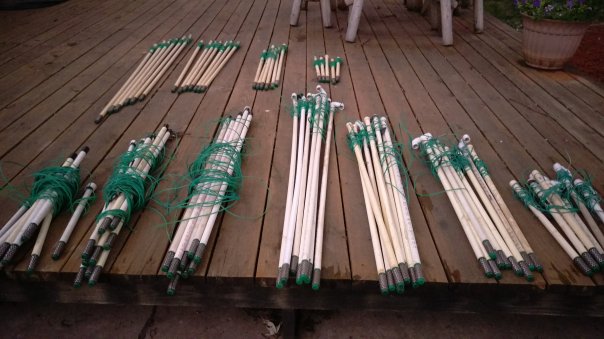
- First, make sure sensors read 199.
- Then, soak sensors for at least 24 hours. They should read 10 or less (Jenny’s note-I realize they may read this in a matter of minutes to hours but it’s our best practice recommendation to ensure all air bubbles are removed).
- If they don’t read 10 or less, gently rub any soil loose on them with your fingers (don’t use a brush) and allow to continue soaking for another 24-48 hours. If they still don’t read under 10, I don’t use them.
- Best practice is to then allow the sensors to completely dry out again to 199 to complete the wet/dry process. (Jenny’s note: I realize, due to time constraints, many sensors get installed once they have been soaking and never go through the complete drying process).
Installation:
- Avoid installing sensors in saturated soil conditions in clayey soils. Doing so allows a thin clay film to develop on the sensors which then affects readings .
- Prior to installation, the sensors should be soaked again and installed wet. The soaking process only takes a matter of minutes to get back to 10 or below. I carry the water bucket with sensors with me into the field.
- When soaking, water moves into the PVC pipe, thus it can take time for the water to drain providing accurate readings if not removed. Some sensors have a hole drilled in the PVC pipe above the sensor to allow water to drain. Otherwise, it’s important to remove the caps and tip the sensors over to dump any water that has accumulated in the PVC pipe during the soaking process. I then put the cap back on, take my hand and wet the PVC pipe with water so it pushes in easier. Some like to use WD-40 but my concern with that is it getting on the sensor affecting readings.
- Install all sensors where the sensor itself sets using an ag consultant tube (can be 12 or 18 inches). An ag consultant tube has a slightly smaller diameter that provides a tight fit for the sensor. Use a regular soil probe for the foot above that. For example, for 1’ sensor, I use ag consultant tube. For 2’ sensor, I use regular probe for first foot and ag consultant tube for second foot. For 3’ sensor, I use regular probe for first 2 feet and ag consultant tube for third foot. The reason for this is in clayey soils that are wet, there’s greater resistance to pushing in that sensor, so this is one way I’ve found which is easier for someone like me to push them in. (Jenny’s note: many have installed sensors with a regular soil probe through the years and that’s also fine. Just know that you may see more water run along side of tube before soil makes a tight fit around where sensor is located. I’ve just found less issues with this when I use the process described above).
- NEVER pour water into the hole or make a slurry. Make sure the sensor hits the bottom of the hole as air gaps can make the sensor readings inaccurate. Some people find it better to not remove the entire amount of soil for a specific depth and then push the sensor the rest of the way till the correct depth is obtained. I’m not always strong enough to do that so do what works for you as long as the sensor is at the correct depth and there’s no air gaps.
After Installation:
- Make sure to fill in any gaps around the sensor with soil and make sure there’s no soil cracks around the sensors.
- Make sure to mark each sensor and flag them well.
- Sensor readings should equilibrate with the soil within 48-72 hours but especially within a week.
- If a sensor starts reading really dry, before replacing it, I often remove it and reprime it in the field. This can be done by re-soaking in water for 1 minute or so till it goes back below 10 and then reinstalling in same hole. If it doesn’t go below 10, I replace it. If it reads strange the next week, I also replace it.
ET gages:
- A reminder to use distilled water in the tube and to fill the ceramic top when you’re also filling the main tube. I usually fill the ceramic top and wait for it to soak up a little then fill again.
- Prime the ET gage ensuring no air bubbles are in the second tube with the stopper. I always overfill the ET gage to help with priming and ensuring there’s no air bubbles.
- Excess water can be removed and also air bubbles can be removed by gently pulling down on the glass site gauge tube at the rubber base and releasing extra water from it. Air bubbles can also be released in this process. Place the site gauge tube back in place when you are at a water level between ‘0 and 1’. Then place one red marker ring on that beginning start level.
- I always plan to refill the ET gage when it gets down to ‘9’ on the site tube.
- The green canvas cover should be replaced at least every 2 years and be sure to dust it off and the white membrane below it.
In another column I’ll share how to use the two tools together for irrigation scheduling. All videos and charts with more information can be found at: https://water.unl.edu/category/nawmn. This is a checklist I made awhile back with Daryl Andersen which has more detail and could honestly be updated: http://www.littlebluenrd.org/pdf’s/forms/etgage_sensor_checklist.pdf but may also be helpful.
Tree Damage: Recent windstorms have caused for many downed branches and even some trees. When removing broken branches or dead branches, it’s important to prune correctly for tree health. Correct pruning of larger branches can often involve 3 cuts per limb. The first two cuts are made away from the trunk of the tree to remove most of the weight of the limb. The third cut is near the trunk itself at the bark collar ridge where the tree will eventually seek to heal. I like this Backyard Farmer YouTube video as a good visual of correct pruning: https://youtu.be/9cl0Qxm7npk. Pruning is best done in the dormant season of February and March. It’s best avoided in April and May when trees are putting energy into new leaves and in the fall as fall pruning can result in growth instead of the tree preparing for and going into dormancy. Some great resources with more information on proper pruning are: https://go.unl.edu/v9uf, https://go.unl.edu/gdb9, and this blog post https://jenreesources.com/2014/04/20/proper-tree-pruning.
JenREES 6-3-18
Crop Update: So grateful for some rain for much of the area last week! Updated soil moisture status at http://jenreesources.com. The crops are rapidly growing now as are the weeds. Some were seeing Palmer shooting heads at soil level already…last year we
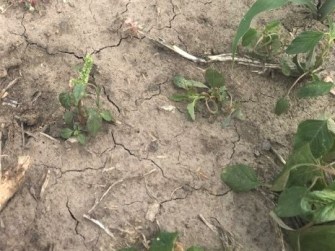
Palmer shooting a head at the soil surface. Photo courtesy Matt Kirchhoff.
didn’t see that till late July. Many have been in the process of postemergence herbicide applications. We revisited a CropWatch article regarding best management practice considerations for postemergence dicamba-based applications to corn based on the research that is available. Please see the full article with more explanation at http://cropwatch.unl.edu. Briefly, those practices include:
- Consider a quick irrigation (rainfast/irrigation timing based on label requirements for the product you’re applying) of only 1000 gal/ac to help reduce any potential volatility.
- Don’t use dicamba products in both corn and soybean to reduce selection pressure and resistance.
- Check for temperature inversions and wind speed. Temperature inversions can be tested by using Innoquest SpotOn® inversion tester and testing the temperature at 1 meter and 3 meters. If the temp is cooler at 1 meter than 3 meters, a temperature inversion is occurring and spraying is not recommended.
- Consider using the more restrictive RUP dicamba requirements regarding wind speed, boom height, etc. Also consider not using AMS with any dicamba product even though it is labeled for use in some of the corn dicamba products. This may result in you needing to increase the glyphosate rate to the highest labeled rate to increase efficacy. Amit Jhala will showcase research on efficacy of dicamba products with and without AMS at the South Central Ag Lab Weed Science Field Day on June 27.
Volunteer corn is also a major issue in many corn and soybean fields in the area and there’s two articles in CropWatch at http://cropwatch.unl.edu addressing this topic. A number of grass herbicides are available for control in soybean. The challenge is in the continuous corn fields. If you had glyphosate resistant corn last year and used a different technology such as Liberty or Enlist, you have some other options this year. For Liberty Link corn this year, two applications, each of 32 to 43 fl oz/acre, could be made. Remember that Liberty will NOT be effective if Roundup Ready + Liberty Link hybrid corn was planted last year. Regarding Enlist corn, Assure® II is the only grass herbicide labeled to control volunteer corn with this technology. It can be applied at 5 to 12 fl oz/acre in Enlist Corn for selective control of volunteer corn. Please be sure to read and follow all label requirements. A few farmers have also discussed their past experiences with cultivation, using either one or two passes and their concern about the soil moisture situation this year.
So how much yield loss can be anticipated from volunteer corn? Perhaps more than one would think with more loss occurring in soybean! Studies were conducted in several mid-western states at various densities including 3500, 5000, 7000 and greater volunteer corn plants per acre. To envision this, imagine 3.5, 5, and 7 volunteer corn plants respectively in 1/1000 of an acre (17’5” in 30” rows). Some fields this year have much higher densities than this! Clumps of corn impact yield more than individual plants.
UNL research found a volunteer corn density of 3500 plants/acre led to 10% yield reduction in soybean. Doubling the density to 7000 plants/acre led to a 27% yield reduction. South Dakota State University data revealed similar trends. A volunteer corn density of 5000 plants/acre resulted in a 20% yield reduction (12 bu/acre yield loss in 60 bu/ac soybean).
Clumps of volunteer corn in soybean led to greater yield loss as they were more competitive than individual plants. In the UNL study a density of 3500 clumps of corn/acre resulted in a 40% yield reduction. Researchers in Minnesota and Illinois also found increased competition with clumps of volunteer corn versus individual plants. Clumps of corn (7-10 plants/clump) were established at different densities. Depending on the location and year, soybean yield was reduced 1% for every 75-115 clumps/acre.
A recent UNL research study found highest yield reduction occurred when volunteer corn was left uncontrolled or when it was controlled too late at the R2 (full flower) soybean growth stage. The combined density at this greatest yield reduction was at 24,710 volunteer corn plants per acre plus 1,235 volunteer corn clumps per acre.
In corn, UNL research found a volunteer corn population of 3500 plants/acre resulted in a 2% yield reduction in corn. Doubling the density to 7000 plants/acre caused a 5% yield reduction. Clumps of volunteer corn led to greater yield loss as they were more competitive than individual plants. A density of 7000 clumps of corn/acre resulted in a 14% yield loss compared to a 5% yield loss with individual plants. So volunteer corn in general can be fairly competitive especially to our legume crops. It can also be a problem regarding harboring corn rootworm in soybean fields, reducing the advantage of the rotation from that perspective.
Also, an update on my soybean planting date demo at the fairgrounds: I wasn’t counting on rabbits! All the soybeans were reduced to stems below the point of recovery. So there is no demo but the groundskeeper preferred they took out my soybeans instead of his petunias 🙂 Will try again next year.
JenREES 5-20-18
Crop Update: So grateful for rain and truly hope those who wanted and needed rain received it! An update to soil moisture profile as of 5/17/18 can be found at http://jenreesources.com.
A number of crop issues surfaced this week. One being root burn and wilted-looking corn seedlings from anhydrous ammonia applications with the dry winter/spring we’ve had thus far. Anhydrous ammonia can expand in soils 2.5-3” in all directions and potentially more in dry soils. Pivots were running to help with that and hopefully rain events will help non-irrigated fields that were suffering in this way. Another problem observed in some non-irrigated corn fields has been fomesafen carryover injury from products such as Flexstar, Reflex, Prefix, etc. These products have a 10 month planting window back to corn which is fine in most years, but dry conditions didn’t allow for the herbicide to break down in all situations from applications last June. This active ingredient is in Group 14 (PPO inhibitors) and the injury from this particular active ingredient is unique in that it causes yellow/brown striping of the veins themselves instead of interveinal chlorosis/necrosis. Seedlings most affected right now are found on field edges or wherever there was overlap of application. Hopefully corn should grow out of this injury in time. Herbicide carryover may be a something to watch for in soybean as well from other active ingredients. We also saw regrowth occurring on plants affected by wind/dust/debris damage but there are situations where replanting will be needed on endrows, etc. Roger Elmore has a photo gallery explaining regrowth in this week’s CropWatch at http://cropwatch.unl.edu.
Another situation that surprised me this year was finding seed corn maggot damage in

Seed corn maggot feeding on soybean seed. No insecticide was included in the seed treatment.

Seed corn maggot affecting soybean seedlings by feeding on cotyledons and hypocotyls. The brown grain-like structure in the bottom of the picture is a seed corn maggot that is pupating. These seeds did not have an insecticide in the seed treatment.
soybean. At first I was puzzled as the beans were clearly treated but then learned the beans didn’t have an insecticide added to the seed treatment. In scouting a number of fields, I’ve actually seen quite a bit of seed corn maggot damage, particularly in tilled fields and those with manure applied or those with cover crops that were green or where termination included tillage. I’ve also been surprised how many have told me they don’t use an insecticide seed treatment on early planted beans. We didn’t have any research in our early soybean planting studies without insecticide + fungicide seed treatment so we just automatically recommend both. Unfortunately this year we’re seeing what can happen without it with higher insect pressure in some fields. For seedlings with the insecticide seed treatment, I’m seeing light scarring on the cotyledons and hypocotyls but no maggot penetration. In fields without the seed treatment, I’m actually seeing penetration of the cotyledons and hypocotyls. The good news is that most of the maggots were also pupated, pupating or will be soon. But it is something to watch for, particularly in fields that have been tilled and especially if manure was applied or they were tilled and had a cover crop on them. They are not as attracted to no-till fields. Regarding stands, from my experience with soybean pops and stand loss due to crusting, hail, herbicide injury, etc., I keep stands of 60,000 plants/acre or more. It really stinks to talk about replanting anything right now with guys still trying to finish planting. If you choose to replant soybeans, consider proving it to yourself by planting strips and leaving strips. If you’re interested in that, I’d be happy to work with you. You can learn more about seed corn maggots here: https://crops.extension.iastate.edu/cropnews/2016/04/look-seedcorn-maggot-corn-and-soybean.
Wheat in the area ranges from boot to flowering. A couple of wheat fields I know of

Wheat field cut at boot stage for hay.
were taken for hay. For those still considering silage, check out the CropWatch article this week where Todd Whitney shares data on wheatlage (wheat silage): https://go.unl.edu/qkbr. The rainfall will greatly help our wheat right now. And, rainfall at heading to flowering makes me think about the potential for Fusarium Head Blight (scab). The wheat scab prediction monitor http://www.wheatscab.psu.edu/ is predicting medium to high risk for scab in Nebraska for the next 48-72 hours. Some years I feel the model is delayed in prediction, but I still feel it’s a good tool and resource. Scab is caused by Fusarium graminearum and is favored by warm (70-80°F temps), humidity, and rain events before and during flowering. Once wheat begins flowering (Feekes 10.5.1), many foliar wheat fungicides are off-label. In fact, recent research presented at the 2017 Fusarium Head Blight meetings shows that in general, strobilurin products can actually increase the presence of deoxynivalenol (DON) in wheat if applied at full heading (Feekes 10 or 10.5). Thus, your better fungicide options for preventing scab are Caramba and Prosaro and these products can also kill any fungal diseases present on leaves (such as powdery mildew, tan spot, and rust). These products aren’t 100% for scab prevention due to the variation of heading and flowering that occurs in so many fields. Better efficacy is obtained with more uniform plants which begins at seeding time. So I would recommend watching the growth stage in your fields, the weather, and the prediction tool regarding if you feel you need to treat any fields this year to prevent scab. Research has shown best efficacy to be obtained when at least 50% of the plants are at 1/3 flowering. Flowering begins with yellow anther sacs in the middle of the head with flowering continuing throughout the head from there. Once the pollen is released, the anther sacs turn white.
LBNRD Open House Public Hearing: The Little Blue Natural Resources District (LBNRD) is hosting a public hearing on May 29th from 6:30-9:00 p.m. at the Davenport Community Center in Davenport, NE. The purpose of the hearing is to provide information and receive testimony on proposed amendments to Groundwater Management Rules and Regulations. The hearing will be an open house format allowing individuals to ask questions of the NRD staff, look at exhibits, and offer testimony. The proposed rule changes and additional information can be found on the LBNRD website at: http://www.littlebluenrd.org/. Please contact the NRD with any questions at (402) 364-2145.
Not part of my news column: on a more positive note after mentioning all the crop problems, the lilacs in general were beautiful and smelled amazing!!!

Herbicide Grazing Restrictions
Forage Feed Grazing Restrictions
Replant Options Rotation Restrictions-long
Grateful for a nice week for harvesting and for the good yields being reported! It’s also good to see cattle being turned into cornstalks. A reminder to read herbicide labels to understand if there’s any grazing restrictions from corn and soybean herbicides applied in-season.
It’s also important to look for any grazing restrictions on fall-applied herbicides to control marestail and other germinating weeds. These restrictions can also be found in the Forage Feed Grazing Restrictions in the UNL Guide for Weed Management. The forage, feed, and grazing restriction only applies to the crop for which the herbicide was applied. When it comes to grazing cover crops planted into these residues, one must use the replant/rotation restriction guidelines found on the herbicide label and in the UNL Weed Guide: Replant Options Rotation Restrictions-long. I apologize as these scanned blurry; hopefully you can zoom in ok to read what you need.
If the label doesn’t specify any restrictions, then it should be ok. If you want to be on the safe side, a rule of thumb is to use the pre-harvest interval for the amount of time to wait before grazing stalks. Some labels will say that residue should not be grazed or baled and fed to livestock. Sometimes studies were actually conducted to know there is a safety concern. In other cases, the chemical company may not choose to conduct all the studies the Environmental Protection Agency (EPA) required for labeling due to high costs. If that’s the case, the EPA requires the strongest restrictive language be placed on the label. Regardless, if it says there’s a grazing restriction on the label, the label needs to be followed as it is a legal document and the law.
As you plan for next year’s herbicide program, if you’re thinking about fall cover crops, the following NebGuide may be of benefit to you as it goes through the grazing restrictions of various herbicides.
Hail Damage
On-Farm Research Protocols:


Hail and wind damage occurred throughout the area I serve last week. Overall, I’ve been encouraged by the regrowth observed on corn and soybean plants affected by the June 14th storm. We were blessed with warmer weather and sunshine that allowed for regrowth to occur in many situations other than some fields around the Deweese area.


You can look for regrowth on leaves within the whorl of corn plants and on the axillary buds of soybeans. Even what appeared to be soybean ‘sticks’ may show regrowth by now.
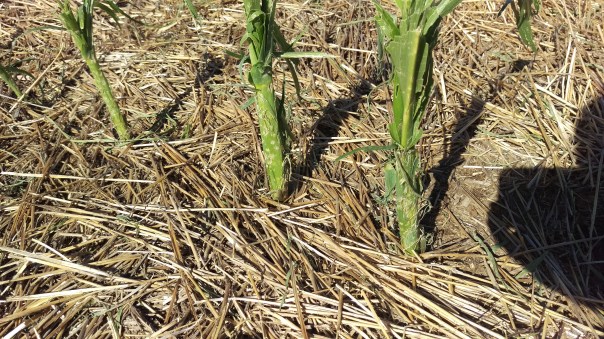
The concerns I have for plants affected by these storms is all the stem bruising on both corn and soybeans and the potential for bacterial diseases to affect corn.
For those of you affected by June 16th storms, we recommend to wait a week to assess damage and any decisions. I realize we’re also at a critical stage for replant decisions as we continue later in the season. Ultimately, decisions need to be made on a field by field basis.
Resources:
- CropWatch Hail Damage Resources
- Resources from storm damage in 2014
- Fungicide Use After Hail or Wind
Fungicide Application
There’s no good research to Dr. Tamra Jackson-Ziems or my knowledge to support this. Fungicides only control fungal diseases. Bacterial diseases are favored after hail events and we have already seen bacterial leaf streak in the area prior to the storm. From past-years’ experience of prior wind/rain events, we can expect to see more of it in about a week. Fungicides won’t help that disease nor Goss’s wilt which is another we often see come in after hail events.
However, if you’re considering this, I’d like to have several farmers prove it to yourselves with on-farm research this year so we do have data for the future. It’s this simple. All you do is spray fungicide in enough width to complete 2 combine passes. Then skip an area for 2 combine passes. Then treat again and repeat across the field. Fungicide Protocol for Hailed Corn and Soybean. Please let me know if you’re interested in this!
Timing of fungicide app: ISU did a study to simulate hail damaged corn at tassel stage within an average of 3 or 8 days post-hail. They didn’t find the timing to provide any yield effects. They also didn’t find a statistical yield increase (90% confidence level) in fungicide application to hail damaged plants vs those which weren’t hailed although they also reported a numerical increase in 12 of the 20 fields.
Herbicide application: I spoke with Dr. Amit Jhala, Extension Weed Specialist for his thoughts regarding this. He said ultimately herbicides shouldn’t be applied to stressed weeds in order to achieve greatest efficacy. The concern for many including me right now is how well the weeds survived the hail and how quickly they are regrowing compared to the damaged corn and soybeans. This again is a field by field assessment regarding how well your corn and soybean regrowth is occurring and how rapidly your weeds are. I watched one palmer plant in one field after June 14 storm: 1 day post hail and 2 days post hail put on two sets of leaves in that time period. I also took pictures of soybeans reduced to sticks while 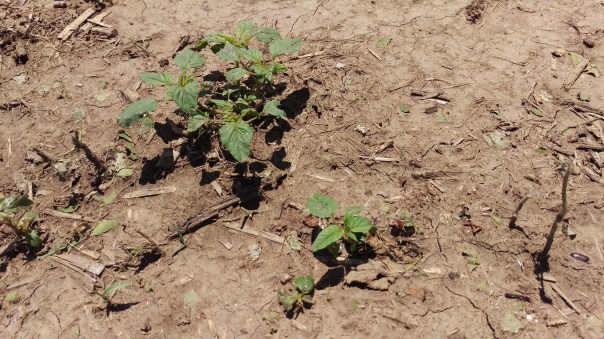 waterhemp in that field was virtually untouched. I think many are trying to wait 5-7 days post-hail to apply herbicides but there were some fields I was suggesting to apply over the weekend with the recovery already occurring and less damage.
Corn replant: The biggest concerns with corn would be stands, eventual stalk rot/downed corn due to stalk bruising, and bacterial diseases. I’ve essentially watched stands reduced over the course of the growing season after early-season hail storms mostly due to bacterial diseases like Goss’ wilt. It will be important to have your crop insurance adjuster look at the field again prior to harvest. Splitting the stems of damaged plants across the field can help you assess any damage to growing points; they should be white/yellow and firm not brown and soft. Tattered leaves that are wrapped around the whorl should eventually turn brown and break off with the wind. They can sometimes impede new growth from the whorl as well though.
Soybean replant: Soybeans can compensate so greatly for reduced stands. From hail at this stage in the past, we’ve said to leave stands of non-irrigated at 60,000 plants per acre and irrigated at 75,000 plants per acre. Some soybeans reduced to sticks are shooting axillary buds. My biggest concern on soybeans is the stem bruising which isn’t accounted for in hail adjustments. If you want to prove replanting or not to yourself, consider slicing in soybeans next to the old row in strips across your field. Be sure to inoculate the soybeans and be sure to take prior stand counts. Soybean Replant Protocol.
There’s nothing like doing these studies and seeing the results on your own ground or from your peers’ farms. In 2006, I worked with a grower in the Lawrence, NE area on a non-irrigated soybean plant population study where he tested seeding rates of 100K, 130K, and 160K seeds/acre. He received hail at the cotyledon stage and because he was non-irrigated, chose to leave the stand. His actual stand counts were 74.4K, 89.4K, and 97.9K plants/acre respectively for the previous mentioned seeding rates which resulted in yields of 38.6, 40.6, 42.7 bu/ac respectively. Another soybean replant study occurred near Columbus, NE where the grower had an average plant stand of 75,000 plants per acre on June 11th. He chose to replant five strips across the field at a diagonal to the existing rows. The replanted soybeans ended up yielding 1 bu/ac less than the original plant stand. I realize it’s hard to want to do these extra steps for on-farm research, but this is why it’s important; it’s the way to answer these questions for yourself! Please contact one of our team members if you’re interested in on-farm research this year!

Corn Concern in Wheat/Rye Cover

What we see is larger plants next to stunted or shorter plants. The smaller plants often show some type of ‘flagging’ of the leaves where one or several leaves or sometimes the whorl is brown and wilted. Upon digging these plants, the roots were healthy and there were no symptoms of damping off or other obvious disease issues. While there have been reports of some wireworms, this also hasn’t been the main issue with these plants I’ve been seeing.

John Mick with Pioneer alerted me to what he was seeing and several of us have since found the same. Carefully unrolling leaves from the stems of these plants revealed feeding on the stems and crown area. You can see from this photo the small larva of what we believe to be wheat stem maggots (top leaf). I’m finding from 1-3 per plant (on this plant there were more in the disfigured area of the stem). I’m also noticing some plants that are tillering such as is shown in this photo after they’ve been damaged.

The larva in another plant.
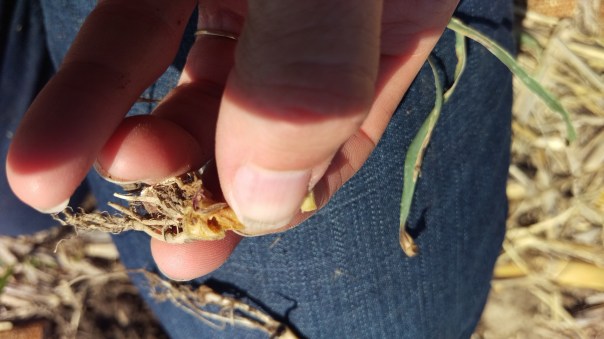
The growing point area of the same plant.
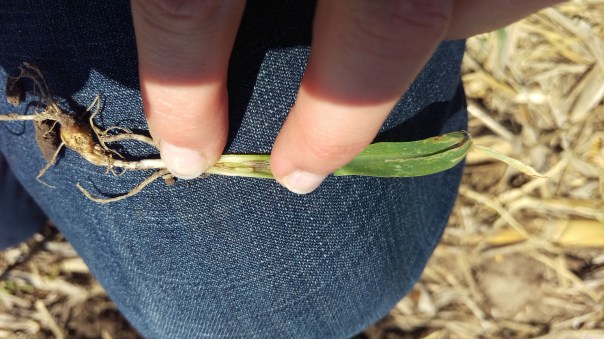
Carefully unroll the leaves to reveal any potential larvae.

Also found wheat stem maggot in some rye stems from rye that didn’t completely die. White heads in wheat and rye can be an indication of their feeding. You can then pull on the head and easy removal reveals where the maggot was feeding.
So two questions:
- Why are we seeing this this year?
- Is there anything we need to do?
The short answer to both is that we really don’t know. Perhaps one hypothesis is our warm winter allowed for an earlier generation of wheat stem maggots to pupate and emerge as flies during corn planting when they would typically do so later in May. Perhaps in fields where wheat or rye wasn’t yet terminated, the flies could lay eggs and the larvae that hatched moved from the wheat or rye to the corn upon emergence and once the cover was terminated.
The larvae we’re finding now are in different stages and some are getting close to pupating. After pupating, they will emerge into flies that will lay eggs in grass crops. We don’t know for certain if the flies will lay eggs in these corn fields again or if they will move to other grassy species. We’re not recommending insecticide applications.
South Dakota State and Kansas State have previously reported rare incidences of this occurring in corn. This is my first time observing this in Nebraska. To date, I’ve seen stand loss range in fields from 5-50%.
This doesn’t mean that all potential stunted plants or stand concerns are due to this particular insect as a number of other factors could be involved. This post is intended to increase awareness of another option to look for with the number of questions I’m receiving right now regarding corn concerns in terminated rye or wheat cover.
Dr.s Justin McMechan and Bob Wright are surveying fields and conducting studies to better understand any potential concerns in future years. We will keep you informed as we continue to learn more.
Crop Update May 25

Yellow banding can be seen on corn plants from the cold temperatures at various times of the plant’s growth. Some have been packed with mud from rains or have wind-whipped leaves. I’m also seeing some evidence of seedling diseases caused most likely by Pythium sp. in portions of fields with excess moisture.


I’ve been asked to look at fields where soybeans appeared to be dying and/or had discoloration of the cotyledons and hypocotyls. Most of what I’m seeing thus far with the discoloration of cotyledons and hypocotyls have been in fields where a pre-emergent herbicide program containing a PPO inhibitor was used. These are helpful products in reducing weeds. We’ve just seen this in the past as well after rain events that the chemical can be rain-splashed onto the cotyledons and/or the plant is unable to outgrow the effects of the chemical quickly enough in comparison to the damage observed. Hopefully most of these fields will still be ok with plant stands if enough plants can grow out of it; we’d say to leave plant stands of at least 75,000 plants per acre because of the way soybeans compensate for reduced populations without a significant yield effect. There may also be situations of damping off diseases occurring in soybeans. They keys are to look at where the damage is occurring. Discoloration of the roots/below-ground stem would most likely be due to seedling diseases whereas, PPO injury will occur on the cotyledon and hypocotyl-so essentially above the soil. There could be instances where the stress of herbicide damage is also complimentary to Rhizoctonia root rot, but I haven’t sent any samples in to confirm this. The following article is from a few years ago, but summarizes the situations in which damage could more likely be anticipated: http://go.unl.edu/2jbf.

The symptoms on this soybean plant with the ‘halo’ effect on cotyledons is typical of what we see with ILeVO seed treatments. The effects will be on the cotyledon but not on the unifoliate leaves or above.

Soybeans planted April 21st at 2″ depth have been battered by recent rain and wind events. Currently close to V1 stage with first trifoliate unfurling.
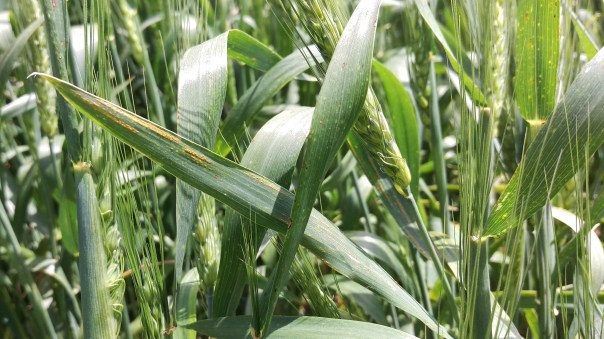
Wheat is in various stages of pollination to beginning filling. Stripe rust and leaf rust continue to spread on leaves but wheat is past the point of fungicide application if it is over 50% pollinated.

Really pretty wheat field I’ve been watching this year. Very even growth and low incidence and severity of rust in this more resistant wheat variety.

May 19 Wheat Update


Damage to heads from frost/freeze is beginning to appear as white awns/florets in wheat heads. Thankfully this damage is very minor in area wheat fields right now.


Barley yellow dwarf is also appearing in fields and is noticeable by flag leaves with a yellow/purple color. This is a disease vectored by various aphid species. The aphid in this photo is a corn leaf aphid and I’m seeing these in wheat as well right now in addition to lady beetles which are feeding on them. We also observed aphids last fall and were concerned about them potentially vectoring this disease. I would say this is my least favorite wheat disease because you can do many things correct with wheat just to have this one show up and affect yield.


Stripe rust and leaf rust are also rapidly increasing in area fields with the humidity and moisture this past week. Fungicide options differ right now dependent upon wheat growth stage.

Wheat flowering (pollinating). Look for the small yellow anthers. The wheat head will begin pollination in the center first and then pollinate the top and bottom. I’m also concerned about the potential for Fusarium Head Blight (scab) in our wheat right now with all the rain we’re receiving during pollination. Only a few fungicides are labeled for wheat during flowering and the ones that are can only be applied up to 50% flowering. These include Caramba, Prosaro, Folicur, and Proline which are slated to help prevent scab and also kill fungal diseases like rust already present on the leaves. Read and follow all pesticide label directions.

Also seeing some loose smut in fields which again is fairly minor. Both loose smut and stinking smut (common bunt) can be prevented by using a seed treatment fungicide at planting. Often these diseases occur in fields where wheat has been planted and smut has occurred before and when using bin-run wheat that has not been treated with a seed treatment fungicide. Also notice all the yellow ‘flecks’ on these leaves which are indicative of fungal infection (most likely rust) on these leaves.


 JenResources