Category Archives: Guest Blog
Dr. Kohl’s Ag Update
This week, I’m sharing an article that my colleague, Brandy VanDeWalle wrote on December 5, 2025 about “Ag Update and the Road Ahead” by Dr. David Kohl’s presentation at the recent Farmers and Rancher’s College Program. Brandy writes,
“Recently at a Farmers & Ranchers College program, Dr. David Kohl shared his global perspective on current events and how they influence U.S. agriculture—insights that are always incredibly valuable. One of the highlights of his presentation was a “SWOT analysis” of the United States. While many businesses routinely use SWOT analyses to evaluate strengths, weaknesses, opportunities, and threats, it was fascinating to consider how this framework applies to an entire country.
Kohl noted that one of the United States’ greatest strengths is its abundant natural resources. Together, the U.S. and Canada hold 20% of the world’s water supply. The nation’s extensive river system also provides an efficient means of transporting goods. Additional strengths include a solid capital structure, legal system, and property rights; the global role of the U.S. dollar in trade; a strong educational system; an entrepreneurial economy; and the country’s historic position as a global influencer since World War II.
Weaknesses cited include political polarization, inconsistent policies, and declining trust in institutions. The U.S. also faces an aging population combined with a reactive healthcare system, a growing federal deficit, substantial budget obligations, a service-dependent economy, a widening concentration of wealth and income, and aging infrastructure paired with supply chain challenges.
Kohl highlighted that North America has tremendous potential when the U.S., Canada, and Mexico work together—representing 5% of the world’s population but 29% of the global economy. Additional opportunities include improving proactive healthcare to enhance quality of life, cultivating next-generation leadership at all levels, advancing as a global leader in applied technologies, and strengthening natural resource and environmental management.
Among the threats, Kohl warned of the likelihood of a catastrophic technology event that could disrupt major industries or even the country itself. He also identified the risk of a “brain drain,” as scientists and researchers leave the U.S. due to issues such as funding uncertainty, instability, perceived anti-science sentiment, and heavy recruitment from other global powers including the EU and China.
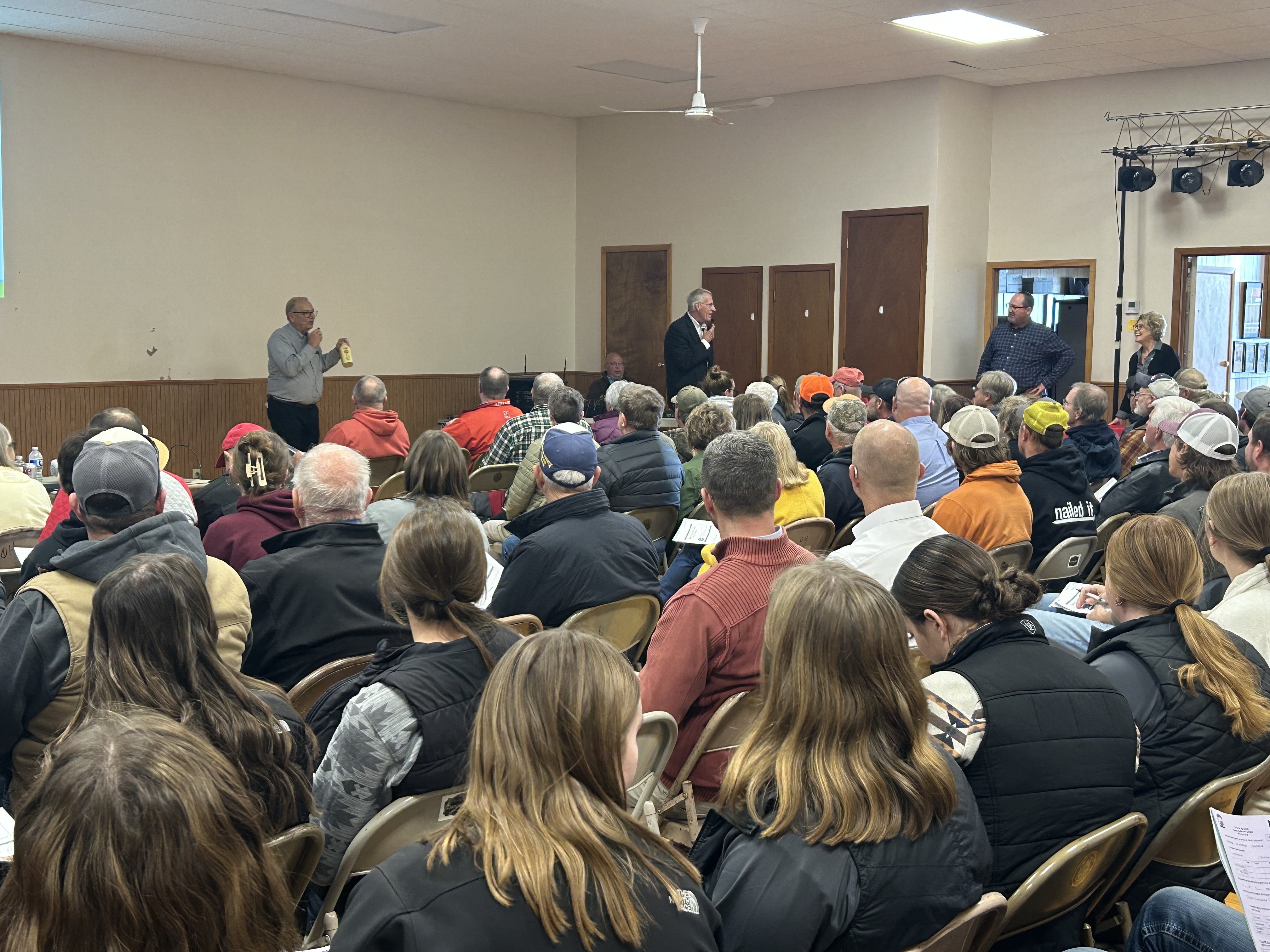
Dr. Kohl emphasized the critical importance of human interaction and communication. While artificial intelligence and other technological tools can help reduce workloads, they can never replace genuine human relationships. He reminded attendees that people need connection and purpose. Quoting a favorite saying, he noted, “It is better to have a good neighbor than their farm,” reinforcing the idea that being kind and building strong relationships matter far more than acquiring more land or expanding a business.
In conclusion, he provided leadership principles that stand the test of time:
- Change occurs bottom up, not top down.
- Manage the controllables, manage around the uncontrollable.
- Quick money builds ego – disciplined principle-based strategy/activity results in resiliency, nimbleness, agility and character.
- If you are going to lead, you must read!
- Success is often measured in dollar signs. Significance is giving back and making a difference in people’s lives.
- A successful culture and society must have success in agriculture.
It was great to see over 30 FFA members and community college students in attendance which Dr. Kohl praised and asked them each to share what they learned. He praised the 4-H and FFA programs for providing youth a purpose and developing life skills.”

2025 Yields
This harvest was a difficult one, plagued with breakdowns, slow-going in storm-damaged corn, and disappointing yields. While there were a few reports of decent yields, the overwhelming majority of farmers and seed dealers in the area have been disappointed. Honestly, I was worn down and needed a mental break before I could address this in writing. I asked Dr. Roger Elmore, Dr. Tom Hoegemeyer, Dr. Bob Nielsen, and Dr. Eric Hunt if my reasoning was on track and for their additional thoughts and am grateful to them.
Major Point: People are looking for solutions, but increased nitrogen rates, more fungicide applications, and tillage are not the answers. What went right? Balanced nutrient management with reduced nitrogen inputs, TIMELY fungicide application, and proper irrigation management are future keys.
We began the season with dry planting conditions. I was arguing we were potentially drier than Spring 2023 with the observations about rye and pastures not growing. Crops went into the ground quickly without cold snaps. Several farmers were completely done planting in April. Irrigation began early to get moisture into seedbeds and to activate herbicide. Plant stands and emergence were uneven, evidenced again at harvest with varying ear sizes and plants with ears that didn’t pollinate. I think that impacted us more than we realized. The Memorial Day weekend rains saved us.
A relief was that rain kept falling in spite of it varying greatly in timing and amounts. Some experienced higher non-irrigated yields in corn and soybeans compared to irrigated fields. That nearly always is due to too much irrigation and timing of those irrigations, often occurring right before a significant rain event.
We had a few wind/hailstorms in July and the fairly widespread Aug. 8-10 wind/hail event, which York Co. escaped. Much of the year we received lower than average solar radiation (which includes photosynthetically active radiation or PAR). There were several periods of cloudy/hazy/smoky days. Research utilizing shade cloth revealed 25-30% potential yield loss with shading occurring from R2-R6 stages in corn. As Dr. Roger Elmore pointed out, the hybrid maize model was predicting average yields at the end of the growing season in spite of the low PAR, which would suggest biotic (living) factors being the greater issue. Photosynthetic stress on plants can also include southern rust impacts on leaf tissue and stalk rots. I’m wondering if irrigation prior to heavy rain events exacerbated the fusarium crown rot/gibberella stalk rot we saw? Dr. Tom Hoegemeyer wondered the same thing. “Photosynthetic stress and stalk rot go together like beans and weenies. Each one can cause the other. We MAY have had some early infection with Fusarium/gib due to saturated soils/etc. As you know, high N rates, lower K available and a dozen other stress sources make it worse.”
High night-time temperatures burn sugars that should go into ears to fill kernels. I mentioned my concern about this throughout July and August. By mid to late August, ears began pre-maturely drooping, cutting off the food supply to kernels. Looking at kernels in numerous fields at harvest time, they appeared shriveled/pinched at the base. Dr.’s Tom Hoegemeyer, Roger Elmore, and Bob Nielsen all attribute that to stress occurring before black layer in which the kernels prematurely died before completing the normal black layer process. I feel the greatest contributors of this were the high night-time temperatures and the stresses of southern rust and stalk rots. Dr. Eric Hunt also mentioned the high humidity, particularly in York County due to the sheer amount of irrigation which may have led to increased disease pressure including stalk rots.

Dr. Bob Nielsen: “Your description of the kernels makes me think that kernel development was prematurely halted. Although, honestly, severe reductions in photosynthetic leaf tissue prior to BL (black layer) due to southern rust etc. or early onset of severe stalk rots would also prematurely shut down kernel development. And, of course,…(large) ears with excellent kernel set create a huge demand for photosynthate during grain fill, which exacerbates the negative effects of severe loss of photosynthetic leaf tissue and predisposes the stalk and root tissue to rapid fungal rot infection and development.”
Dr. Tom Hoegemeyer summed it up: “I think we had lots of issues that caused PS (photosynthetic) stress, some of which impacted our irrigated acres worse than our dryland acres. (My home dryland area had lots of 200 to 220 bpa corn and 65 to 70 bpa soybeans. After a dry spring, we had more rain than we’ve had for years). Irrigated corn in the area often wasn’t as good as the dryland, even with more N applied. The more stressors (hot nights, light limitations, too high N for the amt of light/PS–exacerbating disease issues, multiple leaf diseases combined with high humidity, continuous corn, etc.) the bigger the yield loss. And, in some instances, I think adding water to these fields hurt more than it helped.”


Sources:

York: -21 MJ/m2
Grand Island: -9.7 MJ/m2
Lincoln: -25.2 MJ/m2
Falls City: -28.3 MJ/m2
Norfolk: -10.7 MJ/m2
Wayne: +19.7 MJ/m2
West Point: -1.3 MJ/m2″


Southern Rust Myths
The following article, originally published in CropWatch (https://cropwatch.unl.edu/mythbusters-southern-rust-edition/) , was written by Dr. Tamra Jackson-Ziems and Kyle Broderick. High disease levels of southern rust were present in 2025, impacting yields. This article addresses the misinformation we are hearing about southern rust before decisions are made for next year’s growing season.
“Myth #1: Overwintering Rust: The southern rust fungus cannot overwinter in Nebraska. (It cannot survive in corn residue or soil).
The southern rust fungus (Puccinia polysora) needs to infect living, green corn in order to survive, and there is no known alternate host. Thus, the fungus can’t overwinter anywhere the climate doesn’t support corn growth through the winter months.
In fact, our rust fungi are likely blown north into the United States from subtropical locations, such as parts of Mexico, where corn is grown year-round. The southern rust fungi typically reach Nebraska in late July; however, this year they arrived earlier than usual, with the first confirmed sighting on July 9 — the earliest on record for the state.
Myth #2: Infected Grass: Southern rust doesn’t infect brome or other grasses nearby.
Rust fungi tend to have very narrow host ranges, infecting only one or a few plant species. Because several species of rust thrive under the same environmental conditions, it’s not unusual to see multiple plant species showing rust symptoms at the same time — even though they’re caused by different pathogens.
Myth #3: Super Strains: There is no new “super strain” of southern rust fungus.
… the severity we observed was due to prolonged periods of extremely favorable weather conditions — southern rust thrived under high relative humidity and average temperatures around 80°F. Southern rust…has been confirmed in 19 of the last 20 years…. If you remember 2006, you might recall another historic outbreak centered in south-central Nebraska. That season also brought delayed corn planting from spring rains, followed by ideal weather for rust development during the first two weeks of August. Many fields suffered stalk weakening and lodging, which caused memorable harvest challenges.
Myth #4: Fungicide Failures: Fungicides did not fail to control southern rust this year.
Although yield data are still coming in, most reports indicate that fungicides performed wellagainst southern rust this year. During years with substantial disease pressure, differences in fungicide performance become more apparent, underscoring the importance of selecting effective products and applying them at the right time. Results from multiple states, compiled by the Crop Protection Network, reinforce these findings. Remember: Even the best product can’t perform well without good coverage and proper timing, especially in a season like 2025 when disease pressure was unusually high.” The full article can be viewed at: https://cropwatch.unl.edu/mythbusters-southern-rust-edition/.



Ambiguous Loss & Farming — Views from VanDeWalle
Sharing this post from my colleague Brandy VanDeWalle with Fillmore County Extension. You can read the remainder of it by clicking on the link to her blog below.

Picture this scenario. A young farmer in his thirties is looking forward to taking over the family farm someday. Suddenly the father is impacted by a life-changing health incident that leaves him mentally incapacitated and unable to explain the workings of the farm or other advice for the son. Or… imagine being the wife who […]
Ambiguous Loss & Farming — Views from VanDeWalle
Corn Emergence and Growing Degree Days
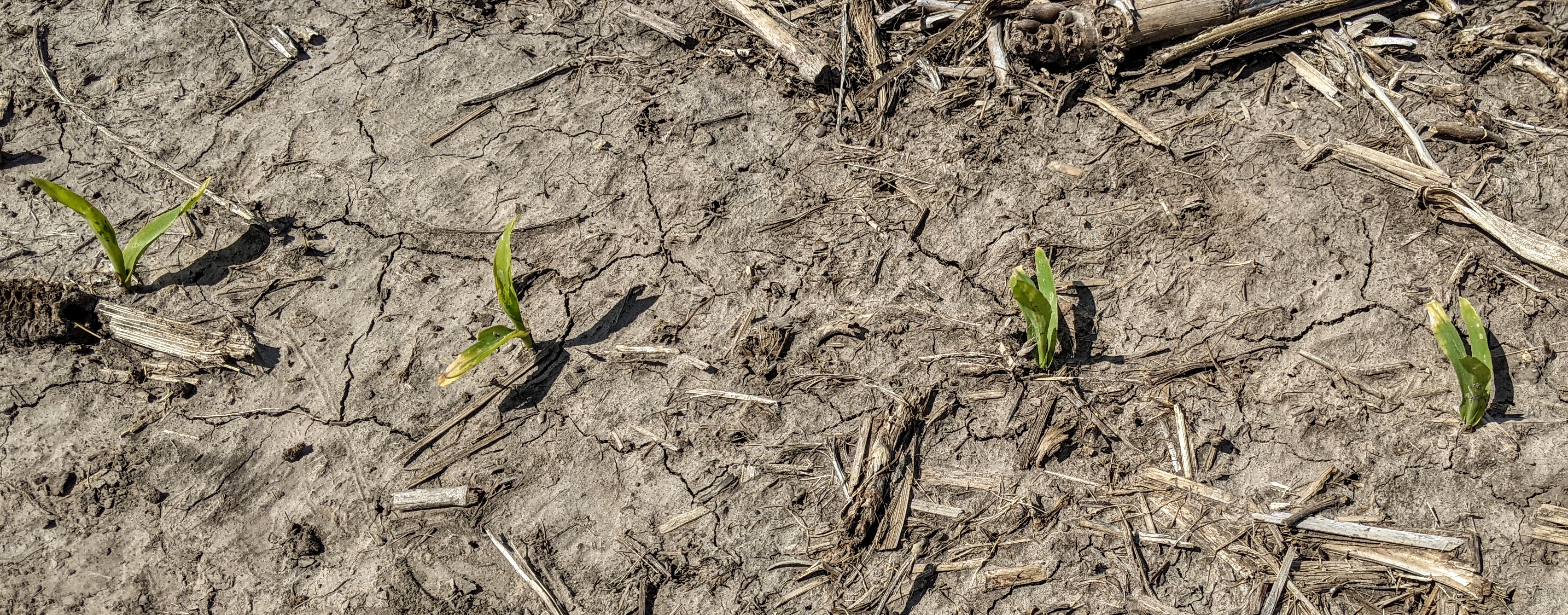
Corn Emergence and Growing Degree Days: For this week’s column, I’m going to share information my colleague, Nathan Mueller, Extension Educator in Saline, Gage, and Jefferson counties wrote in his recent blog post. “Many factors affect corn growth and development, especially early in the growing season. A common question this time of year after corn is planted and some fields have emerged whiles other have not is “How many Growing Degree Days (GDD) does it take for my corn to emerge?” Since corn emergence is directly related to soil temperature (and of course soil moisture), the days to emergence vary especially when one compares early planting dates to later planting dates. The general assumption is 120 Growing Degree Days abbreviated GDD for corn to emerge under favorable conditions. However, we know that some planting practices and environmental conditions can decrease or increase the amount of GDD needed for corn to emerge. We use the GDD calculation for air temperature to estimate how long it will take corn to emerge even though soil temperature is the driving factor.
Growing Degree Days (GDD) or Growing Degree Units (GDU) calculation is determined from air temperature. The corn equation for GDD or GDU = (Daily Maximum Air Temperature + Daily Minimum Temperature)/2 – 50. When the maximum air temperature is greater than 86 degrees, we set the value at 86 in the equation, as the growth rate of corn does not increase much beyond 86. Likewise, when minimum air temperature is less than 50 degrees, we set the value equal to 50 in the equation. The sum of daily GDD or cumulative GDD for corn emergence is approximately 90 to 120 under favorable conditions. As a base line for GDD required for corn emergence, colleagues at the University of Wisconsin report that 125 GDD are required for emergence. Based on research in Iowa, corn typically required 90 to 120 GDD from planting to emergence. This range assumes adequate soil moisture and will vary with planting depth, tillage system, and residue cover.
Research shows some adjustments are needed to help fine tune expected emergence dates based on GDD determined from air temperature. Planting practices that change the amount of GDD for corn to emerge include planting date, depth, and residue cover (view full table of variables at https://cropwatch.unl.edu/growing-degree-units-and-corn-emergence). It takes about 10-25 more accumulated GDD for emergence with early planting dates. Planting deeper than 2 inches will increase the number of GDD to emergence by about 15. More than 75% residue cover increases the accumulated GDD needed for emergence, ranging from 30 to 60 GDD more. Additionally, the soil moisture, soil condition, and soil texture change the needed GDD for corn to emerge. Dry seedbed conditions will require more GDD. Crusted or cloddy soils can increase GDD by 30 more. Heavy textured soils require more GDD than do coarse textured soils. Corn genetics also can affect GDD needed for emergence. Therefore, the amount of accumulated GDD from planting to corn emergence can range easily range from 90 to 200 GDD.
In Nebraska, the U2U tool (https://hprcc.unl.edu/gdd.php) can be used to determine local accumulated GDD based on your planting date. For example, at the tri-county corner of Saline, Jefferson, and Gage counties from May 1 to May 13, we accumulated 114 GDD and the 30-year average is 139. In summary, remember that numerous factors drive corn emergence and assuming a standard 120 Growing Degree Days (GDD) for corn to emerge will not always hold true.”
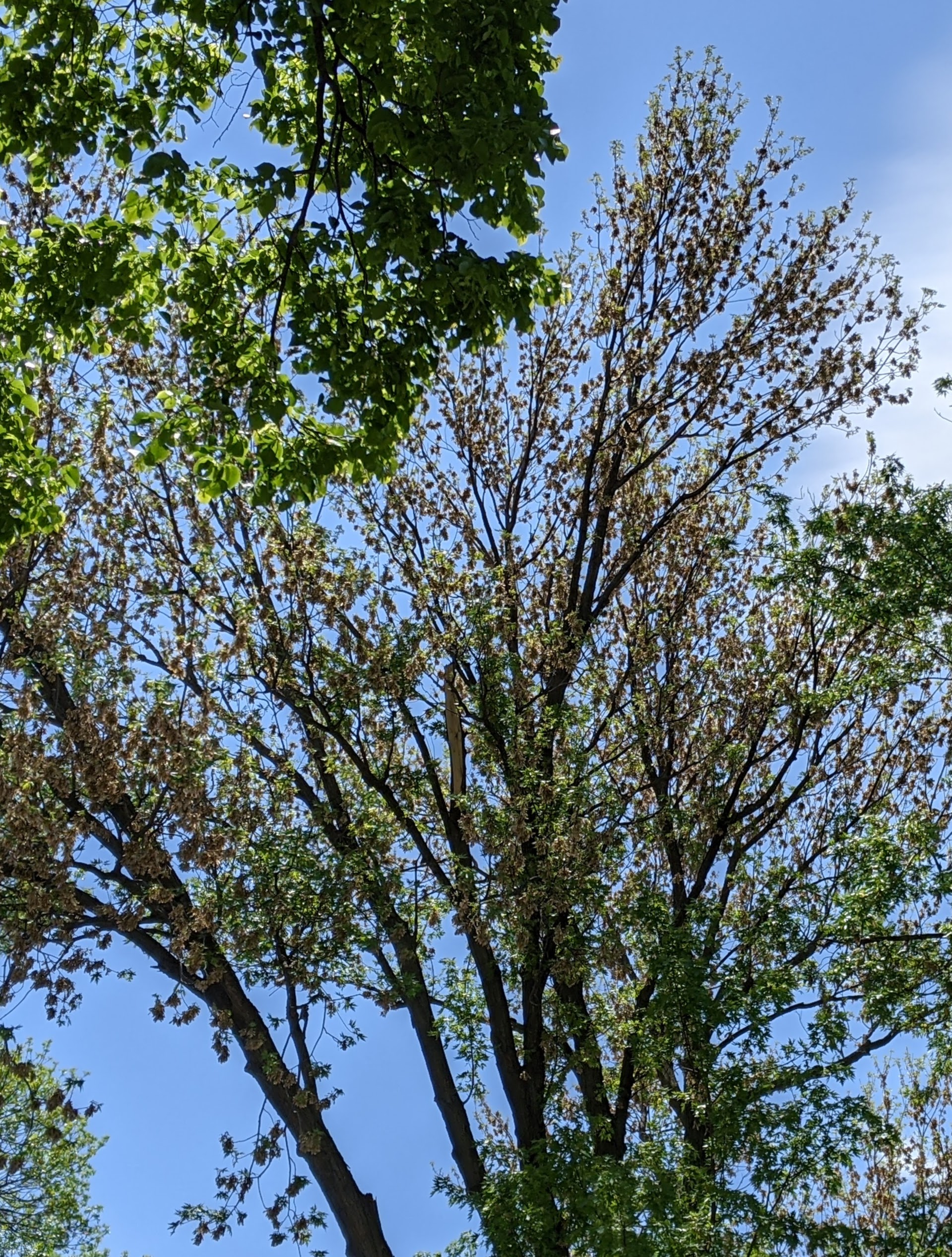
Tree seeds and leafing out: I’ve been watching silver/red maples and ash trees noticing that some, including one of mine, is very heavy in seed production like what we experienced in 2019. There’s also quite a range in oaks with some leafing out normally and others leafing out rather slowly. I think the seed production possibly is due to the warm March. Information from Ohio State shared that, “Every spring, maple trees produce small flowers that turn into seeds. Normally, a cold frost kills some blossoms, but this year the usual chill didn’t arrive at the right time. More blossoms than usual turned to seed.” Oaks leafing out at different rates could be due to the fact we’ve had a cool April/May and it’s also a survival mechanism to not all leaf out at once. We’ve also been experiencing some oak decline (which is also observed in August when leaves prematurely turn brown), and this can also result in slower leafing out. These are just some thoughts; I really don’t know the answers, just sharing that for those who are asking, I’m also observing this.
Henbit, Crabgrass, & Ground Ivy… Oh My! — Husker Hort

Purple flowering henbit is blooming right now. Spring has officially sprung. The crabapples and flowering pears are nearing full bloom. Tulips and daffodils are starting their flower show. Henbit and dandelions are looking gorgeous. Are the last two not quite the kinds of spring flowers you want in your landscape? If so, there are some […]
Henbit, Crabgrass, & Ground Ivy… Oh My! — Husker Hort
Considerations for Leasing Land for Solar Development
Leasing land for solar development is a topic landowners in the McCool Junction and Lushton area are facing. This is a guest column by my colleague John Hay, Nebraska Extension Energy Educator.
Renewable energy has increased significantly in recent years and the number of wind farms and size of wind turbines are a visual reminder of renewable development. Due to higher development cost, solar electric systems, also called solar photovoltaic (PV), have lagged in commercial electric development. In recent years, the dramatic price decline of solar PV has led to greater interest in utility scale solar development. For instance, consider a 5-Megawatt system similar to the one constructed West of Lincoln North of I-80. Based on solar cost benchmarks published by the National Renewable Energy Lab, a 5-Megawatt system constructed in 2010 would have cost $27.6 million dollars, compared to $5.65 million dollars to construct the same size project in 2018. Combine this with the 26% federal tax credit and the economics of utility scale solar are sufficient for major development interest across the nation. The federal tax credit is currently 26% and set to decline to 22% in 2021, then 10% for future years.
Utility scale solar farms are constructed on open ground generally near access to the electric transmission grid. Other considerations for siting solar farms may be the solar resource, proximity to electricity demand, other local incentives, and regional value of electricity. Access to land is an early step in utility scale solar development. Farmers and landowners in Nebraska are being approached to lease land for solar development and these landowners are facing important long-term decisions about the future of their land. When considering a solar leasing contract many factors should be considered. According to the Farmland Owner’s Guide to Solar Leasing published by the National Agricultural Law Center these considers are: Length of the commitment, Who has legal interests in the land?, Impacts on the farm and land, Family matters, Property taxes, Government programs, Liability and insurance, and Neighbor and community relations.
Utility solar farmland leases are long term contracts and need to be reviewed by a qualified attorney. In Nebraska these leases can be as many as 40 years and longer if extended. For many landowners this long-term contract may extend into the next generation and should be discussed with family. Landowners at times feel pressure to sign contracts and this can be stressful. Take the time to review and negotiate these contracts and always know that saying “no” is an option.
Solar leases can be attractive to landowners as they can offer long term income and profitability on the leased land. A study in Michigan of landowners with wind farm leases showed farmers with leases invested more in their farms than farmers without leases. This suggest the lease income may influence farm stability and longevity. Solar farms like wind farms add to county tax income. These developments are exempt from property tax and instead have a nameplate capacity tax paid each year in place of the property tax.
Utility scale solar farms are unlike wind farms in some ways. For example, wind turbines may take only 1-2 acres out of production per turbine because farmers can farm around the base of the turbine and turbine access road. In comparison, a 1,000 acre solar farm will take all 1,000 acres out of production. Solar farms are low to the ground and have less impact on the skyline. Generally solar farms will be fenced with vegetation growing amongst the solar panels. Vegetation could be perennial pollinators, grass, or weeds. Common management is periodic mowing to ensure plants do not disrupt solar operation and production.
Landowners approached about solar leases should seek advice from an attorney and take time to thoroughly consider the contract and its implications to their farmland. Review of the Farmland Owner’s Guide to Solar Leasing published by the National Agricultural Law Center will help frame the issues and considerations for solar leases. This can be found at: https://farmoffice.osu.edu/sites/aglaw/files/site-library/Farmland_Owner’s_Guide_to_Solar_Leasing.pdf. For additional questions about solar leasing, please see https://cropwatch.unl.edu/bioenergy/utility-scale-solar, or contact John Hay, Extension Educator at 402-472-0408 or jhay2@unl.edu.
Feeding Storm Damaged Corn; a Few Thoughts from a Veterinarian
With the recent sprouting of grain on the ears and with more producers now learning what percent loss their crop insurance is determining for each field, I felt it would be good to talk about feeding this damaged grain again. This post is written by Dr. Dee Griffin, DVM at UNL’s Great Plains Veterinary Education Center at Clay Center. I appreciate Dee’s willingness to provide this information from a Veterinarian’s perspective. 
Also a note, to date we have not found Aspergillus in our hail damaged fields. The grain molds we are seeing are Diplodia and Fusarium. Diplodia does not have the potential to produce mycotoxins. Fusarium has the potential of producing fumonisin, vomitoxin, or DON. You can bring forage samples to Husker Harvest Days this coming week to the IANR building and have them tested that day for nitrates for free if you wish.
Dr. Griffin writes: Any time a growing grain producing plant is damaged there is a potential for changes in the plant or grain on the plant contaminated with fungus/molds to grow. The most common change in stressed plants is the accumulation of nitrates. Aspergillus or Fusarium will be the most likely fungi to be contaminating harvested grain from storm damaged corn in our area.
It is really important to know that most molds are not toxic. Therefore just because mold growth is observed doesn’t mean the feedstuff will harm livestock. Even though a mold may not be toxic it can still cause feed refusal. Not all livestock species are equally sensitive to mold contamination and not all production groups are equally sensitive. For instance pregnant and young animals are more sensitive than mature non-pregnant animals.
Nitrate accumulation in stressed plants can cause be harmless or cause serious harm depending on:
- the level of nitrate in the feed harvested from stressed plants,
- on the life stage of the animal,
- and on the species of animal.
Nitrates accumulate in the forage portion of the plant, so nitrates are not a concern in grain harvested from stressed plants. Additionally, it is important to know nitrate levels will always be highest in the bottom part of the plant and lowest in the top foliage. Nitrate testing is simple and reasonable quick. Your local UNL Extension Educator can help you locate the nearest facility that does forage nitrate testing.
Feed containing nitrate levels less than (<) 1000 parts per million (ppm) seldom are associated with an animal health concern. Feed containing nitrate levels greater than (>) 1000 ppm may be a concern in younger animals and levels >2000 ppm should not be fed to pregnant cattle. Feeder cattle are reasonably resistant to nitrates but feeds containing >4000 ppm should not be fed to any animals.
Molds in corn grain of concern could be either Aspergillus or Fusarium. Your UNL Extension Educator can be a great help in identifying mold growing on ears of your storm damaged corn before the grain is harvested. Both of these fungi are potentially dangerous when found in livestock feed. Toxins produced by molds are extremely stable, therefore if a significant level is found, the level will not decrease over time. Silage produced from damaged plants and grain harvested from mold infested plants is potentially a problem.
Good silage management is critical to lessen the likely hood of continued mold growth after ensiling. Proper packing to remove oxygen and improve fermentation which ensures the pH will be below 4.5 is critical.
You can’t look at harvested grains from storm damaged fields and visually identify mycotoxins. Corn grain from storm damaged fields can … and mostly likely should … be tested for mycotoxins before feeding to livestock. Your local UNL Extension Educator, nutritionist or veterinarian can help with mycotoxin testing.
Proper sampling is crucial to getting reliable results back from the laboratory. A “grab sample” is not adequate. The sample submitted to the lab should be representative of the entire load, bin, pit or pile of feedstuff being evaluated.
The steps are simple
- If sampling a field before harvest, sample at least two dozen ears that appear to have mold growth and submit all the ears to the laboratory for mycotoxin evaluation
- If sampling after harvest, take multiple samples uniformly from throughout the silage or grain in question
- The sample should be taken from what would be used in a single load of feed
- That means, if five loads of feed could be made from a 50,000 lb semi-load of corn, collect not less than five samples from the semi-load of corn
- The sample should be based on sample volume not weight
- For instance, collect “coffee can” size samples
- Mix all the all samples together that were collected from the feed in question
- For instance, if 10 coffee can size samples were collected from across the face of a silage pit, pour all 10 samples onto a plastic sheet and thoroughly mix them together
- Next, collect a single sample from within the 10 mixed samples
- Submit the single sample to the laboratory
The laboratory results usually will provide some recommendations for how the feedstuff can be used. There is an old saying, “Dilution is the solution …” meaning in this consideration, that many feedstuffs that contain higher levels of mycotoxin than would be acceptable, might be usable if a sufficient amount of non-mycotoxin contaminated feedstuff is used to dilute the mycotoxin. Your UNL Extension Educator, nutritionist or veterinarian can help evaluate the possible uses of a damaged feedstuff containing unacceptable levels of a mycotoxin.
Apps and Mobile Sites for Mobile Devices on the Farm
It didn’t take long for the phrase “there’s an app for that” to be seen and heard regularly in the phone and mobile device world. Today, there are many apps and mobile websites that can be fantastic tools for producers to use in decision-making. University of Nebraska Extension has developed several mobile apps to take a look at and be sure to visit our site often to learn of additional new apps.
In addition to our Extension Apps, Dennis Kahl, UNL Extension Educator, and I have also compiled a list of a few mobile apps that we think could be useful to farmers yet this year as they get closer to harvest, but also for next year to test out and see if they will indeed help them do work quicker and make decisions more accurately.
Today we are going to highlight a few mobile applications and mobile websites that producers may be using now as they make preparations for fall harvest.
- UNL CropWater – provides an easy way to estimate soil water status based on Watermark sensors installed at depths of 1, 2, and 3 feet. With these sensor readings, the Crop Water app will estimate the water used as well as what is still available for Nebraska soils.
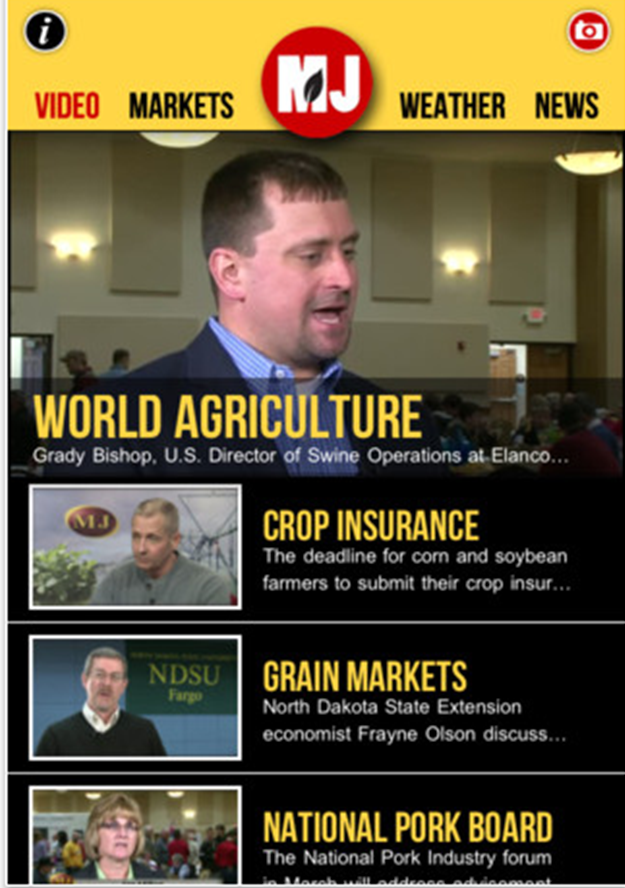
- Market Journal – Television for Ag Business Decisions. Weekly crop reports, markets, weather and current insect,
 disease and harvest issues. It was also listed at Agriculture.com’s #1 ag app for 2013.
 - RealAgriculture – focuses on the issues that are impacting agriculture. The site is focused on getting farmers the opinions on issues so that you not only get the news but the insight into what the news means in the production business.
- DTN/PF – The Progressive Farmer – provides market data, link charts to market data for single, seamless view of how the latest prices correlate with current market trends.
- Farm Progress – Keep up on local ag news, grain and livestock markets, enhanced weather and blogs as well as Nebraska Farmer magazine.
- Husker Harvest Days Show – Maximize your time at Husker Harvest Days with this application that includes exhibitor and category lists, show maps and other tools to help you maximize your time at the show.
- Ag PhD Harvest Loss Calculator – Allows farmers to estimate yield loss before and during harvest by recording the number of individual corn, soybean, wheat, sorghum, barley or oat seeds found on the ground in a square foot.
- Combine Performance Optimizer by John Deere – Help operators adjust and set the critical settings for next year’s harvest of small and large grain crops to improve machine performance.
- Calibrate My Sprayer – Aid in the proper calibration of spraying equipment.
- In addition to the apps listed above, Crop Life featured a story of the Top 13 Mobile Ag Apps for 2013 and Agriculture.com has a list of mobile apps. Take a look at these as well.
With wireless technology available in most areas of the state, we utilize Verizon Wireless with our mobile devices in the field and in our communities to update various social media outlets such as Twitter, Facebook and blogs. Mobile access has allowed University of Nebraska Lincoln Extension to provide current information and situations in the field at all times. We encourage producers to subscribe to various resources including:
- Twitter
- @UNL_Cropwatch
- @UNLBeef
- @MarketJournal
- @IANRNewsService
- @UNLExtension
- For information on some of the newest technology, visit Innovative Tips for Rural Communities blog.
- If you are interested in staying up-to-date with crop information be sure to subscribe to and bookmark cropwatch.unl.edu and subscribe to Jenreesources Extension Blog.
Special thanks to Dennis Kahl as a Guest blog contributor to this post!


 JenResources