Category Archives: JenREES Columns
JenREES 11-25-18
With harvest finished or wrapping up, focus has shifted to anhydrous applications and managing residue. Corn residue management has been a topic of discussion for years. Research on this topic has included use of tillage, baling, grazing, and use of products like nitrogen.
Iowa State conducted a three year study evaluating the effects of conventional tillage, no-till, and strip-till on residue breakdown on Bt and non-Bt corn residues. They did this by placing bags of residue of Bt and non-Bt hybrids in the three different tillage systems and evaluated decomposition after 3, 6, 9, and 12 months in a corn/soy rotation. The results showed no significant difference between tillage systems or Bt and non-Bt hybrid decomposition. These researchers also studied the impact of nitrogen applications on corn residue breakdown over two years in no-till. Immediately after harvest, three N rates (UAN 32 percent) of 0, 30 and 60 lb N/acre were applied to corn residue. A specific amount of residue was placed in nylon mesh bags and left in the field for 3, 6, 9, and 12 months, after which residue decomposition was evaluated. The different rates of N resulted in no differences in rate of decomposition. In general, the longer the residue remained in the field, the more it decomposed over time, regardless of N rate. Thus the authors shared that applying N after harvest for residue decomposition was not effective nor economical as soil and air temperatures decreased over time after harvest. They shared that in general, decomposition of crop residue is primarily influenced by soil moisture and temperature which allow for microbial activity.
Last year I wrote a series of articles for my news column and shared them in CropWatch 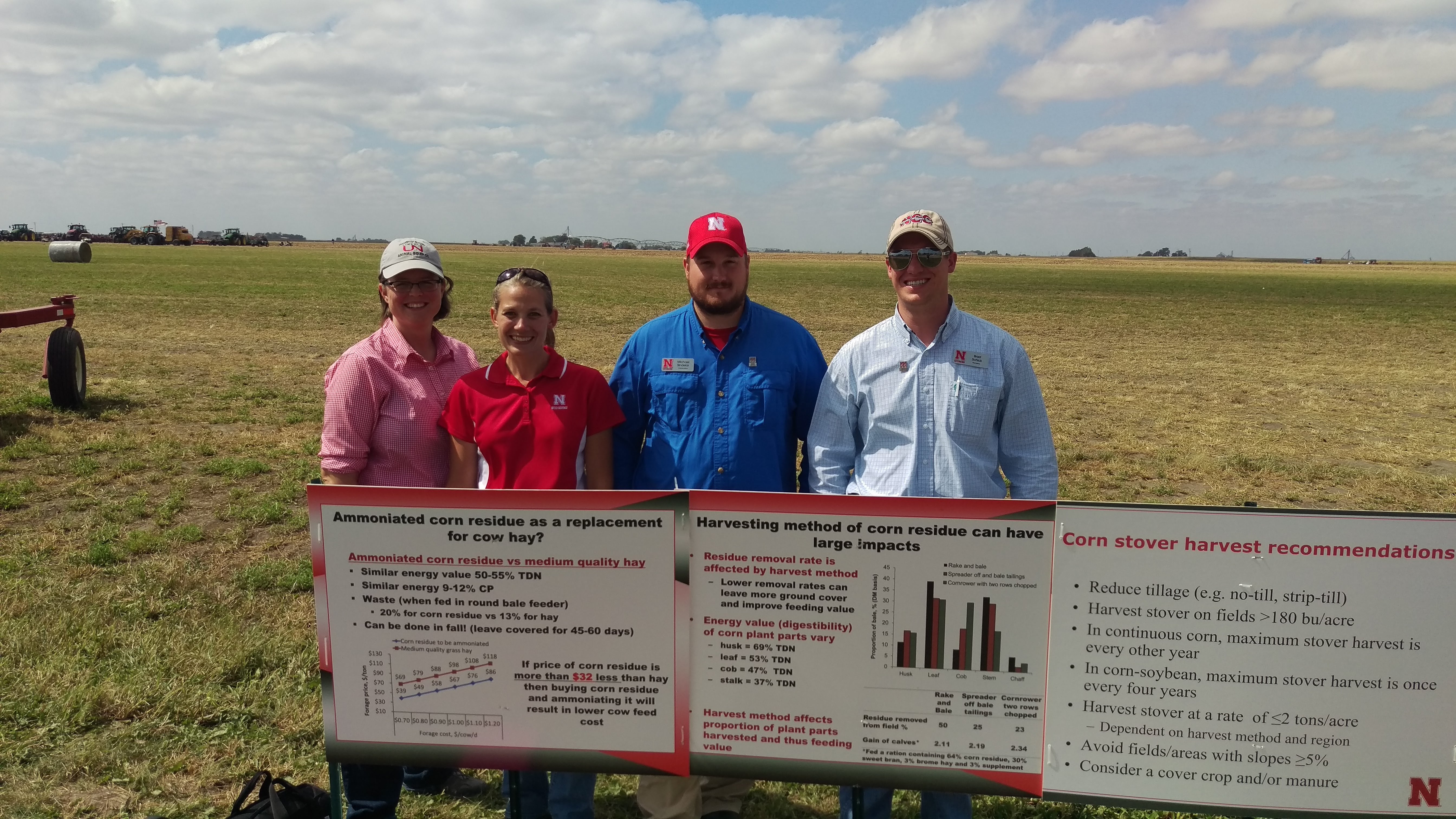 regarding cornstalk baling. A team of Extension Specialists/Educators and USDA-ARS also worked together on a workshop at 2018 Husker Harvest Days on this topic. I’ve received various reactions to these efforts, but my desire is to present the research. My perspective is twofold:
- Better serving farmers/landowners in helping answer your residue management questions via the research available and
- With the high winds, dust storms and vehicle accidents last winter/early spring, could we potentially rethink residue management besides so much conventional tillage for this part of the State?

I took this photo Feb. 2018 on I-80.
I’m not saying conventional tillage doesn’t have a place, especially as we think of one-time burial of weed seed. I just wonder if we can help reduce soil loss by utilizing other methods of residue management, perhaps including increased use of livestock grazing and cornstalk baling under the right field situations?
Summarizing the research, cornstalk baling is not for every piece of ground or every 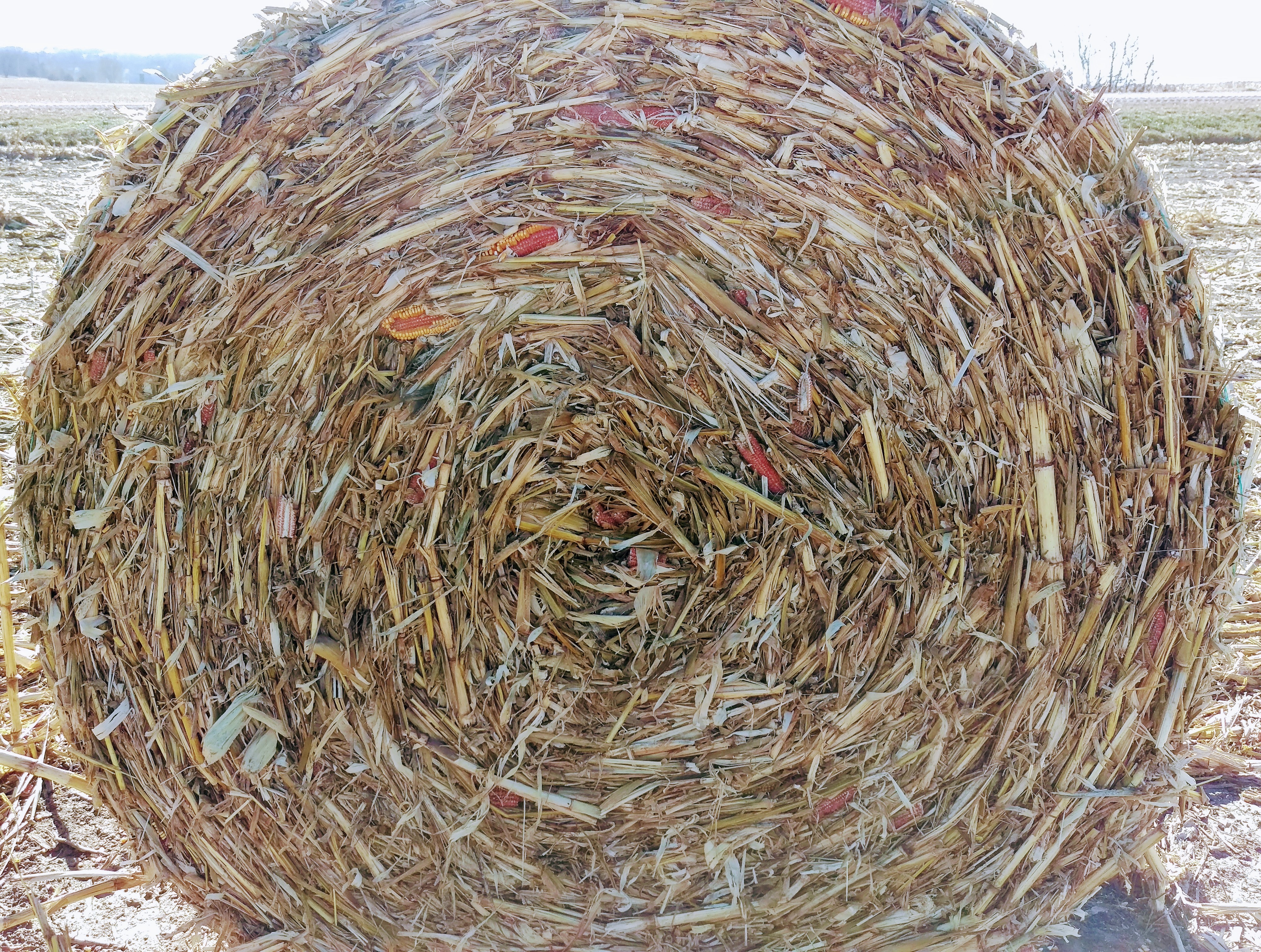 situation. From the research, our recommendations are that baling of corn residue should only occur on ground with less than 5% slope that yields 180 bu/ac or more, harvesting no more than 2 tons/acre. Retaining at least 2.4 tons of residue allowed for soil carbon maintenance and retaining more residue also reduced erosion. Every 40 bu/ac of corn results in 1 ton of residue at 10% moisture. Baling on fields fitting the above-mentioned criteria should occur a maximum of every other year in continuous corn or once every four years in a corn/soy rotation (due to reduced residue already present after soybean harvest). The research showed no significant impact on soil properties or soil carbon following those guidelines. Other recommendations would be to use a reduced tillage system in the field where baling occurred and consider planting a cover crop and/or adding manure.
In 239 site-years across 36 studies, corn residue baling resulted in 3% average yield increase where moisture was not limited, most likely due to more uniform stands. The average nutrients found in 1 ton of corn or sorghum residue was 17 lbs of Nitrogen, 4 lbs of P2O5, 3 lbs of Sulfur, 34 lbs of K2O (which due to Nebraska soils being high in K, the value may be 0-50% of this depending on soil test results), and cations equivalent to 30 lbs of lime. There’s also research that suggests less nitrogen is needed the following year going into corn due to the change in the C:N ratio and increased mineralization. So corn residue baling, based on the research, can be an effective way of managing residue without significantly impacting soil properties if done using the considerations mentioned above. Many fields I’ve observed cornstalk baling in the area this year look good regarding these criteria and most took less than 50% residue off the fields.
This year we’ve also seen a large increase in soybean residue baling in this part of the State. I realize it’s mostly being used for livestock bedding. In a future column and CropWatch article, the research regarding soybean baling will be shared in addition to an economics comparison of various residue management strategies. I will also share on grazing research for residue management in a future column.
JenREES 11-18-18 Farm Transition

Wishing everyone a blessed Thanksgiving with family and friends! We have much for which to be thankful!
Last week we held a farm transition meeting in York. I was thinking back to a family gathering we had shortly after one of my dad’s farm accidents. We were grateful he was going to be ok. In talking about what needed to be done on the farm, I asked something like, “Does anyone here know what your wishes or plan is for the farm if this had been more serious?” It wasn’t the best time and I didn’t do this correctly. It did allow for discussion as we never talked about what would happen to the farm before that. I’m grateful my parents responded over time asking each of us kids our intentions/values regarding the farm. They then put their estate plan together and at Christmas one year, went through everything with everyone including any spouses that were present. What I appreciate the most is that they were intentional and there is no secret.
The fact that estate plans can be secret was a common frustration among attendees at the workshop…and as I talk with various farmers. Dave Goeller, emeritus Farm Transition Specialist, shared a sad story about a man in his late 60’s whose 90+ year old dad still hadn’t transitioned management of the ranch to him. When he asked his dad about the opportunity to manage the ranch in the future, the dad didn’t wish to talk and said not to worry. I won’t go into the details but when the parents passed away, the ranch was sold. What’s sad is that, most likely, the outcome is not what the parents intended, and certainly not what the son hoped. We need to get away from estate plans being a secret.
Consider these questions:
- Have you been able to talk to your parents about what is happening with their estate plans? If not, why?
- What is your biggest concern/anxiety/fear(s)? What are you afraid you might find out?
- What is the biggest obstacle in your family dynamics?
- What do you love about your family business?
- What is the worst situation you can think of which might happen in the future?
- What could you learn that can help you?
- What is your mission statement for your farm/ranch? What is your vision for the farm/ranch?
- What are your goals for your farm/ranch? What will you do to make your vision happen?
Dave shared that while a person may feel like a ‘vulture’ when asking about the estate plan (as asking can come across as greed), it can really be a question over shared values. As I think about my immediate family, our shared values are faith, family, hard work, sacrifice, maintaining our family farm. I should’ve broached the subject using shared values instead:
“Dad, I’m so grateful God protected you and you’re going to be ok! You and mom have worked so hard and sacrificed so much for us kids and for this farm. We as your children wish to see your legacy live on in keeping the farm in our family. May we please discuss what your and mom’s goals and dreams are for the farm in the future?”
For those who have asked me how to have this conversation, perhaps some of these questions found in the Workbook at http://go.unl.edu/FarmRanchTransition may help? I also have copies of this workbook in the Extension Office. The questions cover a range of topics from understanding common values, asking if there are written documents, what is long term health care plan to protect the farm/ranch, contribution of all heirs, etc. Please also consider the Nebraska Farm Hotline at 800-464-0258 as a valuable and free resource for you! This hotline is a confidential resource for talking about stress, anxiety, financial concerns, and also for scheduling a time to meet with Dave Goeller and Joe Hawbaker (Attorney) for free to discuss estate plans and farm transitions. All you need to do is call 800-464-0258. For those interested in meeting regarding estate plans/farm transition, Dave and Joe have promised to come back to York to meet individually with families once they receive at least 5 calls. So, if this is of interest to you, please mention this when you call the hotline.
Final thought, this past year in particular, several farmers have shared with me their children would like to see them retire. I sense a variety of feelings about that from them as I listened. I also asked several questions including, “What does retirement look like to them? What does it look like to you?” Perhaps those and other questions could be asked in an honest conversation together?
Much of our identity, right or wrong, is found in what we do for a living. After all, we tend to ask this question when we meet new people. Through life’s circumstances, I’ve had to learn to seek my identity in who I am. Dave mentioned to think of retirement not as no longer working on the farm or being an important player, but retiring the management to the next generation. So, perhaps work out a transition plan that fits your situation where the first perhaps 3-10 years, the older generation is the primary manager in a mentor role explaining why he/she made the decisions a certain way to the next generation. The next 3-10 years, decision making is shared between the older and next generation. After that, decision making is transitioned to the next generation. And, during this entire process, the older generation needs to consider what he/she will be “retiring to”…what purpose or meaning can be found to occupy the time that was once spent in managing the farm?
Ultimately, estate planning and farm transition…relationships…are too important to not talk about these topics. Let’s no longer keep them a big secret!
JenREES 11-11-18
Through the years I’ve been blessed to meet many individuals including farmers/ag industry professionals who served (or continue to serve) our Country in the military. I’ve observed how service has influenced perspective on life’s difficulties for many individuals. And, I’ve observed how impacts of service have resulted in additional difficulties in life after service for some. There shouldn’t be shame regarding the struggle or in seeking help. While it can be scary, healing can come in the midst of honesty and vulnerability. Tonight I watched a special TV interview with four highly decorated individuals of the Iraq/Afghanistan wars-a couple of whom I’ve read their books. It was interesting hearing their perspectives on combat then coming home, on being in the military and then getting out, and much more. They ultimately shared how difficult it is after war and after service to step into civilian life and how important their military connections were in keeping them going. They also shared how important it was to find a sense of purpose in serving others and living life well in honor of those with whom they served who never made it home. Most likely all of us can think of a family member or friend who has served. Those individuals may have stories and/or wounds without words. Let’s be sure to show our gratitude to them for our freedom in America. Thank you to all our Veterans and all those in our Armed Forces for your service! Thank you also to their families!
Fall Applied Anhydrous Ammonia: When I began my Extension career, it was a different perspective for me to experience fall applications of nitrogen. My perspective from our farm was in-season nitrogen applications. Since then, there’s been several research based studies regarding the benefits of in-season nitrogen application. I appreciate there’s different reasons for the ways farmers approach the decisions within your farming operation. I’ve also observed more farmers of various operation sizes moving to more in-season applications. The reasons they’ve shared with me include: wanting to be more efficient with nitrogen application when the plant needs it, worried about any loss in off-season and wanting better water quality for kids/grandkids, research shows hybrids need nitrogen later in season, wanting to find a way to make it work before any potential regulation, and wondering if they can get by with less nitrogen with better timing in season. We also know today’s farmers in general have become increasingly efficient in both nitrogen and water use. There’s an interesting article in this week’s UNL CropWatch (http://cropwatch.unl.edu) where a multi-disciplinary team of authors share on nitrogen application in the fall having enhanced risk due to potential loss. This is due to data on the increase in extreme precipitation events over time that can lead to increased nitrogen loss through leaching and/or denitrification. We also know that there are years, like last winter, where areas I served didn’t even receive 2” of precip from fall through early May. So every year is different. Because we can’t predict the weather, the authors suggest, “Consider a more robust and less risky N management method that includes: applying a small percentage of N near planting time; follow with sidedress N applied as late as is possible given your equipment capabilities or several fertigation applications that are timed with crop uptake needs; and ensure the final application of N is done before the R3 growth stage.” They also suggest the following if you plan to apply N in the fall, “Avoid fall N application for soils of hydrologic Group A (sand, loamy sand, sandy loam) and Group B (loam, silt loam, silt); Avoid fall application of fertilizers containing urea or nitrate; Apply only when soil temperature is consistently below 50°F to slow nitrification (Last week temperatures fluctuated above and below 50°F at the 4-inch depth.); Use an inhibitor with known efficacy when applying N; and Hope for dry cold weather!”. The following is a really good resource if you’re interested in different University studies regarding various nitrogen inhibitors: https://www.ag.ndsu.edu/publications/crops/nitrogen-extenders-and-additives-for-field-crops. It’s too long to share here. A general summary of studies involving the inhibitor N-Serve used with anhydrous ammonia applications shows that it consistently resulted in increased ammonium nitrate the following spring (thus it worked well as a nitrification inhibitor). Yield increases were inconsistent throughout studies and years due to precipitation differences amongst the years. That resource also discusses research regarding other nitrification inhibitors in addition to urease inhibitors and slow-release N products, so it may be a helpful resource. We’ve also had farmers conduct on-farm research studies in the past looking at the application of inhibitors in anhydrous vs. none. They also haven’t consistently shown a yield increase (and we failed to always take soil samples to document any differences in ammonium nitrate the following spring). But if you’re interested in trying a study this coming year looking at nitrogen timing or use of inhibitor, please contact me or your local Extension Educator and we’d be happy to work with you!
JenREES 11-4-18
Last week I had the opportunity to attend and speak at the Weed Science School. It was an interesting day of learning, discussion, even reflection. Dr. Amit Jhala, Weed Science Specialist, did a really nice job of organizing the day and creating opportunities to hear from University, Industry, and Nebraska Dept. of Ag (NDA) speakers in addition to providing hands-on activities. While dicamba was a topic that was discussed, we didn’t hear about EPA’s ruling till the following day that the RUP products for soybean will be re-registered. Tim Creger with NDA shared that 6 other dicamba products, most with pre-mixes, will be registered this year. He also shared there are 40 ag labeled dicamba products that are not restricted use pesticides, and as long as they aren’t registered for soybean use, he doesn’t anticipate they will become restricted use pesticides. Comparing NDA claims from 2017 to 2018, they received 95 claims (24 investigated due to lack of resources) in 2017 compared to 106 (50 investigated but only 31 resulted in full investigations due to desire of the person filing the complaint) in 2018. Of the 106 claims in 2018, 17 were non-ag related.
In last week’s column, in sharing about fall burndown apps, I had mentioned that 60% of marestail (horseweed) in Nebraska germinated in the fall. An updated number of 90-95% fall germination for Eastern Nebraska was shared. This once again emphasizes the importance of considering fall apps for fields with marestail pressure.
Dr. Kevin Bradley from University of Missouri shared on 7 points he’s learned from 15 years of researching waterhemp. They included: Never underestimate waterhemp (I’d say the same for palmer); Era of simple, convenient, quick control is over; Use full herbicide rates and pre-emergence herbicides with residual; Overlap pre + post applications (which we also see with palmer-put that post on a week earlier than you think you need it); Glufosinate, dicamba, and 2,4-D may work now but they’re tools being abused; New traits won’t solve the problem; and Get rid of herbicide-centric way of thinking-we need an integrated approach. He thought he was sharing something shocking in that last statement, but I’d say several of us seek an integrated system’s approach to what we do, including weed management. So ultimately, herbicides aren’t the answer for weed control and we need to be thinking about management from a system’s perspective including crop rotation, use of cover crops, residue management, seed destruction, etc. Especially as from the industry perspective presented, it takes an average of 12 years and average investment of $250 million for a new chemistry to be developed. They are seeking chemistries now that work on specific sites of action (how targets within plant) within the mode of action (specific group or chemistry number).
On November 14th, we’re hosting a Farm/Ranch Transition workshop at the 4-H building in York. This is the closest location for our area. The workshop will focus on the needs of the “sandwich generation” between parents who still own land and children who might want to join the operation, on whom farm/ranch transition and transfer often falls. The Gen2, or Sandwich Generation, will learn how to communicate with family to understand the transition and practice asking difficult questions. Legal topics will include elements of a good business entity, levels of layers for on-farm heirs control and access, and turning agreements into effective written leases. Joe Hawbaker, estate planning attorney, and Allan Vyhnalek, Nebraska Extension transition specialist, will share stories and experiences to successfully plan on the legal side. Dave Goeller, financial and transition specialist, will cover financial considerations, retirement, and compensation versus contribution. Cost is $20 per person. If more than two people are attending per operation, the cost is $15/person. Pre-register at (402) 362-5508 or jrees2@unl.edu for meal count. Funding for this project was provided by the North Central Extension Risk Management Education Center, the USDA National Institute of Food and Agriculture Award Number 2015-49200-24226.
November 15th is the York County Corn Grower Banquet at Chances ‘R in York. Social time begins at 6:30 p.m. with a wonderful meal at 7:00 p.m. We will hear from Nate Blum, LEAD 36, on his international trip. We will also hear from local and state directors. Tickets are only $10 and can be obtained from any of the local Corn Grower directors or from the Extension Office at (402) 362-5508. The winner of the Yeti cooler from guessing plot yields will be announced, and those who guessed need to be present in order to have a chance to win. Plot results can be obtained from the Extension Office. Hope to see you there for a nice evening with a wonderful meal to hopefully celebrate the end of harvest season!
JenREES 10-28-18
Dates are something I tend to remember. This past week I was reflecting on a year ago: fire dangers with three wind events including the Thursday event that was the final straw, a beautiful Wednesday for getting plots out, and then Friday seeing the massive change in yields due to dropped ears. To me, many challenges began with last year’s harvest, and many may wish to forget last year. But reflecting also allows us to learn and count our blessings. Grateful for all the harvest that occurred the past couple of weeks with beautiful weather!…especially since things looked pretty bleak with all the rain and the snow event! Grateful for good yields overall and that we’re not dealing with widespread dropped corn ears at this time!
With the challenges on the soybean side, there’s two
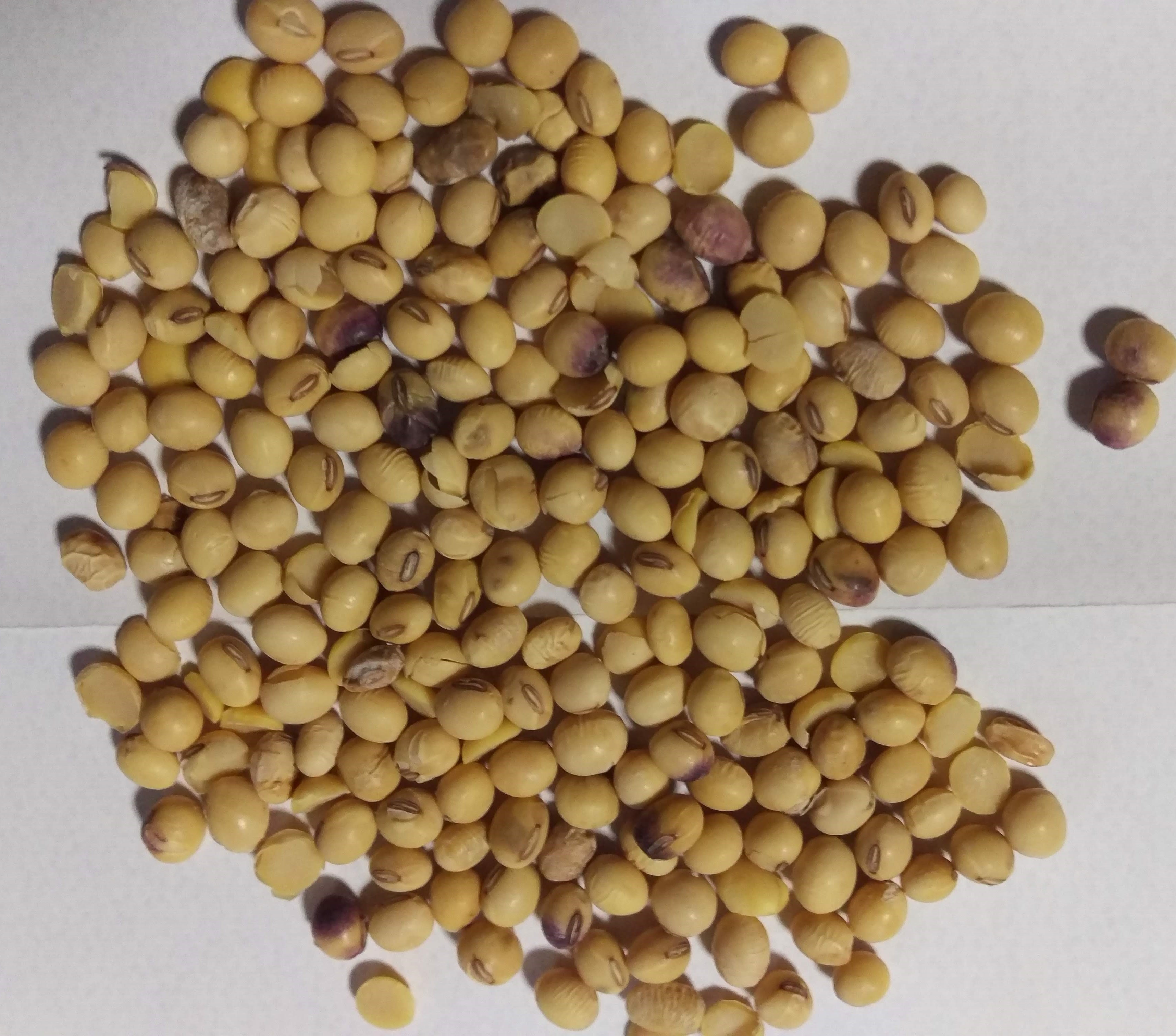
Soybeans showing discoloration from purple seed stain, Phomopsis seed decay, and potential stinkbug damage.
articles in this week’s CropWatch at http://cropwatch.unl.edu that may be of interest. One is about feeding soybeans to cattle. With reports of elevators rejecting soybean loads to the east of our area, we received questions if they could be fed. The Cercospora fungus causing purple seed stain and the Phomopsis fungus causing seed decay do not produce mycotoxins. We’re not aware of any soybean mycotoxins. We also don’t know how these fungi affect soybean seed quality regarding the feed value. So, we recommend testing for that if you’re interested in doing this.
Another article is by Cory Walters, UNL Ag Economist talking about crop insurance help with various dockage that one may have received. This fall’s weather could trigger indemnity payments due to low quality. This is just a short excerpt of his article. He writes, “The following discussion describes how crop insurance adjusts soybean yield due to quality for a particular county. While I have not found any differences in discount factors among counties, it is possible. The final outcome depends upon what the county actuarial documents stipulate. Discount rules contain quite a few if/then statements, so final outcomes will depend upon the particular production characteristics.
…Final yield is determined by multiplying the harvest yield by one minus the sum of all discount factors. Factors for each discount type are summarized as follows:
- A sample grade outcome results in a 3% discount factor so no discount factors for any other grade.
- For test weight, discount factors start at 48 to 48.99 lb with a discount factor of 0.7% that increases to a 1.5% discount factor with a 44 to 44.99 test weight. Test weights lower than 44 are settled through the other category.
- Damage discounts start at 8.01% with a 4.4% discount factor that increase to a 25.2% discount factor with a 34.01% to 35% damage. Just like with test weight, damage over 35% are settled through the other category. Damage includes everything except heat.
- Odor sample grade discounts are 2% for musty odor, 2% for sour odor, and 4% for commercially objectionable foreign odor (COFO).
For example, suppose your harvest soybean sample comes back as grade 4 with a 48.5 lb test weight and 9.4% damage. The field yielded 50 bu/ac. Yield would be reduced by 5.9% from the summation of 0.7% (test weight discount) + 5.2% (damage discount). Final yield would equal 47.05 bu/ac (50 x (1-.007-.052)). An indemnity will be paid if harvest revenue is less than guaranteed, which will vary among producers with different insurance products, coverage levels, and APHs.
Producers with multiple insurable units, likely coming from optional or basic units, should contact their insurance agent to determine the process for keeping samples of each unit. This is very important when soybeans are going to the bin. Quality discounts found here will likely not cover the entire price deduction found at the elevator. While this is unfortunate, some coverage is better than none. It is possible to get discount factors updated and/or modified for upcoming insurance contracts.” For questions and comments please contact Cory Walters at cwalters7@unl.edu and view the entire article in this week’s CropWatch.
Fall Burndown Apps is something we recommend, particularly if you have a problem with marestail or winter annuals like henbit in your fields. Nebraska data has shown over 60% of marestail germinates in the fall. Amit Jhala, Extension Weed Scientist shared an article in this week’s CropWatch. The following is a small excerpt, “Preliminary data for eastern Nebraska suggests that a fall burndown applied with a residual herbicide may eliminate the need for an early spring burndown for marestail control; however, this would not replace an at-planting residual application for management of additional troublesome weed species such as waterhemp and Palmer amaranth. For successful marestail management in the fall, apply herbicides following harvest while weather conditions remain favorable (air temperature above 50°F).
- Glyphosate-resistant marestail is widespread across eastern Nebraska, thus 1 lb a.e. 2,4-D per acre is recommended as the base treatment for marestail burndown.
- Glyphosate or other products such as Sharpen® or Gramoxone® may be tank-mixed with 2,4-D to provide broader spectrum control of winter annuals and certain perennial weeds.
- We generally do not recommend including residual herbicides in fall applications since they provide little benefit in managing weeds that emerge the following spring; however, if infestation of marestail is high in the field and the field has a history of marestail seedbank, it would be advantageous to add a residual herbicide such as Authority® or Valor® or Autumn™ Super, or other metribuzin products.
- Refer to the most recent Guide for Weed, Disease, and Insect Management in Nebraska for more herbicide options.
Fall herbicide application is unlikely to eliminate the need for burndown application at planting. Weeds adapted to cool temperatures, such as marestail, are likely to emerge prior to planting, making it necessary to control them.” He also shows photos in this Week’s CropWatch article of fall tillage or use of rye cover crop as additional options for reducing/suppressing marestail and other winter annual weeds.
JenREES 10-21-18
Grateful for beautiful weather and harvest progressing again! We got the York County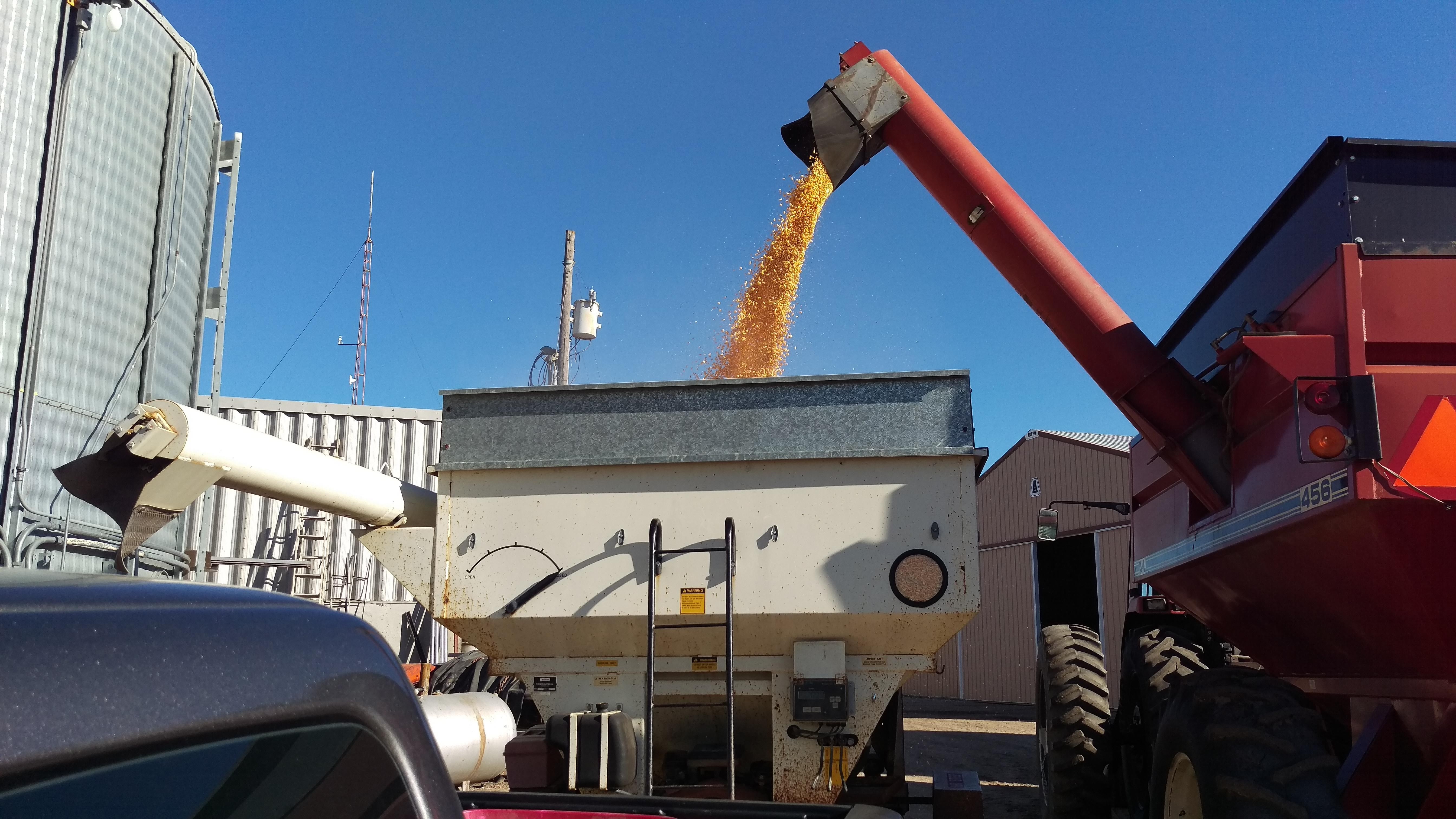 Corn Grower Plot out on Friday and special thank you to Ron and Brad Makovicka for their work and dedication to that effort! I will share the official plot results next week. The York County Corn Grower Banquet will be held on Thursday, November 15 at Chances ‘R in York with social time at 6:30 p.m. and meal at 7:00 p.m. Tickets are only $10 per person for a wonderful meal! Tickets can be obtained from any of the local directors or from the York County Extension Office at (402) 362-5508.Nate Blum from Nebraska LEAD Class 36 will give a presentation on his international tour and there will also be updates from Local, State, and National Corn Directors. For those who estimated yields during the plot tour, you need to be present in order to win the Yeti cooler.
Corn Yields: There’s an interesting article in this week’s CropWatch at http://cropwatch.unl.edu regarding final yield forecasts. Interesting to me are the box plots showing the range of ’30 year average’ vegetative and reproductive stages vs. 2018. The high heat in June shortened the vegetative time-frame. However, the silking through grain fill period was relatively typical for most locations and the long grain fill period with lower temperatures allowed for the better yields we’re experiencing (where drought and late-season hail wasn’t a factor).
Soybean Harvest Losses: Four soybeans in one square foot equals 1 bu/ac harvest loss. Various publications show how to determine harvest losses in areas of 10 to 25 sq. feet. For those with the SoyCorn Pocket Field Guide, page 78 shows estimating loss based on combine header width: http://nebraskasoybeans.org/wp-content/uploads/2017/02/SoyCorn-Field-Guide.pdf.
Evergreen Trees: Some evergreen needles are also changing color right now. It is good to look at your trees to determine the cause of the needle color changes. Evergreen trees actually go through a natural needle drop process with some years resulting in more thinning than others. I think this year may be one of those years as stress events can make needle drop heavier. Needle drop appears as needles turning yellow and falling from the tree. Pine trees may keep their needles for 2-3 or more years while spruce keep theirs for 5-7 years before needle drop occurs. Natural needle drop tends to appear along the main trunk and inside needles of the tree.
I also check for the presence of fungal disease. If the pine tree needles have dark spots/bands on them, it may be a fungal disease like dothistroma needle blight (on Ponderosa and Austrian pines) or brown spot (on scotch pines). The fungi actually kill the needles both directions from the location of the infection. With our heavy rains and high periods of humidity, I’m seeing increased fungal disease in evergreen trees this year. Fungicides applied in mid-May and again in mid to late June can help prevent this.
Pine wilt disease occurs in Scotch and Austrian pines. It’s caused by a bark beetle that has nematodes in its gut. The nematodes are native to Nebraska but Scotch and Austrian pines are not. Ponderosa pines aren’t affected because they’re native to Nebraska. The beetle ‘vomits’ the nematodes into the xylem (water-carrying vessels of the tree). The tree senses the presence of the nematodes and shuts down water to various branches as a way to prevent the nematodes from attacking. Thus why one sees a major branch then side of a tree turning gray-green then yellow-brown. Unfortunately, the entire tree will die typically within 3-9 months. Some farmers have tried trunk injections and drenches around their trees in hopes of saving them, to no avail.
On spruce trees, I’m seeing yellow/purple/browning of needles. This often is due to a fungal disease called rhizosphaera needle cast. One way to determine if this is the culprit is to look for tiny black dots on the gray twigs next to affected needles. The black dots are actually fungal structures that allow for infection to occur. Fungicide applied in May and after heavy rains can help. I always intend to spray my spruce tree each May but have failed to get it done the past several years. With recent rains, I’m trying it this fall to see if it can help; will let you know!
There have been several calls about arborvitae rapidly turning brown and I’m seeing evidence of heavy spidermite pressure at one time. Spruce spidermites affect spruce, juniper, arborvitae, etc. The rains and snow washed them off, which is one way to manage them. Evidence can be stippling (tiny yellow-green dots on needles) and also using a magnifying glass, one may see some webbing on undersides of needles. One can also just bang the needles on a white piece of paper to see if any mites are still active. Mites are most active in the cooler times of the season…so August through October in this case. Great resources for additional information include: Diseases of Evergreen Trees and Insect Pests of Evergreen Trees which can be obtained here: https://nfs.unl.edu/publications.

The dark spots/bands observed on these needles are indicative of fungal disease (dothistroma needle blight on Austrian and Ponderosa pines) and (brown spot on Scotch pines). The fungus kills the needle both directions from where infection occurs creating needles that are often part green to yellow-brown eventually becoming yellow-brown.
JenREES 10-7-18
Grateful for the crops that have been harvested thus far! Also grateful for so many paying attention to grain quality coming out of the fields! That’s been a large part of the past 10 days for me…obtaining grain samples and pictures to answer grain quality questions from quite an area. So I did a quick literature review to better understand the conditions when various ear rot fungi grow and also put together a blog post to hopefully help all of us better diagnose what we’re seeing in grain samples-whether corn or soybean. You can find it at: https://jenreesources.com/2018/10/08/grain-observations/.
Fungal growth in storage is based on moisture, humidity, and temperature. I’ve heard various numbers being used for grain storage and I’m not a grain storage expert. I can also appreciate it costs you more and takes time with the current weather conditions to dry corn. In general, most Extension publications throughout the U.S. recommend getting grain dried to 15% as quickly as possible and maintaining grain in long-term storage at 13%. Briefly, in looking through the literature, the reason for this advice is because various ear rot fungi can continue to grow on and inside those kernels. There’s over 25 species of ear rot fungi with most of them ceasing growth at 15%. The main exception is Aspergillus which has species that can continue from just below 13 to above 14%. Thankfully we don’t have a problem with Aspergillus this year. We are seeing a lot of Fusarium and some Gibberella (which may increase with this rain). But we’re also seeing some Diplodia and other lesser ear rot fungi such as Penicillium, Cladosporium, and Nigrospora. The thing is that each fungal species has a temperature and moisture range in which they continue to grow. So if one is growing in a kernel, it gives off heat and moisture allowing for changes in temperature, humidity, and moisture within that area which can allow for other fungal species to grow. Fungi grow from one infected kernel to adjacent kernels. Having more ‘fines’, cob pieces, etc. can increase potential for fungal growth in the bin. Insects also give off heat which changes localized dynamics. Because of these reasons, our recommendation is to get grain dried to 15% as quickly as possible to help stop fungal growth we’re experiencing this year, particularly from Fusarium species. We’re not saying you need to get the grain dried to 13% immediately. It’s only a consideration down the road if you’re storing the grain till next summer. The following NebGuide is a great resource: Management of In-Bin Natural Air Grain Drying Systems to Minimize Energy Costs: http://extensionpublications.unl.edu/assets/pdf/ec710.pdf. Our grain storage resource page can be found at: https://cropwatch.unl.edu/grain-storage-management.
Also, there’s a new app called “Mycotoxins” and it’s another resource with ear rot pictures and mycotoxin information put out by several Universities produced for both Apple and Android devices.
Farm/Ranch Transition When You Aren’t in Control Nov. 14 York: Passing the farm/ranch on to the next generation is a tough job, especially if the next generation is unsure of what will happen when their parents pass. It is especially for those people, who are wondering what is going on, that a series of farm and ranch transition workshops are planned at Valentine, Ainsworth, O’Neill, Norfolk and York from Oct. 23 to Nov. 14.
The workshops will focus on the needs of the “sandwich generation” between parents who still own land and children who might want to join the operation, on whom farm/ranch transition and transfer often falls. Lack of communication often hinders transitions. The Gen2, or Sandwich Generation, will learn how to communicate with family to understand the transition and practice asking difficult questions.
Legal topics presented at the workshops will center around Gen2 needs, including elements of a good business entity, levels of layers for on-farm heirs control and access, and turning agreements into effective written leases. Joe Hawbaker, estate planning attorney, and Allan Vyhnalek, Nebraska Extension transition specialist, will share stories and experiences to successfully plan on the legal side. Dave Goeller, financial and transition specialist, will cover financial considerations, retirement, and compensation versus contribution.
Many families struggle to split assets fairly between on-ranch and off-ranch heirs, while continuing the ranch as a business. Goeller will discuss the family side and what to consider when dividing assets. Vyhnalek will also cover less-than-ideal situations, negotiating, and looking for other business options. The times are 9 a.m.-4:30 p.m. at each location. The closest location to this area is November 14 in York at the 4-H Building. Cost is $20 per person. If more than two people are attending per operation, the cost is $15/person. Pre-register at (402) 362-5508 or jrees2@unl.edu for meal count.
Funding for this project was provided by the North Central Extension Risk Management Education Center, the USDA National Institute of Food and Agriculture Award Number 2015-49200-24226.
JenREES 9-30-18
Crop Update: In some ways it’s felt like a strange harvest season with how much of the area crop was harvested early due to storm damage and drought, but that’s also a blessing. It’s also been a blessing to have had surprisingly good test weights from some of the hail damaged corn and low mold damage reported thus far. There’s still a lot of harvest to go and I think stalk and ear rots are on the minds of us all.


I’ve been seeing more ‘less common’ ear rots this year and starting to receive questions on them. These include Nigrospora ear/cob rot, Cladosporium rot, and Trichoderma rot. These are caused by weaker fungi feeding on ears of plants that were stressed or killed prematurely. So hybrids that had problems with anthracnose top dieback, top leaf death, root rot issues, shortened husks with exposed ear tips, and hail/wind damage may have more problems with these diseases. Symptoms include when the cob feels rotted or falls apart when you break an ear in half. With Nigrospora, the kernels often have black spores on them and the spores can also be noticed on the cob pith as well. With Cladosporium and Trichoderma, the spores appear more green in color. None of the fungi causing these diseases have a mycotoxin associated with them, which is good. The diseases can create lighter test-weight ears and can create more chaff and dust during harvest due to the cobs falling apart. In storage, the biggest problems would be the fines, broken cobs, and extra chaff; keeping the grain below 15% moisture will stop fungal growth.
I’ve also had people asking for more specifics on conducting the pinch test to determine percent stalk rot in the field. Sometimes it’s easier to visualize this versus me keep writing about it. Thus, I created a very short video this week to hopefully help. One note is as you do this pinch test, the stalks may not completely crush, but a stalk with rot has a definite ‘give’ to it. You can view the video at: https://www.youtube.com/watch?v=7z75VN1c51Q.
For those who left hail-damaged soybean standing in fields with yields less than 5 bu/ac, some have asked about grazing those acres. For whole fields, we were recommending seeding a cereal into them (like rye at this point) just to offset the fat content of any remaining beans and provide some cover on the ground. That’s still a possibility for those interested in doing this. Some have also asked about grazing the soybean acres adjacent to seed corn residue without adding in a cover crop. That could be an option too and we don’t anticipate problems with that situation. When grazing seed corn or corn residue in any fields, it will be important to determine amount of ear loss on the ground prior to grazing. A way to do this is to measure off 100 feet and count the number of ears you find within that distance; do this 3 times throughout the field (for a total of 300 feet). Add the total number of ears found in 300 feet. Then, assuming each ear is about 0.5 bu, multiply the total number of ears by 0.5 to determine the average bushels on the ground in the field. Normal grazing management can be used if the total is 10 bu/ac or less on the ground. If more than that, different management needs to be considered and the following is a good resource for those considerations: https://go.unl.edu/8j4n.
For those asking about wheat varieties for Eastern Nebraska, the following resource may be of benefit to you at: https://cropwatch.unl.edu/2018/winter-wheat-varieties-eastern-nebraska-fit.
Also, Aaron Berger, Nebraska Extension Educator who conducts podcasts for the UNL Beef website, recently interviewed Chad Dane, a Clay County farmer. You can hear this podcast on “A Row Crop Farmer’s Perspective on Cover Crops and Cattle Grazing” at: http://s3-us-west-2.amazonaws.com/unlbeefwatch/2018/Sep_2018_Chad_Dane.mp3.
JenREES 9-23-18
It was great seeing harvest progressing this week and a challenge to stay ahead of harvest notes with on-farm research plots coming out! With the craziness of this week, I didn’t get a CropWatch article written on rapid drydown of corn and soybean. However, there’s a really good resource on this topic from Bob Nielsen at Purdue and you can find it here: https://www.agry.purdue.edu/ext/corn/news/timeless/graindrying.html.


Purple Seed Stain: I meant to write about this last week as I was finding it in fields pre-harvest. So far I’ve seen or heard it to be mainly in mid-group 2 bean varieties. During early to late seed fill, you may have noticed some reddish/bronzing color on soybean leaves. This can be due to Cercospora Blight in soybean. The disease is also characterized by leaf drop while petioles remain. However, while the same fungus causes both Cercospora Blight and Purple Seed Stain, there’s no clear association as to how much seed stain will be observed if the leaf blight also occurred. The fungus, Cercospora kikuchii, is related to the fungi causing gray leaf spot in corn and frogeye leaf spot in soybean. Thus, humidity, leaf wetness, rain, and the cloudy conditions experienced in August and early September allowed for Cercospora species in general to increase late this past year. Purple seed stain symptoms appear as pink or purple specks or splotches occurring on the soybean seed. I haven’t heard of enough seed symptoms in loads to affect docking, but it could happen if fields were affected severely enough. There are resistant varieties to Cercopsora blight but no known resistance for purple seed stain. The fungus is seed transmitted, so seed infected with purple seed stain should be treated with a fungicide seed treatment if used for seed.
Soybean problems: Diaporthe/Phomopsis complex may be the explanation for those of you who had patches of fields turn brown/gray and die early with pods appearing flat and seeds shrunken/moldy. That’s not to say there hasn’t been other problems such as anthracnose, phytophthora, and some sudden death syndrome as well. Keeping a few stems and sending them into a diagnostic lab is the best way to tell. The Diaporthe/Phomopsis complex includes a number of diseases including Pod and Stem Blight, Stem Canker, and Phomopsis Seed Decay. Infections can occur at any time on the plants, but infection increases with warm/humid weather close to maturity (as we experienced this year), wet weather during harvest increases pod infection, and high winds/hail/and other events that allow entry-way for pathogens into the plant.
Wheat: It’s been great to receive questions the past few weeks on planting wheat! For those seeking resources, my colleague Nathan Mueller in Dodge County has dedicated a section of his web page (http://croptechcafe.org/winterwheat/) to growing wheat in Eastern NE including an email listserv that shares new information. There was also an edition of UNL CropWatch devoted to winter wheat information here: https://cropwatch.unl.edu/2018/august-31-2018. Key points I emphasize for wheat include: killing out volunteer wheat at least 2 weeks prior to planting new wheat, treating wheat with fungicide seed treatment, and ensuring proper seeding depth by ensuring enough weight on the seeder particularly when no-till planting into residue.
I realize the economics for one year don’t look great for wheat. However, looking at the bigger picture, what is that wheat crop allowing in adding additional time for a forage or cover crop, breaking pest cycles, and giving you an additional 2-3 months time before needing to apply herbicides for weeds like palmer amaranth? And, what is it providing in residue for the following year to help reduce the number of weeds you see? The following comes from an article Nathan wrote on his website. There’s many benefits for adding wheat in rotation and perhaps it’s something you wish to consider this year! “Adding wheat to your eastern Nebraska cropping system can offer many other benefits:
- Additional revenue in utilizing or selling the straw
- Added profit by growing more late summer and early fall forage crops
- Ability to more effectively incorporate cover crops
- Selling grain at elevators with good basis, for example wheat often is 10 cents above futures in Fremont
- Reducing herbicide cost for troublesome weeds like marestail, waterhemp, and Palmer amaranth, in short, disrupting weed cycles
- Higher soybean yields in 3-yr rotation due to reduction in pest pressure
- Potential reduction in yield loss from compaction by not driving on wetter soils during manure application in the fall and spring.
- Opportunity to contract with feedlots for manure application in the summer months
- Reduce soil erosion and nutrient loss during high risk months of April-May-June.
- Improved soil health, soil structure, and infiltration may provide long-term profitability
- Reduced labor cost through better distribution of workload on the farm.
- Possible higher cost share for conservation work during the months of July, August, September.
- Possible higher USDA CSP ranking score for planting winter wheat resulting in additional revenue
- During periods of dry years, dryland corn yield boost the following year.
- Demonstrated local success at obtaining high yields (100 bushel/ac)”
Early Leaf Drop: The rain and humidity increased our fungal diseases in shade trees and we’re seeing early leaf drop in some species as a result. In particular, I’ve received calls and looked at ash, maples, lindens, crabapples, and flowering pears. Early leaf drop also may be due to the environmental swings we experienced this year from rain and cooler temps to hot, dry conditions. We don’t recommend homeowners do anything about this and it shouldn’t impact the long-term health of the tree.


 JenResources