JenREES 5/7/23

It’s been a great week of planting weather regarding warmer days and soil temps! There were even a couple beautiful calm days! Thanks to those of you who filled out my quick survey last week. The results of 36 respondents showed in 2023: 17 planted corn first, 8 planted soybean first, 5 planted corn and soybean at the same time, and 6 hadn’t planted yet. So, the survey did informally show that 13 of the 36 people who responded plant soybeans earlier or at the same time as corn. The CropWatch article I was mentioning was released last Friday if you’re curious regarding the data behind some of the key points I stated last week: https://go.unl.edu/gqt3.
For this week’s article, will share answers to a number of questions I’ve received the past few weeks.
Pesticide cards: This has been my daily top question as producers are needing certification to purchase and pick up restricted use pesticides. For those who attended ANY in-person or online Extension training, you must pay the $25 fee to NDA that comes as a bill in the form of a postcard in order to receive your license. If you didn’t receive a postcard or misplaced it, the quickest way to pay the $25 fee via credit card is to call NDA at (402) 471-2351. This number gets you to the switchboard. Say that you need to pay your $25 fee to get your license and they will connect you with the NDA plant protection office. You will need to say your name, address, birth date, when you took the training and where, and may need to confirm your applicator number (unless you are new). You will then get your card and be listed in the ‘certified’ database that anyone can look up.
For those calling who still needing training, your only option is the online training and please read the directions mentioned once you register at this site: https://go.unl.edu/4tzw. There’s a test out option where you can take the test before going through any modules. If you pass, you’re done and NDA will send you your postcard bill. If you don’t pass, it will then let you take the modules and retest as many times as needed. Please call the UNL pesticide office with questions: 800-627-7216.
Drought Assistance Webinar: If you missed it, here’s the USDA Drought Assistance Webinar recording for Nebraska: https://go.unl.edu/ba8f.
Lawn/Garden Resources:
- Fertilizers for Vegetables in Home Gardens (most garden soil tests I’ve seen in this part of State show minimal need for fertilizer!): https://extensionpublications.unl.edu/assets/pdf/g945.pdf
- Simplifying Soil Test Interpretations for Turf (Here’s a great NebGuide resource that’s very visual and shares Nebraska recommendations): https://turf.unl.edu/NebGuides/g2265.pdf.
- With soil temps over 50F for several days and this week’s temps continuing to be warm, for those who’ve asked, it’s time to get crabgrass preventer on lawns.
For those who planted new or overseeded Kentucky bluegrass or tall fescue grass this spring, I’m getting questions about what to do to prevent crabgrass. There is a product from Scotts called “Scotts Turf Builder Triple Action Built for Seeding” (blue bag) that’s supposed to be safe. It contains fertilizer and herbicide claiming to prevent crabgrass and dandelions for up to 6 weeks. Not an endorsement, just sharing an option. I hadn’t chosen to use it in past years because I knew the lawn would look interesting with white patches in the green, but decided to try it this year so I could see how well it worked for future questions. It contains mesotrione (a herbicide that is a pigment inhibitor, so it will turn your newly emerged weeds white). It gets reactivated with water. My lawn doesn’t have an irrigation system and gets watered sporadically, so I’m unsure if it would look better or worse with irrigation. So far, the dandelions are turning white and my lawn is thickening up. A person may need another crabgrass preventer product after 6 weeks, depending on how the lawn thickens, to catch the late flush that often appears.
JenREES 4/30/23
Corn and Soybean Planting Periods: The flowers/trees have been beautiful in the midst of a cool, dry, windy spring. I’ve been thinking about planting windows a lot. Appreciate all who have communicated thoughts on planting. From these conversations, I feel there’s been a shift in thinking, at least for this part of the state, with more paying attention to cold snap windows. Also been a shift to planting soybeans earlier or at the same time as corn. But to show whether that’s true or not, can you please help me with a quick one question visual survey on planting: https://app.sli.do/event/eV5gr4ioSZiSQKabEwRheB? It’s not letting me embed it, so you’ll have to click the link.
From what I’m hearing, planting progress ranges. Some are completely done, some are done with one crop or the other; many will finish this week. Others (mostly non-irrigated) are just starting this week. Some are concerned about May planting and yield loss. The rest of this info. mostly pertains to corn with encouragement that data has shown corn yields not to drop off till after mid-May planting dates. The article links provide the hard data.
Dr. Jim Specht, Professor Emeritus of UNL Agronomy and Horticulture, put together an article we will hopefully release in CropWatch this week. He was using NASS Nebraska Corn and Soybean 50% planting progress in comparison with NASS reported yields. Two key findings based on 43 years of data are:
- Delays in the Nebraska corn 50% progress date that occur within the May 2 – 12 planting period do not have an appreciable impact on resultant corn yield.
- The Nebraska soybean 50% progress date has advanced by eight days from a 43-year mean of May 22 to an expected May 14 date for the 2023 season.
Dr. Roger Elmore, also an Emeritus Professor of UNL Agronomy and Horticulture, had shared a similar sentiment in a 2019 CropWatch article where he shared about planting windows for corn using UNL research and NASS data. He shared, “A planting window exists within which (corn) yields do not vary tremendously. That window starts to close after mid-May. Many factors in addition to planting date influence final yields. There is always a chance that late-planted corn may out-yield early-planted corn.” Dr. Bob Nielsen, Emeritus professor at Purdue University shares similar key points for corn in an article, “Early planting favors higher yields, but does not guarantee higher (corn) yields. Statewide averages for planting progress and yield are not strongly related. Planting date is but one of many yield influencing factors.”
Alfalfa Weevils: I haven’t checked alfalfa fields yet, but had been watching comments down in Kansas. Alfalfa weevil larvae had hatched in southern Nebraska and also at the research station near Mead. In spite of planting, be sure to monitor alfalfa fields.
Dr. Bob Wright, Extension entomologist, and colleagues share the following in a recent CropWatch article. “The larvae of alfalfa weevils feed on first cutting alfalfa as larvae, and adults (and sometimes larvae) feed on the regrowth after the first cutting. In the Panhandle and in the northern tier of counties, there may be two flushes of weevil larvae this spring, leading to regrowth damage after the first cutting. Observations indicate the cause may be due to significant survival of both adult and larval weevils.”
It basically takes 1-2 alfalfa weevil larvae per stem to reach the economic threshold with today’s alfalfa prices. Take 10 stems from an area of the field, cut at ground level and hit them on the inside of a bucket. Count the number of weevil larvae present (also make sure to unfurl the bud leaves as some stay trapped in there). Depending on how close you are to harvest, one can choose to not treat and just harvest the alfalfa field while watching the green up for potential need to treat then, or treat prior to taking first cutting if harvest is still a ways off and economic thresholds are met. Insecticides for alfalfa weevil control include those that are pyrethroids (active ingredient ends in “thrin”) and products containing indoxacarb (e.g., Steward).
JenREES 4/16/23

The April 12, 2023 Nebraska Drought Monitor shows 98% of Nebraska in moderate to exceptional drought (D1-D4). We will keep praying rain; it will rain again one day! There’s truly concern about the dry conditions due to lack of subsoil moisture. Those planting last week shared how conditions were changing with the winds making surface soil hard. A few colleagues and I put together the following info. about planting into dry conditions in CropWatch that I will share this week.
I didn’t talk about planting deeper last week, but for those asking, Bob Nielsen, emeritus professor at Purdue said corn can be seeded 2.5-3” deep if that’s where uniform soil moisture is located in order to achieve uniform germination and emergence. We don’t recommend planting soybean deeper than 2.5”.
In general, we would only suggest watering before planting if the planter needs higher soil moisture levels to work well. So, if the soil is too hard, too powdery or cloddy, it may be worth running the pivot. Another situation to consider pre-watering is if greater than 180 lb/ac anhydrous ammonia was applied in a strip with less than two inches of moisture received since application to help reduce ammonia burn to the corn. Otherwise, our recommendation is to run the pivot after you plant if needed.
The usual recommendation is not to run a pivot when temperatures are below 40 degrees. Last year, several pivots were operated below 40 degrees without problem, but keep in mind with low dewpoints the pivot can ice up when the actual air temperature is well above 32. So, if you do choose to run in these conditions, keep a close eye out for ice buildup, which can collapse the pivot.
Bare, powdery soils will seal over very easily from rain or irrigation, so keep an eye out for runoff problems even with fairly low application amounts. And make sure if you do irrigate that you put on enough to get water down to the moist soil below. This is particularly a problem with tillage or where fertilizer knives have been used and dried the soil out.
It’s important that herbicides are activated with 0.5- to 0.75-inch of rainfall or irrigation, preferentially within five to seven days after herbicide application. If moisture received is less than this amount, some herbicide products have the potential to remain on the soil for up to 14 days without being fully activated. We will have to see how the high winds blowing soil and removing soil particles containing herbicide impact future weed control.
For those who applied dry or liquid urea on the soil surface, particularly without the use of an inhibitor, irrigation of 0.5-inch can help with incorporating the urea into the soil and minimize urea loss. If irrigation is not available, an inhibitor was not used and no rainfall has been received within seven days, monitor the corn crop to determine if nitrogen deficiency occurs due to nitrogen loss.
John Mick, Pioneer agronomist, shared last year that water from irrigation wells in the southern part of the state often is around 50-53°F, with it slightly less in temperature as one moves north in the state. These temperatures are not a problem to be concerned with regarding any negative impacts to seeds imbibing water.
Lawns: For those struggling with lawn winterkill, Kelly Feehan shares, “Some lawns may come out of winter with dead areas in need of reseeding. While early September is the ideal time to seed Kentucky bluegrass and tall fescue, spring seeding success can be improved by seeding as soon as possible so seedlings establish roots before summers’ heat. Improve seed to soil contact by aerifying, power raking, and/or hand raking right before seeding. After seeding, a light raking will further mix the seed and soil. Water lightly and often to keep the seedbed moist. Mulch will help conserve water, but use lightly so at least 30 to 40% of soil is still visible through the mulch. Use low rates of fertilizer, about one-half to three-fourths pounds per 1000 square feet, applied every four to six weeks until mid-June; and keep the area well-watered all summer while avoiding overwatering which can lead to poor rooting and disease.” Also avoid crabgrass preventer to newly seeded areas.
Evaluating Wheat Stands handout by Nathan Mueller: https://croptechcafe.org/wp-content/uploads/2020/04/Evaluating-Winter-Wheat-Stands.pdf
JenREES 4/9/23
Each year is another opportunity to learn. The forecasted warmer temps for the coming week have many excited to be in the field. It feels so early for planting, yet I can appreciate the general warming trend for several days. My concern is when the low temps get back into the 30’s again. Seeking advice from multiple sources can be wise. It’s important to know your level of risk, crop insurance and replant options. It’s important to make wise decisions with the factors we can control during planting season as planting sets the stage for the rest of the year. So, some considerations:
1-Make sure your soil conditions are fit for planting. This can include the soil not being too wet to create sidewall compaction and getting the seed vee closed. I think the greater thing some will deal with is making sure there’s moisture where the seed is placed.
2-Along with the soil being fit is ensuring we’re getting the proper planting depth. With some moisture this winter, it appears we got more freeze/thaw action than last winter and the soil is more mellow. But that may not be true for all areas/fields. I recommend putting corn and soybeans in the ground at 2”. That may seem deep for beans but our UNL research found 1.75” seeding depth provided the highest yield for soybean. Proper seeding depth for corn is important for nodal root establishment. Proper seeding depth for soybean helps keep that seed in buffered soil moisture and temperature when planted early. It also aids that seedling from emerging too early. And, when planting, no matter what monitors say for seeding depth, I still recommend getting out and digging to make sure.
3-Another consideration is soil temp. Agronomically we’ve come a long way with genetics and seed treatments. Because of this, some don’t worry about soil temps. Yet every year I think most agronomists would say we can trace various problems back to a specific planting date(s) or planting window. So, I still feel they’re an important consideration.
I prefer removing one more stress off corn by putting it in the ground when soil temps will stay over 50F for 5-7 days, but realize that’s not always doable. And while we do share that early planting dates are the best way to increase soybean yield beyond genetics, our UNL and on-farm research for early vs. late planted soybeans was conducted with April planting dates of April 22 and later.
The consideration is for soil temps in the mid-40’s on a warming trend with no chance of a cold snap (cold rain/snow) within 8-24 hours for soybean and 48 hours for corn. The time-frame is due to the imbibition (critical water uptake) time-frame for corn and soybean. Soybean seed uptakes water more rapidly than corn and once the imbibition phase is complete, the soybean going through the osmotic phase can tolerate 35-40F soil temps as long as soil is not saturated. Soil temps for your field can be monitored by using a thermometer or checking out CropWatch soil temps at: https://cropwatch.unl.edu/soiltemperature.
4-For corn seeding rates, it’s best to check with your local seed dealer as all our research shows that optimal corn population varies by hybrid. However for soybean, our recommendation after 16 years of on-farm research studies (2006-2022) in heavier textured soils and 30″ rows continues to be: plant 120,000 seeds/acre, aim for a final plant stand of 100,000 plants/acre and you’ll save money without reducing yields. If that’s too scary, try reducing your rate to 140,000 seeds/acre or try testing it for yourself via on-farm research!
One final thought, make sure you’re keeping yourself and those in your operation safe by wearing proper PPE when handling treated seed. Seed tag labels will list PPE required for the seed treatments in case you weren’t aware of this. Here’s wishing you all the best whenever the planting season begins for your farm!
Hope you had a Blessed Easter!
Thoughts for 2023 Season

A week ago I was out east visiting family. Sunshiny daffodils were blooming in medians and we saw cherry blossoms and magnolias blooming at the National Arboretum in D.C. As I look in my backyard today, green leaves of tulips and daffodils are poking through. Rye, wheat, and lawns are greening up-the green this time of year is so stark in contrast to the brown. I’m so grateful to live in a place with seasons to see creation on display throughout the year!
March flew by and April is here. Another growing season will soon be upon us. I wasn’t mentally ready for another growing season. I’ve thought a lot about this and have heard this from others as well.
I knew I needed time in March to get my mind back into facing another one. I think of so many of you and there’s not been much break. Every spare moment of a ‘decent’ weather day this winter has been spent repairing/replacing pivots, buildings, bins, homes, or dealing with livestock.
I encourage us all to take some time to reflect on the blessings we’ve been given to work in agriculture, to be stewards of this land, and provide food for our families and the world. Reflecting on my purpose, “my why” for my Extension career and how blessed I am to get to serve many in this role, has reinvigorated my excitement for a new year. Perhaps reflect on “your why”? We have, we are, and will continue to face challenges as we aren’t in control of so much, especially the weather. But producers and those in ag careers are some of the most optimistic and resilient people I know. My hope is that we can all find some renewed joy and excitement for a new growing season!
Cover Crop Termination: For those who did plant small grains, the question of termination timing always comes up. The following are some thoughts to consider for planning. The temperature and year will determine how quickly a small grain will die.
- Termination timing considerations: https://jenreesources.com/2021/03/28/jenrees-3-28-21/.
- Photo gallery: https://jenreesources.com/2022/04/03/cover-crop-termination-including-planting-green/
- Can use only 20-22 oz/ac of Roundup Powermax (even when headed). Vetch + small grain: vetch will survive the Roundup application allowing it to produce more nitrogen. Can kill with post-app containing a Group 27 herbicide (like Callisto) later.
- Clethodim vs. glyphosate: clethodim provides a slower kill allowing the rye/wheat to stay greener longer for weed/erosion control. Benefit for farmers who need to terminate prior to corn or seed corn planting. Clethodim rates: most use 10-12 oz/ac. For corn, clethodim needs to be applied to the small grain to kill it at least 7 days prior to planting corn. For soybeans, can apply anytime after planting/emergence.
- When the small grain is greater than 12”, increase gallonage to 15-20 gal/ac for better coverage.
- When planting corn green into a small grain on subsurface drip irrigation (SDI), need the ability for higher capacity well to get moisture up to the seedbed. Potential yield loss otherwise.
- When planting soybeans green, the goal is often to off-set the PRE herbicide cost with the cover crop seed and application cost. A residual is necessary at some point either at time of termination or up to a week after termination when planting soybean green. Plan on 0.5-0.75″ irrigation/rainfall to get residual to the ground, especially on small grains taller than 12”.
- For those rolling small grains, roll twice if needed. And, plan on using a variety instead of VNS in future to help with evenness of maturity.
My key points for planting green include: plan on some form of nitrogen at planting if planting corn green into a small grain, have the pivot ready to go if need moisture for the seedbed, don’t use a PRE in soybean if can’t get seed vee closed, plan to water residual application as soon as label allows to get residual to ground, and if non-irrigated, consider seedbed moisture for termination timing. Have a Plan A, B, C.
JenREES 3/26/23
Happy Spring! Special thank you to all who helped make the Seward County Ag Banquet so successful! It’s a very special night celebrating agriculture, the farm family, farm business, and scholarship award winners! For this week’s column, I’ll share on a number of different resources.
Preliminary farm real estate numbers were released last week at: https://cap.unl.edu/realestate. All Center for Ag Profitability webinars can be found at: https://cap.unl.edu/webinars. Last week’s Virtual Landlord/Tenant Cash Rent workshop for Eastern and Western NE should be posted soon on that site.
Soil Temperatures can be found at: https://cropwatch.unl.edu/soiltemperature. This is helpful for knowing when to plant vegetables, when to plant crops, and what the soil temp is when applying fertilizer to fields. It’s also helpful for homeowners to wait to apply crabgrass preventer for lawns until soil temps are at least 50-55F for 5-7 days straight.
CropWatch at cropwatch.unl.edu is still our one-stop shop for all crop-related information from Nebraska Extension. In case you missed it, this week’s edition covered a number of nutrient-management related topics including a comparison showing the importance of residual soil nitrogen and the dollar savings for this year’s crop and calculating the value of nutrients in manure for crop fields.
On-Farm Research Results Book: PDF version can be viewed at: https://on-farm-research.unl.edu/results-pdfs/2022research-results.pdf. Different protocols can be viewed at: https://on-farm-research.unl.edu/protocols. You can also contact your local Extension educator directly to develop protocols that fit your needs.
Vegetable Planting Guide for the area can be found at: https://go.unl.edu/pgwk.
Gardening Workshop: Sarah Browning, Extension Educator, did a fabulous job at the Project Grow gardening workshop several weeks ago. Whether you were able to attend or not, the full slide presentation is posted at: https://www.upperbigblue.org/sites/default/files/images/Events/veg-gardening-handout.pdf. If you’re interested in gardening but don’t have room at your home, there is a community garden with Project Grow; please contact the UBBNRD if you’re interested in learning more.
Lawn Calendars:
- Kentucky Bluegrass Lawn Calendar: https://go.unl.edu/r7ay
- Tall Fescue Lawn Calendar: https://go.unl.edu/frkp
- Buffalograss Lawn Calendar: https://go.unl.edu/6xgu
Lawn Care: Kelly Feehan shares, “Lawn care that can be done in March or early April, once conditions allow, is removal of debris that collected over winter, raking leaves that were not removed last fall, and mowing. However, wait to mow until after turfgrass has started to grow. Some people mow dormant turf very low in hopes of stimulating growth. It is best to allow turfgrass to come out of dormancy on its own. If new growth has not started, there is no need to mow. Low mowing is usually not good for lawns. Ideally, leave turfgrass the same height all season. For Kentucky bluegrass and tall fescue, this is about three to three and a half inches. If you wish to mow low in spring, do not mow any lower than 2.5 inches. With some snow cover this year, vole damage may be seen. This damage appears as two-inch wide tracks in lawns where grass has been chewed close to the ground. These areas fill in once new growth begins and are not a concern.” Overseeding of thin turf areas can also be done now.
Ag Week 2023
Happy National Ag Week! What happens in ag impacts all Nebraskans as 1 in 4 Nebraska jobs are connected to ag. A strong ag economy (Nebraska ranks #1 in farm cash receipts of all commodities/capita) helps Nebraska’s overall economy. “In 2020, every dollar in agricultural exports generated $1.03 in economic activities such as transportation, financing, warehousing and production. Nebraska’s $7.1 billion in agricultural exports in 2020 translates into $7.4 billion in additional economic activity.” Also, 92% of Nebraska’s land is used for farming and ranching to grow the food, fiber, and fuel we rely on each day. The following are from Nebraska Dept. of Ag’s ‘Nebraska Ag Facts Brochure’: https://nda.nebraska.gov/publications/ne_ag_facts_brochure.pdf and 2023 Ag Facts card: https://nda.nebraska.gov/facts.pdf. Thank you to all who are involved ag-related careers! And, for youth, there’s numerous opportunities to pursue ag-related careers in the future!
#1: Nebraska’s largest ag sector is beef production with Nebraska leading the nation in commercial cattle slaughter. We moved up and are currently tied with Texas as #1 in all cattle on feed at 2.78 million. #2 in all cattle and calves, beef and veal exports, and commercial red meat production. Nebraska’s beef industry generates approximately $10.6 billion in annual cash receipts. With 6.8 million head of cattle, cattle outnumber people in Nebraska more than three to one.
#1: Nebraska ranks 1st in U.S. popcorn production with approximately 34% of the popcorn consumed in the U.S. produced in Nebraska. Nebraska also ranks 1st in Great Northern bean production, 2nd for pinto bean production and 4th in the nation for all dry edible bean production.
#2: Nebraska is #2 in ethanol production capacity. With 24 operating ethanol plants utilizing 32% of Nebraska’s corn crop as the main feedstock, Nebraska produces more than 2.5 billion gallons of renewable fuel annually. Distillers grains, a co-product of ethanol production, is an important livestock feed. Nebraska is also #2 in bison production.
#3: Nebraska is #3 in corn exports and we fell to #4 in corn production (perhaps another result of 2022 storms). Today’s corn farmers grow 87% more corn per ounce of fertilizer than they did 30 years ago.
#4-7: Nebraska is ranked #4 in dry edible pea production. We rank 5th in soybean exports and we fell to 6th in soybean production. We also rank 5th in grain sorghum production and 5th in the nation for production of sugar beets, with half of U.S. sugar production coming from sugar beets. Nebraska is 6th for all hogs and pigs on farms and in commercial hog slaughter. Nebraska ranks 7th in alfalfa hay production.
Nebraska is the 14th largest wheat producing state; one bushel of wheat weighs 60 lbs on average and can make 64 loaves of bread. We are ranked 8th for organic cropland acres and 8th for all hay production.
I’m unsure of avian influenza’s impact on these numbers in 2022: Nebraska has approximately 9.1 million birds populating Nebraska’s commercial laying facilities producing more than 2.6 billion eggs/year. Nebraska ranks 25th in total milk production from dairy cattle. There are around 78,000 sheep and lambs raised in Nebraska and Nebraska is home to more than 24,000 meat goats and around 3,500 dairy goats.
There’s so much to be proud of regarding agriculture in Nebraska! Yet, ag increasingly is blamed for many problems. Every industry can improve. It’s times like this, like now, that I wish I could see more unity within ag. So often I hear divisions…divisions around tillage practices, use or not of cover crops, grass fed vs. grain fed, conventional vs. organic, direct vs. non-direct marketing, etc. Divisions impact our ability to provide united messages and solutions when attacked. These divisions also impact our consumers’ view of ag. I’m blessed with an incredible career to learn from all of you I serve…to learn why you each do what works for you and watch you adapt! We all observe each other’s operations as we drive around the countryside. Do we silently criticize or are we curious? How often do we actually have a conversation, seeking to understand why a neighboring farmer/livestock producer chooses a specific practice or marketing strategy? My encouragement to all of us, especially within ag, is to seek to understand, learn from, and encourage each other. Find common ground on the things that unite us so we can continue to produce food for our families, this nation, and the world in years to come. As we’re seeing throughout the world, we can’t take farming and food production for granted! May we seek to celebrate the opportunities we all in ag provide consumers: safe products and a choice of products at various price points consumers can purchase!
JenREES 3/12/23
Seward County Ag Banquet: The Kiwanis Club of Seward partnered with SCCDP and Seward Co. Ag. Society will honor Seward County Ag Leaders on Monday, March 20, 2023 with the 55th Annual Agriculture Recognition Banquet at the Ag Pavilion at the Seward Co. Fairgrounds. Social hour with wine, cheese, beer, and music will be at 5:30 p.m. with the prime rib meal and program to follow at 6:30 p.m. The cost to attend the banquet is $30.00 per person. Please contact Pam Moravec (402-643-7748) or Shelly Hansen (402-643-3636) to reserve your seat. The Kiwanis Club of Seward will use the proceeds from the event to support the youth of Seward County through a variety of programs and events.
Nitrogen Rate Studies: As growers consider pre-plant nitrogen applications this year, there’s opportunity to consider a variety of nitrogen rates to test any impacts on one’s own field(s). I covered the results of some area studies comparing rates of 50 lb N/ac nitrogen differences in an earlier article. One can easily test this for yourself in a field by either using field-length blocks as those studies did, or with the use of precision ag technologies, prescriptions can be written to try different N rate blocks that are smaller in scale (300’ long by 30’ or so wide). These blocks can then be repeated throughout areas of the field with different soil types and topography. I have an example at jenreesources.com of what this looked like from studies last year. Please let me know if you’re interested in testing this. The 2022 on-farm research results can be viewed at: https://onfarmresearch.unl.edu/.
Perennial cover crops: Several weeks ago, I shared our research on interseeding cover crops into early season corn and soybeans and said I’d share our next steps in a future column. One goal of the cooperators was to achieve a living cover that survived into the next growing season. When we saw that interseeded red clover established in soybeans and survived the following spring, we got excited about the possibility of more intentionally growing clovers as a perennial cover crop.
In March of 2022, six sites were dormant seeded with either Mammoth red clover (tall), Medium red clover, or Dutch white clover (low-growing, aggressive like clover in lawns). The clover eventually emerged at all the locations. All but two sites were lost due to the dry spring or June 14 hailstorms. Two sites in Clay County survived the June 7th hailstorm. The grower at those sites chose the Mammoth red clover. It was dormant seeded in March using a drill interseeder into cereal rye. The cereal rye was killed with 10 oz/ac clethodim prior to planting corn and after planting soybean. Once the clover had emerged and was at least 1” tall, Zidua was used in both the corn/clover and soybean/clover areas and was used again 3-4 weeks later. The check areas in the corn and soybean used the grower’s full herbicide program.
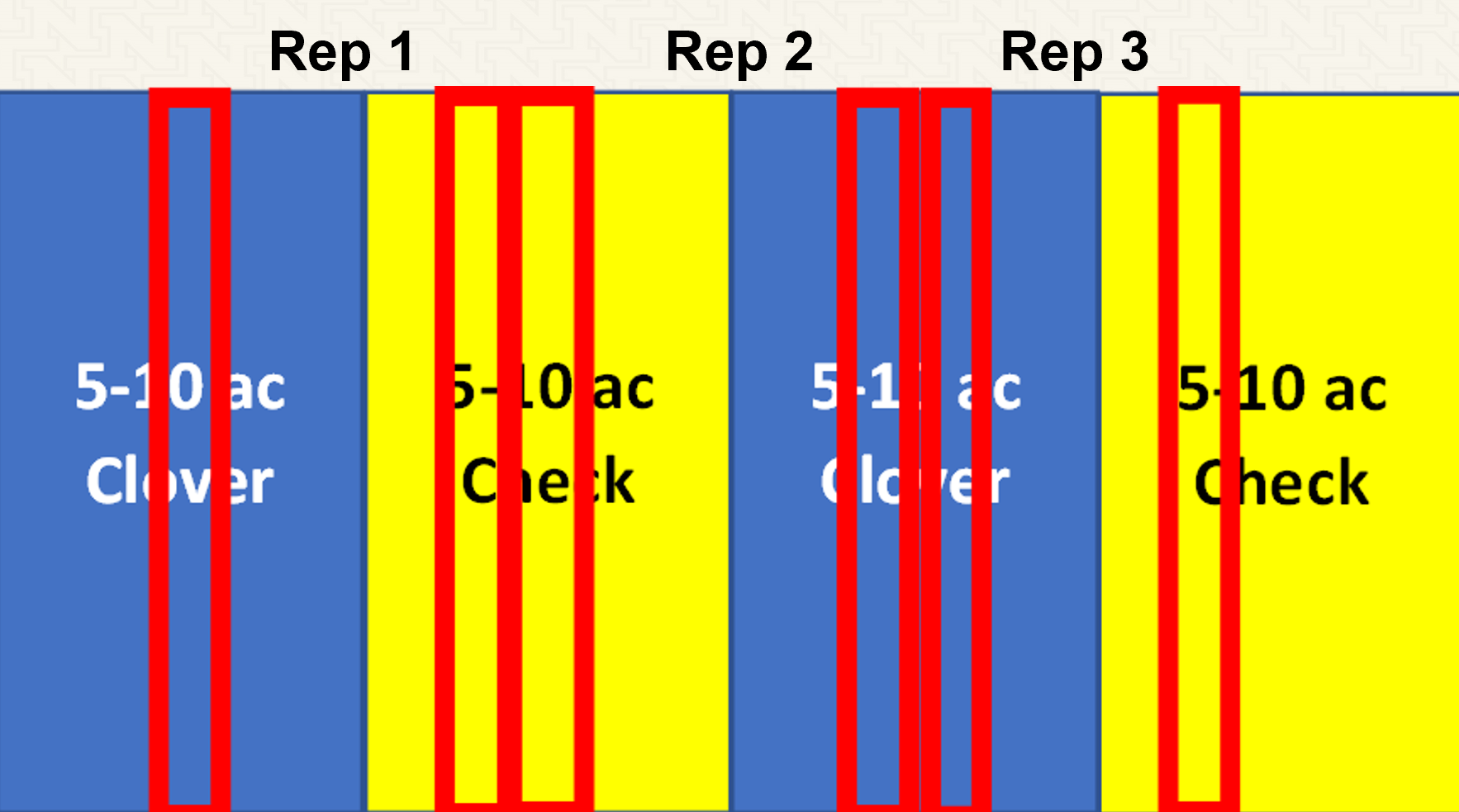
The clover provided excellent weed control in the corn. It had good weed control in the soybean with velvetleaf, sunflower, and lambsquarters being the predominant weed species. Biomass samples of the clover prior to harvest showed 30 lb N/ac available. Samples will be taken again this spring. The soybean without clover out-yielded the soybean with clover (74 bu/ac vs. 68 bu/ac). It also economically did better this first year. The ultimate goal is to get something living between the rows for reducing chemical and nitrogen inputs, providing a grazing benefit, and determining impacts to yields and economics over several years. We currently have 9 growers planning on some type of clover study in 2023. If anyone is interested, the easiest way to try this is just dormant seeding this March (can drill or broadcast) clover in 5+ acre blocks leaving a check block between the clover blocks and checks on either side. I will work with you on the combine passes to get the replications. This year the farmers are trying AberLasting clover (Dutch white X Kura), Dutch White + Medium Red, or Mammoth red clover. We also have a couple of growers trying AberLasting with either bluegrass or buffalograss. The simpler design being used by the growers is on my blog. This is a different way of thinking, in some ways going back to what our ancestors did only with today’s hybrids and varieties. These growers are desirous to find ways to reduce inputs on their own farms for the future. Please let me know if you’re interested in trying this too.


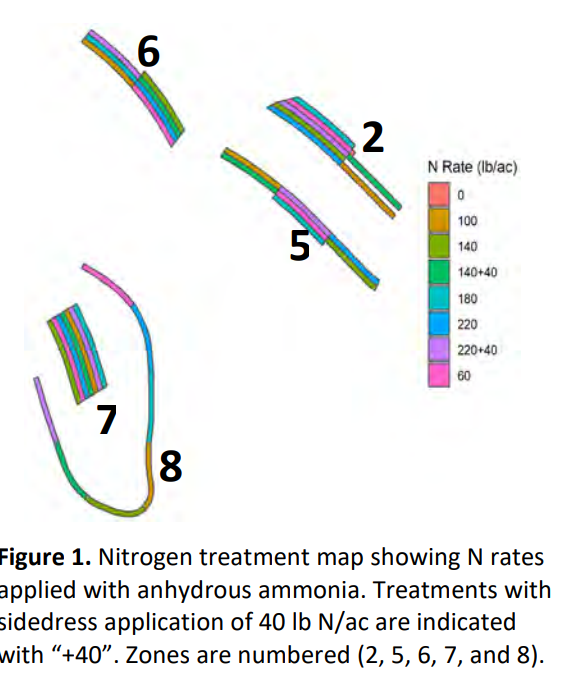
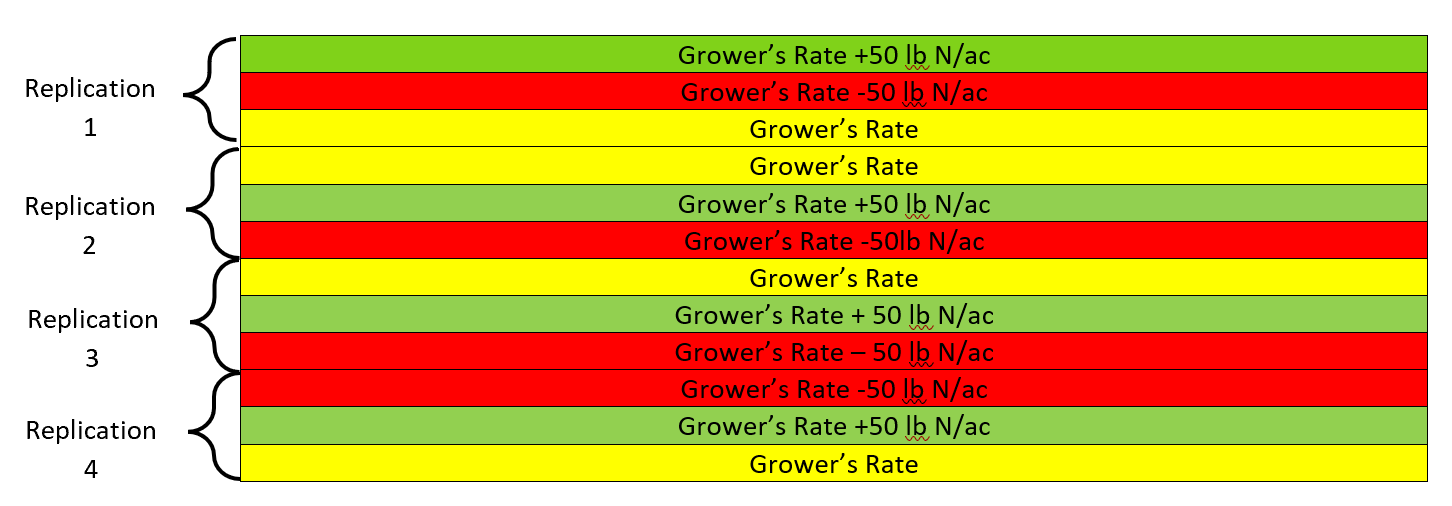
The above designs are just some ideas for doing nitrogen rate prescriptions by soil type/topography or field-length strips.


10 lb/ac Mammoth red clover was dormant drill seeded March 2022 into cereal rye. A shot of rain in the spring helped it get established. The grower felt it was more successful establishing the clover into old soybean ground prior to the corn crop. The cereal rye was terminated with clethodim around 10 days prior to corn planting. Once the clover was up 1″, Zidua was applied to the field (other Group 15 herbicides could be used instead). He used Zidua again 3-4 weeks later. The corn with the clover had excellent weed control as did his check treatment which used a full corn herbicide program. The clover got about 2.5′ tall and then laid down. We couldn’t take this study via on-farm research because two different hybrids were used across the clover/check area. He moved over with strip till rig in the fall and took out some of the clover, but quite a bit still remained. Soybeans will be planted in this field next year and the plan is to maintain the clover in the strips without needing to reseed anything.


10 lb/ac Mammoth red clover was dormant drill seeded into cereal rye in March 2022. A timely shot of rain helped with establishment. Soybeans were planted green into the field. The rye was then terminated with 10 oz/ac of clethodim and Zidua was applied when clover was at least 1″ tall (other Group 15 herbicides could be used instead). Zidua was applied again 3-4 weeks later. A June 7, 2022 hailstorm damaged the soybean and clover with the clover recovering faster than the soybean. The Mammoth red clover gets tall and it looked kind of interesting in September to see the soybeans holding the clover up so it could reach sunlight. When soybean leaves started senescing, the clover started forming more of a mat. Primary weed species were velvetleaf, sunflower, lambsquarters (weed species shift from predominantly waterhemp/palmer). This field has a history of being very clean. At harvest, the combine didn’t seem to have much issue harvesting it and the grower had combine set well so there wasn’t green material going into the tank. The field smelled like fresh cut alfalfa after harvest. The grower strip tills in the fall and moved the strip to the side of the old row, taking out some of the clover. Corn will be planted into those strips this spring with the goal of maintaining the clover without seeding any additional clover.
JenREES 3/5/23
Well, March is here, and we start looking towards the next growing season. It was a great winter programming season, though, and it was great seeing many people!
Nontraditional Products: There’s a number of products on the market with claims of the biology or chemistry within them allowing for reduced nutrient inputs by the producer. The goal is for the biology or chemistry to make unavailable nutrients more available to the plant. Interest in the products stems from the potential to reduce nutrient inputs and enhance environmental stewardship, both of which would be beneficial. Perhaps the more recognized products currently are Pivot Bio PROVEN® and PROVEN®40? These products contain an N-fixing bacterial inoculant that is expected to fix N over the growing season. Use of biological N fixation in cereal crops has potential to reduce the use of synthetic N fertilizer, thus increasing N use efficiency and reducing N losses. We have 11 site-years of on-farm research data on the Pivot Bio products in 2021-2022. We have minimal testing on other biological/chemical products for reducing nitrogen rates. Pivot Bio was applied at 12.8 oz/ac and compared to an untreated check. The nitrogen rates were selected by the growers. Some growers chose the same N rate for both treatments, while others chose to evaluate Pivot Bio at additional reduced rates. It’s helpful to see comparisons at a range of reduced nitrogen rates to better determine nitrogen response to products tested.
Across 64 replications, the Check treatment yielded 234 bu/ac on average and Pivot Bio yielded 235 bu/ac on average, with no statistical difference at a 90% confidence level. When looking across the 64 replications, Pivot Bio had a 5 bu/ac or greater yield increase 27% of the time, a 5 bu/ac yield reduction 17% of the time, and yield difference within +/- 5 bu/ac 56% of the time. When looking at many of the individual locations, the grower-chosen N rates most likely could have been reduced beyond 40 lb/ac. Future on-farm research will focus on testing Pivot Bio PROVEN®40 at a wider range of N rates across different soil textures and landscape positions. One way to test this is by creating prescriptions for N rate blocks for different areas of the field. If you’re interested in testing something like this for Pivot Bio or any other non-traditional product, please let me know.
There’s also interest from producers seeking a regenerative ag path to grow their own microbes for reducing inputs through the use of compost extracts and teas. Compost is built through different processes then microbes are extracted from the compost using water and air. The water/microbe solution is then applied to a field while the compost is added back into a pile to be reused. One compost option is via a Johnson-Su bioreactor which uses a static aerobic composting process. Another is aerobic composting via a Turned Compost process. In 2022, a Seward Co. producer chose to compare a Check treatment of 142 lb N/ac and reduce the nitrogen rates added to the biological products in his study by nearly 40 and 100 lb N/ac. His goal was to push the system to see how the biological products compared and to have low enough nitrogen rates to see what the biological products would do in releasing N. His treatments and yields were: Check (total 142 lb N/ac yielding 235 bu/ac); Johnson-Su Compost High (total 106 lb N/ac yielding 220 bu/ac); Johnson Su Compost Low (Total 48 lb N/ac yielding 167 bu/ac); Turned Compost High (Total 106 lb N/ac yielding 212 bu/ac); Turned Compost Low (Total 48 lb N/ac yielding 164 bu/ac); and Pivot Bio Proven®40 (total 106 lb N/ac yielding 195 bu/ac). The Check treatment yielded the greatest and statistically was not different than the Johnson-Su High and Turned Compost High at the 90% confidence level. The Check treatment was different from the Pivot Bio and the lower rates of the compost extracts. The Johnson-Su and Turned Compost were applied at 8 gal/ac extract in furrow at planting. This study was pivot irrigated in a silt loam soil where the previous crop was soybean. This study will continue on these same strips for three years. Please let me know if you’re interested in testing compost extracts as we seek to obtain more data around this topic.
One thing to consider with any type of biological treatment study is it’s helpful to conduct the study on the same areas of the field for multiple years to better determine any impacts over time. 2022 On-Farm research book at: https://onfarmresearch.unl.edu/.


 JenResources