JenREES 1-24-21
Farm Bill: In my desire to share what I’ve learned with you all, I realized I threw too much information into the decision tool blog post, and what I was seeking to share didn’t come across clearly. So, I revised it and you will need to refresh your web browser to view the most updated version.
Ultimately, PLC offers price protection. If your MYA price is less than the reference price ($3.70 for corn; $8.40 for soy; $3.95 for sorghum; $5.50 for wheat), a PLC payment is triggered. ARC-CO is a revenue safety net with price and yield protection, and it takes into account a 5-year Olympic average of prices and yields (for this 2021 decision it looks at 2015-2019).
So as things set today, it’s possible there won’t be either an ARC-CO nor PLC payment for corn or soybean for 2021. Corn tends to favor a PLC election. Wheat favors PLC. Sorghum traditionally has favored PLC. Soybean could be selected either way, particularly depending on if the county has irrigated/non-irrigated split or not. What can impact this is if we see major yield or price losses from current expectations.
What I don’t know yet is if ARC-IC is an option as a result of the significant windstorm in several counties. Once we get the 2020 county yields (most likely in February), I will start looking at that.
Sometimes looking at the probabilities in the decision tools can be confusing, but they can also provide direction if you’re unsure. Thus, why I provide the blog post on how to use the decision tools.
The calculation I shared with you last week may be the easiest thing you can do. So, I put that into a separate blog post and placed screen shots of county by crop in Nebraska so you can see which way things are favored by county. The best way to find all this info. is go to the “Farm Bill” category on my blog: https://jenreesources.com/category/farm-bill-2/ (but only look at the 2021 info.).

Fungus Gnats: Kelly Feehan shares, “If you have small gnats flying around your home or windows, these may be fungusgnats. These nuisance pests are small fly-like insects mainly noticed around houseplants. They cause no harm to people, pets and rarely to plants. Fungus gnats develop in overwatered houseplant soil or poorly drained potting mixes. The larvae, which is a tiny maggot, lives and matures in the potting medium, mainly feeding on fungal or algal growth in overwatered soil. If the potting mix is harboring fungus gnats, cut back on watering frequency so the mix dries out briefly between watering. If needed, repot plants using a well-drained potting mix and containers with drainage holes. Pour excess water out of catch basins after watering. Reduced moisture limits fungal growth, hence fungus gnat larvae food. The upper two inches of the potting mix can also be treated with a labeled houseplant insecticide or insecticidal soap.”
York-Hamilton Cattlemen January Meeting is scheduled for Tuesday, January 26, 2021 at Chances ‘R’ in York. The meeting will open the doors at 6:30 p.m. with meal at 7:00 p.m. Gerald Peterson, Secretary, said this meeting is scheduled in place of the Cattlemen’s Banquet that is usually held this time of year but has been canceled for 2021 on recommendations of area health departments. Kim Siebert, Cattlemen’s President said the evening will feature a presentation from Max McLean of McLean Beef who are in the process of opening a new animal processing and retail meat business in south York. McLean Beef is a longtime cattle feeder farmer in the Benedict area of northern York County. Bill Rhea, President of the Nebraska Cattlemen has been invited to attend the meeting along with Nebraska Cattlemen staff to update the Cattlemen on bills in the Nebraska Legislature. Please RSVP to Gerald Peterson by email at gpeterson808@gmail.com or by phone at 308-991-0817 if you plan to attend.
2021 Farm Bill Decision Tools
*Thank you to Dr. Brad Lubben, Randy Pryor, and Austin Duerfeldt for their review of this information*
This blog post shares screenshots to help you work through the Kansas State, Texas A&M, and Illinois farm bill decision tools. If you’re not interested in running the decision tools, consider using this ARC-CO calculation instead. Crop insurance and marketing are ultimately a huge chunk of risk management too. Ultimately, the decision is up to you and no one can predict prices/yields. This information is just shared as a way to hopefully help with your decision making.
Background: Ultimately, PLC offers price protection. If your MYA price is less than the reference price ($3.70 for corn; $8.40 for soy; $3.95 for sorghum; $5.50 for wheat), a PLC payment is triggered. ARC-CO is a revenue safety net with price and yield protection, and it takes into account a 5-year Olympic average of prices and yields (for this 2021 decision it looks at 2015-2019).
We’ve had good market prices recently. However, remember ARC-CO is based on a 5-year Olympic average where the high and low are thrown out. This average is based on 2015-2019 (2020 doesn’t come into the picture until the 2022 decision. And, if it’s the high, it gets thrown out then…so it may take a couple years of high prices). And, the reality is that PLC corn price of $3.70 may also not trigger depending on the MYA price. Another consideration for the 2021 election is county yields for ARC-CO payments (looking at years 2015-2019 where the high and low are thrown out).
So as things set today, it’s possible there will be no ARC-CO nor PLC payment for corn or soybean for 2021. Corn tends to favor a PLC decision. Wheat favors PLC. Sorghum traditionally has favored PLC. Soybean could be selected either way, particularly depending on if the county has irrigated/non-irrigated split or not. What can impact this is if we see major yield or price losses from current expectations. Because different weather events hit portions of counties, and because some counties have separate payments for irrigated and non-irrigated acres, it’s important to look at your individual county data to make decisions.

Farm Bill Tools:
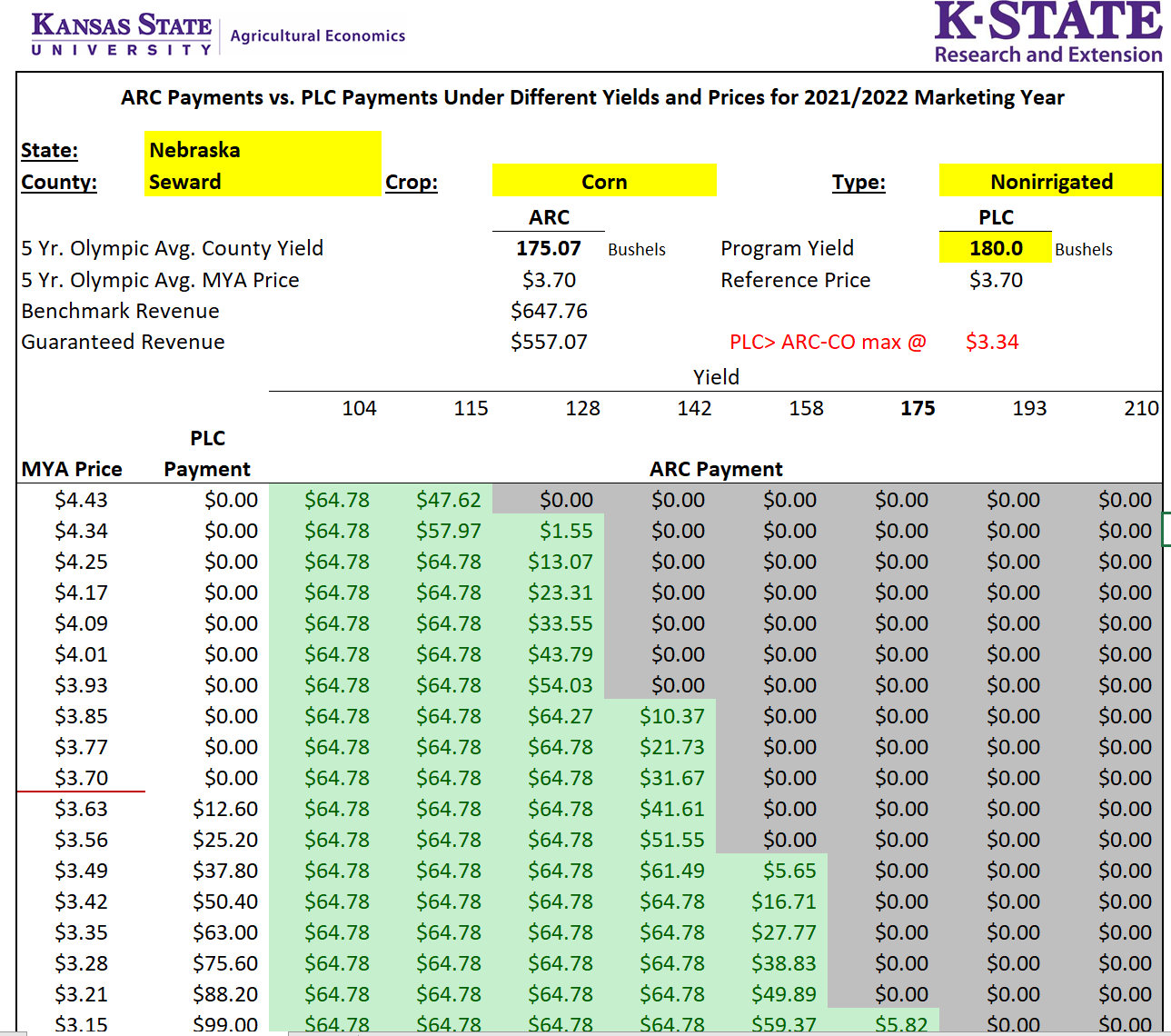
Kansas State Spreadsheet: https://www.agmanager.info/ag-policy/2018-farm-bill/tradeoff-between-20212022-arc-and-plc. This tool is one that more farmers and I appreciate using as it is very visual. It provides a quick glance at which program is favored when MYA prices change and county yields change.
Texas A&M: https://www.afpc.tamu.edu/tools/farm/farmbill/2018/
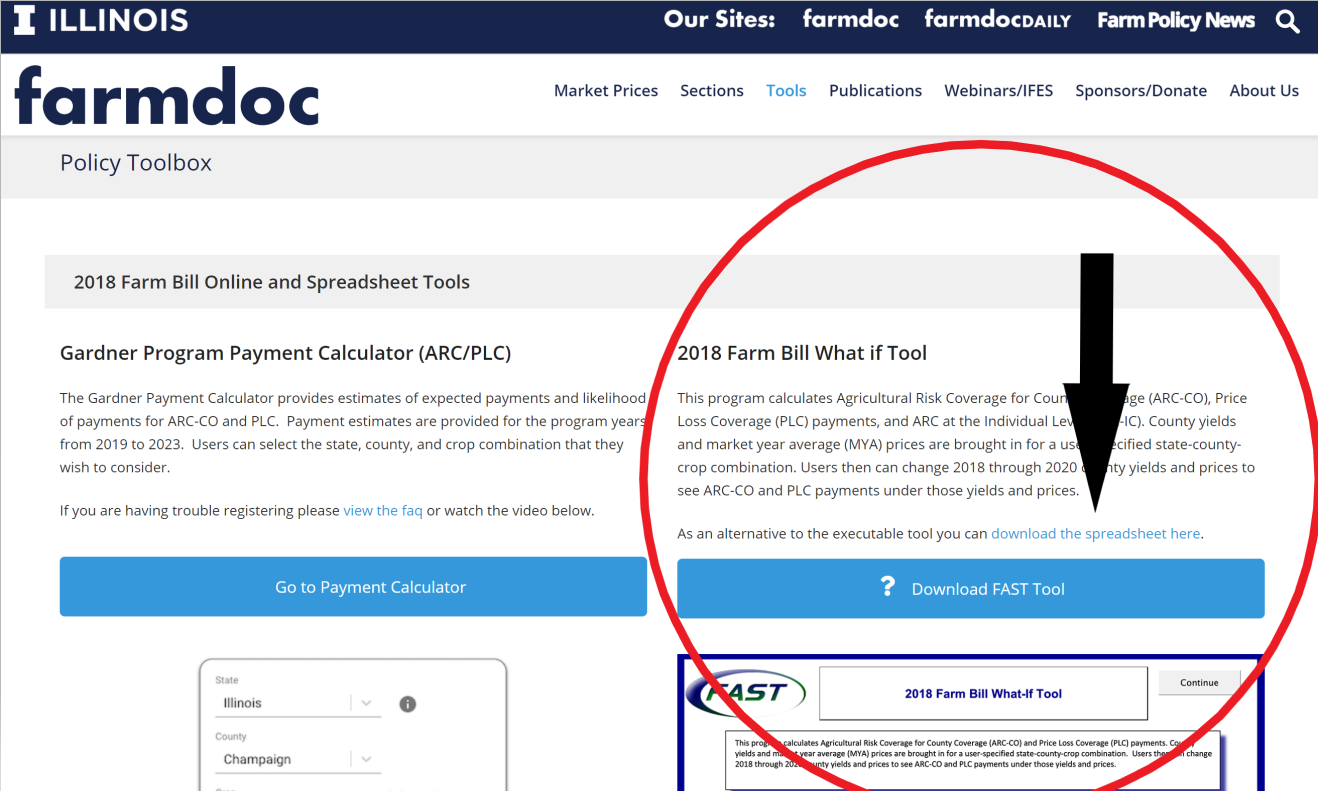
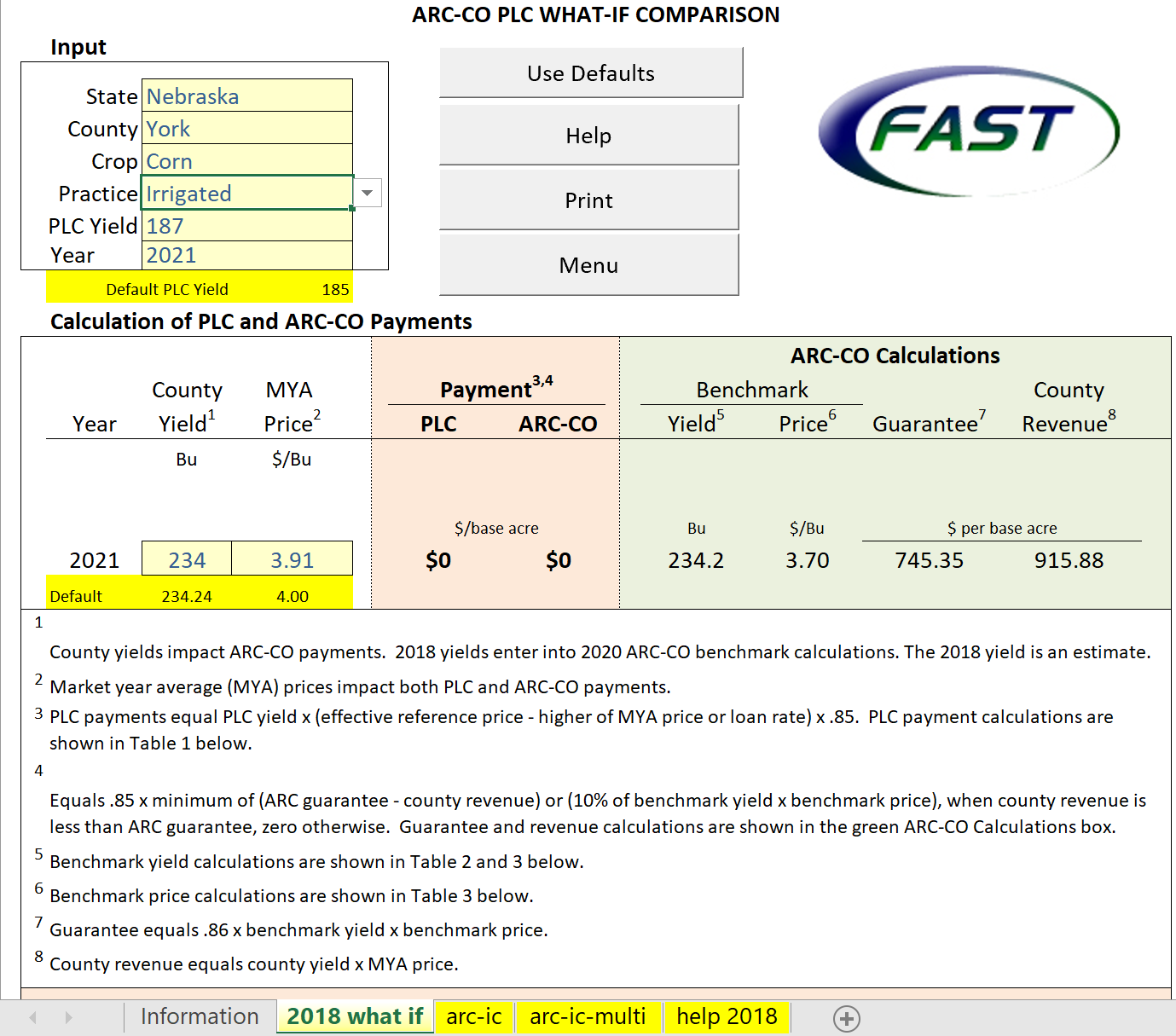
Illinois “What If” Tool: https://farmdoc.illinois.edu/policy-toolbox (I use the ‘What If’ tool in the right column of the page. I just downloaded the spreadsheet). There is another tool, on the left-hand side and also at https://fd-tools.ncsa.illinois.edu/, but be aware it shows results for the 5 year life of the farm bill (so only look at the 2021 results).
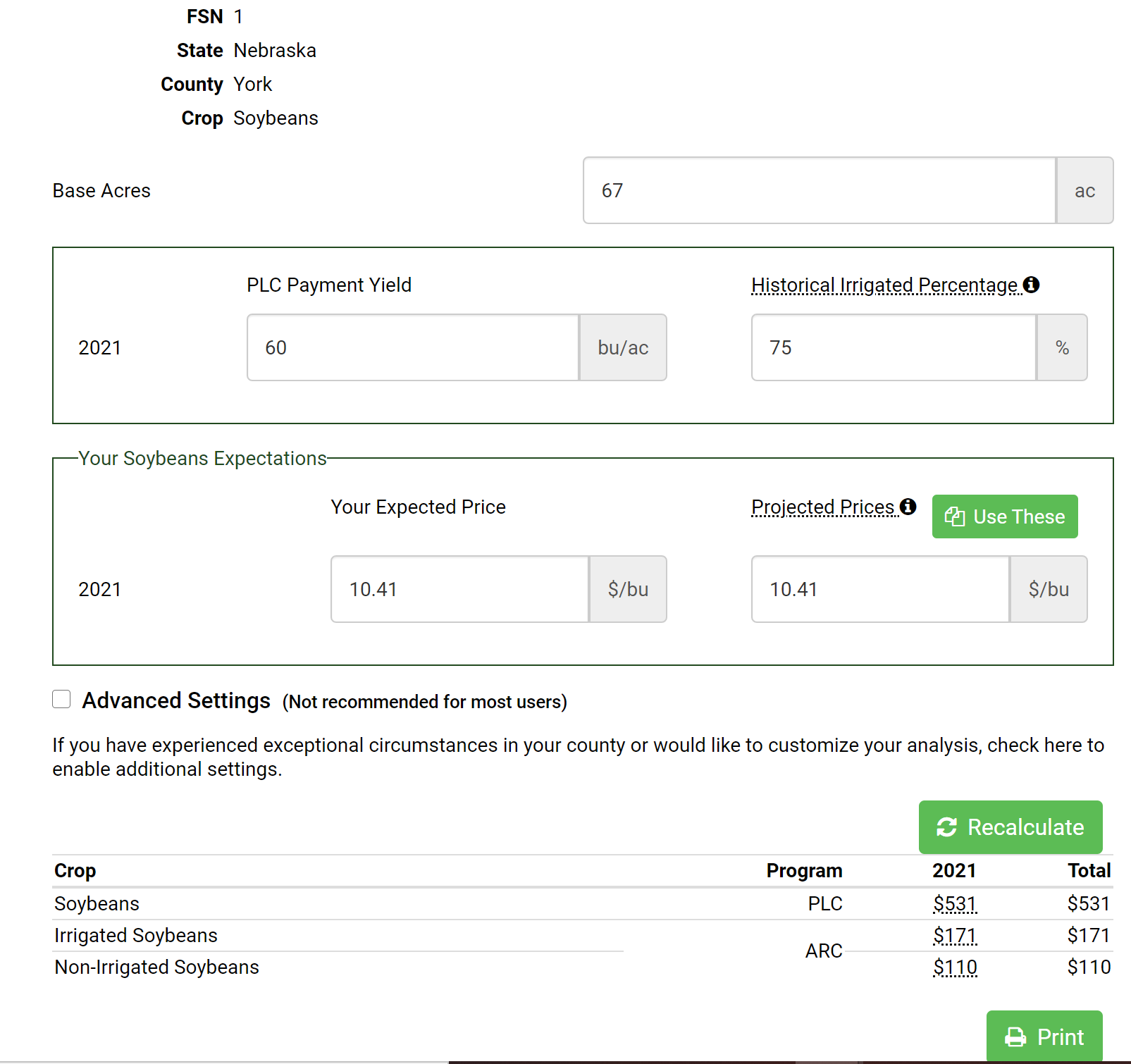
The Texas A&M tool uses a default price of $3.91 for corn and $10.40 for soybean and runs 500 possible scenarios using the data inputted. The Illinois “What If” tool uses a default price of $4.00 for corn and $11.00 for soybean and provides one potential payment based on the data inputted. Both tools provide input into the ARC-CO and PLC decision. The Illinois tool also provides input into ARC-IC if you are considering that option.
Kansas State Spreadsheet
This spreadsheet can be found at: https://www.agmanager.info/ag-policy/2018-farm-bill/tradeoff-between-20212022-arc-and-plc. I’m not going to share additional details on this one as they have done a great job of explaining this spreadsheet already at the link above. You will see a video when you go to this website that explains the tool and then a link to a spreadsheet is found below the video. Personally, I’m finding this tool to be a lot easier for growers to understand as it’s so visual. It clearly shows what has to happen with county average yields and market year average prices for ARC-CO to trigger.


Texas A&M Tool


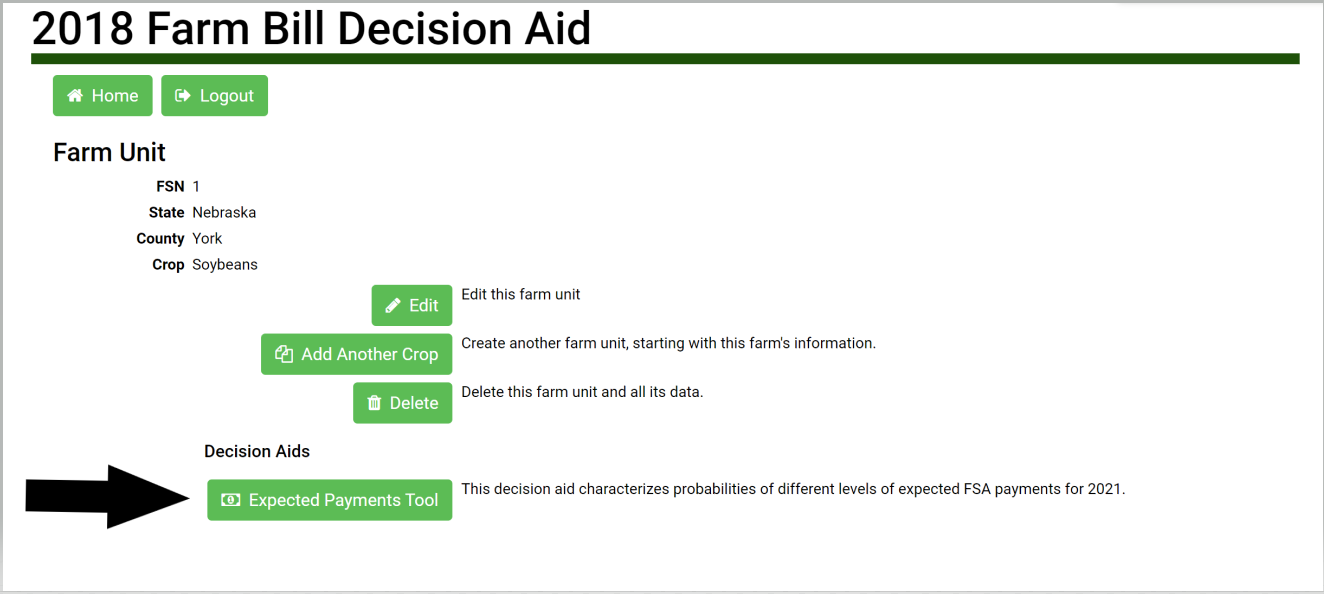
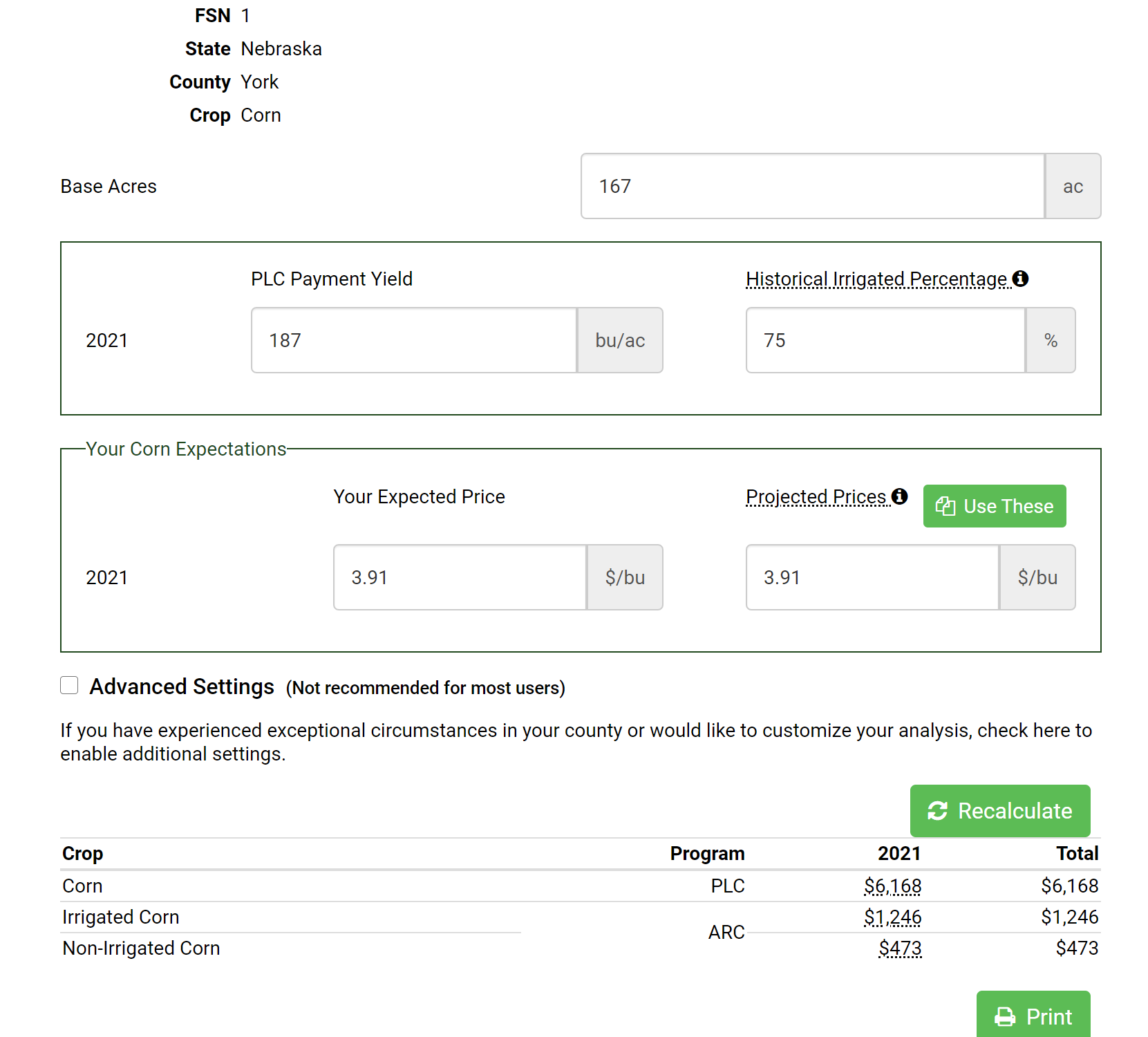


Illinois “What If” Tool


Additional Resources:
- 2021 ARC/PLC recorded webinar
- JenREES ARC-CO Calculation Blog Post
- JenREES 2021 Farm Bill Decision Tools
- JenREES K-State Decision Tool examples
- 2021 Crop Production Clinic Farm Bill Presentation
- USDA FSA Farm Bill Info.
- USDA County Yield and Revenue Excel Spreadsheet for ARC-CO decision (Download. NE data shown. Unhide cells to see other states.)


JenREES 1/17/20
Winter in-person meetings are ‘a go’ for this week for this part of the State. Also, the online pesticide training is available for those who would rather not attend in person. It’s found at: https://web.cvent.com/event/4efa4d41-c770-4a78-99d7-4c4ea75d45ae/summary
Dicamba Training will be conducted by the companies, not UNL. Most have an online training option. Some also have live webinars and in-person meetings. Please see each company’s info:
Bayer (Xtendimax): https://www.cvent.com/c/calendar/7829eb5d-ddef-4c2f-ac2c-a67626018ece
BASF (Engenia): https://www.engeniaherbicide.com/training.html
Syngenta (Tavium): https://www.syngenta-us.com/herbicides/tavium-application-stewardship
Farm Bill: Because the tools are the same as in the past, I’ve updated a blog post (go to the “Farm Bill” category) at jenreesources.com. It shows step by step instructions on how to enter data into the Texas A&M and Illinois decision making tools. Your election this year is for one year only (2021). Some of my data was saved in the Texas A&M tool, so hopefully that’s the case for you individually as well.
After looking at data, here’s some things that may be helpful for consideration. Yes, we’ve had good market prices recently. However, remember ARC-CO is based on a 5-year Olympic average where the high and low are thrown out. This average is based on 2015-2019 (2020 doesn’t come into the picture until the 2022 decision. And, if it’s the high, it gets thrown out then…so it may take a couple years of high prices). And, the reality is that PLC corn price of $3.70 may also not trigger depending on the MYA price.
Another consideration for the 2021 election is county yields for ARC-CO payments (looking at years 2015-2019 where the high and low are thrown out). Because different weather events hit portions of counties, and because some counties have separate payments for irrigated and non-irrigated acres, it’s important to look at your individual county data to make decisions.
If you don’t want to use the decision tools from Texas A&M and Illinois, another option is a simple calculation. On my blog, you can click on a link to download a USDA excel spreadsheet which shows data for figuring ARC-CO triggers and payments. I’ve hidden the cells for the rest of the U.S. and only have Nebraska shown; once downloaded, you can unhide cells if you want to look at other states. For the calculation:
Take your 2021 County Guaranteed Revenue for a specific crop and divide that by 2021 County Benchmark Yield for that crop. For example, York County irrigated corn (irrigated and non-irrigated are combined) shows a 2021 Guaranteed Revenue of $745.35. The 2021 Benchmark Yield (which is an Olympic average yield from 2015-2019) is 234.24. Taking 745.35/234.24=$3.18. Based on these numbers, an ARC-CO payment would not be triggered for corn in York County unless the price went down to $3.18. This is in comparison to PLC in which the trigger is $3.70 for the corn price. This helps with decision making as it leans towards enrolling in PLC for corn. (Again, no guarantee of a payment even with PLC depending on the MYA price). You can also try other figures (ex. trying 240 and 220 bu/ac) if you think the trendline yields may be higher or lower than the current estimate to see other potential ARC Co price triggers. You can use this same calculation for other crops such as soybean, wheat, sorghum, etc. and compare the prices obtained vs. the PLC price for that crop.
The windstorm, fairly widespread in this part of the state, impacted many individual corn yields. I don’t know how that compares to average county yields for 2020. In the past, we had those at some point in February, so it will be interesting to look at this later.
JenREES 1-10-21
It was great to have in-person meetings last week! Even though the set up and planning was more taxing, I’m grateful we were able to have them. Also, wanted to thank those who responded to the Extension survey for me; your feedback is greatly appreciated!
In-person Extension meetings are ‘a go’ for this coming week for this part of the State. For Crop Production Clinics, groups are allowed to watch together at Coops or businesses if you prefer. You will still need to register individually. Your ‘ticket’ for recertification is to individually complete the program evaluation and provide the codes provided during sessions throughout the day. Please also know any of the area Extension offices will work with you regarding picking up weed guides regardless of where you said you’d pick them up. Thank you for your patience as we navigate all this together!
Farm Bill: Received a number of calls this week regarding 2021 election sign-up. Honestly, I haven’t had the opportunity to run numbers in the tools yet. Will provide more info. in a future column.
On-Farm Research: This past week, we also peer reviewed all the on-farm research studies conducted in 2020. There were 20 studies where farmers worked with me in this part of the State and I’m grateful to all of them for their efforts! My hope is to share research results in the coming weeks as reports are finalized. Our on-farm research updates will occur on Feb. 25 and 26 and I’m really pumped about the format! The meetings will be morning only, hosted by the local Extension educator, providing more discussion of studies shared by the farmers, and allow planning for the upcoming year. Those attending virtually will discuss as their own group. Please pre-register early to ensure a spot. Registration at: https://cropwatch.unl.edu/nebraska-farm-research-network-results-update-meetings-2021.
De-Icing Agents are sometimes needed for safety but can be harmful to plants. You may wish to check what you’re using at home. Common deicing compounds are listed below. These may be used alone or blended together to improve performance or reduce damage to concrete or landscapes. Also, keep products on hand that improve footing on slick surfaces, like sand, sawdust, or cat litter. They can be used instead of traditional deicing products, or blended with them to improve traction and limit deicer use.
- Sodium chloride, urea, and potassium chloride have high potential of damaging landscape plants.
- Calcium chloride is the most effective deicing product at low temperatures, working down to -25°F. It will not damage vegetation if used as directed.
- Magnesium chloride is sprayed on roadways before a snowstorm to prevent ice bonds from forming, making ice and snow removal easier. It causes very little damage to concrete or metal. It’s also gentle on landscape plants and pet safe if used as directed.
- Acetates can be found in three forms – calcium magnesium acetate (CMA), sodium acetate and potassium acetate. CMA is a salt-free product and is the safest product for use around pets and landscape plants. CMA is made from dolomitic limestone and acetic acid (the principal component of vinegar). Studies have shown the material has little impact on plants. It also has a very low level of damage to concrete or metal.
- Beet juice deicers, a newer organic option, are products derived from beet juice. They contain only 12% sodium chloride (salt), much less than traditional sodium chloride. Beet juice products are fully biodegradable, but shouldn’t be applied where melt runoff will move to aquatic areas.
JenREES 1-3-21
Happy New Year! This past week I’ve received several questions about winter meetings so wanted to better clarify what to expect. Also, area winter program brochures were mailed out last week. If you no longer wish to receive this, please let us know and we’ll update our mailing list.
Risk Dial: For Extension programs, if the risk dial is ‘Red’, in-person events are cancelled. The risk dial is reset every Friday for many district health departments throughout the State. Thus, those who pre-register will be notified by Monday the following week of any cancellations and next options. This week, locally we are in ‘Orange’, so pesticide training in York on Jan. 7 and chemigation training in York on Jan. 8 (both at Cornerstone Event Center at Fairgrounds) are thankfully on! UNL guidelines require masks when the risk dial is ‘Orange’. Thank you to all who have called in to pre-register!
Crop Production Clinics: Technically these are all presented virtually whether you choose to watch online on your own or at an in-person location. I enjoy seeing people and catching up at winter meetings, so I’m grateful we still have in-person meeting options! The following website has the agendas and registration information: https://agronomy.unl.edu/cpc. There’s not an easy way to see where the in-person options are located unless you click on the ‘Register’ button and scroll. Thus, I will list them for you below. For those of you who’ve attended in the past, you know there’s two rooms which allow for various learning opportunities and CCA credits: certification/pest management room and a crop/soil/water room. When watching virtually, you will have the option to switch between the different rooms. There are specific ways built in to ensure those who need recertification and are watching virtually are accounted for and to account for those desiring various CCA credits. Some in-person locations like Hastings, Aurora, Central City are hosting both rooms. In York, on Jan. 14 and 21 at the Cornerstone building at the Fairgrounds, for specific reasons I’ve chosen to only host the pest management room. That works if you only need certification or wanted to watch only those topics. Otherwise, if you needed soil/water credits, it would work best to choose a different in-person location or watch virtually. I just wanted you to be aware of that. For the Nebraska Crop Management Conference, most of us are only able to provide two of the four rooms. When you register for CPC/NCMC this year, you will choose whether you have the weed guide shipped directly to you or to a nearby Extension Office where you can pick it up. In-person locations include:
Jan. 6: Central NE Locations: Hastings, North Platte, Kearney, Holdrege
Jan. 7: Eastern NE Locations: Lincoln, Geneva, Norfolk, Syracuse
Jan. 13: Central NE Locations: North Platte, Hastings, Central City, Holdrege
Jan. 14: Eastern NE Locations: Lincoln, Norfolk, York, Syracuse
Jan. 20: Central NE Locations: Hastings, Aurora, Holdrege, Kearney
Jan. 21: Eastern NE Locations: Lincoln, Norfolk, York
Jan. 27: Nebraska Crop Management Conference Locations: Hastings, Kearney, Seward, Holdrege, North Platte, Syracuse
Chemigation: For those desiring to apply fertilizer and/or chemicals through irrigation systems, you can obtain your initial or recertification for chemigation at an in-person training or online. The online version is also for both initial and recertification and can be obtained at: https://water.unl.edu/article/agricultural-irrigation/chemigation. There is no charge for chemigation training. For those attending in person, please pre-register and please bring a calculator (can’t use smartphone). Area January in-person trainings include: Jan. 8 at 9:30 a.m. at the Cornerstone Bldg. Fairgrounds in York; Jan. 21 at the Fairgrounds in Hastings; Jan. 25 at 1:30 p.m. at the Fairgrounds in Central City.
Crop Budgets are updated for 2021 and available at:https://cropwatch.unl.edu/budgets.
Extension Survey: It’s also that time of year for annual reporting. If you could please help me out by completing this 5 question anonymous survey, I’d appreciate it: https://app.sli.do/event/s8g48y8z. Thank you!
JenREES 12-27-20
There’s perhaps a certain anticipation to see the end of each year and the dawning of a new one. That speaks to optimism and hope many have.
While covid changed many things in 2020, there’s many positive things that happened too. One has been watching families, communities, and neighbors rally around each other as hard times and losses were realized. I hope that’s something that never changes within our communities. Both personally and professionally, covid also provided an opportunity for increased focus and intentionality on what was genuinely important in my life. Perhaps for others as well?
In Extension, and most likely for all, the challenges forced us to stretch, learn new technologies, and think outside the box more. For example, video production via smartphones out in the fields, pastures, and feedlots exponentially increased and more of my colleagues learned video production/editing. The 4-H, Family, and Food/Nutrition teams brought many virtual learning opportunities to family living rooms and provided fitness challenges for families. We also made some changes for county fair that worked better. Being forced to think outside the box was beneficial in many ways!
I’m also so grateful for my administrators allowing and trusting me to do my job in serving people in the midst of covid. That may sound strange to say, but I have colleagues in other states who weren’t allowed to leave their homes for work…essentially research shut down and anything done Extension-wise happened virtually. So I’ve been incredibly grateful that much of my job remained the same with field visits and conducting on-farm research studies!
As we approach a new year, how can some of the challenges and positives of 2020 impact our 2021? Are there things in our lives that aren’t necessarily bad, but are keeping us ‘busy’ and taking time from the more ‘important things’? What realistic yet necessary goals should we individually set for 2021? Here’s wishing you a blessed 2021!
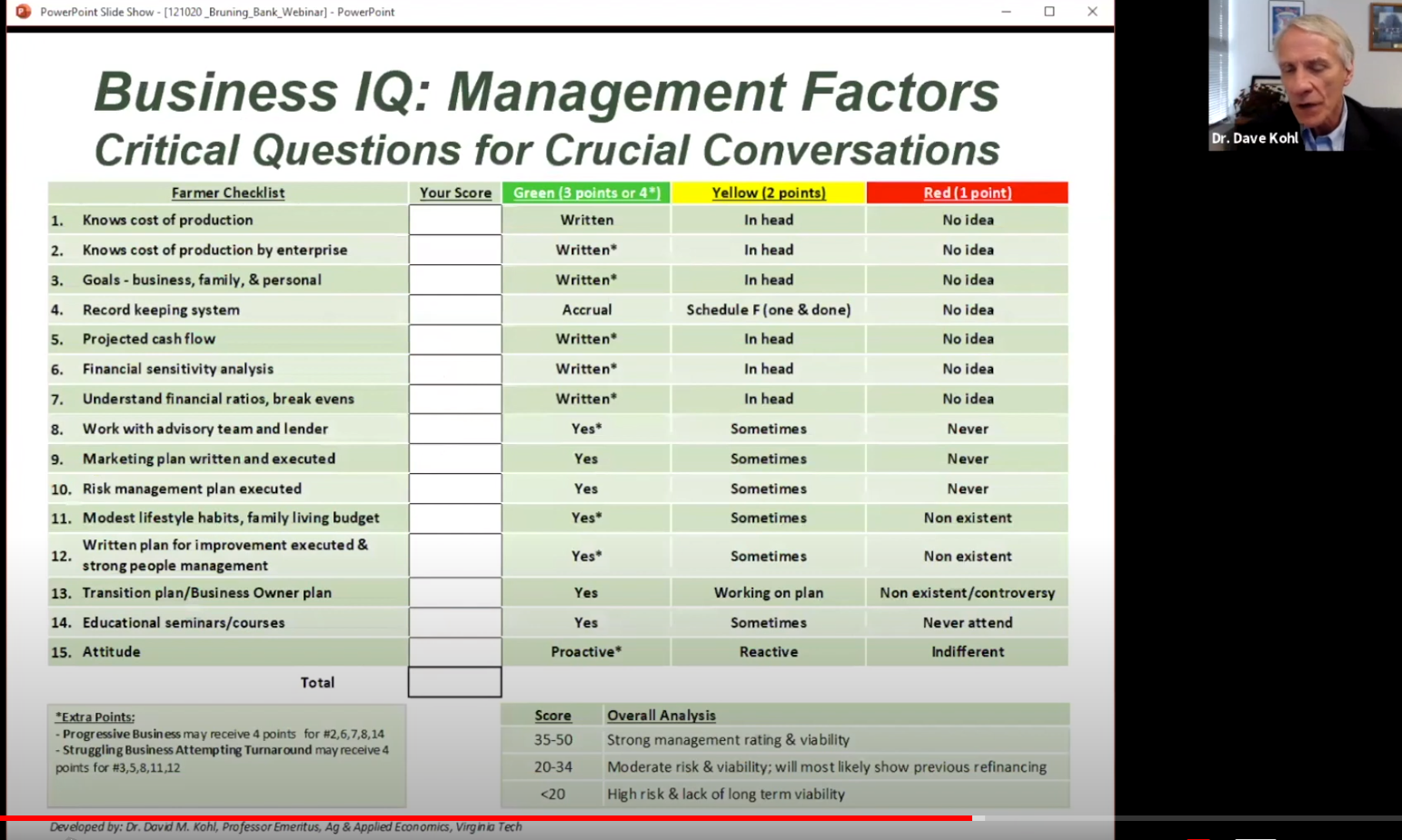
Business IQ may be one key to success in the 2020’s: This may perhaps help with some goal setting. In a recent webinar, Dr. David Kohl, Professor Emeritus Ag and Applied Economics from Virginia Tech, shared a ‘Business IQ’ spreadsheet with 15 key performance indicators ranging from knowing cost of production and having a written marketing plan to one’s attitude. It’s an assessment where farmers (or any business owner) can honestly score oneself. He then suggests to write down 3 areas to continue and 3 areas to improve (no more than three each). I’m unsure I can share it on a website, but am willing to email or print a copy if you’re interested.
He also shared two poll results. In the first, 976 ag lenders were polled in the summer of 2020 on “Characteristics That Are Important to Agricultural Producers for Resiliency & Agility”. The top three answers included: knowing cost of production (62%); executing a marketing risk management plan (58%); and strong working capital (41%). In the second, 300 Kansas farm and ranch women selected their top three “Specific Actions You Are Taking in Your Business, Family & Personal Life for Resiliency & Agility”. Their collective top three answers included: Reexamining goals-business, family & personal (68%); Building cash and working capital (41%); and Refining family living budget (39%). If you’d like to learn more, his recorded presentation is available till January 10th at: https://go.unl.edu/dec10recording.
Extension Survey: It’s also that time of year for annual reporting. If you could please help me out by completing this 5 question anonymous survey, I’d appreciate it: https://app.sli.do/event/s8g48y8z. Thank you!
JenREES 12-20-20
Wishing you and your family a blessed Christmas!!!
Farm Bill Webinar Link: Received some questions this month regarding decisions for 2021 ARC/PLC election sign-up but haven’t looked at or worked with decision tools yet. Last week there was a webinar on program elections and the recorded link can be found at: https://go.unl.edu/yg90. For those of you who elected ARC-IC for 2019-2020 due to prevent plant or significant yield loss in 2019, it will be important to reconsider your options. This webinar does a great job of explaining and going through them. While our last election we could look back to get an idea, we don’t have that opportunity going forward. It’s nice that it’s a one year election so it can be changed as prices/yields fluctuate. Hope to share more information in January after working with real data to get a feel for things. Curious how the significant windstorm and drought in areas may impact decisions for specific counties going forward. For now, you can find more information, including the decision tools, at: https://www.fsa.usda.gov/programs-and-services/arcplc_program/index. If you’ve used the decision tools in the past, you will use the same login info. you created in the past.
Ag Land Leasing and Budgeting Webinar was also held last week. If you missed it or were interested in watching the recording, you can do so at the following YouTube link for 30 days: https://www.youtube.com/watch?v=dH-RVIhnIG8&t=166s.
Ag Budgeting Workshop: calculating the cost of production per crop enterprise was a webinar held after the ag leasing webinar. You can also view this recording via YouTube at: https://www.youtube.com/watch?v=KIgbkp0QNH0.
Live Christmas Trees: Just a reminder to daily check live Christmas trees for their watering needs to avoid a fire hazard. Kelly Feehan, Extension horticulture educator shares, “The rule-of-thumb is a tree will use one quart of water per day for every inch of trunk diameter near the base. If you have a tree with a 3-inch base, it can use 3 quarts of water per day. The trunk should have been freshly cut at a slant just prior to putting it in the stand. If the stand is empty for more than six to eight hours, the tree’s pores plug up again. Water uptake is much reduced and the tree dries out sooner. If a tree stand dries out for half a day or more, the only thing that can be done is to remove the tree from the stand and recut the base; which is not a fun task with the lights and ornaments. When watering, nothing needs to be added to water in the tree stand to promote freshness.”
Christmas Cactus: Kelly also shares the following, “to keep Christmas cactus blooming as long as possible, place it in bright but indirect light. Too much sun can cause leaves to turn yellow. Keep soil or potting mix constantly moist but not waterlogged. Even though they are cactus, they are jungle natives and prefer just moist conditions with indirect light. Avoid fertilizing Christmas cactus during the winter; but do fertilize every other week from spring through fall. Plants seem to flower best if they are a little pot bound; but if roots become over-crowded in the container, blooming will decrease. If you haven’t repotted in several years, or you notice a decrease in flowering from the previous year, repot the plant into a slightly larger pot, but wait until spring. If possible, move the plants outside for summer. Keep in a shady area as Christmas cactus will not tolerate full sun.”

JenREES 12-13-20
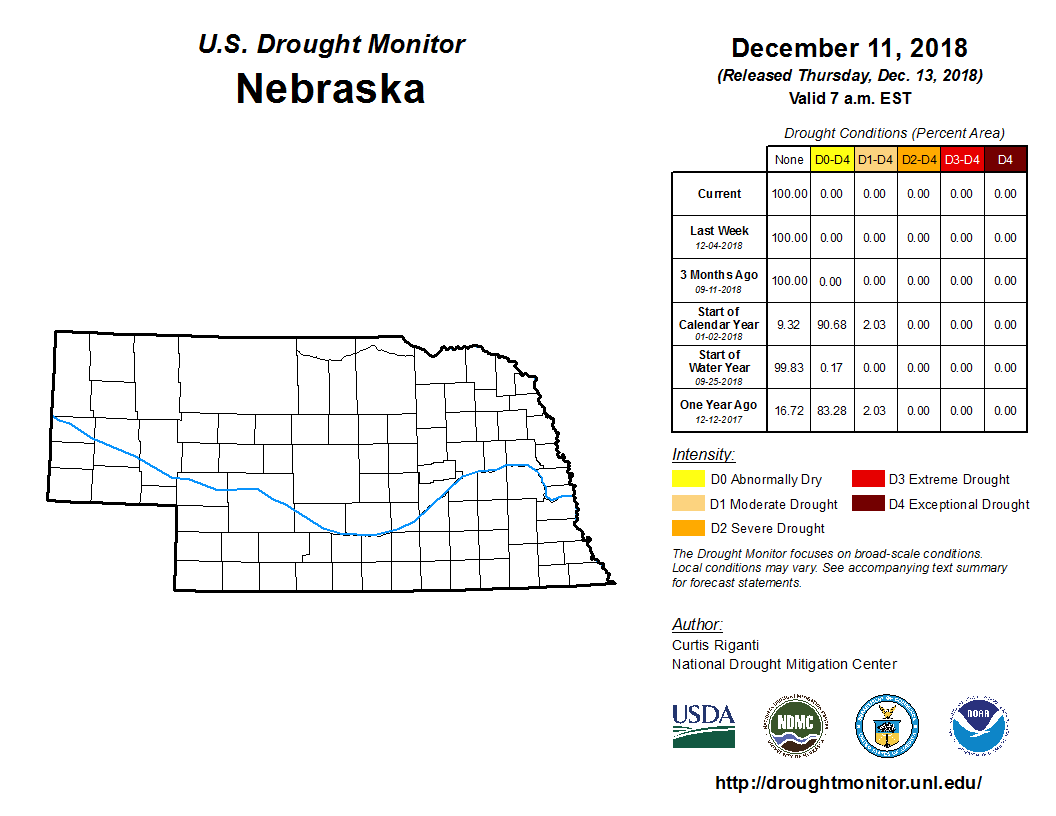
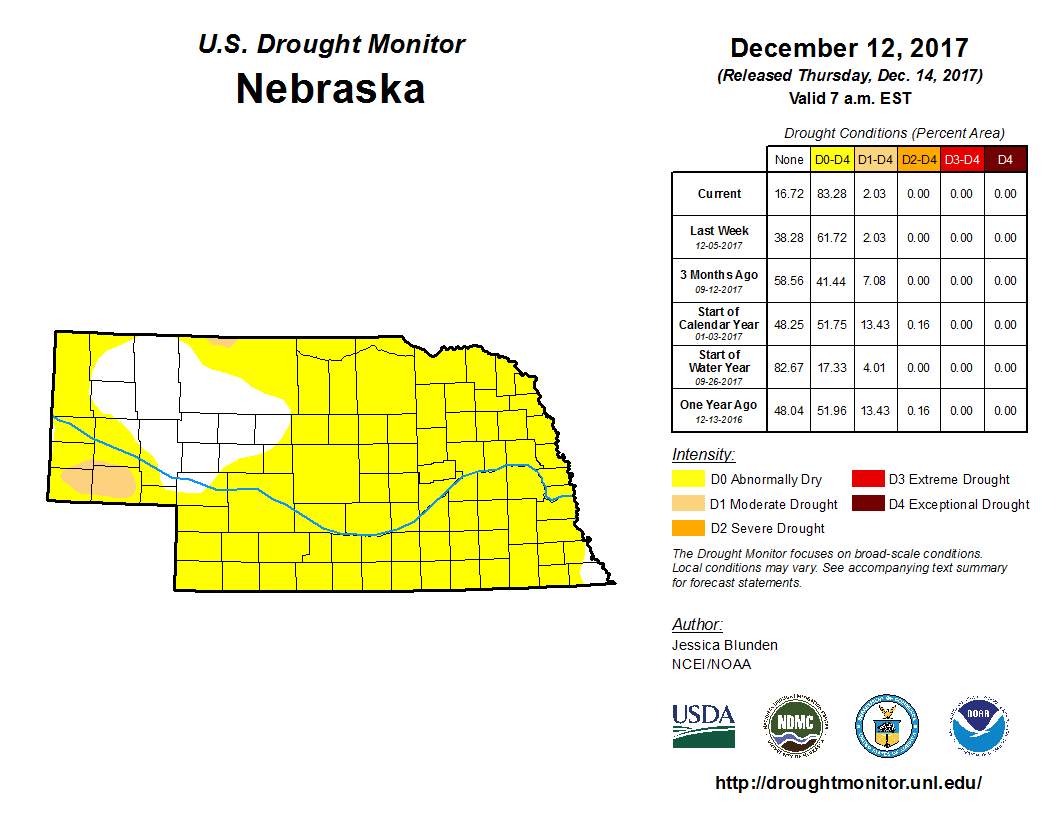
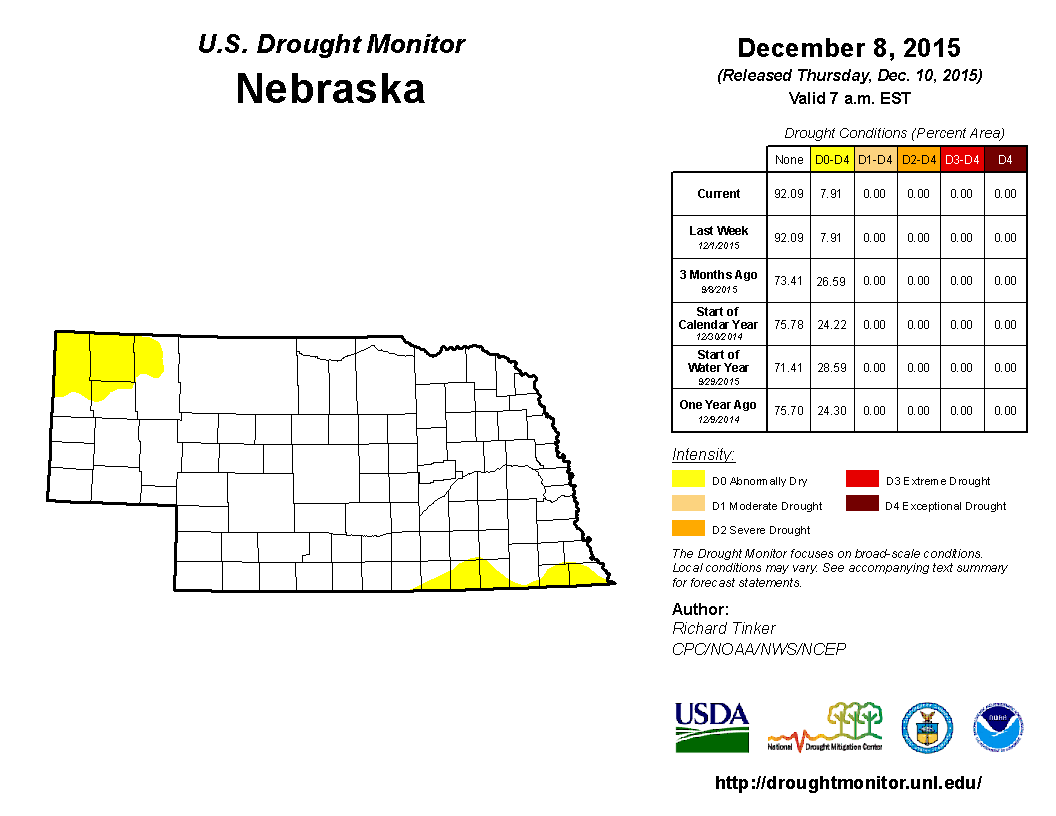
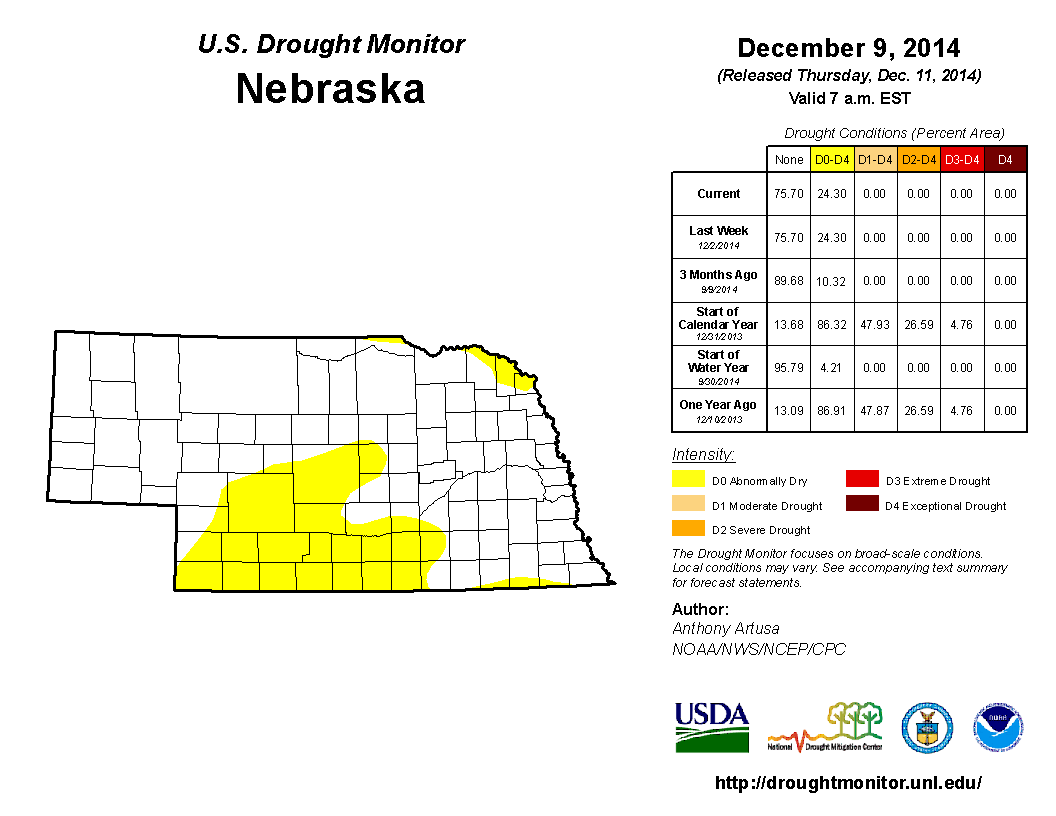
The sun glistening on the snow holds such beauty after a warm, dry beginning to December! Moisture is very much needed! For curiosity sake, I looked at the Drought Monitor for this past week and compared it to the same week in previous years. The pics are shared at jenreesources.com and it’s quite interesting comparing and thinking back through the years. Hopefully we can receive more precipitation prior to planting season.
If you missed it, the Farmers and Ranchers College program featuring Dr. David Kohl and Eric Snodgrass can be found for 30 days at: https://www.youtube.com/watch?v=9cFKs13i_Ak. I appreciate how Eric shares global weather and climate information in an easy to understand way! He also shared an interesting story of how El Nino is related to the Christmas season, so you’ll have to watch the recording to learn that. Some stats he shared for the State of Nebraska: June was the 18th driest on record followed by the wettest July on record. That was followed by the driest August on record with September as the 18th driest on record (would have been driest but thankfully we received precipitation after Labor Day weekend). He looked at weather data from 1901-2020 for Nebraska and the U.S. which showed a trend of 2.5” precipitation gain from April-October (with higher gains as one goes east in the U.S.). He also looked at the past 40 years which showed heavy rainfall events (more than 2” per event) has tripled.
There was an effort my colleagues began a few years ago called “Weather Ready Farms” https://weather-ready.unl.edu/. It was designed to improve or increase resilience towards the impacts of extreme weather on Nebraska’s farms. A number of things go into that with some examples at the website. A few examples of things farmers have done since the 2012 drought and the 2019 floods include keeping the ground covered with residue and cover crops to help reduce evapotranspiration, increase water infiltration, and reduce wind/water erosion as we experience these more extreme events.
BeefWatch Webinar Series is designed to highlight management strategies in grazing, nutrition, reproduction, and economics to increase cow/calf and stocker production efficiency and profitability. More information and registration for the BeefWatch Webinar Series can be found at: https://beef.unl.edu/beefwatch-webinar-series. Dates are January 5, 12, 19 and 26 with each webinar beginning at 8:00 p.m. CST. The focus for January’s webinar series is “Preparing and Managing for the Calving Season”. Jan. 5: Preventing calf scours (Is there a way to reduce the likelihood of calf scours without adding additional vaccines or other cash expenses to your current program?)
Jan. 12: Calving tool box and record keeping (favorite tools and tricks for smoother season)
Jan. 19: Calving complications and when to call the vet
Jan. 26: Cow nutrition needs at calving and in early lactation
Poinsettias: Kelly Feehan shares the following, “It’s Poinsettia time. Hard to believe these bright, colorful plants originated from a weed. And amazing what plant breeding and good marketing can do. To enjoy your Poinsettia as long as possible, place them in an area with bright sun for at least half the day. If possible, provide a night temperatures in the 50’s or 60’s. This is often the most challenging condition to meet in the home, but keep plants as cool as possible at night. If plants are near a window, don’t let the leaves touch cold window panes; and keep Poinsettias away from warm or cold drafts. Poinsettias need to be well-watered. Because they are in a light weight soil-less mix, they will dry out quickly. Allow the soil to dry slightly between watering; then water thoroughly until water runs out of drainage holes. Be sure to punch holes in decorative foil wraps to prevent soggy soil conditions or at least pour excess water out of the foil after each watering.”





Certification Trainings
This week, sharing more regarding certification trainings for ag professionals and master gardeners. Meeting in ‘hubs’ has been our vision in the midst of covid to reduce the number of people attending any one location for larger programs such as Crop Production Clinics and Nebraska On-Farm Research Updates. Example: instead of one day where 200+ people meet in York for Crop Production Clinics, attendees have the option of attending one of 6 days of central or eastern-focused Crop Production Clinics hosted by several local county Extension Offices each of those days, or they can attend virtually. As of current recommendations, if the risk dial is in the Red, we can only meet virtually.
Pesticide Training: For commercial and non-commercial pesticide applicators with the ‘ag plant’ or ‘demo/research’ categories, the Crop Production Clinics are your option for recertification. They will be virtual this year (and in person via ‘hubs’ if risk dial isn’t Red) https://agronomy.unl.edu/cpc. Initial certification is still via testing: https://pested.unl.edu/certification-and-training#commercial.
For private pesticide applicators, our goal is in person training first. Should the risk dial be in the ‘Red zone’ at the time a training is scheduled, the training will be moved to a virtual option and those registered will receive the connection information. We also have a self-study option again which is an option provided by the local Extension office for those who are uncomfortable attending in person and/or have difficulty with using computers for virtual programming. Depending on the risk dial, and also depending on the town, there may be a mask requirement in place. To follow directed health measures on meeting capacities, Pre-Registration is Required. Not all county Extension Offices are publicizing their meetings. You will need to call the County Extension Office where you’d like to attend a meeting to Pre-Register. My preference is to share my meeting dates:
York County: Jan. 7 at 9:30 a.m. and 1:00 p.m. and Feb. 8 at 6:30 p.m. all at the Cornerstone Event Center at the Fairgrounds in York. RSVP to (402) 362-5508.
Seward County: Jan. 18 at 2 p.m. and 6:30 p.m. and Feb. 10 at 9:30 a.m. all at Harvest Hall at the Fairgrounds in Seward. RSVP to (402) 643-2981.
Chemigation Training: For those desirous to apply pesticides and/or fertilizer through irrigation systems, a chemigation license is necessary. If this is your first time, it’s helpful to have the books ahead of time and you can contact the York Co. office if you’d like them. Training for our area will be conducted by Steve Melvin on January 8th at 9:30 a.m. at the Cornerstone Event Center at the Fairgrounds in York. Pre-Registration is Required to (402) 362-5508.
RUP Dicamba Training is no longer being conducted by Extension. Nebraska Department of Ag is leaving training up to the Registrants, and if I understand correctly, they will no longer require those trained to be listed on the NDA website.
Master Gardeners: If you have a strong interest in gardening and enjoy helping others, you are invited to become a Nebraska Extension Master Gardener volunteer. This program will increase your knowledge and understanding of best cultural practices for growing flowers, vegetables, turf, plant disease and insect pest identification, and much more. One area training option is through Lancaster Co. Extension beginning in Feb. 2021 via Zoom during the day. The fee is $190.00. Application deadline is Jan. 15, 2021 at: https://ssp.qualtrics.com/jfe/form/SV_08OngDRFkSOJIRT. Please call Mary Jane Frogge at 402-441-7180 for any questions.
Current Master Gardeners can plan on recertification training via zoom on Feb. 16, 23, Mar. 2, and 9 from 6:30 – 9:00 PM.
JenREES 11/29/20
Hope you all had a wonderful Thanksgiving! May we continue to count our blessings as we are so blessed!
December brings another Extension winter programming season. Several have asked what this year’s season entails. Honestly, like much in the midst of COVID, it’s a moving target with adaptability and flexibility being key for us all. Had put together local plans allowing for both in-person and virtual programming. However, with a new set of restrictions, programming will depend on the risk dial going forward. I greatly prefer seeing people at meetings and field days, so still hoping for in-person meeting options for the future!
Risk Dial: As of 11/30/20, if either the district health risk dial Or state risk dial is Red, all Extension programming (including 4-H programs, meetings, and events) must be delivered virtually. Thus, for our part of the State, all December Extension programming is now virtual only. In-person programming with specific guidelines can only resume if the risk dial is not Red. The following are some upcoming December programs and connection info.
Dec. 2: Women Managing Ag Land Conference, 11:30 a.m.-2:30 p.m., https://wia.unl.edu/WMAL. Learn about navigating challenges of owning/renting ag land, improve business management and communication skills.
Dec. 10: Farmers & Ranchers College Weather & Economics Unplugged w/ Dr. David Kohl, Professor Emeritus, Dept. of AAEC, VA TECH & Eric Snodgrass, Principal Atmospheric Scientist for Nutrien Ag Solutions, 9:15 a.m.-Noon, https://go.unl.edu/december10. Learn latest on global trade, government payments, supply & marketing chain disrupters, and updated weather trends that impact ag business.
Dec. 17: Nebraska Soybean Day and Machinery Expo, 9 a.m.-3 p.m., https://go.unl.edu/w8k9. Learn marketing strategies, about soybean gall midge, soybean weed control, and improving Nebraska’s soybean yield and quality.
Crop Production Clinics: The 2021 Nebraska Crop Production Clinics will feature research updates and information tailored to regional crop issues and grower interests. The Clinics will be offered virtually in 2021. (Depending upon directed health measures, there may also be limited opportunity for in-person viewing of Clinic presentations at various county locations).
Sponsored by Nebraska Extension, the programs will feature “live” presentations via zoom held on nine days throughout January. The clinics will be the primary venue for commercial and non-commercial pesticide applicators to renew their licenses in the following categories: ag plant and demonstration/research. The crop production clinics also will serve as a venue for private pesticide applicators to renew their licenses. Dates include:
Western NE Focused Clinics: Tuesdays, Jan. 5, 12, 19, 2021
Central NE Focused Clinics: Wednesdays, Jan. 6, 13, 20, 2021
Eastern NE Focused Clinics: Thursdays, Jan. 7, 14, 21, 2021
Individual clinics will be customized to address topics specific to that area of the state, allowing growers to get research-based information on the issues they face locally. Complete agendas and online registration for each site will be posted at http://agronomy.unl.edu/cpc. Pre-registration is required and costs $80. Certified Crop Advisor credits will be available in these areas: crop production, nutrient management, integrated pest management, water management and professional development.
*Next week I’ll share on private pesticide recertification and other certification program options.


 JenResources