Farmer Testimonials: Sentinel Ag
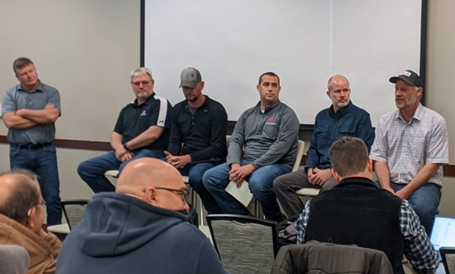

Photos (Left): 2024 Nitrogen Challenge Farmer Panel: Jason Richters, Scott Richert, Mike Spray, Tyler Smith, Phil Christenson, Jesse Williams (photo by Jenny Brhel). (Right): 2025 Nitrogen Challenge Farmer Panel: Jason Richters, Todd Schmieding, Erik Friesen, Tyler Smith (photo by Abigayle Warm).
***Newspaper Editors: Please note this week’s column is longer; because it’s unique, I would appreciate you printing it all if possible-even if it needs to be over a few editions. Thank you!***
Farmers appreciate hearing from other farmers’ experiences. So, I asked farmers who tried Sentinel Ag in the Upper Big Blue and Little Blue NRDs if they’d be willing to share: their why, their experiences, and advice to farmers considering trying it. The following were willing and have used Sentinel Ag for more than one year. I appreciate the vulnerability from these farmers in sharing!
Jason Richters: I had a desire to improve my nitrogen use efficiency, so I decided to try the Sentinel Ag nitrogen management system three years ago. The ability to know if the crop needs a nitrogen application based on satellite imagery is a game changer, and we have learned that we can better manage and reduce our nitrogen application rates while maintaining yields. This is good for our bottom line and may eventually reduce nitrate levels in our groundwater.
Using a nitrogen management system is a management change, but more importantly it’s been a management improvement. I encourage other farmers to try this technology, especially if they are already split applying their nitrogen.
Tyler Smith: My experience is a little different than most producers because I was able to be a part of the development of the concept that grew into Sentinel Ag with my role at UNL. As far as my personal farm operation, I had started fertigating about 15 years ago and had seen the benefits of spreading out my nitrogen applications but there were years where I wondered if I needed that last fertigation. After Sentinel became commercially available, I could see the promise of the method and I enrolled a couple of fields in 2022 and 2023. I was realizing nitrogen savings without losing yield. In 2024 and 2025, I’ve had all of my irrigated corn acres enrolled and I’ve been able to lower my nitrogen use by 10-40% while achieving several new field best yields.
What I’ve observed is that nitrogen availability is so variable in both total growing season need and the timing of that need that I don’t know how I can ever hope to accurately predict it. It’s much easier to let the corn tell me when it needs it and, at the end of the season, I’ll know what the total need was, not at the beginning. We don’t decide how much irrigation we will need for the next growing season in November or March, it’s a real-time decision that we make as we go through growing season that accounts for changes in weather, yield potential, ROI, etc. We have the ability to manage nitrogen the same way that accounts for all of the unknowns in real-time with a sensor-based approach.
Scott Richert: I started my in season nitrogen a while ago with the Nsense program using sensors on a Hagie sprayer. I had been sidedressing for years but wanted to see if I could get better. What I found was I was close. I was putting on enough to have a good yield but the sensors had better ROI. From there we kept adjusting and when the Sentinel program came out I put 2 fields in. I found the same thing that I was getting a good yield but the sensors were having a better ROI. So ROI is great but the other thing that means is that I was over applying nitrogen. In the Upper Big Blue NRD I live in one of the areas that has not moved up on the list for testing and reporting. Looking at how the numbers have been moving though it’s just a matter of time. For my soil it takes 30 years for the nitrate to make it to the water table. It basically takes most of a farming career for the nitrogen you apply to make it to the aquifer.
If we want to make things better for the people that come behind us we need to make changes now. With in season application I have nitrogen in the system only when my crop is there and using it. I have the nitrogen that the crop needs now not for the whole season. If we have adverse weather I can adjust to that. If it is hailed out I save the balance of my fertilizer and don’t let it leach away. If the plant is telling me it needs more I can put it on. If the mineralization is really good the plant will tell me it is happy and I can save an application.
There are some issues to work through. You don’t really know how much nitrogen you are going to use on each farm each year. You may need to purchase more later in the season or you may need to store some until next year. Sometimes it has been hard to apply when you want. It can rain at an inopportune time but I’ve never not got the application done. The sensors have a seven day window of time to make an application.
Todd Schmieding: Sentinel has allowed me to manage nitrogen as it is needed on the field. It accounts for release from cover crops in a way that gives me the full credit when it is available. It does add challenges in timing and changing when my work occurs, as it is not predictable. I have also seen changes in status before I applied the nitrogen, creating additional questions as to what is happening in the field. If you’re considering adding this to your program start on one field at first, and then expand from there.
Jesse Williams: Using in season nitrogen application through the pivot allows you to spread the applications out and “spoon Feed” the crop. Adding a sensor system such as Sentinel provides an additional tool to monitor crop needs. The big benefit to this in my mind is the ability to apply nitrogen based on crop needs and potential throughout the season. Applying a full rate upfront of 1-1.2lb per expected bushel can prove to be extremely wasteful if you encounter weather related issues such as hail, heavy rainfall or wind damage. Using the spoon feed approach with fertigation for the last three years I have typically been able to keep my Nitrogen use under .8lb per bushel.
Challenges for me have been gaps in imagery due to cloud cover/smoke. This year I probably shot from the hip more on applications due to the fact that I was going a week or more between imagery updates and trying to time applications between rainfalls. I think sentinel has some solutions to help with this including capturing drone imagery and modeling expected uptake based on planting date, maturity and GDU’s. We had thought linking my Field View account would bring some of this information in but Field View seems to be struggling to link with any partners this year. Another challenge is working with applicators on variable rate Nitrogen applications since there seems to be very few farmers in the area doing variable rate Nitrogen so their experience in applying it is not where it should be; I have also struggled to get as applied maps back from applicators after the application is done.
Brad Morner: This has been my third season using Sentinel and my experience with in-season nitrogen has been good. I am glad I’ve tried it. It’s made me aware of how much less nitrogen I can use and still have good yields. Working with sentinel has been a very good experience. They are so easy to work with and always get back to me quickly when I have questions. I like it because Sentinel tells me when the corn needs more nitrogen based on the satellite sensing technology, so I’m not just guessing when to apply more. I realized that I could get by with less nitrogen and still get the same yields. The biggest challenge is that it takes a little more time during the season. I used to fertigate once during the season. With Sentinel, I do 2 or 3 smaller applications instead of one large application but I also realize that it is worth the extra time because I am applying the nitrogen more efficiently as needed.
Erik Friesen: Yesterday we took out 2 NCGA (National Corn Grower Association) contest plots. Both were about 140#’s N, two different hybrids and both did 295. These were also non gmo white corn. This year every acre we have has less than 150#’s N. If people can update equipment, adapt to different tillage practices, use of autosteer and technology, why do people still use the same idea that they did 40 years ago when it comes to fertilizer recommendations? The struggle I see is the time it takes, big farmers will just keep doing the same thing. But I guess this is what makes me more competitive with them, raising high value crops, using less inputs.
Grateful to these farmers for sharing their experiences! Please reach out to them with questions if you’re interested in trying Sentinel Ag this coming year.
Nitrogen Reduction Incentive Act
Thank you to those who responded to last week’s poll question whether via the poll or contacting me via email or phone. The poll results are shared on my blog site.
Nitrogen Reduction Incentive Act (NiRIA): With high input prices, one opportunity to reduce costs is to become more efficient with nitrogen fertilizer applications. (Information from this article comes from the NiRIA Program website, guidance documents, and UNL CropWatch). Established under LB 1368 (2024), NiRIA is a state program that offers payments to producers who reduce their nitrogen fertilizer application rates by the lesser of 40 pounds per acre or 15% of their baseline rate. The program is available to corn, sugarbeet, wheat and potato producers statewide, with total funding for 2026 capped at $1 million.
Producers who successfully participated in the 2025 program may enroll again if reductions are on different fields. Administration and funding of NiRIA are done through the partnerships of the Nebraska Department of Water, Energy, and Environment (DWEE), local Natural Resources Districts (NRDs), and the Nebraska Corn Board.
Each participant will need to identify the practice(s)/product(s) they plan to implement to achieve the 40 lb N or 15% reduction of N per acre. Practices/products are subjected to individual NRD approval:
- Reduction in nitrogen application
- Implementation of in-season sensor-based technology
- Implementation of a nitrogen stabilizer
- Implementation of a biological product
- Implementation of other technology utilizing nitrogen timing and/or rate
Applications due to local NRDs by Nov. 15, 2025, with approvals announced by Dec. 15, 2025. Payments range from $10 to $15 per acre, depending on your priority area (A, B or C). Each NRD manages application approval and prioritization based on available funding. Contact your local NRD for assistance in determining your priority area and for submission details. NiRIA program information, application form, and NRD’s point of contact can be found on the NDEE website.
Nebraska On-Farm Research conducted in the York/Seward and surrounding county area has found the following regarding the various practices shared in the options above.
- Nitrification Inhibitor: Only one study (which used ATS as the inhibitor with 32%) in 22 site-years-worth of studies found a positive yield increase when using nitrification inhibitors (mostly with anhydrous) in heavier textured soils. Minimal savings in N leaching was found.
- Rate and Timing: No yield difference when applying N pre-plant vs. split application. No yield differences when nitrogen was applied +/- 50 lb N/ac vs. the grower rate. (7 site-years)
- Pivot Bio: Across 64 replications, 27% of studies showed a 5 bu/ac or greater yield increase, 17% showed a 5 bu/ac or greater yield decrease, and 56% of studies were within 5 bu/ac.
- In-Season Sensor-based technology using Sentinel Ag: average of 57 lb N/ac of nitrogen savings between grower and Sentinel treatments in 2023 and 42 lb N/ac over 17 site-years (2023-2024) without significant yield differences. It can be used with fertigation and/or sidedress applications in both irrigated and non-irrigated acres.
Poll results from 9/29/25: What’s the 1-2 main reasons holding you back from trying technology like: Fertigation and/or In-Season Plant Sensing Technologies like Sentinel Ag? (11 responses)
Anonymous: I have not fertigated because I utilize ydrop application. I’m not opposed to fertigating, it is just 1 more certification we have to obtain on an already certificate happy society. Ydrop application definitely has its downfalls though like time for extra passes, more hours on a machine, not very fun to apply, labor and most likely limited to just 1 pass. Have not had much experience w plant sensing technology and have always questioned its accuracy, especially on the go at a high speed. Fertilizer is a pretty important pass, would hate to not get it right. Usually when you see signs of shortages it’s too late.
Anonymous: Available time to do fertigation.
Anonymous: I often ask this same question if we are trying to be more efficient and we have the data to back it why are we allowed to put so much pre plant fertility out the data shows less applied more times = efficient
Anonymous: My side dressing works well.
Anonymous: I already fertigate all corn 1 time per season. It’s hard to find time with water needs, weather, crop stage, getting fertilizer to the pivots etc to do numerous passes.
Anonymous: Cost Not sure it fits my farm
Anonymous: Fertigation is an “upper level” management practice. Many farmers do not have the time, education, or experience it takes to fertigate correctly and safely. There is expense involved with the permit and the equipment involved. (Example: The gasket in my chemigation valve had a small crack from age so it did not pass inspection by NRD. A new valve was over $900 plus the labor and time to replace it!) Plant sensing technologies come with an expense and a learning curve also.
Anonymous: 32% is more expensive than anhydrous Cost of equipment and management of fertilizing with numerous pivots
Anonymous: time, labor
Anonymous: Trusting that the technologies actually work and give consistent results.
Anonymous: Lack the knowledge to do this.
Fertilizer Prices
The heat and sunshine are rapidly drying out grain! We have a number of harvest safety resources in this week’s https://cropwatch.unl.edu. Here’s wishing everyone a safe harvest!
Fertilizer input costs is another topic farmers have been sharing with me about. Farmers will realize the cost of nitrogen inputs are higher than this time last year. An article in Farmdoc Daily from the University of Illinois shares, “Prices in the first week of August averaged $786/ton for anhydrous, $594/ton for urea, and $431/ton for liquid nitrogen. These prices are 6%, 10%, and 20% higher than those reported for the first week of August in 2024….
Relative fertilizer prices provide another important perspective. The ratio of anhydrous to monthly national cash prices for corn reported by the USDA is also included in Figure 1 (right axis). In calculating the ratio, the anhydrous price is converted to dollars per pound of nitrogen based on the average N content of 82%. For example, the latest anhydrous price of $786 per ton is equivalent to $0.48 per pound of nitrogen ($786/(2000*0.82) = $0.48).

The relative price measure (anhydrous to corn price ratio) has followed a similar path to fertilizer price levels since the start of 2020. Relative nitrogen prices peaked at the end of 2021 with a ratio of 0.17. Since the fall of 2023 the ratio has varied around the current level of 0.11. Also similar to absolute prices, the relative price of fertilizer in the past few years has been above longer run averages (average ratio of 0.09 from September 2008 through 2020).”
The authors suggest, “Forward pricing, volume discounts, and varying the timing of purchases and applications are strategies that can be used by farmers to control costs and the risks associated with fertilizer price risk. Farmers are advised to collect pricing information from multiple sources and consider their application rates given the ongoing cost-price squeeze.”
A number of farmers the past few weeks have shared frustration with the input cost prices compared to the crop prices in anticipation of next year’s crop season. Several farmers have asked about how to make their nitrogen more efficient. I don’t claim to have all the answers.
One farmer was looking at numbers and shared frustration over the current fertilizer pricing structure. He looked at where he could be if he became more efficient by 10% over 10 years. Seeing that savings, he asked a question, if farmers in general would become 10-25% more efficient over 10 years, resulting in reduced demand, what would that do to the fertilizer market? And, how could that help with groundwater quality for future generations?
With all these conversations I bring up Sentinel Ag. While no technology is without challenges, based on the research, the main way forward for increasing fertilizer efficiency is to apply less pre-plant nitrogen and use in-season sensing technologies to apply only what the plant needs. That is the point of my Nitrogen Challenge: For farmers with irrigated ground, apply 70-100 lbs N/ac pre-plant. Farmers with non-irrigated ground could apply 50-70 lb N/ac pre-plant. Use a sensing technology like Sentinel Ag to apply the remainder of the in-season nitrogen. There’s options to apply in-season nitrogen via fertigation and also side-dress. I was also asked, “What holds farmers back from using fertigation or from applying nitrogen in-season?” So, that’s a question I will ask you in this one-question poll, and I will share the answers next week: https://app.sli.do/event/bWh8PhzaqsPWRvwweB5YTp.

Using Cover Crops to Help Reduce Other Costs

Fall Armyworms have been around for about 5 weeks now. They’ve really ramped up feeding in pastures, alfalfa, and lawns. Watch fields recently grazed, alfalfa which was recently hayed, and any small grains/cover crops that you are seeding now. Threshold is 3-4 armyworms per square foot but most situations have more. They feed at night and the larger larvae can take out pastures within a day or two. More information at: https://go.unl.edu/oex0.
Using cover crops to reduce other input costs: With an earlier harvest season upon us, tight economics, increasing input costs, and weed resistance issues, the following are considerations for using cover crops to offset and/or reduce other input costs. These considerations come from walking alongside growers who are currently using these practices in their operations at scale and also from research. While adding a cover crop is an additional input cost, look through what I propose below and pencil out the economics for yourself on your own operation. Even if you just try something on one field, it’s worth giving it a try for any of the goals mentioned below.
Forages: Converting some crop ground to annual forages for grazing makes a great deal of economic sense, particularly if you own cattle and crop ground. I will write a separate article on this. For now, rye, triticale, and hairy vetch are options to be considering for spring forage grazing that can be planted yet this fall.
If Planting Soybeans: Goals that fit this consideration: erosion control, weed and disease management. Planting rye this fall or oats in March followed by planting soybeans green into the small grain helps in several ways. First, you can reduce a full PRE-herbicide and only apply the glyphosate at termination time with a residual product if it gets rained or watered in. You should only need 1 POST-herbicide application with a residual product. We have seen rye reduce impacts to soybeans from hail and off-target dicamba. We have seen rye result in no need for a fungicide application for white mold. We have seen oats and rye reduce soybean cyst nematode numbers in fields and reduce sudden death syndrome in fields. There is plenty of research proving how small grains reduce palmer and also soybean diseases.
- For consideration, pencil out removing: Full PRE-herbicide, Second POST-herbicide. With scouting, you can also pencil out removing: Fungicide for white mold. This works best if you plant the soybeans green into the small grain and wait to terminate till closer to flag leaf/boot stage of the small grain.
If Planting Corn: Goals that fit this consideration are: erosion control, weed management, nitrogen from legumes, reducing nitrogen leaching, grazing prior to corn planting. Plant rye, wheat, or winter barley this fall with hairy vetch. Corn can be either planted green into the small grain/vetch mix or the small grain can be terminated pre-plant by glyphosate or clethodim. Don’t use a regular PRE herbicide and allow the vetch to grow till you apply your POST-herbicide that includes an HPPD inhibitor (Callisto-type chemistry to kill the vetch). The vetch will provide nitrogen for the corn crop and an incredible mat for weed control. If one delays corn planting till May 5-15 time-frame, there’s also opportunity to graze the small grain/vetch mix prior to small grain termination and corn planting. While the growers I’ve worked with haven’t observed toxicity from grazing hairy vetch, there are some concerns with this: https://eupdate.agronomy.ksu.edu/article_new/grazing-cover-crops-toxicity-considerations-320.
What one does really depends on the goals. Some are choosing to plant hairy vetch without a small grain to supplement nitrogen. In that case, one needs at least 15 lb/ac vetch seeded preferably in September. If allowed to grow till at least May 10-15 in our area, hairy vetch can provide 50-100 lb nitrogen per acre that we can credit…depending on seeding rate, when it was planted and terminated. Taking a biomass sample next spring will help you determine what potential you have. I highly recommending coupling this with using technology like Sentinel Ag to show when the nitrogen is released to the crop. We had 3 on-farm research studies where corn was planted after hairy vetch in 2025. We don’t have yield results yet, but we did see all three studies show nitrogen release from the vetch around July 2nd. It’s incredible to use tools like this to watch mineralization (or lack of) occur year by year as we just don’t know how to tell this otherwise. Please reach out to me if you’d like to talk through scenarios that may fit your farm goals.


Corn Dry-Down
With harvest ramping up this week, wishing you safety and a good harvest! Make sure to think fire safety and also take care of yourselves emotionally, mentally, and physically. Taking breaks will be important, especially when harvesting this storm-damaged corn, but also because of the stress many are facing.
Watch crop harvest moistures: I mentioned the importance of watching soybean moisture last week and checking soybeans when there’s still some leaves remaining on plants in spite of green stems. We updated this CropWatch article last week https://go.unl.edu/dzb4 and added a table to better visualize what’s being given up in gross by selling soybeans above and under 13% moisture.

Corn is also drying faster than what one may realize, especially after this weekend’s hot temperatures and because of the amount of late-season disease. I’ve been asked what to expect for dry-down for those using storm-damaged corn for high-moisture corn and/or silage. Upon reaching physiological maturity (black layer), most corn hybrids are around 30% moisture. The average corn dry-down for hybrids reaching maturity in late August is around 0.8 percentage point per day and 0.4 percentage point per day for hybrids reaching maturity in mid-September. High heat and wind, such as we experienced last year in September 2024, can lead to well over 1.0 percentage point per day in dry down.

Accelerated senescence and grain drying of corn can also occur with the hail damage and lodging in addition to high amount of late-season southern rust and tar spot this year. One can easily observe hybrid differences in how they’ve reacted to southern rust. Sometimes these pressures lead to premature death of plants including the premature formation of black layer. When that happens, grain drying occurred earlier than anticipated with a higher dry-down rate per day than if the grain had matured normally.
Corn hybrid characteristics can also impact kernel moisture. Hybrids that have thinner or permeable pericarp layers (outermost layer of the corn kernel), are more subject to moisture loss and faster drying rates in the field. I’m unsure how one knows this characteristic though. Other characteristics resulting in quicker dry-down include: lower husk leaf number and thinner husk leaf, how soon the husk leaf tissue turns brown, how well the husk covers the ear (less coverage allows for faster drying), how tight the husk is (as looser husks will increase moisture loss), and how fast the ear turns down vs. remaining upright.
My concern, particularly in the non-irrigated fields, storm damaged stripped up corn, and corn heavily impacted by southern rust in the area I serve, is that corn is actually dryer than one may realize. Apparently this concern also exists in Indiana as Dr. Bob Nielsen, Professor Emeritus from Purdue University, released an article last week on avoiding selling too dry of corn to the elevator: https://www.agry.purdue.edu/ext/corn/news/timeless/WaterShrink.html.
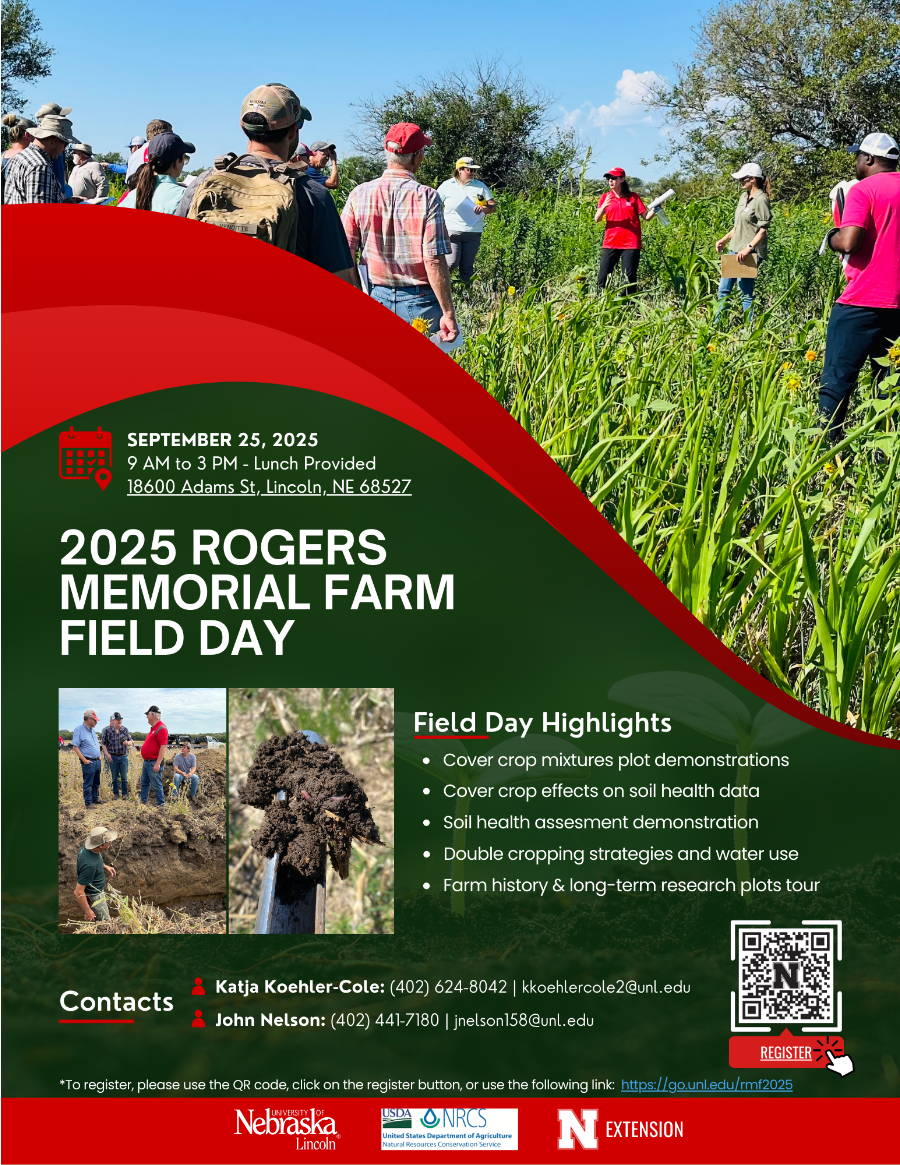
Alfalfa and Wheat Expo: Nebraska Extension is hosting the 2025 Southeast Nebraska Alfalfa & Wheat Expo on Friday, Sept. 19, from 8:30 a.m. to 3:30 p.m. at the Saline County Fairgrounds Office (1600 Tuxedo Park Rd., Crete). This one-day event is designed for wheat and alfalfa producers to gain practical insights, connect with experts, and sharpen their management strategies. Topics include: Equipment considerations for wheat production; Wheat disease updates and management strategies; Insights on achieving high-yield wheat in southeast Nebraska; Alfalfa irrigation, insects, weeds, and crop health management; Pesticide safety updates; Sponsor exhibits, networking, and raffle prizes. Come for the whole day or stop in for the sessions that fit your schedule. Register online at https://go.unl.edu/2025-alfalfa-wheat-expo or call the Saline County Extension office at 402-821-2151.

Harvest Soybean Moisture
What a beautiful September we’ve had thus far! Seed corn harvest has begun and non-irrigated corn is rapidly turning. Soybean harvest will most likely occur by this weekend the way early-season beans are turning.
One note, I’ve noticed droopy ears for several weeks now. It can be due to various environmental X genetic factors such as the high night-time temps coupled with cloudy weather both impacting photosynthesis with specific genetics. I also often observe ear droop to be associated with Fusarium crown rot. Estimated yield losses can be from 12-40% per ear (depending on if the shank pinching occurred during late or early dent stage, respectively). Also, scout fields for shank integrity and seek to prioritize harvest of fields with any increased risk of ear drop.
As we approach soybean harvest, perhaps a frustrating, yet important topic, is seeking to harvest soybeans as close to 13% (the elevator standard) as possible. The frustration is it seems to be such an art and luck in order to do so. For the last several years, it seems that the beans are often drier than what one realizes in spite of green stems and sometimes even leaves remaining on the beans. Test the beans for moisture earlier than you think they may be ready. There’s years like last year when I didn’t even bring this topic up with the hot, dry winds. Hopefully we don’t have a repeat of that.
To avoid beginning harvest when the soybeans are too dry, consider beginning harvest at 14% moisture making combine adjustments and operating at slower speeds as necessary. While there is a dock of around 2.5% for the first 2 points delivering wet beans (the percentage differs by Coops), delivering soybeans much below 13% moisture reduces profits because there’s fewer bushels to sell (load weight divided by 60 lbs/bu assuming 13% moisture). Selling soybeans at 8% moisture, you’re losing about 5.43% yield; at 9% moisture, it’s 4.4%; at 10% moisture, 3.3%; at 11% moisture, 2.25%; and at 12% moisture, it’s 1.14% yield loss. That doesn’t take into account additional risk for shatter losses during harvest. Only 4-5 beans on the ground can add up to a bushel/acre loss due to shatter. The following are profit examples for a field that’s yielding 75 bu/ac:
Example 1. If the grower was to sell beans at 13.8% moisture, he/she could be docked 2.5% of the selling price of $9.60/bu, reducing the actual price to $9.36 per bushel. Total income per acre would be: 75 bu/ac yield x $9.36/bu = $702 per acre gross
Example 2. If the soybeans were harvested at 9% moisture, there would be 3.3 fewer bushels per acre to sell (4.4% of 75 bu/ac yield due to water loss): 75 bu/ac – 3.3 bu/ac =71.7 bu/ac yield x $9.60 = $688.32 per acre gross. In this example it’s better to take a dockage for selling beans at 13.8% moisture than sell them at 9%. The difference is a positive gain of $13.68 per acre or around $1846.80 on a 135 acre field.
Example 3. If the soybeans were harvested at 12% moisture, there would be 0.86 fewer bushels per acre to sell (1.14% of 75 bu/ac due to water loss): 75 bu/ac – 0.86 = 74.14 bu/ac yield X $9.60 = $711.74 per acre gross. If you can’t hit 13%, it’s still pretty profitable to sell them for 12% moisture compared to the other examples.
One more note, we tend to see around 1 day delay in harvest for every 0.1 difference in maturity group. Here’s wishing you a safe and profitable harvest!


Various Resources
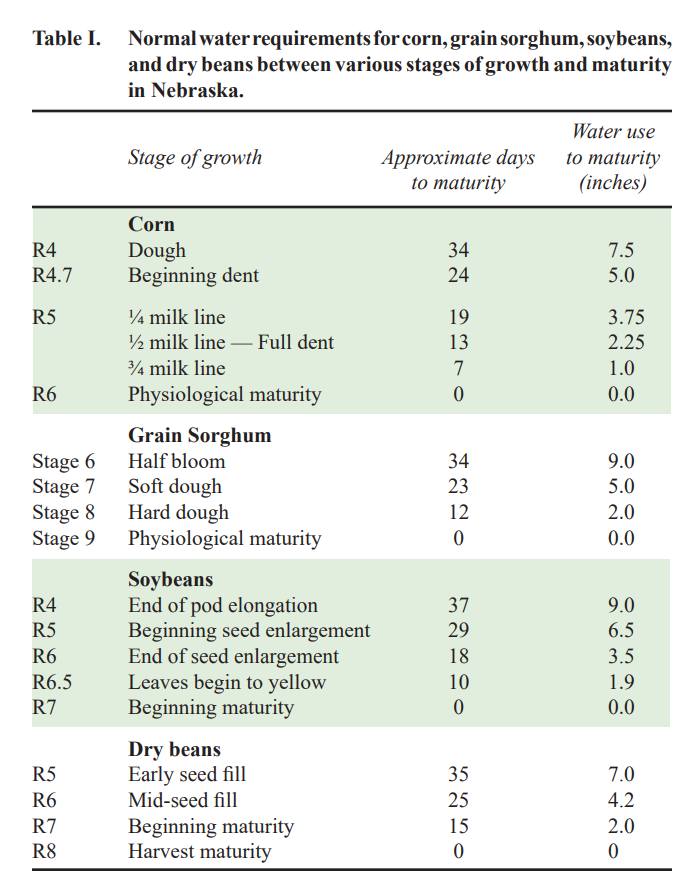
Water use till maturity for Corn: Beginning Dent 5”, ¼ milk 3.75”; ½ milk 2.25”; ¾ milk 1”.
Water use till maturity for Beans: Beg. Seed 6.5”; Full Seed 3.5”; Leaves beg yellow 1.9”.
The Nebraska State Fair is occurring and this past week/weekend was a full one for the 4-H side with FFA projects to be showcased next weekend! Extra special to me are the 4-H identification contests where youth compete to show their knowledge. This year, the York County 4-H youth received Champion Intermediate Horticulture ID team, Champion Intermediate Weed ID team, and Reserve Champion Senior Weed ID Team! So proud of all the youth who competed this year and in the past!
Southern rust of corn was the most frequent question I received last week. The recommendation from research shows there’s no additional benefit to spraying when the corn is two weeks prior to full dent. https://cropprotectionnetwork.org/publications/an-overview-of-southern-rust. Corn is also rapidly progressing in maturity due to the high night-time temperatures we’ve had. This results in corn plants burning sugars at night instead of filling kernels as deeply which can impact yields.

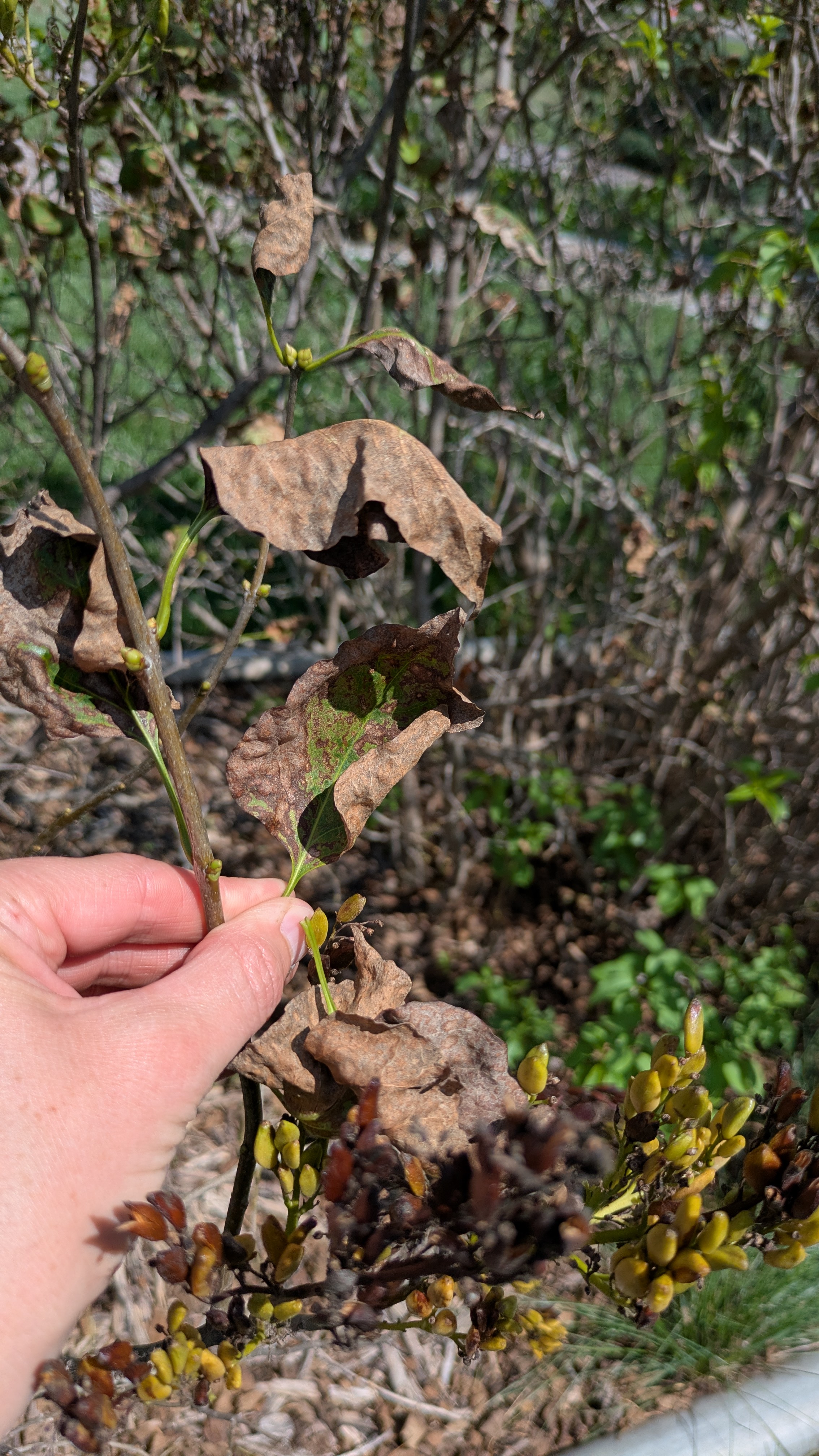
Leaf spot on lilacs: have received a number of calls about lilacs that appear to be “dying”. The culprit is pseudocercospora leaf spot, which is caused by a fungus. The leaves will brown and fall off the lilacs and you will most likely see new growth occurring. Stems are still pliable and buds are still green. Nothing to do other than to rake up the leaves that fall as the fungus can survive in the leaves for two years. More detailed information: https://extension.missouri.edu/media/wysiwyg/Extensiondata/Pro/PlantDiagnosticClinic/Docs/leaf-spot-on-lilac.pdf.
An additional note, fungal leaf spots are found on a number of trees and shrubs right now due to the humid conditions with heavy dew. You may observe impacted leaves fall off early with new growth beginning on the trees/shrubs. Again, nothing to worry about or do for now.
Fall Armyworms have been on the rise over the past few weeks in pastures, alfalfa, lawns, and some crop fields. It will be important to keep watching newly seeded small grain, alfalfa, and cover crop fields this fall. Caterpillars ¾ inch or longer are close to maturity and can be harder to control with an insecticide. There’s a number of conventional and organic insecticides that can be used. Products with 0 day grazing restrictions in pastures include Warrior II, Mustang Max, Beseige, and Prevathon. While it’s not updated, a Q/A for consideration can be found here: https://cropwatch.unl.edu/2021/fall-armyworms-pastures-alfalfa-small-grains-cover-crops-and-lawns/.
Resources: Wanted to share a number of resources. First, a reminder if you have a verbal crop lease you wish to terminate, that must be done by September 1st. More specific information here: https://cap.unl.edu/news/terminating-verbal-farmland-lease-nebraska/. We recommend transitioning verbal leases to written ones and a great resource to help you do that is Ag Lease101 https://aglease101.org/doclib/ where they have various free templates to help.
There have been a number of recent webinars regarding how the Big Beautiful Bill impacts ag. In case you missed them, here’s some recorded webinars:
- Impacts of the Big Beautiful Bill to Ag: https://cap.unl.edu/more-than-one-big-beautiful-impact-ag/
- Changes to Ag Taxes: https://cap.unl.edu/lets-talk-taxes-webinar/
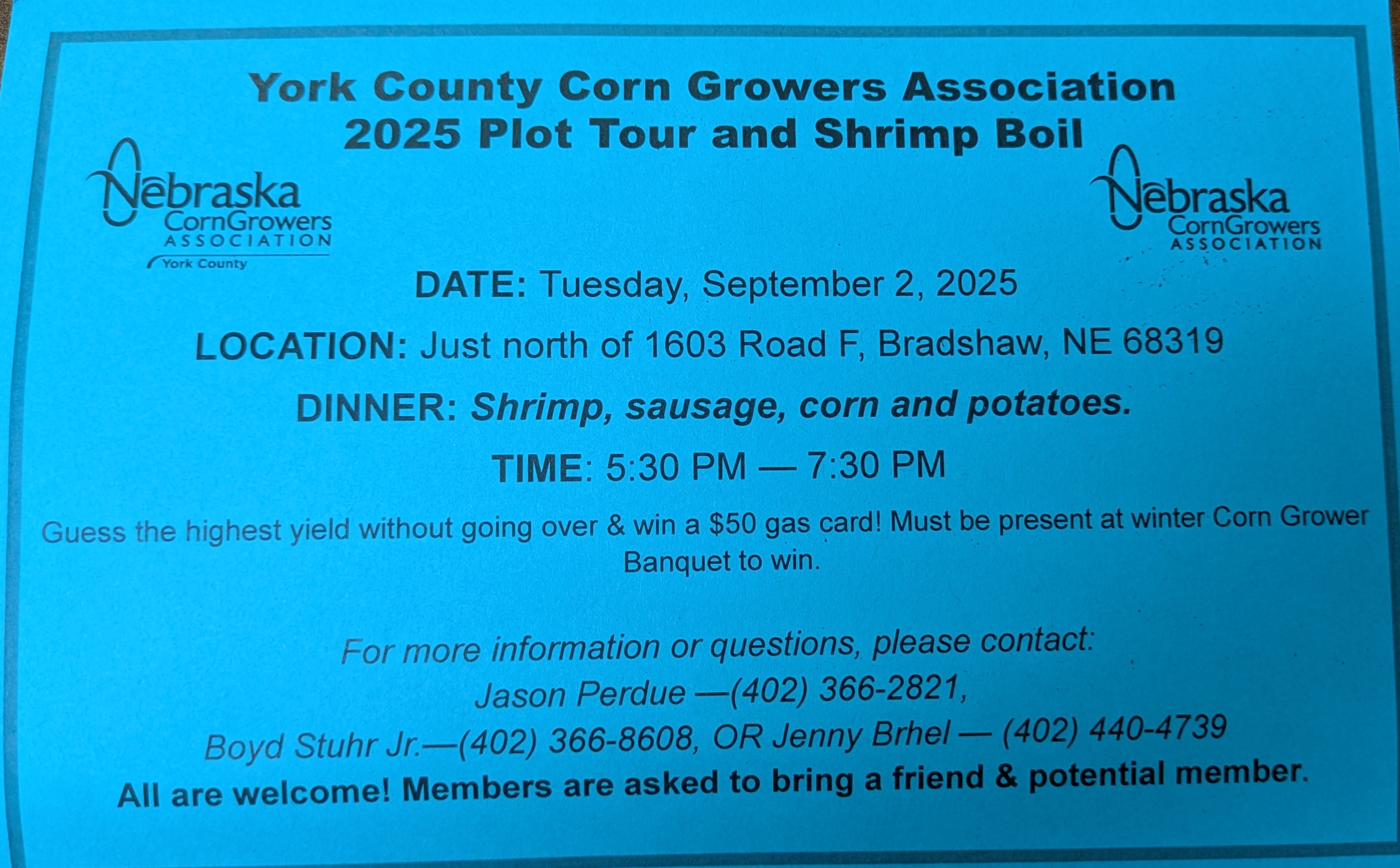
York County Corn Grower Plot Tour and Shrimp Boil will be held September 2, 2025 from 5:30-7:30 p.m. just north of 1603 Road F, Bradshaw, NE. Seed reps will showcase their hybrids, we’ll hear an update from Nebraska Corn, and enjoy a delicious shrimp boil meal (shrimp, sausage, corn, and potatoes). Guess the highest yield without going over and win a $50 gas card. Must be present at the winter Corn Grower Banquet to win. All are welcome! Members are asked to bring a friend and potential member.


Nebraska Soil Health Coalition
Soil Health Success Stories: This week I’m sharing on the Nebraska Soil Health Coalition. I’ve watched this effort since 2019 and am grateful for the leadership, vision, dedication, and endurance of the Board individuals who have successfully completed the beginning efforts of this Coalition! Some background from their website at: https://www.nesoilhealth.org/, “In recognition of the need to achieve more rapid and widespread adoption of soil health practices with multiple benefits, the Nebraska Legislature passed LB 243 in 2019. The legislation created a 17-member Healthy Soils Task Force (HSTF) task with developing a Nebraska Healthy Soils Initiative. The Healthy Soils Task Force concluded that healthier soils produced through best soil management practices improve yield stability, produce greater financial returns over time, reduce the need for chemical inputs, increase water infiltration rates and water storage capacity making soil more resilient to drought, flooding, and erosion, and protect and improve water quality.”
“In May of 2023 a group of committed individuals decided to establish an independent, non-profit Soil Health Coalition in Nebraska. The purpose of the Coalition is to advance producer-centered education, outreach, and adoption of soil health principles to build resilient farms, ranches, and communities across Nebraska.”
What I appreciate is the three-pronged, four metric approach that is different than what has been built in other states. The three prongs include: producer learning communities, demonstration/education sites, stakeholder visioning groups. The fourth metric includes Outcomes (soil health benchmarks, improved economics, community growth, success stories).
The other difference is the building of “Hubs” that include producers and stakeholders (medical, financial, consulting, community, etc.) in the surrounding communities of around a 9-county area. Hub 1 began in the Hastings and surrounding area with Hub 2 rolling out now in Southwest NE.
The producers participated in economic interviews with the Soil Health Institute (SHI) and socio-behavior interviews with Dr. Julie Snorek. Why is this important? SHI seeks to quantify economics of conventional vs. regenerative ag practices. By interviewing producers in a similar region, the economics and practices of that region can better be quantified and relevant to those producers.
What was learned? 20 farmers who had adopted soil health management strategies for at least 5 years (cover crops, reduced tillage, Sentinel Ag, etc.) were interviewed. For irrigated corn/soybean, it was found that overall, producers were able to reduce expenses by adopting soil health practices by a total of $147.19/ac for corn and $88.27 for soybeans. Added value from revenue such as grazing provided a total value of soil health practices of $152.94/ac for corn and $89.73/ac for soybean. Non-irrigated corn soybean saw a total value of $197.80 for corn and $102.12 for soybean for adopting soil health management practices. The full fact-sheet can be found here and is worth a read!
On the socio-behavioral side, the producers shared about isolation in adopting practices different than their neighbors, the importance of producer learning communities/peer networks to be vulnerable in sharing successes and failures, independence they felt in reducing the need to pay entities for inputs, farming being more fun/interesting in trying different practices, and also the need for alternative markets. The joy for me in attending the Celebration Event last week was seeing a glimmer of the hard work and dedication of the Board realized with producers and stakeholders presenting outcomes and the ability to have economics around these topics that are meaningful to Nebraska producers. Our hope is that more producers who are watching on the fringes will join us in adopting soil health practices in the future! More info. at: https://www.nesoilhealth.org/.
Water use till maturity for Corn: Beginning Dent 5”, ¼ milk 3.75”; ½ milk 2.25”; ¾ milk 1”.
Water use till maturity for Beans: Beg. Seed 6.5”; Full Seed 3.5”; Leaves beg yellow 1.9”.


Register now to reserve your seat: https://cvent.me/WMzLdk.
Cloudy Days and Corn Tip-Back
Received a number of questions about tip-back in corn and also how the cloudy/smoky days could impact yields. First wanted to mention the difference between pollination concerns vs. tip-back concerns.
Pollination concerns are when the green silk remains attached to the ovule that should have formed a kernel if it had pollinated. Gently husking back an ear and shaking it will reveal where pollination occurred on the ear where the brown silks detach. Green silks remain attached where pollination did not occur. Tip back is when the ovule pollinated but the kernel later aborted (looks shrunken/shriveled) due to some reason, often some type of stress.
This week’s UNL CropWatch shared yield potential for different places in the Midwest using weather modeling and comparing it to a 30-year average. The data clearly shows low solar radiation (which includes photosynthetically active radiation (PAR)), meaning photosynthesis is reduced. In spite of that, the article is suggesting for non-irrigated corn, nearly 100% of above-average yields for the Beatrice area, and nearly 75% chance of above-average yields near the Clay Center and Mead areas. For irrigated corn, it’s estimating 50% near-average yields for Clay Center, 75% near-average yields for Beatrice, and 50% above-average yields for Mead. These estimations are just based on weather and don’t account for stand losses, disease, insects, etc. The full article is at: https://go.unl.edu/tkz6.

Dr. Roger Elmore and Dr. Tom Hoegemeyer wrote a CropWatch article several years ago about the impacts of cloudy days on different stages of corn development. The full article can be found at: https://go.unl.edu/sv06 and the following are excerpts from it.
“Early et al., 1967,…shaded plants around the “reproductive phase” for 21 days as well as during the “vegetative stage” for 54 days and the “maturation phases” for 63 days. Shading during reproductive stages reduced plant yields the most, but 30% shading during the maturation stages ― what we consider the seed set and grain-fill periods (R2-R6) ― not only reduced yield per plant 25% to 30% but also reduced kernels per plant and the amount of protein per plant.
Researchers in a new study shaded plants from silking to maturity (R1-R6) (Yang et al., 2019). They also found reductions in yield and biomass with more shading resulting in more losses. Shading reduced yields more with higher plant populations than with lower populations.”
If you’re seeing tip-back concerns, it could be due to the consecutive days of cloudy skies reducing photosynthesis. But it’s also important to understand the hybrids in your fields. Hybrids are very specific in how they handle stress such as heat, drought, and cloudy weather during and shortly after pollination. Some hybrids have long ears, and in counting kernels, 30-40 kernels per row with a 1-2” tip-back may be “normal”, especially if there are a larger number of rows around for a decent total kernel number per ear. Plant populations also can play a roll in tip-back. So, not all tip-back is a concern. Knowing the hybrid and counting total kernels per ear can tell a bigger story. We will have to wait and see how the remainder of the grain fill season progresses to better understand any potential yield impacts from the cloudy days.


August 2025 Events
Thank you to all who helped make the 2025 York County Fair a success! I didn’t get out to the fields this past week so sharing reminders on some upcoming field days.
Aug. 5 Grazing Cover Crops Field Day of area farmer Alex Daake will be held from 4-6 p.m. at 4136 Superior Rd. near Utica, NE. Alex split a pivot into 4 quarters where he rotates corn, soybeans, rye for seed, and grazed cover crops. The focus will be primarily on what he’s doing for grazing covers and the economics of this system where pasture is limited for cattle production. Alex also has an on-farm research nitrogen study on the corn portion of this pivot where he’s looking at reducing nitrogen inputs due to the grazed cover crops. He’s monitoring the nitrogen strips with Sentinel Fertigation. If you’re interested, you’re welcome to RSVP to jrees2@unl.edu. Walk-ins are also welcome and cookies/water will be provided by Nebraska On-Farm Research.
Aug. 7 South Central Ag Lab Field Day will be held 8:45 a.m.-3:10 p.m. (Registration at 8:30 a.m.) Attendees can tailor their schedule by selecting from various presentations and interactive demonstrations (Irrigation, Diseases, Insects, Weeds (including robotic weeders), Nutrients). There is no charge and CCA credits will be provided. Please RSVP at: go.unl.edu/scalfieldday.
Dan Snow is the keynote speaker and will discuss nitrate challenges in groundwater. This talk will cover findings from a study with the Upper Big Blue NRD and UNL focusing on nitrate and agrichemical levels in the vadose zone across 12 water quality management zones. Lunch talks also feature a farmer panel discussion, providing an opportunity for attendees to engage and interact at the local level.
The SCAL Research Farm is located at 851 Hwy. 6 near Harvard, NE. Directions: 13 miles east of Hastings on Hwy. 6 or 4.5 miles west of the intersection of Hwy. 14 and Hwy. 6 north of Clay Center. Field day GPS coordinates: 40.575256, -98.137824. More info please call (402)762-3536.
Soybean Management Field Days will be held Aug. 12-15. Topics will vary by location and the first three days are twilight tours from 6-8 p.m. There is no charge but registration is requested two days in advance at: https://enreec.unl.edu/soydays/.
- Tuesday, Aug. 12 – Ravenna, NE. Lonnie and Scott Bohn farm 6:00 p.m. to 8:00 p.m. (5:30 p.m. – Registration)
- Wednesday, Aug. 13 – Concord, NE. UNL Haskell Ag Lab 6:00 p.m. to 8:00 p.m. (5:30 p.m. – Registration)
- Thursday, August 14 – Weeping Water, NE, Rick Meyer farm 6:00 p.m. to 8:00 p.m. (5:30 p.m. – Registration)
- Friday, August 15 – Mead, NE, UNL Eastern Nebraska Research, Extension & Education Center – (10:00 a.m. – Registration)
Aug. 25 Regenerative Ag Field Day will feature area farmer Jordan Uldrich. The field day will be from 10 a.m.-Noon, ½ mile east of 1606 County Road J, Geneva, NE. Lunch will be provided following the field day. Jordan has interseeded cover crops into his corn to aid with soil health and weed management. He will also discuss the economics of alternative farming practices. For more information, please call Andrew at 402-590-7096.


 JenResources