JenREES 11-10-19
With harvest wrapping up, many of the questions/conversations this week involved economics in some way. So this week’s column will focus on upcoming learning opportunities. But before I get to that, thank you to all our veterans for your service and sacrifices! Thank you also to your families!
Ag Land Management Webinar: On Monday, November 18th at 6:30 p.m., Jim Jansen, an agricultural economist, and Allan Vyhnalek, a farm and ranch succession specialist, will lead their final ‘Agricultural Land Management Quarterly’ webinar of the year. They will provide an overview of the 2019 Cash Rental Rate Survey, conducted by the USDA National Agricultural Statistics Service, and discuss prevented planting considerations for Farm Service Agency programs and crop insurance. The importance of landlord/tenant communication during the winter months and tips for leasing also will be discussed. The free session is open to everyone at https://agecon.unl.edu/landmanagement. The recorded webinar will be archived there, along with past sessions. There will be time for participants to ask questions at the end of the session. Questions also may be submitted in advance at https://agecon.unl.edu/landmanagement.
Dr. Kohl to present at Farmers and Rancher’s College: On December 9th Dr. David Kohl, Professor Emeritus at Virginia Tech and popular for his insights, will be presenting at the Bruning Opera House in Bruning from 1-4 p.m. about “Agriculture Today: It is What it is…What Should We Do About It”. There is no charge for the program due to the Farmers and Rancher’s College sponsors, but please RSVP for meal at: (402) 759-3712 or online at: https://extension.unl.edu/statewide/fillmore/agriculture-0/.
Women Managing Ag Land Conference: Female agriculture landowners, farmers, and ranchers looking to increase their business management skills are encouraged to register for the 2019 Women Managing Agricultural Land conference. The conference will be held Dec. 11 at Nebraska Innovation Campus, 2021 Transformation Drive in Lincoln. Participants will have the opportunity to hear from leading experts in land values, Nebraska property taxes, cash rental rates and cultivating landlord-tenant relationships. Jim Jansen, co-author of the Nebraska Farm Real Estate survey, will discuss trends in Nebraska land values. Mykel Taylor, of Kansas State University, will share resources related to negotiations and communication between landowners and tenants. Cathy Anderson, from the Nebraska USDA Farm Service Agency, will discuss the 2018 Farm Bill and its implications for Nebraska agriculture. The full conference schedule and registration form are available at https://wia.unl.edu/wmal. A registration fee of $45 per person covers materials, meals, and breaks. The conference is hosted by Nebraska Extension and is inspired by Annie’s Project. In Nebraska, Annie’s Project is supported by Farm Credit Services of America. Also, a reminder that all Farm Bill information and upcoming meetings can be found at: http://farmbill.unl.edu.
Cover Crop Day: On November 20, a workshop focusing on cover crops will be held from 9 a.m.-1 p.m. (Reg. 8:30) at the 4-H Building in York. Presentations from NRCS, UNL, and Pheasants Forever will cover using cover crops to address soil compaction and improve soil health; precision conservation opportunities to increase farm profitability while conserving soil, water, and wildlife; and opportunities for cover crop on-farm research and cost share options. A free meal and optional field tour is provided but please RSVP to: http://nebraskapf.com/product/cover-crop-field-day-habitat-tour/
or call the Extension Office at (402) 362-5508.
On-Farm Research Searchable Database: A helpful resource to view studies growers’ peers have conducted with the economics provided can be found at https://resultsfinder.unl.edu. It’s a little picky based on the words one chooses, but has a lot of great info. Also, for anyone interested in conducting studies involving anhydrous with and without inhibitors this fall or spring, I have on-farm research protocols developed, so please let me know.
Women Managing Ag Land Conference
This would be a very helpful conference for any woman currently managing land or interested in learning more about managing land in the future. Great networking opportunity as well!

There are many women whether by choice or chance who manage agricultural land. For some, it is their livelihood and business. Other women might have inherited land from a family member and there are also women who just want to learn more about the agricultural business in partnership with a spouse or family member. No matter what the circumstance, Nebraska Extension will be providing a program to equip women with necessary management skills.
 Photo by Kaboompics .com on Pexels.com
A recent news release came out which shared that any female agriculture landowners, farmers, and ranchers looking to increase their business management skills are encouraged to register for the 2019 Women Managing Agricultural Land conference. The conference will be held Dec. 11 at Nebraska Innovation Campus, 2021 Transformation Drive in Lincoln.
The first-ever Women Managing Agricultural Land Conference will allow women to build relationships with each other, attend workshops and gain…
View original post 164 more words
JenREES 11-3-19
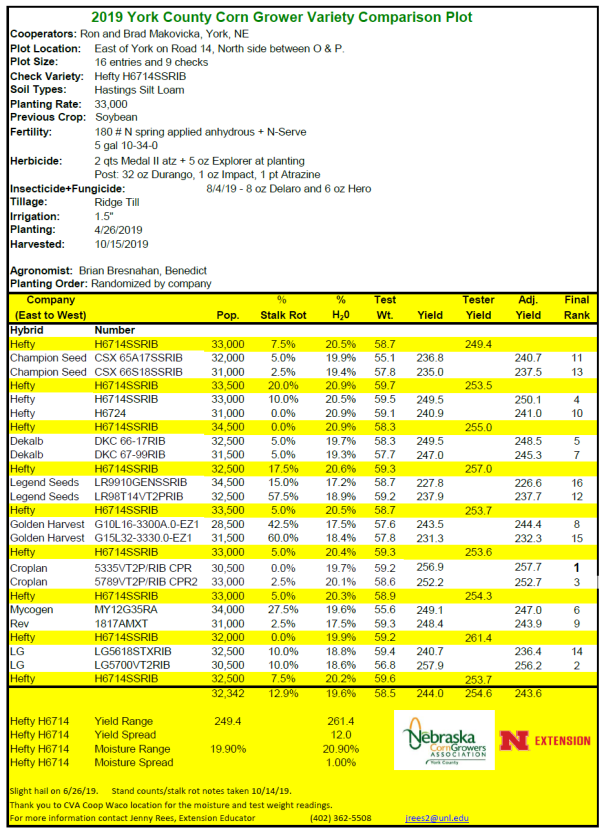
York County Corn Grower Plot Results and Banquet: The results of the York County Corn Growers plot can be found at: https://jenreesources.com/2019/11/03/2019-york-county-corn-grower-plot-results/. Special thanks to Ron and Brad Makovicka for their  dedication and work in hosting! Also appreciate all the seed companies who participate! The York County Corn Grower’s Banquet will be held Tuesday, November 26 at Chances ‘R in York with social at 6:30 p.m. and dinner at 7:00 p.m. Tickets are $10 and may be purchased from any York Co. Corn Grower director or at the York Co. Extension Office.
Fall Nitrogen Application: With November here, a reminder to check soil temperatures before applying anhydrous ammonia to crop fields. Soil microbial activity and the rate of conversion of ammonium to nitrate is very low when the soil temperature is less than 50oF. Thus, apply fertilizer-N (and manure) when the soil temperature at the 4” soil depth is below 50°F and trending cooler. Daily and weekly soil temperatures (taken 4” below the surface of bare soil) can be found at: https://cropwatch.unl.edu/soiltemperature.
Extension Soil Fertility and Nutrient Management Specialists Javed Iqbal, Charlie Wortmann, Bijesh Maharjan, and Laila Puntel shared additional considerations for fall Nitrogen application in this week’s CropWatch: Apply anhydrous ammonia rather than other N fertilizers; Limit fall application of N to silt loam, silty clay loam, and finer textured soils; Use nitrification inhibitors to slow the conversion of ammonium to nitrate, especially on sand-dominant soils; Avoid fall application on wet soils; and Consider applying a lower base rate of nitrogen in the fall and plan on applying the rest at planting, or as a side-dress application.
On-Farm Research Protocols are available for anyone interested in fall vs. spring nitrogen management studies, inhibitor studies, or other potential on-farm research studies by contacting your local Extension educator. For growers within the UBBNRD interested in on-farm research studies that have a water quality focus, you may be eligible for additional support through the UBBNRD. In some instances it may cover district staff and equipment use; in others, it may cover a portion of the costs of lab analysis of soil, plant tissue, or water samples. If you’re a grower interested in this type of study, please contact the UBBNRD or your local Extension Educator to talk through your study idea and for additional information.
Farm Bill Meetings: Joint Nebraska Extension and Nebraska Farm Service Agency (FSA) producer education meetings are scheduled at 28 locations across the state from late November to mid-December in advance of the coming ARC/PLC enrollment deadlines in early 2020. The meetings are free and open to the public. Advance registration is encouraged for planning purposes for materials and facilities. Attendees can register for any of the meetings conveniently on the web at farmbill.unl.edu or by calling or visiting their county FSA or Extension office. The educational programs will feature information and insights from FSA specialists and Extension experts, as well as other relevant information from local agencies.
Nearest locations for this area of the State include: Nov. 25. Community Center, Red Cloud (1-4 p.m.); Dec. 3 ENREC near Mead (9-Noon); Dec. 4 Ag Park in Columbus (9-Noon); Dec. 5 College Park in Grand Island (1-4 p.m.); Dec. 5. Opera House, Bruning (1:30-4:30 p.m.); Dec. 6 Fairgrounds Cornerstone Building York (9-Noon); Dec. 16. Extension Office Lincoln (9-Noon); Dec. 17 Fairgrounds 4-H Bldg. Beatrice (9-Noon); Dec. 17 Fairgrounds in Kearney (1-4 p.m.).
2019 York County Corn Grower Plot Results
Special thanks to Ron and Brad Makovicka for their dedication and work in hosting the York County Corn Grower Plot! Thank you also to all the seed companies who support this effort!
JenREES 10-26-19
Fall Weed Control: With snow in the forecast and harvest wrapping up for some, I received a couple of questions regarding how cool weather and frost impact fall weed control. Following is a portion of what Dr. Amit Jhala and I shared in CropWatch a few years ago. Applying herbicides in the fall for control of winter annual weeds or other fall-emerging weeds can be an important tool for weed control. Some winter annual weeds also serve as hosts for pathogens like soybean cyst nematode (SCN): purple deadnettle (strong host), henbit (strong host), field pennycress (moderate host), shepherd’s-purse (weak host), small-flowered bittercress (weak host), and common chickweed (weak host). SCN can reproduce in the field on henbit and purple deadnettle.
Fall herbicide application isn’t necessary in each field. It’s important to scout fields for current weed pressure. Also consider targeting fields that have a history of winter annual weeds or marestail. Recent Nebraska research shows that up to 95% of marestail (horseweed) germinates in the fall, so fall application is the primary way to help manage marestail. Tank-mixing a residual herbicide with a burndown product will improve marestail control because the residual activity will control marestail emerging after herbicide application. Be sure to check labels for any grazing restrictions if livestock will graze cornstalks after a fall herbicide application. If the label doesn’t specify and you want to be on the safe side, a rule of thumb is to use the pre-harvest interval for the amount of time to wait before grazing stalks.
The likelihood of reduced weed control due to cool temperatures will vary depending on the target weed, herbicide, and rate of application. The ideal temperature for applying most post-emergence herbicides is between 65°F and 85°F; however, that window is not always practical with other fall practices. Herbicides can be applied at temperatures of 40°F to 60°F, but weeds may be killed slowly. When the temperature is below 60°F, absorption of herbicides such as glyphosate and translocation of herbicides such as 2,4-D are lower compared with applications at higher temperature; therefore, they act slowly. When the temperature is below 40°F for an extended time after burndown herbicide application, weed control will most likely be reduced, specifically for a systemic burndown herbicide such as glyphosate. Additionally, weed control may be reduced under cloudy conditions following an initial temperature drop below 40°F. With late-fall herbicide applications be sure to add labeled adjuvants to improve herbicide efficacy. For example, if you are planning to apply 2,4-D, add crop oil concentrates at 1% v/v (1 gallon per 100-gallon spray solution) or non-ionic surfactant at 0.25% v/v (1 quart per 100-gallon spray solution). Spray volume should be 15 gallons per acre for better coverage when a dense weed population is present.
Actively growing weeds are key to achieving good control, whatever herbicide you use. When weeds are under stress, herbicide efficacy drops. Frosts of less than 25°F usually cause leaf damage to annual plants, making them poor targets for herbicide applications; however, winter annual weeds may tolerate a frost up to 20°F and continue growing when conditions improve, with little tissue damage. Symptoms of frost damage to leaves are a water-soaked appearance shortly after the frost. After weeds experience frost, active growth may not begin again for a few days. Growers should wait until new leaf tissue is produced, scout the field, and then consider applying herbicide. Generally, this would be when nighttime temperatures are 35°F or greater and daytime temperatures are at least 50°F for two consecutive days. Additionally, sunshine is needed for plants to recover.
Dr. Kohl to present at Farmers and Rancher’s College: A date you may wish to save on your calendar is December 9th as Dr. David Kohl, Professor Emeritus at Virginia Tech and popular for his insights, will be presenting at the Bruning Opera House in Bruning from 1-4 p.m. about “Agriculture Today: It is What it is…What Should We Do About It”. There is no charge for the program due to the Farmers and Rancher’s College sponsors, but please RSVP for meal at: (402) 759-3712 or online at: https://extension.unl.edu/statewide/fillmore/agriculture-0/.
JenREES 10-20-19
Crop Update: So grateful for this past week’s weather in aiding harvest progress! Also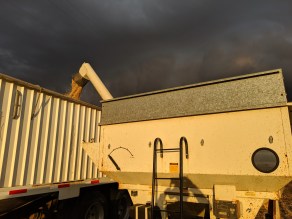 grateful to all the growers who worked with me in on-farm research this year and for all the studies harvested this past week!
One of the more frequent questions/comments I’ve received the past few weeks is regarding yields. It sounds like irrigated yields for corn and even soybean are around 5-15% lower than what farmers hoped for in this part of the State. Most aren’t necessarily ‘bad’ yields, just not what was desired. Irrigated corn is mostly going 225-245 bu/ac with high-yielding genetics and everything else aligned correctly going 250-265 bu/ac. And, as more fields are harvested, there may be some better yields due to the long grain fill period. There’s irrigated fields of soybeans that did 50-60 bu/ac. What is positive is non-irrigated yields for both corn and soybeans with non-irrigated beans sometimes out-yielding the irrigated ones.
The impacts of the difficult cold, wet planting season could be seen season-long in fields
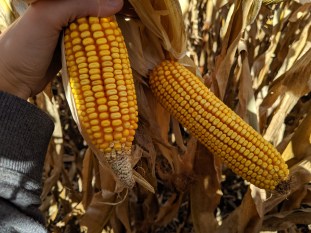
Plant to plant variability impacting kernels/ear.
with uneven plant emergence and eventually variable ear height and kernels/ear. That plant to plant variability can add up to yield impacts more than one realizes. There’s also field variability due to ponding/flooding in fields, hail/wind damage, and additional challenges during harvest with wind and moisture leading to lodging and/or ear loss and some soybean shatter.
The high humidity and leaf wetness along with cool, wet weather allowed for more disease in both corn and soybean. Perhaps one reason why non-irrigated corn and soybean are yielding well was due to reduced disease pressure from reduced plant population and increased air flow. I know of a handful of irrigated soybean fields in 2019 planted on seed corn acres where, to the line, the soybean on seed corn had more sudden death syndrome (SDS) pressure and less yield than the soybean on soybean corners of fields. I had never before seen this so striking.

Same soybean variety. Yellow area is soybean planted on seed corn residue under pivot with heavy SDS pressure. Green area to the line is soybean on soybean in pivot corners.
My hypotheses: 1-Test for soybean cyst nematode in the seed corn acres vs. corners. Anything that will move soil will move SCN, including equipment. 2-Fusarium virguliforme (pathogen that causes SDS), reproduces best on corn kernels followed by corn residue, followed by soybean seeds and residue. Even if the seed corn acres had a cover crop and were grazed, cattle don’t easily pick up loose kernels lost to the 2018 hail storm or harvest loss. 3-SCN in the field + great conditions for SDS in 2019 allowed for synergistic effect of more SDS and yield loss.
Cloudy weather also played a role in photosynthesis and ultimately yield. Dr. Roger Elmore and colleagues shared the following research on shading and yield impacts. “Many researchers have investigated the effects of lower solar radiation on corn using shade cloth of different densities. These can effectively block solar radiation by 10% to 90% or more (e.g., Schmidt and Colville 1967, and Reed et al. 1988). Invariably they found that shading the crop two to three weeks after silking (R1) reduced yields more than shading before R1. Most also find that hybrids differ in their responses to shading.” (This can help explain the tip back due to kernel abortion some of you asked me about after pollination). “Very few researchers used shade cloth during the grain-fill period, which would be similar to the reduced solar radiation period central Nebraska experienced the third week of August.
Early et al., 1967, shaded plants around the “reproductive phase” for 21 days as well as during the “vegetative stage” for 54 days and the “maturation phases” for 63 days. Shading during reproductive stages reduced plant yields the most, but 30% shading during the maturation stages ― what we consider the seed set and grain-fill periods (R2-R6) ― not only reduced yield per plant 25% to 30% but also reduced kernels per plant and the amount of protein per plant. Researchers in a new study shaded plants from silking to maturity (R1-R6) (Yang et al., 2019). Shading reduced yields more with higher plant populations than with lower populations.” (This may also help explain why non-irrigated fields with lower plant populations may have good yields in spite of cloudy conditions in 2019).
JenREES 10-13-19
Crop Update: The sunshine, hard freezes, and wind are helping dry things out. Grateful this week looks favorable for harvesting! Please continue to think safety. With the increase of late season diseases this year, I’ve been hearing reports of combines turning orange and/or black from fungal spores and running hot. This week’s CropWatch at https://cropwatch.unl.edu addresses fire safety during harvest if you’re interested in checking out those tips. Masks/respirators may help those affected by fungal spores.
The rains/humidity and also Fusarium/Gibberella fungal growth (which produce

giberellins) have allowed for some kernel sprouting on ears over the past month. Sprouting can occur anywhere on the ear, particularly at the base or places where hail and/or insect damage occurred. Upon reaching maturity, hormone levels within the kernels change allowing for higher levels of gibberellin compared to low/no abscisic acid. This gives kernels the ability to sprout. We just prefer not to see this in fields prior to harvest; thus, you may wish to alert your crop insurance adjuster of these situations. Be aware sprouted kernels lead to higher kernel damage and can increase fines in a load. These kernels may also be lighter and blown out the back of the combine. In case they’re not, drying to 14% will help kill the sprout and be sure to monitor stored grain closely for hot spots, mold, and additional sprouting grain.
Soybean and Freeze: Prior to the frost, I was receiving questions about yield loss to soybean at various growth stages, including, how to determine R7 (physiological maturity). Dr. Jim Specht took the lead on two CropWatch articles this week to address these questions. Ultimately, for each pod, physiological maturity occurs when the pod membrane no longer clings tightly to seeds in that pod. For pods still at R6 (green bean stage with membrane clinging to seed), yield loss can be significant, anywhere from 35-50% depending on if the plant is in early or late R6. At R7, 0-5% yield loss is expected.
Oct. 16 Ag Bankruptcy Webinar: Lower commodity prices, extreme weather, and ongoing trade tensions in world markets have contributed to widespread financial strain throughout American agriculture. The American Farm Bureau Federation recently reported that “the delinquency rates for commercial agricultural loans in both the real estate and non-real estate lending sectors are at a six-year high” and that Chapter 12 bankruptcies increased the previous year in all but one region of the country. Recently, the Bankruptcy Code was amended to ease eligibility requirements for family farmers considering filing for Chapter 12 bankruptcy. A webinar on October 16th from 11-Noon (CST) will provide a basic introduction to Chapter 12. It will discuss eligibility requirements, advantages of filing a Chapter 12 over other types of bankruptcy, and uses of a plan to make changes in the farming operation. For more information and to register, please go to: https://nationalaglawcenter.org/consortium/webinars/chapter12/.
Horticultural Plants and Frost: While many plants succumbed to the hard frosts, some protected plants did not. I’ve been asked when should perennial foliage be cut back in the fall. The answer is to wait until a hard freeze kills the foliage. This is because photosynthesis is still occurring on plants with green foliage, so carbohydrates and sugars are being moved to roots for winter storage, increasing plant vigor for next spring. You can also leave the foliage till early spring for winter interest.
Vegetables/Fruits and Frost: Rhubarb should not be harvested or eaten when leaves are wilted and limp and stalks become soft/mushy after a hard freeze. Otherwise, there’s no toxicity concerns with other vegetables/fruits after frost. The texture and storage potential of other vegetables are affected by freezing temperatures, such as lettuce, peppers, summer squash and sweet potatoes. Some vegetables may actually improve in flavor following freezing temperatures, including parsnip, Jerusalem artichoke and horseradish.
JenREES 10-6-19
As I reflect, it was a hard week for many of you in our farming community with the weather and harvest delays. Many of us would say the challenges of 2019 actually started in the fall of 2018. From that perspective, it’s been an extra hard year! As we continue with a delayed harvest, I’m truly hoping the fall of 2019 doesn’t result in an extra challenging 2020 as well. I’m sure that’s a hope for us all!
It’s amazing how something as simple as the sun shining or incredible sunrises on then dreary, drizzly days lifted my spirits and the spirits of many of you I spoke or texted with this past week. For those who receive my email newsletter, you’ve seen me share each week a set of tips to consider for help in relieving stress/changing current mindset based on how much time you have in the day. And, some of you have rightfully put it back on me when I’ve needed a mindset change! While you may not want to take 30 minutes or even 10 minutes, we all have 2 minutes. So, my challenge for all of us is utilize one of the following tips for two minutes or use something else that works for you each day this week to change our mindset/lift our spirits when needed. Two minute tips (Adapted from: Gilbert Parra, PhD; Holly Hatton-Bowers, PhD, and Carrie Gottschalk, LMHP, MS): Breathe; Stretch; Laugh; Doodle; Acknowledge one of your accomplishments; Say no to a new responsibility; Look out the window (or go outside); (adapted) Faith based prayer. Please go to jenreesources.com for the full list.
Soybean Cyst Nematode (SCN) Sampling: With the increase in sudden death syndrome this year, several have asked for soybean cyst nematode sampling bags (as the two diseases are synergistic with each other). Free sampling is via the Nebraska Soybean Board through your soybean checkoff dollars. Sampling bags can be obtained from your local Extension Office or call 402-472-2559 to obtain bags. Crop consultants should contact Extension Plant Pathology directly (402-472-2559) for larger numbers of sample bags. Samples should be done for areas 40 acres or less (less is better). If you had areas with higher SDS this past year or places where yield maps showed lower yields, plan to take a sample from those areas of the field. Also take a sample from a good yielding area of your field for comparison. Take around 20 cores 6 to 8” deep. If you or an agronomist is taking soil samples, taking a few extra cores will allow for part of the sample to be sent in for fertilizer recommendations and the other part for SCN. Make sure to thoroughly mix the cores collected before transferring to sample bags. If you take them from a soybean field, taking the sample a few inches off the old soybean row may provide the highest potential numbers if SCN is present in the field. However, SCN samples can be taken from corn or sorghum fields as well to help inform decisions if rotating to soybean next year. Other places in fields which may first show SCN include: low areas where water drains after rain; along a stream that periodically floods; along fence lines; field entryways or driveways as that’s the first place equipment enters from other fields. Anything that moves soil will move SCN.
Lawn Weed Control: Now is an excellent time for weed control in lawns, especially for dandelions, clover, ground ivy, and plantain. This is because carbohydrates are being transferred to the roots of perennial weeds and thus allows for the chemical to move to the roots as well. If using granular products that contain weed killer, they’re best applied on mornings with heavy dew and no rain in the forecast for 24 hours (however, read the herbicide label). Most herbicides labeled for use around the yard will contain 2,4-D and/or dicamba. I’m often asked for names but this is not an exhaustive list and not intended to exclude anything available (2,4-D, dicamba, Weed B Gon, Trimec Plus, Trimec Classic).
*End of News Column.
- Breathe
- Stretch
- Laugh
- Doodle
- Acknowledge one of your accomplishments
- Say no to a new responsibility
- Look out the window
- (adapted) Faith based prayer
- Listen to music
- Have a cleansing cry
- Chat with a co-worker, friend, or family member
- Sing out loud
- Jot down dreams
- Step outside for fresh air
- Go for a brief walk
- Enjoy a snack or make a cup of coffee/tea
- (adapted) Read faith-based devotional
- Evaluate your day, Write in a journal
- Call a friend
- (adapted) Meditate, Prayer, Devotional
- Tidy your work area
- Assess your self-care
- Draw a picture
- Listen to soothing sounds/music
- Read a magazine
JenREES 9-29-19
Warm weather with sunshine this time of year prompts a tiny insect looking for final

Minute Pirate Bug (photo courtesy Jim Kalisch)
food before winter to cause a painful bite on humans. I’ve received several questions about “what is that tiny black bug with white marks on back that bites?” The insect, known as the minute pirate bug (and insidious flower bug), is actually a beneficial predator of thrips, mites, aphids, tiny caterpillars, and insect eggs. People will even purchase these insects for biological control, particularly in greenhouse settings. They’re found throughout crop, garden, landscapes, and wooded areas in the summer preying on other insects. However, this time of year they start biting humans they land on. One doesn’t need to worry about them injecting a venom, feeding on blood or transmitting disease. People’s reactions to the bites range from no reaction to swelling like a mosquito bite. Unfortunately there’s also no method of controlling them. Insect repellents don’t work as they aren’t attracted to carbon dioxide like mosquitoes are. They are attracted to light colored clothing, so wearing darker colors and long sleeves can help when being outdoors during warm, sunny days. Otherwise, work outdoors on cool, cloudy days.
Bagworms: This year was a heavy year for bagworms and I’m still receiving calls about treating for them as people find damage. We would recommend it’s too late to treat now as eggs have been laid in most bags at this point and insecticides, including systemic ones, won’t move inside the bags to kill any adults or eggs within the bags. Wherever feasible, you can reduce next season’s load by picking off bags and either squishing them or drowning them in soapy water. Simply throwing them on the ground doesn’t help. I was even finding bags that had dislodged from windbreaks in adjacent crop fields this year with larvae traveling back towards the windbreak! Between 500-1000 eggs can be found in one bag. Aim for insecticide applications next year when larvae hatch and feed, usually at some point in June.
Harvest Thoughts: Several times the topic of palmer amaranth came up this week while in the fields with palmer in patches or especially on field edges. I believe the first step of palmer management begins at harvest by choosing to not run the combine through those patches. Research from the southern U.S. showed 99% of palmer seed survives the combine and we also know the combine is very effective at seed dispersal. Several farmers have shared they could see the worst palmer spreading in their fields the following year where the first combine pass occurred. Research supports this. The highest number of new palmer plants counted in a field were found the successive year where the first combine pass occurred after combining a patch of palmer. So some suggestions to consider: 1-Consider disking or shredding patches of palmer. 2-Plant a small grain like rye or bin-run wheat into endrows and/or patches where palmer was present. Research has shown that burying palmer seed 3-4” and leaving it buried for 3 years can reduce germination 80-100%. I realize disking doesn’t necessarily go that deep and that it’s difficult for no-till guys to want to do any tillage. Shredding won’t kill seed, but it will keep the seed from going through the combine. The small grain will help reduce light interception to the soil surface next spring. That’s the #1 trigger for palmer germination-light penetration on bare soil.
Also, I realize it’s difficult to achieve, yet a reminder to check your beans and harvest as  close to 13% as possible. A number of fields last week even with green stems and some leaves remaining on lower plants were actually at 13% when harvested. Delivering soybeans below 13% reduces profits while there’s a dock for delivering wet beans. While not a dock, less than 13% moisture results in fewer bushels to sell (load weight divided by 60 lbs/bu assuming 13% moisture). Selling soybeans at 8% moisture, you’re losing about 5.43% yield; at 9% moisture, it’s 4.4%; at 10% moisture, 3.3%; at 11% moisture, 2.25%; and at 12% moisture, it’s 1.14% yield loss. That doesn’t take into account additional risk for shatter losses during harvest. So another consideration as we consider economics and profitability this year.
JenREES 9-22-19
Harvest: Grateful to see harvest going last week! There’s a good article in CropWatch from Roger Elmore, Tom Hoegemeyer, and Todd Whitney regarding how cool weather and reduced solar radiation (sunlight) in August impacted yields. Part of our problem with stalk quality is also due to this. Yield potential can be reduced by cool, cloudy weather yet it can also increase grain fill period allowing for heavier ears as we’ve also seen. You can read the article with full details at https://cropwatch.unl.edu. We would also ask for your input regarding the most important weed problems/issues in your part of the State by completing this survey at: https://www.surveymonkey.com/r/QZV8Z2T.
A reminder for all of us to please be safe during harvest! It was sobering scrolling
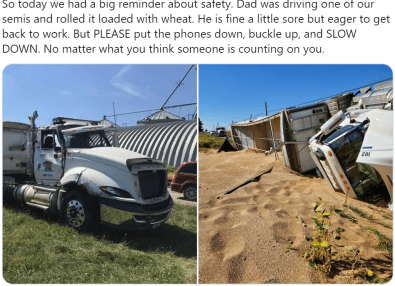
From Ag Twitter Sept. 18, 2019
through Ag Twitter last week seeing the number of people posting pictures of farm accidents. Most common were truck drivers taking corners too quickly, overturning vehicles. It was extra sobering that some of the accidents led to death of family or friends. Others posted remembrances of this time of year when they lost someone due to a farm accident.
For all of us as we’re on the roads,

From Ag Twitter Sept. 19, 2019
please be alert and slow down. It’s also important to talk about safety with teens who drive. Gravel roads are especially dangerous with dust blowing as vehicles travel, limiting visibility. Slow down at intersections. On highways, slow down when coming upon slow-moving equipment. And, be aware of equipment turning. Collisions involving 1,432 Ohio farm vehicles and other motor vehicles were analyzed for a four-year period (1989-1992). Seventy-eight percent of two-vehicle collisions occurred during daylight hours, with a peak occurrence during the time interval from 3:00 to 6:00 P.M. Forty-two percent of the nighttime crashes were rear-end collisions, compared to 8% of the daylight crashes. Fifty-two percent of daylight crashes occurred when the tractor operator was making a left-hand turn. It’s hard to know if the drivers behind a tractor will try to pass when you want to make a left-hand turn. To avoid this some will pull off to the right and square up to go straight when they want to make a left-hand turn. I also read an interesting publication from Purdue University called “Learning from Truck and Equipment Collisions”-interesting actual accounts and photos. Bottom line: even if the tractor or truck driver wasn’t at fault, there’s a checklist of items that will be asked as the other party will look for any potential way to place fault. I think it’s a helpful read, especially if you have employees within your farm or ag operation: https://ppp.purdue.edu/wp-content/uploads/2019/07/PPP-127.pdf.
Reading an article on harvest safety by Iowa State University, I was surprised the greatest number of harvest accidents actually involve slipping or falling off equipment. But it makes sense as people are mounting and dismounting tractors and combines several times a day. Painted metal on ladders and platforms can become slippery especially when wet or with factors such as mud, crop residue, snow, or ice. Reminder to use grab bars when mounting or dismounting machinery; wear well-fitting shoes with non-slip soles; and recognize that fatigue, stress, drugs/alcohol, and age can affect stability.
Double check where all people are. Keep children away from machinery and grain bins. Double check to make sure all machinery is working properly and that safety shields are in place. When moving equipment, especially grain augers, watch for power lines, keeping equipment at least ten feet from them. Don’t get into grain wagons or bins while the grain is moving. There’s a new film that every farm family should consider seeing called “Silo” where it talks about the dangers of entering grain bins. This week’s Market Journal highlighted the movie and you can learn more here: https://www.silothefilm.com/. Shut down moving equipment when it gets plugged. It only takes a few extra seconds and is well worth it to save a limb. In the rush of harvest season, our ultimate goal is everyone gets home safely each day/night! Here’s wishing you a safe harvest season!


 JenResources