
JenREES 1-13-18
Winter meetings are going full throttle, as is the flu season, it appears. Grateful for all

Farmer Panel: Tyler Burkey, Kim Siebert, Scott Gonnerman, Paul Althouse, and Chad Dane (not pictured).
the speakers, farmer panelists, and distance technology that allowed speakers to present in spite of the flu with the AgExpo last week! Also grateful to have those educational sessions and the good discussions for those who attended. Thank you to all the exhibitors and everyone who worked so hard to make the Expo happen! Lyndy Phillips gave a wonderful performance and his message was great for all of us… “laugh more, stress less!”.
Face to Face Dicamba Trainings: Several Extension Educators have decided to provide one face-to-face dicamba training per county. During this training, attendees will watch the same video series that you can view in the online training. All state-wide face-to-face trainings offered through UNL will be posted at the NDA website at: http://www.nda.nebraska.gov/pesticide/dicamba.html
Anyone attending will need to know your pesticide applicator number which is found on your green pesticide card. Also, please be sure to check out this week’s CropWatch at http://cropwatch.unl.edu regarding several dicamba-related articles. Area upcoming trainings include:
Jan. 22: York County: Cornerstone Event Center, Fairgrounds, York, 2:00-3:30 p.m.
Jan. 23: Nuckolls County: Auditorium in Nelson, 10:00-11:30 a.m.
Jan. 23: Clay County: Activity Bldg., Fairgrounds, Clay Center, 3:00-4:30 p.m.
Jan. 29: Thayer County: Community Center in Davenport, 5:00-6:30 p.m.
Jan. 31: Seward County: Civic Center in Seward, 5:00-6:30 p.m.
Feb. 6: Kearney County: Fairgrounds in Minden, Noon-1:30 p.m.
Feb. 12: Merrick County: Fairgrounds in Central City, 10:00-11:30 a.m.
Feb. 14: Gosper County: Fairgrounds in Elwood, 1:00-2:30 p.m.
Feb. 15: Fillmore County: Fairgrounds in Geneva, 2:00-3:30 p.m.
Feb. 22: Hamilton County: 4-H Building, Fairgrounds in Aurora, 10:00-11:30 a.m.
Feb. 22: Harlan County: Courthouse meeting room in Alma, 11:30 a.m.-1:00 p.m.
Feb. 26: Polk County: Polk Co. Fairgrounds, Osceola, 10:00-11:30 a.m.
Mar. 6: Webster County: Webster Co. Fairgrounds, Bladen, 4:30-6:00 p.m.
Mar. 15: Adams County: Adams County Fairgrounds, Hastings, 4:30-6:00 p.m.
Farmers and Ranchers Cow/Calf College – Jan. 30: The annual Farmers and Ranchers Cow/Calf College “Partners in Progress – Beef Seminar” will be held at the U.S. Meat Animal Research Center and Great Plains Veterinary Education Center near Clay Center on Jan. 30 with registration, coffee and donuts starting at 9:30 a.m. This program is sponsored by Nebraska Extension’s Farmers and Ranchers College. There is no cost; it does include a noon meal, which means that early registration is necessary to reserve materials and a meal. Please pre-register by Jan. 23rd, to Fillmore County Extension by calling (402) 759-3712 or registering online at https://go.unl.edu/t38n to ensure a seat and lunch. Walk-ins are accepted, but may not get a lunch. Your contact information is required to be on the U.S. MARC property, so pre-registration is helpful and will save you time at the door!
The program begins at 10:00 a.m. with a welcome by Dr. Gary Bennett of USMARC and Dr. Dale Grotelueschen, Director of the Great Plains Veterinary Education Center. Brett Crosby with Custom Ag Solutions will kick off the event with “Ways to Optimize Cattle Marketing”. Mary Drewnoski, Nebraska Extension Specialist will present on “One Size Does Not Fit All: Grazing residue with various classes of cattle.” She will talk about some of the issues many producers had this year with so much corn in the stalks and strategies for effectively grazing residue. Lunch session will feature “Livestock Disaster Assistance Programs” from Fillmore County FSA Director, Ryne Norton. The afternoon session will start with Rob Eirich, Nebraska Extension Educator with the “Beef Quality Assurance Audit”. It is important to know how beef producers have done in regards to quality assurance and results were just released in the summer of 2017. Dr. Kip Lukasiewicz, Sandhills Cattle Consultants Inc., will lead you through “Implementing BQA and Animal Husbandry”. A popular presenter, Dr. Kip is sure to entertain you while being right on target to address some of critical quality assurance issues that face beef producers. For our beef producers Dr. Kip will also inform participants on effective animal husbandry and stockmanship techniques. A presenter panel will wrap up the event.
York/Hamilton County Cattlemen’s Banquet: The 70th Annual York-Hamilton County Cattlemen’s Banquet is scheduled for Tuesday, January 30 (6:30 p.m. social, 7 p.m. prime rib) at the Holthus Convention Center in York, reported Gerald Peterson, Cattlemen’s Secretary.
The Annual Cattlemen’s Banquet will feature entertainment by The Peterson Farm Brothers of Assaria, Kansas. The brothers Greg, Nathan, Kendall and their ‘honorary bro’ Laura started their entertainment careers by producing farming and agriculture oriented videos to help inform the general public about day to day farm life. Since 2012 the Brothers have been producing videos, writing songs and traveling the Midwest with their Advocacy for Agriculture message. Their first song “I’m Farming and I Grow It” received over 5 million YouTube views from over 200 countries in two weeks.
Kim Siebert, York-Hamilton Cattlemen’s President said tickets are $25 and are available from any of the York-Hamilton County Cattlemen’s Directors or at the Extension Offices in York and Hamilton Counties. York-Hamilton County Cattlemen Directors for 2017 include: Brock Ekhoff and Terry Ross of Aurora, David McDonald of Phillips, Allen Klute and Mark Klute of Hampton, Jeff Underwood of Exeter, Jeff Meradith, Josh Chrisman and Kim Regier of York, Chad Hoffschneider of Waco, Brian Blasé of Hordville, and Kim Siebert of Henderson.
Long-Term Irrigation Water Requirements for Corn in the Little Blue Natural Resources District Counties
Irmak S-Newsletter Article LBNRD-Final (PDF version of this article)
Authored by:
Suat Irmak
University of Nebraska–Lincoln
239 L. W. Chase Hall, P.O. Box 830726, Lincoln, NE 68583-0726
E-mail: sirmak2@unl.edu Ph: (402) 472-4865
http://engineering.unl.edu/bse/faculty/suat-irmak-0/|
(Author’s note) The scientific and research-based data and their interpretation presented in this article is intended solely for informational purposes and should not be interpreted otherwise in any shape or form. As a University faculty member, the author cannot and will not take sides with respect to water resources allocation decisions. Thus, the author is not for or against any potential water allocation. The author sees his role as an unbiased university faculty member is to share information and data with all people we serve to aid in making better-informed decisions. The following information was presented to the Little Blue Natural Resources District Board by the author on December 6, 2016.
Water allocations may occur in areas where long- or short-term rate of depletion of water resources exceeds water availability. Availability (decline or increase) of water resources can be impacted by numerous natural and human factors, including:
- Overpumping of surface and/or groundwater resources due to suboptimal irrigation management that result in over-irrigation [optimal irrigation management is considered as using one of the or a combination of the technologies available (soil-based, climate-based, or plant-based) to determine the proper irrigation timing and amount to meet crop water requirements for optimum crop growth and yield],
- Change in climatic variables, including air temperature, precipitation, solar radiation, wind speed, vapor pressure deficit,
- Soil physical properties,
- Potential changes in crop water use as a result of changes in climatic and other hydrologic variables,
- Changes in growing season length,
- Cropping patterns, including changes in crop hybrids, varieties, and cultivars, and switching from agricultural lands to natural land use (e.g., grasslands) and vice versa,
- Irrigation methods used as well as irrigation management practiced,
- Soil and crop management practices,
- Geologic conditions, including elevation,
- Other factors.
Thus, when water allocation programs are planned, the aforementioned factors should be taken into account to develop and implement a reasonable, but effective, allocation program. Discussions have been occurring in the Little Blue Natural Resources District (LBNRD) in terms of potential water allocations. In this article, long-term (30 years) data are presented to evaluate the impact(s) of various water allocation amounts in terms of meeting (or not meeting) crop water requirements for one of the major agronomic row crops produced in the district (corn). The counties considered in the analyses are: Adams, Clay, Jefferson, Thayer, Webster, Nuckolls, and Fillmore. Dr. Irmak has been conducting numerous scientific research projects in this part of the state for corn, soybean, sorghum, winter wheat, sweet corn, seed corn, and other cropping systems since 2003. Some of the major research topics include, but are not limited to: soil-water resources and irrigation engineering; crop water use efficiency; variable rate irrigation and fertigation; agricultural water management and conservation; measurement and modeling of surface energy balance, evapotranspiration, transpiration, evaporation and water productivity of agro-ecosystems; spatio-temporal plant water extraction; agro-meteorology; impact of change in climate variables on water resources and agro-ecosystem productivity; impact of tillage practices on water and energy balance; cover crop impact on soil quality and water and energy balance; measurement and modeling of soil moisture dynamics and soil physical properties.
Using long-term climate and crop water production functions that have been measured in Dr. Irmak’s research fields, crop water requirements were calculated for each growing season from 1986 to 2015 for corn. Detailed procedures are presented in refereed scientific journal articles published by Dr. Irmak and his research team and all these scientific publications are available.
Precipitation Trends
One of the critical variables that impact water availability and water balance components in any given area is precipitation. The growing season total precipitation amounts from 1986 to 2015 for seven counties are presented in Figure 1. While it varies with various factors, the growing season in this article was assumed to be from planting in May 1 to physiological maturity in September 30. The growing season precipitation has a fluctuating trend, but overall, there are declining trends in all counties. The magnitude of decline in precipitation exhibited substantial variation between the counties. The growing season precipitation has declined by 5.58, 6.41, 1.21, 2.68, 4.51, 4.45, and 1.73 inches in Adams, Clay, Jefferson, Thayer, Webster, Nuckolls, and Fillmore County, respectively, from 1986 to 2015. When the average of all counties is considered, the LBNRD has been receiving 3.79 inches of less precipitation in recent years than it did in mid-1980s and early 1990s, which can considerably impact water availability in the area and these changes in precipitation trends as well as magnitudes can substantially impact water balance analyses. It should be noted that the aforementioned magnitudes of trends are calculated from 1986 to 2015 and if a different period was used, the magnitudes and trends may change. However, the important point in Figure 1 is the significant overall decline in precipitation over time.
Gross Irrigation Requirements for Corn
Gross irrigation requirement (GIR) is defined as the amount of water required to be pumped to meet the net crop water requirement in the field. Not all pumped water can make it to the crop root zone due to losses during the water transport and application process. Since some amount of water is lost during this process due to conveyance, distribution, field application, evaporation, canopy interception, leaks, etc. additional amount of water is needed to be pumped to ensure adequate net irrigation requirement in the crop root zone is met. The net irrigation requirement (NIR) is the amount of water that is actually needed in the crop root zone to meet crops’ evaporative demand (evapotranspiration) to maintain adequate growth and development for optimum yield production. The amount of water that needs to be pumped to achieve net irrigation requirement is a function of the efficiency of the irrigation system used and other factors. By definition, the NIR does not include losses that may occur during the transport, distribution, and application of water in the field as opposed to gross irrigation water requirement. Thus, the NIR needs to be adjusted with the irrigation system’s efficiency. It should be noted each irrigation system has a different irrigation efficiency value and this value is not constant, rather it is dynamic and change over time, even in the same growing season as a function of numerous factors, including climatic factors and canopy development. For example, not all center pivots have the same or similar irrigation efficiency value and the values can change significantly depending on numerous factors, including how any given system is managed (in addition to climatic conditions and canopy development). Thus, using accurate irrigation system efficiency value is important for accurate quantification of GIR.
Annual gross irrigation requirements (GIR) of corn for all counties for each year are presented in Figure 2. As expected, GIR varied substantially from year to year as a function of numerous factors that influence crop water use, primarily climatic variables, including precipitation. These GIR values were determined for a healthy center pivot-irrigated corn crop that is actively growing and transpiring water vapor and result in very good grain yield (e.g., 230-250 bu/ac). The GIR values were adjusted by the irrigation efficiency of the center pivot, which is assumed to be 85%. It should be noted that the irrigation efficiency of a center pivot system is not a constant value, and can significantly change with numerous factors, including pivot operation conditions, maintenance, crop growth stage, crop management, and other factors. Thus, even for the same center pivot system, the efficiency value can change over time within the same growing season. Even a well maintained center pivot can have very low irrigation efficiency, depending on the conditions in which the irrigation application is practiced. This is valid for all other irrigation systems, but with different irrigation efficiency values.

Figure 1. Temporal (1986-2015) distribution of growing season precipitation in seven counties in the LBNRD.
The GIR for corn ranged from zero in all counties in 1993 (which was one of the wettest years in Nebraska) to as high as 26.9 inch in 2002 in Webster County (Figure 2e). The GIR values were also very high for all counties in 2012 (about 26 inches). Figure 2 is an example of inter-annual variation in irrigation requirements in that it is different every year. Thus, using an average value for GIR or water allocation programs may not provide a detailed picture of this variation.
For much more effective determinations of adequate GIR for a given county, the standard deviations of the GIR values should be considered. Standard deviation values represent the amount of difference from the mean (average) value. The standard deviation values of long-term average corn GIR for each county is presented in Figure 3. As Figure 3 clearly shows, the long-term average GIR values have very large standard deviations that should be taken into account. The standard deviation of long-term average corn GIR ranged from 5.9 inches in Adams County to as high as 7 inches in Jefferson County with a seven county average value of 6.6 inches. The interpretation of the standard deviation values should also be done very carefully, because it will considerably impact the crop productivity response to an average allocation amount. For example, in Jefferson County, in a given year, the long-term average corn GIR can be as much as 7 inches above the long-term average GIR value, depending on the climatic and other conditions. If this happens in a given year, the crop production and associated farm net income would be significantly jeopardized when the water allocation is determined based on the long-term average value. While it is used in practice very often, when natural systems are considered, there is no such term as “normal” as every year is different when various climatic variables are considered. However, determining the standard deviations and especially determining the allocation amounts based on the standard deviations for multiple counties that have spatial attributes is an extremely difficult task. Therefore, in many applications, long-term values are used instead, perhaps for simplification.
Different Water Allocation Amounts and Meeting the Corn Irrigation Requirements
Different hypothetical amount of water allocation amounts and what percent of the time these amounts are not able to meet corn crop’s GIR in each county are presented in Table 1. In Table 1, the allocation amounts were varied from 7 to 12 inches and the number of years and the percentage (with respect to total number of years from 1986 to 2015, which is 30) when the allocation amount was not able to meet corn GIR were determined. The interpretation of Table is rather very simple. For example, a 7-inch of water allocation was below corn GIR in 17, 17, 14, 17, 22, 21, and 12 years out of 30 years in Adams, Clay, Jefferson, Thayer, Webster, Nuckolls, and Fillmore Counties, respectively. In terms of percentage, a 7-inch water allocation was not enough to meet corn GIR at 56.7, 56.7, 46.7, 56.7, 73.3, 70, and 40% of the time in Adams, Clay, Jefferson, Thayer, Webster, Nuckolls, and Fillmore Counties, respectively. The impact of other allocation amounts (8, 9, 10, 11, and 12 inches) on meeting (or not meeting) corn GIR can be interpreted in the same way in Table 1.
Table 1. Percent of time when different water allocation amounts would not meet corn gross irrigation requirement (GIR).
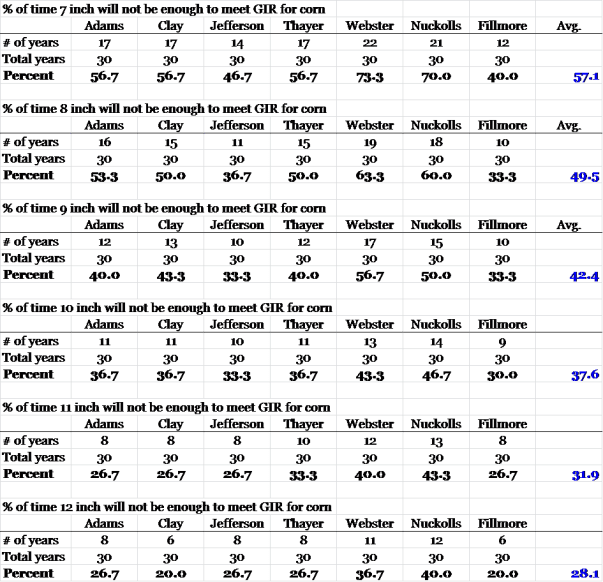
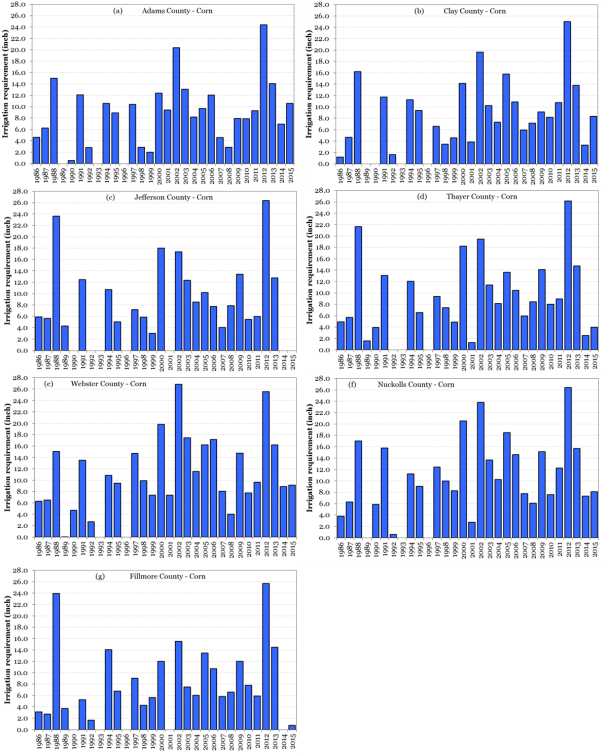
Figure 2. Temporal distribution of corn gross irrigation requirements (GIR) in seven counties in the LBNRD from 1986 to 2015.
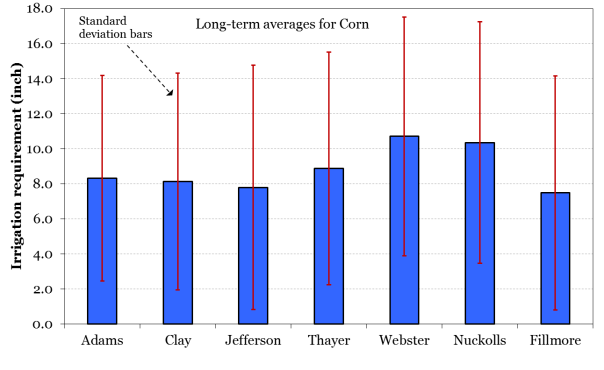
Figure 3. Standard deviation (inch) of gross irrigation requirement (GIR) for corn in seven LBNRD counties. The standard deviation values were calculated for the period from 1986 to 2015.
It is important to note that the analyses for potential impact(s) of various hypothetical water allocation amounts on meeting (or not meeting) corn irrigation water requirement to produce good yields (e.g., 230-250 bu/ac) were carried out for the period from 1986 to 2015 for specific counties in the LBNRD. Analyses, data, and interpretations should not be extrapolated beyond these boundaries.
Information and data provided above are solely for information and education purposes. The author does not take any sides or provide any opinion as to whether allocation should be imposed or not. If the decision is made to go forward with the allocation, some of the most effective water allocation programs are those that incorporate research-based educational and outreach aspects of water management and university can offer technical and scientific aid to growers and others who are involved in crop production and irrigation practices to make the best use of the allocated amount of water resources for optimum crop production. This includes implementation of technology to counter some of the potential negative impact(s) of limited water resources for optimum crop production. There are numerous proven, effective irrigation management strategies, tools, and methods developed at UNL that result in enhanced crop water productivity. This can be achieved by reducing or eliminating over-irrigation and conserving water resources through reducing unnecessary water withdrawal for irrigation. For some of these resources, readers are encouraged to visit the Nebraska Agricultural Water Management Network (NAWMN) website at http://water.unl.edu/cropswater/nawmn. Some of the publications that are related to irrigation science and engineering, evapotranspiration of various cropping systems in each of the NE counties, water management technologies, climate impact(s) on agricultural productivity, and related topics are also listed in Dr. Irmak’s website at https://engineering.unl.edu/bse/faculty/suat-irmak-0/.
RUP Dicamba Training for Soybeans
My top question the past two weeks has been about dicamba training. I just received the information regarding this training from our pesticide program coordinators.
First, to clarify some mis-understandings: Dicamba training is required for those applying the following dicamba products: XtendiMax®, FeXapan™, and Engenia®. These products are all Restricted Use Pesticides (RUP) this year; thus, you have to be a certified applicator to purchase and use these products. Dicamba training is not required if you’re applying dicamba corn products (unless it is the above-mentioned products).
Second, pesticide training of any kind is not the same as dicamba training. Dicamba training is completely separate. Having your pesticide applicator license does not qualify you to apply RUP dicamba in 2018.
Third, some have asked if everyone in the operation needs this training or not…specifically the person who is purchasing the RUP dicamba with his/her applicator license but is not the one intending on applying the chemical. NDA says that, “Dicamba-specific training is only required for application of the product, not for purchase of the product.”
- You need to be a certified pesticide applicator to purchase the RUP dicamba products.
- You need to be a certified pesticide applicator and complete dicamba training to apply the RUP dicamba product. So hopefully that helps clarify who in your operations need this training.
Your options for RUP dicamba training include the following:
- Nebraska Extension online training course hosted by eXtension. See the link at : https://campus.extension.org/login/index.php (1.25-1.5 hours).
- Crop Production Clinics or Nebraska Crop Management Conference. Details at https://agronomy.unl.edu/cpc and https://agronomy.unl.edu/ncmc
- County-hosted training sessions at the option of local educators presenting the video which is the same as the online training (1.25-1.5 hours).
- RUP dicamba product (XtendiMax®, FeXapan™, and Engenia®) manufacturer sponsored training. Each manufacturer will advertise individually.
I took the online training so I could better answer your questions. The link to the UNL online dicamba training can be found at the http://pested.unl.edu site or you can go directly to the training at: https://campus.extension.org/login/index.php. Once at this site, you will need to create an account. You will then be sent a confirmation email and upon opening that, you will be logged in. From the course list choose “pest management”.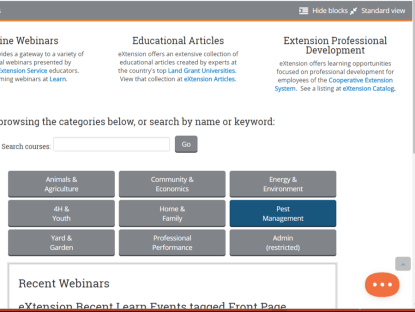
Then scroll and click on “Online Training for Dicamba Herbicide”. 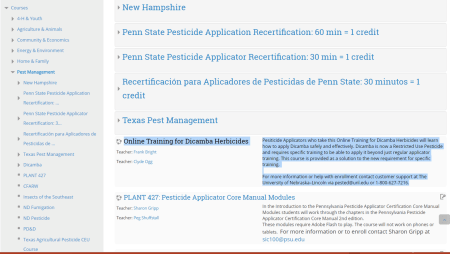
You will then need to register for the training. It will ask you to add your Nebraska pesticide applicator number in a specific field as well. Your name and applicator number are required before you begin the training. You can then click on the first video followed by the first quiz. It keeps track if you completed the entire video or not before you can advance.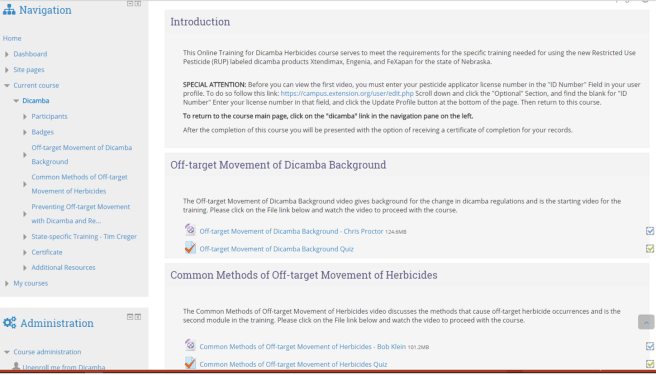
I felt the information was good overall and I appreciated the fact that they mentioned how corn dicamba applications also influenced the problems we saw in 2017. They also share quite a bit of research regarding volatility, conditions/timing of temperature inversions, dosage amounts and effects on yield. The quizzes are short and were fairly common sense. You can click to check each answer once you have selected your choice and will have to submit all your answers before moving on. When you have completed all the videos and quizzes, you can have a certificate emailed to you. You will also be officially entered into Nebraska Department of Ag’s database. NDA said they will only honor those names in their database as those who’ve completed dicamba training.
NDA is asking ag retailers selling these RUP dicamba products to check the NDA database to ensure the person applying the product has received dicamba training. NDA’s dicamba information including record keeping forms, etc. can be found at: http://www.nda.nebraska.gov/pesticide/dicamba.html.
The other thing you need to know: some have asked if a group of people can watch the online training at the same time at your farmstead. The answer is actually no from the standpoint you all would have to watch the training on separate computers/devices. The only way your name is recorded in the NDA database is through your registration name and pesticide applicator number on the training site. It only allows one person to enter his/her information to view the training and complete the quizzes. If you attend an NDA approved face-to-face training such as at Crop Production Clinics, you can train as a group but will still need to supply your individual names and pesticide applicator numbers at the training.
Hopefully this helps clarify some of the questions you have and during this cold weather, you have the opportunity to get this training completed if you need it for 2018.
Reminder: York Ag Expo at the Holthus Convention Center in York January 10-11. Schedule of Events and Exhibitors: http://yorkchamber.org/yorkagexpo/
Educational Sessions: https://jenreesources.com/2017/12/26/york-ag-expo-educational-sessions/
Crop Science Investigation
Youth interested in Crop Science Investigation are welcome from York and surrounding counties. Please also click to view: Crops Monthly Meeting Ideas 2018-2019.

Reflections on 2017
Happy New Year!!! This week has been a good one to reflect on 2017.
It was a year of unusual situations such as the dry winter allowing for nitrogen burn on corn, herbicide carryover, wheat stem maggot in corn from late-terminated wheat/rye, dicamba concerns on soybeans/trees/vegetables, downed corn ears and the challenge of recovering them…I think so often as I reflect, it’s easy to see the problems that occurred as those tended to be the headlines.
But as I also reflect, I think of so much more. It’s been a hard several years both personally and professionally for me and one reason I love Extension is for the relationships I’m so blessed to have. As I reflect on this past year, it was a year of spending time sharing the ways we all were hurting/healing while looking at crop problems, working in on-farm research plots, or just visiting. It was a special year in building even deeper relationships with many of you whom I’ve served in the past and meeting new people in the area I’m serving. Thank you also for your grace as it is a challenge serving regions of counties. I truly am grateful for the friendships and opportunity to serve you!
One of my highlights was pesticide training…yes, pesticide training! I know it’s required for us as private applicators every three years, but it’s my chance to teach/learn from/see so many of you and do my best to share important crop information as well. I enjoy winter meeting time as it always feels like a big reunion to me to see who comes and to catch up! Pesticide training last year was fun to still have the opportunity to train those of you in my former area and meet many in my new area.
Another highlight is a group of youth I meet with each month for Crop Science Investigation (CSI). This was such a rewarding experience for me in Clay County working with Clay/Nuckolls county youth and watching them learn, grow, and some pursue ag careers through the years. In York County I’m blessed with a very young, energetic group of youth who are so much fun and love to learn! Basically, the youth are detectives every time we meet as I give them a real problem to solve. We spend time out in the fields learning about crop growth, weed/insect/disease ID, take industry tours, etc. Our youth right now are mostly in the 6-11 year old range but any youth and parents are welcome to join us if you’re interested. Please just let me know at jrees2@unl.edu for meeting times.
On-farm research plots are always a highlight for me for how much can be learned and this year we had some intense plots regarding data collection! Grateful for the farmer-cooperators in the time spent on these plots and how you’re so good at working with me.
I also am grateful to the media. With fewer of us in Ag Extension, we’re called on more often to share when problems arise. So grateful for the relationships with all our media partners-TV, radio, newspapers, magazines-and all you do in helping us share our research-based information timely!
As I think about 2018, one concern continues to be low commodity prices and ways to make it through. The Farm Bill and what will happen regarding it is another topic. Dicamba unfortunately may continue to be a topic. And, it seems like every year we have varying weather that creates challenges and opportunities. Two things that will continue are the optimism/resiliency I see every year in our farmers and the strong family that Ag in general is. Here’s wishing you a safe and blessed 2018!
York Ag Expo: Reminder of the York Ag Expo January 10-11 at the Holthus Convention Center in York. A full list of exhibitors is available at: http://yorkchamber.org/yorkagexpo/. Lyndy Phillips will be the speaker at the Prime Rib Supper at Stone Creek in McCool Junction with social hour at 5:30 p.m. and supper at 6:30 p.m. Tickets can be purchased for $30 at the York Chamber Office. I’m really excited for the opportunity to provide educational sessions this year and am particularly excited about the cover crops/annual forages for grazing. If you have cattle and are looking for outside-the-box ideas, this session may be helpful. Educational sessions include:
• Chemigation Training by Steve Melvin, Jan. 10 from 9-Noon
• Cover Crops/Annual Forages for Grazing, Jan. 10 from 1-4 p.m.
• Private Pesticide Training by Jenny Rees, Jan. 11 from 9-Noon
• Precision Ag, Jan. 11 from 1-4 p.m.
Winter Ag Program Brochure: You can also find our winter ag program brochure for South Central/Southeast Nebraska at: https://go.unl.edu/vzyg.
Herbicide Grazing Restrictions
Forage Feed Grazing Restrictions
Replant Options Rotation Restrictions-long
Grateful for a nice week for harvesting and for the good yields being reported! It’s also good to see cattle being turned into cornstalks. A reminder to read herbicide labels to understand if there’s any grazing restrictions from corn and soybean herbicides applied in-season.
It’s also important to look for any grazing restrictions on fall-applied herbicides to control marestail and other germinating weeds. These restrictions can also be found in the Forage Feed Grazing Restrictions in the UNL Guide for Weed Management. The forage, feed, and grazing restriction only applies to the crop for which the herbicide was applied. When it comes to grazing cover crops planted into these residues, one must use the replant/rotation restriction guidelines found on the herbicide label and in the UNL Weed Guide: Replant Options Rotation Restrictions-long. I apologize as these scanned blurry; hopefully you can zoom in ok to read what you need.
If the label doesn’t specify any restrictions, then it should be ok. If you want to be on the safe side, a rule of thumb is to use the pre-harvest interval for the amount of time to wait before grazing stalks. Some labels will say that residue should not be grazed or baled and fed to livestock. Sometimes studies were actually conducted to know there is a safety concern. In other cases, the chemical company may not choose to conduct all the studies the Environmental Protection Agency (EPA) required for labeling due to high costs. If that’s the case, the EPA requires the strongest restrictive language be placed on the label. Regardless, if it says there’s a grazing restriction on the label, the label needs to be followed as it is a legal document and the law.
As you plan for next year’s herbicide program, if you’re thinking about fall cover crops, the following NebGuide may be of benefit to you as it goes through the grazing restrictions of various herbicides.
Hail Damage
On-Farm Research Protocols:


Hail and wind damage occurred throughout the area I serve last week. Overall, I’ve been encouraged by the regrowth observed on corn and soybean plants affected by the June 14th storm. We were blessed with warmer weather and sunshine that allowed for regrowth to occur in many situations other than some fields around the Deweese area.


You can look for regrowth on leaves within the whorl of corn plants and on the axillary buds of soybeans. Even what appeared to be soybean ‘sticks’ may show regrowth by now.
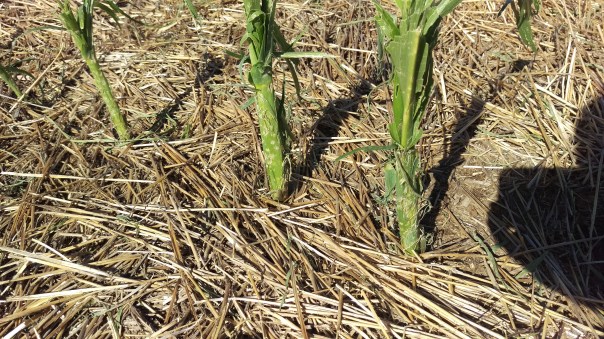
The concerns I have for plants affected by these storms is all the stem bruising on both corn and soybeans and the potential for bacterial diseases to affect corn.
For those of you affected by June 16th storms, we recommend to wait a week to assess damage and any decisions. I realize we’re also at a critical stage for replant decisions as we continue later in the season. Ultimately, decisions need to be made on a field by field basis.
Resources:
- CropWatch Hail Damage Resources
- Resources from storm damage in 2014
- Fungicide Use After Hail or Wind
Fungicide Application
There’s no good research to Dr. Tamra Jackson-Ziems or my knowledge to support this. Fungicides only control fungal diseases. Bacterial diseases are favored after hail events and we have already seen bacterial leaf streak in the area prior to the storm. From past-years’ experience of prior wind/rain events, we can expect to see more of it in about a week. Fungicides won’t help that disease nor Goss’s wilt which is another we often see come in after hail events.
However, if you’re considering this, I’d like to have several farmers prove it to yourselves with on-farm research this year so we do have data for the future. It’s this simple. All you do is spray fungicide in enough width to complete 2 combine passes. Then skip an area for 2 combine passes. Then treat again and repeat across the field. Fungicide Protocol for Hailed Corn and Soybean. Please let me know if you’re interested in this!
Timing of fungicide app: ISU did a study to simulate hail damaged corn at tassel stage within an average of 3 or 8 days post-hail. They didn’t find the timing to provide any yield effects. They also didn’t find a statistical yield increase (90% confidence level) in fungicide application to hail damaged plants vs those which weren’t hailed although they also reported a numerical increase in 12 of the 20 fields.
Herbicide application: I spoke with Dr. Amit Jhala, Extension Weed Specialist for his thoughts regarding this. He said ultimately herbicides shouldn’t be applied to stressed weeds in order to achieve greatest efficacy. The concern for many including me right now is how well the weeds survived the hail and how quickly they are regrowing compared to the damaged corn and soybeans. This again is a field by field assessment regarding how well your corn and soybean regrowth is occurring and how rapidly your weeds are. I watched one palmer plant in one field after June 14 storm: 1 day post hail and 2 days post hail put on two sets of leaves in that time period. I also took pictures of soybeans reduced to sticks while 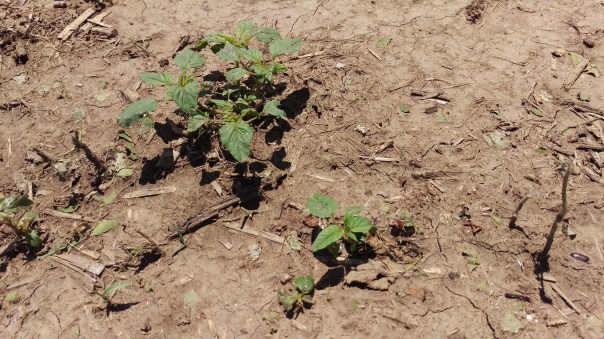 waterhemp in that field was virtually untouched. I think many are trying to wait 5-7 days post-hail to apply herbicides but there were some fields I was suggesting to apply over the weekend with the recovery already occurring and less damage.
Corn replant: The biggest concerns with corn would be stands, eventual stalk rot/downed corn due to stalk bruising, and bacterial diseases. I’ve essentially watched stands reduced over the course of the growing season after early-season hail storms mostly due to bacterial diseases like Goss’ wilt. It will be important to have your crop insurance adjuster look at the field again prior to harvest. Splitting the stems of damaged plants across the field can help you assess any damage to growing points; they should be white/yellow and firm not brown and soft. Tattered leaves that are wrapped around the whorl should eventually turn brown and break off with the wind. They can sometimes impede new growth from the whorl as well though.
Soybean replant: Soybeans can compensate so greatly for reduced stands. From hail at this stage in the past, we’ve said to leave stands of non-irrigated at 60,000 plants per acre and irrigated at 75,000 plants per acre. Some soybeans reduced to sticks are shooting axillary buds. My biggest concern on soybeans is the stem bruising which isn’t accounted for in hail adjustments. If you want to prove replanting or not to yourself, consider slicing in soybeans next to the old row in strips across your field. Be sure to inoculate the soybeans and be sure to take prior stand counts. Soybean Replant Protocol.
There’s nothing like doing these studies and seeing the results on your own ground or from your peers’ farms. In 2006, I worked with a grower in the Lawrence, NE area on a non-irrigated soybean plant population study where he tested seeding rates of 100K, 130K, and 160K seeds/acre. He received hail at the cotyledon stage and because he was non-irrigated, chose to leave the stand. His actual stand counts were 74.4K, 89.4K, and 97.9K plants/acre respectively for the previous mentioned seeding rates which resulted in yields of 38.6, 40.6, 42.7 bu/ac respectively. Another soybean replant study occurred near Columbus, NE where the grower had an average plant stand of 75,000 plants per acre on June 11th. He chose to replant five strips across the field at a diagonal to the existing rows. The replanted soybeans ended up yielding 1 bu/ac less than the original plant stand. I realize it’s hard to want to do these extra steps for on-farm research, but this is why it’s important; it’s the way to answer these questions for yourself! Please contact one of our team members if you’re interested in on-farm research this year!
Weed Management/Cover Crops Field Day — Views from VanDeWalle

During the summer, our crops extension team has some great field days to share research and management strategies to farmers. One of those opportunities to learn more about weed management and cover crops will be on June 28 at the South Central Agricultural Laboratory near Clay Center. There is no charge for the field day […]
via Weed Management/Cover Crops Field Day — Views from VanDeWalle


 JenResources