Waiting on Spring Tasks
The warm weather is creating the temptation to get outside and garden! But patience is a virtue and it’s only March! Here are some great tips from Elizabeth Killinger, UNL Extension Educator in Hall County about waiting on spring tasks.

The warm weather these past few days has gotten everyone ready to head outside and get their hands dirty. Just because it feels like spring, doesn’t mean we have to finish all of our spring to-dos now.
It may be tempting to completely remove all of the leaves and mulch from around tender perennials, but don’t give in. Strawberries, roses, chrysanthemums, and other tender plants can be protected from the fluctuating winter temperatures with winter mulch. If the mulch is removed too soon, new growth can form on the plant too early. This new growth is susceptible to damage caused by cold temperatures. Try and delay the removal of winter mulches as long as possible, but be sure it is removed before new growth begins. If the warm temperatures have caused new plant growth, rake the mulch to the side, but don’t remove it completely. If freezing temperatures are forecasted…
View original post 536 more words
Spring!
Happy Belated Spring! I meant to get this posted earlier this week but just didn’t get it done. I love living in Nebraska and  being able to observe God’s creation via the changes in seasons! Spring and Fall are probably my favorite, but there’s beauty in all of them. Everything is 2-3 weeks early this year so will be interesting to see if we end up with March going out like a lion or if we end up with an Easter freeze like we did a few years ago. While it wasn’t a bad winter, I always enjoy seeing new life and green in the springtime!
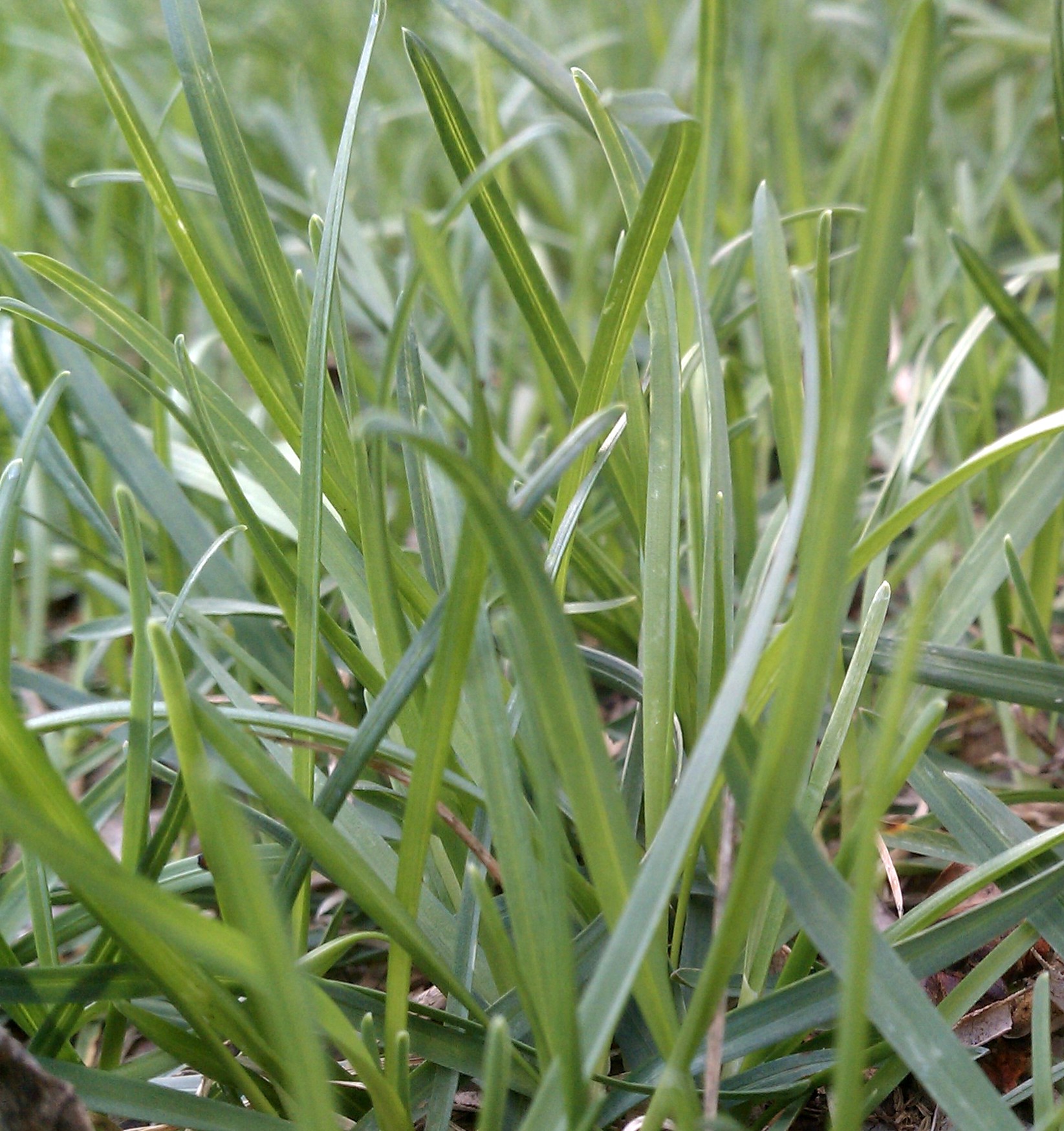
Grass greening up in front lawn. Sending this pic out to my husband who has seen grass very little in 9.5 months in Afghanistan! Will look forward to you helping me mow when you return! : )
My favorite tree is the magnolia and someday I hope to have one! I always enjoy going to UNL East Campus in the spring and seeing the magnolias in bloom. However, I was surprised how quickly they bloomed this year and that they were already loosing their blossoms!

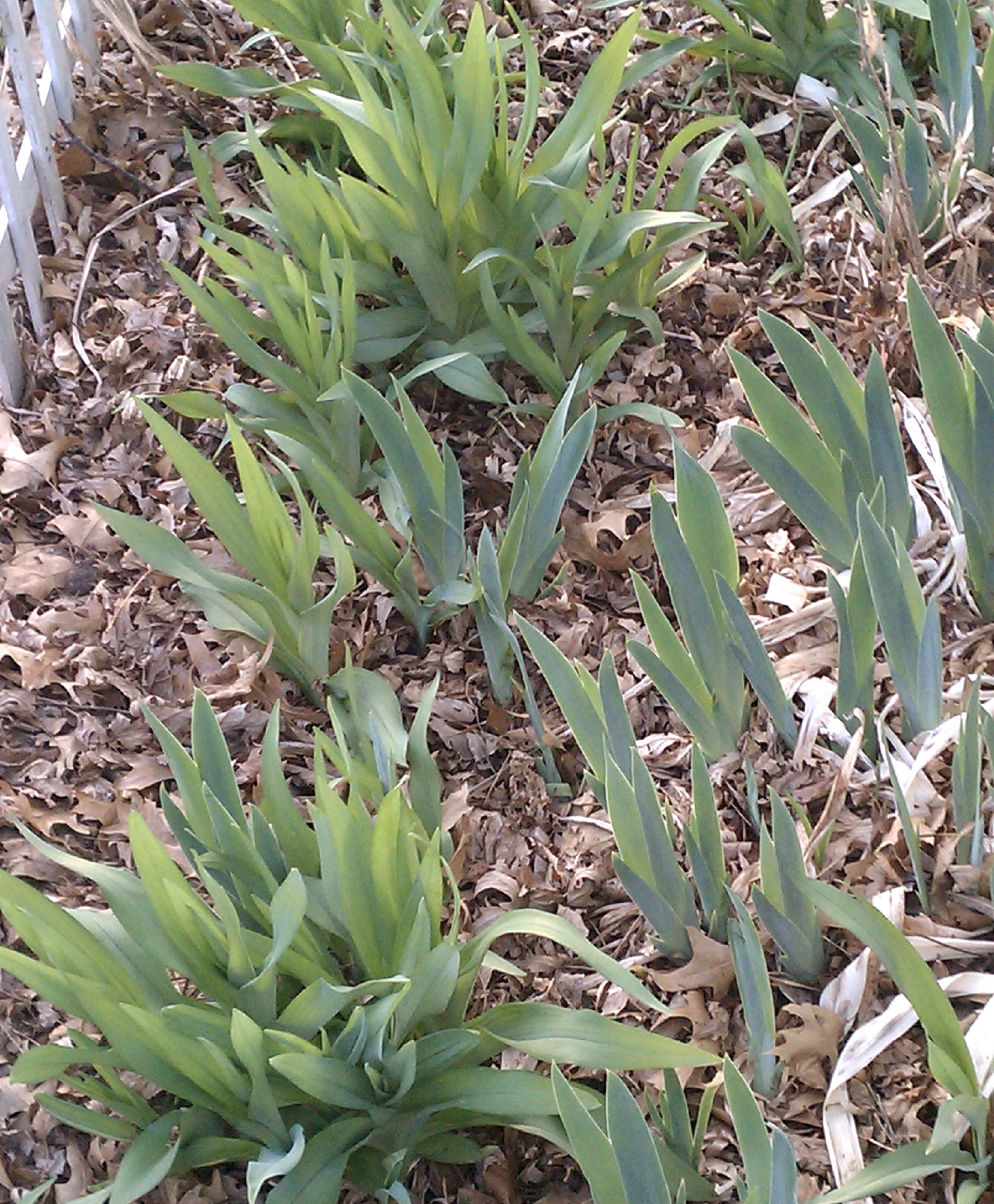
Through the leaf mulch even my iris and daylillies are emerging. I haven’t removed mulch yet in the event we end up with a cold snap. It’s still early, though tempting!
Great resources from UNL regarding horticulture and turf: http://byf.unl.edu/ and http://turf.unl.edu/.
Crop Science Investigation Camp
This is the first year we are doing a Crop Science Investigation (CSI) Big Red Camp for youth! We’d encourage any youth who enjoy plants, science, and agriculture who are 15-18 years old and who are interested in having fun learning about these topics to check this out! Big Red Camps are open to youth in any State. Please help spread the word!

Are you interested in science, agriculture, plants, crops, insects, or diseases? If so, join our team of detectives to solve crop-related problems in the Crop Science Investigation (CSI) Big Red Camp! Become a detective while participating in hands-on sessions to learn about and increase your knowledge of crops, science, and agricultural careers. Youth detectives will interact with agronomic professionals across Nebraska to solve experiments in: nutrient management; managing disease, insect and weed problems; water management; crop production, and much more! Do you have what it takes to become a CSI detective?
There are a variety of careers related to plant sciences such as: Agricultural Communicator; Agronomist; Cro p Consultant; Crop Insurance Adjuster; Educator; Co-op Manager; Farmer or Rancher; Farm Credit Banker; Field or Lab Researcher; Plant Breeder; Soil or Water Conservationist; Seed, Fertilizer, or Chemical Sales; or Technical Representative.
Scholarships are available in the amount of $300 to participants…
View original post 172 more words
Protecting #Nebraska #Ag & #Farm Transition
A few weeks ago I shared some thoughts with you regarding what I learned from an animal welfare conference. We have an opportunity to hear more in at a much closer location-Sutton Community Center in Sutton-on March 12th at 6:00 p.m. Dewey Lienemann, UNL Extension Educator will be presenting on “Protecting Nebraska Agriculture” following a meal sponsored by the Sutton Chamber of Commerce Ag Committee as well as area Cattlemen Associations, Breeders & Feeders, and Ag Producer groups. Anyone interested is invited to attend-and I would encourage anyone who possibly can to attend. This topic not only affects livestock producers, it affects crop producers, and consumers as well. It’s very important to understand how various interest groups are attacking animal agriculture and why and how we in rural America can share our stories. Please pre-register by contacting Tory Duncan at (402) 773-5576 or ccntory@gmail.com or Todd Mau at (402) 773-5224 or todd@toddstrailers.com.
Another opportunity for learning more about family farm transition is with the last Farmers/Ranchers College program this year. It will be March 15 in Friend at the San Carlos Community Room (next to the Pour House) with meal beginning at 6:00 p.m. (Registration at 5:30 p.m.) The program entitled “Discussing the Undiscussabull” will be presented by Elaine Froese from Manitoba, Canada. Froese’s expertise in helping families get unstuck is sought after across the country. She has worked with families in business for over 20 years and is now coaching the next generation. Elaine believes that change is an opportunity, not a threat…she has practical tools to help people discuss the “undiscussabull” to make their dreams come true. In order to save your spot and reserve a meal, registration is needed by calling the Fillmore County Extension office at (402) 759-3712. The Farmers & Ranchers College is sponsored by area agribusiness, commodity groups in collaboration with the University of Nebraska-Lincoln Extension.
Women in #ag #farm Transition
Last week I attended the Women in Ag Conference in Kearney. It’s always a great conference to see many friends and meet  new ones who live and work in agriculture! I also enjoyed teaching a very engaged group of women the second day about crop science investigation. It was fun for me to see them dig into the hands-on activities!
The first session I attended was by Dave Specht from the UNL Ag Economics Dept. He does a great job of relating to the audience and talked about “Woman’s Influence-the Key to Generational Business Transitions”. Dave has a consulting business on the side and as part of that business he meets with families to develop a farm transitional plan based on the Continuity Quotient he developed. The Quotient contains 7 parts and I’ll share some key highlights via questions he raised that stuck out to me. Perhaps they’ll raise more questions for you as well.
1-Business/Estate Planning: The goal of the business/estate plan is to reduce the number of surprises to the farm and family members upon death of the farm owner. Is your plan coordinated with all the advisers in the operation and does it consider the perspectives of all the generations involved in the operation? Is it even documented and has it been communicated to the entire family before the owner passes away?
2-Communication: Are family members able to openly discuss the farm and what it means to them?
3-Leadership Development: No one is ever “ready to take ownership”; it is learned along the way. Opportunities for the next generation to make decisions need to be allowed. Often we hear of exit plans, but is there an “entrance plan”-a strategy to invite the next generation back to the farm?
4-I didn’t catch the name of this point but essentially Dave was saying that if the next generation is always asking his/her parents for a bailout, that it delays the trust that the person can someday operate the farm. How the next generation handles personal finances is important in showing he/she can someday run the operation.
5-Personal Resilience: How does the next generation handle challenges? Does the person retreat and avoid them or does the person look for ways to overcome them and use it as a growing experience? If the person retreats, he/she may not be wired for ownership in the future.
6-Retirement/Investment Planning: When will the older generation plan to retire? How much will the farm support (meaning how many people)? Where will retirement cash flow come from? The goal is to not rely on the next generation to generate your entire retirement income.
7-Key non-family employees: Sometimes the most valuable family business asset goes by a different name! Is the vision for the family farm communicated to these employees? How you talk about employees to next generation and how you talk to next generation about the employees is important in dictating future partnerships; someday the employees and next generation will be partners.
I would recommend checking out Dave’s Web site at http://www.davespecht.com for more information. He provides communication and consultation about farm transition and financial planning. Life is so short! Make sure you have a plan in place that follows the keys Dave provided above!
This is a great blog post from Chris Chinn, a farmer in Missouri, who shares why her family raises pigs the way they do to protect them and keep them comfortable. You can read additional blog posts from her at http://chrischinn.wordpress.com

(Disclaimer: The intent of this blog is to help people outside of agriculture to understand why some farmers choose to raise their animals indoors. What works on my farm may not work for another farmer, each farm is different, as are the genetics of hogs. My intent with this post is to help people understand why some farmers use modern technology on their farm. Our family changed the type of hog we raise to be a leaner hog with less body fat because of consumer demand. With that change came additional challenges to raising this type of pig in harsh weather conditions. That is why we chose to move our animals inside of barns because the lean type of hogs we raise can not endure the weather as well as hogs with more body fat. This is not meant to be an indictment of farmers who choose to raise their hogs outdoors.)
———————————
Today
View original post 1,295 more words
Cornhusker Economics Conference
The Cornhusker Economics Conference will focus on the ag outlook and management decisions for farmers and ranchers at  Clay Center on February 29th at the Clay County Activities Building at the Clay County Fairgrounds. The program will run from 10:00 a.m.-2:30 p.m. with registration beginning at 9:30 a.m. The conference will cover key topics affecting farm management and production decisions for 2012. It is offered by UNL Extension and the UNL Department of Agricultural Economics and is sponsored in part by funding from the Nebraska Soybean Board.
Dan O’Brien of Kansas State University will share his insight on grain and oilseed outlook and risk management decisions in today’s uncertain markets. While market volatility shows the need for sound hedging strategies, concerns about futures market performance and the recent MF Global bankruptcy affecting hedge margin accounts raise questions about the best path ahead for managing market risk. O’Brien will bring his experience and analysis of futures market performance to bear on the issues and discuss implications for producer decisions.
Shane Ellis, livestock marketing specialist at Iowa State University, will discuss the outlook for livestock markets and producer profitability. With outlook for meat demand and continued reductions in cattle supplies, the market fundamentals look strong, but must weigh against grain supplies and feed prices. Ellis will bring his expertise to the situation and provide guidance for producer marketing and production decisions in 2012.
The land market has also been moving in the past year and UNL Extension Educator Allan Vyhnalek will use his local knowledge and analysis to discuss land markets and leasing arrangements with implications for producer decisions. The closing session will feature a focus on agricultural policy and the direction for new farm programs. Brad Lubben, policy specialist, will discuss the policy outlook in Washington and the major policy developments that could affect agriculture in 2011. Then, Lubben will team with UNL Extension educators to discuss specific directions for the new farm bill and implications for farm programs, conservation programs, and risk management decisions.
There is a $25 registration fee to cover programming expenses for speakers, materials, and the noon meal. Please RSVP to Jenny Rees at the Clay County Extension Office at (402) 762-3644 or jrees2@unl.edu by Feb. 27 so we can obtain a meal count. Hope to see you at the excellent conference!
Beauty after the Snow Storm
Here are some pics I took during our snowstorm last Saturday and the beauty in it with the sun shining on Sunday. While snow has started melting, cold temperatures are still keeping branches of trees and shrubs heavy. If you can, carefully take a broom and knock off the snow on bushes and shrubs to help prevent branch breakage but don’t remove the snow from around the shrubs. Elizabeth Killinger, UNL Extension Educator in Hall County and horticulture expert, speaks about winter tree care in this post.




Crazy?
Crazy? Perhaps! Which according to one of my farmer friends is a little typical of me when I put my mind to figuring out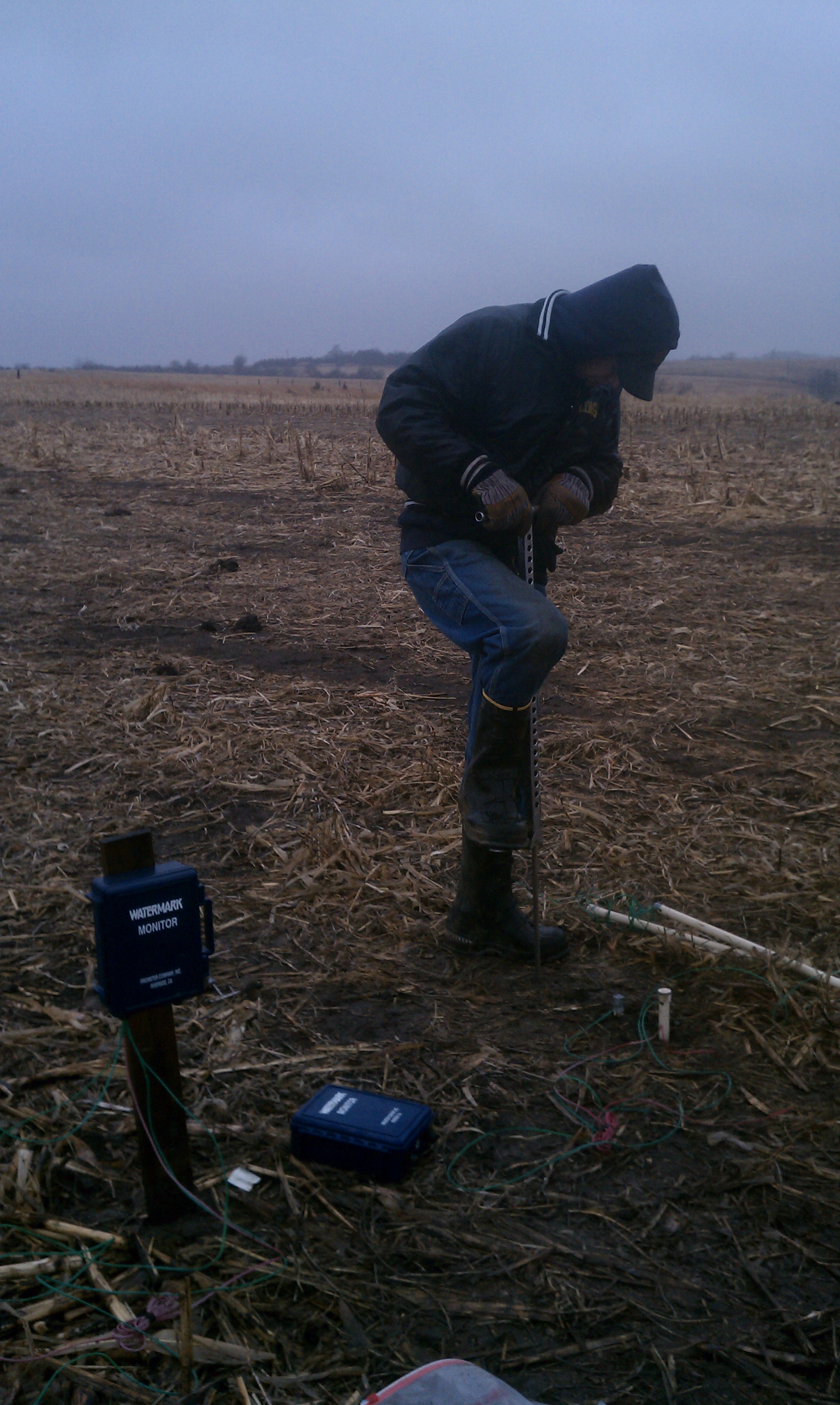 something. So I had been analyzing my crop water use data from my dryland corn, sorghum, soybean crop water use comparison study. It’s the one where we had coon problems this year and ended up trapping a skunk! I noticed how much the soil moisture profile had been depleted and knowing we’ve received minimal precip during fall and winter, I wondered what our soil moisture profile would be for dryland fields by planting. During a meeting yesterday I thought it would be good to install some watermark sensors to determine soil moisture profile recharge with the pending storm. Problem was I was at a meeting over 100 miles from my equipment and the pending storm was starting today. But I was still determined to get them in the ground as early as possible in order to measure the soil moisture status. So I woke up at 4:00 a.m. to heavy rain. Great! It was such a gorgeous day yesterday, and the past week…past month… The first thing my colleagues had asked me when I told them my idea was “Why didn’t you think of this sooner?” Answer: “Guess I needed a precipitation event!”
So I drive to the field in the rain, get the gear together and start installing the sensors. First foot went in easy with the rain that had soaked in. Then it seemed like I tried for 20 minutes (although probably not near that long) putting all my weight on the soil probe to get the 2nd foot in. Wind-driven rain soaked my jeans since I didn’t have rainpants on…fingers were numb from the cold. I  kept telling myself this will still hopefully be worth it! On the research data from this field, the second foot was driest of all the crops (was depleted well above plant available water). I got the third foot in and John, the man who farmed the field appeared.
While he thought it was crazy he graciously volunteered to help as he always does. He put in the rest of the sensors while I
hooked everything up.
The last several years we have been blessed to have a fully charged profile going into planting. Even with this rain/snow event, I’m not sure we will have that in dryland fields in this area of Nebraska. So I thought it would be interesting to know 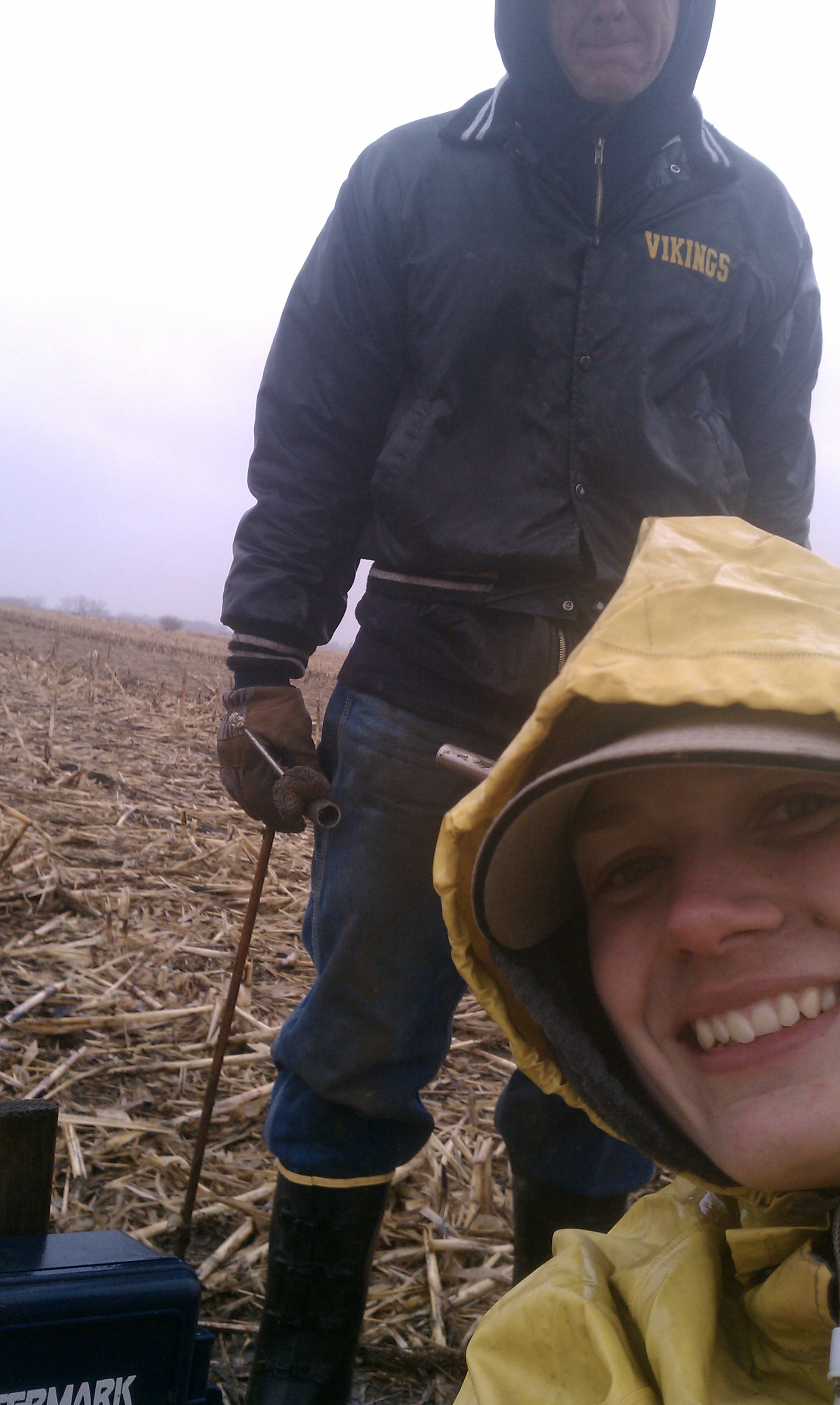 where we stood before planting and figured the farmers may want to know that as well. Perhaps a little crazy regarding installing the sensors on such a bad weather day but hoping the data in the end will benefit our farmers and be worth it!
Cash Rent Questions
Cash rent questions continue to be the primary question I receive and it’s been hard for me to keep sharing numbers based on the UNL or USDA surveys as I question how useful the surveys alone really are. I caught up with Al Vyhnalek, Extension Educator in Platte Co. during the crop production clinics. Al’s specialty is risk management. He shared the following with me which may be helpful to you as well. This isn’t research-based or based on surveys; it’s based on land productivity and yield potential. But it’s another potential tool to reach a starting point for cash rent considerations. The numbers discussed below assume the landlord owns the irrigation equipment.
“Farmers and landowners alike want to know what they should offer or charge for farmland next year. The question is simple, while the answer is more complicated. There is no formula or equation available that will definitively provide an objective value for farm or pasture land. The caller wants to know what the UNL or USDA survey of cash rental rates says to help them determine the correct starting point for discussing cash rent for the following year. While I am glad to provide that information and do provide that information, I am more uncomfortable than ever in providing that information. Why am I not feeling good about that? Because the price of cash rent for a piece of farm ground should be based on the productivity of the ground. It is important to think about the value being tied to yield potential.
One quick way to do the calculation of productivity is to take the last 5 year average corn and/ or soybean yields for the farm you are renting times the local elevator price for 2012. This calculation equals the estimated gross income per acre. Take that number multiplied by 25-30% for corn or 30-33% for soybeans with the lower percentages for dry land crops and the higher ones for irrigated acres. It gets you to a starting point for that cash rent negotiation. Many want to set rent based on the 2011 high price of about $7.00 per bushel, but that price has never been available for the 2012 crop. Using the 2012 fall elevator price is more realistic of what might happen next year. Using this information as a starting point and combining it with the information from the surveys will help with fair negotiations of the cash lease. The example percentages were determined by working through UNL budgets when determining cost/acre.
As an example – 200 bushel irrigated corn times $5 per bushel (2012 harvest price) is $1,000 gross per acre. 30% of 1000 is $300 per acre (corn acres). Soybeans: 60 bushel beans times $11 per bushel is $660 times 33% is $220 per acre – landlord’s share. If we have 1/2 acres beans and 1/2 acres corn then average the two rent numbers – or $260 per acre average for the farm. That is how I think we should arrive at a discussion point for cash rents in the upcoming year based on productivity.” For more information, please contact Allan Vyhnalek, 402-563-4901 or e-mail AVYHNALEK2@unl.edu.


 JenResources