Blog Archives
Week of Feb. 15th Events
This beautiful weather resulting in a warm, dry winter, provides an important opportunity to be watering evergreen trees and lawns. Our horticulture educators have the following information to share. Now is the time to water trees and lawns to prevent desiccation, especially with warm temperatures in the extended forecast. If you want to prevent evergreens from turning ever-brown, take time over the winter to provide supplemental water. Any time air temperatures are above 40°F you can do a slow soak of water around your evergreen trees and shrubs (and even lawns). Allow enough time for the water to infiltrate before temperatures drop below freezing. For information about this and other winter tree care tips read more here: https://water.unl.edu/article/lawns-gardens-landscapes/tree-care-during-winter/.
Friday Conversations: This past week’s conversation on nutrient balance could’ve lasted much of the afternoon as it went two hours over the scheduled time. Will write on that topic next week. Friday Feb. 20th’s conversation will be on Cows, Compost, and Covers. Hear from growers who have converted crop ground to annual forages for grazing and the economics of that, especially compared to corn and soybeans this year. There’s still time to make that change for 2026. We’ll share options for different classes of cattle, including custom grazing if you don’t own/have enough cattle. I’ve heard some growers struggling with landlords/lenders to make that decision. If you are in that situation, please contact me and I’d be happy to talk with them and you. We need more diversity in our operations to spread risk and reduce pests! You’ll also hear how we’re using compost extracts on our farms to aid in biology and other benefits. You’ll also learn from the growers why they use various species of cover crops in their operations and what each species does for their soils and their system. If you’re interested, please join us from 10 a.m.-noon this Friday, Feb. 20th at the 4-H Building in York. RSVP to 402-362-5508 isn’t required, but is helpful to ensure I have enough handouts.
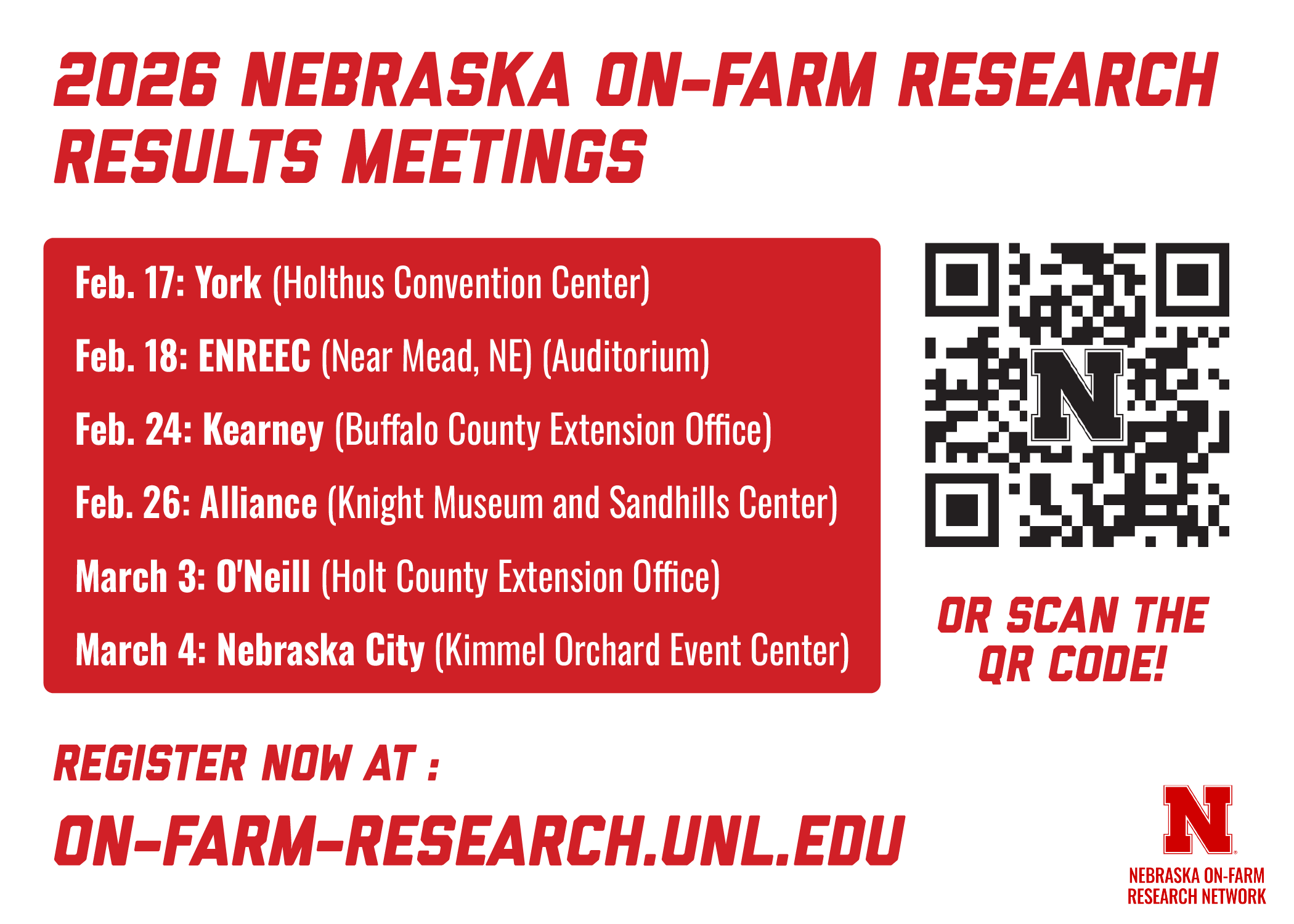
On-Farm Research Updates: There’s several on-farm research updates upcoming with the first being this Tuesday, Feb. 17th at the Holthus Convention Center followed by Feb. 18th at ENREEC near Mead. Program starts at 9 a.m. with registration at 8:30 a.m. If you’re looking to hear what other growers are trying on their farms and their results, it’s a great opportunity. More info.: https://on-farm-research.unl.edu/.
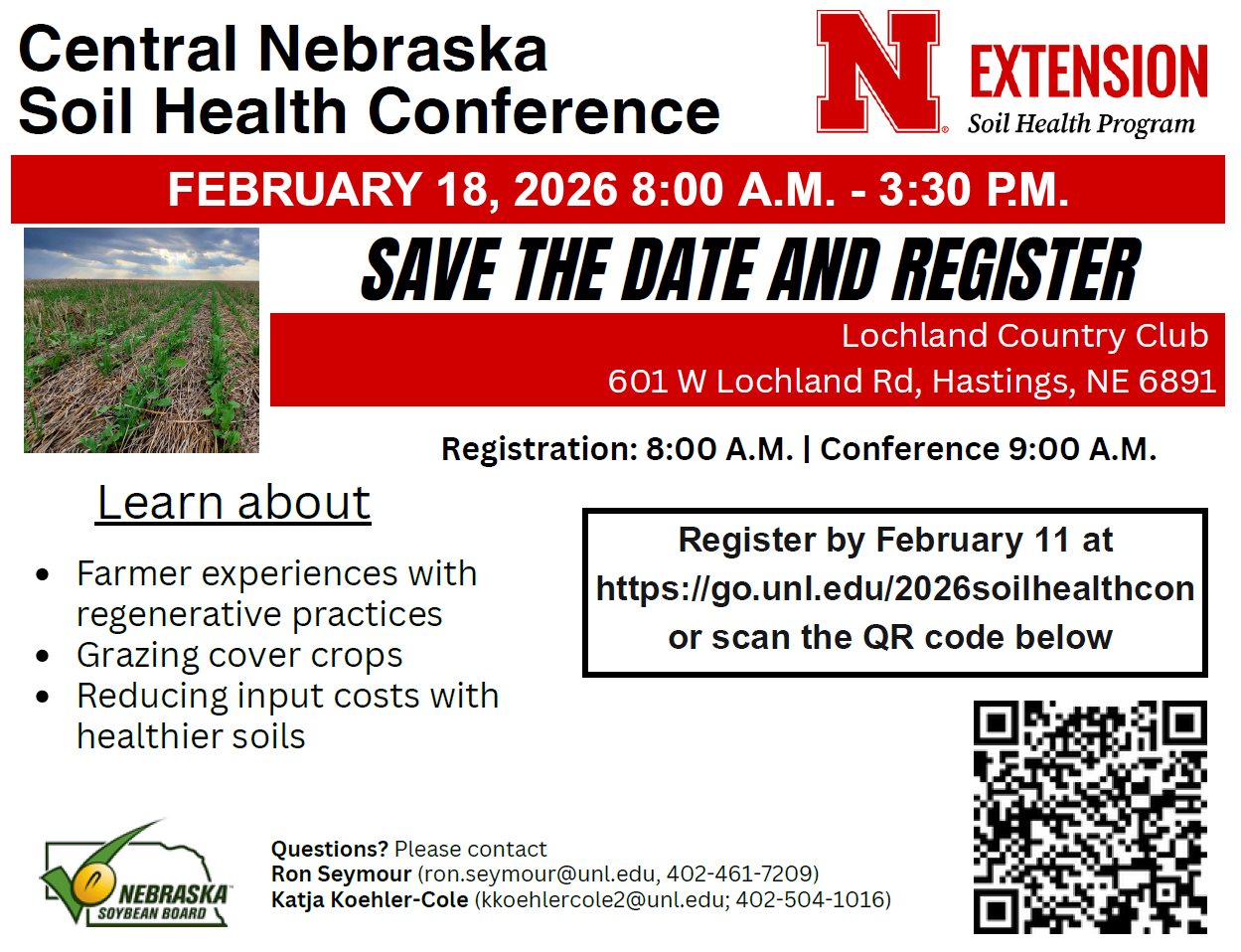
Central Nebraska Soil Health Conference will be held Feb. 18th in Hastings at the Lochland Country Club with program beginning at 9 a.m. and registration at 8 a.m. At that meeting, you will hear from some of our producers utilizing cover crops for grazing with the economics and how they are also reducing inputs in the corn the following year after that cover crop grazing year. You will also hear from growers who are reducing inputs in soybeans using soil health practices. The keynote speaker will share on biochar. More info. and RSVP: https://go.unl.edu/2026soilhealthcon.
York Co. Corn Grower Tour will be held Wed., Feb. 25. We’ll meet at the York Co. Extension Office at 9:40 a.m. First stop will be Timpte Manufacturing in David City. Lunch will be at La Carreta in Seward followed by tours at Hughes Brothers Inc. and Bottle Rocket Brewing Co., both in Seward. Please RSVP to the Extension Office at 402-362-5508 if you’re interested in attending.

JenREES 8-19-18
Hail Damage Info: Thank you to all who attended our hail damage meetings last Monday and we truly hope the information was helpful. It was a lot of information at one time, so I have compiled it at: https://jenreesources.com/2018/08/14/late-season-hail-damage-resources/.
The ‘blessing’ in the timing of these later-season storms is in the reduced kernel moisture and shorter length of time till harvest. This is important to reduce the time for fungal growth in the ears. If you missed the meeting, presentations and information are at the link above. The main key I will stress: Please, ask your crop insurance agent how he/she wants to handle grain quality at harvest. Does the agent want to take samples for mold/potential mycotoxin? Does the agent go off of COOP samples? Does the agent require samples prior to going in the bin? These are key questions as we do know there is fungal growth on damaged ears. The presence of fungal growth does not automatically mean the presence of a mycotoxin. However, if grain quality isn’t handled and documented correctly at harvest, it can mean the loss of compensation if grain goes out of quality in storage. If anyone is taking hail damaged corn for silage, Dr. Mary Drewnoski is interested in samples prior to and after ensiling and is willing to help with sample analysis cost. Even if silage has already occurred, we’d be interested in samples after ensiling. Please contact me if interested. I will share additional considerations next week, but please check out the weblink above (or if it’s easier just go to http://jenreesources.com). Please let me know if you have any questions!
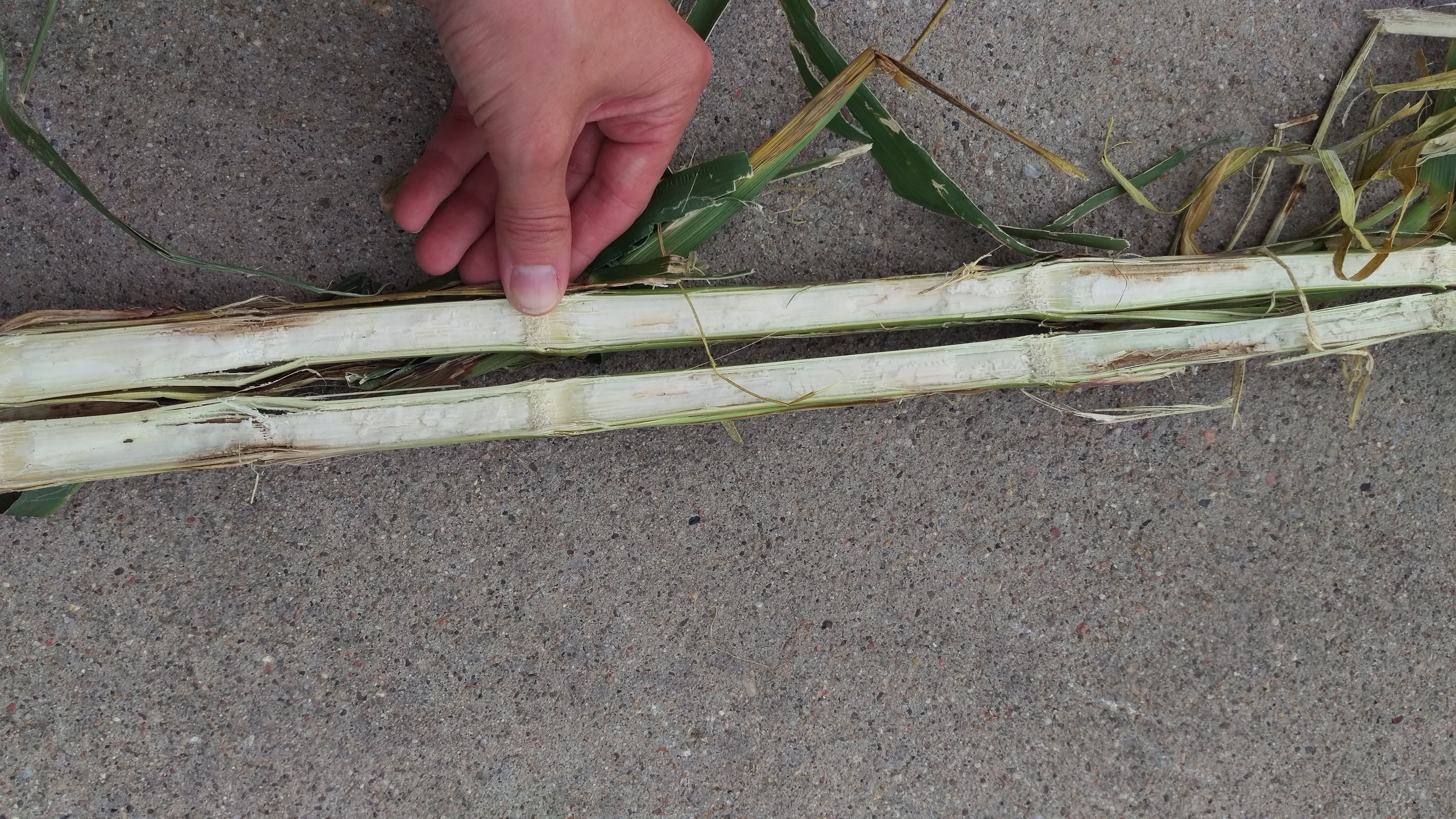
One week after the August 6, 2018 hail storm, stalk rot is setting in where stones hit the stems. This is regardless if fungicide was sprayed on fields at some point this season.

Soybean plants vary in damage. Many pods have moldy seeds where hail affected them or where they are no longer able to fill. We don’t tend to worry about molds in soybean and our experience has been these become light-weight and blow out the back of the combine at harvest.
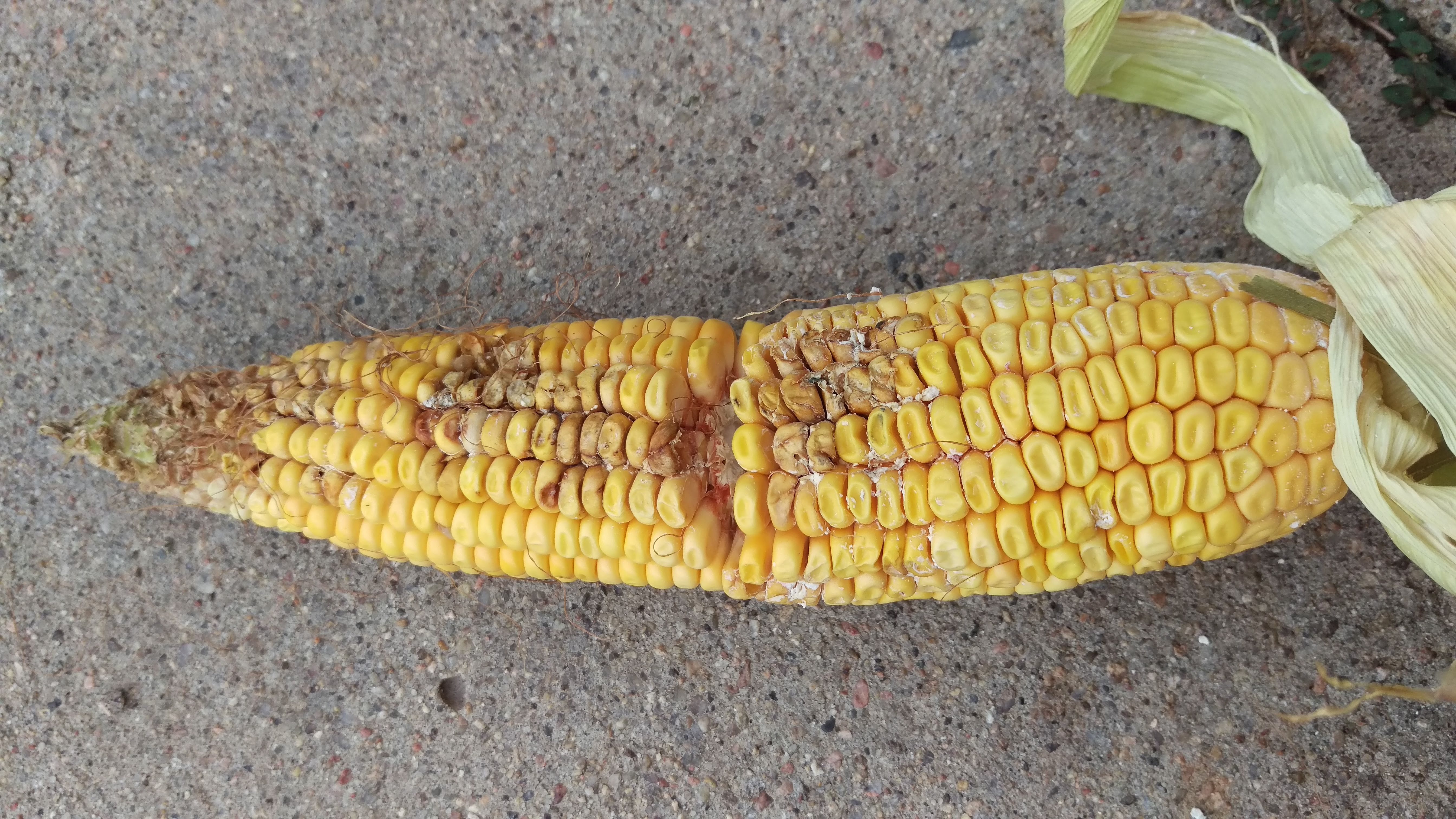
Seven days after the August 6, 2018 storm, fungal growth and mold is present on ears, but pretty much only the places where hail stones hit the kernels. Corn was at late dough to early dent at the time of this storm. The growth is minimal compared to what I’ve seen on ears when damaged earlier than this when more moisture was present in kernels. Fusarium which is fluffy and white/pink in color, is what I’m seeing mostly on the specific hail stone or any insect damage on ears (I took this pic after the ears were passed around at the meetings, so the fungi don’t show up well). Fusarium has the potential to create the mycotoxins vomitoxin or fumonisin-but the presence of Fusarium (or related fungus Gibberella) does not automatically mean the presence of a mycotoxin. Diplodia (white growth see at top of photo near base of ear) is showing up more now with the additional moisture events. Diplodia does not have a mycotoxin associated with it. However, it will greatly explode on an ear creating light-weight ears and kernels and can be a problem in grain storage. It is what caused the most problem in the 2013 and 2014 hail storms. It also creates problems in tight-husked ears that remain upright and moisture gets into the base of them.
York County Corn Grower Plot Tailgate will be held from 5-7 p.m. on August 23rd. The plot is located east of York on Road 14 between Roads O and P on the north side of the road. View hybrids and visit with company representatives. Also, provide your estimate of the highest yield of the plot without going over. The winner will be awarded a Yeti cooler at the York County Corn Grower banquet in November. Pizza and beverages will be provided. Hope to see you there!
South Central Ag Lab Field Day will be held Wednesday, Aug. 29 from 8:55 a.m. to 4 p.m. at 851 HWY 6 near Harvard, NE. The day will begin with registration at 8:30 a.m., followed by tours of research sites through 4 p.m. Keynote speaker for the lunch is Mike Boehm, University of Nebraska-Lincoln Harlan Vice Chancellor for the Institute of Agriculture and Natural Resources and University of Nebraska vice president. Participants will be able to choose from four of the following six tours during the day. View program brochure for schedule.
Topics include the latest research in: Cover crops to corn issues; Corn insect management; Comparisons of variable rate irrigation and fertigation to fixed rate and impacts of cover crops on soil quality; Nitrogen fertilizer management (inhibitors and sensors) in irrigated corn; Corn and soybean disease updates; and Opportunities and challenges for weed control in soybean. CCA credits have been applied for. To register, please go to: https://go.unl.edu/2018scalfieldday by Aug. 26 for lunch planning purposes. Directions: 13 miles east of Hastings on Hwy 6 or 4.5 miles west of the intersection of Hwy 14 and Hwy 6. north of Clay Center.
Hamilton County Corn Grower Plot Tour will be held August 29th beginning at 11 a.m. The field location is just west of M Road and Hwy 34 on the south side (4 miles west of the Hwy 34 and 14 junction in Aurora), just past the viaduct. The program will feature Tom Hoegemeyer talking about the history of corn and how plant breeders have improved the yields. Kelly Brunkhorst, Executive Director of the Nebraska Corn Board will round out the program with an update on trade, the farm bill, and tariffs. Lunch starts at noon at the Oswald Farm followed by the featured speakers. The farm is located from L Road and Hwy 34 (5 miles west of the Hwy 34 and 14 junction in Aurora), 1 mile south to 12th Rd., then 1/2 mile west on the south side of the road.
Irrigation Field Days: Field days on Aug. 27 and 28 will demonstrate soil water measuring tools in production fields designed to help growers feel confident with their irrigation scheduling decisions. The demonstrations will show several irrigation scheduling equipment systems that were installed in the field this summer and have been recording data. Field Days will be located:
- August 27 – near Broken Bow. The August 27 presentation will be part of the Custer County Corn Growers 2018 Field Day at the Jeremy Coleman farm near Broken Bow. The tour will start at 5:30 p.m. at the field site, located five miles west of the intersection of Hwy 2 and Callaway Road then south ¾ mile on 433 Road. A meal will be served about 6:30 p.m. at Coleman’s shop one mile east of the field on Road 798. The educational program will be presented during the meal.
- August 28 – near Bradshaw. The August 28 tour will start at 12 p.m. with field demonstrations of the irrigation scheduling equipment, followed by a meal and presentations in the farm shop. The Bruce Hudson farm is at 2405 Road G, Bradshaw. That is 3.5 miles east of Polk on Hwy 66 to Rd G and 2 .7 miles south or from Benedict (Hwy 81 & State Spur 93C) 6 miles west to Rd G and 2.25 miles north.
JenREES 2-4-18
Dicamba Updates: For those of you who farm in both Nebraska and Kansas, or have customers that do, the following is what is needed for RUP-dicamba training. Nebraska and Kansas have a reciprocal agreement regarding private, commercial, and non-commercial applicator training. Those who have a KS applicator license who wish to apply RUP dicamba in Nebraska don’t need to take additional pesticide training in Nebraska. They do need to apply for a reciprocal license in Nebraska through the NDA and pay the $25 fee (private) or $90 fee (commercial/non-commercial) for a Nebraska pesticide applicator license. There is no additional fee for dicamba training in Nebraska. Kansas Dept. of Ag accepts Nebraska’s dicamba training with no further requirements. Nebraska will accept Kansas dicamba training IF you can also prove you watched the NDA Nebraska specific requirements video. Otherwise, it’s perhaps simpler to take the RUP online dicamba training from Nebraska or attend a Nebraska face to face session.
If you missed the UNL face to face sessions for your area, you can also attend Industry trainings which are upcoming and listed on the NDA website at: http://www.nda.nebraska.gov/pesticide/dicamba.html (please refresh your browser). And, you may wish to attend an industry training anyway depending on the product which you plan to apply to hear more about specific buffer requirements and ask specific questions.
Also, to be clear, anyone who has attended UNL trainings will not receive certificates. Your proof of training will be to download the excel spreadsheet at the NDA website listed above and ensure your name is on that spreadsheet. I’ve been asking that you give NDA 7-10 days before checking it with all the paperwork coming in right now. If you attend a training and don’t see your name, please contact the trainer whose session you attended. It may take longer for those of you who became new pesticide applicators.
The York UNL dicamba training has been rescheduled to February 16 from 10:00-11:30 a.m. at the 4-H Building at the Fairgrounds in York. Updated FAQs can be found at this site (https://pested.unl.edu/documents/RUP_Dicamba_FAQ_2018.pdf) as we receive questions and verify answers with NDA and EPA (please refresh your browser for the updated info.)
Converting ground to annual/perennial forage systems: For the past few years, some of you have spoken with me about converting a pivot to an annual forage system if you owned the land and had cattle. We’ve worked through some economics and a handful of you have tried various options. With current corn and soybean prices, I’ve received an increasing number of questions regarding this topic from farmers and ag lenders. A team of Extension specialists including Dr.’s Jay Parsons, Mary Drewnoski, and Daren Redfearn are seeking your input into what they’ve put together for economics of example systems this coming year. A webinar is scheduled for Tuesday, February 13th beginning at 6:00 p.m. CST. To participate, you can click on the following url: https://unl.zoom.us/j/827594794. Audio can be through your computer speakers or you can also call in. Full details regarding phone number options and additional information can be viewed at: https://cropwatch.unl.edu/2018/economics-annual-and-perennial-forages-webinar. The goal of this webinar is to explain economic examples for both annual and perennial forage systems using different classes of cattle and allow you to provide input into those numbers and ask questions. For those of you interested in this topic and/or are already using annual forages/converted pivots to perennial grass systems, we’d greatly appreciate your input and please do consider sharing your insight!
York County Corn Grower Tour: Gary Zoubek, Extension Educator Emeritus, has planned a great Corn Grower tour for those interested in attending on February 13th! Please call the York County Extension Office at (402) 362-5508 if you plan to attend. Attendees will meet at the York County Extension Office at 8 a.m. with travel to Lincoln at 8:30 a.m. Tours in Lincoln will include Nebraska Innovation Campus (including Nebraska Innovation Studio (the makerspace), the Food Innovation Center, and the Greenhouse Innovation Center, home of the LemnaTec High Throughput Plant Phenotyping system). Attendees will then tour Quantified Ag that developed cattle ear tags equipped with sensors to monitor the health of the individual as well as the herd. Lunch at Valentinos will be followed by Campus visits including learning about biobased textiles, the Ag Econ Marketing Lab/Commodity Trading Room, and the UNL Dairy Store. The final stop will be at Neogen labs that develops, manufacturers, and markets a diverse line of products dedicated to food and animal safety before traveling back to York around 5:15 p.m. You can view more details and the full itinerary at: https://jenreesources.com/2018/01/29/york-co-corn-grower-tour-feb-13/.


 JenResources